
Category Archives: Futurology

Why Every Organization Needs a Future Signals Intelligence Capability

Why Every Organization Needs a Future Signals Intelligence Capability

GUEST POST from Chateau G Pato


I. The Strategic Imperative: Beyond Traditional Forecasting

Organizations today operate in an environment of compounding velocity, where the half-life of competitive advantage is shrinking faster than ever. Yet, leadership teams continually fall into the trap of looking backward to navigate forward.

The Limitations of Retrospective Data

Traditional market research, historical financial metrics, and lagging key performance indicators (KPIs) tell you where you have been, not where you are heading. Relying solely on retrospective data forces organizations to play a perpetual game of catch-up, reacting to disruptions only after they have already impacted market share, customer loyalty, or profit margins.

Noise vs. Signal

The challenge for modern leaders is rarely a lack of information—it is an overwhelming deluge of noise. Future signals are different. They are the early, often faint indicators of emergent behavior, technological breakthroughs, subtle regulatory shifts, or grassroots socio-cultural pivots. While they may appear insignificant or fringe today, they represent the leading edges of tomorrow’s mainstream disruptions.

The Cost of Blind Spots

Missing these early indicators carries a profound strategic cost. Organizations that fail to cultivate peripheral vision risk sudden obsolescence, while those that master early detection unlock a powerful competitive advantage. By identifying shifts at the periphery, leaders gain the vital lead time needed to design proactive, human-centered responses rather than enduring costly, reactive crises.

II. What is a Future Signals Intelligence (FSI) Capability?

To navigate dynamic and uncertain environments, organizations must transform passive trend observation into an active, strategic muscle. Future Signals Intelligence (FSI) is not an occasional strategic planning exercise—it is an ongoing operational capability designed to give leaders a window into what lies ahead.

Definition & Scope

Future Signals Intelligence is the systematic, cross-organizational discipline of continuously scanning internal and external environments, capturing weak signals, filtering noise, and translating early indicators into actionable insight. Rather than relying on rigid long-term forecasts, an FSI capability equips an organization to maintain dynamic situational awareness and pivot with confidence.

The Human-Centered Lens

Too often, futures work focuses strictly on emerging technologies or macro-economic shifts, missing the critical element that drives long-term value: human motivation and experience. A human-centered FSI capability anchors technological and market data in real-world context, looking specifically at unarticulated customer needs, shifting employee expectations, and changing social behaviors to design responses that truly resonate.

FSI vs. Traditional Strategic & Business Intelligence

While traditional intelligence functions serve crucial roles, FSI fills a vital gap at the outer edge of organizational perception:

Intelligence Function Primary Focus Time Horizon Strategic Objective
Business Intelligence (BI) Internal metrics & operational efficiency Present / Recent Past Optimize existing operations
Competitive Intelligence (CI) Known competitors & direct market moves Near Term Protect market position
Future Signals Intelligence (FSI) Weak signals, emergent behavior & peripheral shifts Medium to Long Term Drive innovation & proactive change

III. The Core Pillars of a Future Signals Intelligence Framework

Building an effective Future Signals Intelligence capability requires a structured methodology that moves an organization seamlessly from peripheral observation to strategic execution. The FSI framework rests on four interconnected pillars designed to turn weak indicators into high-impact organizational outcomes.

1. Sensing (Continuous Scanning)

Sensing is the practice of continuously monitoring internal and external environments for faint signals of change before they reach mainstream awareness.

  • Tapping the Periphery: Looking beyond core markets into fringe communities, early adopters, cross-industry anomalies, and grassroots movements where innovation emerging first.
  • Blended Scanning: Combining AI-driven social listening and predictive analytics with frontline employee insights, customer feedback, and observational experience design techniques.

2. Interpreting (Sensemaking & Framing)

Data without context is mere distraction. The interpreting stage converts fragmented, disparate signals into coherent, human-centric narratives.

  • Pattern Recognition: Connecting seemingly unrelated signals across technological, societal, and regulatory domains to uncover emergent macro-trends.
  • Human-Centered Framing: Applying experience design tools—such as empathy mapping, speculative user journeys, and scenario planning—to understand the real human impact of abstract shifts.

3. Synthesizing & Prioritizing (Impact Mapping)

Not every weak signal requires an immediate strategic pivot. Organizations must rigorously evaluate and categorize signals to determine relevance and urgency.

  • Multidimensional Assessment: Evaluating signals against probability, potential disruption, and strategic time horizons to filter out background noise.
  • Translating to Implications: Mapping prioritized signals directly to potential impacts on product portfolios, service models, operational structures, and organizational culture.

4. Activating (Orchestrating Strategic Response)

The ultimate value of signals intelligence lies in action. Activation ensures that foresight directly influences organizational strategy, innovation, and change initiatives.

  • Pipeline Integration: Feeding insights into the early stages of the innovation portfolio to fuel new product concepts, business models, and service experiences.
  • Agile Prototyping & Experimentation: Triggering rapid, low-fidelity experiments and stress-testing strategy against emerging futures to build organizational resilience and agility.

IV. Human-Centered Change: Overcoming Organizational Blindness & Resistance

The greatest barrier to future readiness is rarely a lack of information—it is human and organizational psychology. Even when weak signals are clearly detected, organizations frequently ignore, rationalize, or actively suppress them until it is too late.

The Cognitive & Cultural Barriers

Organizations are naturally optimized for stability and incremental performance, creating inherent friction against peripheral signals that challenge the status quo:

  • Confirmation Bias & Executive Blindness: Leadership teams often filter incoming data through past successes, dismissing disruptive signals as “niche,” “temporary,” or “irrelevant.”
  • Short-Term Incentive Structures: Quarterly financial targets encourage focus on near-term efficiency, penalizing investments aimed at long-term uncertainty.
  • Institutional Inertia: Sunk costs in legacy systems, infrastructure, and mental models create immense cultural resistance to strategic pivots.

Designing the Change Architecture

To overcome this friction, leaders must apply human-centered change design principles directly to the signals capability itself:

  • Fostering Psychological Safety: Creating a culture where employees feel safe to challenge orthodoxy, flag emerging threats, and propose unorthodox opportunities without fear of career risk.
  • Normalizing Curiosity & Experimentation: Shifting the internal mindset from “certainty and control” to “continuous learning and adaptation.”

Democratizing Foresight Across the Enterprise

Future Signals Intelligence cannot function effectively if it remains isolated in an “ivory tower” strategic planning unit or corporate innovation silo. To build true organizational agility, foresight must be democratized across the enterprise:

  • Empowering frontline teams—customer support, sales, product designers, and field operations—to act as official “signal scouts.”
  • Embedding weak signal reviews and trend sensemaking into regular operational rhythms, product design sprints, and divisional strategy reviews.

V. Actionable Roadmap: How to Build Your FSI Capability

Transforming Future Signals Intelligence from a theoretical concept into an operational engine requires a pragmatic, phased approach. Organizations can construct a robust, scalable capability by moving systematically from initial alignment to full strategic integration.

Phase 1: Mobilize & Audit

Establish baseline awareness and map your existing intelligence landscape to surface hidden gaps and untapped assets.

  • Internal Intelligence Audit: Inventory existing data sources, market research practices, customer feedback channels, and peripheral inputs currently scattered across business units.
  • Gap Analysis: Identify blind spots in current scanning mechanisms—specifically looking at overlooked fringe markets, emerging technologies, and subtle shifts in human behavior.
  • Leadership Alignment: Secure executive sponsorship and define key strategic domains (e.g., customer experience, workforce dynamics, technological disruption) to focus initial scanning efforts.

Phase 2: Formalize the Network

Structure the human and technical infrastructure needed to capture and synthesize weak signals consistently.

  • Build a “Signal Scout” Network: Recruit diverse, cross-functional champions from product, design, frontline operations, and customer support to act as official signal observers.
  • Establish Common Taxonomies: Define standardized criteria, tags, and central repositories for documenting, sharing, and categorizing weak indicators across teams.
  • Implement Sensemaking Cadences: Schedule regular cross-functional workshops to review flagged signals, connect disparate dots, and construct emergent foresight narratives.

Phase 3: Integrate & Prototype

Embed signals intelligence directly into decision-making frameworks and business workflows to move from insight to action.

  • Strategic Planning & Innovation Gates: Connect FSI outputs directly into stage-gate processes, product roadmaps, and annual strategic reviews.
  • Agile Experimentation: Launch low-fidelity prototypes, small-scale pilot programs, and speculative design projects to stress-test organizational responses against weak signals.
  • Scenario Planning: Integrate prioritized signals into dynamic scenario models to help leadership pressure-test current strategic assumptions.

Phase 4: Measure & Scale

Refine the capability through continuous feedback loops and track its tangible impact on organizational agility and value creation.

  • Track Key Performance Indicators: Measure lead time on strategic pivots, the velocity of signal-to-experimentation cycles, and the success rate of early-stage innovation investments.
  • Expand Enterprise Access: Democratize tools and insights across additional business units through internal dashboards, learning sessions, and open intelligence networks.
  • Continuous Capability Refinement: Periodically calibrate scanning filters, data sources, and analytical frameworks to adapt to evolving market realities.

VI. Conclusion & Call to Action

The future is not a distant, unpredictable destination that suddenly arrives overnight. It is being actively signaled today in the subtle, emerging behaviors of consumers, the fringe experiments of early adopters, and the weak signals accumulating at the edges of every industry.

Organizations don’t fail because they lack ambition or operational discipline; they fail because they remain anchor-bound to historical success while ignoring the quiet warnings on the horizon. Establishing a Future Signals Intelligence capability is not merely about predicting the future—it is about cultivating the peripheral vision, human-centered empathy, and organizational agility required to design it.

By moving from passive observation to active, continuous sensing, leaders can replace reactive crisis management with intentional, proactive innovation. The choices you make in response to today’s weak signals will define your organization’s strength tomorrow.

A Call to Action for Modern Leaders

Take a hard look at your leadership team’s current strategic view and ask yourselves:

“What weak signals is our organization dismissing or ignoring today that have the potential to completely reshape our industry, customer experiences, or business model tomorrow?”

Don’t wait for the quiet whisper on the horizon to become the roar of disruption at your front door. Start building your Future Signals Intelligence capability today.


Frequently Asked Questions (FAQ)

What is Future Signals Intelligence (FSI)?

Future Signals Intelligence is a structured, cross-organizational discipline that continuously scans internal and external environments, captures weak indicators of change, filters background noise, and translates them into actionable foresight to drive innovation and proactive strategy.

How does FSI differ from traditional Business or Competitive Intelligence?

While Business Intelligence (BI) focuses on internal metrics and the past/present, and Competitive Intelligence (CI) tracks known competitors in the near term, FSI specializes in detecting weak signals, emergent human behavior, and peripheral shifts across a medium- to long-term horizon.

Why is a human-centered approach critical for future signals intelligence?

Technological and market shifts only create long-term value when anchored in human experience. A human-centered FSI framework ensures that organizations look beyond dry data to understand unarticulated customer needs, shifting workforce expectations, and changing socio-cultural behaviors.


SPECIAL BONUS: Braden Kelley’s Problem Finding Canvas can be a super useful starting point for doing design thinking or human-centered design.

“The Problem Finding Canvas should help you investigate a handful of areas to explore, choose the one most important to you, extract all of the potential challenges and opportunities and choose one to prioritize.”

Image credit: Gemini

Subscribe to Human-Centered Change & Innovation WeeklySign up here to get Human-Centered Change & Innovation Weekly delivered to your inbox every week.

Seven Areas of Mastery for Futurists

Seven Areas of Mastery for Futurists

GUEST POST from Art Inteligencia

The future of technology and the way that individuals interact with their environment continues to evolve and develop at a rapid rate. As a result, it is becoming increasingly important for individuals to understand and master the various areas of futurist disciplines. With the advent of new technologies and advancements in artificial intelligence, the need for individuals to be able to effectively navigate the ever-changing landscape of the future has never been more important. Seven areas futurists should continue to master include:

1. Strategic Foresight: The ability to interpret trends, assess their potential impact, and develop sound strategies to take advantage of them.

2. Analytical Thinking: The capacity to analyze complex problems and develop solutions to them.

3. Systems Thinking: The ability to see the “bigger picture” and how different elements can interact to create a desired outcome.

4. Technology Fluency: A deep understanding of the implications of technological advancements, and how to best leverage them for maximum benefit.

5. Innovation: The capacity to identify opportunities for disruptive change and create new products, services, and experiences.

6. Adaptability: The ability to quickly adapt to change and to embrace new ideas and processes.

7. Communication: The ability to effectively communicate ideas, thoughts, and plans to stakeholders and the public.

As technology advances and the world moves further into the future, the need for futurists to stay competitive in the job market increases. These areas of mastery are becoming increasingly valuable as the world continues to evolve, and those who possess these skills will be in high demand.

Does your organization employ a futurist?

Bottom line: Futurists are not fortune tellers. They use a formal approach to achieve their outcomes, but a methodology and tools like those in FutureHacking™ can empower anyone to be their own futurist.

Image credit: Pixabay

Subscribe to Human-Centered Change & Innovation WeeklySign up here to get Human-Centered Change & Innovation Weekly delivered to your inbox every week.

AI Futures, Soft Landings & Alternative Futures

AI Futures, Soft Landings & Alternative Futures

GUEST POST from Art Inteligencia


Executive Summary & Core Purpose

The Illusion of Technical Determinism: Technology alone does not dictate the future—human adoption, change capability, and experience design ultimately shape the final outcome. While raw technological advancement progresses exponentially, organizational capacity to absorb and harness that change progresses linearly. Bridging this gap requires intentional, human-centered leadership that treats technology as a catalyst rather than a destination.

Beyond Binary Futures: Mainstream narratives often force leaders into a false binary choice between frictionless AI utopia and existential apocalypse. This article provides a grounded, strategic framework that moves beyond hyperbole, equipping leaders to navigate the realistic, nuanced space in between through structured foresight and scenario planning.

The Core Purpose: To provide executives, innovation leaders, and change catalysts with actionable frameworks for architecting “soft landings”—managing AI-driven disruption with minimal cultural friction, reduced organizational trauma, and maximum human empowerment. By intentionally designing alternative future scenarios today, organizations can move from reactive adaptation to proactive leadership.

Section I: The AI Futures Spectrum

Mapping Horizon 1 to Horizon 3: Strategically evaluating AI integration requires categorizing technological impact across three distinct operational horizons, moving from short-term efficiency gains to fundamental organizational transformation.

  • Horizon 1 (Incremental): Automated efficiencies, synthetic assistants, and task-level augmentation. Focuses on optimizing existing business processes, reducing routine task latency, and embedding inline AI assistance within established workflows.
  • Horizon 2 (Structural): Business model disruption, autonomous workflows, and shifting value chains. Involves redesigning core operations around agentic orchestration, redefining customer interaction models, and reallocating organizational resources toward high-leverage activities.
  • Horizon 3 (Transformational): Novel organizational paradigms and cognitive-first enterprise ecosystems. Represents entirely new value creation mechanisms where human intent, strategic foresight, and autonomous systems co-create products and services previously unfeasible.

Futurology as a Design Tool: Strategic foresight is not about predicting a single definitive future, but rather testing current organizational resilience against multiple plausible scenarios. By utilizing foresight frameworks, leaders can Stress-test innovation investments, identify hidden operational vulnerabilities, and build adaptive capacity into the core culture.

Section II: Engineering the “Soft Landing”

Defining the Soft Landing: A soft landing is the intentional orchestration of technological transition designed to minimize cultural friction, reduce workforce shock, and preserve institutional trust. As artificial intelligence automates routine cognitive tasks, leadership success will not be measured merely by implementation speed, but by the organization’s ability to maintain psychological safety and engagement throughout the shift.

Human-Centered Change Planning: Technology transitions fail when they treat workforce adaptation as an afterthought. Achieving a soft landing requires three structural change imperatives:

  • Mitigating AI Anxiety: Establishing radical transparency around technology roadmaps and creating psychologically safe environments where employees can experiment, express concerns, and actively participate in workflow redesign.
  • Proactive Skill-Bridging Pathways: Replacing reactive, emergency retraining programs with continuous learning pipelines that anticipate shifting job requirements well before roles become redundant.
  • Transitioning to Value Orchestration: Elevating employee roles from direct task execution to higher-level oversight, strategic curation, creative judgment, and stakeholder empathy.

Experience Design for Co-Intelligence: Modern experience design must expand beyond basic user interfaces to encompass the collaborative touchpoints between human intelligence and machine capability. Designing for co-intelligence ensures that AI acts as a cognitive amplifier for employees (EX) and an intuitive, friction-free value delivery system for customers (CX).

Section III: Alternative Futures & Strategic Scenarios

Scenario A: The Frictionless Augmentation (The Collaborative Ideal)
AI is seamlessly integrated across organizational structures as a cognitive partner. Productivity surges as routine cognitive loads disappear, unlocking a human-led creative explosion. Success in this scenario relies on robust human-centered design, where technology enhances employee autonomy rather than micromanaging performance.

Scenario B: The Asynchronous Disruption (The Polarized Realism)
Technological capabilities advance exponentially while organizational change capacity struggles to keep pace linearly. A widening gap emerges between adaptive, change-agile organizations and legacy enterprises struggling with cultural friction and operational inertia. Organizations that fail to build systemic change capacity risk rapid obsolescence.

Scenario C: The Regulatory & Cultural Backlash (The Counter-Trend)
Algorithmic skepticism, privacy concerns, and strict regulatory frameworks reshape AI adoption boundaries. A premium emerges for verifiable human authenticity, artisan expertise, and high-empathy touchpoints. Strategic resilience requires balancing automated efficiency with transparent, human-verified integrity.

Scenario D: The Autonomous Ecosystem (The Systemic Shift)
Agentic workflows operate with significant autonomy across interconnected enterprise networks. As routine decision-making and operational execution automate, primary human value shifts entirely toward high-level strategic intent, ethical oversight, systems curation, and relational empathy.

Section IV: Actionable Change Framework for Leaders

The Strategic Foresight Audit: Organizations cannot prepare for alternative futures without first assessing their baseline change readiness. Conducting a strategic foresight audit enables leaders to evaluate current cultural agility, identify systemic friction points, and stress-test strategic plans against emerging AI inflection points before disruption hits.

Continuous Innovation Architecture: One-off digital transformation initiatives are obsolete in an era of exponential change. Organizations must construct a continuous innovation architecture—embedding modular change capacity into everyday operations, establishing rapid experimentation loops, and treating organizational structure as a fluid, evolving design asset.

Measuring What Matters: Traditional efficiency metrics like head-count reduction and short-term cost savings miss the true value of AI-driven transformation. Forward-thinking leaders measure adoption velocity, employee capability expansion, psychological safety indices, and overall experience quality across customer and employee touchpoints.

Frequently Asked Questions

Below are key insights regarding AI futures, soft landings, and strategic change design, formatted for both human readers and search or answer engines.

What is a “soft landing” in the context of AI and organizational change?

A soft landing is the intentional orchestration of technological transition designed to minimize cultural friction, reduce workforce shock, and preserve institutional trust. Rather than forcing rapid, top-down AI implementation that causes anxiety and operational resistance, leaders engineer a soft landing by building psychological safety, proactive skill-bridging pathways, and human-centered workflows.

Why is foresight essential for navigating alternative AI futures?

Foresight moves organizations away from technical determinism—the flawed belief that technology alone dictates the future. By modeling alternative scenarios (such as frictionless augmentation, asynchronous disruption, or regulatory backlash), leaders can stress-test current strategies, identify hidden operational vulnerabilities, and build flexible change capacity rather than betting on a single predicted outcome.

How do leaders measure success in human-centered AI transformation?

Rather than relying solely on traditional cost-cutting or headcount reduction metrics, forward-thinking leaders measure adoption velocity, capability expansion, psychological safety, and experience quality across both customer (CX) and employee (EX) touchpoints. This ensures AI acts as a cognitive amplifier that drives sustainable long-term value.


Image credit: Gemini

Subscribe to Human-Centered Change & Innovation WeeklySign up here to get Human-Centered Change & Innovation Weekly delivered to your inbox every week.
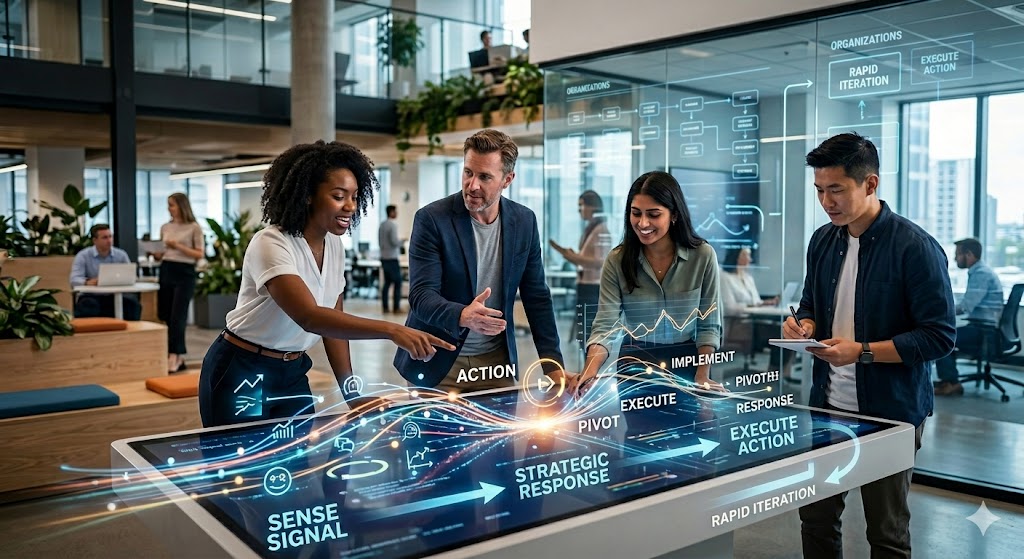
The Signal-to-Strategy Gap

The Signal-to-Strategy Gap

GUEST POST from Art Inteligencia


I. The Mirage of the Future-Ready Enterprise

The Noise Trap: When More Data Yields Less Direction

Organizations today are swimming in more data, trend reports, and strategic foresight presentations than at any point in corporate history. Innovation labs dot major tech hubs, cross-functional teams subscribe to expensive trend feeds, and executive retreats routinely feature external futurists warning of upcoming disruptions. Yet despite this unprecedented access to peripheral intelligence, leaders find themselves repeatedly blindsided by industry shifts, rapid shifts in customer behavior, and nimble new competitors.

The paradox of the modern enterprise is that an abundance of information has not created clarity—it has created cognitive fatigue and operational noise. When every weak signal is amplified equally, signal pollution sets in, leaving decision-makers paralyzed by options or retreating back to the familiar metrics of short-term quarterly performance.

Defining the Signal-to-Strategy Gap

The core issue is rarely a failure of perception; it is a failure of operational connectivity. The Signal-to-Strategy Gap represents the dangerous latency—and frequent breakdown—between detecting an emerging indicator on the periphery and translating that insight into resource allocation, portfolio adjustment, and human-centered change execution.

A weak signal captured in an innovation lab or strategy deck means nothing if it cannot cross the chasm into core business operations. When signals remain trapped inside slide decks or isolated silos, the enterprise operates under the dangerous illusion of future-readiness, confusing awareness with capability.

The Human Barrier: Cultural Friction and the Core Operational Bias

Why does this gap persist? Because organizations are fundamentally designed to optimize the present, not invent the future. Core business operations are governed by predictable operational rhythm—the domain of keeping current machinery running efficiently. In this environment, early indicators are routinely dismissed as statistical anomalies, irrelevant edge cases, or threats to current revenue streams.

Furthermore, strategy is ultimately a human endeavor. Without a structured, visual framework to make sense of weak signals and build alignment across diverse teams, short-term pressures will always overpower long-term foresight. Closing the Signal-to-Strategy Gap requires moving past passive trend-watching and designing human-centered bridges that empower leadership to turn peripheral noise into strategic, actionable conviction.

II. Why Signals Get Lost in Translation

Passive Trend-Watching vs. Active Foresight

One of the primary reasons organizations fail to bridge the signal-to-strategy gap is their fundamental approach to futurology. Most leadership teams treat trend analysis as a passive, periodic exercise—buying thick research reports, attending annual industry keynotes, or hosting quarterly executive briefings on “emerging trends.”

While these activities provide intellectual stimulation, they rarely drive strategic momentum. Passive trend-watching treats the future as an external force that happens to the organization, rather than an interactive canvas that can be intentionally shaped. Active strategic foresight, by contrast, requires shifting from observation to operational capability—converting peripheral signals into dynamic hypotheses, stress-testing current assumptions, and actively designing strategic choices.

The “Adjacent Industry” Blindspot

Traditional competitive analysis is inherently backward-looking and dangerously narrow. Enterprises tend to monitor the direct, visible moves of known competitors within their immediate category. However, true disruption almost never originates from inside the incumbent circle.

Disruption occurs at the intersections—where technological capabilities, shifting consumer expectations, and novel business models from adjacent industries collide. When an enterprise focuses solely on its own sector, it misses the cross-industry ripple effects that reframe customer expectations overnight. A seamless experience in retail or digital services instantly elevates customer expectations across banking, healthcare, B2B services, and beyond.

Cognitive, Cultural, and Structural Resistance

Even when a weak signal is correctly identified and understood by forward-looking leaders, it faces an uphill battle against deep-seated organizational mechanics. Strategic foresight inherently asks an enterprise to question its current profit engines and operating models.

Status quo bias, risk-averse incentive structures, and the natural desire to protect legacy revenue streams combine to create cultural friction. Early signals are easily rationalized away as niche edge cases, unproven markets, or temporary noise. Without a structured, visual framework to depersonalize strategic conversations and build collaborative alignment across business units, the gravity of present operations will consistently crush the seeds of future growth.

III. The Four Steps to Bridging the Gap (The FutureHacking™ Approach)

Step 1: Precision Signal Picking

Bridging the gap begins with signal curation, not signal collection. Instead of drowning in vast, generic macro-trend reports, leaders must cultivate precision signal picking—identifying weak indicators on the periphery that directly intersect with human behavior, unmet customer needs, or emerging cultural friction.

Precision signal picking shifts the focus from broad headlines to underlying human dynamics. A signal is not merely a new technology or market statistic; it is a shift in how people express value, seek convenience, or navigate friction. By framing signals around human experience, organizations can filter out ambient hype and hone in on indicators that carry genuine strategic potential.

Step 2: Mapping Signal Evolution and Interdependencies

Isolated signals rarely disrupt industries on their own. Disruption occurs when independent weak signals accelerate, converge, and amplify one another.

By mapping signal evolution and interdependencies using visual diagnostic tools like FutureSignals™, teams can trace velocity, acceleration triggers, and proximity to core operational capabilities. Visualizing how technology shifts, demographic trends, and cross-industry behaviors intersect reveals compound impacts long before they manifest as undeniable macro-trends.

Step 3: Designing Scenarios Across the Futures Cone

Strategic foresight must move beyond single-point forecasting. The future is non-linear, and attempting to predict a single outcome leaves organizations fragile. Using the Futures Cone framework, leadership teams systematically map out Possible, Probable, and Preferable futures.

This step shifts the executive posture from passive anticipation—asking “What will happen to us?”—to active agency: “What preferable future do we want to design, and what strategic moves must we make today to bring it to life?”

Step 4: Translating Foresight into Strategy and Experience Design

A strategic scenario is only as valuable as the decisions it informs. In the final step of the FutureHacking™ approach, abstract scenarios are grounded directly in organizational choices, capability mapping, and human-centered experience design.

Teams identify capability gaps, stress-test current offerings, and model updated customer, employee, and partner experiences. Grounding foresight in tangible experience models ensures that strategic insights move seamlessly from foresight decks into product roadmaps, service designs, and operational priorities.

IV. Operationalizing Foresight Through Human-Centered Change™

Aligning the Nine Innovation Roles™ Across the Journey

Translating peripheral insight into organizational reality requires a balanced diversity of talent and perspectives. Too often, strategic foresight remains trapped within dedicated strategy or foresight teams, detached from the operational muscle needed to execute. Closing the signal-to-strategy gap requires intentionally mobilizing The Nine Innovation Roles™ across the innovation journey.

While Revolutionaries and Artists excel at picking weak signals and conceptualizing novel scenarios, they must collaborate early with Troubleshooters and Judges to evaluate systemic friction and operational feasibility. Ultimately, bridging the gap to execution relies on Evangelists to build organizational conviction and Conscripts and Connectors across functional units to embed new capabilities into daily operations.

Visual and Collaborative Alignment

The friction that crushes early strategic signals is rarely intellectual; it is alignment-driven. When cross-functional teams operate with divergent assumptions, jargon, and priorities, strategic foresight gets diluted in endless committee meetings.

Using visual, human-centered methodologies—such as the Change Planning Canvas™—democratizes complex strategic conversations. Visual canvases replace text-heavy reports with an open, shared mental model where leadership, operations, product design, and customer experience teams can co-create change pathways, surface hidden risks, and establish joint ownership over strategic choices.

Insulating Exploration from the Core

Core operations are optimized for predictability, risk mitigation, and immediate return on investment—the essential realm of keeping current business models healthy. If emerging strategic options driven by weak signals are forced to compete directly for resources against core operations on day one, short-term pressures will win every time.

Organizations must create visual foresight spaces and structural insulation to nurture early-stage strategic initiatives. Providing distinct governance, iterative milestones, and protective space allows high-potential strategic options to mature, undergo real-world experiment cycles, and build momentum before being integrated into core operational systems.

V. Conclusion: Designing the Future Before It Designs You

The True Cost of Strategic Delay

By the time a weak signal on the horizon solidifies into a mainstream macro-trend, the window for true strategic differentiation has already closed. Waiting for complete certainty or waiting until competitors validate a new market direction shifts an enterprise from proactive market shaper to reactive follower.

The cost of the Signal-to-Strategy Gap is not simply missed revenue; it is loss of agency. Organizations that fail to bridge this gap find themselves perpetually playing catch-up, forced into costly turnarounds and defensive restructuring rather than leading their industries forward.

Building an Agile, Future-Ready Enterprise

Building a resilient enterprise requires pairing continuous innovation capability with structured, human-centered strategic foresight. Foresight provides the compass, experience design provides the bridge, and human-centered change provides the momentum.

When these disciplines align, signal detection ceases to be an academic exercise in trend-watching and becomes a dynamic engine for strategic agility—allowing organizations to anticipate friction, capture emerging value, and continually renew their competitive advantage.

A Call to Action for Business Leaders

The future is not an incoming storm to survive; it is an open canvas to design. Stop viewing strategic foresight as a passive spectator sport or an isolated slide deck.

Empower your teams with visual tools, bridge internal silos using human-centered change frameworks, and leverage signal detection to actively build your preferable future before market forces dictate it for you.

Frequently Asked Questions

1. What is the Signal-to-Strategy Gap?

The Signal-to-Strategy Gap is the latency and organizational breakdown between detecting weak signals on the industry periphery and translating those insights into strategic resource allocation, capability building, and human-centered change execution.

2. How does FutureHacking™ help bridge the Signal-to-Strategy Gap?

FutureHacking™ moves strategic foresight from passive trend-watching to active creation. It uses structured, visual methodologies to isolate precision signals, map interdependencies, design scenarios across the Futures Cone, and ground foresight directly into experience design and strategy.

3. Why do traditional innovation efforts fail to act on weak signals?

Most traditional organizations suffer from core operational bias, short-term quarterly performance pressure, and functional silos. Without visual alignment frameworks and distinct spaces to insulate early exploration, core operations consistently suppress long-term strategic signals.


Image credit: Gemini

Subscribe to Human-Centered Change & Innovation WeeklySign up here to get Human-Centered Change & Innovation Weekly delivered to your inbox every week.

How to Detect Weak Signals Before They Become Strategic Disruptions

GUEST POST from Chateau G Pato


I. Introduction: The Cost of Strategic Blind Spots

Organizations rarely collapse overnight due to sudden, unannounced catastrophes. More often, they fall victim to a far quieter failure: missing the early, subtle indicators — the weak signals — that precede every major market disruption. Long before a breakthrough technology, a shift in customer behavior, or a new business model reshapes an industry, the clues are already visible on the fringes. Yet, most leadership teams remain blind to them until the threat arrives on their doorstep.

The core issue lies in how traditional strategic planning operates. Most corporate planning processes rely on linear extrapolation — assuming tomorrow will look remarkably like today, only slightly optimized. This creates a dangerous comfort zone where teams focus on incremental efficiency while ignoring non-linear shifts across technology, regulation, culture, and human expectations. In an environment defined by continuous disruption, relying on historical performance to predict future success is no longer just conservative; it is reckless.

To survive and lead in an era of rapid transformation, organizations must evolve beyond reactive crisis management and static forecasting. We must cultivate a proactive, human-centered strategic foresight capability—one that enables us to systematically sense weak signals, map their potential trajectories, and actively shape our preferred future before disruption forces our hand.

II. Understanding Weak Signals through a Human-Centered Lens

To capture weak signals before they become seismic disruptions, we must first recognize what they are—and more importantly, why traditional organizational models consistently fail to see them. A weak signal is not a full-blown trend, nor is it the loud market noise dominating today’s industry headlines. Mega-trends like cloud migration or generative AI adoption are already mainstream, high-volume noise; by the time an trend reaches that level of visibility, the strategic opportunity to lead has passed.

In contrast, weak signals are subtle, highly fragmented, and often erratic indicators emerging at the periphery. They appear in edge-case technological experiments, unexpected workarounds adopted by customers, shifts in employee sentiment, niche subcultures, or early regulatory murmurs. They represent the first quiet whispers of a changing reality. Because they lack immediate statistical weight or mass-market volume, executive dashboards routinely filter them out as statistical noise or irrelevant anomalies.

However, strategic foresight is fundamentally a human endeavor. The biggest obstacle to detecting weak signals is rarely a lack of data; it is institutional cognitive bias. Organizations are naturally built to defend their core business model. Psychological filters like status quo bias, confirmation bias, and the defense of legacy revenue streams lead leadership teams to dismiss early indicators as edge cases that “won’t scale” or “don’t apply to our market.”

To overcome these blind spots, we must apply a human-centered lens to foresight. Weak signals are not abstract data points; they are human stories. They reflect evolving human needs, shifting cultural values, emerging friction points, and changing expectations. When we reframe weak signals around the human experience — examining how people interact with technology, work, and each other — we move from passive trend-watching to actionable strategic insight.

III. The FutureHacking™ Approach: 4 Steps to Sensing & Shaping the Future

Systematically identifying and acting on weak signals requires moving beyond ad-hoc brainstorming sessions. Organizations need a structured, visual, and collaborative methodology to operationalize strategic foresight. The FutureHacking™ framework provides a practical 4-step approach to navigate from peripheral noise to high-impact strategic execution.

Step 1: Picking the Signals That Matter

The challenge in signal detection is rarely a lack of information; it is managing the volume of noise. Not every anomaly indicates a future disruption, which makes structured filtering essential. Using tools like the FutureHacking™ Signal Picker, organizations can systematically scan across broad STEEP vectors (Social, Technological, Environmental, Economic, and Political forces) to uncover meaningful indicators on the fringe.

To capture these insights continuously, foresight cannot remain confined to executive strategy units or isolated planning groups. Organizations benefit from empowering a cross-functional network of signal scanners. Harnessing diverse perspectives across the organization — drawing on distinct behavioral archetypes such as the Revolutionary (who challenges existing assumptions), the Investigator (who digs deep into anomalous data), and the Evangelist (who articulates the potential of early shifts) — ensures that subtle indicators from frontline operations, customer interactions, and emerging markets are surfaced early.

Step 2: Mapping Signal Evolution & Interdependencies

Weak signals rarely trigger major shifts in isolation. The most significant strategic disruptions occur when distinct, seemingly unrelated signals collide. A minor technological breakthrough, paired with an incremental shift in customer expectations and a subtle regulatory update, can rapidly compound into a transformative market shift.

Foresight practice requires connecting these disparate threads across domains to map how signals interact. Utilizing specialized visual canvases and FutureSignals™ diagnostic tools allows teams to trace acceleration triggers and evaluate velocity—determining how quickly a signal might move from an edge-case phenomenon into mainstream market reality.

Step 3: Scenario Design — Possible, Probable, and Preferable Futures

Predicting a single static outcome often leads to fragile strategic plans. Modern strategic planning focuses instead on evaluating a range of plausible futures. By mapping potential signal trajectories, leadership teams can construct distinct scenarios that encompass possible, probable, and preferable outcomes.

Defining a preferred future provides a clear direction for organizational strategy. Visualizing where the organization intends to lead makes it possible to evaluate current operational models against future demands. Mapping these strategic gaps highlights the distance between current operational capabilities — the domain of the NowBuilder™ — and the demands of the future business environment, revealing necessary adaptations early.

Step 4: Translating Foresight into Human-Centered Action

Strategic foresight generates value only when it leads to meaningful organizational action. Once scenarios are established, insights must be translated into tangible innovation roadmaps, exploratory pilot programs, and strategic initiatives. This enables organizations to test assumptions, validate signal direction, and build operational flexibility before broad market shifts occur.

Crucially, implementing foresight-driven strategy requires embedding Human-Centered Change™ principles throughout the execution phase. When organizational direction shifts in response to emerging signals, teams require clear context around the shift. Articulating the rationale behind strategic pivots reduces uncertainty, aligns leadership across business units, and fosters employee adoption, turning strategic foresight into sustained competitive advantage.

p.s. If you want to get early access and demonstration of Braden Kelley’s FutureCanvas Picker™ which gives a deeper illustration of the power of the FutureHacking™ methodology, contact Braden.

IV. Operationalizing Signal Detection in Your Culture

Establishing a process for weak signal detection is only half the battle; the real test lies in embedding foresight into the operational DNA of the organization. Without a culture that actively nurtures peripheral vision, even the most sophisticated signal-gathering tools will be suffocated by day-to-day execution pressures and corporate short-termism.

Protecting Innovation from the Core

One of the most frequent reasons strategic foresight fails inside established organizations is that emerging, signal-driven initiatives are forced to compete directly with core operational metrics. When a weak signal inspires an early-stage pilot or exploratory project, measuring its immediate progress using traditional key performance indicators—such as short-term profit margins or core line-item return on investment—will crush it before it can validate its market potential.

To give early-stage signals room to develop, leadership must create sheltered governance models. Signal-driven innovation requires distinct metrics focused on learning velocity, hypothesis validation, and strategic optionality rather than immediate top-line revenue. By insulating exploratory efforts from the core business’s short-term quarterly demands, organizations protect their ability to incubate long-term strategic alternatives.

Creating Visual & Collaborative Foresight Spaces

Foresight cannot be an annual corporate retreat topic or a confidential report locked away in an executive binder. To be effective, signal detection must be democratized, visible, and highly collaborative across functional lines. Strategy flourishes when it becomes a shared visual experience.

Deploying interactive canvases, visual signal mapping boards, and cross-functional workshops transforms strategic foresight from an abstract exercise into a hands-on discipline. When teams physically map out connections between human friction points and emerging technologies using collaborative toolkits, they break down organizational silos. Visual alignment ensures that marketing, product, operations, and leadership share a common mental model of the changing competitive landscape.

Institutionalizing Curiosity Across the Enterprise

Ultimately, weak signal detection relies on the collective intelligence and daily observations of your workforce. Frontline employees, customer success teams, product designers, and sales leaders encounter peripheral shifts long before they show up on executive reporting dashboards. However, if employees believe that highlighting anomalous customer behaviors or emerging market threats is ignored—or worse, viewed as a distraction—they will remain silent.

Building a foresight-driven culture requires institutionalizing curiosity. Leaders must explicitly encourage teams to bring fringe observations to the surface, reward employees for uncovering non-obvious customer friction points, and create formal channels to discuss edge-case threats. When curiosity is recognized and integrated into regular strategic conversations, signal scanning stops being a specialized task for a small team and becomes an enduring competitive advantage built by the entire enterprise.

V. Conclusion: The Best Way to Predict the Future is to Design It

The business landscape will not slow down to accommodate legacy planning cycles or corporate complacency. The shifts that will define the next decade of your industry—whether driven by emerging technologies, evolving societal values, or radical business model shifts—are already under way. Their early indicators are hovering at the edges of your market, waiting to be decoded.

Organizations do not need a crystal ball or infallible fortune-tellers to navigate uncertainty. What they need is a repeatable, human-centered capability to systematically detect, interpret, and act on weak signals before competitors realize the rules of the game have changed. By moving beyond linear forecasting, leveraging collaborative visual frameworks, protecting early-stage exploration from core operational pressures, and fostering a culture of active curiosity, you transform unpredictable change into a continuous source of strategic advantage.

Disruption is only surprising to those who refuse to look at the fringe. The future is not something that merely happens to your organization—it is something you actively co-create. Start building your strategic foresight capability today: audit your current strategic scanning processes, gather your teams to pick your first set of weak signals, and empower your organization to stop reacting to the future, and start designing it.

Frequently Asked Questions

What is the difference between a macro-trend and a weak signal?

A macro-trend (such as generative AI adoption or cloud migration) is a high-volume, highly visible market movement that is already mainstream. In contrast, a weak signal is a subtle, fragmented indicator emerging at the periphery—such as an unusual customer workaround, an edge-case technology, or a minor regulatory shift. By the time an indicator becomes a macro-trend, the strategic opportunity to lead has passed; detecting weak signals gives organizations a head start before disruption occurs.

Why do traditional strategic planning processes miss weak signals?

Most corporate planning relies on linear extrapolation, assuming future performance will mirror past trends. This mindset, combined with institutional cognitive biases (such as status quo bias and defending core revenue streams), leads organizations to dismiss early indicators as statistical noise or irrelevant anomalies until they become full-blown disruptions.

How can organizations operationalize weak signal detection without distracting from core operations?

Signal detection requires a structured, visual framework—such as the FutureHacking™ Signal Picker—and cross-functional scanning networks. To protect these efforts, leadership must establish sheltered governance models and learning-focused metrics for early-stage initiatives rather than judging them immediately against core operational KPIs or quarterly profit margins.


Bottom line: Futurology is not fortune telling. Futurists use a scientific approach to create their deliverables, but a methodology and tools like those in FutureHacking™ can empower anyone to engage in futurology themselves.

Image credit: Gemini

Subscribe to Human-Centered Change & Innovation WeeklySign up here to get Human-Centered Change & Innovation Weekly delivered to your inbox every week.
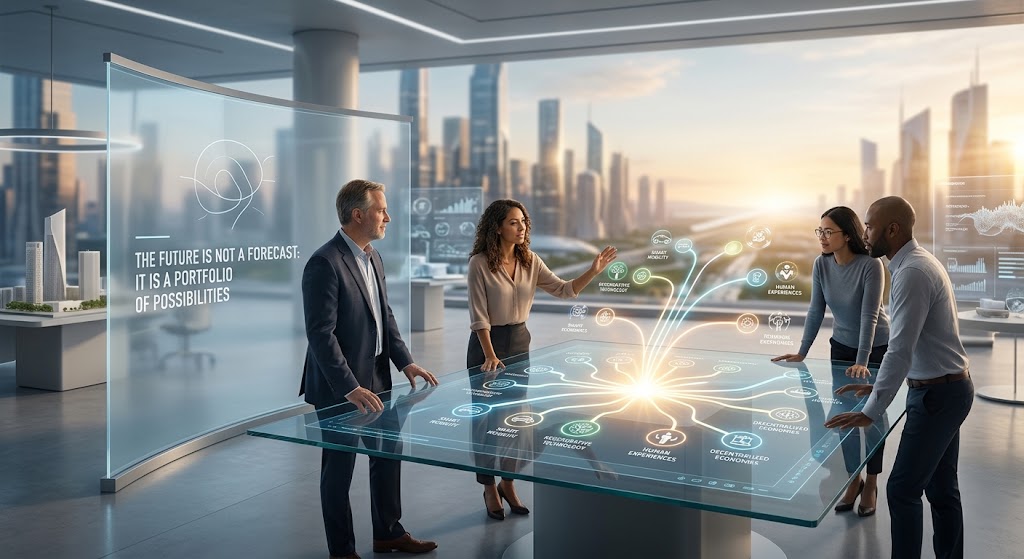
The Future is a Portfolio of Possibilities

Not a Forecast

The Future is a Portfolio of Possibilities

GUEST POST from Chateau G Pato


I. The Fallacy of the Single Line

For decades, strategic planning has relied heavily on linear extrapolation. Organizations gather historical data, draw a neat trend line outward, and call it the future. This approach operates under a dangerous assumption: that tomorrow will simply be a slightly faster, more efficient version of yesterday. In a world defined by exponential technological shifts, shifting customer behaviors, and systemic volatility, predicting a single trajectory isn’t just naive—it’s a critical strategic vulnerability.

The Predictive Trap

Traditional forecasting breeds a false sense of security. When leadership teams commit to a single-line forecast, they lock capital, culture, and capabilities into a rigid path. When reality inevitably departs from the spreadsheet, the organization experiences immediate friction. Because the plan left no room for divergence, leadership is forced into reactive crisis management rather than deliberate strategic adjustment. The trap lies in confusing high-precision metrics with actual clarity about what lies ahead.

The Illusion of Certainty

Spreadsheets and financial models love certainty, but the real world is chaotic and human. Linear forecasts fail because they ignore non-linear events—unexpected cultural movements, sudden technological breakthroughs, or sudden shifts in employee and customer expectations. By treating the future as a fixed destination to be calculated rather than a dynamic landscape to be navigated, leaders build fragile organizations that shatter under pressure instead of adapting.

Shift the Mindset: From Prediction to Preparation

To build genuine resilience and continuous innovation, we must fundamentally shift our primary question. We need to move away from asking “What will happen?”—a question that demands an impossible forecast—and start asking “What might happen, and how do we position ourselves to shape it?” Navigating uncertainty isn’t about guessing correctly; it’s about expanding our perception to recognize possibilities early and building the organizational agility required to act on them.

II. Framing the Possibility Space

If the future is not a single linear path, how do we begin to map it without drowning in infinite variables? We begin by expanding our lens to frame the possibility space. Foresight is not about gazing into a crystal ball; it is a structured discipline of scanning, framing, and contextualizing the emerging forces around us. By systematically identifying emerging dynamics, we turn ambiguous uncertainty into actionable strategic territory.

Signals Over Noise: Horizon Scanning for Weak Signals

Transformation rarely arrives without warning. It begins in the margins—as weak signals of change tucked inside technological shifts, subtle cultural evolutions, emerging business models, or evolving human behaviors. Most organizations ignore these early indicators because they do not yet impact quarterly earnings. However, waiting for a signal to become a loud trend means you are already late. Effective foresight requires continuous horizon scanning, training your organization to spot subtle shifts, separate meaningful signals from short-term hype, and interpret their strategic implications long before they disrupt your industry.

Visualizing Futures: Mapping Plausible Horizons

Abstract concepts become actionable when they are made visual. Mapping the possibility space requires structuring potential outcomes across distinct horizons of change rather than relying on a single baseline forecast:

  • The Baseline Future: The continuation of present trends and incremental evolution.
  • Alternate Futures: Divergent paths driven by economic, regulatory, or competitive shifts.
  • Disruptive Futures: High-impact scenarios triggered by emerging technologies or market turnarounds.
  • Transformational Futures: Fundamental shifts in societal values, operating models, or category definitions.

By using interactive visual frameworks to map these paths, leadership teams move away from abstract debate and toward a shared mental model of where the market could move—and where opportunity lies.

Placing Human Experience at the Center

Technology and market forces provide the backdrop for the future, but human behavior dictates which possibilities actually take hold. A strategic scenario that ignores human reality is merely speculative fiction. As we evaluate plausible future states, we must ground every scenario in experience design, asking critical questions about the human element:

  • How will customer expectations, desires, and friction points evolve in this environment?
  • How will employee motivations, ways of working, and collaboration models change?
  • Where are the points of empathy, trust, and connection that technology cannot replace?

True market leadership belongs to those who do not just track where technology is heading, but who design meaningful, human-centered experiences within those future landscapes.

III. Managing the Portfolio of Options

Framing plausible futures is only half the equation; the real strategic advantage comes from how you allocate resources across those possibilities. Rather than making giant, irreversible bets on a single projected outcome, high-performing organizations manage uncertainty much like venture capitalists: by building and balancing a dynamic portfolio of strategic options.

Core, Growth, and Exploratory Bets

A resilient strategy balances investments across three distinct operational horizons to maintain stability today while building relevance for tomorrow:

  • Core Bets (Horizon 1): Optimizing current operations, enhancing core products, and defending existing market share. These bets keep the engine running and generate the capital required to fund future growth.
  • Growth Bets (Horizon 2): Extending successful capabilities into adjacent markets, launching emerging product lines, and scaling proven business model innovations.
  • Exploratory Bets (Horizon 3): Small-scale, high-upside experiments targeted at disruptive and transformational possibilities. These are designed to discover new revenue engines before legacy models mature.

By explicitly categorizing initiatives across these horizons, leaders prevent the short-term pressures of the core business from cannibalizing long-term exploration.

Creating Strategic Optionality

The goal of exploratory bets is not immediate profitability—it is buying the right to execute in the future without being obligated to do so. In financial terms, an option gives you upside exposure with limited downside risk. In strategic innovation, designing low-cost, high-learning experiments functions the exact same way.

By running targeted pilots, prototype tests, and micro-ventures across your possibility portfolio, you build organizational capabilities and real-world intelligence. If a scenario begins to materialize, you have already established a foothold and can rapidly scale. If the scenario fails to gain traction, your downside risk is capped at the cost of the initial experiment.

Dynamic Capital and Talent Allocation

The traditional annual budgeting process is a major barrier to adaptive strategy. Locking capital and talent into rigid 12-month plans forces teams to execute strategies that may already be obsolete mid-year.

Managing a portfolio of options requires dynamic resource allocation. Funding and talent must flow fluidly based on real-time feedback loops, weak signals, and experiment results. When a Horizon 3 exploratory initiative validates a high-potential hypothesis, the organization must be structured to redeploy capital rapidly from declining core areas into scaling that new growth engine. Strategy ceases to be an annual event—it becomes a continuous portfolio rebalancing process.

IV. Human-Centered Execution: Orchestrating the Transition

A portfolio of strategic options is useless if the organization lacks the cultural capability to navigate it. Strategy often fails not in its design, but in the human transition required to bring it to life. Moving fluidly between plausible futures requires leading people through uncertainty without causing operational paralysis or change fatigue.

Overcoming Change Resistance by Re-Framing Uncertainty

Human beings naturally seek predictability, and ambiguity often triggers anxiety and self-preservation. When leaders introduce new directions without context, teams push back—not out of stubbornness, but out of fear of losing control or competence. Successful execution starts by reframing uncertainty. Rather than positioning change as a disruptive reaction to a crisis, leaders must frame the portfolio of possibilities as a structured landscape of opportunity where employees are active participants in shaping the journey.

Collaborative Foresight and Visual Engagement

Strategy cannot remain an isolated exercise conducted behind boardroom doors. To build alignment, organizations must democratize foresight. Using visual frameworks, canvases, and collaborative planning tools, cross-functional teams can actively participate in mapping scenarios, identifying operational friction points, and co-creating experiment pathways.

When people help draw the map, they understand the destination. Engaging diverse perspectives across operations, product, and frontline customer experience ensures that strategies are grounded in reality while fostering collective ownership of the outcomes.

Building Continuous Organizational Agility

True agility is not merely an IT methodology; it is a core cultural competency. Orchestrating a smooth transition across strategic horizons requires embedding three essential capabilities into the organizational DNA:

  • Psychological Safety: Creating an environment where intelligent failure in Horizon 3 experiments is treated as valuable organizational learning rather than a career misstep.
  • Continuous Feedback Loops: Establishing rapid learning rhythms that capture real-world signals from customers and experiments, feeding insights back into leadership decision-making.
  • Decentralized Decision-Making: Empowering multidisciplinary teams at the edges of the organization to adjust tactics rapidly without waiting for lengthy hierarchical approval loops.

When leadership pairs a structured portfolio strategy with human-centered execution, the organization shifts from resisting change to operating as an adaptable, continuously innovating ecosystem.

V. Conclusion: From Passive Spectators to Active Architects

The future is not a predetermined destination waiting to be discovered, nor is it a rigid single-line forecast dictated by historical trends. It is an unwritten, dynamic portfolio of possibilities waiting to be designed. Leaders who remain fixated on predicting the exact turn of events will continuously find themselves caught off guard by the non-linear realities of tomorrow.

The Ultimate Competitive Advantage

In an era defined by rapid technological evolution and shifting human expectations, true strategic advantage does not belong to the organizations with the most polished 5-year plans. It belongs to those that cultivate foresight as an active muscle. By framing possibility spaces, investing in a balanced portfolio of options, and leading teams through human-centered execution, you transform uncertainty from a source of anxiety into your primary strategic edge.

Designing Tomorrow, Today

We must step away from the sidelines of passive observation. The choices, experiments, and capabilities we invest in today define which plausible futures we are equipped to unlock tomorrow. Stop trying to forecast the future—start building the portfolio of options that allows you to actively architect it.

Frequently Asked Questions

Why is linear forecasting dangerous in uncertain markets?

Linear forecasting assumes tomorrow will be a direct continuation of yesterday’s trends. In environments shaped by sudden technological, social, or market shifts, relying on a single trajectory creates rigid plans that shatter when unexpected disruption occurs. Preparing for multiple plausible futures creates strategic agility instead of operational fragility.

How does a portfolio of possibilities differ from traditional strategic planning?

Traditional planning places large, long-term bets on a single forecasted outcome. A portfolio approach operates like strategic venture capital: allocating resources across Core (Horizon 1), Growth (Horizon 2), and Exploratory (Horizon 3) bets. It relies on small, low-risk experiments to create options for multiple plausible futures without overcommitting capital upfront.

What role does human-centered experience design play in strategic foresight?

Market forces and technology define what is possible, but human behavior determines what actually scales. Incorporating human-centered design into foresight ensures that scenarios account for evolving customer expectations, employee needs, trust factors, and organizational culture—turning abstract market predictions into actionable, human-ready strategies.


Bottom line: Futurology is not fortune telling. Futurists use a scientific approach to create their deliverables, but a methodology and tools like those in FutureHacking™ can empower anyone to engage in futurology themselves.

Image credit: Gemini

Subscribe to Human-Centered Change & Innovation WeeklySign up here to get Human-Centered Change & Innovation Weekly delivered to your inbox every week.
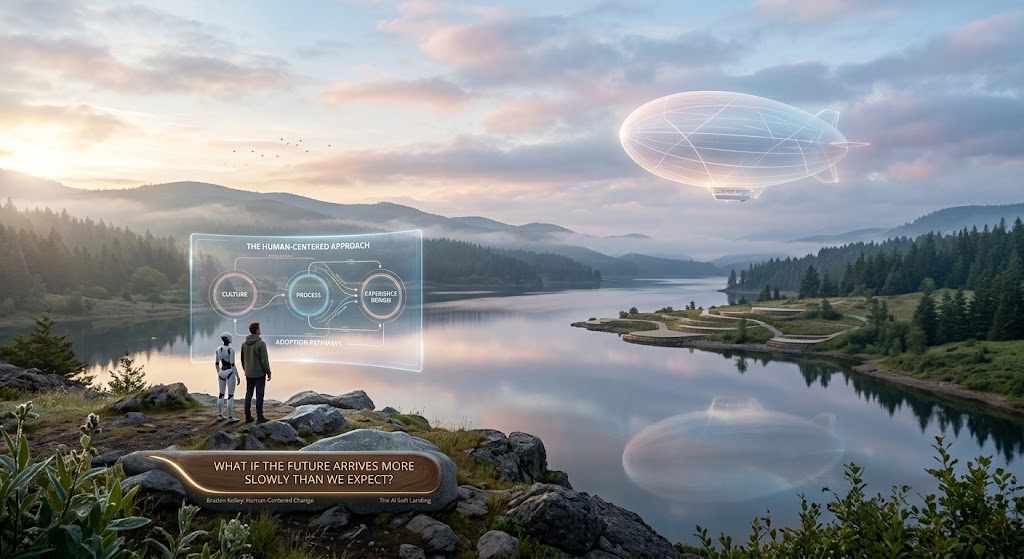
What If the Future Arrives More Slowly Than We Expect?

What If the Future Arrives More Slowly Than We Expect?

GUEST POST from Art Inteligencia


The Hype Velocity vs. Reality Gap

The discourse surrounding Artificial Intelligence is currently dominated by exponential curves, hyperbolic existential threats, and grand promises of immediate disruption. Every morning brings news of a new model, a revolutionary tool, or a forecast declaring that entire industries will be upended before the next quarter ends. Organizations are being bombarded with a singular, high-stress mandate: adapt in 90 days or face irrelevance.

Yet, history tells a fundamentally different story about how transformative technology actually integrates into society. Radical general-purpose innovations—from electricity and the internal combustion engine to the internet and cloud computing—never crash into the enterprise overnight. Instead, they drift in via a “soft landing.” Their true impact is constrained and shaped by the reality of human adoption curves, regulatory guardrails, institutional inertia, and deeply entrenched legacy systems.

The Thesis: Why the Landing Will Be Soft

A technology can scale digitally in seconds, but human habits, organizational culture, and systemic trust adapt at a profoundly human pace. Rushing headfirst into AI deployment without addressing these structural realities leads to high friction, employee burnout, and degraded customer experiences. The future of AI will not be an abrupt, sci-fi rupture; it will be a steady, structural evolution that rewards preparation over panic.

Reframing the Core Strategic Question

If AI adoption plays out as a marathon rather than a sprint, the critical challenge for leadership changes entirely. The core question facing executives today is not “How fast can we automate everything?” but rather:

“How do we pivot from reactive panic to strategic, human-centered capacity building—ensuring our people, processes, and experience designs are truly ready to absorb continuous change?”

The Four Brakes on the AI Fast-Track

The narrative of instantaneous disruption ignores the physical, psychological, and operational friction inherent in any complex system. While algorithmic capability advances rapidly, four powerful structural brakes act as natural stabilizers, slowing down the real-world arrival of the AI future.

1. The Human Adoption Barrier (Why Strategy Fails)

Technology may scale overnight, but human habits, trust, and psychological safety do not. When organizations introduce generative tools without managing the human dynamics of change, the immediate response is rarely enthusiastic transformation—it is defense.

Employees fear replacement, question the reliability of output, or default to familiar, comfortable routines. Without a focus on organizational empathy, change readiness, and psychological safety, technology investments stall out at the barrier of human resistance. Culture will always eat unmanaged technological change for breakfast.

2. Organizational Friction & Legacy Architecture

An algorithm is only as effective as the environment it operates within. Dragging legacy enterprise architectures, fragmented data silos, and decades of process debt into the future acts as a massive anchor on AI integration.

Most organizations operate on tangled, undocumented workflows designed for a pre-digital era. Attempting to layer advanced AI capabilities on top of broken processes doesn’t create transformation; it simply automates chaos and accelerates inefficiency.

3. The Experience Paradox (EX & CX)

In the rush to capture efficiency gains, organizations frequently sacrifice experience design. Replacing thoughtful human interaction with unrefined, hallucination-prone, or cold AI interfaces damages both the Employee Experience (EX) and the Customer Experience (CX).

When AI tools increase employee cognitive load or create frustrating loops for customers, trust erodes rapidly. A soft landing requires designing experiences where AI acts as a seamless co-pilot, enhancing human capability rather than degrading the quality of interaction.

4. Regulatory, Ethical, and Trust Infrastructure

Finally, the broader ecosystem imposes its own speed limits. Emerging regulatory frameworks, data privacy laws, intellectual property disputes, and compliance requirements force enterprises to tread carefully.

Establishing institutional governance, data sovereignty, and ethical boundaries is a deliberate, time-consuming process. These mechanisms are not merely bureaucratic roadblocks; they are essential stabilizers that prevent systemic risk and ensure long-term viability.

Reframing Strategy: From Sudden Disruption to Continuous Innovation

Recognizing that the AI revolution is a marathon rather than a sprint forces a fundamental shift in how leaders approach strategy. Moving past short-term panic requires abandoning tactical, piecemeal implementation in favor of a deliberate, long-term commitment to continuous innovation and structured change.

Moving Beyond Horizon 1 Band-Aids

The vast majority of current enterprise AI initiatives are stuck in Horizon 1: applying new technology to incrementally optimize existing, legacy ways of working. Summarizing meetings, auto-generating emails, and drafting basic copy are convenience features, not strategy.

A true soft-landing strategy uses structured innovation frameworks to look beyond immediate efficiency gains. Instead of asking how to automate existing steps, forward-thinking organizations use this transition to reimagine entire value propositions, service models, and business architectures.

Building a Continuous Change Capability

AI is not a “one-off IT rollout” with a clean start and end date; it is a permanent increase in the background velocity of technological evolution. Treating it as a single software deployment guarantees organizational fatigue and change resistance.

Organizations must build a permanent, muscle-memory capability for continuous change. This means establishing visual, collaborative, and repeatable disciplines that allow cross-functional teams to continuously scan the horizon, evaluate emerging capabilities, and integrate new tools seamlessly into daily operations.

Co-Creation Over Mandates

Top-down mandates to “use more AI” inevitably trigger an organizational immune response. Employees perceive forced adoption as a prelude to downsizing or a threat to their expertise, driving tools underground or into malicious compliance.

Sustained transformation relies on co-creation. Engaging frontline teams—those who know the operational friction points intimately—to map risks, identify high-value use cases, and co-design AI-augmented workflows builds psychological safety and transforms passive targets of change into active champions of innovation.

Designing the “Soft Landing” Operational Blueprint

Moving from strategic intent to operational reality requires a practical, human-centered blueprint. When the timeline for widespread AI adoption expands into a steady, multi-year evolution, leaders gain the space—and the responsibility—to build sustainable operational foundations rather than rushing out fragile quick fixes.

Visual Change Alignment

Complex transformations fail when teams operate off divergent mental models. Relying on dense, 80-page strategy decks or fragmented email threads creates misalignment and ambiguity across departments.

Achieving a smooth landing requires visual change tools—such as structured change planning frameworks—to bring cross-functional leaders, IT architects, and frontline operational teams together onto a single page. Mapping out capability gaps, human impacts, resource constraints, and success criteria visually fosters real-time alignment, uncovers hidden risks early, and creates shared ownership over the transformation journey.

Focusing on Human Experience (HX)

The most valuable implementations of AI do not seek to remove humans from the loop; they focus on elevating human capability. Designing for Human Experience (HX) means crafting workflows that leverage machine efficiency for data processing and pattern recognition, while unleashing human strengths in critical thinking, empathy, creativity, and strategic judgment.

By consciously designing AI as a collaborative co-pilot that reduces cognitive burden and eliminates soul-crushing administrative friction, organizations cultivate an environment where employees feel empowered rather than sidelined.

Measuring What Matters

Legacy metrics that focus purely on head-count reduction or raw activity output fail to capture the true ROI of augmented intelligence. Tracking “number of prompts generated” or “hours saved on emails” encourages superficial adoption while obscuring true value creation.

Organizations preparing for a soft landing must modernize their diagnostic rubrics and performance indicators. Measurement frameworks should evaluate innovation velocity, cross-functional agility, the quality of customer outcomes, and employee experience indicators (EX). Real value is measured by how effectively technology enhances systemic organizational capability, not by how fast it cuts corners.

Conclusion: Playing the Long Game

The narrative that AI will instantly level every industry overnight is an illusion born of hype cycles and technological determinism. While the long-term impact of artificial intelligence will undoubtedly be profound, its arrival is constrained by the deliberate pace of human adaptation, organizational alignment, and systemic trust.

The Leader’s Advantage

The ultimate winners of this transformation will not be the organizations that scrambled to deploy half-baked, superficial AI features first to satisfy short-term quarterly noise. The long-term advantage belongs to leaders who play the long game—those who recognize the “soft landing” for what it is: a strategic window of opportunity.

By using this time to build genuine organizational agility, address underlying process debt, and nurture human capability, forward-thinking enterprises create a resilient foundation that can effortlessly absorb whatever technological shifts lie ahead.

Final Call to Action

It is time to step back from reactive panic and stop preparing for an abrupt, sci-fi rupture. Instead, invest in the hard, rewarding work of human-centered change: engage your teams in co-creation, align your strategy visually, and design experiences that elevate human potential. The future is arriving—sustainable success depends on making sure your organization is truly ready to land it.

Frequently Asked Questions

What is the “AI Soft Landing” hypothesis?

The AI Soft Landing hypothesis proposes that the widespread adoption and operational integration of artificial intelligence will occur as a steady, multi-year evolution rather than an immediate, disruptive rupture. While algorithmic capabilities scale exponentially, real-world enterprise adoption is naturally stabilized by human habit formation, organizational friction, experience design requirements, and regulatory guardrails.

Why is human-centered change critical during AI adoption?

Technology can deploy in seconds, but human trust, psychological safety, and workflow habits adapt at a human pace. Ignoring the human dimension leads to employee burnout, change resistance, degraded customer experiences, and high failure rates. Human-centered change ensures that AI initiatives prioritize co-creation, capability building, and experience design, enabling teams to embrace technology as a co-pilot rather than fear it as a replacement.

How should enterprise leaders prepare for a gradual AI rollout?

Instead of chasing short-term automation mandates, leaders should focus on building long-term organizational agility. Key steps include using visual change planning tools to align cross-functional teams, eliminating underlying process debt, co-creating AI-augmented workflows with frontline employees, and updating diagnostic metrics to measure human experience (HX), innovation velocity, and value creation rather than raw headcount reduction.


EDITOR’S NOTE: Braden Kelley’s Problem Finding Canvas can be a super useful starting point for doing design thinking or human-centered design.

“The Problem Finding Canvas should help you investigate a handful of areas to explore, choose the one most important to you, extract all of the potential challenges and opportunities and choose one to prioritize.”

Image credit: Unsplash

Subscribe to Human-Centered Change & Innovation WeeklySign up here to get Human-Centered Change & Innovation Weekly delivered to your inbox every week.

The Role of AI in Shaping the Future of Work

The Role of AI in Shaping the Future of Work

GUEST POST from Chateau G Pato

Artificial Intelligence (AI) is no longer just a concept from science fiction movies – it has become a reality that is reshaping various industries, including the way we work. As AI technologies continue to evolve, they are playing an increasingly significant role in revolutionizing work processes across different sectors. In this article, we will explore how AI is shaping the future of work and discuss two case study examples that demonstrate its potential.

Case Study 1 – Customer Service

One prominent example of AI transforming the workplace is in the field of customer service. Traditionally, customer inquiries were handled by human operators, often resulting in long wait times and limited availability. However, with the advent of AI-powered chatbots, organizations are able to provide 24/7 customer support with minimal wait times. These AI chatbots are capable of understanding and responding to customer queries in real-time, offering personalized assistance and resolving issues efficiently. For instance, leading global e-commerce platform, Amazon, utilizes AI-powered chatbots to assist customers with order inquiries, tracking shipments, and answering frequently asked questions. The implementation of these AI chatbots has not only improved customer satisfaction but also reduced the workload for human customer service agents, allowing them to focus on more complex and specialized tasks.

Case Study 2 – Healthcare

Another example of AI’s impact on work processes can be seen in the healthcare industry. Medical professionals are now leveraging AI technologies to enhance diagnostic accuracy and patient care. AI algorithms can analyze vast amounts of medical data, including patient records, lab results, and medical images, to assist doctors in making more informed decisions. One such case study involves the use of AI in radiology. A study published in Nature found that an AI algorithm developed by Google’s DeepMind outperformed human radiologists in detecting breast cancer from mammogram images. By leveraging AI’s ability to detect subtle patterns and anomalies, this technology has the potential to tremendously improve early diagnosis rates and reduce the burden on radiologists.

Beyond Healthcare and Customer Service

The application of AI in the workplace extends beyond customer service and healthcare. Industries such as finance, manufacturing, and logistics are also witnessing the transformational impact of AI on work processes. Financial institutions are employing AI-powered algorithms to automate repetitive tasks, such as fraud detection and risk assessment, enabling them to operate more efficiently and securely. In manufacturing, AI-powered robots are being utilized for tasks that require precision and repetitive manual labor, resulting in increased productivity and cost savings. Moreover, in logistics and supply chain management, AI technologies are being used to optimize route planning, inventory management, and demand forecasting, reducing operational costs and enhancing delivery efficiency.

As AI continues to evolve, it is evident that its role in shaping the future of work will expand even further. It presents both opportunities and challenges. While the implementation of AI can automate mundane tasks, improve efficiency, and reduce human error, it also raises concerns about job displacement and the need for upskilling. It is important for organizations and individuals to adapt and embrace AI technologies to stay competitive in the evolving job market.

Conclusion

AI is revolutionizing the way we work across various industries. Case studies show that AI-powered chatbots are transforming customer service, ensuring round-the-clock assistance and enhancing customer satisfaction. Additionally, AI algorithms are augmenting the capabilities of healthcare professionals, allowing for more accurate diagnoses and improved patient care. From finance to manufacturing and logistics, AI is impacting work processes and opening up new opportunities for efficiency and innovation. The future of work is undoubtedly intertwined with AI, and embracing its potential will be essential for success in the evolving job market.

Bottom line: Futurology is not fortune telling. Futurists use a scientific approach to create their deliverables, but a methodology and tools like those in FutureHacking™ can empower anyone to engage in futurology themselves.

Image credit: Pixabay

Subscribe to Human-Centered Change & Innovation WeeklySign up here to get Human-Centered Change & Innovation Weekly delivered to your inbox every week.

Stop Predicting the Future and Start Building for Multiple Futures

Stop Predicting the Future and Start Building for Multiple Futures

GUEST POST from Chateau G Pato


For decades, strategic planning has relied on a comfortable illusion: the single-line forecast. Executive teams gather, review market trends, and select a preferred future, committing capital and resources to a single roadmap. But in a world defined by rapid technological shifts, cultural movement, and systemic volatility, predicting the future isn’t just difficult—it’s dangerous.

When an organization bets everything on a single vision, it builds rigidity into its core operations. Deviations from the forecast are treated as anomalies rather than signals, leaving leadership scrambling when reality takes an unexpected path. True organizational resilience isn’t about getting the prediction right; it’s about eliminating the fragile dependency on being right in the first place.

To thrive amid uncertainty, leaders must shift their focus from prediction to preparation. By combining human-centered experience design, disciplined futurology, and adaptable change management, organizations can design systems capable of thriving across multiple plausible futures. The objective is no longer to guess what comes next, but to build the strategic optionality required to lead no matter what happens.

I. The Fallacy of the Single-Forecast Trap

The “Crystal Ball” Flaw

Traditional linear forecasting operates on a fundamental misconception: that the future is an extrapolation of the past. Organizations routinely analyze historical data, draw a straight trendline into the next three to five years, and treat that output as actionable certainty. In volatile, complex environments, this approach fails because disruptive change rarely happens linearly. It arrives in compounding, interconnected shifts across technology, human behavior, and global markets.

The High Cost of Being “Right”

When leadership places a heavy bet on a single future scenario, it creates structural rigidity. Budgets are locked in, performance metrics are tied to static milestones, and teams become culturally incentivized to defend the chosen path. When market conditions inevitably diverge from the plan, the organization faces immense friction—treating subtle warnings as statistical noise until forced into an expensive, reactive pivot. The risk isn’t just being wrong; it’s the lost opportunity cost of failing to adapt early.

Human Reaction to Uncertainty

False certainty persists because human psychology prioritizes safety and predictability. Unmanaged ambiguity triggers organizational anxiety, driving leaders back toward comfortable forecasts and rigid frameworks. Applying human-centered experience design to strategic planning helps address this emotional baseline. By structuring clear, manageable scenarios, we reduce the psychological threat of the unknown, empowering teams to embrace uncertainty with curiosity and strategic discipline rather than fear.

II. Shifts in Mindset: From Prediction to Preparation

The Futurology Shift

Futurology is often misunderstood as the art of prediction, but its true power lies in exploration. Rather than asking “What will happen?”—a question that invites false precision—strategic leaders must ask “What could happen, and how do we shape it?” This subtle shift moves an organization from a passive stance of waiting for the future to unfold to an active stance of scenario preparation. By mapping out a spectrum of plausible futures, you expand your strategic horizon and build the capability to steer outcomes regardless of external turbulence.

Human-Centered Agility

Change initiatives fail when they treat people as passive execution variables rather than active participants. True organizational agility isn’t just about fast software deployment or iterative frameworks; it is grounded in human behavior. To build for multiple futures, teams must be psychologically equipped for continuous change. This requires designing environments where psychological safety is high, experimentation is rewarded, and shifting direction is viewed as strategic intelligence rather than operational failure.

Agile Strategy Execution

Static five-year strategic plans are liabilities in modern business environments. Building for multiple futures requires transforming strategy execution into a portfolio of dynamic options. Instead of allocating resources to rigid, long-term deliverables, leaders should structure investments as scalable experiments. As signals from the market clarify which plausible future is emerging, resources can be rapidly scaled up or redirected without dismantling the broader organizational vision.

III. The Framework for Building Multiple Futures

Scenario Mapping (The Spectrum of Possibilities)

Building for multiple futures begins by identifying critical uncertainties rather than obvious trends. Instead of assuming a single trajectory, leaders must isolate key forces across technological, social, environmental, and economic horizons. By pairing these uncertainties on multi-axis grids, organizations construct a spectrum of plausible scenarios. The goal isn’t to determine which quadrant is most likely, but tostress-test current capabilities and uncover blind spots across every plausible environment.

Modular Experience Design

Rigid business models and monolithic product architectures crumble when market conditions shift. Modular experience design applies systemic flexibility to products, services, and operations. By designing core capabilities as interconnected, adaptable building blocks, organizations can rapidly reconfigure user experiences and operational workflows as different future scenarios manifest. Modular design transforms agility from a vague philosophy into a concrete architectural discipline.

The Change Planning Canvas Approach

Pivoting across strategic scenarios requires frictionless alignment between human capacity and operational infrastructure. Utilizing structured visual frameworks—such as the Change Planning Canvas—enables cross-functional teams to explicitly map out the impact of change on people, tools, and culture before execution begins. This structured visualization ensures that when market signals demand a strategic shift, the organization can re-align its people and resources with clarity, empathy, and speed.

IV. Activating Multi-Future Capability

Building Scalable Portfolios

To successfully activate a multi-future strategy, resource allocation must reflect dynamic risk management. Organizations must maintain a balanced portfolio divided across core optimization, adjacent expansion, and transformational bets. Core initiatives protect present cash flow, adjacent efforts adapt existing capabilities to emerging trends, and transformational bets create option value in highly uncertain horizons. Scaling investments up or down based on real-time market feedback ensures that capital flows naturally toward the futures taking shape.

Creating Early-Warning Sensing Mechanisms

Pivoting effectively requires early detection. Organizations need an intentional “radar” system to monitor weak signals across technological advancements, regulatory changes, and shifting customer expectations long before they become mainstream disruptions. By defining explicit indicators for each scenario mapped in your strategy, leadership can establish pre-determined trigger points that signal when it is time to reallocate resources or activate contingent business models.

Designing the Change Architecture

Strategic readiness is ultimately a human capability. Building a resilient change architecture requires embedding psychological safety, continuous learning, and rapid experimentation into the daily culture. When employees are trained to view change as an ongoing capability rather than a disruptive event, the friction of shifting direction disappears. A robust change architecture transforms organizational adaptability from a top-down mandate into an organic, decentralized advantage.

V. The Ultimate Goal: Strategic Optionality

From Reactive to Proactive

Traditional change management focuses on reaction—scrambling to adapt after a shift has already disrupted operations. Multi-future readiness flips this dynamic entirely. By building organizational flexibility and mapping scenario triggers in advance, you move from panic to poise. Unexpected market shifts cease to be crises; instead, they become predictable triggers for pre-designed strategic responses, turning potential chaos into a distinct competitive advantage.

The Call to Action

The habit of trying to predict a single, static future is an outdated remnant of a slower era. Modern leaders must abandon the search for an elusive crystal ball and focus on what can actually be controlled: organizational adaptability, human-centered experience design, and robust change architecture. Stop treating the future as a single destination to forecast—start engineering the continuous capability to co-create whichever future arrives.

Frequently Asked Questions

Why is traditional linear forecasting dangerous for modern organizations?

Traditional linear forecasting assumes the future is a direct extrapolation of the past. In complex, rapidly changing environments, disruptive shifts occur exponentially across technology, economics, and human behavior. Betting heavily on a single forecast creates organizational rigidity, leading to high friction, wasted resources, and panic when market conditions diverge from the plan.

How does building for multiple futures differ from scenario planning?

While traditional scenario planning often ends as an intellectual exercises or static reports, building for multiple futures focuses on operational execution and strategic optionality. It combines scenario mapping with modular experience design, human-centered change architecture, and dynamic resource allocation, allowing an organization to actively adapt and scale initiatives in real time as signals emerge.

What is the first step leaders can take to move from prediction to preparation?

The first step is shifting leadership mindset and resource allocation from fixed commitments to scalable portfolios. Leaders should begin by identifying critical uncertainties, mapping a spectrum of plausible scenarios, and establishing early-warning sensing mechanisms to track weak market signals before major disruptions occur.


EDITOR’S NOTE: Braden Kelley’s Problem Finding Canvas can be a super useful starting point for doing design thinking or human-centered design.

“The Problem Finding Canvas should help you investigate a handful of areas to explore, choose the one most important to you, extract all of the potential challenges and opportunities and choose one to prioritize.”

Image credit: Gemini

Subscribe to Human-Centered Change & Innovation WeeklySign up here to get Human-Centered Change & Innovation Weekly delivered to your inbox every week.

The Trend Audit: A Diagnostic Framework for Evaluating Your Market Responsiveness

GUEST POST from Art Inteligencia


Executive Summary: The Foresight Illusion

Most executive suites do not have a trend identification problem—they have a trend digestion problem. Organizations routinely spend millions collecting trend reports, tracking signals, and sponsoring innovation offsites, yet remain functionally reactive when market dynamics shift. Subscribing to foresight reports creates a dangerous illusion of progress while core business models remain completely untouched.

Foresight without operational readiness is just expensive entertainment. To survive perpetual market chaos, leaders must stop asking “What’s coming next?” and start asking “How fast can our organizational machinery adapt when it arrives?”

Core Takeaways

  • Shift from Scanning to Action: The gap between insight and execution is created by cognitive bias, structural silos, and over-indexed planning cycles.
  • The Trend Audit Framework: A systematic diagnostic evaluating organizational readiness across four key pillars: Signal Literacy, Relevance Filtering, Organizational Agility, and Scalability.
  • Continuous Adaptation: True market responsiveness requires embedding low-risk experimentation and human-centered change management directly into core operations.

I. The Gap Between Insight and Action

Knowing the future is changing is easy. Adapting your organization to meet it is where most leadership teams stall out. We call this the “Foresight Illusion”—the comfortable, dangerous belief that buying trend subscriptions, attending innovation keynotes, and filing glossy market decks equals strategic agility. When a trend hits the market, the failure to respond is rarely a breakdown in environmental scanning. It is an internal breakdown across three predictable friction points:

1. Cognitive Delay (The Mindset Trap)

Success breeds orthodoxy. Leadership teams are naturally biased toward defending the legacy business models that brought past prosperity. Weak signals are dismissed as “niche,” “unproven,” or irrelevant to current top-tier customers—until a competitor or market shift turns those weak signals into an existential threat overnight.

2. Structural Inertia (The Silo Trap)

Even when front-line teams, design researchers, or customer experience specialists spot significant market shifts early, organizations lack clear horizontal channels. Information remains trapped within functional silos. Without a structured pathway to elevate insights directly to decision-makers with resource allocation authority, signals simply die in committee.

3. Execution Paralysis (The Planning Trap)

Traditional enterprise planning operates on rigid annual or multi-year cycles. When a market opportunity emerges that demands a rapid, low-risk experiment, the organization forces it through full business-case hurdles, budget committee sign-offs, and multi-department governance. By the time the experiment is approved, the market window has closed.

“Organizations don’t get disrupted because they were blind to the future; they get disrupted because their operating system wasn’t built to act on what it saw.”

II. The Anatomy of The Trend Audit Framework

To overcome internal friction, organizations need a structured diagnostic mechanism that evaluates market responsiveness across the entire lifecycle of an insight. The Trend Audit evaluates organizational readiness across four interconnected pillars:

Pillar 1
Phase: Discovery

Signal Literacy (Detection)

High market responsiveness starts with broader radar scope. Signal literacy measures how systematically your enterprise scans outside immediate industry boundaries to spot early indicators before they hit mainstream saturation.

  • Evaluates multi-source horizon scanning mechanisms beyond conventional vendor decks.
  • Distinguishes background noise from actionable, early-stage weak signals.
  • Measures frontline customer insight integration into strategic leadership loops.

Pillar 2
Phase: Strategic Alignment

Relevance Filtering (Translation)

Not every trend demands a strategic response. Relevance filtering pressure-tests macro-environmental signals against core organizational capabilities and potential value creation vectors, using models like the Eight I’s of Infinite Innovation™.

  • Translates macro-trends into micro-implications for specific customer experience touchpoints.
  • Filters out short-term novelty fad-chasing from durable value opportunities.
  • Maps trend impacts explicitly across product, operational, and business model dimensions.

Pillar 3
Phase: Prototyping

Organizational Agility (Experimentation)

Agility is measured by velocity, not intent. This dimension audits how rapidly validated signals transition into low-cost market probes, live prototypes, and structured experiments without triggering corporate antibody responses.

  • Assesses availability of dedicated sandboxes and decentralized pilot budgets.
  • Evaluates time-elapsed from signal validation to initial market test launch.
  • Measures institutional comfort with hypothesis-driven, controlled risk-taking.

Pillar 4
Phase: Operations

Scalability & Change Integration (Transformation)

An experiment that never scales is merely an innovation side-project. The final pillar assesses your organization’s capacity to integrate successful probes back into core business processes and support employees through continuous transition.

  • Examines handoff pathways between experimental units and core operations.
  • Applies human-centered change methodology to mitigate organizational anxiety.
  • Audits long-term capacity for continuous business model evolution.

III. The Diagnostic: Scoring Your Market Responsiveness

Evaluating market responsiveness requires moving beyond subjective gut feelings and assessing hard organizational metrics. To conduct a effective Trend Audit, leadership teams must measure performance across key quantitative indicators and identify where their current operational posture sits.

Diagnostic Metric Core Evaluation Question Responsiveness Benchmark
Time-to-Probe How many days or weeks elapse between validating a trend signal and launching a live, low-risk market experiment? World Class: < 30 Days
Lagging: > 6 Months
Signal-to-Portfolio Ratio What percentage of active innovation projects directly originate from validated market signals versus internal incremental requests? World Class: > 40% External Signals
Lagging: < 10% External Signals
Cross-Functional Velocity How many handoffs and approval gates must a validated insight pass through before funding for experimentation is unlocked? World Class: 1–2 Decentralized Gates
Lagging: Multi-Committee Sign-Offs
Scale-Through Rate What proportion of successful low-cost experiments are successfully integrated into core operations or mainstream product lines? World Class: 25%–35% Integrated
Lagging: < 5% (Orphaning Pilots)

The Three Responsiveness Archetypes

Based on diagnostic scoring, most organizations fall into one of three distinct operational profiles:

1. The Anchored Giant

High Insight Capability | Zero Execution Speed. Possesses massive research budgets, subscribes to every top trend service, and produces beautifully designed foresight decks. However, rigid governance, risk aversion, and deep operational silos ensure that signals rarely translate into live experiments. Vulnerable to fast-moving disruptors.

2. The Reactive Chaser

High Action Speed | Zero Strategic Filter. Lacks rigorous relevance filtering. Pivots wildly toward every shiny new fad or competitor headline without checking strategic alignment or customer experience relevance. Suffers from severe organizational fatigue, fragmented resources, and constant strategic whiplash.

3. The Infinite Navigator

Balanced Scanning | Disciplined Filtering | Rapid Adaptation. Maintains a broad radar, filters signals through a clear strategic lens, and empowers decentralized teams to run rapid, low-risk probes. Combines operational speed with human-centered change management to scale successful responses smoothly.

IV. Moving from Audit to Actionable Capability

Diagnosing your responsiveness score is only the baseline. Transforming your enterprise into an Infinite Navigator requires shifting from episodic trend reviews to building continuous organizational muscle across three execution pillars:

1

Establish Dynamic Trend Auditing Cadences

Replace static annual offsites with continuous, monthly signal evaluation sessions. Embed diagnostic checkpoints into ongoing portfolio reviews to evaluate whether resource allocation actively reflects shifting market realities or merely perpetuates legacy projects.

2

Embed Empathetic, Human-Centered Change

Market pivots induce organizational anxiety. When trends force strategic shifts, apply human-centered change frameworks to help teams understand the why behind the pivot, manage loss of legacy ownership, and build psychological safety around continuous adaptation.

3

Decouple Experimentation from Core Operations

Protect early-stage trend experiments from standard enterprise ROI hurdles. Deploy lightweight tools like the Experiment Canvas to pressure-test key assumptions with real customers in small, controlled sandboxes before asking governance committees for main-line capital.

Conclusion: Making Market Responsiveness a Core Competency

Trends are not static targets to hit—they are dynamic environments to navigate. The goal of market responsiveness is not to predict the future with 100% accuracy, but to build an organizational operating system capable of sensing shifts early, filtering them with discipline, and acting with velocity.

By shifting your focus from passive trend gathering to active diagnostic auditing, you move your culture away from asking “What’s coming next?” and toward a far more resilient posture: “How ready are we to adapt when it arrives?”

Ready to Audit Your Market Responsiveness?

Evaluate your organization’s innovation velocity, signal literacy, and change integration readiness using our structured diagnostic frameworks and visual toolkits.


Explore Innovation & Change Diagnostics

Frequently Asked Questions

How often should an organization conduct a Trend Audit?

While major strategic diagnostic assessments should occur annually, high-performing organizations review signal literacy and experimentation velocity monthly. Shifting from static annual planning cycles to dynamic monthly or quarterly trend auditing cadences ensures resource allocation continuously reflects emerging market realities rather than legacy priorities.

How does a Trend Audit differ from traditional trend reports or environmental scanning?

Traditional trend reports merely list external market shifts, identifying what is changing outside your organization. A Trend Audit is an internal operational diagnostic that evaluates your organization’s internal capacity to absorb, filter, experiment with, and scale responses to those shifts before competitors do.

What is the biggest barrier organizations face when attempting to act on trends?

The primary barrier is execution paralysis caused by forcing early-stage, low-cost trend experiments through traditional enterprise governance, budget committees, and multi-year ROI business cases. Decoupling early experimentation from core operations allows teams to pressure-test assumptions rapidly without enterprise overhead.


EDITOR’S NOTE: Braden Kelley’s Problem Finding Canvas can be a super useful starting point for doing design thinking or human-centered design.

“The Problem Finding Canvas should help you investigate a handful of areas to explore, choose the one most important to you, extract all of the potential challenges and opportunities and choose one to prioritize.”

Image credit: Gemini

Subscribe to Human-Centered Change & Innovation WeeklySign up here to get Human-Centered Change & Innovation Weekly delivered to your inbox every week.