GUEST POST from Art Inteligencia
I. The Mirage of the Future-Ready Enterprise
The Noise Trap: When More Data Yields Less Direction
Organizations today are swimming in more data, trend reports, and strategic foresight presentations than at any point in corporate history. Innovation labs dot major tech hubs, cross-functional teams subscribe to expensive trend feeds, and executive retreats routinely feature external futurists warning of upcoming disruptions. Yet despite this unprecedented access to peripheral intelligence, leaders find themselves repeatedly blindsided by industry shifts, rapid shifts in customer behavior, and nimble new competitors.
The paradox of the modern enterprise is that an abundance of information has not created clarity—it has created cognitive fatigue and operational noise. When every weak signal is amplified equally, signal pollution sets in, leaving decision-makers paralyzed by options or retreating back to the familiar metrics of short-term quarterly performance.
Defining the Signal-to-Strategy Gap
The core issue is rarely a failure of perception; it is a failure of operational connectivity. The Signal-to-Strategy Gap represents the dangerous latency—and frequent breakdown—between detecting an emerging indicator on the periphery and translating that insight into resource allocation, portfolio adjustment, and human-centered change execution.
A weak signal captured in an innovation lab or strategy deck means nothing if it cannot cross the chasm into core business operations. When signals remain trapped inside slide decks or isolated silos, the enterprise operates under the dangerous illusion of future-readiness, confusing awareness with capability.
The Human Barrier: Cultural Friction and the Core Operational Bias
Why does this gap persist? Because organizations are fundamentally designed to optimize the present, not invent the future. Core business operations are governed by predictable operational rhythm—the domain of keeping current machinery running efficiently. In this environment, early indicators are routinely dismissed as statistical anomalies, irrelevant edge cases, or threats to current revenue streams.
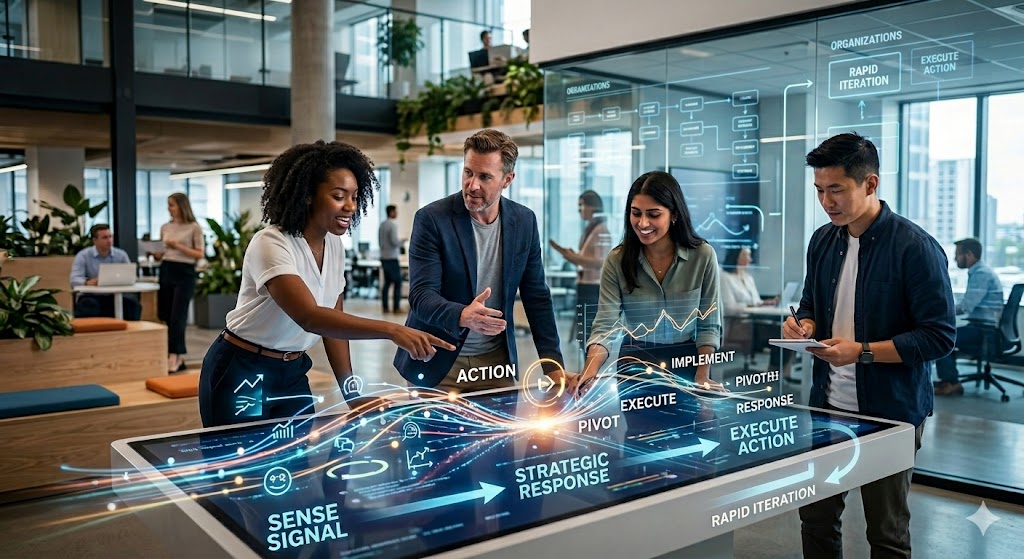
Furthermore, strategy is ultimately a human endeavor. Without a structured, visual framework to make sense of weak signals and build alignment across diverse teams, short-term pressures will always overpower long-term foresight. Closing the Signal-to-Strategy Gap requires moving past passive trend-watching and designing human-centered bridges that empower leadership to turn peripheral noise into strategic, actionable conviction.
II. Why Signals Get Lost in Translation
Passive Trend-Watching vs. Active Foresight
One of the primary reasons organizations fail to bridge the signal-to-strategy gap is their fundamental approach to futurology. Most leadership teams treat trend analysis as a passive, periodic exercise—buying thick research reports, attending annual industry keynotes, or hosting quarterly executive briefings on “emerging trends.”
While these activities provide intellectual stimulation, they rarely drive strategic momentum. Passive trend-watching treats the future as an external force that happens to the organization, rather than an interactive canvas that can be intentionally shaped. Active strategic foresight, by contrast, requires shifting from observation to operational capability—converting peripheral signals into dynamic hypotheses, stress-testing current assumptions, and actively designing strategic choices.
The “Adjacent Industry” Blindspot
Traditional competitive analysis is inherently backward-looking and dangerously narrow. Enterprises tend to monitor the direct, visible moves of known competitors within their immediate category. However, true disruption almost never originates from inside the incumbent circle.
Disruption occurs at the intersections—where technological capabilities, shifting consumer expectations, and novel business models from adjacent industries collide. When an enterprise focuses solely on its own sector, it misses the cross-industry ripple effects that reframe customer expectations overnight. A seamless experience in retail or digital services instantly elevates customer expectations across banking, healthcare, B2B services, and beyond.
Cognitive, Cultural, and Structural Resistance
Even when a weak signal is correctly identified and understood by forward-looking leaders, it faces an uphill battle against deep-seated organizational mechanics. Strategic foresight inherently asks an enterprise to question its current profit engines and operating models.
Status quo bias, risk-averse incentive structures, and the natural desire to protect legacy revenue streams combine to create cultural friction. Early signals are easily rationalized away as niche edge cases, unproven markets, or temporary noise. Without a structured, visual framework to depersonalize strategic conversations and build collaborative alignment across business units, the gravity of present operations will consistently crush the seeds of future growth.
III. The Four Steps to Bridging the Gap (The FutureHacking™ Approach)
Step 1: Precision Signal Picking
Bridging the gap begins with signal curation, not signal collection. Instead of drowning in vast, generic macro-trend reports, leaders must cultivate precision signal picking—identifying weak indicators on the periphery that directly intersect with human behavior, unmet customer needs, or emerging cultural friction.
Precision signal picking shifts the focus from broad headlines to underlying human dynamics. A signal is not merely a new technology or market statistic; it is a shift in how people express value, seek convenience, or navigate friction. By framing signals around human experience, organizations can filter out ambient hype and hone in on indicators that carry genuine strategic potential.
Step 2: Mapping Signal Evolution and Interdependencies
Isolated signals rarely disrupt industries on their own. Disruption occurs when independent weak signals accelerate, converge, and amplify one another.
By mapping signal evolution and interdependencies using visual diagnostic tools like FutureSignals™, teams can trace velocity, acceleration triggers, and proximity to core operational capabilities. Visualizing how technology shifts, demographic trends, and cross-industry behaviors intersect reveals compound impacts long before they manifest as undeniable macro-trends.
Step 3: Designing Scenarios Across the Futures Cone
Strategic foresight must move beyond single-point forecasting. The future is non-linear, and attempting to predict a single outcome leaves organizations fragile. Using the Futures Cone framework, leadership teams systematically map out Possible, Probable, and Preferable futures.
This step shifts the executive posture from passive anticipation—asking “What will happen to us?”—to active agency: “What preferable future do we want to design, and what strategic moves must we make today to bring it to life?”
Step 4: Translating Foresight into Strategy and Experience Design
A strategic scenario is only as valuable as the decisions it informs. In the final step of the FutureHacking™ approach, abstract scenarios are grounded directly in organizational choices, capability mapping, and human-centered experience design.
Teams identify capability gaps, stress-test current offerings, and model updated customer, employee, and partner experiences. Grounding foresight in tangible experience models ensures that strategic insights move seamlessly from foresight decks into product roadmaps, service designs, and operational priorities.
IV. Operationalizing Foresight Through Human-Centered Change™
Aligning the Nine Innovation Roles™ Across the Journey
Translating peripheral insight into organizational reality requires a balanced diversity of talent and perspectives. Too often, strategic foresight remains trapped within dedicated strategy or foresight teams, detached from the operational muscle needed to execute. Closing the signal-to-strategy gap requires intentionally mobilizing The Nine Innovation Roles™ across the innovation journey.
While Revolutionaries and Artists excel at picking weak signals and conceptualizing novel scenarios, they must collaborate early with Troubleshooters and Judges to evaluate systemic friction and operational feasibility. Ultimately, bridging the gap to execution relies on Evangelists to build organizational conviction and Conscripts and Connectors across functional units to embed new capabilities into daily operations.
Visual and Collaborative Alignment
The friction that crushes early strategic signals is rarely intellectual; it is alignment-driven. When cross-functional teams operate with divergent assumptions, jargon, and priorities, strategic foresight gets diluted in endless committee meetings.
Using visual, human-centered methodologies—such as the Change Planning Canvas™—democratizes complex strategic conversations. Visual canvases replace text-heavy reports with an open, shared mental model where leadership, operations, product design, and customer experience teams can co-create change pathways, surface hidden risks, and establish joint ownership over strategic choices.
Insulating Exploration from the Core
Core operations are optimized for predictability, risk mitigation, and immediate return on investment—the essential realm of keeping current business models healthy. If emerging strategic options driven by weak signals are forced to compete directly for resources against core operations on day one, short-term pressures will win every time.
Organizations must create visual foresight spaces and structural insulation to nurture early-stage strategic initiatives. Providing distinct governance, iterative milestones, and protective space allows high-potential strategic options to mature, undergo real-world experiment cycles, and build momentum before being integrated into core operational systems.
V. Conclusion: Designing the Future Before It Designs You
The True Cost of Strategic Delay
By the time a weak signal on the horizon solidifies into a mainstream macro-trend, the window for true strategic differentiation has already closed. Waiting for complete certainty or waiting until competitors validate a new market direction shifts an enterprise from proactive market shaper to reactive follower.
The cost of the Signal-to-Strategy Gap is not simply missed revenue; it is loss of agency. Organizations that fail to bridge this gap find themselves perpetually playing catch-up, forced into costly turnarounds and defensive restructuring rather than leading their industries forward.
Building an Agile, Future-Ready Enterprise
Building a resilient enterprise requires pairing continuous innovation capability with structured, human-centered strategic foresight. Foresight provides the compass, experience design provides the bridge, and human-centered change provides the momentum.
When these disciplines align, signal detection ceases to be an academic exercise in trend-watching and becomes a dynamic engine for strategic agility—allowing organizations to anticipate friction, capture emerging value, and continually renew their competitive advantage.
A Call to Action for Business Leaders
The future is not an incoming storm to survive; it is an open canvas to design. Stop viewing strategic foresight as a passive spectator sport or an isolated slide deck.
Empower your teams with visual tools, bridge internal silos using human-centered change frameworks, and leverage signal detection to actively build your preferable future before market forces dictate it for you.
Frequently Asked Questions
1. What is the Signal-to-Strategy Gap?
The Signal-to-Strategy Gap is the latency and organizational breakdown between detecting weak signals on the industry periphery and translating those insights into strategic resource allocation, capability building, and human-centered change execution.
2. How does FutureHacking™ help bridge the Signal-to-Strategy Gap?
FutureHacking™ moves strategic foresight from passive trend-watching to active creation. It uses structured, visual methodologies to isolate precision signals, map interdependencies, design scenarios across the Futures Cone, and ground foresight directly into experience design and strategy.
3. Why do traditional innovation efforts fail to act on weak signals?
Most traditional organizations suffer from core operational bias, short-term quarterly performance pressure, and functional silos. Without visual alignment frameworks and distinct spaces to insulate early exploration, core operations consistently suppress long-term strategic signals.
Image credit: Gemini
 Sign up here to get Human-Centered Change & Innovation Weekly delivered to your inbox every week.