Not a Forecast
GUEST POST from Chateau G Pato
I. The Fallacy of the Single Line
For decades, strategic planning has relied heavily on linear extrapolation. Organizations gather historical data, draw a neat trend line outward, and call it the future. This approach operates under a dangerous assumption: that tomorrow will simply be a slightly faster, more efficient version of yesterday. In a world defined by exponential technological shifts, shifting customer behaviors, and systemic volatility, predicting a single trajectory isn’t just naive—it’s a critical strategic vulnerability.
The Predictive Trap
Traditional forecasting breeds a false sense of security. When leadership teams commit to a single-line forecast, they lock capital, culture, and capabilities into a rigid path. When reality inevitably departs from the spreadsheet, the organization experiences immediate friction. Because the plan left no room for divergence, leadership is forced into reactive crisis management rather than deliberate strategic adjustment. The trap lies in confusing high-precision metrics with actual clarity about what lies ahead.
The Illusion of Certainty
Spreadsheets and financial models love certainty, but the real world is chaotic and human. Linear forecasts fail because they ignore non-linear events—unexpected cultural movements, sudden technological breakthroughs, or sudden shifts in employee and customer expectations. By treating the future as a fixed destination to be calculated rather than a dynamic landscape to be navigated, leaders build fragile organizations that shatter under pressure instead of adapting.
Shift the Mindset: From Prediction to Preparation
To build genuine resilience and continuous innovation, we must fundamentally shift our primary question. We need to move away from asking “What will happen?”—a question that demands an impossible forecast—and start asking “What might happen, and how do we position ourselves to shape it?” Navigating uncertainty isn’t about guessing correctly; it’s about expanding our perception to recognize possibilities early and building the organizational agility required to act on them.
II. Framing the Possibility Space
If the future is not a single linear path, how do we begin to map it without drowning in infinite variables? We begin by expanding our lens to frame the possibility space. Foresight is not about gazing into a crystal ball; it is a structured discipline of scanning, framing, and contextualizing the emerging forces around us. By systematically identifying emerging dynamics, we turn ambiguous uncertainty into actionable strategic territory.
Signals Over Noise: Horizon Scanning for Weak Signals
Transformation rarely arrives without warning. It begins in the margins—as weak signals of change tucked inside technological shifts, subtle cultural evolutions, emerging business models, or evolving human behaviors. Most organizations ignore these early indicators because they do not yet impact quarterly earnings. However, waiting for a signal to become a loud trend means you are already late. Effective foresight requires continuous horizon scanning, training your organization to spot subtle shifts, separate meaningful signals from short-term hype, and interpret their strategic implications long before they disrupt your industry.
Visualizing Futures: Mapping Plausible Horizons
Abstract concepts become actionable when they are made visual. Mapping the possibility space requires structuring potential outcomes across distinct horizons of change rather than relying on a single baseline forecast:
- The Baseline Future: The continuation of present trends and incremental evolution.
- Alternate Futures: Divergent paths driven by economic, regulatory, or competitive shifts.
- Disruptive Futures: High-impact scenarios triggered by emerging technologies or market turnarounds.
- Transformational Futures: Fundamental shifts in societal values, operating models, or category definitions.
By using interactive visual frameworks to map these paths, leadership teams move away from abstract debate and toward a shared mental model of where the market could move—and where opportunity lies.
Placing Human Experience at the Center
Technology and market forces provide the backdrop for the future, but human behavior dictates which possibilities actually take hold. A strategic scenario that ignores human reality is merely speculative fiction. As we evaluate plausible future states, we must ground every scenario in experience design, asking critical questions about the human element:
- How will customer expectations, desires, and friction points evolve in this environment?
- How will employee motivations, ways of working, and collaboration models change?
- Where are the points of empathy, trust, and connection that technology cannot replace?
True market leadership belongs to those who do not just track where technology is heading, but who design meaningful, human-centered experiences within those future landscapes.
III. Managing the Portfolio of Options
Framing plausible futures is only half the equation; the real strategic advantage comes from how you allocate resources across those possibilities. Rather than making giant, irreversible bets on a single projected outcome, high-performing organizations manage uncertainty much like venture capitalists: by building and balancing a dynamic portfolio of strategic options.
Core, Growth, and Exploratory Bets
A resilient strategy balances investments across three distinct operational horizons to maintain stability today while building relevance for tomorrow:
- Core Bets (Horizon 1): Optimizing current operations, enhancing core products, and defending existing market share. These bets keep the engine running and generate the capital required to fund future growth.
- Growth Bets (Horizon 2): Extending successful capabilities into adjacent markets, launching emerging product lines, and scaling proven business model innovations.
- Exploratory Bets (Horizon 3): Small-scale, high-upside experiments targeted at disruptive and transformational possibilities. These are designed to discover new revenue engines before legacy models mature.
By explicitly categorizing initiatives across these horizons, leaders prevent the short-term pressures of the core business from cannibalizing long-term exploration.
Creating Strategic Optionality
The goal of exploratory bets is not immediate profitability—it is buying the right to execute in the future without being obligated to do so. In financial terms, an option gives you upside exposure with limited downside risk. In strategic innovation, designing low-cost, high-learning experiments functions the exact same way.
By running targeted pilots, prototype tests, and micro-ventures across your possibility portfolio, you build organizational capabilities and real-world intelligence. If a scenario begins to materialize, you have already established a foothold and can rapidly scale. If the scenario fails to gain traction, your downside risk is capped at the cost of the initial experiment.
Dynamic Capital and Talent Allocation
The traditional annual budgeting process is a major barrier to adaptive strategy. Locking capital and talent into rigid 12-month plans forces teams to execute strategies that may already be obsolete mid-year.
Managing a portfolio of options requires dynamic resource allocation. Funding and talent must flow fluidly based on real-time feedback loops, weak signals, and experiment results. When a Horizon 3 exploratory initiative validates a high-potential hypothesis, the organization must be structured to redeploy capital rapidly from declining core areas into scaling that new growth engine. Strategy ceases to be an annual event—it becomes a continuous portfolio rebalancing process.
IV. Human-Centered Execution: Orchestrating the Transition
A portfolio of strategic options is useless if the organization lacks the cultural capability to navigate it. Strategy often fails not in its design, but in the human transition required to bring it to life. Moving fluidly between plausible futures requires leading people through uncertainty without causing operational paralysis or change fatigue.
Overcoming Change Resistance by Re-Framing Uncertainty
Human beings naturally seek predictability, and ambiguity often triggers anxiety and self-preservation. When leaders introduce new directions without context, teams push back—not out of stubbornness, but out of fear of losing control or competence. Successful execution starts by reframing uncertainty. Rather than positioning change as a disruptive reaction to a crisis, leaders must frame the portfolio of possibilities as a structured landscape of opportunity where employees are active participants in shaping the journey.
Collaborative Foresight and Visual Engagement
Strategy cannot remain an isolated exercise conducted behind boardroom doors. To build alignment, organizations must democratize foresight. Using visual frameworks, canvases, and collaborative planning tools, cross-functional teams can actively participate in mapping scenarios, identifying operational friction points, and co-creating experiment pathways.
When people help draw the map, they understand the destination. Engaging diverse perspectives across operations, product, and frontline customer experience ensures that strategies are grounded in reality while fostering collective ownership of the outcomes.
Building Continuous Organizational Agility
True agility is not merely an IT methodology; it is a core cultural competency. Orchestrating a smooth transition across strategic horizons requires embedding three essential capabilities into the organizational DNA:
- Psychological Safety: Creating an environment where intelligent failure in Horizon 3 experiments is treated as valuable organizational learning rather than a career misstep.
- Continuous Feedback Loops: Establishing rapid learning rhythms that capture real-world signals from customers and experiments, feeding insights back into leadership decision-making.
- Decentralized Decision-Making: Empowering multidisciplinary teams at the edges of the organization to adjust tactics rapidly without waiting for lengthy hierarchical approval loops.
When leadership pairs a structured portfolio strategy with human-centered execution, the organization shifts from resisting change to operating as an adaptable, continuously innovating ecosystem.
V. Conclusion: From Passive Spectators to Active Architects
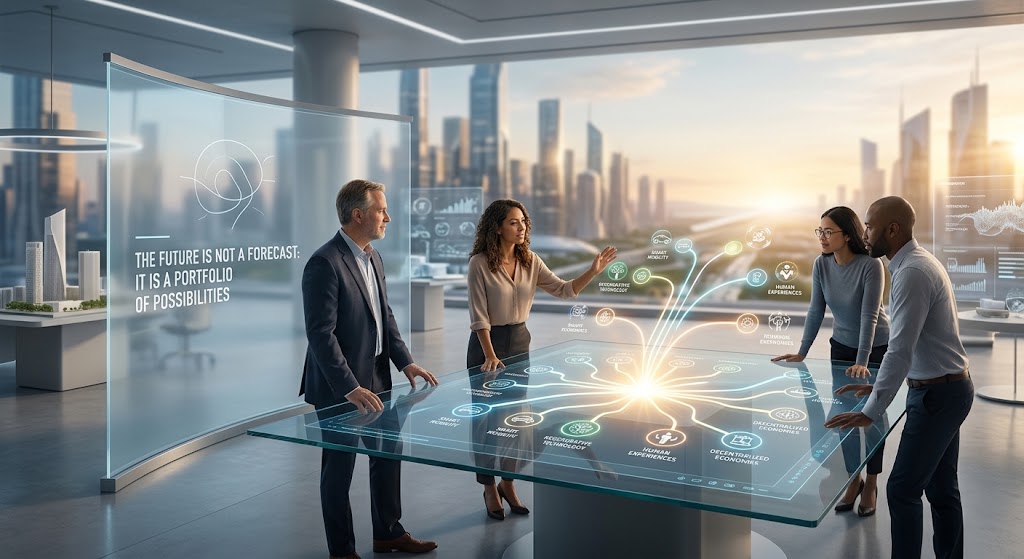
The future is not a predetermined destination waiting to be discovered, nor is it a rigid single-line forecast dictated by historical trends. It is an unwritten, dynamic portfolio of possibilities waiting to be designed. Leaders who remain fixated on predicting the exact turn of events will continuously find themselves caught off guard by the non-linear realities of tomorrow.
The Ultimate Competitive Advantage
In an era defined by rapid technological evolution and shifting human expectations, true strategic advantage does not belong to the organizations with the most polished 5-year plans. It belongs to those that cultivate foresight as an active muscle. By framing possibility spaces, investing in a balanced portfolio of options, and leading teams through human-centered execution, you transform uncertainty from a source of anxiety into your primary strategic edge.
Designing Tomorrow, Today
We must step away from the sidelines of passive observation. The choices, experiments, and capabilities we invest in today define which plausible futures we are equipped to unlock tomorrow. Stop trying to forecast the future—start building the portfolio of options that allows you to actively architect it.
Frequently Asked Questions
Why is linear forecasting dangerous in uncertain markets?
Linear forecasting assumes tomorrow will be a direct continuation of yesterday’s trends. In environments shaped by sudden technological, social, or market shifts, relying on a single trajectory creates rigid plans that shatter when unexpected disruption occurs. Preparing for multiple plausible futures creates strategic agility instead of operational fragility.
How does a portfolio of possibilities differ from traditional strategic planning?
Traditional planning places large, long-term bets on a single forecasted outcome. A portfolio approach operates like strategic venture capital: allocating resources across Core (Horizon 1), Growth (Horizon 2), and Exploratory (Horizon 3) bets. It relies on small, low-risk experiments to create options for multiple plausible futures without overcommitting capital upfront.
What role does human-centered experience design play in strategic foresight?
Market forces and technology define what is possible, but human behavior determines what actually scales. Incorporating human-centered design into foresight ensures that scenarios account for evolving customer expectations, employee needs, trust factors, and organizational culture—turning abstract market predictions into actionable, human-ready strategies.
Bottom line: Futurology is not fortune telling. Futurists use a scientific approach to create their deliverables, but a methodology and tools like those in FutureHacking™ can empower anyone to engage in futurology themselves.
Image credit: Gemini
 Sign up here to get Human-Centered Change & Innovation Weekly delivered to your inbox every week.