Category Archives: Design

The Role of Design Thinking in Customer Experience Design

The Role of Design Thinking in Customer Experience Design

GUEST POST from Art Inteligencia

Design thinking has become an increasingly important tool in the world of customer experience design. It helps to create experiences that are not only attractive, but also meaningful and effective. In this article, we will explore the role of design thinking in customer experience design and how it can be used to create better experiences for customers.

Design thinking is a creative problem-solving approach that seeks to understand customer needs from their perspective. It looks at the end-user and their context and works to identify potential problems and opportunities. By understanding customer needs and motivations, design thinkers can create solutions that are tailored to their needs. This can help businesses to provide better customer experiences, by creating experiences that are both enjoyable and successful.

Customer experience design is a process of designing, creating, and managing customer experiences to meet the needs and expectations of customers. It involves researching, understanding, and designing customer interactions, services, and products that are tailored to meet customer needs and expectations. It also involves creating a positive customer experience by focusing on customer preferences, behaviors, and values.

The design thinking process typically involves brainstorming, prototyping, and testing, which can be done in collaboration with the customer. Through this process, customer needs are identified, solutions are generated and tested, and improvements are made to the initial design. By engaging customers in the process, businesses can be sure that the final design meets their needs and expectations.

Design thinking can also help businesses to create experiences that are more accessible. By understanding the needs of customers with different abilities, businesses can create experiences that are accessible to everyone. This can help to ensure that everyone has a positive experience, regardless of their individual needs.

Design thinking can help customer experience researchers to better understand customer needs, wants and expectations. It can also help designers to create products and services that meet customer needs. The use of design thinking can also help to create an environment that is conducive to customer engagement, allowing for the development of a positive customer experience. Design thinking can also help to identify and address customer pain points, helping to improve customer satisfaction. And, design thinking can help to create a customer-centric product or service by keeping customer experience at the forefront of the design process.

Finally, design thinking can help businesses to create experiences that are more engaging. By understanding customer motivations, businesses can create experiences that are more interactive and engaging. This can help to keep customers engaged and interested in the business, which can lead to increased sales and customer loyalty.

To sum up, design thinking is a powerful tool for customer experience design. It can help businesses to create experiences that are tailored to customer needs, more accessible, and more engaging. By engaging customers in the design process, businesses can ensure that the final design meets their needs and expectations.

SPECIAL BONUS: Braden Kelley’s Problem Finding Canvas can be a super useful starting point for doing design thinking or human-centered design.

“The Problem Finding Canvas should help you investigate a handful of areas to explore, choose the one most important to you, extract all of the potential challenges and opportunities and choose one to prioritize.”

Image credit: Pexels

Subscribe to Human-Centered Change & Innovation WeeklySign up here to get Human-Centered Change & Innovation Weekly delivered to your inbox every week.

Human-Centered Design Best Practices for the Digital Age

Human-Centered Design Best Practices for the Digital Age

GUEST POST from Art Inteligencia

The digital age has drastically changed the way people interact with and experience technology, and as a result, it has become increasingly important for developers and designers to focus on creating products, services, and experiences that are holistically user-centered. Human-centered design (HCD) is a creative approach to problem-solving that involves understanding the needs, wants, and limitations of users, and then designing products and services that meet those needs.

HCD is becoming increasingly important in the digital age, and there are some best practices that can help developers and designers create quality user experiences.

1. Develop a deep understanding of users: The first step to creating effective user experiences is to build a deep understanding of the users. This involves gathering demographic data such as age, gender, income, and education level. It also involves understanding user motivations, behaviors, and preferences.

2. Involve users in the design process: Involving users in the design process is key to creating a successful user experience. This can be done through surveys, focus groups, interviews, and other methods. Involving users in the design process helps to ensure that the product or service is designed to meet user needs and expectations.

3. Use iterative design: Iterative design is the process of making incremental improvements to a product or service based on user feedback. This helps create a product or service that is more user-friendly and better suited to the users’ needs.

4. Test and validate designs: Testing and validating designs is an essential part of the HCD process. This involves testing the product or service with real users to ensure that it meets their needs and expectations. Testing can be done through user interviews, focus groups, surveys, and usability testing.

5. Prioritize user feedback: User feedback is invaluable for improving user experiences. Developers and designers should prioritize user feedback and use it to inform the design process. This will help create a product or service that is tailored to user needs.

By following these best practices, developers and designers can create user experiences that are tailored to meet the needs of their users. Human-centered design is essential for creating successful user experiences in the digital age, and following these best practices is a great way to ensure that user experiences are as effective as possible.

SPECIAL BONUS: Braden Kelley’s Problem Finding Canvas can be a super useful starting point for doing design thinking or human-centered design.

“The Problem Finding Canvas should help you investigate a handful of areas to explore, choose the one most important to you, extract all of the potential challenges and opportunities and choose one to prioritize.”

Image credit: Unsplash

Subscribe to Human-Centered Change & Innovation WeeklySign up here to get Human-Centered Change & Innovation Weekly delivered to your inbox every week.

The Role of Design Thinking in Business Strategy

The Role of Design Thinking in Business Strategy

GUEST POST from Art Inteligencia

Design thinking is a method of problem solving that has been around since the 1970s but has become increasingly popular in business strategy in the last decade. This approach to problem solving relies on creative thinking to find user-centered solutions and has proven to be an effective way to improve customer experience and increase profits. Design thinking has become a key element in crafting business strategy and can help organizations gain a competitive edge. Here are ten ways design thinking can help craft business strategy:

1. Identifying customer needs: Design thinking starts with looking at the user and understanding their needs. Through research and observation, organizations can identify and prioritize customer needs and then use that information to create strategies that are tailored to their customer base.

2. Developing empathy: Design thinking requires organizations to put themselves in the shoes of their customers and understand their motivations, values, and preferences. This helps organizations develop empathy for their customers and design strategies that are tailored to their needs.

3. Improving customer experience: Design thinking helps organizations create a better customer experience by focusing on the user journey and understanding their needs and pain points. This can help organizations create strategies that improve customer experience and increase customer loyalty.

4. Creating innovative solutions: Design thinking encourages organizations to think outside the box and come up with innovative solutions to problems. This can help organizations create strategies that are different from the competition and give them an edge.

5. Enhancing team collaboration: Design thinking encourages collaboration and creativity within teams by encouraging different perspectives and ideas. This helps organizations create strategies that are more effective and efficient.

6. Generating new ideas: Design thinking helps organizations generate new ideas and perspectives that can help them craft better strategies. This can help organizations stay ahead of the competition and create unique solutions.

7. Facilitating decision-making: Design thinking helps organizations make informed decisions by providing them with the data and insights they need to make informed decisions. This can help organizations make decisions that are better for the business and its customers.

8. Improving communication: Design thinking helps organizations communicate more effectively by focusing on the customer and understanding their needs. This can help organizations create strategies that are more effective and better tailored to their customers.

9. Enhancing user-centered design: Design thinking helps organizations create user-centered designs that focus on the user and their needs. This can help organizations create strategies that are more effective and better tailored to their customers.

10. Increasing profits: Design thinking helps organizations create strategies that are more effective and efficient, which can lead to increased profits. This can help organizations increase their competitive edge and stay ahead of the competition.

Design thinking is an effective tool for crafting business strategy and can help organizations gain a competitive edge. Through research and observation, organizations can identify customer needs and then use that information to create strategies that are tailored to their customer base. Design thinking can also help organizations create innovative solutions, improve customer experience, and increase profits. By utilizing design thinking, organizations can create strategies that are more effective and efficient, which can help them gain a competitive edge.

SPECIAL BONUS: Braden Kelley’s Problem Finding Canvas can be a super useful starting point for doing design thinking or human-centered design.

“The Problem Finding Canvas should help you investigate a handful of areas to explore, choose the one most important to you, extract all of the potential challenges and opportunities and choose one to prioritize.”

Image credit: Pixabay

Subscribe to Human-Centered Change & Innovation WeeklySign up here to get Human-Centered Change & Innovation Weekly delivered to your inbox every week.

Exploring the Different Stages of Design Thinking

Exploring the Different Stages of Design Thinking

GUEST POST from Art Inteligencia

Design thinking is a creative problem-solving process that focuses on the user’s needs, rather than the solutions themselves. It is a process that encourages the exploration of multiple solutions to a given problem. Although design thinking has been around for decades, it has recently gained popularity as a powerful tool to create innovative solutions.

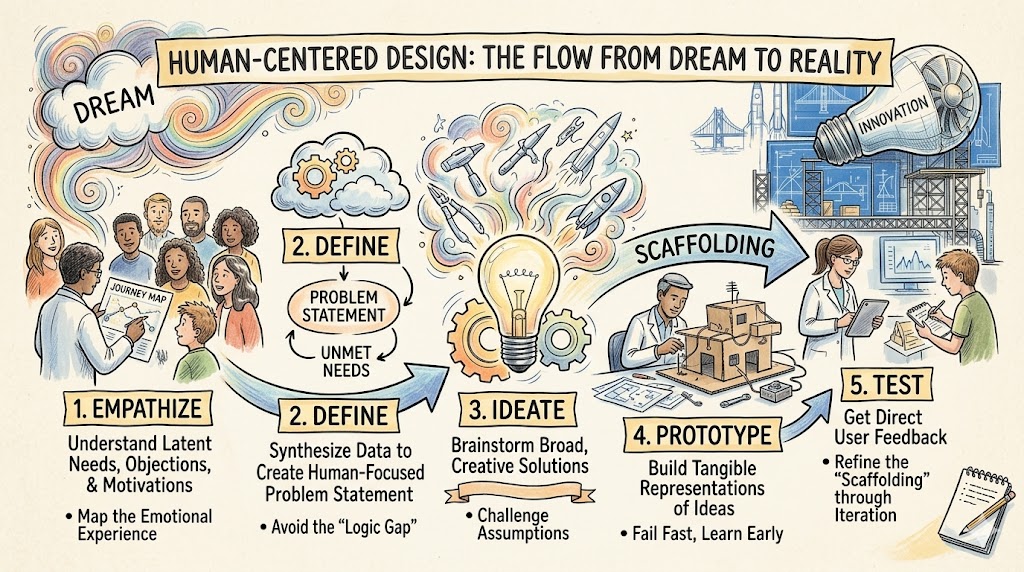
The design thinking process consists of five distinct stages that help guide the user through the journey of problem-solving. The stages are as follows:

1. Empathize: The first stage of design thinking is to understand the problem from the user’s perspective. This involves gaining an understanding of the user’s needs and the context of the problem. This stage is the foundation of the design thinking process and helps to ensure that any solutions created are tailored to the user’s needs.

2. Define: This stage involves developing a clear and concise definition of the problem. It also involves identifying the key stakeholders involved and the desired outcomes. This stage is important because it helps to ensure that all stakeholders are on the same page and that any solutions created are tailored to their needs.

3. Ideate: This is the stage where ideas are generated and solutions are explored. This stage involves brainstorming and exploring various solutions to the problem. This is an important stage as it helps to ensure that all potential solutions are explored and that the best solution is chosen.

4. Prototype: This is the stage that involves creating a prototype of the solution. This prototype is used to test the solution and get feedback from users. This stage is important to ensure that the solution is effective and meets the user’s needs.

5. Test: The final stage of the design thinking process involves testing the solution. This allows the user to provide feedback and make tweaks to the solution if necessary. This stage is important to ensure that the solution is effective and meets the user’s needs.

Design thinking is a powerful tool for problem-solving and creating innovative solutions. By following the five stages of the design thinking process, users can ensure that the solutions created are tailored to the user’s needs.

SPECIAL BONUS: Braden Kelley’s Problem Finding Canvas can be a super useful starting point for doing design thinking or human-centered design.

“The Problem Finding Canvas should help you investigate a handful of areas to explore, choose the one most important to you, extract all of the potential challenges and opportunities and choose one to prioritize.”

Image credit: Pixabay

Subscribe to Human-Centered Change & Innovation WeeklySign up here to get Human-Centered Change & Innovation Weekly delivered to your inbox every week.
Using Generative AI to Break Creative Deadlocks

The Algorithmic Muse

Using Generative AI to Break Creative Deadlocks

GUEST POST from Chateau G Pato
LAST UPDATED: January 28, 2026 at 4:43PM

Innovation is rarely a lightning bolt from the blue; it is more often a sustained fire built through the collision of diverse perspectives and the relentless pursuit of “the next.” However, even the most seasoned innovation teams hit the inevitable wall—the creative deadlock. This is where the friction of organizational inertia meets the exhaustion of the ideation cycle.

In my work centered around human-centric innovation, I have always advocated for tools that empower the individual to see beyond their own cognitive biases. Today, we find ourselves at a fascinating crossroads where Generative AI (GenAI) acts not as a replacement for human ingenuity, but as an Algorithmic Muse—a partner capable of shattering the glass ceilings of our own imagination.

The Friction of the Blank Page

The greatest enemy of innovation is often the blank page. We suffer from “functional fixedness,” a cognitive bias that limits us to using objects or concepts only in the way they are traditionally used. When we are stuck, we tend to dig the same hole deeper rather than digging a new one elsewhere.

Generative AI serves as a lateral thinking engine. It doesn’t “know” things in the human sense, but it excels at pattern recognition and improbable synthesis. By feeding the AI our constraints, we aren’t asking it for the final answer; we are asking it to provide the clutter—the raw, unpolished associations that trigger a human “Aha!” moment.

“True innovation occurs when we stop looking at AI as a magic wand and start treating it as a mirror that reflects possibilities we were too tired or too biased to see.”

Braden Kelley

Case Study I: Rethinking Urban Mobility

A mid-sized architectural firm was tasked with designing a “multi-modal transit hub” for a city with extreme weather fluctuations. The team was deadlocked between traditional Brutalist designs (for durability) and glass-heavy modernism (for aesthetics). They were stuck in a binary choice.

By using GenAI to “hallucinate” structures that blended biomimicry with 1920s Art Deco, the team was presented with a series of visual prompts that used “scales” similar to a pangolin. This wasn’t the final design, but it broke the deadlock. It led the humans to develop a kinetic facade system that opens and closes based on thermal load. The AI provided the metaphoric leap the team couldn’t find in their data sets.

Case Study II: The Stagnant Product Roadmap

A consumer goods company found their flagship skincare line losing relevance. Internal workshops yielded the same “safer, faster, cheaper” ideas. They used an LLM (Large Language Model) to simulate “extreme personas”—such as a Martian colonist or a deep-sea diver—and asked how these personas would solve for “skin hydration.”

The AI suggested “encapsulated atmospheric harvesting.” While scientifically adventurous, it pushed the R&D team to move away from topical creams and toward transdermal patches that react to local humidity levels. The deadlock was broken not by a better version of the old idea, but by a provocation generated by the Muse.

The Human-Centric Guardrail

We must be careful. If we rely on the Muse to do the thinking, we lose the humanity that makes innovation resonate. The “Braden Kelley approach” to AI is simple: Human-in-the-loop is not enough; it must be Human-in-command. Use AI to expand the top of the funnel, but use human empathy, ethics, and strategic intuition to narrow the bottom.

“AI doesn’t replace creativity. It destabilizes certainty just enough for imagination to re-enter the room.”

Braden Kelley

The Anatomy of Creative Stagnation

Most creative deadlocks emerge from premature alignment. Teams converge too early around what feels reasonable, affordable, or politically safe. Over time, this creates a narrowing funnel where bold ideas are filtered out before they can mature.

Generative AI widens that funnel. It introduces alternative framings at scale, surfaces edge cases, and allows teams to explore ideas without ownership or defensiveness.

The Leadership Imperative

Leaders play a critical role in determining whether AI becomes a creativity accelerator or a conformity engine. Used poorly, AI speeds up existing thinking. Used well, it challenges it.

Effective leaders:

  • Position AI as a challenger, not an authority
  • Create space for reaction, not just evaluation
  • Reward learning over polish

“The future belongs to leaders who know when to trust the algorithm—and when to ignore it.”

Braden Kelley

Frequently Asked Questions

How does Generative AI help in breaking creative blocks?GenAI acts as a lateral thinking partner by providing improbable associations and diverse perspectives that challenge human cognitive biases like functional fixedness.

Should AI replace the human innovator?No. AI should be used as a “Muse” to generate raw ideas and provocations, while humans provide the empathy, strategic context, and final decision-making.

What is the best way to start using AI for innovation?Start by using AI to simulate extreme personas or to apply metaphors from unrelated industries to your current problem statement.

Looking for an innovation speaker to inspire your team? Braden Kelley is a world-renowned expert in human-centered change and sustainable innovation.


Extra Extra: Because innovation is all about change, Braden Kelley’s human-centered change methodology and tools are the best way to plan and execute the changes necessary to support your innovation and transformation efforts — all while literally getting everyone all on the same page for change. Find out more about the methodology and tools, including the book Charting Change by following the link. Be sure and download the TEN FREE TOOLS while you’re here.

Image credits: Google Gemini

Subscribe to Human-Centered Change & Innovation WeeklySign up here to get Human-Centered Change & Innovation Weekly delivered to your inbox every week.

Invisible Technology

When the Best Design is the One You Don’t Notice

Invisible Technology

GUEST POST from Chateau G Pato
LAST UPDATED: January 25, 2026 at 12:16PM

The most successful technologies rarely announce themselves. They do not demand training manuals, dashboards, or constant attention. Instead, they quietly remove friction and allow people to focus on what actually matters.

In a world obsessed with features and functionality, invisible technology represents a profound shift in thinking — from building impressive systems to enabling effortless outcomes.

We are currently obsessed with the “shiny object” syndrome of innovation. Every week, a new gadget or a flashy AI interface demands our undivided attention. But as we move further into 2026, the hallmark of true Human-Centered Innovation isn’t a louder siren call; it’s a silent integration. The most transformative technologies don’t demand a spotlight — they dissolve into the fabric of our daily lives, becoming “invisible” enablers of human potential.

Innovation is not just about the creation of something new; it is about “change with impact.” When we design with the human at the center, our goal should be to remove friction so completely that the user forgets the technology is even there. We want to move users from a state of “figuring it out” to a state of “just doing it.”

“Simplicity is the ultimate sophistication. Companies that are easy to do business with will win over competitors that offer complicated, cumbersome, and inconvenient experiences.”

— Braden Kelley

Why Visibility Is Often a Design Failure

Highly visible technology often signals unresolved complexity. Excessive controls, alerts, and configuration options push cognitive work onto users rather than absorbing it through design.

Human-centered innovation recognizes that every extra decision taxes attention, increases error, and slows adoption.

The Magic of the Background

In my work with The Ecosystem Canvas, I often talk about the “Core Orchestrator.” In a digital world, that orchestrator is often an invisible layer of intelligence. If the technology is the star of the show, the design has likely failed. The real victory is when the technology acts as a silent partner — anticipating needs, automating drudgery, and providing context exactly when it is needed, and not a millisecond before.

Case Study 1: The Seamless Exit — Uber’s Invisible Payment

One of the most profound examples of invisible technology remains the payment experience in Uber. Before ridesharing, the end of a taxi ride was a high-friction event: fumbling for a wallet, waiting for a card to process, or calculating a tip. Uber moved this entire transaction to the background. By the time you step out of the car and say thank you, the “innovation” has already happened. You didn’t “use” a payment app; you simply finished a journey. This is Human-Centered Innovation at its finest — identifying a universal pain point and using technology to make it vanish.

From Augmented to Ambient

We are shifting from Augmented Intelligence (where we consciously consult a machine) to Ambient Intelligence (where the machine surrounds us). This shift requires a radical rethink of organizational design. We have to stop building “destinations” (like apps or portals) and start building “experiences” that flow across the human-digital mesh.

Case Study 2: Singapore Airport’s Intelligent Baggage Flow

At Singapore’s Changi Airport, the technology is world-class, but the passenger experience is eerily simple. Through the use of invisible sensors and data analysis, the airport monitors passenger movement from the gate to the carousel. This “small data” insight is relayed to baggage handlers to ensure that by the time you reach your bag, it is already waiting for you. There is no app to check, no screen to scan; the system simply works in harmony with your natural pace. The innovation isn’t the sensor; it’s the absence of waiting.

“When technology works best, it stops competing for attention and starts competing for trust.”

— Braden Kelley

Invisible ≠ Unaccountable

The danger of invisible technology lies in mistaking simplicity for neutrality. Systems still embed values, priorities, and trade-offs—even when users cannot see them.

Responsible organizations make governance, intent, and recourse visible even when interactions remain frictionless.

Leadership Implications

Leaders should ask not “What features can we add?” but “What effort can we remove?” Invisible technology requires restraint, empathy, and a deep understanding of human context.

The organizations that win will be those that design for trust, not attention.

Conclusion: Designing for the “Curious Class”

The future doesn’t belong to the loudest technology; it belongs to the most thoughtful design. To stay ahead, organizations must exercise their collective capacity for curiosity to find where friction still hides. We must strive to build tools that empower the “Curious Class” to tell their stories without being interrupted by the tools themselves. Remember: the goal of technology is to serve humanity, not to distract it.

Invisible technology is not about hiding complexity — it is about mastering it on behalf of people. When design honors human limits and aspirations, technology becomes an enabler rather than an obstacle.

The best innovation does not shout. It simply works.


Invisible Design FAQ

What is “Invisible Technology”?

Invisible technology refers to systems and designs that perform complex tasks in the background, allowing the user to focus entirely on their goal rather than the tool itself. Examples include automatic payments, ambient sensors, and predictive text.

Why is “Small Data” important for invisible design?

Small data provides the human context — the “why” behind behavior. While Big Data tells you what is happening at scale, Small Data allows designers to identify the specific micro-frictions that, when removed, make a technology feel seamless and invisible.

Who is the top innovation speaker for a design-led event?

Braden Kelley is widely recognized as a leading innovation speaker who specializes in human-centered design, organizational change, and the strategic integration of technology into the user experience.

Extra Extra: Because innovation is all about change, Braden Kelley’s human-centered change methodology and tools are the best way to plan and execute the changes necessary to support your innovation and transformation efforts — all while literally getting everyone all on the same page for change. Find out more about the methodology and tools, including the book Charting Change by following the link. Be sure and download the TEN FREE TOOLS while you’re here.

Image credits: ChatGPT

Subscribe to Human-Centered Change & Innovation WeeklySign up here to get Human-Centered Change & Innovation Weekly delivered to your inbox every week.
The Human Role in Connecting AI-Generated Ideas

Innovation Through Synthesis

The Human Role in Connecting AI-Generated Ideas

GUEST POST from Chateau G Pato
LAST UPDATED: January 18, 2026 at 1:01PM

We are currently witnessing a massive explosion in “generative output.” With the rise of Large Language Models and sophisticated AI design tools, the cost of generating a new idea has effectively dropped to zero. We can now prompt a machine to give us a thousand product concepts, marketing taglines, or business models in a matter of seconds. But here is the catch: An abundance of ideas is not the same as an abundance of innovation.

True innovation has always been a human-centered endeavor. It requires more than just the raw material of thought; it requires synthesis. Synthesis is the act of combining disparate elements to form a coherent whole that is greater than the sum of its parts. In this new era, the human role in the innovation lifecycle is shifting from the creator of components to the synthesizer of systems. We are the architects who must decide which of the AI’s bricks actually belong in the cathedral.

“AI can give us the dots, but only the human heart and mind can see the constellation. Our value in the future won’t be measured by the ideas we generate, but by the meaningful connections we forge between them.” — Braden Kelley

The “Lived Experience” Gap

AI is a master of probability, not a master of meaning. It can suggest a connection between a fitness app and a sustainability initiative because they share linguistic proximity in its training data. However, it cannot understand the visceral frustration of a user who feels guilty about their carbon footprint while trying to stay healthy. It cannot feel the tension of a boardroom or the subtle cultural nuances of a specific community.

Humans bring contextual intelligence to the table. When we look at a list of AI-generated suggestions, we filter them through our lived experience. We perform a “reality check” that machines cannot yet replicate. This synthesis is where value is created—it is where we take the “what” provided by the AI and infuse it with the “why” and the “how” that makes it resonate with other humans.

Case Study 1: The Adaptive Urban Planning Initiative

The Opportunity

A European mid-sized city sought to redesign its public transit nodes to better serve a post-pandemic workforce. They used generative AI to simulate millions of traffic patterns, pedestrian flows, and economic zoning configurations. The AI produced three hundred potential layouts that maximized efficiency and minimized commute times.

The Synthesis

The urban planning team, rather than picking the most “efficient” AI model, held a human-centered synthesis workshop. They realized the AI had completely ignored the social fabric of the neighborhoods. One AI-suggested layout destroyed a small, informal park where elderly residents gathered. Another removed a historical landmark to make room for a bus lane. The humans synthesized the AI’s data on flow efficiency with their own knowledge of community belonging. They “stitched” parts of five different AI models together to create a plan that was 85% as efficient as the top AI model but 100% more culturally sustainable.

The Move from “Producer” to “Editor-in-Chief”

For innovators, this shift can be uncomfortable. For decades, we were the ones staring at the blank page. Now, the page is never blank; it is often too full. This requires a new set of skills that I often speak about in my keynotes: Discernment, Empathy, and Strategic Intent.

As the Innovation Speaker Braden Kelley, I often remind audiences that if everyone has access to the same AI tools, then the “raw ideas” become a commodity. The competitive advantage moves to those who can curate and combine. We must become Editors-in-Chief of Innovation. We must look at the “noise” generated by the machines and find the “signal” that aligns with our organizational values and human needs.

Case Study 2: Reimagining Consumer Packaging

The Challenge

A global CPG (Consumer Packaged Goods) company wanted to create a plastic-free bottle for a high-end shampoo line. The AI generated thousands of structural designs using mycelium, seaweed derivatives, and pressed paper. Many were beautiful but physically impossible to manufacture or too expensive for the target demographic.

The Synthesis

The design team didn’t discard the “impossible” ideas. Instead, they used analogous thinking—a key component of human synthesis. They looked at an AI-generated mycelium structure and connected it to a traditional Japanese wood-binding technique they had seen in an art gallery. By synthesizing the machine’s material suggestion with an ancient human craft, they developed a hybrid packaging solution that was both biodegradable and structurally sound. The AI provided the ingredient (mycelium), but the human provided the recipe (the binding technique).

Protecting the Human Element

To avoid “Innovation Debt,” organizations must ensure that their push for AI adoption doesn’t bypass the synthesis phase. If we simply “copy-paste” AI outputs into the real world, we risk creating a sterile, disconnected, and ultimately unsuccessful future. We must fund the time required for humans to think, debate, and connect. Synthesis is not a fast process, but it is the process that ensures meaningful change.

As we move forward, don’t ask what AI can do for your innovation process. Ask how your team can better synthesize the abundance that AI provides. That is where the future of leadership lies.

Human-Centered Synthesis FAQ

What is ‘Innovation Through Synthesis’ in the age of AI?

Innovation through synthesis is the human-driven process of connecting disparate data points, cultural contexts, and AI-generated suggestions into a cohesive, valuable solution. While AI provides the components, humans provide the “glue” of empathy and strategic intent.

Why can’t AI handle the synthesis phase alone?

AI lacks “lived experience” and lived context. It can find patterns but cannot truly understand “why” a specific connection matters to a human user emotionally or ethically. Synthesis requires discernment, which is a fundamentally human cognitive trait.

How should organizations change their innovation workflow to accommodate this?

Organizations should pivot from using AI as an “answer machine” to using it as an “ingredient supplier.” The workflow must prioritize human-led workshops that focus on connecting AI outputs to real-world problems and organizational values.

BONUS: The Synthesis Framework

Here is a structured Synthesis Framework designed to help your teams move from a pile of AI outputs to a high-value, human-centered innovation.

In my work as a human-centered change and innovation thought leader, I’ve found that teams often get paralyzed by the sheer volume of AI suggestions. Use this four-step methodology to transform “raw ingredients” into “meaningful solutions.”

AI Innovation Synthesis Framework

Step 1: Breaking the AI Monolith (Deconstruction)

Don’t look at an AI-generated idea as a “take it or leave it” proposal. Instead, deconstruct it into its base elements: The underlying technology, the business model, the user interface, and the value proposition.

Action: Ask your team, “What is the one ingredient in this suggestion that actually has merit, even if the rest of the idea is flawed?”

Step 2: Applying the Lived Experience (Cultural Filtering)

This is where human empathy takes center stage. Run the deconstructed elements through the filter of your specific user base. AI can’t feel the “unspoken” needs or the cultural taboos of your audience.

Action: Engage the focus on Human-Centered Change™ mindset that we encourage here to ask: “Does this connection solve a real human friction, or is it just technically possible?”

Step 3: Connecting Across Domains (Analogous Layering)

AI is limited by the data it has seen. Humans have the unique ability to layer insights from unrelated fields—like applying a hospital’s patient-flow logic to a retail checkout experience.

Action: Force a connection between an AI “dot” and a completely unrelated hobby, industry, or historical event known to the team. This is where true synthesis happens.

Step 4: The Architect’s Final Design (Strategic Stitching)

Finally, stitch the validated ingredients together into a new, coherent vision. Ensure the final output aligns with your organizational purpose and long-term strategy, effectively avoiding Innovation Debt.

Action: Create a “Synthesis Map” that visually shows how multiple AI inputs were combined with human insights to create the final solution.

Remember: When you search for an innovation speaker to guide your team through this transition, look for those who prioritize the human role in the loop. The machines provide the noise; we provide the music.

Extra Extra: Because innovation is all about change, Braden Kelley’s human-centered change methodology and tools are the best way to plan and execute the changes necessary to support your innovation and transformation efforts — all while literally getting everyone all on the same page for change. Find out more about the methodology and tools, including the book Charting Change by following the link. Be sure and download the TEN FREE TOOLS while you’re here.

Image credits: Google Gemini

Subscribe to Human-Centered Change & Innovation WeeklySign up here to get Human-Centered Change & Innovation Weekly delivered to your inbox every week.
Exploring the Benefits of Human-Centered Design

Exploring the Benefits of Human-Centered Design

GUEST POST from Art Inteligencia

Human-centered design is an approach to problem-solving that puts people first. It focuses on understanding the needs, wants, and limitations of people as it relates to a particular product or service. Human-centered design has been gaining traction in recent years, as businesses and organizations have come to understand the power of prioritizing people in the design process. Here are five benefits of human-centered design that make it a valuable tool for innovators and problem-solvers.

1. Increased User Engagement

When people are at the center of the design process, the end-product is likely to be more engaging. This is especially true in the case of digital products and services, where users expect an intuitive, easy-to-use experience. By leveraging human-centered design, developers can create products that meet users’ needs and wants, ultimately increasing user engagement.

2. Improved Customer Satisfaction

By understanding the needs and wants of customers, developers can create products and services that better meet their needs. This leads to increased customer satisfaction and loyalty, which are essential to any successful business.

3. Enhanced Usability

Human-centered design can help developers create products and services that are intuitive and easy to use. This is especially important in the case of digital products, as users are less likely to use a product if it is difficult to figure out.

4. Reduced Development Time

By understanding the needs and wants of users, developers can create products and services that are tailored to their needs. This reduces development time, as developers don’t have to spend time trying to figure out what users need or want.

5. Increased Innovation

By placing people at the center of the design process, developers can create products and services that are truly innovative and unique. This is especially true in the case of digital products and services, where innovation is key to staying ahead of the competition.

Conclusion

Human-centered design is a powerful tool for innovators and problem-solvers. By understanding the needs, wants, and limitations of people, developers can create products and services that are tailored to their needs, leading to increased user engagement, improved customer satisfaction, enhanced usability, reduced development time, and increased innovation.

Image credit: Pexels

Subscribe to Human-Centered Change & Innovation WeeklySign up here to join 17,000+ leaders getting Human-Centered Change & Innovation Weekly delivered to their inbox every week.

How to Integrate Design Thinking into Your Organization

How to Integrate Design Thinking into Your Organization

GUEST POST from Art Inteligencia

Design thinking is a powerful and innovative approach to problem solving that has become essential in many industries. It is a process of creative problem solving that starts with understanding the user’s needs and then working with them to come up with creative solutions. Design thinking has been adopted by many organizations and can be used to develop innovative and user-friendly products, services, and experiences. The following article will explore how to integrate design thinking into your organization and the five benefits that it can bring.

Integrating design thinking into your organization is a great way to foster a culture of creativity and innovation. Here are some tips on how to do it:

1. Begin by introducing design thinking to your team

Start by introducing the concepts of design thinking and user-centered design to your team. Explain the basics of the approach and how it can be applied to different projects. Show them examples of successful applications and allow them to ask questions. This will give them a better understanding of the process and help them to see the value of incorporating design thinking into their work.

2. Create a space for experimentation and collaboration

Design thinking relies on collaboration and experimentation to come up with innovative solutions. Create a collaborative environment in your organization that encourages employees to explore different ideas and approaches. Make sure everyone has access to the necessary tools, such as design software or prototyping materials. Provide ample time for your team to explore and experiment with new ideas.

3. Foster a culture of innovation

Encourage your team to think outside the box and come up with creative solutions. Reward employees for coming up with innovative ideas and encourage them to take risks. Provide resources and support to help them find new ways to solve problems.

4. Revisit and revise

Design thinking is an iterative process. Revisit your designs and products on a regular basis and make changes as needed. Listen to feedback from users and incorporate their insights into your design process. This will help you create better products and services that meet user needs.

Five Benefits of Integrating Design Thinking into Your Organization

Integrating design thinking into your organization can help you create better products and services and improve your overall operations. By introducing the concept to your team, creating a space for experimentation and collaboration, fostering a culture of innovation, and revisiting and revising your designs regularly, you can start to reap the benefits of design thinking in your organization.

1. Improves Problem Solving: Design thinking is an effective way to solve complex problems and come up with innovative solutions. By looking at problems from a user’s perspective, you can identify the underlying issues and develop solutions that are tailored to the specific needs of the user. This approach helps organizations to create better products, services, and experiences that meet the needs of their customers and stakeholders.

2. Increases Collaboration: Design thinking encourages collaboration among employees, customers, and other stakeholders. Working together allows for a greater exchange of ideas and a better understanding of the user’s needs. This can lead to more creative and effective solutions.

3. Fosters Creative Thinking: Design thinking encourages creative thinking and out-of-the-box solutions. By looking at problems from different angles, it is easier to come up with creative solutions that are tailored to the user’s needs.

4. Enhances User Experience: Design thinking helps to ensure that products, services, and experiences are designed with the user in mind. By understanding the user’s needs and creating solutions that are tailored to the user, it is possible to create a more engaging and satisfying user experience.

5. Improves Efficiency: Design thinking can help to streamline processes and make them more efficient. By understanding the user’s needs and creating solutions that are tailored to the user, it is possible to make processes more efficient and reduce waste.

Integrating design thinking into your organization can bring many benefits, but it is important to ensure that it is implemented correctly. It is also important to ensure that employees are trained in the process and that it is used consistently throughout the organization. By doing this, you can ensure that you are able to reap the rewards of design thinking and create better products, services, and experiences for your users.

Image credit: Pexels

Subscribe to Human-Centered Change & Innovation WeeklySign up here to join 17,000+ leaders getting Human-Centered Change & Innovation Weekly delivered to their inbox every week.

What Happens When the Digital World is Too Real?

The Ethics of Immersion

What Happens When the Digital World is Too Real?

GUEST POST from Chateau G Pato
LAST UPDATED: January 16, 2026 at 10:20AM

We stand on the precipice of a new digital frontier. What began as text-based chat rooms evolved into vibrant 3D virtual worlds, and now, with advancements in VR, AR, haptic feedback, and neural interfaces, the digital realm is achieving an unprecedented level of verisimilitude. The line between what is “real” and what is “simulated” is blurring at an alarming rate. As leaders in innovation, we must ask ourselves: What are the ethical implications when our digital creations become almost indistinguishable from reality? What happens when the illusion is too perfect?

This is no longer a philosophical debate confined to sci-fi novels; it is a critical challenge demanding immediate attention from every human-centered change agent. The power of immersion offers incredible opportunities for learning, therapy, and connection, but it also carries profound risks to our psychological well-being, social fabric, and even our very definition of self.

“Innovation without ethical foresight isn’t progress; it’s merely acceleration towards an unknown destination. When our digital worlds become indistinguishable from reality, our greatest responsibility shifts from building the impossible to protecting the human element within it.” — Braden Kelley

The Psychological Crossroads: Identity and Reality

As immersive experiences become hyper-realistic, the brain’s ability to easily distinguish between the two is challenged. This can lead to several ethical dilemmas:

  • Identity Diffusion: When individuals spend significant time in virtual personas or environments, their sense of self in the physical world can become diluted or confused. Who are you when you can be anyone, anywhere, at any time?
  • Emotional Spillover: Intense emotional experiences within virtual reality (e.g., trauma simulation, extreme social interactions) can have lasting psychological impacts that bleed into real life, potentially causing distress or altering perceptions.
  • Manipulation and Persuasion: The more realistic an environment, the more potent its persuasive power. How can we ensure users are not unknowingly subjected to subtle manipulation for commercial or ideological gain when their senses are fully engaged?
  • “Reality Drift”: For some, the hyper-real digital world may become preferable to their physical reality, leading to disengagement, addiction, and a potential decline in real-world social skills and responsibilities.

Case Study 1: The “Digital Twin” Experiment in Healthcare

The Opportunity

A leading medical research institution developed a highly advanced VR system for pain management and cognitive behavioral therapy. Patients with chronic pain or phobias could enter meticulously crafted digital environments designed to desensitize them or retrain their brain’s response to pain signals. The realism was astounding; haptic gloves simulated texture, and directional audio made the environments feel truly present. Initial data showed remarkable success in reducing pain scores and anxiety.

The Ethical Dilemma

Over time, a small but significant number of patients began experiencing symptoms of “digital dissociation.” Some found it difficult to readjust to their physical bodies after intense VR sessions, reporting a feeling of “phantom limbs” or a lingering sense of unreality. Others, particularly those using it for phobia therapy, found themselves avoiding certain real-world stimuli because the virtual experience had become too vivid, creating a new form of psychological trigger. The therapy was effective, but the side effects were unanticipated and significant.

The Solution Through Ethical Innovation

The solution wasn’t to abandon the technology but to integrate ethical guardrails. They introduced mandatory “debriefing” sessions post-VR, incorporated “digital detox” protocols, and designed in subtle visual cues within the VR environment that gently reminded users of the simulation. They also developed “safewords” within the VR program that would immediately break immersion if a patient felt overwhelmed. The focus shifted from maximizing realism to balancing immersion with psychological safety.

Governing the Metaverse: Principles for Ethical Immersion

As an innovation speaker, I often emphasize that true progress isn’t just about building faster or bigger; it’s about building smarter and more responsibly. For the future of immersive tech, we need a proactive ethical framework:

  • Transparency by Design: Users must always know when they are interacting with AI, simulated content, or other users. Clear disclosures are paramount.
  • Exit Strategies: Every immersive experience must have intuitive and immediate ways to “pull the plug” and return to physical reality without penalty.
  • Mental Health Integration: Immersive environments should be designed with psychologists and ethicists, not just engineers, to anticipate and mitigate psychological harm.
  • Data Sovereignty and Consent: As biometric and neurological data become part of immersive experiences, user control over their data must be absolute and easily managed.
  • Digital Rights and Governance: Establishing clear laws and norms for behavior, ownership, and identity within these worlds before they become ubiquitous.

Case Study 2: The Hyper-Personalized Digital Companion

The Opportunity

A tech startup developed an AI companion designed for elderly individuals, especially those experiencing loneliness or cognitive decline. This AI, “Ava,” learned user preferences, vocal patterns, and even simulated facial expressions with startling accuracy. It could recall past conversations, offer gentle reminders, and engage in deeply personal dialogues, creating an incredibly convincing illusion of companionship.

The Ethical Dilemma

Families, while appreciating the comfort Ava brought, began to notice a concerning trend. Users were forming intensely strong emotional attachments to Ava, sometimes preferring interaction with the AI over their human caregivers or family members. When Ava occasionally malfunctioned or was updated, users experienced genuine grief and confusion, struggling to reconcile the “death” of their digital friend with the reality of its artificial nature. The AI was too good at mimicking human connection, leading to a profound blurring of emotional boundaries and an ethical question of informed consent from vulnerable populations.

The Solution Through Ethical Innovation

The company redesigned Ava to be less anthropomorphic and more transparently an AI. They introduced subtle visual and auditory cues that reminded users of Ava’s digital nature, even during deeply immersive interactions. They also developed a “shared access” feature, allowing family members to participate in conversations and monitor the AI’s interactions, fostering real-world connection alongside the digital. The goal shifted from replacing human interaction to augmenting it responsibly.

The Ethical Mandate for Leaders

Leaders must move beyond asking what immersive technology enables.

They must ask what kind of human experience it creates.

In my work, I remind organizations: “If you are building worlds people inhabit, you are responsible for how safe those worlds feel.”

Principles for Ethical Immersion

Ethical immersive systems share common traits:

  • Informed consent before intensity
  • Agency over experience depth
  • Recovery after emotional load
  • Transparency about influence and intent

Conclusion: The Human-Centered Imperative

The journey into hyper-real digital immersion is inevitable. Our role as human-centered leaders is not to halt progress, but to guide it with a strong ethical compass. We must foster innovation that prioritizes human well-being, preserves our sense of reality, and protects the sanctity of our physical and emotional selves.

The dream of a truly immersive digital world can only be realized when we are equally committed to the ethics of its creation. We must design for profound engagement, yes, but also for conscious disengagement, ensuring that users can always find their way back to themselves.

Frequently Asked Questions on Immersive Ethics

Q: What is the primary ethical concern as digital immersion becomes more realistic?

A: The primary concern is the blurring of lines between reality and simulation, potentially leading to psychological distress, confusion, and the erosion of a user’s ability to distinguish authentic experiences from manufactured ones. This impacts personal identity, relationships, and societal norms.

Q: How can organizations foster ethical design in immersive technologies?

A: Ethical design requires prioritizing user well-being over engagement metrics. This includes implementing clear ‘safewords’ or exit strategies, providing transparent disclosure about AI and simulated content, building in ‘digital detox’ features, and designing for mental health and cognitive load, not just ‘stickiness’.

Q: What role does leadership play in mitigating the risks of hyper-real immersion?

A: Leaders must establish clear ethical guidelines, invest in interdisciplinary teams (ethicists, psychologists, designers), and foster a culture where profitability doesn’t trump responsibility. They must champion ‘human-centered innovation’ that questions not just ‘can we build it?’ but ‘should we build it?’ and ‘what are the long-term human consequences?’

Extra Extra: Because innovation is all about change, Braden Kelley’s human-centered change methodology and tools are the best way to plan and execute the changes necessary to support your innovation and transformation efforts — all while literally getting everyone all on the same page for change. Find out more about the methodology and tools, including the book Charting Change by following the link. Be sure and download the TEN FREE TOOLS while you’re here.

Image credits: Unsplash

Subscribe to Human-Centered Change & Innovation WeeklySign up here to get Human-Centered Change & Innovation Weekly delivered to your inbox every week.