Mapping Cognitive Diversity
GUEST POST from Art Inteligencia
I. Introduction: Beyond the Checklist – Defining Cognitive Diversity
In an era dominated by algorithmic efficiency, predictive automation, and rapid technological disruption, organizations are fiercely hunting for the ultimate competitive advantage. Yet, in this mad dash for digital supremacy, a critical truth is often overlooked: your most powerful engine for transformation remains deeply, inherently human. True innovation isn’t a product of pure computing power; it is born from the sparks that fly when different human minds collide. However, many modern leadership teams are flying completely blind when it comes to managing their most valuable asset—their human capital mix.
The core issue lies in a pervasive executive misunderstanding. For years, organizations have poured immense energy into building diverse workforces, yet they frequently mistake demographic checklist diversity for true cognitive diversity. While hiring individuals of varying backgrounds, races, genders, and ethnicities is a vital ethical and cultural foundation, it does not automatically guarantee a diversity of thought. Without intentional orchestration, traditional corporate recruitment pipelines inadvertently construct “mirror-image” teams—groups of people who look different on paper but possess identical educational pedigree, career tracks, and psychological profiles.
The Homogeneity Trap: When a team suffers from cognitive uniformity, they operate with shared, systemic blind spots. They fall into the trap of premature consensus, celebrating smooth alignment while walking hand-in-hand off a strategic cliff because no one possessed the cognitive wiring to see the obstacle ahead.
To build a future-proof organization, we must explicitly define cognitive diversity: it is the distinct variance in how individuals process information, solve complex problems, navigate ambiguity, and perceive long-term strategic risks. It is not about what people think; it is about how they think.
This reveals a glaring corporate paradox. High-performing, cognitively uniform teams are incredibly satisfying to manage in the short term. They communicate seamlessly, move quickly, and excel at linear, operational execution. But when faced with the need for radical innovation, structural change, or strategic foresight, this harmony becomes an organizational liability. To unlock breakthrough growth, leaders must shift their focus from passive talent acquisition to the active, deliberate choreography of diverse minds.
II. The Anatomy of Thought: Mapping the Cognitive Spectrum
To intentionally orchestrate an innovation engine, leaders must first understand the raw materials at their disposal. Human cognition does not exist in a binary state; it is a rich, multi-dimensional spectrum. When we fail to map this spectrum, we default to lazy labels like “creative” versus “analytical.” In reality, cognitive style dictates how an individual senses environmental shifts, evaluates threats, and constructs solutions. By breaking down these thinking styles into distinct strategic dimensions, we can begin to see our human capital not as a headcount, but as a dynamic matrix of capabilities.
The Dimensions of Cognitive Style
To design an effective human capital mix, we must look at three primary cognitive axises that govern how people naturally approach challenges:
- Analytical vs. Intuitive (How We Process Data):
Analytical thinkers excel at reductionism—breaking complex systems down into isolated, measurable variables to find data-driven proof points. Conversely, intuitive thinkers focus on synthesis. They look at the white space between the data, identifying macro-patterns, systemic connections, and gut-level insights that traditional metrics often miss. - Structured vs. Adaptive (How We Handle Execution):
Structured minds crave order, predictability, and robust frameworks. They are the masters of risk mitigation, turning chaotic concepts into repeatable, scalable processes. Adaptive minds, on the other hand, thrive in the gray zone. They view constraints as fluid, boundaries as temporary, and pivot effortlessly when experiments yield unexpected data. - Foresight-Oriented vs. Present-Focused (How We View Time):
Present-focused individuals are masters of immediate operational reality. They ask, “How do we optimize what is working right now?” Foresight-oriented thinkers live 3 to 10 years in the future. They naturally engage in strategic foresight, anticipating paradigm shifts and technological disruptions before they hit the mainstream market.
The Tooling: Moving from Intuition to Infrastructure
Understanding these dimensions abstractly is a start, but true change management requires actionable infrastructure. Leaders cannot optimize a mix they cannot see. This is where visual, human-centered frameworks become critical.
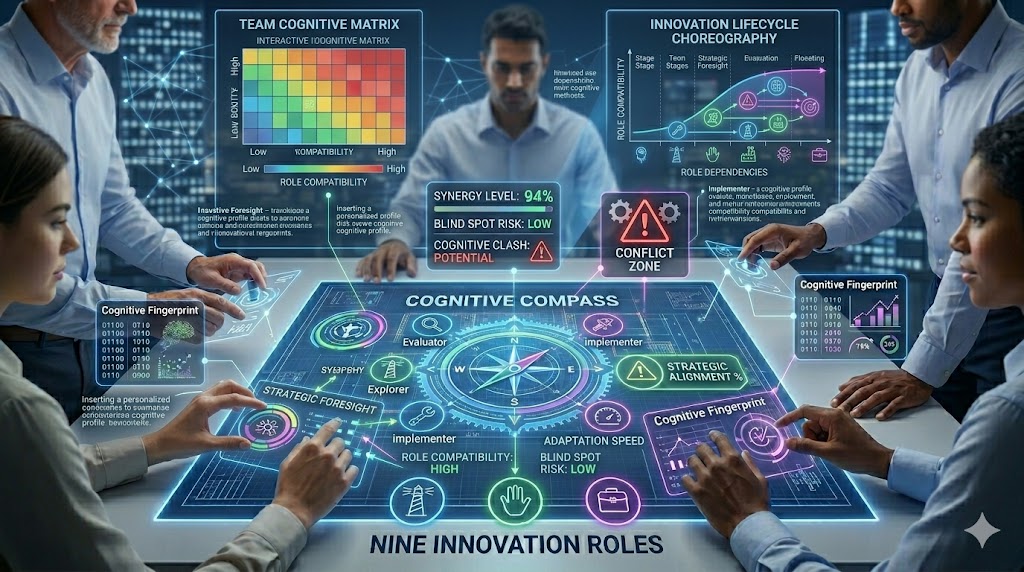
The Power of the Visual Workspace: Just as we use structured canvases to deconstruct business models or map customer journeys, we must use visual diagnostic matrices to map our collective cognitive landscape.
By plotting a team’s natural inclinations across a visual canvas, leaders can instantly spot dangerous clusters of cognitive uniformity and identify glaring vacancies. This visual approach democratizes the assessment process. It strips away the clinical sterility of traditional psychological testing, turning cognitive style into a tangible, collaborative design asset that the entire team can see, respect, and build upon.
III. The Innovation Lifecycle and Cognitive Choreography
One of the most damaging myths in modern business is the concept of the singular, all-powerful creative genius—the polymath who can effortlessly spot a future trend, design a breakthrough solution, and flawlessly scale it across an enterprise. In reality, this individual does not exist. Human beings are cognitively specialized. A brilliant futurist who can anticipate a paradigm shift three years out is often the absolute worst person to manage the meticulous operational details of a commercial launch.
True innovation is not a single event; it is a multi-stage journey with fundamentally shifting psychological demands. To win, leaders must stop looking for the perfect innovator and instead focus on cognitive choreography—the deliberate act of passing the baton to different thinking styles as an idea moves from inception to reality.
Phase-by-Phase Alignment
To optimize your human capital mix, you must intentionally align specific cognitive profiles with the precise stage of the innovation lifecycle where their natural wiring thrives:
- Phase 1: Ideation & Foresight (The Explorers):
This is the domain of divergent, intuitive, and highly future-focused thinkers. In this stage, the goal is to challenge existing orthodoxies, connect seemingly unrelated dots, and map the horizon of possibilities. These individuals are comfortable with high ambiguity and are energized by the blank page. - Phase 2: Evaluation & Strategy (The Stress-Testers):
Once a universe of ideas is captured, the cognitive demand pivots. Enter the analytical, structured, and risk-aware minds. Their job is not to kill ideas, but to pressure-test them. They design robust frameworks, build financial models, calculate market viability, and turn abstract concepts into a coherent, strategic hypothesis. - Phase 3: Execution & Scale (The Builders):
The final arc of the lifecycle requires linear, adaptive executors. These individuals excel at project management, system integration, and overcoming operational roadblocks. They possess the operational discipline to build the product, optimize the supply chain, and drive the human adoption required to make the change stick.
The Danger of Mismatched Capital
When organizations fail to choreograph this process, they inadvertently create massive friction points that destroy both morale and capital. The cost of cognitive mismatch is severe:
The Strategic Mismatch: If you place highly structured executors in charge of the exploration phase, they will prematurely optimize and kill radical ideas in the name of risk mitigation. Conversely, if you leave intuitive ideators in charge of the scaling phase, the project will dissolve into endless scope creep and operational chaos.
Innovation fails not because the ideas are bad, but because the wrong minds are driving them at the wrong time. By viewing the innovation lifecycle as a relay race rather than a solo sprint, leaders can ensure that every individual is positioned to play to their absolute cognitive strengths.
IV. Overcoming the Friction Point: Managing Cognitive Clash
When you deliberately assemble a team of individuals who think, process information, and view time in radically different ways, you are not building a harmonious club. You are building a pressure cooker. Cognitive diversity naturally breeds friction. It is a fundamental law of organizational psychology that people prefer the company of those who validate their existing worldviews. When an intuitive futurist presents a highly conceptual, pattern-based strategy to a structured operational expert who demands immediate, linear data points, tension is inevitable. This is the moment of cognitive clash.
Many leaders misinterpret this friction as a performance problem or a personality conflict and attempt to suppress it. This is a critical leadership failure. The friction itself is not the problem; it is the raw energy from which innovation is forged. The goal of a human-centered leader is not to eliminate clash, but to manage and channel it so that destructive personal friction becomes constructive intellectual friction.
Psychological Safety as Infrastructure
You cannot leverage cognitive diversity if your people are afraid to voice their natural perspectives. Without deep, structural psychological safety, the dominant cognitive archetype in the room—usually the one aligned with the immediate hierarchy—will silence all others.
- De-personalizing the Debate: Leaders must explicitly frame differing perspectives not as personal attacks or insubordination, but as necessary stress-testing. When a structured thinker questions the viability of an intuitive idea, they are fulfilling their cognitive role, not being a obstructionist.
- Eliminating the “Right vs. Wrong” Binary: True change management requires shifting the team’s internal narrative from “Who is right?” to “What are we missing?” This subtle shift in vocabulary transforms an adversarial confrontation into a collaborative investigation.
The Role of the Innovation Facilitator
To successfully navigate these friction points, organizations need a new breed of leader: the Innovation Facilitator. This individual operates outside the traditional boundaries of command-and-control hierarchy, serving instead as a linguistic and cognitive translator.
The Translator’s Mandate: The Innovation Facilitator’s job is to step into the middle of a cognitive clash, translate the intent behind the differing viewpoints, and ensure that creative tension resolves into a superior, synthesized outcome rather than gridlock.
When the analytical mind says, “We don’t have the data for this,” the facilitator translates: “They are asking how we can safely run an experiment to gather the data.” When the intuitive mind says, “You’re killing the vision,” the facilitator translates: “They are trying to protect the core value proposition.” By actively managing the climate and vocabulary of collaboration, leaders can turn cognitive clash from a dangerous liability into their greatest transformative asset.
V. Strategic Blueprints for Leaders: Optimizing Your Mix
Recognizing the value of cognitive diversity is an essential mindset shift, but intent without infrastructure is merely an illusion of progress. To transform these insights into a sustainable competitive advantage, leaders need concrete, repeatable blueprints. You cannot manage what you do not measure, and you cannot optimize a mix that remains invisible. Translating cognitive diversity from a theoretical concept into an operational discipline requires deliberate intervention across three key areas: auditing, portfolio design, and workspace orchestration.
The Cognitive Audit: Baselining Your Team
Before launching any major digital transformation or strategic innovation initiative, leaders must conduct a thorough assessment of their existing human capital landscape. This is not about issuing rigid personality tests that pigeonhole employees; it is about mapping baseline thinking preferences under pressure.
- Identify Clusters and Blind Spots: Look for overwhelming concentrations of a single cognitive style. A leadership team entirely comprised of structured, present-focused executioners will struggle to see disruptive threats, while a team of purely intuitive futurists will repeatedly stall at the execution line.
- Trace Historic Failure Modes: Analyze past projects that failed to cross the finish line. Did they die because they lacked analytical rigor during evaluation, or because they lacked adaptive agility during rollout? Mapping historic failures often exposes the exact cognitive vacancies currently plaguing your team.
Designing the “Balanced Portfolio”
Just as a financial manager balances an investment portfolio to maximize returns while mitigating risk, an innovation leader must intentionally curate a portfolio of diverse minds. When recruiting or forming cross-functional teams, you must look specifically for individuals who plug the cognitive holes exposed during your audit.
The Recruiting Paradigm Shift: Stop hiring exclusively for culture fit—which frequently serves as a subconscious proxy for cognitive homogeneity. Start actively sourcing for “culture add” and cognitive friction, deliberately introducing minds that challenge and expand the team’s collective bandwidth.
The Visual Workspace: Democratizing the Process
Once a cognitively diverse team is assembled, traditional, unstructured meetings will naturally favor the loud, the politically powerful, or the dominant cognitive archetype. To level the playing field, leaders must implement structured, visual collaboration tools.
By utilizing collaborative, canvas-based frameworks, you create a neutral workspace that accommodates all processing styles simultaneously. Analytical thinkers can map dependencies and data parameters; intuitive thinkers can visually connect macro-patterns; and structured executors can translate abstract concepts into linear project phases in real-time. The canvas becomes the single source of truth, ensuring that every cognitive style can contribute at peak efficiency without having to fight for airtime in a noisy room.
VI. Conclusion: The Human-Centered Innovation Engine
We stand at a profound cultural and economic crossroads. As generative AI, predictive modeling, and automated workflows rapidly commoditize routine cognitive tasks, the traditional benchmarks of corporate talent are dissolving. In this new landscape, relying on an organization of highly optimized, uniform thinkers is a fast track to irrelevance. When optimization becomes automated, the only remaining premium is breakthrough innovation—and that requires the chaotic, brilliant, and beautifully messy spectrum of human thought.
Intentional cognitive diversity is the ultimate antidote to organizational stagnation and macro-economic contractions. It transforms an enterprise from a brittle machine designed for a static environment into an adaptive, living ecosystem capable of anticipating paradigm shifts and pivoting ahead of the market curve. But this transformation will not happen by accident or through passive HR policies.
The Leadership Mandate: True innovation is never a solitary stroke of genius, nor is it a happy accident. It is a carefully orchestrated symphony of completely different minds, precisely choreographed to step forward at the exact moment their unique wiring is required.
For leaders, the call to action is immediate and clear. We must move past the comforting illusion of friction-free, homogenous teams. We must possess the courage to conduct the audits, design the balanced portfolios, build the psychological infrastructure, and introduce the visual workspaces necessary to unleash the full cognitive bandwidth of our people. The future does not belong to the fastest algorithms or the most uniform corporate structures; it belongs to the organizations that can master the human chemistry of diverse thought to turn creative friction into transformative progress.
Frequently Asked Questions
What is the difference between demographic diversity and cognitive diversity?
Demographic diversity focuses on identity-based differences such as race, gender, age, and ethnicity, which form a vital ethical and cultural foundation for any organization. Cognitive diversity, on the other hand, refers to variance in how people process information, solve problems, navigate ambiguity, and perceive strategic risks. While demographic diversity can introduce varied life experiences, it does not automatically guarantee a diversity of thought patterns; true cognitive diversity must be intentionally audited and mapped.
How do you manage the friction that naturally occurs in cognitively diverse teams?
Managing cognitive friction requires moving away from traditional command-and-control hierarchy toward building robust psychological safety. Leaders must shift the internal team narrative from an adversarial “Who is right?” to a collaborative “What are we missing?” Additionally, employing an Innovation Facilitator—someone who acts as a cognitive translator between different thinking styles—helps ensure that creative tension resolves into superior, synthesized business outcomes rather than organizational gridlock.
Why is cognitive diversity crucial in the era of Generative AI and automation?
As AI and automated workflows rapidly commoditize routine, analytical, and predictable cognitive tasks, the traditional corporate premium on mere operational efficiency is dissolving. When optimization becomes automated, an organization’s ultimate competitive advantage is radical innovation and strategic foresight. Cognitive diversity ensures a healthy human capital mix of intuitive, future-focused, and adaptive minds capable of driving the creative leaps and human-centered transformations that algorithms cannot replicate.
Image credit: Gemini
 Sign up here to get Human-Centered Change & Innovation Weekly delivered to your inbox every week.