A Practical Framework
LAST UPDATED: March 26, 2026 at 12:27 AM
GUEST POST from Art Inteligencia
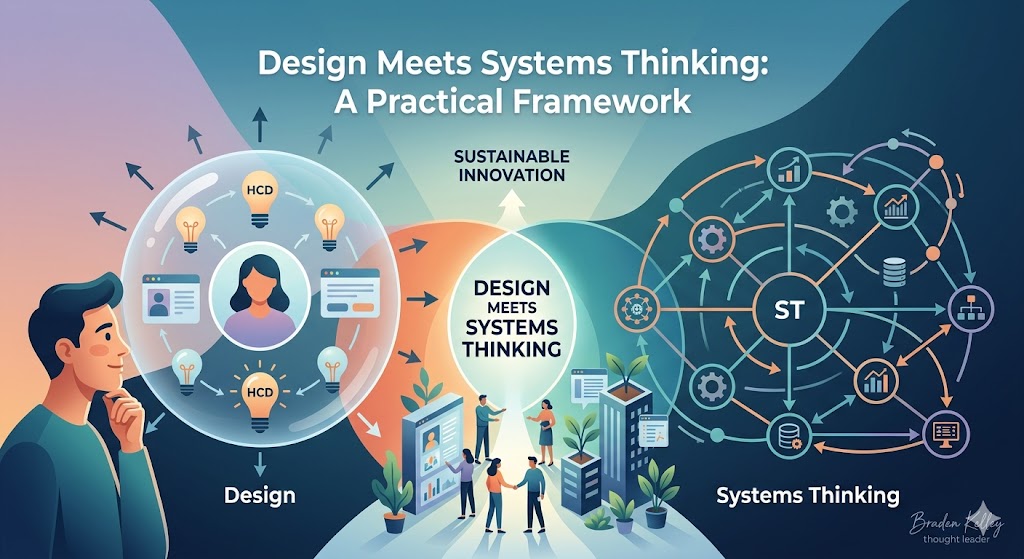
The Convergence of Empathy and Complexity
In the modern landscape of change management, we often find ourselves caught between two powerful yet incomplete methodologies. On one hand, Human-Centered Design (HCD) offers deep emotional resonance and intuitive solutions. On the other, Systems Thinking (ST) provides the structural map required to understand the vast webs of cause and effect that define our organizations.
The Innovation Gap: Why HCD Alone Often Fails at Scale
Design thinking is brilliant at solving the immediate friction points of an individual user. However, when we treat a problem in isolation — fixing a “symptom” without acknowledging the broader environment — we risk creating a perfect solution for a person that inadvertently breaks the system. Innovation that scales requires more than just a “delightful” interface; it requires an understanding of how that interface shifts the equilibrium of the entire business ecosystem.
The Power of “And”: Architecting Sustainable Solutions
By integrating design with systems thinking, we move from being “problem solvers” to “system architects.” This intersection is where we balance desirability (what people want) with durability (what the system can sustain). It’s about ensuring that a change in one department doesn’t create a bottleneck in another. We are not just looking for a “quick win”; we are looking for a leverage point — a place where a specific, human-focused intervention can ripple outward to create massive, positive structural change.
The Goal: Moving Beyond Symptoms
The ultimate objective of this practical framework is to stop the cycle of “reactive innovation.” Instead of playing a game of whack-a-mole with organizational issues, we use Holistic Empathy to see the human within the machine. We aim to design solutions that don’t just work for the user today but strengthen the health and resilience of the system for tomorrow.
Core Pillars: The Foundation of the Integrated Approach
To master the intersection of design and systems thinking, we must learn to toggle our perspective. Traditional innovation often suffers from “tunnel vision,” focusing so intently on the user that we lose sight of the environment. Conversely, pure systems thinking can suffer from “sky vision,” becoming so abstract that it loses the human pulse. The foundation of this framework rests on the ability to move fluidly between these two lenses.
Zooming In (HCD): The Precision of Individual Needs
The “Zoom In” phase is where Human-Centered Design shines. Here, we are looking for the nuances of the human experience. We aren’t just looking at data points; we are looking for empathy. This pillar focuses on:
- Micro-Interactions: The specific moments of friction or delight a person experiences during a task.
- Cognitive Load: Understanding the mental energy required to navigate a process.
- Emotional Resonance: How a change makes a person feel — safe, empowered, or perhaps anxious and overwhelmed.
When we zoom in, we ensure that the “solution” actually solves a problem for a real person. Without this, a system is just a cold machine without a purpose.
Zooming Out (ST): The Architecture of the Ecosystem
The “Zoom Out” phase is the Systems Thinking lens. Once we understand the individual’s need, we must look at the “gravity” acting upon them. This pillar requires us to map the invisible structures that dictate behavior:
- Feedback Loops: Identifying where a small change might be amplified (reinforcing loops) or suppressed (balancing loops).
- Unintended Consequences: Predicting how a “fix” in Section A might create a crisis in Section B.
- Interdependencies: Recognizing that no user exists in a vacuum; they are connected to departmental goals, technical constraints, and cultural norms.
The Human-System Feedback Loop
The most critical insight of this framework is recognizing the recursive relationship between the person and the structure. Individual behaviors shape systems — through workarounds, culture, and innovation. Simultaneously, systems dictate individual choices — through incentives, hierarchy, and toolsets. An integrated leader understands that to change the behavior, you often have to redesign the system; but to design a better system, you must first deeply understand the behavior. We are designing for emergence: the unpredictable but manageable outcomes that arise when humans and systems interact at scale.
The Framework: A Step-by-Step Integration
Moving from theory to practice requires a structured approach that respects both the human pulse and the systemic skeleton. This four-phase integration ensures that design decisions are grounded in reality while being architected for scale and resilience.
Phase 1: Holistic Empathy (Research)
Traditional HCD focuses heavily on the “End User.” Holistic Empathy expands this lens to the entire Stakeholder Ecosystem. We must identify not just who uses the solution, but who maintains it, who funds it, and who is affected by its exhaust.
- Mapping the Ecosystem: Identifying primary, secondary, and tertiary stakeholders.
- Shadow Stakeholders: These are the individuals often ignored in design sessions — legal teams, procurement, or frontline staff — whose “veto power” or operational constraints can sink an innovation if not addressed early.
Phase 2: Synthesis & System Mapping
Once we have gathered human insights, we must visualize how they collide with organizational structures. This is where we transition from stories to Systems Logic.
- Visualizing the Current State: Creating maps that show nodes (people/tools) and connections (information flow/power dynamics).
- Identifying Leverage Points: Don’t try to change everything at once. We look for the specific intersection where a human-centered intervention — like a new communication protocol — can naturally correct a systemic imbalance.
Phase 3: Co-Creative Ideation
In this phase, we move beyond the “What if?” of creative brainstorming and add the rigorous “What then?” of systems thinking. We are designing for Emergence — the realization that the system will react to our presence in unpredictable ways.
- Anticipating Systemic Reactions: If we make X easier for the user, does it create a data bottleneck for the analyst in Department Y?
- Designing for Evolution: Creating “soft” solutions that can be adjusted as the system inevitably shifts in response to the new innovation.
Phase 4: Prototyping at Scale (The Pilot)
Prototyping is usually about testing a feature. In this framework, we are testing a Relationship. We must validate the “Micro-Experience” and the “Macro-Infrastructure” simultaneously.
- The Systemic Pilot: Instead of a isolated lab test, we run a “Safe-to-Fail” experiment within a live environment to see how the organizational immune system reacts.
- Rapid Learning Loops: Using real-time feedback to iterate not just the design of the tool, but the design of the processes surrounding it.
Overcoming Common Obstacles
Even the most brilliant integrated frameworks face resistance when they meet the “organizational immune system.” To move from design to true systemic change, we must proactively identify and dismantle the barriers that keep us trapped in linear thinking.
The Silo Trap: Bridging Departmental Gaps
Organizational silos are the natural enemy of systems thinking. When one department optimizes for its own KPIs without considering the ripple effects on others, the “human-centered” solution for one group becomes a systemic burden for another. To overcome this:
- Cross-Functional Empathy: We must treat internal departments as users. What does the Finance team need from this new Innovation project? How does the Legal team’s constraint actually inform the design?
- Shared Visibility: Moving from individual project Dashboards to Ecosystem Maps that show how data and value flow across the entire organization.
The “Quick Fix” Temptation: Resisting the Band-Aid
In a fast-paced business environment, there is immense pressure to deliver immediate results. This often leads to “Surface Innovation” — fixing a UI element or a single touchpoint while leaving the broken underlying process intact. A human-centered leader must have the courage to say, “This isn’t a design problem; it’s a structural one.”
We must shift the conversation from output (how many features did we launch?) to outcome (how has the health of the system improved?).
Measuring Success: From Satisfaction to Resilience
Traditional metrics like Net Promoter Score (NPS) or User Satisfaction are valuable, but they are “Zoomed In” metrics. To measure a system, we need a new set of indicators:
- Systemic Health: Are we reducing technical and organizational debt, or are we adding to it?
- Long-term Resilience: Does this new framework allow the team to adapt more quickly to future market shifts?
- Cognitive Load & Experience Level Measures (XLMs): Moving beyond “uptime” to measure the actual emotional and cognitive resonance of the system on the people operating within it.
The Role of the Modern Innovator
The biggest obstacle is often our own definition of our role. We are no longer just “Designers” or “Project Managers.” We are Systemic Designers. Our job is to facilitate the conversation between the human need and the systemic reality, ensuring that neither is sacrificed for the sake of the other.
Conclusion: Leading the Change
The marriage of design and systems thinking is not merely a tactical upgrade; it is a fundamental shift in the philosophy of leadership. As our organizational environments become increasingly volatile and interconnected, the ability to harmonize the needs of the individual with the integrity of the whole becomes the ultimate competitive advantage.
The Emergence of the Systemic Designer
We are witnessing the evolution of the innovator. The Systemic Designer is a leader who possesses the empathy to feel the user’s frustration and the strategic clarity to trace that frustration back to its systemic root. This role requires a unique form of “bilingualism” — the ability to speak the language of human emotion and the language of operational logic simultaneously. You are no longer just building a product; you are cultivating an ecosystem where both people and profits can thrive sustainably.
A Practical Call to Action: Start Small, Think Big
Transitioning to this integrated mindset doesn’t require a total organizational overhaul overnight. You can begin by introducing “Zoom Out” moments into your existing workflows:
- The “What Then?” Workshop: At the end of your next ideation session, spend 15 minutes asking how each proposed solution might negatively impact a “Shadow Stakeholder.”
- Ecosystem Auditing: Before launching a new feature, map out the three primary feedback loops it will trigger within your department.
- Empathy Beyond the User: Interview one person from a “siloed” department (like Compliance or Operations) to understand the systemic pressures they face.
The Future of Innovation
In a world of “quick fixes” and rapid-fire feature releases, the organizations that stand the test of time will be those that prioritize Resilient Design. By applying this framework, you move beyond the noise of temporary trends and begin to solve the deep-rooted challenges of our time. The future belongs to those who can see the forest and the trees — and have the courage to design for both.
Innovation is an infinite game. It’s time we started playing with the whole board.
Frequently Asked Questions
How does Systems Thinking differ from traditional Design Thinking?
While traditional Design Thinking focuses on the empathy and friction points of the individual user (the “Zoom In”), Systems Thinking maps the broader organizational ecosystem, feedback loops, and interdependencies (the “Zoom Out”) to ensure solutions are sustainable and scalable.
What is a “Shadow Stakeholder” in this framework?
Shadow Stakeholders are individuals or departments impacted by a design change who are often left out of the initial research — such as Legal, Compliance, or back-end Operations. Identifying them early prevents the “organizational immune system” from rejecting the innovation later.
Why should I measure “Experience Level Measures” (XLMs) instead of just NPS?
NPS measures a snapshot of sentiment, but XLMs track the cognitive load and emotional resonance of a system over time. This helps leaders understand if a tool is actually reducing friction or if it is creating new, invisible systemic burdens for the workforce.
Image credit: Google Gemini
 Sign up here to get Human-Centered Change & Innovation Weekly delivered to your inbox every week.