Author Archives: Chateau G Pato

About Chateau G Pato

Chateau G Pato is a senior futurist at Inteligencia Ltd. She is passionate about content creation and thinks about it as more science than art. Chateau travels the world at the speed of light, over mountains and under oceans. Her favorite numbers are one and zero. Content Authenticity Statement: If it wasn't clear, any articles under Chateau's byline have been written by OpenAI Playground or Gemini using Braden Kelley and public content as inspiration.

Fostering Innovation Across Physical and Digital Walls

Leading the Hybrid Team

LAST UPDATED: December 13, 2025 at 10:09AM

Fostering Innovation Across Physical and Digital Walls

GUEST POST from Chateau G Pato

The innovation challenge in a hybrid world is not about technology; it’s about equity of collaboration. When some team members are physically together and others are virtual, a crucial information gap emerges. Those in the room benefit from body language, side conversations, and spontaneous moments—the very things that fuel informal innovation. Remote participants, however, often become second-class collaborators. This asymmetry kills the diverse thinking necessary for truly radical ideas. Hybrid leaders must address this proximity bias head-on.

In the framework of Human-Centered Innovation, we view the hybrid environment as a design problem. We are tasked with intentionally designing processes and utilizing tools to ensure that every participant—regardless of location—has an equal voice and equal access to information. We must unlearn the default reliance on impromptu, analog collaboration and replace it with structured, asynchronous digital processes that prioritize inclusion. The goal is to move from managing where people work to managing the quality of the collaboration they engage in.

The Three Pillars of Hybrid Innovation Leadership

To lead an innovative hybrid team, we must focus on three strategic areas:

1. The Doctrine of Digital-First Documentation

Innovation thrives on shared, persistent knowledge. In a hybrid setting, if an idea is discussed verbally in an office meeting room, it is effectively lost to the remote team when the meeting ends. The Digital-First Doctrine mandates that all work artifacts—brainstorming notes, idea sketches, mock-ups, and decision matrices—must live in a shared digital space (Miro, Figma, shared docs) that is accessible, editable, and visible to everyone, always. The physical whiteboard is dead; the digital canvas is the common ground.

  • Action: Leaders must insist that all meetings, even internal co-located ones, use a shared digital board as the single source of truth. If it isn’t documented digitally, it didn’t happen.

2. Intentionality in Serendipity and Spontaneity

The “water cooler moments” are where informal innovation often happens. You can’t replicate spontaneous encounters, but you can design for intentional serendipity. This involves allocating specific, non-work time for unstructured interaction.

  • Action: Schedule short, recurring “Idea Coffee Breaks” where participants are randomly assigned to small virtual breakout rooms with no agenda other than to discuss current projects or personal interests. Use a hybrid work day for “Deep Co-Creation Days” where co-located teams come in specifically to work on complex, generative tasks together, while remote teams join via high-quality video links optimized for collaborative tools.

3. The Principle of Time Zone and Asynchronous Equity

Hybrid teams often span time zones, making mandatory real-time meetings a productivity killer and a source of burnout. Asynchronous work — where teams collaborate over time rather than simultaneously—is the innovative advantage of the hybrid model.

  • Action: Shift the innovation pipeline to leverage asynchronous tools. For example, instead of a two-hour brainstorming session, implement a 24-hour Digital Brainstorm where team members contribute ideas over a full day in their preferred working window. Use short, recorded video updates instead of live status meetings, allowing teams to consume information when it is most convenient. This is the Human-Centered approach to global teamwork.

Case Study 1: Re-designing the Global Product Launch

Challenge: Staggered Innovation and Decision Paralysis in a Multi-National Hybrid Team

A global consumer electronics firm (“ConnectCorp”) needed to launch a new product line. Their teams were spread across three continents (US, EU, Asia) and were struggling with decision-making due to time zones and a reliance on US-centric, real-time meetings. Decisions made in the US often felt like directives to the Asian and European teams.

Hybrid Innovation Intervention: Asynchronous Decision Making

The innovation lead, embracing Human-Centered Innovation, introduced a “Decision Document” protocol. All key decisions were documented asynchronously (e.g., via a shared Notion or Confluence page) that clearly outlined:

  • The Context and Problem (1-page maximum).
  • The Options Considered and their data-backed pros/cons.
  • The Proposed Decision and the deadline for final input.

The Innovation Impact:

By forcing decisions into an asynchronous, digitally documented format, the team eliminated unnecessary meetings. The European and Asian teams had ample time to contribute thoughtful, written critiques before the decision was finalized. This change not only saved thousands of hours of meeting time but led to a 35% reduction in post-decision rework because regional insights were fully incorporated before launch. The process became more efficient, more transparent, and radically more inclusive.

Case Study 2: Designing the Inclusive Brainstorm

Challenge: Dominating Voices and Proximity Bias in Hybrid Brainstorming Sessions

A marketing agency (“IdeaForge”) found that in hybrid brainstorming sessions, the four or five people in the office consistently dominated the conversation, leaving the eight virtual participants as passive observers. The quality of idea generation suffered due to a lack of diversity.

Hybrid Innovation Intervention: Parallel Digital Brainwriting

The team adopted a strict protocol for all ideation sessions: the first 20 minutes were dedicated to Parallel Digital Brainwriting. All participants—local and remote—were required to submit their first five ideas silently and anonymously onto a shared digital canvas. No one was allowed to speak until all ideas were submitted.

  • This technique eliminated anchoring bias (where the first idea mentioned shapes all subsequent thinking) and proximity bias (where the loudest voice or the person closest to the facilitator wins).
  • The anonymous digital submission ensured introverted, virtual, and junior team members had equal input from the start.

The Innovation Impact:

The agency saw an immediate 40% increase in idea volume and a noticeable jump in the originality of the ideas generated. They successfully moved from an environment where innovation was an accidental performance (dominated by those physically present) to one where it was a structured, equitable process for every member, fully embodying the principles of Human-Centered Change.

Conclusion: Leadership Through Intentional Design

Leading the innovative hybrid team is a masterclass in organizational design. It is not about forcing people back into the office or simply tolerating remote work; it is about intentionally designing collaboration systems that overcome the physics of distance and the biases of proximity. The best hybrid leaders use the constraints of physical and digital walls to build stronger, more equitable processes. By adopting a Digital-First Doctrine, designing for intentional serendipity, and leveraging asynchronous equity, organizations can ensure that their innovation engine is powered by the talent of all their people, not just those who happen to share a common zip code. Innovation in the hybrid age is a conscious, inclusive act of design.

“If you want true innovation in a hybrid world, stop waiting for the hallway conversation and start designing the digital town square.”

Frequently Asked Questions About Hybrid Team Innovation

1. What is “proximity bias” and how does it kill hybrid innovation?

Proximity bias is the unconscious tendency to favor those who are physically closer to you (the manager). In a hybrid setting, this means co-located employees are often given more spontaneous access, better mentorship, and more visibility into key decisions, which starves remote teams of the crucial informal information needed for continuous innovation.

2. How does asynchronous work actually foster innovation, rather than slowing it down?

Asynchronous work fosters innovation by enabling deep work and reflection. Instead of being rushed into generating ideas live, team members have time to consume information, conduct research, and contribute high-quality, well-thought-out ideas when they are most focused. It trades the speed of live discussion for the depth and quality of measured contribution.

3. What single technology is most critical for an innovative hybrid team?

The most critical technology is the persistent, shared digital canvas (e.g., Miro, Mural, advanced shared docs). This tool acts as the central hub for all generative work—brainstorming, mapping, prototyping. It is the only way to ensure all team members, regardless of location, are working from the exact same, real-time visual information and have the ability to contribute equally.

Your first step toward hybrid innovation: Audit your last three brainstorming sessions. Document every idea and note, and then ask your remote participants to rate their perceived influence on the final outcome on a scale of 1-10. If the average rating is below 7, immediately implement the Parallel Digital Brainwriting technique for your next session.

Extra Extra: Because innovation is all about change, Braden Kelley’s human-centered change methodology and tools are the best way to plan and execute the changes necessary to support your innovation and transformation efforts — all while literally getting everyone all on the same page for change. Find out more about the methodology and tools, including the book Charting Change by following the link. Be sure and download the TEN FREE TOOLS while you’re here.

Image credit: Pixabay

Subscribe to Human-Centered Change & Innovation WeeklySign up here to get Human-Centered Change & Innovation Weekly delivered to your inbox every week.

Chief Intrapreneur – A New Role for the Modern C-Suite

LAST UPDATED: December 13, 2025 at 10:09AM

Chief Intrapreneur - A New Role for the Modern C-Suite

GUEST POST from Chateau G Pato

In most established organizations, the C-Suite is designed for execution, optimization, and defense. The CEO drives overall vision, the COO manages efficiency, the CFO controls resources, and the CMO owns the market message. But who owns the necessary creative destruction? Who is the executive dedicated not just to sustaining today’s business, but to building the profitable version of the business five years from now? The traditional Chief Innovation Officer (CIO) role often gets bogged down in R&D or incremental IT improvements. What we need is an executive champion of the internal entrepreneur: The Chief Intrapreneur (CInO).

The CInO’s mandate is not product development, but cultural orchestration. They function as the internal venture capitalist, allocating seed funding, securing resources, and, most crucially, shielding disruptive projects from the antibodies of the core business. This role is the organizational answer to the reality of Human-Centered Innovation, recognizing that the biggest barrier to innovation is not external competition, but internal bureaucracy, short-term financial pressure, and political turf wars. The CInO ensures that the organization not only tolerates internal challenges but actively cultivates them. We must unlearn the habit of punishing failure and replace it with a system that rewards calculated, iterative risk-taking.

The Three-Part Mandate of the Chief Intrapreneur

The CInO’s responsibilities extend beyond the traditional R&D lab and into the core operations and culture of the enterprise:

1. The Barrier Breaker: Cultural and Political Shielding

The most important function of the CInO is to act as the executive shield. New ventures are fragile and can be easily destroyed by core business metrics (e.g., demands for unrealistic quarterly returns). The CInO reports directly to the CEO, giving them the authority to push back on operational leadership and create dedicated, protected spaces — “skunkworks” or innovation sandboxes — where new ideas can be measured by learning speed, not profit alone. This requires strong political capital to override the objections of department heads who see innovation as a threat to their budgets or control.

2. The Resource Orchestrator: Internal Venture Capitalist

Unlike a traditional CIO who manages the IT budget, the CInO manages an internal Venture Fund. They allocate capital based on lean experimentation models, prioritizing small, rapid funding rounds over large, slow appropriations. They treat internal ideas as a portfolio of startups, measuring success by the validated learning generated. This requires fluency in venture capital metrics like speed of validation, pivot capacity, and option value, not just traditional financial forecasting.

3. The Competency Builder: Unlearning and Re-Skilling

Innovation requires new ways of working (Design Thinking, Lean Startup, Agile). The CInO is responsible for fostering a culture of intrapreneurial competence across the entire organization. This means creating rotational programs, mentorships (connecting internal entrepreneurs with executive sponsors), and training pathways that teach employees how to identify white space, run disciplined experiments, and communicate failure as a valuable learning outcome. The goal is to embed intrapreneurial DNA into the workforce, making innovation a shared capability, not a siloed department.

Case Study 1: Transforming a Legacy Financial Institution

Challenge: Stagnation and Fear of Regulatory Disruption

A large, centuries-old investment bank (“CapitalCore”) suffered from Status Quo Bias and political resistance to change. Teams were generating good ideas for fintech platforms, but these projects were consistently killed by the Compliance and IT departments, which prioritized regulatory safety and system stability over growth.

CInO Intervention: The Innovation Sandbox and Direct Reporting Line

CapitalCore appointed a CInO with a direct reporting line to the CEO. The CInO established a fully compliant “Innovation Sandbox” — a ring-fenced technology and regulatory environment where new platforms could be tested with real customer data but without risking the core system. The CInO had the authority to compel the Head of Compliance and the CIO to provide resources for the sandbox, turning them from internal blockers into necessary partners.

  • The CInO’s team, using the sandbox, successfully launched three new products in 18 months, compared to zero in the previous three years.
  • The success was achieved because the CInO de-risked the regulatory challenge politically and technically, protecting the intrapreneurs from the inevitable friction of the core business.

The Innovation Impact:

By establishing the CInO role, CapitalCore shifted its culture from one of fear-based gatekeeping to one of controlled experimentation. The CInO did not invent the products; they invented the process and authority structure that allowed the internal teams to succeed — the essence of Human-Centered Innovation.

Case Study 2: The Intrapreneurial Talent Pipeline

Challenge: High Turnover of High-Potential Talent Seeking Autonomy

A large manufacturing firm (“ManuFuture”) kept losing its best young engineers and marketers to startups because these employees felt their ideas were too slow to implement and that the organization offered no path for autonomy and internal ownership.

CInO Intervention: The Internal Incubation Fund and Equity System

The CInO at ManuFuture established an Internal Incubation Fund (IIF) with clear criteria for submission and funding. Crucially, the CInO worked with HR to create a new compensation structure: if an intrapreneurial project spun out into a successful new business unit, the founding team members were granted a phantom equity stake tied to the new unit’s performance.

  • This created a clear, financial incentive for employees to take risks internally, directly mirroring the startup environment’s reward system.
  • The CInO personally mentored the IIF teams, providing air cover and brokering access to existing suply chain and distribution resources that a true startup could never access.

The Innovation Impact:

ManuFuture saw a dramatic decrease in the attrition of high-potential employees, and the IIF successfully launched two new product lines that targeted adjacent markets the core business was ignoring. The CInO became the executive champion who provided both the capital and the career path necessary for internal entrepreneurs to succeed, transforming talent retention into a disruption engine.

Conclusion: The CInO as the Integrator of Change

The creation of the Chief Intrapreneur role is a strategic acknowledgment that innovation is a political act that requires C-Suite authority to overcome organizational gravity. The CInO is the architect of the environment, not just the ideas. By shielding projects, orchestrating resources, and building true intrapreneurial competency across the firm, this executive ensures that the organization remains capable of self-disruption. In an era of accelerating change, having an executive whose success is measured by the growth of tomorrow’s revenue — even if it competes with today’s — is not optional. It is the core requirement of sustainable Human-Centered Innovation. The CInO is the future of corporate longevity.

“Innovation dies not from lack of ideas, but from lack of executive air cover.”

Frequently Asked Questions About the Chief Intrapreneur (CInO)

1. How is the CInO different from a traditional Chief Innovation Officer (CIO)?

A traditional CIO often focuses on technology implementation, R&D, and incremental process improvements. The CInO has a broader, higher authority mandate focused on internal disruption and cultural change. They act as a cross-functional venture capitalist and political shield, ensuring new business models can scale without being suffocated by the core business.

2. To whom should the Chief Intrapreneur report?

The CInO must report directly to the CEO. This is crucial because their primary function is to resolve cross-departmental conflict and override the objections of other executives (CFO, COO, CMO) who prioritize short-term returns. Without the direct authority of the CEO, the CInO’s disruptive projects will be easily marginalized or defunded.

3. What is the most critical cultural shift the CInO must achieve?

The most critical shift is moving the organization from punishing failure to rewarding validated learning. The CInO must establish metrics that celebrate rapid, low-cost failure when it generates high-value insights, ensuring that internal entrepreneurs are incentivized to test risky assumptions quickly, rather than concealing problems until it’s too late.

Your first step toward intrapreneurship: Identify the top two most promising new ideas currently stuck in political or budgetary limbo. Assign them an executive sponsor (ideally the CEO or a CInO if one exists) whose formal job description now includes removing the next three barriers for that idea to progress.

Extra Extra: Because innovation is all about change, Braden Kelley’s human-centered change methodology and tools are the best way to plan and execute the changes necessary to support your innovation and transformation efforts — all while literally getting everyone all on the same page for change. Find out more about the methodology and tools, including the book Charting Change by following the link. Be sure and download the TEN FREE TOOLS while you’re here.

Image credit: Pixabay

Subscribe to Human-Centered Change & Innovation WeeklySign up here to get Human-Centered Change & Innovation Weekly delivered to your inbox every week.

Beyond the Prototype – How to Test and Iterate on a Business Model

LAST UPDATED: December 10, 2025 at 12:12PM

Beyond the Prototype - How to Test and Iterate on a Business Model

GUEST POST from Chateau G Pato

The journey of innovation often starts with a flash of insight, proceeds through design thinking, and culminates in a beautiful, working prototype. Unfortunately, too many organizations mistake this technical milestone for ultimate validation. They assume that because the product works, the business model — the economic engine that funds and scales that product — will also work. This is the most dangerous assumption in the innovation lifecycle.

The business model itself is the largest, most complex hypothesis we launch. It encompasses everything from how we acquire customers and what they are willing to pay, to the cost of our key resources and the nature of our partnerships. If your revenue streams are a guess, your cost structure is a hope, and your channels are a pipe dream, your product, however well-designed, is destined for the scrap heap. In the realm of Human-Centered Innovation, we must unlearn the product-first mentality and embrace the model-first testing philosophy. This requires shifting from testing product usability to testing business viability using model-specific metrics.

The Three Hypotheses in Business Model Testing

Testing a business model means breaking it down into its core, measurable assumptions. We focus on three interconnected areas:

1. The Value Hypothesis (Customer/Value Proposition Fit)

This is the foundation: Does the product or service actually solve a problem for a defined customer segment? While prototyping addresses product usability, model testing addresses willingness-to-pay and actual usage patterns. We test whether the perceived value aligns with the revenue model.

  • Test Focus: A/B test pricing tiers (monthly vs. annual, premium vs. basic), run “smoke tests” to gauge initial sign-ups for a non-existent product, or use Concierge MVPs where services are manually delivered to deeply understand the customer journey and price sensitivity before automation.
  • Key Metric: Willingness-to-Pay (WTP), Net Promoter Score (NPS) for the specific value exchange.

2. The Growth Hypothesis (Channel/Acquisition Fit)

A great product fails if you cannot affordably get it into the hands of customers. This hypothesis tests the efficiency and scalability of your customer acquisition channels and your key partners.

  • Test Focus: Run small, contained experiments across different channels (e.g., paid social vs. SEO vs. strategic partnership referrals) to compare costs and conversion rates. Test various partner roles — do they act as distributors, co-creators, or merely service providers?
  • Key Metric: Customer Acquisition Cost (CAC), Lifetime Value (LTV), and LTV/CAC ratio. This ratio is the ultimate test of viability.

3. The Operational Hypothesis (Cost/Resource Fit)

This tests the internal engine: Can we deliver the value proposition at a cost that is significantly lower than the price we charge? This involves testing key activities, resource assumptions, and supply chain scalability.

  • Test Focus: Create a “Shadow P&L” for the new model, tracking variable costs associated with early customer acquisition and service delivery. Run controlled pilots focused on simulating the Key Activities (e.g., if a new service requires 24/7 support, test that support capability with real, paying customers for a month).
  • Key Metric: Contribution Margin, Cost of Goods Sold (COGS) as a percentage of revenue, and scalability metrics (e.g., cost to serve the 10th customer vs. the 100th customer).

Case Study 1: The Subscription Anchor That Was Cut

Challenge: Failed Launch of a Health-Tech Diagnostic Device

A medical device company (“MedTrack”) developed a portable diagnostic device. The initial prototype was technically perfect, but the business model relied on a mandatory high-cost monthly subscription for data analysis software. The subscription revenue stream was designed to create recurring revenue and offset the low upfront device cost.

Model Testing Intervention: Value Hypothesis Pivot

Initial pilot testing revealed that while customers loved the device, the high subscription created massive churn after the first year. MedTrack tested the Value Hypothesis:

  • Hypothesis 1 (Failed): Customers will pay $150/month for comprehensive data analysis.
  • Test: Offer three options: $150/month (current model), $25/month for basic data (new tier), and a $1,500 one-time software license.

The Innovation Impact:

The test showed that the $25/month basic data tier attracted 80% of new customers and had 95% retention. The $1,500 one-time fee also proved attractive to institutional buyers. By iterating on the Revenue Stream (a key business model block) from a rigid subscription to a tiered and licensed model, MedTrack dramatically improved its LTV/CAC ratio. They realized their innovation wasn’t the device; it was the flexibility of the pricing model tailored to different customer segments, a critical element of Human-Centered Innovation.

Case Study 2: Testing the Delivery Channel of Services

Challenge: Scaling an Expensive B2B Consulting Service

A strategy firm (“StratX”) wanted to scale a high-value, bespoke market entry strategy service without proportionally increasing its headcount — a severe constraint in its Cost Structure block. Their initial Growth Hypothesis relied on high-touch, senior consultant sales.

Model Testing Intervention: Growth and Operational Hypothesis Test

StratX decided to test replacing the expensive consultant delivery with a technology-augmented channel. They ran an A/B test on their target customer segment:

  • Group A (Control): Full senior consultant engagement (high Cost Structure, high Revenue Stream).
  • Group B (Test): A “Hybrid Model” where the initial 80% of the strategy report was generated by AI/data science tools (saving Key Activities cost), followed by a single senior consultant review session (low Cost Structure, slightly reduced Revenue Stream).

The Innovation Impact:

The Hybrid Model achieved an LTV/CAC ratio that was300% higher than the Control Group. Customers in Group B were highly satisfied with the speed and data quality, accepting a slightly lower consultant touchpoint for a lower price and faster delivery. StratX had successfully validated a new, highly scalable Key Resource (the data science platform) and a new Channel, allowing the firm to expand its addressable market and free up expensive senior consultants for truly bespoke, complex client needs. This proved that innovation in service delivery is a critical component of the business model.

Conclusion: Business Model Validation is the Ultimate De-Risking

The successful launch of any new initiative, particularly in the realm of radical innovation, is determined long after the prototype is functional. It is determined by the rigor with which you test and iterate on your business model hypotheses. By dissecting your model into its core assumptions — Value, Growth, and Operational — and designing measurable experiments (MVPs, A/B tests, Shadow P&Ls), you move from guessing to knowing. This structured approach, rooted in Human-Centered Innovation, shifts the risk from catastrophic failure at launch to manageable learning throughout development. Stop perfecting the product; start proving the model.

“If your product is a masterpiece but your business model is a mystery, you have a hobby, not an innovation.”

Frequently Asked Questions About Business Model Testing

1. What is the difference between testing a product and testing a business model?

Testing a product focuses on usability, functionality, and desirability (e.g., does the app work, do people like the color?). Testing a business model focuses on viability and scalability (e.g., are people willing to pay enough for the app to cover the cost of acquiring them and running the service?).

2. What is a “Shadow P&L” in the context of innovation?

A Shadow P&L (Profit and Loss) is a separate, simulated financial statement created specifically for an innovation project. It tracks the real-world costs and simulated revenues associated with the new business model during the testing phase. It helps the team validate their Cost Structure and Revenue Stream hypotheses before integrating the project into the main corporate finances.

3. How do you test a distribution channel without a full launch?

Distribution channels can be tested using small, contained experiments. For instance, testing a partnership channel can involve a single pilot partner with clear, measurable KPIs (conversion rates, lead quality). Testing a direct-to-consumer channel can use A/B testing of targeted digital ads to measure Customer Acquisition Cost (CAC) without building out the entire logistics infrastructure.

Your first step toward model testing: Take your most promising new idea, map it onto a Business Model Canvas, and circle the three riskiest assumptions in the “Revenue Streams,” “Cost Structure,” and “Key Activities” blocks. Design one small, cheap experiment for each of those three assumptions next week.

Extra Extra: Because innovation is all about change, Braden Kelley’s human-centered change methodology and tools are the best way to plan and execute the changes necessary to support your innovation and transformation efforts — all while literally getting everyone all on the same page for change. Find out more about the methodology and tools, including the book Charting Change by following the link. Be sure and download the TEN FREE TOOLS while you’re here.

Image credit: Unsplash

Subscribe to Human-Centered Change & Innovation WeeklySign up here to get Human-Centered Change & Innovation Weekly delivered to your inbox every week.

Anchors & Biases – How Cognitive Shortcuts Kill New Ideas

LAST UPDATED: December 10, 2025 at 12:12PM

Anchors & Biases - How Cognitive Shortcuts Kill New Ideas

GUEST POST from Chateau G Pato

Innovation is inherently messy, uncertain, and challenging. To navigate this complexity, our brains rely on cognitive shortcuts – heuristics — to save time and energy. While these shortcuts are useful for avoiding immediate danger or making routine decisions, they become the primary internal roadblocks when attempting to generate or evaluate truly novel ideas. These shortcuts are our anchors and biases, and they consistently pull us back to the familiar, the safe, and the incremental.

In the context of Human-Centered Innovation, we must shift our focus from just generating innovation to protecting it from these internal threats. The key is to recognize the most common biases that derail novel concepts and build specific, deliberate processes to counteract them. We must unlearn the assumption of pure rationality and embrace the fact that all decision-making, especially concerning risk and novelty, is tainted by predictable cognitive errors. This recognition is the first step toward building a truly bias-aware innovation ecosystem.

Anchors & Biases - How Cognitive Shortcuts Kill New Ideas

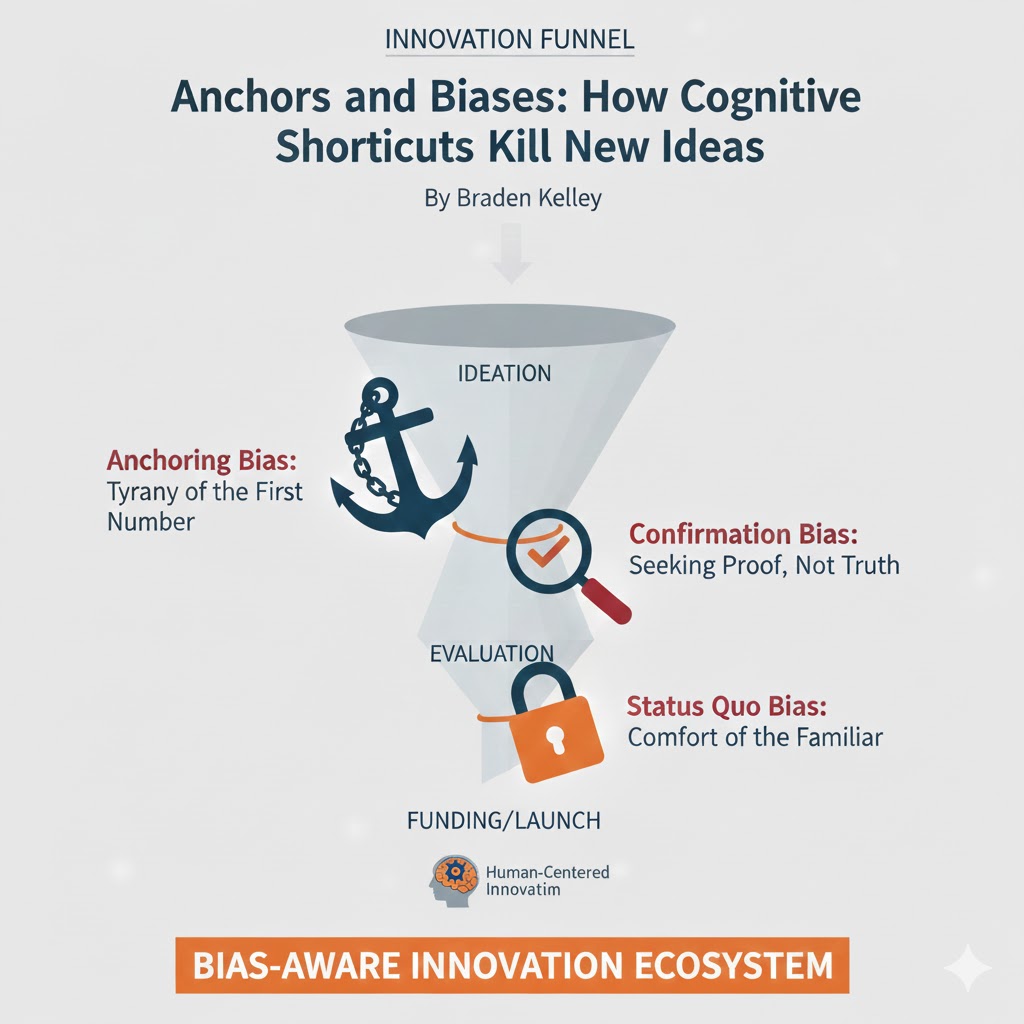
Visual representation: A diagram illustrating the innovation funnel being constricted at different stages (Ideation, Evaluation, Funding) by three key cognitive biases: Anchoring, Confirmation Bias, and Status Quo Bias.

Three Innovation Killers and How to Disarm Them

While hundreds of biases exist, three are particularly lethal to the innovation process:

1. Anchoring Bias: The Tyranny of the First Number

The Anchoring Bias occurs when people rely too heavily on the first piece of information offered (the “anchor”) when making decisions. In innovation, the anchor is often the budget of the last project, the timeline of the most recent success, or the projected ROI of the initial idea submission. This anchor skews all subsequent analysis, making it nearly impossible to objectively evaluate ideas that fall far outside that initial range.

  • The Killer: A disruptive idea requiring a tenfold increase in budget compared to the anchor will be instantly dismissed as “too expensive,” even if the potential ROI is twentyfold.
  • The Disarmer: Use Premortem Analysis (imagining the project failed and listing the causes) before assigning any financial figures. Also, use Three-Point Estimates (optimistic, pessimistic, and most likely) to establish a range, preventing a single number from becoming the dominant anchor.

2. Confirmation Bias: Seeking Proof, Not Truth

The Confirmation Bias is the tendency to search for, interpret, favor, and recall information that confirms or supports one’s prior beliefs or values. In innovation, this leads teams to design market research that validates their pet idea and ignore data that challenges it. This results in the pursuit of solutions nobody wants, but which the team believes they want.

  • The Killer: A team falls in love with a solution and only interviews customers who fit their narrow ideal profile, ignoring a critical segment whose objections would save the project from failure.
  • The Disarmer: Institute a Red Team/Blue Team structure. Assign a dedicated “Red Team” whose only job is to rigorously critique the idea and actively seek disconfirming evidence and data. Leadership must reward the Red Team for finding flaws, not just for confirming the status quo.

3. Status Quo Bias: The Comfort of the Familiar

The Status Quo Bias is the preference for the current state of affairs. Any change from the baseline is perceived as a loss, and the pain of potential loss outweighs the potential gain of the new idea. This is the organizational immune system fighting off innovation. It’s why companies often choose to incrementally improve a dying product rather than commit to a disruptive new platform.

  • The Killer: A new business model that could unlock 5x revenue is rejected because it requires decommissioning a legacy product that currently contributes 10% of profit, even though that product is in terminal decline. The perceived certainty of the 10% trumps the uncertainty of the 5x.
  • The Disarmer: Employ Zero-Based Budgeting for Ideas. Force teams to justify the existence of current processes or products as if they were a new idea competing for resources. Ask: “If we didn’t offer this product today, would we launch it now?” If the answer is no, the status quo must be challenged.

Case Study 1: The Anchor That Sank the Startup

Challenge: Undervaluing Disruptive Potential Due to Legacy Pricing

A B2B SaaS startup (“DataFlow”) developed an AI tool that automated a complex, manual compliance reporting process, reducing the time required from 40 hours per month to 2 hours. The initial team, anchored to the price of the legacy human labor (which cost clients approximately $4,000/month), decided to price their software at a conservative $300/month.

Bias in Action: Anchoring Bias

The team failed to anchor their pricing to the value delivered (time savings, error reduction, regulatory certainty) and instead anchored it to the legacy cost structure. Their $300 price point led potential high-value clients to view the product as a minor utility, not a mission-critical tool, because the price was too low relative to the problem solved. They were competing on cost, not value.

  • The Correction: External consultants forced the team to re-anchor based on the avoided regulatory fine risk (a $100k-$500k loss). They repositioned the product as an insurance policy rather than a software license and successfully raised the price to $2,500/month, radically improving their perceived value, sales pipeline, and runway.

The Innovation Impact:

By identifying and aggressively correcting the anchoring bias, DataFlow unlocked its true market value. The innovation was technical, but the success was achieved through cognitive clarity in pricing strategy.

Case Study 2: The Confirmation Loop That Killed the Feature

Challenge: Launching a Feature Based on Internal Enthusiasm, Not Customer Need

A social media platform (“ConnectAll”) decided to integrate a complex 3D-modeling feature based on the CEO’s enthusiasm and anecdotal data from a few early-adopter focus groups. The development team, driven by Confirmation Bias, only sought feedback that praised the technical complexity and novelty of the feature.

Bias in Action: Confirmation Bias & Sunk Cost

The internal team, having invested six months of work (Sunk Cost Fallacy), refused to pivot when the initial Beta tests showed confusion and low usage. They argued that users simply needed more training. When the feature launched, user adoption was near zero, and the feature became a maintenance drain, detracting resources from core product improvements.

  • The Correction: Post-mortem analysis showed the team needed Formal Disconfirmation. The new innovation process mandates that market testing must include a structured interview block where testers are paid to actively try and break the new feature, list its flaws, and articulate why they wouldn’t use it.

The Innovation Impact:

ConnectAll learned that the purpose of testing is not to confirm success, but to disconfirm failure. By forcing teams to seek and respect evidence that contradicts their initial beliefs, they now kill flawed ideas faster and redirect resources to validated, human-centered needs.

Conclusion: Bias-Awareness is the New Innovation Metric

The greatest barrier to radical innovation isn’t a lack of ideas or funding; it’s the predictability of human psychology. Cognitive biases like Anchoring, Confirmation Bias, and Status Quo Bias act as unconscious filters, ensuring that only the incremental and familiar survive the evaluation process. Organizations committed to Human-Centered Innovation must make bias-awareness a core competency. By building systematic checks (Premortems, Red Teams, Zero-Based Thinking) into every stage of the innovation pipeline, leaders transform cognitive shortcuts from fatal flaws into predictable inputs that can be managed. To innovate boldly, you must first think clearly.

“The mind is not a vessel to be filled, but a fire to be kindled — and often, that fire is choked by the ashes of old assumptions.” — Braden Kelley

Build a Common Language of Innovation on your team

Frequently Asked Questions About Cognitive Biases in Innovation

1. What is the difference between a heuristic and a cognitive bias?

A heuristic is a mental shortcut used to solve problems quickly and efficiently — it is the process. A cognitive bias is a systematic pattern of deviation from norm or rationality in judgment — it is the predictable error resulting from the heuristic. Biases are the consequences of using mental shortcuts (heuristics) in inappropriate contexts, such as innovation evaluation.

2. How does the Status Quo Bias relate to the Sunk Cost Fallacy?

The Status Quo Bias is a preference for the current state (a passive resistance to change). The Sunk Cost Fallacy is the resistance to changing a current course of action because of resources already invested (an active commitment to past expenditure). Both work together to kill new ideas: the Status Quo protects the legacy product, and Sunk Cost Fallacy protects the legacy project that failed to deliver.

3. Can AI help eliminate human cognitive biases in decision-making?

Yes. AI can be a powerful tool to mitigate human bias by acting as an objective “Red Team.” AI can be prompted to ignore anchors (e.g., “Analyze this idea assuming zero prior investment”), actively seek disconfirming data, and simulate scenarios free of human emotional attachment, providing a rational baseline for decision-making and challenging the human team’s assumptions.

Your first step toward mitigating bias: Before your next innovation meeting, ask everyone to write down the largest successful project budget from the last year. Collect these, then start the discussion on the new idea’s budget by referencing the highest and lowest numbers submitted. This simple act of introducing multiple anchors diffuses the power of any single number and forces a broader discussion.

Extra Extra: Because innovation is all about change, Braden Kelley’s human-centered change methodology and tools are the best way to plan and execute the changes necessary to support your innovation and transformation efforts — all while literally getting everyone all on the same page for change. Find out more about the methodology and tools, including the book Charting Change by following the link. Be sure and download the TEN FREE TOOLS while you’re here.

Image credit: Pexels

Subscribe to Human-Centered Change & Innovation WeeklySign up here to get Human-Centered Change & Innovation Weekly delivered to your inbox every week.
Innovating the Path for Human Growth

Career Lattice, Not Ladder

LAST UPDATED: December 10, 2025 at 12:12PM

Innovating the Path for Human Growth - Career Lattice, Not Ladder

GUEST POST from Chateau G Pato

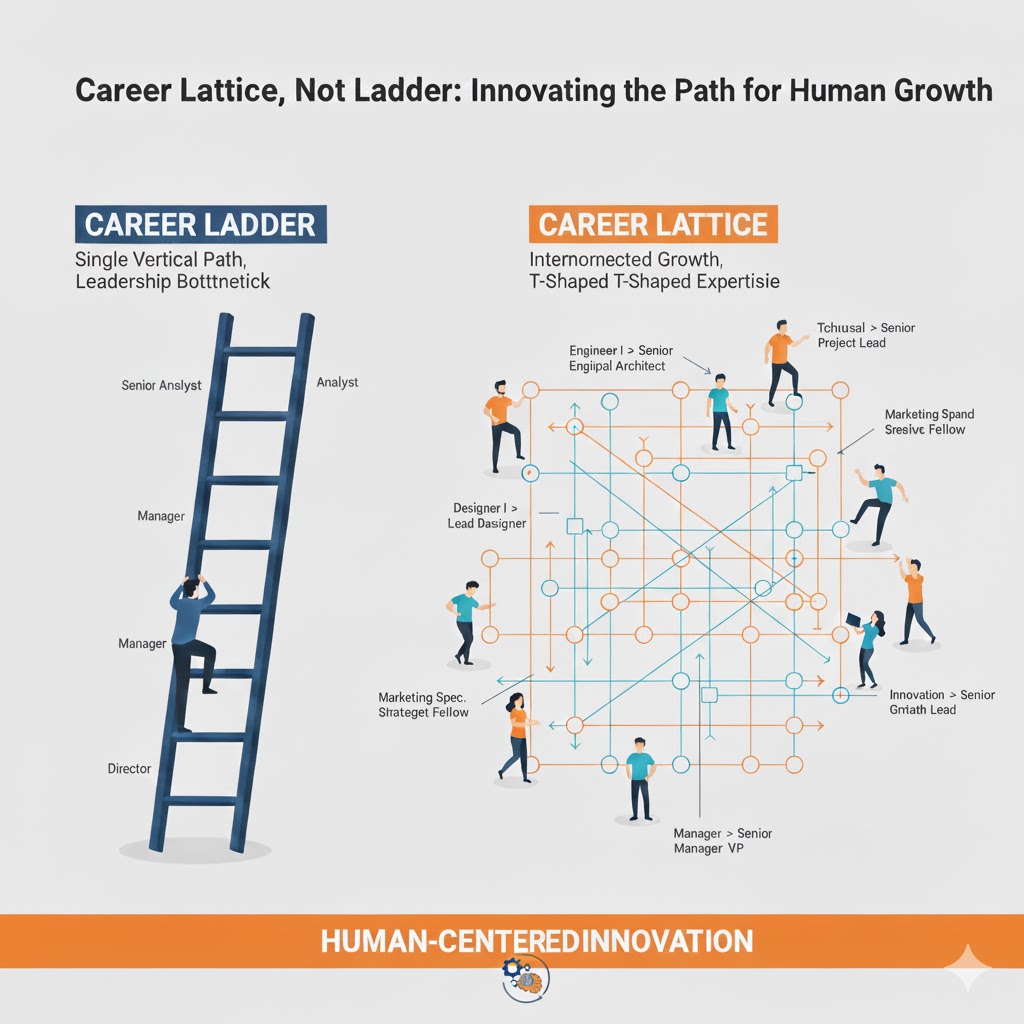
For over a century, the metaphor guiding professional development has been the career ladder: a single, vertical track where success is measured solely by climbing to the next managerial rung. This linear approach is fundamentally broken for the modern, innovation-driven economy. It forces technical experts into supervisory roles they neither want nor excel at, creates deep talent silos, and ultimately limits an organization’s adaptive capacity. The traditional ladder generates leadership bottlenecks and expertise gaps.

The solution is the Career Lattice. This model replaces simple vertical promotion with a complex, interconnected network of roles that rewards movement across functions, deepening of non-managerial expertise, and mastery of cross-disciplinary skills. This horizontal and diagonal movement is the necessary foundation for building a resilient, innovative, and human-centered workforce. The lattice acknowledges that a lateral move from marketing to product development, or a diagonal shift into a subject matter expert track, is often more valuable to the individual’s growth and the company’s innovation ecosystem than a simple management title. Organizations must unlearn the idea that management is the only path to influence and compensation and embrace the horizontal value of the expert. This is the structural requirement for true Human-Centered Innovation.

Visual representation: A diagram comparing the Career Ladder (a single vertical line with few rungs) to the Career Lattice (a broad, interconnected grid showing horizontal, vertical, and diagonal movement between different functions like Engineering, Marketing, and Strategy).

The Three Core Benefits of the Lattice

Shifting to a lattice model yields three transformative benefits that directly fuel innovation:

1. Deepened T-Shaped Expertise

The lattice explicitly supports the growth of T-Shaped Professionals — individuals who possess deep expertise in one area (the vertical bar of the ‘T’) but also broad, cross-functional knowledge (the horizontal bar). A designer who has spent a year in customer service, or a developer who has shadowed the finance team, gains the empathy and perspective necessary to create truly human-centered solutions. The lattice makes these moves desirable and compensable, creating a workforce rich in interdisciplinary context.

2. Unblocking the Expert Track

The biggest failure of the ladder is forcing valuable experts — brilliant engineers, data scientists, or regulatory specialists — into managing people just to gain a pay raise or seniority. The lattice introduces parallel, high-status, high-compensation Expert Tracks (e.g., Distinguished Engineer, Principal Architect, Master Strategist) that are non-managerial. This allows top talent to focus on complex problem-solving and mentorship without sacrificing their career ambition, keeping critical institutional knowledge and technical leadership focused on innovation, not administration.

3. Fostering Organizational Agility

A workforce with experience across multiple functions is inherently more agile. When teams need to pivot or collaborate on a complex, novel problem (the core of innovation), individuals who have worked in different departments understand the language, incentives, and constraints of their partners. This shared context dramatically reduces friction, misunderstandings, and siloed thinking, accelerating the organization’s responsiveness to market shifts. The lattice acts as an organizational glue.

Designing the Lattice: Essential Structural Elements

Simply drawing a box grid is not enough. A functional Career Lattice requires intentional structural changes:

  • Value Equivalence: Compensation and seniority must be mapped to skill mastery and organizational impact, not reporting lines. A Principal Architect (non-manager) must be demonstrably capable of earning the same as a Director (manager).
  • Internal Mobility as a KPI: The success of managers and HR should be tied to the percentage of employees making meaningful lateral or diagonal moves. Internal mobility must be prioritized over external hiring for specific roles.
  • Rotational Assignments: Formalize temporary, project-based assignments outside a person’s core function. These tours of duty expose employees to new challenges and build lattice connections without permanent job changes.

Case Study 1: Transforming a Technology Team into a Business Partner

Challenge: IT Department Viewed as a Cost Center, Lacking Business Empathy

A large financial services company (“FinNova”) had a technically excellent IT department, but it was siloed. IT projects often failed because the team lacked empathy for the daily struggles and strategic needs of the sales and operations teams. The only promotion path in IT was to become an IT manager, increasing the isolation.

Lattice Intervention: Diagonal and Horizontal Movement

FinNova implemented a Career Lattice focused on building business context. They established a “Business Architect” track — a diagonal move from IT specialist. These non-managerial roles required 18 months of embedded work in a business unit (Sales, Compliance, Operations) followed by a return to IT to lead strategic integration projects.

  • The Business Architect track was compensated equally to the IT Manager track.
  • IT staff were required to complete at least one rotational assignment (e.g., three months in a branch office) before being eligible for the top technical roles.

The Innovation Impact:

The lattice successfully broke the silo. IT projects began incorporating operational realities from the start. The quality of IT strategic advice improved dramatically, and the IT department transitioned from a cost center to a genuine business partner, directly enabling the firm’s transition to a digital-first service model. The lattice created cross-functional translators.

Case Study 2: Retaining Top Talent Through Expertise Recognition

Challenge: Loss of Senior Scientific Researchers to Competitors

A bio-technology startup (“BioLeap”) found that its top PhD-level researchers were leaving for management positions at larger firms after reaching the ceiling of the non-managerial “Senior Scientist” role. The company was hemorrhaging institutional knowledge and technical leadership.

Lattice Intervention: The Expert Track Parallel

BioLeap formally introduced a parallel Expert Track to run alongside the Management Track. They created “Research Fellow” and “Principal Investigator” titles, offering compensation and perks equivalent to Director and VP-level roles, respectively.

  • Research Fellows were given protected time for pure research and mentorship responsibilities but zero direct reports.
  • The promotion criteria for the Expert Track were focused on patent creation, publication of high-impact research, and mentoring junior scientists — not people management.

The Innovation Impact:

By explicitly valuing and rewarding technical mastery over administration, BioLeap immediately stabilized its senior research team retention. The company not only retained its most valuable minds but also leveraged them as internal consultants and mentors, significantly accelerating the development of novel therapies. The lattice allowed their best scientists to continue being scientists, directly contributing to the core mission of disruptive innovation.

Career Lattice Not Ladder Infographic

Conclusion: The Lattice is Human-Centered Strategy

The Career Lattice is more than just an HR policy; it is a fundamental shift in strategy that aligns organizational structure with Human-Centered Innovation. It rewards the natural human desire for continuous learning, diverse experiences, and deep mastery, rather than forcing everyone into the narrow, often ill-fitting, constraints of management. Leaders must champion this shift, not just to retain talent, but to build an enterprise that is inherently more versatile, empathetic, and capable of generating sustained, cross-functional innovation. Stop climbing ladders; start weaving a lattice.

“The depth of your expertise matters as much as the height of your title.” — Braden Kelley

Frequently Asked Questions About the Career Lattice

1. How is a Career Lattice different from a dual-track career system?

A dual-track system (Management vs. Technical) is a component of a lattice. A true Career Lattice is much broader: it allows for horizontal movement between different departments (e.g., Marketing to Finance) and diagonal movement from a technical track into a cross-functional role (e.g., Technical Expert to Project Strategist), rewarding diverse experience, not just vertical or single-track progression.

2. Does the Lattice eliminate the need for traditional managers?

No. The Lattice clarifies and elevates the role of the manager. Instead of being the only path to success, management becomes a distinct specialization focused on people leadership, resource allocation, and strategy execution. It ensures that those who become managers are genuinely skilled in leadership, while experts are free to focus on deep technical or strategic contributions.

3. What is the single biggest barrier to implementing a Career Lattice?

The biggest barrier is cultural—specifically, the ingrained perception that higher management titles automatically equate to higher value and compensation. Successfully implementing a lattice requires leaders to publicly, explicitly, and financially validate the equivalence of the top Expert Track roles with Director or VP-level Management Track roles. Without this cultural shift, employees will still default to chasing the traditional title.

Your first step toward building a Career Lattice: Identify your top five non-managerial experts who are nearing a career ceiling. Create a specific, high-status “Principal” or “Distinguished” title for them and publicly announce their promotion, ensuring the compensation is equal to the next level of management. This sends the clearest signal that expertise is valued horizontally.

Extra Extra: Because innovation is all about change, Braden Kelley’s human-centered change methodology and tools are the best way to plan and execute the changes necessary to support your innovation and transformation efforts — all while literally getting everyone all on the same page for change. Find out more about the methodology and tools, including the book Charting Change by following the link. Be sure and download the TEN FREE TOOLS while you’re here.

Image credit: Pexels

Subscribe to Human-Centered Change & Innovation WeeklySign up here to get Human-Centered Change & Innovation Weekly delivered to your inbox every week.
Talking to the Machine for Maximum Innovation Output

The New Skill of Prompting

LAST UPDATED: December 9, 2025 at 3:34PM

Talking to the Machine for Maximum Innovation Output

GUEST POST from Chateau G Pato

In the landscape of Human-Centered Innovation, the tools we use are constantly evolving. For decades, our focus has been on understanding human behavior, market dynamics, and organizational psychology. While these remain critical, a new, rapidly ascending skill is redefining innovation: prompting. This isn’t about esoteric coding; it’s the art and science of communicating effectively with artificial intelligence to unlock unprecedented levels of creativity, efficiency, and insight.

The rise of generative AI means that our ability to articulate needs, define constraints, and guide machine cognition will directly determine our innovation output. Those who master this skill will not merely automate tasks; they will augment human ingenuity, turning vague concepts into tangible prototypes, complex data into actionable strategies, and bold visions into executable plans. We must unlearn the idea that machines only follow rigid commands and instead embrace them as intelligent collaborators, whose effectiveness is a direct reflection of our communication clarity and intent. This is the essence of human-machine co-creation.

The New Skill of Prompting

Visual representation: A diagram showing a human figure interacting with an AI interface, with arrows depicting iterative communication between prompt and output, leading to an innovative product or solution.

The Four Principles of Effective Prompting for Innovation

Effective prompting isn’t about magic words; it’s about structured thinking and iterative refinement. Here are four core principles:

1. Be Specific and Context-Rich (The “Who, What, When, Where, Why, How” for AI)

Vague prompts yield vague results. To get innovative outputs, you must provide the AI with a rich tapestry of context, constraints, and desired outcomes. Think of it as briefing an exceptionally intelligent, but context-blind, junior consultant. Define the role of the AI (e.g., “Act as a seasoned product manager”), the target audience (e.g., “for busy small business owners”), the problem you’re solving, the format of the output, and any limitations (e.g., “no more than 3 bullet points”). The more specific you are, the less the AI has to guess, and the more relevant its innovative suggestions become.

2. Leverage Iteration and Refinement (The “Dialogue-Driven” Discovery)

Innovation is rarely a one-shot process, and neither is prompting. Treat your interaction with the AI as a dialogue. Start with a broad prompt, analyze the output, and then refine your request based on what you’ve learned. This iterative process, often called “prompt chaining” or “conversation loops,” allows you to progressively narrow down solutions, explore adjacent ideas, and course-correct in real-time. Don’t expect perfection on the first try; expect a powerful co-creative journey.

3. Define the Desired Persona (Injecting Intent and Tone)

AI models can adopt various personas, which dramatically influences the style, tone, and even the creativity of their responses. Specifying a persona—”Act as a disruptive startup founder,” “Write like a meticulous scientific researcher,” or “Brainstorm like an unconstrained artist”—can unlock entirely different modes of thinking within the AI. This is where you inject the human element of intent into the machine’s generation, ensuring the output aligns not just with the facts, but with the spirit of your innovation challenge.

4. Use Examples and Constraints (Guiding Creativity, Not Limiting It)

While AI can generate novel ideas, it excels when given examples of the type of output you’re looking for, or clear boundaries. Providing “few-shot” examples (e.g., “Here are three examples of innovative headlines; generate five more in a similar style”) can significantly improve the quality and relevance of the output. Similarly, setting negative constraints (e.g., “Do not use jargon,” “Avoid cliché solutions”) focuses the AI’s creative energy towards truly original and effective solutions. These aren’t limitations; they are scaffolding for breakthrough thinking.

Case Study 1: Accelerating New Product Ideation

Challenge: Stagnant Idea Pipeline for a Consumer Electronics Company

A leading consumer electronics firm (“InnovateTech”) struggled with generating truly novel product ideas. Traditional brainstorming sessions often reverted to incremental improvements on existing products, and market research provided limited forward-looking insights. The ideation process was slow and often led to groupthink.

Prompting Intervention: AI-Augmented Brainstorming

InnovateTech integrated a generative AI into its early-stage ideation. Product managers were trained in advanced prompting techniques:

  • Specific Context: Prompts included detailed customer personas, unmet needs, existing market gaps, and even desired technological components (e.g., “Act as a futurist product designer. Brainstorm 10 disruptive smart home devices for busy urban professionals, focusing on sustainability and ease of integration, avoiding voice assistants as the primary interface.”).
  • Iteration: Initial AI outputs were then used as a basis for further prompts: “Refine these three ideas, focusing on how they could be gamified for user engagement,” or “Generate potential risks for these ideas, along with mitigation strategies.”

The Innovation Impact:

The AI-augmented ideation dramatically increased the volume and diversity of novel product concepts. The team reported a 200% increase in “truly unique” ideas, with the AI serving as an impartial, tireless brainstorming partner, challenging assumptions and suggesting unconventional combinations. The time from concept to validated idea was reduced by 30%, demonstrating how effective prompting transformed a bottleneck into a catalyst for innovation.

Case Study 2: Rapid Market Entry Strategy Development

Challenge: Slow and Costly Market Research for a SaaS Startup

A B2B SaaS startup (“GrowthEngine”) needed to quickly identify the most promising new international markets for its niche analytics platform but lacked the resources for extensive traditional market research. The founders faced a high-stakes decision with limited data.

Prompting Intervention: Strategic AI Analysis

GrowthEngine’s strategy team, using advanced prompting, leveraged an AI model for rapid market analysis:

  • Persona & Specificity: The prompt was framed as: “Act as a global market expansion consultant for a B2B SaaS company specializing in real-time data analytics for supply chain optimization. Evaluate the top five emerging markets (outside North America/Europe) for product-market fit, considering regulatory hurdles, competitive landscape, and potential customer segments. Present a SWOT analysis for each, and rank them with justification. Focus on markets with high digital transformation potential but underserved analytics needs.”
  • Constraints & Examples: They provided examples of previous successful market entry strategies for similar companies to guide the AI’s analysis and requested the output in a structured table format for easy comparison.

The Innovation Impact:

What would have taken weeks or months of dedicated analyst time was compressed into a few hours of iterative prompting. The AI provided detailed, actionable insights that identified two unexpected, high-potential markets that traditional research might have overlooked. This accelerated GrowthEngine’s market entry decision by 75%, allowing them to seize a first-mover advantage and proving that intelligent prompting is a strategic competitive differentiator.

Conclusion: Prompting as a Core Innovation Competency

The ability to effectively “talk to the machine” through prompting is no longer an optional skill; it is a core competency for the modern innovator. Organizations dedicated to Human-Centered Innovation must invest in training their teams in these principles. It’s about empowering humans to ask better questions, to think more expansively, and to leverage AI not as a replacement, but as an indispensable partner in the journey of discovery and creation. The future of innovation belongs to those who master the dialogue with their intelligent tools. Start prompting, start innovating.

“The future of work isn’t about replacing humans with AI; it’s about amplifying human potential with AI, and prompting is the key.” — Braden Kelley

Frequently Asked Questions About Prompting for Innovation

1. What is “prompting” in the context of AI and innovation?

Prompting is the skill of formulating clear, specific, and context-rich instructions or questions for an artificial intelligence model to generate desired outputs. In innovation, it’s about guiding AI to brainstorm ideas, analyze data, create content, or simulate scenarios to accelerate problem-solving and creative development.

2. Is prompting a technical skill, or more about communication?

Prompting is primarily a communication skill, deeply rooted in critical thinking and understanding intent, rather than pure technical coding. While some technical nuances can optimize results, the core competency lies in the ability to clearly articulate a problem, provide relevant context and constraints, and iterate effectively with the AI.

3. How can organizations encourage prompting skills among their teams?

Organizations can encourage prompting skills by providing dedicated training on effective prompting principles, creating shared “prompt libraries” of successful examples, integrating AI tools into daily workflows, and fostering a culture of experimentation and iterative dialogue with AI. Leadership should actively demonstrate and reward effective AI collaboration.

Your first step toward mastering prompting: The next time you face a creative block or a complex problem, instead of staring at a blank screen, open your favorite generative AI tool. Start with a very simple prompt describing your need, then spend 15 minutes iteratively refining it based on the AI’s responses. Treat it as a rapid-fire brainstorming partner, and watch your initial idea transform.

Extra Extra: Because innovation is all about change, Braden Kelley’s human-centered change methodology and tools are the best way to plan and execute the changes necessary to support your innovation and transformation efforts — all while literally getting everyone all on the same page for change. Find out more about the methodology and tools, including the book Charting Change by following the link. Be sure and download the TEN FREE TOOLS while you’re here.

Image credit: Pexels

Subscribe to Human-Centered Change & Innovation WeeklySign up here to get Human-Centered Change & Innovation Weekly delivered to your inbox every week.
Measuring the Unmeasurable – Metrics for Curiosity, Trust, and Openness

LAST UPDATED: December 8, 2025 at 2:34PM

Measuring the Unmeasurable - Metrics for Curiosity, Trust, and Openness

GUEST POST from Chateau G Pato

In the relentless pursuit of Human-Centered Change and innovation, we face a critical paradox: the most impactful drivers of breakthrough ideas—things like curiosity, trust, and openness—are often dismissed as “soft” or “unmeasurable.” We diligently track KPIs related to output, revenue, and efficiency, yet overlook the very inputs that foster an environment where these outputs can thrive. This is a profound mistake. What gets measured gets managed. What isn’t measured often languishes.

To truly build resilient, innovative organizations, we must unlearn the rigid assumption that only direct, quantitative metrics hold value. Instead, we must embrace the art and science of inferential measurement, building a mosaic of data points that, together, illuminate the state of these crucial, yet intangible, human qualities. These are not about vanity metrics; they are about understanding the health of your innovation ecosystem.

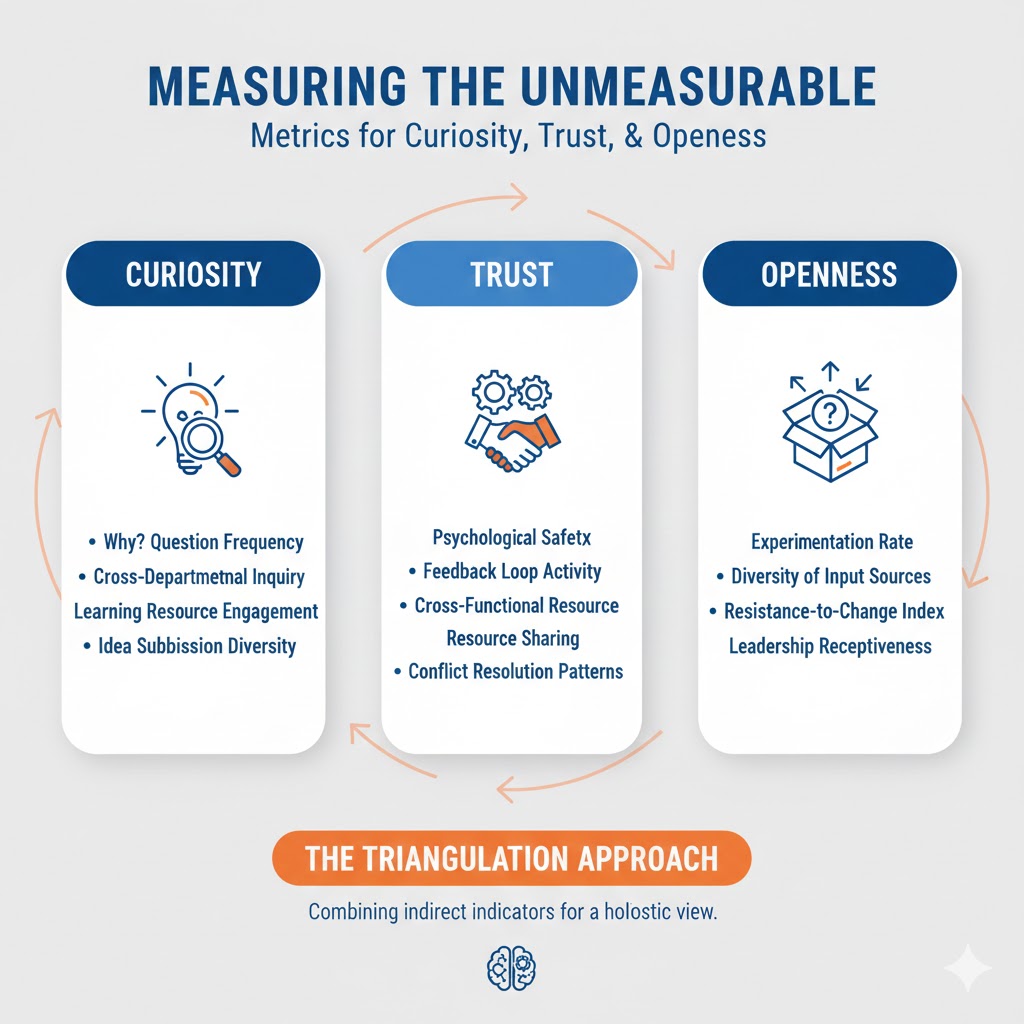
Visual representation: An infographic illustrating how indirect metrics (e.g., questions asked, cross-functional collaboration, idea submissions) can be proxies for Curiosity, Trust, and Openness.

The Triangulation Approach: Unlocking Hidden Insights

Measuring the unmeasurable is not about finding a single, perfect number. It’s about triangulation: combining multiple, often indirect, indicators to create a robust picture. Here’s how we can approach curiosity, trust, and openness:

1. Measuring Curiosity: The Fuel for Exploration

Curiosity is the impulse to explore, learn, and question. It drives individuals to seek new solutions and challenge assumptions. To measure it, look for behavioral proxies:

  • “Why?” Question Frequency: In meetings, workshops, and project discussions, track the number of times individuals or teams ask fundamental “why” questions rather than just “how” or “what.” A higher frequency suggests deeper inquiry.
  • Cross-Departmental Inquiry: Track the number of informal (coffee chats) and formal (shadowing, interviews) information-seeking interactions employees initiate outside their immediate team or department. Tools like communication platforms or internal social networks can help monitor this.
  • Learning Resource Engagement: Monitor engagement with internal learning platforms, external courses, industry reports, and innovation labs. How many unique topics are explored? How many non-mandatory courses are completed?
  • Idea Submission Diversity: Beyond just the number of ideas, analyze the breadth of domains or problem spaces addressed in idea submissions. Are people exploring completely new territories, or just iterating on existing ones?

By combining these, you can gauge whether your culture is merely allowing curiosity or actively fostering it.

2. Measuring Trust: The Foundation of Collaboration

Trust is the belief that others will act in good faith and that one’s vulnerabilities will not be exploited. It is essential for sharing nascent ideas and taking risks. Proxies for trust include:

  • Psychological Safety Index: Utilize anonymous surveys (e.g., Google’s Project Aristotle model) to gauge employees’ comfort level with speaking up, admitting mistakes, and sharing unconventional ideas without fear of negative repercussions. Focus on statements like, “If I make a mistake on this team, it is not held against me.”
  • Feedback Loop Activity: Track the volume and bidirectional nature of constructive feedback. Are people giving and receiving candid feedback freely, or is it primarily top-down and formal? High-trust environments foster frequent, informal feedback exchanges.
  • Cross-Functional Resource Sharing: Beyond simple collaboration, look at the willingness to share sensitive information, critical resources, or even temporary team members between departments. This indicates a deeper level of inter-team trust.
  • Conflict Resolution Patterns: Observe how conflicts are resolved. Is it through formal escalation (low trust) or direct, informal discussion and negotiation (high trust)?

A thriving innovation culture cannot exist without strong inter-personal and inter-team trust. Building this foundation is not soft; it is strategic.

3. Measuring Openness: The Gateway to New Possibilities

Openness is the willingness to consider new ideas, approaches, and perspectives, even if they challenge existing paradigms. It’s about shedding cognitive biases and embracing ambiguity. Metrics for openness include:

  • Experimentation Rate: Track the number of small-scale experiments, MVPs, and pilots initiated monthly. More importantly, measure the learning cycle time—how quickly experiments are run, results analyzed, and decisions made.
  • Diversity of Input Sources: Where do new ideas originate? Are they solely internal, or is there a strong influx from external sources (customer co-creation, academic partnerships, competitor analysis, diverse new hires)?
  • Resistance-to-Change Index: Use pulse surveys or qualitative interviews to identify explicit and implicit resistance to new processes, technologies, or strategies. Look for patterns in objections—are they evidence-based, or fear-based?
  • Leadership Receptiveness: Assess how often leaders genuinely seek out dissenting opinions, actively listen to junior staff ideas, and publicly acknowledge when their own assumptions were challenged and proven incorrect. This sets the tone for the entire organization.

Ultimately, openness determines an organization’s capacity for true transformation, not just incremental improvement.

Case Study 1: Reinvigorating a Stagnant R&D Lab

Challenge: Declining Innovation Output in a Legacy R&D Division

A global pharmaceutical company (“PharmaCo”) noticed its once-pioneering R&D lab was becoming risk-averse, producing fewer novel compounds. Direct output metrics remained stable due to incremental improvements, but true breakthrough innovation had stalled.

Measurement Intervention: Curiosity & Openness Proxies

PharmaCo introduced new “soft” metrics alongside traditional KPIs:

  • Curiosity: Tracked participation in cross-disciplinary “Lunch & Learn” sessions (informal scientific sharing), internal publication of research outside one’s core specialty, and spontaneous “deep dive” requests to the central knowledge repository.
  • Openness: Monitored the number of “negative result” reports (failures leading to new insights), external collaboration proposals, and employee-initiated “exploratory project” pitches outside core mandates.

The Innovation Impact:

By explicitly measuring and rewarding these proxies, PharmaCo shifted its culture. Within two years, cross-disciplinary “Lunch & Learns” increased by 300%, and “negative result” reports (previously buried) became celebrated learning documents. This led to a 15% increase in novel drug candidate proposals from unexpected combinations of research, demonstrating that measuring inputs can drive groundbreaking outputs.

Case Study 2: Building Inter-Departmental Trust in a Tech Giant

Challenge: Siloed Teams and Blame Culture Post-Acquisition

A rapidly growing tech company (“MegaTech”) experienced significant friction and blame-shifting between its engineering and product teams following a major acquisition. This eroded trust, slowed development cycles, and increased employee turnover in critical roles.

Measurement Intervention: Trust & Openness Proxies

MegaTech launched a Human-Centered Change initiative focusing on trust. Metrics included:

  • Trust: Anonymous pulse surveys on psychological safety (e.g., “I feel safe disagreeing with my manager”), and “shadowing days” where engineers spent a day with product teams, and vice versa.
  • Openness: Tracked the number of “feedback sessions” where teams collectively reviewed each other’s work (not just managers), and the explicit mention of “lessons learned” in post-mortems, rather than just “root causes.”

The Innovation Impact:

Over 18 months, the psychological safety score increased by 25%. More importantly, the quality and speed of conflict resolution improved dramatically, and employee retention in critical engineering roles stabilized. By making trust and openness measurable, MegaTech systematically dismantled silos, fostering a culture where inter-team learning and mutual respect became the norm.

Conclusion: The Strategic Imperative of Intangible Metrics

Ignoring curiosity, trust, and openness as “unmeasurable” is a strategic blunder. These are not optional nice-to-haves; they are the fundamental operating system of an innovative enterprise. By adopting a triangulation approach—combining observable behaviors, qualitative insights, and intelligent proxies—leaders can gain unprecedented visibility into the health of their innovation culture. This shift from purely output-driven metrics to input-driven insights is the next frontier of Human-Centered Change. Start measuring these “unmeasurables” today, and watch your innovation capacity soar.

“If you only measure the easy things, you’ll miss the most important things.” — Braden Kelley

Frequently Asked Questions About Measuring Intangible Metrics

1. Why are curiosity, trust, and openness considered “unmeasurable”?

They are often considered unmeasurable because they are subjective human qualities that cannot be directly counted or quantified in a simple numerical way. Traditional metrics focus on outputs (e.g., sales, production), whereas these are inputs that describe psychological states and behaviors, requiring more nuanced, indirect measurement approaches.

2. What is the “triangulation approach” to measurement?

The triangulation approach involves using multiple, different data sources and types (e.g., surveys, behavioral observations, usage logs) to gain a comprehensive understanding of an intangible quality. Instead of relying on a single “perfect” metric, it combines several indirect indicators to form a more robust and reliable picture.

3. How can I start measuring these in my own team?

Start small with a single proxy. For curiosity, try tracking “why” questions in team meetings. For trust, implement a quick, anonymous psychological safety pulse survey. For openness, monitor the diversity of idea sources. The key is to pick observable behaviors or simple self-reports and consistently track changes over time, then discuss the insights with your team.

Your first step toward measuring the unmeasurable: Convene your innovation leadership team. Instead of asking, “What new products did we launch?” ask, “What new questions did our team ask last month that challenged our core assumptions?” Document these, and you’ve begun to measure curiosity.

Extra Extra: Because innovation is all about change, Braden Kelley’s human-centered change methodology and tools are the best way to plan and execute the changes necessary to support your innovation and transformation efforts — all while literally getting everyone all on the same page for change. Find out more about the methodology and tools, including the book Charting Change by following the link. Be sure and download the TEN FREE TOOLS while you’re here.

Image credit: Pexels

Subscribe to Human-Centered Change & Innovation WeeklySign up here to get Human-Centered Change & Innovation Weekly delivered to your inbox every week.

The Secret Skill of the Modern Innovator

Psychological Flexibility

LAST UPDATED: December 7, 2025 at 12:43AM

The Secret Skill of the Modern Innovator - Psychological Flexibility

GUEST POST from Chateau G Pato

We celebrate the external skills of the innovator: the design thinking workshops, the pitch decks, the engineering prowess. But the greatest innovation hurdle is not external; it is internal. It is the human brain’s innate desire for certainty and comfort. Innovation, by definition, requires uncertainty, risk, and repeated failure. The skill that allows an individual and an organization to navigate this emotional terrain is Psychological Flexibility.

Psychological Flexibility is the ability to fully contact the present moment—including undesirable thoughts, feelings, and sensations—and, depending on what the situation affords, persist or change behavior in the service of chosen values. It’s the opposite of rigidity. Rigidity manifests in the innovation space as Idea Attachment (holding onto a failed concept too long) or Emotional Avoidance (shying away from projects that induce fear of failure). True Human-Centered Change demands that we unlearn avoidance and embrace the discomfort as a necessary input for growth.

Visual representation: A diagram illustrating the key components of Psychological Flexibility: Acceptance, Cognitive Defusion, Contact with the Present Moment, Self-as-Context, Values, and Committed Action.

The Four Practices of the Flexible Innovator

To cultivate this internal agility, innovators must master four practices adapted from Acceptance and Commitment Therapy (ACT):

1. Cognitive Defusion (Disentangling from Thoughts)

Innovation is besieged by self-doubt: “This idea is stupid,” “The market will never accept this,” or “I’m going to lose my job.” Cognitive Defusion is the practice of seeing thoughts not as literal truths, but as mere words or mental events. The flexible innovator does not try to fight or suppress the negative thought; they simply observe it and continue acting in alignment with their goal. The key phrase is, “I am having the thought that I will fail,” instead of “I will fail.” This distance creates mental space for bold action.

2. Values Clarity (Knowing the North Star)

Change often feels chaotic. Psychological Flexibility requires a clear, defined sense of Values Clarity. Why are we innovating? Is it to enhance customer dignity, improve planetary health, or simplify an essential process? When the inevitable setback occurs (a failed MVP, a budget cut), the innovator relies on their North Star values to guide the next move. They don’t pivot arbitrarily; they pivot toward the value, not away from the pain. This turns a moment of crisis into a Commitment Test.

3. Acceptance (Embracing the Error)

Innovation failure is data, but emotionally, it feels like rejection. Acceptance is not resignation; it is the active, non-judgmental embrace of uncomfortable emotions (frustration, anger, sadness) and market realities (the product is flawed). The rigid innovator wastes energy trying to rationalize or ignore the failure. The flexible innovator accepts the emotional hit, processes the data, and redirects that saved energy into Course Correction. This radically accelerates the Build-Measure-Learn loop.

4. Self-as-Context (Fluid Identity)

Many innovators tie their personal worth to the success of their project. When the project fails, their self-esteem is crushed. Self-as-Context means recognizing that one’s identity is the container holding all experiences, not the experiences themselves. The failure of Project X does not mean “I am a failure.” It means “The container is holding the experience of a failed project.” This internal decoupling protects the innovator’s psychological resources, allowing them to remain resilient and return to the challenge without the debilitating fear of identity loss.

Case Study 1: The Media Company’s Content Pivot

Challenge: Market Collapse of Traditional Revenue Stream

A mid-sized media conglomerate (“GlobalNews”) saw its core print advertising revenue rapidly evaporate. The leadership team had spent years successfully managing a highly stable business, and the sudden shift induced profound anxiety and Cognitive Fusion with limiting beliefs (“We are print people,” “Digital is too chaotic”).

Flexibility Intervention: Values-Driven Defusion

The CEO mandated a Human-Centered Change program focusing on psychological skills. The team practiced Cognitive Defusion to observe their limiting thoughts without acting on them. The core value was redefined from Delivering Print to Delivering Trusted Information. They accepted the pain of losing their old model (Acceptance) and used the value of Trusted Information to pivot.

  • The pivot was towards building a paywalled, high-fidelity data analytics service for businesses, not just a news website.
  • The value (Trust) defined the new product’s identity and its business model, moving them out of the volatile ad market.

The Innovation Impact:

By using their core value as the flexible guide and practicing defusion, the team avoided the rigid response of simply cutting costs or doubling down on failed strategies. They achieved a strategic pivot within 18 months, leveraging their expertise in a new, high-growth format, driven entirely by their newfound psychological tolerance for market upheaval.

Case Study 2: The Software Team’s Feature Kill

Challenge: Attachment to a High-Cost, Low-Value Feature

A software development team (“HelixTech”) spent six months and significant budget on a highly complex, technically impressive new feature. Upon launch, Big Data revealed near-zero user adoption. The product manager, having personally championed the feature, experienced intense Idea Attachment and resisted the recommendation to “kill” the feature.

Flexibility Intervention: Acceptance and Self-as-Context

The leadership team intervened by applying the Acceptance and Self-as-Context practices. They explicitly coached the manager: “The failure of Feature Z is not a failure of your competence. It is data showing an unmet customer need.” They asked the manager to practice accepting the data and the resulting negative emotion (frustration/embarrassment) as temporary states, not definitions of self.

  • The manager was then empowered to lead the decommissioning project, re-framing the effort as cleaning up the roadmap (a new valued action).
  • The time saved was immediately reinvested in a small, customer-validated MVP, allowing the manager to instantly re-engage in creative work.

The Innovation Impact:

By separating the innovator’s identity from the idea’s outcome, HelixTech avoided the common inertia where teams waste months supporting defunct features. The quick Acceptance and re-framed Committed Action allowed the team to recover the initial investment of time and maintain high morale, reinforcing the organizational value that failure is simply a learning input.

Conclusion: Building Resilient Organizations

Psychological Flexibility is not a soft skill; it is the hardest skill in innovation. It is the prerequisite for speed, resilience, and true market responsiveness. Organizations focused on Human-Centered Change must recognize that the biggest brake on progress is the collective rigidity of their people, fueled by fear and the desire for emotional comfort. By embedding the practices of Cognitive Defusion, Values Clarity, Acceptance, and Self-as-Context, leaders don’t just build resilient innovators; they build resilient organizations capable of navigating any disruptive shift.

“Innovation is a contact sport. You must be willing to feel the pain of rejection and keep moving towards successful value creation that can overcome market inertia.” — Braden Kelley

Frequently Asked Questions About Psychological Flexibility

1. How does Psychological Flexibility differ from simple Resilience?

Resilience is typically defined as the ability to bounce back from adversity. Psychological Flexibility is a broader, active skill set: the ability to engage fully with painful or undesirable thoughts and feelings (Acceptance) while simultaneously taking effective action aligned with one’s values. It’s about adapting behavior in the face of internal discomfort, not just enduring it.

2. What is “Cognitive Fusion” and why does it stop innovation?

Cognitive Fusion is when a person believes their thoughts are literal truths that must be acted upon or obeyed (e.g., “I am stupid” means I cannot try the hard project). This stops innovation because it prevents the individual from taking valued risks when the inevitable, self-critical thoughts arise. Cognitive Defusion is the opposite skill, allowing the innovator to observe the thought without obeying it.

3. How can a team encourage the practice of “Acceptance”?

Teams encourage Acceptance by making failure an explicit, non-punitive data event. This involves celebrating the learning derived from a failed experiment, publicly discussing the difficult emotions that arose, and immediately reassigning resources to the next valued action. It shifts the culture from failure avoidance to learning acceleration.

Your first step toward cultivating Psychological Flexibility: The next time a new project feels overwhelming or terrifying, pause. Don’t fight the fear. Simply acknowledge it by saying internally, “I am having the feeling of fear, and I choose to start the first task anyway.” Use your values, not your feelings, to guide your immediate action.

Extra Extra: Because innovation is all about change, Braden Kelley’s human-centered change methodology and tools are the best way to plan and execute the changes necessary to support your innovation and transformation efforts — all while literally getting everyone all on the same page for change. Find out more about the methodology and tools, including the book Charting Change by following the link. Be sure and download the TEN FREE TOOLS while you’re here.

Image credit: Pexels

Subscribe to Human-Centered Change & Innovation WeeklySign up here to get Human-Centered Change & Innovation Weekly delivered to your inbox every week.
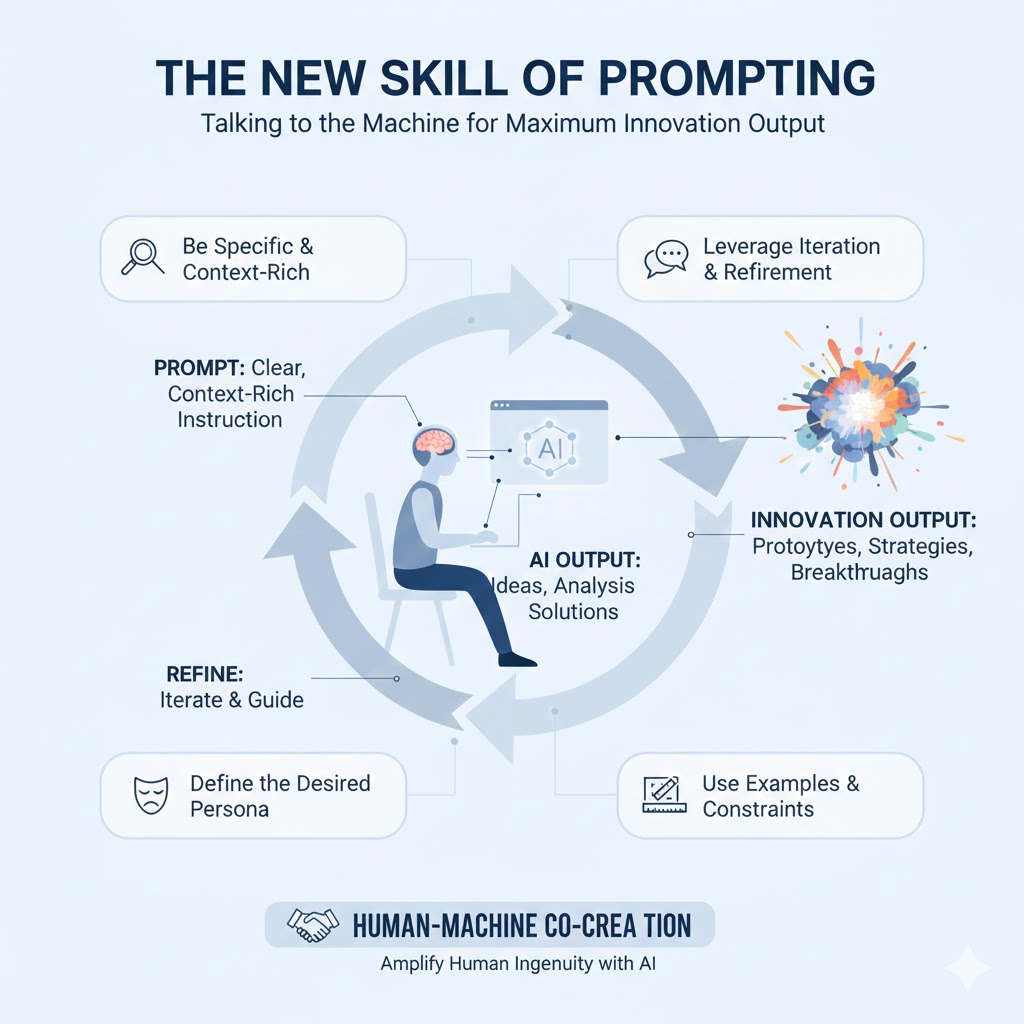
How to Make Virtual Experiences Feel Real

Designing for Presence

LAST UPDATED: December 6, 2025 at 11:05AM

How to Make Virtual Experiences Feel Real

GUEST POST from Chateau G Pato

In the world of Human-Centered Innovation, the most powerful tool is often one that can induce a profound psychological shift. Virtual Reality (VR) promises this, but only if it can successfully convince the brain that the experience is real. This is the concept of Presence, and it is defined by the degree to which a user’s consciousness ignores the physical world and accepts the virtual world as the immediate, sensory reality.

Why does this matter for business strategy? When presence is achieved, training is dramatically more effective, collaboration fosters stronger empathy, and therapeutic interventions yield lasting results. When the brain is truly present, the resulting learning and behavioral changes are transferred more reliably back into the real world. We must unlearn the focus on simple immersion and embrace the deep, psychological design principles that create Authentic Presence.

Visual representation: A diagram illustrating the key factors contributing to Virtual Presence: Fidelity, Consistency, and Interactivity.

The Three Pillars of Authentic Presence

Designing for presence requires mastering three non-negotiable psychological and technical pillars. A failure in any one can shatter the illusion of reality, breaking the user’s immersion and effectiveness.

1. Sensorimotor Consistency (No Sickness, No Lag)

The brain’s biggest alarm system is vestibular mismatch (the feeling of motion sickness). If the visual input (seeing motion) does not perfectly match the inner ear’s input (feeling motion), the sense of presence collapses. Therefore, the absolute priority is low-latency tracking (minimal lag) and a high, stable frame rate. When designing a physical training environment, any lag in hand tracking or head movement instantly reminds the user they are wearing a headset. Consistency is not a feature; it is the foundation of reality.

2. Interpersonal Fidelity (The Uncanny Valley of Avatars)

Presence is intensely social. In collaborative VR environments, your avatar and the avatars of your colleagues must move beyond cartoony representations toward Interpersonal Fidelity. This means realistic eye contact, micro-expressions, and hand gestures. The moment you look at a colleague’s avatar and their eyes don’t track your movement correctly — the Uncanny Valley — the emotional connection and, thus, the sense of co-presence are lost. True innovation in virtual meetings must prioritize realistic social cues to enable Authentic Collaboration.

3. Real-Time Physical Agency (The Power to Affect the World)

Presence is cemented when the user can act on the virtual world and receive an immediate, consistent, and logical response. This is Physical Agency. If you reach out to grab a virtual pen and your hand passes straight through it, the brain registers the environment as fake. Every object the user is expected to interact with must have realistic physics, weight, and haptics (via controllers). The ability to truly manipulate the environment is what transforms passive viewing into active engagement and learning.

Case Study 1: High-Stakes Crisis Training

Challenge: Ineffective Role-Playing for Emergency Responders

A national fire and rescue service (“FirstResponse”) found traditional simulation and role-playing exercises to be costly, logistically complex, and emotionally insufficient. Trainees knew they were “faking it,” leading to limited transfer of knowledge when faced with a real-world crisis.

Presence Intervention: Emotional Immersion

FirstResponse implemented VR training for high-stakes emergencies (e.g., collapsed buildings, active hazards). The design team focused heavily on Sensorimotor Consistency (perfect tracking and low lag to prevent sickness during fast movement) and, critically, added immersive audio cues (the sound of debris falling, realistic panic, and muffled radio communications).

  • Trainees reported experiencing the fight-or-flight response identical to real-world scenarios, a direct result of strong presence.
  • The virtual environment allowed for failure consequence (e.g., virtual casualty count), which built muscle memory for managing extreme emotional stress — a key learning outcome impossible to simulate safely otherwise.

The Innovation Impact:

Because the brain experienced the virtual environment as real (Presence), the cognitive and emotional stress responses were authentic. This led to a measured 40% reduction in response time errors during subsequent real-world exercises. The innovation successfully focused on emotional fidelity to drive lasting behavioral change.

Case Study 2: Architectural Co-Design and Empathy

Challenge: Misalignment and Lack of Empathy Between Architects and Clients

A global architectural firm (“FutureBuild”) struggled with design reviews, often finding that clients couldn’t visualize blueprints, leading to late-stage, costly change orders. Furthermore, architects lacked empathy for how a space would truly feel to a non-expert.

Presence Intervention: Shared Physical Agency

FutureBuild adopted shared, mixed-reality co-design sessions. Both the architect and the client (as realistic avatars) could walk through a holographic projection of the building on the physical table.

  • The system prioritized Interpersonal Fidelity by accurately tracking head gaze and pointing gestures between the two people.
  • They emphasized Real-Time Physical Agency: the architect could virtually grab a wall and move it, and the client could “paint” a surface with a different texture, instantly seeing the change.

The Innovation Impact:

By giving the client physical agency within the design, the sense of co-presence allowed for a level of communication and feedback impossible on a flat screen. Clients identified problems (e.g., “The ceiling feels too low when I stand here”) that were based on true spatial feeling, not just interpretation of lines on a page. The firm saw a 60% reduction in late-stage design modifications because they successfully utilized shared reality to accelerate mutual understanding and Human-Centered Decision Making.

Conclusion: Presence as the ROI of Spatial Computing

The return on investment (ROI) for spatial computing is not measured in hardware units sold, but in the intensity of Presence achieved. When you design a virtual experience, you are not building a game; you are constructing a temporary, alternate reality. To be effective, this reality must adhere to the neurological laws of the human mind.

Leaders must mandate that their innovation teams unlearn the focus on simple graphical output and prioritize the three pillars: Sensorimotor Consistency, Interpersonal Fidelity, and Real-Time Physical Agency. When the technology fades into the background, and the reality of the environment takes over, Authentic Presence is achieved—and that is where true, lasting change begins.

“The goal of VR is not to simulate reality; it is to create a reality that is perceived as authentic.”

Frequently Asked Questions About Designing for Presence

1. What is “Presence” in the context of virtual experiences?

Presence is the subjective, psychological phenomenon where a user’s consciousness fully accepts the virtual environment as their immediate, sensory reality, causing them to temporarily forget their actual physical surroundings. It is the key factor enabling effective learning and behavioral transfer from the virtual world to the real world.

2. Why is Sensorimotor Consistency the most critical pillar for Presence?

Sensorimotor Consistency (low lag, high frame rate) is critical because vestibular mismatch — when visual movement doesn’t match inner ear motion — immediately triggers the brain’s alarm systems, causing motion sickness and shattering the illusion of presence. If the brain detects inconsistency, it cannot accept the virtual environment as real.

3. What is the “Uncanny Valley” effect in VR design?

The Uncanny Valley refers to the unsettling feeling that occurs when avatars or synthetic human representations are *almost* perfectly realistic but have small, subtle flaws (like poor eye tracking or delayed micro-expressions). These flaws break Interpersonal Fidelity and cause emotional discomfort, instantly destroying the sense of “co-presence” in a shared virtual space.

Your first step toward designing for Presence: Hold a review session for your existing VR/MR training program. Instead of asking, “Did the user complete the task?” ask, “Did the user physically flinch, hesitate, or exhibit any signs of motion or social discomfort?” Use these physical cues to identify and eliminate the moment where Presence was broken.

Extra Extra: Because innovation is all about change, Braden Kelley’s human-centered change methodology and tools are the best way to plan and execute the changes necessary to support your innovation and transformation efforts — all while literally getting everyone all on the same page for change. Find out more about the methodology and tools, including the book Charting Change by following the link. Be sure and download the TEN FREE TOOLS while you’re here.

Image credit: Unsplash

Subscribe to Human-Centered Change & Innovation WeeklySign up here to get Human-Centered Change & Innovation Weekly delivered to your inbox every week.

How to Use Human-Scale Insights to Pivot Strategy

Small Data, Big Impact

LAST UPDATED: December 5, 2025 at 3:32PM

How to Use Human-Scale Insights to Pivot Strategy

GUEST POST from Chateau G Pato

Your analytics dashboard can tell you what happened: 70% of users abandoned the checkout process at Step 3. Big Data is superb at identifying this pattern. But it is fundamentally incapable of telling you why that abandonment occurred. Was the font confusing? Was the payment system counter-intuitive? Did the user get distracted by a child? The answer to the why requires Small Data.

Small Data refers to the qualitative, non-numerical, contextual information collected through human observation, deep empathy, and ethnographic research. It is the core of Human-Centered Innovation. Strategy that pivots based solely on aggregated trends risks being perpetually incremental. True, disruptive pivots are always rooted in a single, profound Human-Scale Insight — the realization of an unmet need that Big Data cannot quantify because the need is emotional, procedural, or cultural.

The Three-Step Small Data Strategy Pivot

To effectively leverage Small Data, organizations must embed a simple, three-step human-centered process:

1. Embrace Ethnographic Immersion (Discovery)

Strategy cannot be designed purely from behind a desk. Leaders must mandate and participate in ethnographic immersion. This involves frontline engagement: watching how a customer actually uses a product in their home, observing the communication patterns of a surgical team, or shadowing a field technician. The goal is to collect thick description — detailed, contextual field notes that capture the environment, mood, and exact procedural friction points. This practice requires organizational humility and a commitment to unlearn existing assumptions about the customer.

2. Synthesize for “Job-to-be-Done” (Analysis)

Once Small Data is collected, the analysis must focus on the Job-to-be-Done (JTBD) framework. JTBD moves analysis away from product features toward human motivation. Instead of asking, “Why did they buy our software?” ask, “What progress was the customer trying to make in their life when they hired our software?” The qualitative data often reveals that customers hire your product for a completely different job than you think. This Human-Scale Insight is the most common driver of strategic pivots because it exposes an entirely new market definition.

3. Operationalize the Anecdote (Action)

The single greatest challenge for Small Data is scaling it up against the perceived weight of Big Data. To pivot strategy, the Human-Scale Insight must be translated into a compelling narrative and immediately tested as a Minimum Viable Product (MVP). The anecdote must be operationalized. Instead of saying, “We should change the user interface,” say, “During the home visit, Jane mentioned she feels anxious when the software asks for her social security number three times. We need to test an MVP that reduces that anxiety by asking once and explaining the ‘why’ with clear, non-legalistic language.” This grounds the change in empathy and provides clear, immediate action.

Case Study 1: The Insurance Company’s Claims Process Pivot

Challenge: Low Digital Adoption Despite App Redesign

A major insurance provider (“SecureCo”) launched a highly publicized, expensive app redesign to modernize its claims process. Big Data analytics confirmed the app was technically sound, yet 80% of major claims were still submitted via phone call or physical mail. The Big Data showed what was happening, but offered no useful path for a strategic pivot.

Small Data Intervention: Ethnographic Claims Shadowing

A human-centered innovation team decided to shadow a handful of claimants. They observed one customer, an elderly woman named Helen, trying to submit a complex claim. The Small Data revealed the following Human-Scale Insight: Helen wasn’t confused by the interface; she was terrified of making a single, irrecoverable mistake that would void her payment.

  • The app’s clean, modern interface, which minimized text to look “sleek,” made her feel unsupported.
  • The phone call, despite the wait time, provided the emotional reassurance that a human was accountable for her process.

The Strategic Pivot: Designing for Emotional Safety

The strategic pivot was not a technical fix, but an emotional one. SecureCo unlearned the assumption that speed was the top priority. They redesigned the app to include a permanent, dedicated “Help Desk Chat” button staffed by a specific, named agent for complex claims. They introduced a feature that explicitly allowed the user to undo any step, assuring them that the process was safe. By focusing on the human fear of permanent error (Small Data), the company achieved a 75% digital adoption rate for complex claims within nine months, proving that emotion drives adoption.

Case Study 2: The SaaS Firm’s Enterprise Feature Failure

Challenge: Zero Adoption of a Flagship Enterprise Feature

A B2B SaaS company (“DataStream”) developed a powerful, highly complex “Advanced Analytics Module” for its largest enterprise clients. Despite being a required feature in high-cost contracts, Big Data showed near-zero usage. Usage logs confirmed that every user who clicked the module abandoned it within 30 seconds.

Small Data Intervention: “Desk-Side” Observation

The innovation team conducted in-person, desk-side observation with five key users at a major client. The Small Data analysis showed that the official reason for the product’s existence — “complex data correlation” — was not the user’s Job-to-be-Done. The users were highly stressed analysts who needed a quick snapshot to answer a simple, recurring question from their executive team: “Is this number trending up or down today?”

  • The Advanced Analytics Module required 15 clicks and 5 minutes to generate this answer (procedural friction).
  • The analysts were actually hiring a spreadsheet hack, a complicated but reliable 30-second shortcut they had built themselves.

The Strategic Pivot: The “Executive Answer”

DataStream performed a major strategic pivot, unlearning the notion that “more complex is more valuable.” They immediately launched an MVP dashboard called the “Executive Answer” (Stage 3). This dashboard, which used the same backend data, generated the required snapshot in a single click. The pivot was based entirely on observing five users and understanding their actual Job-to-be-Done. Usage of the original, complex module remained low, but usage of the new, Small-Data-driven dashboard became mandatory within all top-tier accounts, significantly improving client retention.

Small Data as the Change Fuel

Big Data provides the destination (e.g., “Grow revenue 15%”). Small Data provides the ignition — the human-scale insight needed to change course dramatically. Strategic change is often blocked by inertia and a fear of the unknown. By grounding a strategic pivot in a specific, observable human anecdote, leaders can create a compelling narrative that overcomes organizational resistance. The clarity and empathy derived from Small Data is the most potent fuel for Human-Centered Innovation.

“If Big Data is the map, Small Data is the compass that tells you the correct direction of travel.”

Frequently Asked Questions About Small Data

1. What is Small Data and how is it different from Big Data?

Big Data is aggregated, quantitative, and large-scale (the what and how many). Small Data is qualitative, contextual, and human-scale (the why and how). Small Data is collected through deep observation, ethnographic research, and in-depth interviews, focusing on a small number of users to gain deep, empathetic insights into their emotional and procedural friction points.

2. What is a “Human-Scale Insight”?

A Human-Scale Insight is a profound realization about user behavior, often revealed by Small Data, that exposes a latent or unmet need, emotional driver, or procedural friction point. This insight often reframes the “Job-to-be-Done” and is potent enough to drive a strategic pivot—changing not just how a product works, but why the company offers it.

3. Why is organizational “Humility” required to use Small Data effectively?

Humility is required because effective Small Data collection, like ethnographic immersion, demands that leaders and designers unlearn their existing assumptions about the customer and admit that the company may not understand the user’s true needs. It requires leaving the boardroom and observing the customer in their own environment, often revealing uncomfortable truths about product failure.

Your first step toward leveraging Small Data: Choose a product feature with low adoption, but high perceived value. Find three customers who stopped using it. Send a designer or product manager to spend 90 minutes observing them use a competitor’s product. Document the friction points, and use that Small Data to define a simple, empathetic MVP.

Extra Extra: Because innovation is all about change, Braden Kelley’s human-centered change methodology and tools are the best way to plan and execute the changes necessary to support your innovation and transformation efforts — all while literally getting everyone all on the same page for change. Find out more about the methodology and tools, including the book Charting Change by following the link. Be sure and download the TEN FREE TOOLS while you’re here.

Image credit: Pixabay

Subscribe to Human-Centered Change & Innovation WeeklySign up here to get Human-Centered Change & Innovation Weekly delivered to your inbox every week.