Aligning Distinct Behavioral Archetypes with Stages of Growth
GUEST POST from Chateau G Pato
The Human Engine of Growth
Too often, organizations face an invisible wall. They have the capitalization, the market opportunity, and a product that shows immense promise, yet scaling stalls. Leaders pore over financial models, tweak operational processes, and restructure reporting lines, completely missing the underlying reality: companies fail to scale because they have the wrong human behaviors driving the wrong stage of growth. Growth is not merely a sequence of financial milestones; it is a human evolution.
The Paradigm Shift: From Persona to Archetype
For years, design and marketing have leaned heavily on static personas—demographic and psychographic snapshots of who people are. But in the fast-moving landscapes of innovation and change management, who someone is matters far less than how they act, think, and decide under pressure.
By shifting our focus toward fluid behavioral archetypes, we unlock a deeper understanding of organizational chemistry. Archetypes capture dynamic mindsets and problem-solving styles. When we map these behavioral patterns to the distinct horizons of business expansion, we gain the ability to intentionally design the human ecosystem required for sustained success.
The Core Thesis
Sustainable innovation, seamless customer experiences, and successful organizational scaling require leaders to dynamically align distinct behavioral archetypes with the specific cultural and strategic demands of each growth stage. To try to solve tomorrow’s scaling problems with yesterday’s behavioral archetypes is a recipe for stagnation. Success lies in matching the right mindsets to the right moment.
Demystifying Behavioral Archetypes vs. Growth Stages
To build a truly agile, human-centered organization, we must first change how we look at our people. Traditional demographic profiles or rigid job descriptions are no longer sufficient. Innovation and digital transformation require a shift toward behavioral archetypes—and a clear understanding of how these mindsets interact with the natural lifecycle of organizational growth.
Why Behavioral Archetypes Supercharge Innovation and Change
Unlike traditional personas, which anchor people to static identities or demographic boxes, behavioral archetypes focus purely on mindsets, decision-making patterns, and operational motivations. They answer the critical questions: How does this person approach ambiguity? What drives their problem-solving? How do they handle risk?
In times of rapid change, archetypes allow leaders to look past job titles and tap into the underlying cognitive diversity of their workforce. By focusing on behavioral archetypes rather than static roles, organizations can build fluid, cross-functional teams optimized for specific challenges, fostering an environment where Adaptability Quotient (AQ) can truly thrive.
The Lifecycle of Growth: From Inception to Renewal
Every product, service, or organization moves through a predictable lifecycle of evolution. While various business models slice these phases differently, from a human and experience design perspective, growth breaks down into four critical cultural horizons:
- Inception & Exploration: Navigating extreme ambiguity to uncover deep customer needs and find a problem worth solving.
- Validation & Fit: Turning raw, chaotic ideas into a structured, repeatable, and high-value customer experience.
- Acceleration & Scaling: Stripping out operational friction, optimizing processes, and expanding market reach rapidly.
- Maturity & Renewal: Protecting and optimizing the highly successful core business while actively exploring the next S-curve of growth.
The Friction Point: When Mindsets and Milestones Misalign
The most dangerous operational blind spot occurs when an organization successfully transitions to a new growth phase financially or structurally, but its culture remains stuck in the previous one. This mismatch creates severe organizational friction.
For instance, if a company enters the Scaling phase but tries to run it using the chaotic, highly unstructured behavioral mindsets that worked beautifully during Inception, the result is operational whiplash and strategic burnout. Conversely, injecting highly rigid, process-driven optimization mindsets into the early Exploration phase will suffocate creativity before it can take root. Recognizing and proactively managing this alignment is the core responsibility of modern leadership.
Mapping the Matrix: Archetypes Aligned to Growth Stages
To successfully navigate the organizational lifecycle, leaders must intentionally place specific mindsets at the helm of each stage. Below is the behavioral blueprint for matching human archetypes to business horizons.
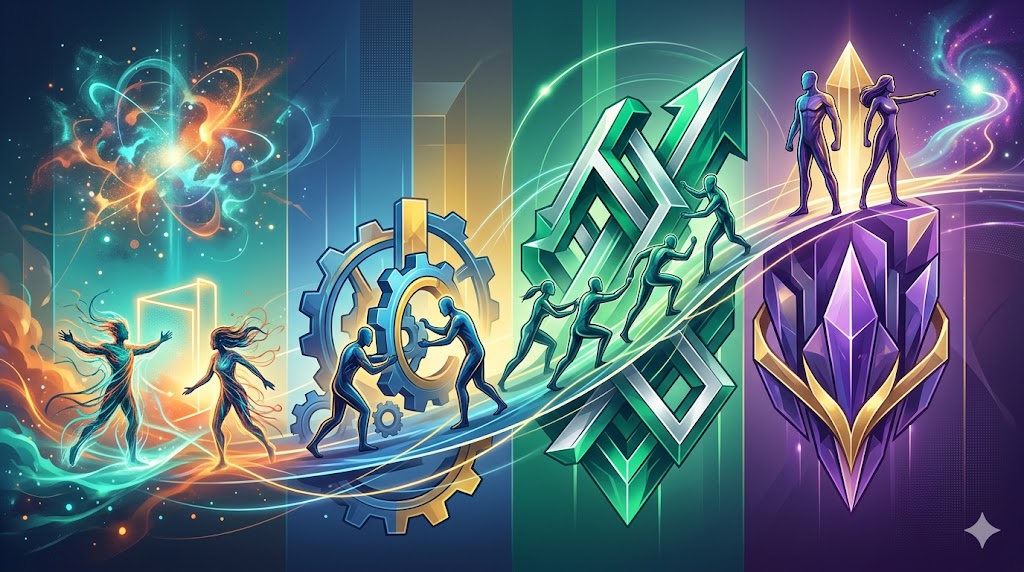
Stage 1: Inception & Exploration (The “Zero to One” Phase)
Primary Objective: Finding a problem worth solving under conditions of extreme ambiguity.
The Ideal Archetype: The Catalyst Explorer
- Key Characteristics: High tolerance for ambiguity, deeply empathetic listener, naturally curious, comfortable with rapid failure and pivot cycles.
- Role in this Stage: The Catalyst Explorer is built to wade into chaos. They excel at talking to customers, looking past surface-level complaints, and uncovering deep, unspoken frustrations. They do not look for clean data; they look for friction points and insights.
- Strategic Impact: They prevent the organization from falling in love with a solution too early, ensuring that the initial value proposition is rooted in a real, deeply felt human need rather than internal assumptions.
Stage 2: Validation & Product-Market Fit (The “One to Ten” Phase)
Primary Objective: Proving commercial value, refining the experience, and establishing a repeatable value delivery model.
The Ideal Archetype: The Value Architect
- Key Characteristics: Expert pattern-recognizer, holistic systems thinker, analytical yet user-obsessed, highly iterative refiner.
- Role in this Stage: If the Explorer finds the raw gold, the Value Architect builds the mine. They take the raw insights and scattered prototypes from Stage 1 and translate them into a structured, functional, and repeatable customer journey. They bridge the gap between creative chaos and operational commercialization.
- Strategic Impact: They ensure that the product or service isn’t just a “good idea,” but a stable, high-value ecosystem that can reliably deliver an exceptional user experience at a justifiable cost.
Stage 3: Acceleration & Scaling (The “Ten to One Hundred” Phase)
Primary Objective: Rapid market expansion, organizational optimization, and stripping out operational friction.
The Ideal Archetype: The Scalability Evangelist
- Key Characteristics: Highly collaborative, process-oriented, champion of operational excellence, master of cross-functional alignment.
- Role in this Stage: This phase requires a cultural shift from “building” to “multiplying.” The Scalability Evangelist codifies the experience. They build the playbooks, break down operational silos, and ensure that as the company grows by 10x or 100x, the core quality of the human experience doesn’t degrade. They evangelize the vision across expanding teams.
- Strategic Impact: They remove individual dependencies, turning a bespoke operation into an optimized growth machine capable of handling volume without losing its cultural or experiential soul.
Stage 4: Maturity, Continuous Improvement & Renewal (The “One Hundred to Beyond” Phase)
Primary Objective: Defending core market share while simultaneously identifying and seeding the next S-curve of growth.
The Ideal Archetype: The Dual-Drive Futurist
- Key Characteristics: Long-term vision, cognitively ambidextrous, risk-intelligent, capable of balancing present operations with future possibilities.
- Role in this Stage: Mature organizations naturally default to complacency and risk aversion. The Dual-Drive Futurist fights this inertia. They possess the unique ability to respect and protect the highly profitable core business (the “Cash Cow”) while simultaneously advocating for, funding, and protecting the fragile new innovations that will replace it tomorrow.
- Strategic Impact: They prevent corporate obsolescence. By constantly injecting fresh, human-centered foresight back into the mature ecosystem, they trigger a renewal phase before the decline curve sets in.
The Dilemma of the “Archetype Shift” (Managing the Change)
Identifying the right archetypes is only half the battle; the real test of leadership lies in managing the transitions between them. As an organization successfully moves from one stage of growth to the next, the dominant cultural mindset must shift accordingly. This transition is rarely seamless, and if unmanaged, it creates profound organizational friction and human anxiety.
The Human Cost of Growth
Growth is inherently disruptive to the human ecosystem. When a company transitions, for example, from validation to rapid scaling, the unconstructed freedom that early employees loved is replaced by standard operating procedures and metrics.
The “Catalyst Explorers” who thrived in the chaotic early days may feel constrained, micromanaged, or sidelined by the arrival of process-driven “Scalability Evangelists.” Conversely, if a company needs to pivot and reinvent itself, employees optimized for optimization may resist the sudden reintroduction of ambiguity. Left unaddressed, these shifts lead to cultural fracturing, loss of key talent, and operational paralysis.
The Leader’s Responsibility: Intentional Realignment and Upskilling
Thoughtful leadership requires recognizing that people do not need to be discarded when a growth stage changes; instead, their focus must be intentionally realigned. Leaders must act as talent orchestrators by taking the following steps:
- Conduct Regular Mindset Audits: Continually evaluate the Adaptability Quotient (AQ) and natural behavioral inclinations of the team against the current strategic horizon.
- Provide Clear Paths for Upskilling: Help team members understand how their core strengths can manifest differently in a new phase—such as helping an Explorer apply their deep customer empathy to training new hires during a scaling phase.
- Honor Past Contributions: Ensure that the foundational work of previous stages is celebrated, preventing a cultural divide between the “old guard” and “new scaling experts.”
Designing Organizational On-Ramps and Off-Ramps
To prevent friction, organizations must design explicit behavioral handoffs. This means creating a psychologically safe environment where one archetype can gracefully pass the baton to the next.
For instance, when a product moves from validation to scaling, a formal “hand-off architecture” should be established. The Value Architects should collaborate directly with the Scalability Evangelists, ensuring that the operational blueprints preserve the core integrity of the original user experience. By designing these structural on-ramps and off-ramps, leadership transforms what could be a jarring disruption into a smooth, predictable, and empowering cultural evolution.
Conclusion: Designing a Dynamic Human Ecosystem
Growth is never a purely financial, structural, or technological milestone—it is fundamentally a human journey. The most beautifully architected digital transformation strategy or the most disruptive innovation pipeline will stall if the organization fails to align its dominant human behaviors with the strategic needs of the moment. True organizational agility requires looking past static personas and rigid job descriptions to embrace the fluid power of behavioral archetypes.
The Ultimate Innovation Lever
By intentionally orchestrating the transitions from Catalyst Explorers to Value Architects, expanding through Scalability Evangelists, and constantly renewing via Dual-Drive Futurists, leadership builds a sustainable engine for continuous growth. This intentional alignment doesn’t just drive market value; it creates a thriving, high-AQ workplace culture where individuals are uniquely positioned to do their best work exactly when the company needs it most.
A Call to Action for Modern Leaders
As you look at your own organization or product portfolio today, look past the quarterly metrics and ask yourself the tougher human questions:
- What growth horizon are we actually operating in right now?
- Are we trying to solve tomorrow’s complex scaling and optimization challenges with yesterday’s unstructured, exploratory mindsets?
- Are we suffocating our next big growth engine by forcing it through rigid, mature operational frameworks too early?
The blueprint for sustained innovation lies in matching the right mindsets to the right moment. Audit your human ecosystem, design your behavioral hand-offs with empathy and intention, and build an organization capable of evolving as fast as the future demands.
Frequently Asked Questions
How do behavioral archetypes differ from traditional user personas?
Traditional personas anchor individuals to static demographic and psychographic profiles (who they are). Behavioral archetypes focus purely on fluid mindsets, decision-making patterns, and operational motivations (how they act under pressure). This makes archetypes far more effective for managing dynamic organizational change and innovation timelines.
What is the biggest mistake leaders make when transitioning between growth stages?
The most common failure point is “mindset misalignment”—trying to solve a new stage’s problems with the previous stage’s behaviors. For example, forcing a creative exploration team to follow rigid scaling processes too early suffocates innovation, while attempting to scale a business using chaotic, unstructured early-stage mindsets leads to operational burnout.
How can a leader assess if their team has the right Adaptability Quotient (AQ) for growth?
Leaders can conduct regular mindset audits to evaluate how team members handle risk, respond to ambiguity, and collaborate across silos. Measuring AQ involves observing behavioral patterns during rapid pivots rather than relying on fixed job descriptions or technical skill sets.
Image credit: Gemini
 Sign up here to get Human-Centered Change & Innovation Weekly delivered to your inbox every week.


 “Innovation can come from anyone, but it is required from everyone for an organization to remain successful.”