by Braden Kelley and Linda Bernardi
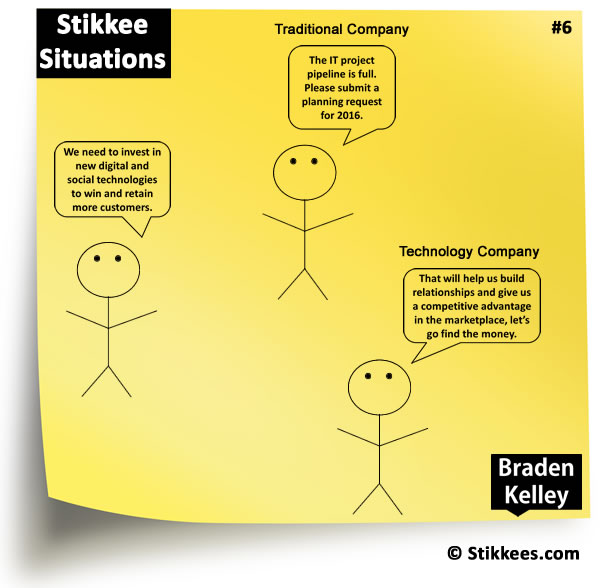
Even in 2014, there are business sectors who feel they are not ‘tech companies’. News flash: Whether you are a consumer products company, an insurance company, a hotel, or a pharmaceutical company, your business is a technology business. Why?
Technology is the link between any business and its customers. To say technology is not core to your business strategy, means you think customers are not the key to your business success. So, your business is a technology business whether you want it to be or not.
Today technology is how you market and sell your products, make your business more efficient, and most importantly, how you stay connected to your customers. Some companies mistake the importance of technology to mean that they need to open a twitter account and monitor social media, put in an ERP and CRM system, and revamp their web site. But the importance of technology in today’s business environment is more than that.
ERP and CRM are common tools, a requirement to remain competitive, and while social media and the internet are important to sales and marketing success, they are becoming yesterday’s news as customers develop deeper connections to their mobile devices. If you aren’t on their devices and interacting in a meaningful way with them there in real-time, you won’t stay connected to them in the long run.
Let’s look at the impact on a few different industries whose members tend not to see themselves as technology companies:
1. Fortune 100 consumer product goods (CPG) companies
2. Hotel Chains
3. Big Box Retailers
1. Fortune 100 CPG companies typically manufacture large quantities of consistent products and have visually pleasing (static) web pages for consumers. But they don’t use technology well enough to detect what the market wants before it knows it, often fail to personalize or customize products to customer needs, and usually lack the online networks that could help connect other customer product needs together into new potential product ideas that the company could co-create with their customers. Often connection means post mortem analytics on data collected in the past, or, analyzing previous customer interactions with static web pages. Creating authentic customer connections requires online and mobile technology these companies usually don’t possess. I don’t mean apps (which often are pretty much the same as a website), but new physical/online/mobile engagement models that inspire customers to stay connected to the company (and each other) in a dynamic, evolving community. Rethinking is needed here. The customer is not just a buyer but an influencer. If CPG companies want to sell that next bottle of $300 facial cream, they better consider delighting, and not just marketing to, their customer base.
2. AirBnB has proven to be a major disruptive force in the hotel and hospitality business, grabbing a massive foothold in a market that the Homeaway.com member companies created and should have dominated. Resistance to AirBnB is massive and lawsuits are abundant, but for a moment let’s go beyond the hype and explore the angst of traditional hotels. AirBnB created a highly connected, effective community of property owners and property renters. This bi-directional ecosystem can only thrive if they are both happy and satisfied. To experience what they’ve created, first go to a traditional hotel website (pictures of room, building, lobby) and then go to AirBnB and browse the hundreds of customer experiences their property owners offer. On the hotel site you’ll see they’ve created the mechanics of paying to rent a hotel room, while on AirBnB you’ll see that they’ve created both an ecosystem and an experience.
3. Big box retailers have done a poor job of seeing themselves as technology companies capable of fending off challenges from online-only retailers. Target made the mistake of seeing themselves as a retailer, not a technology business, and so they outsourced their ecommerce to Amazon in the beginning, only to regret doing so because Amazon was able to learn which 20% of their inventory drove 80% of their profits, and when.
Meanwhile, Costco and Walmart, despite being two of the most successful retailers in the world, have struggled to find success online because they can’t get beyond their brick and mortar heritage to see themselves as a technology business with an integrated online/offline ecosystem. Seriously, it is 2014, do we still need to get our Costco circulars in the mail? Nothing has changed about Costco’s interaction with its customers. Walmart exacerbated the disconnection between the two sides of their business by creating a separate online division and exiling it to Silicon Valley. Costco sells different products online than offline. The results of both of these approaches have been far from stellar.

Technology Lowers Barriers to Entry
In the history of the world, it has never been easier to start and scale a business to a global footprint, not in a matter of decades or years, but in months. And it is not just the other companies in your industry and technology-driven startups that you have to worry about if you choose not to view yourself as a technology company and move as fast as they do. You have to worry about competition from established technology players like Google and Amazon too, because one day they (or people that used to work for them) might decide that your market is attractive enough to enter and come disrupt your industry. For example, Amazon has become a book publisher and a financial services company.
Technology Enables Experiences
Technology enables the creation of customer experiences. I am going to choose my insurance company based on my experience. At the end of the day if all prices are comparable, then how the businesses you interact with make you feel, and the connections you’ve built with them will matter more. Without an emphasis on using technology to make your business a social business, you will find your company displaced by others that do. You must lead your industry in identifying opportunities to use technology to get closer to your customers. The future of business will be all about delighting customers and making their experience more personal.
Technology is not just a tool, but central to everything you do in today’s always on, always connected digital age.
Here are ten ways that technology can help you become a more social business:
- Building Connections
- Developing Networks
- Global Sensing and Prediction
- Sharing Recommendations
- Creating Experiences
- Personalization
- Customization
- Co-Creation
- Crowdsourcing
- Open Innovation
To give you an example of what things will look like in the future, the forward thinking health insurance company will leverage the mobile device for virtual ID cards, drug interaction warnings, personal triage, mobile care, wellness, cost sharing calculations, FSA/HSA administration, diagnostics, and more.
Conclusion
In conclusion, no matter what business you are in, it is very dangerous not to see technology as a competitive differentiator and a core driver of your business. Instead, you must constantly look at how you can become more of a technology company in order to enable deeper customer connections and more meaningful experiences. Today if you don’t connect with, understand, delight and start predicting your customer’s needs/wants, you may not thrive in your industry and your competition and new entrants who do embrace technology will replace you.
This article is brought to you by Linda Bernardi and Braden Kelley. Collectively, we have over 30 years of experience working with large, global multi-disciplinary enterprises. We write this with care and passion as we want your enterprises to succeed. We would love to hear your thoughts.
Guest Collaborator:
 Linda Bernardi is a Technology Strategist, Investor, and Founder & CEO at StraTerra Partners, The Bernardi Leadership Institute and a Strategic Advisor at Cloudant Inc. She is also the Author of Provoke, Why the Global Culture of Disruption is the Only Hope for Innovation. Learn more here about Linda’s work on disrupting large enterprise analytics.
Please note the following licensing terms for Stikkee Situations cartoons:
| 1. BLOGS – Link back to https://bradenkelley.com/category/stikkees/ and you can embed them for free |
| 2. PRESENTATIONS, please send $25 to me on PayPal by clicking the button |
3. NEWSLETTERS & WEB SITES, please send me $50 on PayPal by clicking the button |
|
|
|
 Sign up here to get Human-Centered Change & Innovation Weekly delivered to your inbox every week.

 I was flipping through the throwaway coupon circular the other day to see if there were any coupons for anything that I buy anyways, and I came across a couple of items that for me it wasn’t immediately obvious what they were. At the bottom you have an item that looks like a cross between a milk bottle and a flower, but is in fact a room freshener spray, and at the top you have an item that almost looks like a night light but is a room freshener. Both of these are part of the new