Tag Archives: AI soft landing

Cognitive Enhancement and the Augmented Worker

Another AI Soft Landing Scenario Exploration — The Neurological Frontier

LAST UPDATED: May 17, 2026 at 7:02 PM
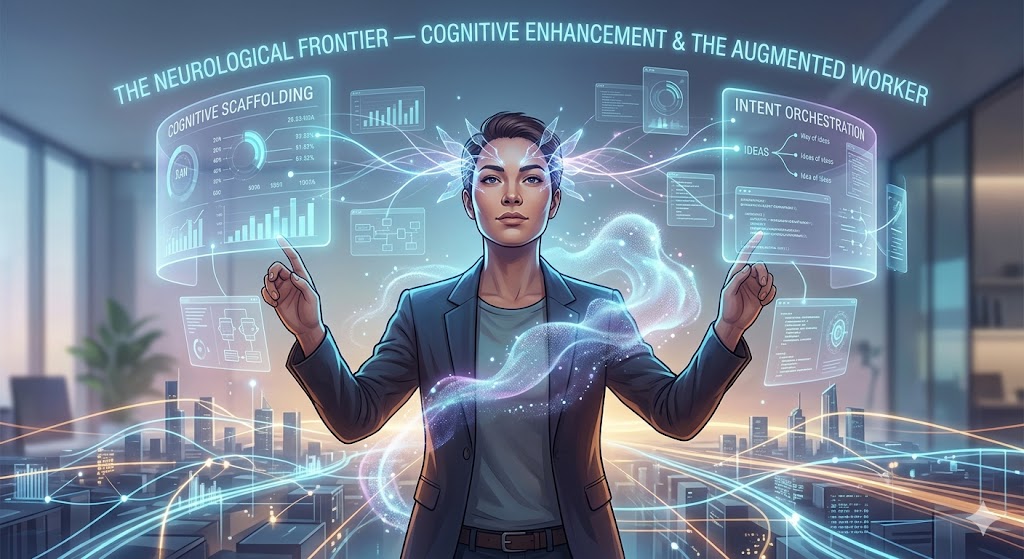
Cognitive Enhancement and the Augmented Worker

by Braden Kelley and Art Inteligencia


Beyond the Automated Horizon

For years, the mainstream narrative surrounding the rise of artificial intelligence has been trapped in a stark, binary choice: either humanity must race against the machine to protect traditional jobs, or we must retreat entirely to purely manual, artisanal, or civic labor. This false dichotomy creates an atmosphere of anxiety, framing AI as an inevitable displacement engine. However, there is a much more compelling, optimistic, and techno-progressive path forward — one that doesn’t replace the worker, but upgrades them.

We are on the cusp of an incremental “Cyborg Transition.” Rather than the dramatic, invasive sci-fi brain chips often popularized in media, this evolution is happening softly and ubiquitously. It is a gradual merging with AI tools through augmented cognition, extended memory, and real-time decision-making support. Just as smartphones transitioned from luxury gadgets to indispensable external brains that we feel lost without, advanced AI agents are becoming a normalized extension of our intellectual identity.

As each generation grows up with deeper, more fluid AI integration, the definition of “human labor” will expand rather than contract. The economy doesn’t lose human workers; it amplifies their potential. Value is shifting rapidly from the speed of task execution to the depth of intent orchestration, empathy, and strategic conceptualization.

Yet, this thrilling neurological frontier brings urgent socioeconomic challenges. As we design this future, we must confront pointed questions about accessibility: Who can afford premium cognitive augmentation, and who risks being left behind as an unaugmented underclass? The future of work is not about automation replacing humanity — it is about intentionally designing a human-centered transition that elevates us all.

Human AI Symbiosis Infographic

I. The Human-AI Symbiosis: Anatomy of the Augmented Worker

The relationship between humans and technology is shifting from a utilitarian model of “user and tool” to a deeply integrated, symbiotic partnership. The augmented worker does not merely operate AI; they think alongside it. This symbiosis fundamentally alters how cognitive tasks are processed, distributed, and executed in the modern enterprise.

Cognitive Scaffolding and Memory Extension

Generative AI and advanced LLMs are evolving far beyond reactive search engines or drafting assistants. They now function as cognitive scaffolding — external structures that support and expand human working memory. By offloading the heavy lifting of data retrieval, synthesis, and administrative tracking to ambient AI, workers dramatically reduce their mental load. This allows the human brain to bypass structural cognitive bottlenecks and maintain focus on higher-order problem solving.

Continuous Contextual Awareness

The true power of the augmented worker lies in real-time, proactive support. Instead of a worker pausing their workflow to query a database, ambient AI companions continuously listen, observe, and analyze the operational environment. Whether an employee is in a customer meeting, a design sprint, or a complex engineering review, the AI proactively feeds them historical context, relevant cross-functional data, and predictive outcomes. Decision-making is no longer limited by what a single human can recall in the moment.

Redefining Human Labor: Intent Orchestration

As task execution becomes increasingly automated, the baseline definition of valuable human labor is undergoing a radical expansion. The economic value of a worker is shifting from how fast they can build to how deeply they can conceptualize. Human labor is becoming a discipline of intent orchestration. In this new paradigm, the most valuable skills are human-centered: empathy, strategic vision, ethical judgment, and the ability to ask the right questions to direct autonomous systems toward meaningful innovation.

Incremental Cyborg Infographic

II. The Incremental Cyborg: How Augmentation Becomes Normalized

Society often envisions the integration of human and machine as a sudden, disruptive event — a dystopian leap marked by invasive cybernetics. In reality, the transition is smooth, behavioral, and highly incremental. We do not notice ourselves becoming cyborgs because the technology adapts to our natural behaviors, slowly weaving itself into the fabric of daily life until it becomes entirely invisible.

The Generational Shift in Technological Adaptation

Every generation establishes a new baseline for what feels “natural.” Digital natives seamlessly adapted to glass touchscreens, shifting human-computer interaction from rigid commands to fluid gestures. The next generation of workers will natively interface with multi-modal AI agents from early childhood. For these individuals, a software tool that does not anticipate their needs, remember their preferences, or actively collaborate with them will feel as broken and archaic as a rotary phone feels to a teenager today.

The Frictionless Interface

The acceleration of this transition is directly tied to the elimination of user-interface friction. The barrier between human thought and digital execution is shrinking rapidly. We are moving away from keyboard-and-mouse dependencies toward high-bandwidth, natural modalities: conversational voice, subtle eye-tracking, contextual gesture control, and predictive text. As these interfaces become completely frictionless, the delay between conceptualizing an idea and seeing it manifested by an AI tool drops to near zero.

The Psychology of Integration: Expanding Intellectual Identity

The final stage of normalization is psychological. When a tool responds instantly, holds perfect recall of your entire career’s output, and matches your cognitive rhythm, the human brain naturally begins to treat it as an extension of the self. This is the phenomenon of extended cognition. Workers will no longer view AI as external enterprise software they have to log into; instead, they will view it as a peripheral lobe of their own brain. The line where the human mind ends and the digital asset begins will blur, permanently expanding our sense of personal intellectual identity.
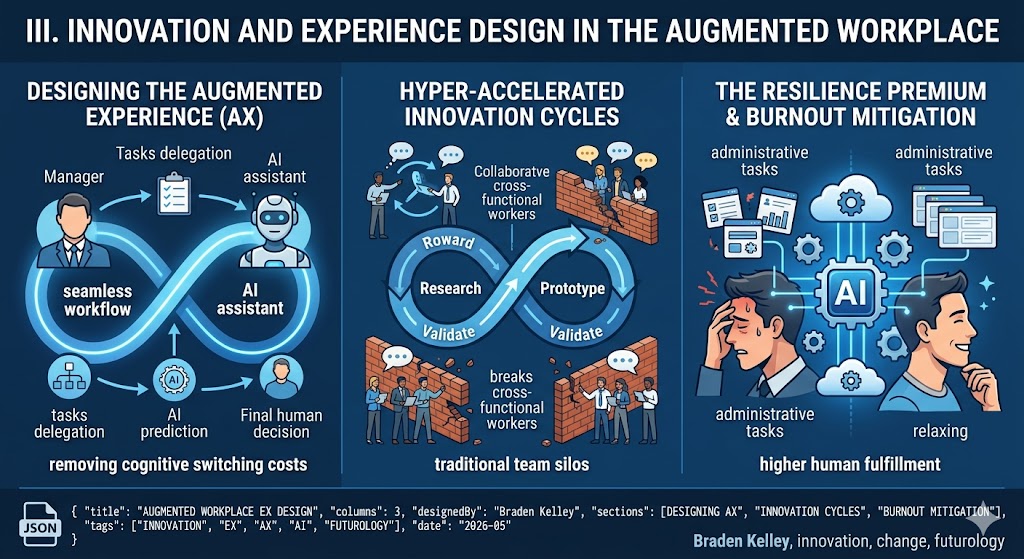
Augmented Workplace Infographic

III. Innovation and Experience Design in the Augmented Workplace

As the capabilities of the workforce expand, the frameworks we use to design business processes and employee experiences must evolve in tandem. Managing an augmented workforce requires a radical shift from traditional human resource management to intentional Experience Design. Organizations must build environments that don’t just utilize tools for efficiency, but actively harmonize human creativity with machine intelligence.

Designing the Augmented Experience (AX)

Traditional User Experience (UX) and User Interface (UI) design paradigms are no longer sufficient. When humans and AI operate in a continuous, bidirectional feedback loop, we must design for the Augmented Experience (AX). AX design focuses on creating non-disruptive, ambient workflows where the AI transitions smoothly between passive observer, active assistant, and autonomous executor. The goal is to eliminate cognitive switching costs, ensuring that software feels like a natural collaborator rather than a demanding administrative chore.

Hyper-Accelerated Innovation Cycles

The democratization of specialized, cross-functional knowledge through AI removes the traditional bottlenecks of organizational silos. An augmented worker in marketing can instantly understand technical architectural constraints; a developer can instantly run predictive financial models on their code. By collapsing the time required to research, prototype, and validate ideas, organizations can transition from rigid, linear development models to continuous, hyper-accelerated innovation cycles. The distance between a strategic spark and market reality shrinks from months to hours.

The Resilience Premium and Burnout Mitigation

Historically, technological revolutions have been used to squeeze more volume out of the worker, leading to chronic stress and burnout. A human-centered approach to augmentation reverses this trend, aiming for a Resilience Premium. By offloading low-value administrative friction, repetitive reporting, and data sorting to AI, we free up human cognitive capacity. Workers can redirect their energy toward high-empathy, high-creativity tasks — the exact areas where human fulfillment is highest — resulting in both a more innovative enterprise and a healthier, more resilient workforce.
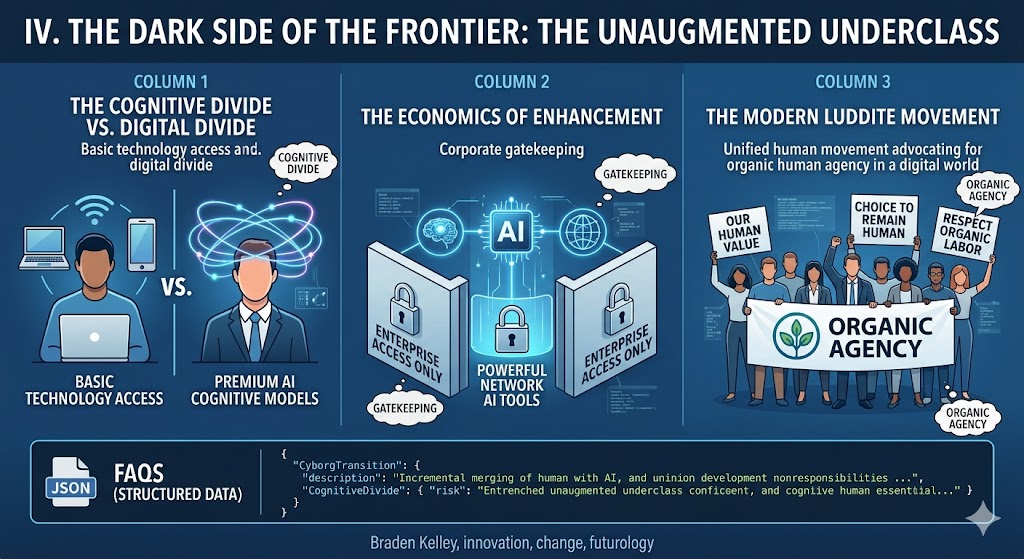
Dark Side of the Frontier Infographic

IV. The Dark Side of the Frontier: The Unaugmented Underclass

While the potential for human elevation is immense, a techno-progressive future is never guaranteed to be an equitable one. As cognitive augmentation becomes the primary driver of economic value, the traditional gaps in society will mutate. We must look past the optimistic horizon to confront a stark societal risk: the creation of a deeply entrenched, structurally excluded unaugmented underclass.

The Cognitive Divide vs. The Digital Divide

For decades, policymakers and technologists have fought to close the “digital divide” — the gap between those with access to internet-connected hardware and those without. The neurological frontier introduces a far more insidious challenge: the Cognitive Divide. This is not a matter of whether a worker has a screen, but whether they have access to premium, high-tier cognitive models that actively shape thought, strategy, and problem-solving velocity. When the barrier to entry for high-paying roles is the quality of your digital mind-extension, inequality becomes deeply intellectual.

The Economics of Enhancement: Corporate Gatekeeping

Advanced, specialized AI ecosystems require massive computational power and proprietary datasets, meaning they will largely be controlled by elite tech conglomerates and well-funded enterprises. If these cognitive tools remain locked behind corporate paywalls or exorbitant personal subscription models, then only the wealthiest individuals and organizations will afford the “upgrade.” This threatens to create a feedback loop where the augmented class accumulates wealth and influence at a velocity that the unaugmented cannot mathematically match, cementing a new form of economic caste system.

The Modern Luddite Movement and Cultural Backlash

We must also anticipate a profound cultural and psychological pushback. Not everyone will want to integrate with ambient AI systems, and many will view the blurring lines of human identity as a fundamental threat to human dignity. This resistance will likely fuel a modern Luddite movement — not driven by an ignorant fear of technology, but by a conscious desire to preserve unaugmented human agency. Society will face severe fragmentation as companies face an identity crisis: how to manage, value, and respect the labor of workers who choose to remain “organically human” in an ecosystem designed entirely for the augmented.

Conclusion: Designing a Human-Centered Autonomous Future

The neurological frontier is not a distant science fiction scenario; it is an active transition unfolding across the global workforce today. By moving past the paralyzing fear of automation and embracing the potential of incremental cyborg symbiosis, we open the door to a massive expansion of human creativity, capability, and fulfillment. The economy does not have to lose its workers to AI — it can choose to lift them up.

A Call to Action for Innovation and Change Leaders

This optimistic future will not happen by accident. Business leaders, change agents, and experience designers cannot treat AI merely as a tool for cutting costs and optimizing headcounts. We must actively architect organizational cultures and technical ecosystems that prioritize human agency. True innovation lies in designing the Augmented Experience responsibly, ensuring that technology serves as a platform for human elevation rather than a mechanism for worker exploitation or burnout.

The Ultimate Metric of Progress

As we navigate this profound shift, the ultimate benchmark of our success must change. We can no longer measure progress solely by the efficiency of our algorithms or the number of tasks automated away. Instead, we must evaluate our organizations by a human-centered standard: How much more capable, creative, and fulfilled are the people within our ecosystem? The Resilience Premium must become a core metric of the modern enterprise.

We are not being replaced by artificial intelligence; we are being challenged by it. We are being pushed to shed the routine, administrative friction of our daily work and step into roles defined by deep empathy, bold imagination, and strategic intent orchestration. The frontier of human labor is expanding — it is now our responsibility to design an equitable, inspiring transition that leaves no worker behind.

Frequently Asked Questions

What is the “Cyborg Transition” in the context of the modern workforce?

The Cyborg Transition refers to the incremental, behavioral merging of human workers with AI tools to enhance cognitive capabilities. Instead of relying on invasive sci-fi brain chips, this transition happens softly through everyday software, ambient AI companions, and natural interfaces (voice, gesture) that expand human memory, context, and decision-making velocity until the tool feels like a natural extension of the worker’s intellectual identity.

How does cognitive augmentation change the definition of human labor?

Cognitive augmentation expands human labor rather than contracting it. As AI automates routine task execution and administrative friction, the value of human work shifts to “intent orchestration.” Human labor is redefined around uniquely human-centered skills: empathy, strategic conceptualization, ethical judgment, and the creative vision required to direct autonomous systems toward meaningful innovation.

What is the “Cognitive Divide” and why is it a risk?

The Cognitive Divide is the socio-economic gap between workers who have access to premium, high-tier cognitive AI tools and those who do not. Unlike the traditional digital divide (which focuses on basic hardware/internet access), the Cognitive Divide threatens to create an “unaugmented underclass” structurally locked out of high-paying roles because they cannot afford the digital mind-extensions controlled by elite corporate gatekeepers.


EDITOR’S NOTE: This is a visualization of but one possible future. I will be publishing other possible futures as they crystallize in my mind (or as you suggest them for me to explore).

Image credits: Google Gemini

Content Authenticity Statement: The topic area, key elements to focus on, etc. were decisions made by Braden Kelley, with a little help from Google Gemini to clean up the article, add images and create infographics.

Subscribe to Human-Centered Change & Innovation WeeklySign up here to get Human-Centered Change & Innovation Weekly delivered to your inbox every week.
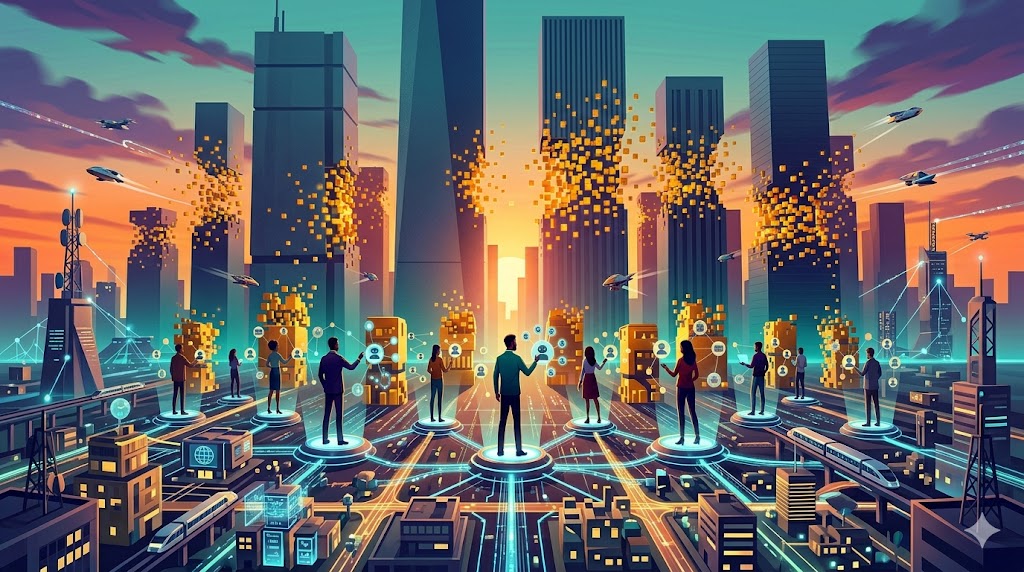
The Micro-Enterprise Explosion

Another AI Soft Landing Scenario Exploration — Entrepreneurship or Bust

LAST UPDATED: May 9, 2026 at 3:38 PM

The Micro-Enterprise Explosion

by Braden Kelley and Art Inteligencia


As we navigate the profound shifts brought about by generative and agentic AI, the question is no longer if the world will change, but how we will land. This article is the fourth installment in our AI Soft Landing series — a collection of hypotheses exploring how humanity and industry might transition into an AI-augmented future without systemic collapse.To understand the full context of this journey, you can explore the previous hypotheses here:

In this edition, we move from the contraction of the old to the explosion of the new. We will investigate the Micro-Enterprise Explosion, a future where AI collapses the minimum viable scale of entrepreneurship, turning the “middle class” into a league of self-orchestrated, high-output firms.

Over the next six sections, we will break down the collapse of organizational friction, identify the un-automatable human pillars of value, and confront the tensions of a fragmented, autonomous economy.

I. Introduction: Beyond the Cubicle and the Gig

The prevailing discourse around Artificial Intelligence often traps us in a binary trap: either AI is a job-destroyer that will leave millions idle, or it is a productivity booster that will simply make our 9-to-5s more efficient. Both perspectives miss a much more fundamental shift. We are moving beyond the traditional “gig economy” and the standard corporate cubicle into a new era of Economic Orchestration.

Historically, the “Theory of the Firm” suggested that large corporations existed because the costs of coordinating tasks — legal, marketing, accounting — were too high for individuals to manage alone. You needed a department for everything. AI is systematically dismantling those barriers, collapsing the minimum viable scale of a global enterprise.

“The future middle class may not be employed. It may be self-orchestrated.”

In this new landscape, AI doesn’t just automate tasks; it democratizes the infrastructure of the corporation. This is the Micro-Enterprise Explosion. It is a future where the “Human Premium” is applied at the smallest possible scale, allowing individuals to operate as high-output firms capable of delivering what once required an entire floor of a skyscraper.

Instead of giant corporations absorbing everyone, we are witnessing the rise of “Nano-Capitalism,” where the primary skill is no longer technical execution, but the ability to orchestrate an AI-driven fleet.

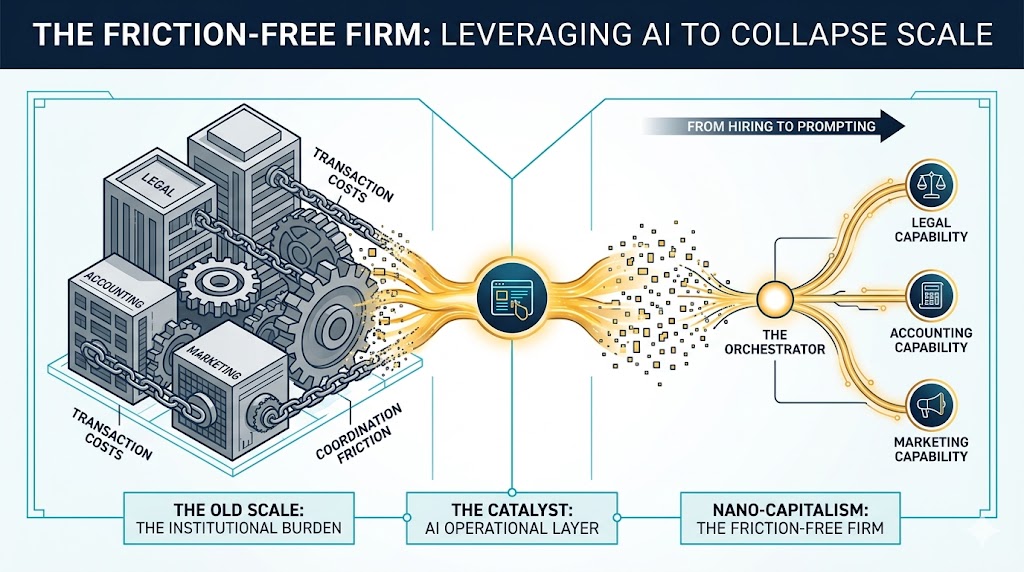
Nano-Capitalism and the Collapse of Organizational Friction

II. The Collapse of Organizational Friction

For over a century, the size of a company was dictated by “transaction costs.” As first proposed by economist Ronald Coase, firms grew large because it was cheaper to manage employees internally than to find, contract, and coordinate with outside specialists for every single task. You built a marketing department, a legal team, and an accounting wing because the friction of the marketplace was too high to do otherwise.

AI is the ultimate friction-reduction engine. By acting as an ubiquitous operational layer, AI agents are now capable of absorbing the coordination costs that once justified massive corporate hierarchies.

  • From Hiring to Prompting: Tasks that previously required a week of cross-departmental meetings — such as drafting a multi-state employment contract, reconciling complex international accounts, or generating a localized go-to-market strategy — can now be orchestrated by a single individual utilizing specialized AI agents.
  • Infrastructure on Demand: AI provides the back-office “bones” of a corporation (Legal, IT, Accounting, and Customer Service) as a software-defined utility rather than a payroll-defined burden.

This shift leads us directly into “Nano-Capitalism.” In this model, the high-output individual isn’t just a freelancer “gigging” for others; they are a low-overhead, high-leverage firm. When the cost of organizational complexity drops toward zero, the competitive advantage of the “Giant Corporation” begins to evaporate, paving the way for a swarm of agile micro-enterprises.

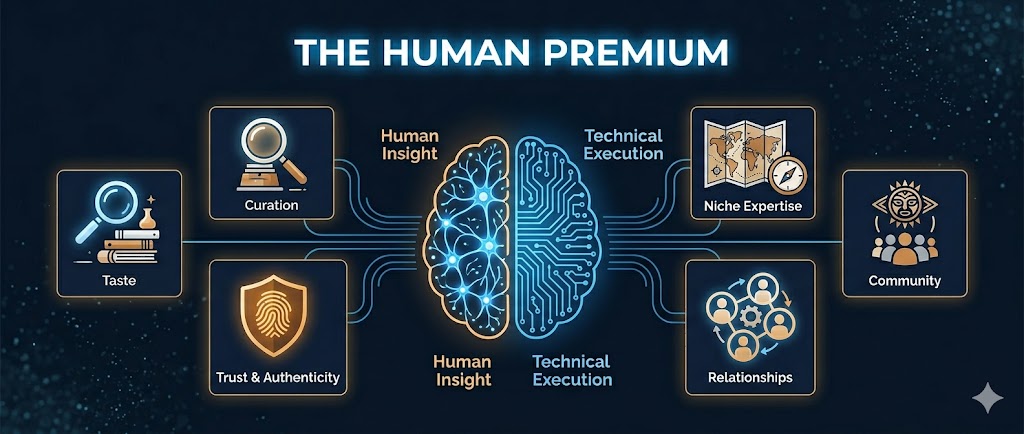
The Human Premium

III. The Migration of Value: Where Humans Still Win

If AI can handle the “how” of business — the technical execution, the data crunching, and the administrative heavy lifting — then where does the value go? As we have discussed in the Human Premium concept, value migrates away from routine competence and toward the uniquely human elements that machines cannot replicate.

In the era of the micro-enterprise, the “orchestrator” succeeds by focusing on five critical pillars of human value:

  • Taste & Curation: In a world of infinite AI-generated content and products, the human ability to say “this is good” or “this matters” becomes the ultimate filter. Success is driven by aesthetic and strategic judgment.
  • Trust & Authenticity: As deepfakes and automated interactions proliferate, humans will crave the “Proof of Personhood.” People want to buy from, and partner with, individuals they can hold accountable.
  • Niche Expertise: AI is excellent at the average of all human knowledge, but it often struggles with “the last mile” — the hyper-specific, local, or experimental context that only a specialist understands.
  • Relationships: Business remains a social endeavor. The ability to navigate complex office politics, build long-term partnerships, and provide true empathy is an un-automatable asset.
  • Community Identity: Micro-enterprises don’t just sell products; they build “tribes.” Value is generated by fostering a sense of belonging and shared identity that a black-box algorithm cannot feel.

The shift is clear: We are moving from a world where you are paid for what you can do to a world where you are paid for who you are and how you see the world. Technical execution is now a commodity; human insight is the new scarcity.

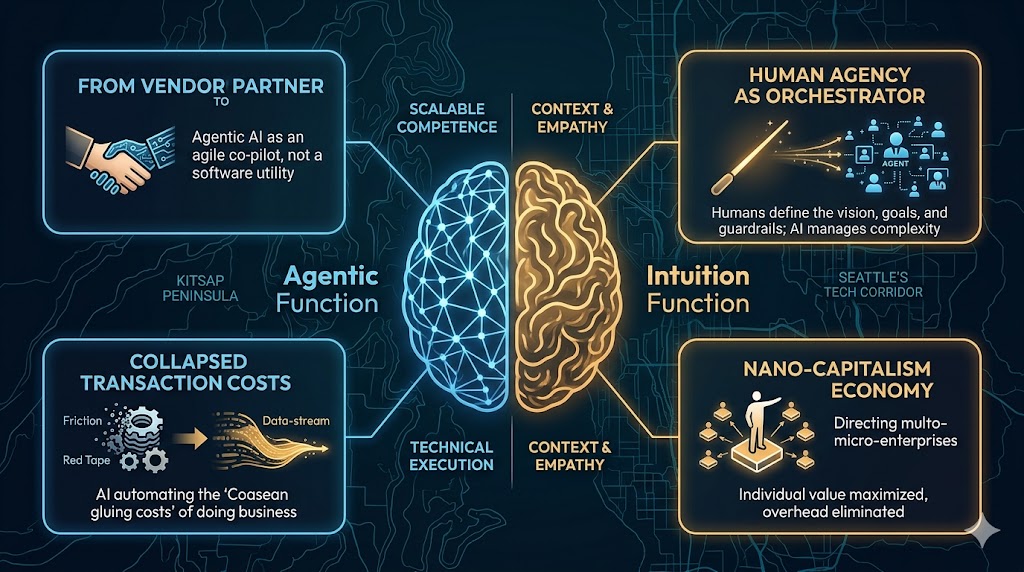
Agentic Intuition

IV. The Great Fragmentation: Tensions and Trade-offs

While the collapse of the traditional corporate ladder offers a path toward a “Soft Landing,” it also introduces a significant structural tension. The move away from centralized institutions toward a decentralized swarm of micro-enterprises creates a Great Fragmentation of the workforce.

This transition is not without its friction. As we move into this new reality, we must navigate several critical trade-offs:

  • Autonomy vs. Volatility: The micro-enterprise offers unparalleled freedom and the ability to “captain your own vessel.” However, it replaces the steady (if often illusory) paycheck of the 9-to-5 with the market-driven volatility of a solo practitioner. The safety net is no longer provided by the employer; it must be built by the individual.
  • The Death of Institutional Loyalty: Traditional careers were built on a social contract of mutual loyalty between the “Company Man” and the organization. In a fragmented economy, that contract dissolves. Relationship-building shifts from vertical (climbing the ladder) to horizontal (networking across the ecosystem).
  • From Specialized Doer to Generalist Orchestrator: The most successful participants in the micro-enterprise explosion will be those who embrace a FutureHacking mindset. Success requires moving beyond a single specialized skill to becoming a generalist who can direct multiple AI agents across diverse domains like marketing, strategy, and operations.

This fragmentation creates a world that is more resilient in the aggregate — millions of small nodes are harder to break than a few giant pillars — but more demanding on the individual. The “Soft Landing” depends on our ability to manage this newfound autonomy without falling into the trap of isolation or burnout.

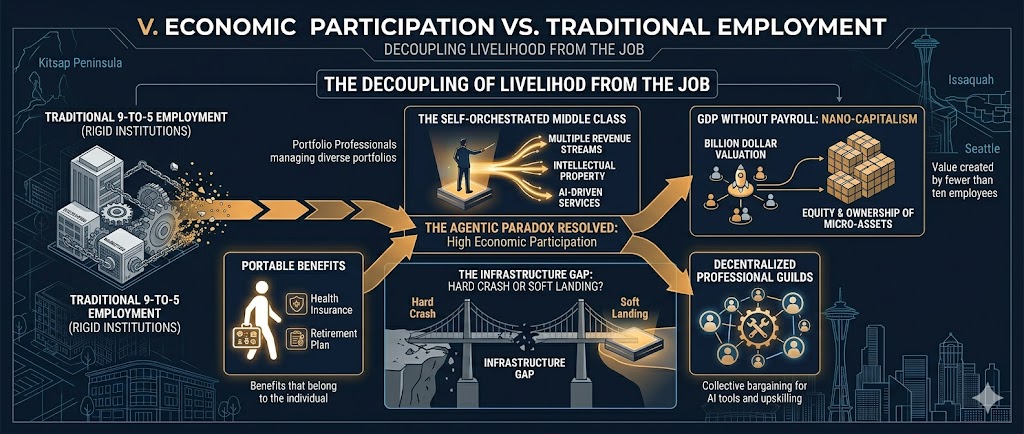
Economic Participation vs Traditional Employment

V. Economic Participation vs. Traditional Employment

The most startling statistic of the next decade may be a widening gap between “employment” numbers and “economic participation.” In a world of AI-leveraged firms, traditional payrolls may shrink while productivity and value creation actually accelerate. This is the heart of the “Soft Landing”: decoupling the idea of a livelihood from the idea of a job.

To navigate this shift, we must redefine what a “middle class” looks like:

  • The Self-Orchestrated Middle Class: For the last century, the middle class was defined by its relationship to a large employer (and the benefits that came with it). The future middle class will likely consist of “Portfolio Professionals” — individuals managing multiple revenue streams, intellectual property, and AI-driven services.
  • GDP Without Payroll: We are entering an era where a company can reach a billion-dollar valuation with fewer than ten employees. This means wealth will be generated through equity and ownership of micro-assets rather than hourly wages.
  • The Infrastructure Gap: The “Soft Landing” becomes a “Hard Crash” if our social structures don’t evolve. We urgently need to transition toward:
    • Portable Benefits: Health insurance and retirement plans that belong to the individual, not the employer.
    • Decentralized Professional Guilds: New versions of unions that provide community, collective bargaining for AI tool pricing, and continuous upskilling.

Ultimately, a decline in traditional employment isn’t a sign of failure; it’s a sign of a fundamental architectural change in how value is captured. The goal is a society where high economic participation is the norm, even if the “9-to-5” becomes a historical relic.

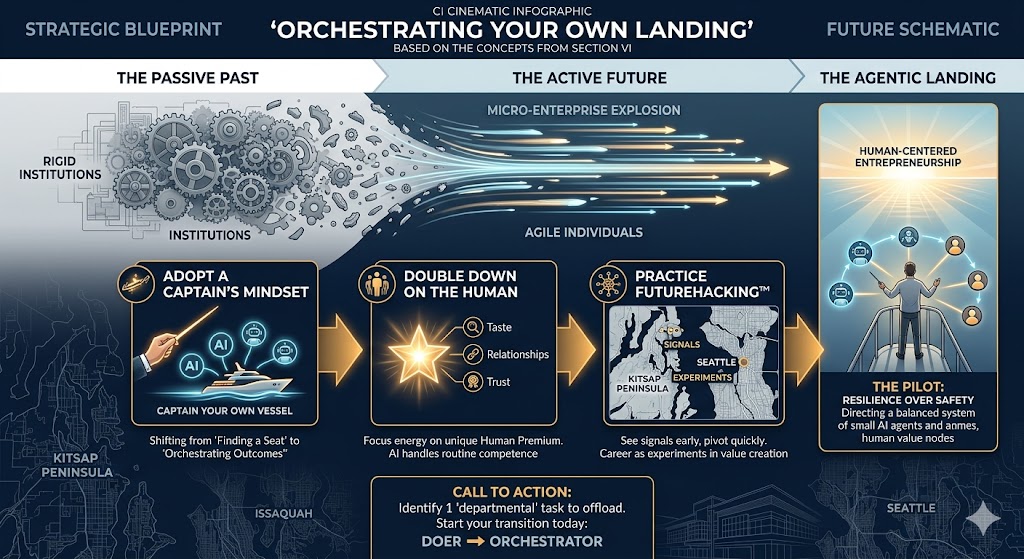
Orchestrating Your Own Landing

VI. Conclusion: Orchestrating Your Own Landing

The “Soft Landing” for the AI era isn’t a passive event that happens to us; it is a future we must actively orchestrate. As we have explored in this hypothesis, the Micro-Enterprise Explosion represents a pivot from a world of massive, rigid institutions to a world of agile, high-leverage individuals.

We are moving toward a reality where the primary competitive advantage is no longer the size of your workforce, but the clarity of your vision and the quality of your human-centered judgment. To thrive in this environment:

  • Adopt a Captain’s Mindset: Stop looking for a seat on someone else’s ship. Start learning how to captain your own AI-powered vessel. The tools to build, market, and scale are now at your fingertips.
  • Double Down on the Human: While AI handles the operational layer, focus your energy on the “Human Premium” — your unique taste, your deep relationships, and the trust you build within your niche.
  • Practice FutureHacking: Success in a fragmented economy requires the ability to see signals early and pivot quickly. Treat your career as a series of experiments in value creation rather than a linear path.

The goal is no longer to find “safety” in a large corporation, but to find resilience in your own ability to create. The Micro-Enterprise Explosion is our opportunity to reclaim agency over our work, turning the threat of automation into the fuel for a new era of human-centered entrepreneurship.


Call to Action: Identify one “departmental” task — be it legal drafting, basic market research, or data analysis — that you can offload to an AI agent this week. Begin your transition from a “Doer” to an “Orchestrator” today.

Frequently Asked Questions

What exactly is a “Micro-Enterprise”?

A micro-enterprise is a business operating at a very small scale — typically one to five people — that leverages AI to perform the operational tasks (legal, marketing, support) that previously required large corporate departments. This allows individuals to maintain high-level output with minimal overhead.

How does the “Human Premium” apply to small businesses?

The Human Premium is the value assigned to qualities AI cannot replicate: unique taste, personal trust, niche expertise, and deep relationships. In a micro-enterprise, these qualities become the primary competitive advantage as technical execution becomes commoditized by AI tools.

What is the difference between the Gig Economy and Nano-Capitalism?

The gig economy often involves individuals performing commoditized tasks for large platforms. Nano-capitalism, or the micro-enterprise model, involves individuals owning the “means of orchestration,” using AI to act as independent firms that create and capture high-margin value through their own intellectual property and brands.


EDITOR’S NOTE: This is a visualization of but one possible future. I will be publishing other possible futures as they crystallize in my mind (or as you suggest them for me to explore).

Image credits: Google Gemini

Content Authenticity Statement: The topic area, key elements to focus on, etc. were decisions made by Braden Kelley, with a little help from Google Gemini to clean up the article, add images and create infographics.

Subscribe to Human-Centered Change & Innovation WeeklySign up here to get Human-Centered Change & Innovation Weekly delivered to your inbox every week.
The AI New Deal

Another AI Soft Landing Scenario Exploration — Government as the Employer of First Resort

LAST UPDATED: May 2, 2026 at 5:33 PM

The AI New Deal

by Braden Kelley and Art Inteligencia


The Structural Gap: Why Process Automation Requires a Civic Pivot

As we navigate the accelerating displacement of cognitive and administrative labor, the conversation around the “AI soft landing” has reached a critical juncture. In my previous explorations, I’ve examined how our future might mirror the extreme wealth gaps of Victorian England and how we might witness a Human Premium Renaissance, where uniquely human traits become our most valuable currency.

However, a significant structural link is missing. While AI is exceptionally efficient at automating process, it is incapable of automating presence. This creates a dangerous void: as middle-class administrative roles evaporate, we risk losing the economic liquidity and social cohesion that sustain our communities.

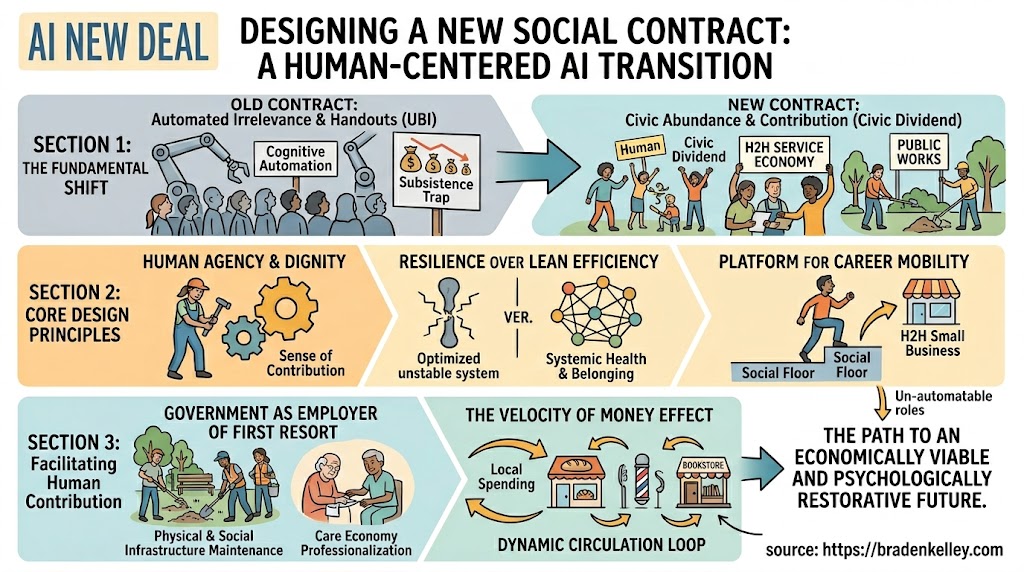
The prevailing solution often discussed is Universal Basic Income (UBI). But as I have argued, UBI is a fiscal mirage — a passive mechanism that fails to account for the human need for agency and the staggering mathematical reality of devalued tax bases. We don’t need a handout; we need a Civic Dividend. We must move from a scarcity mindset focused on protecting obsolete jobs to an abundance mindset that funds the essential work we have historically neglected. This is the foundation of the AI New Deal: positioning the government as the Employer of First Resort.

The Fiscal and Psychological Mirage of UBI

Universal Basic Income (UBI) is often presented as the “silver bullet” for the AI age, but a closer look at the mechanics reveals it to be a flawed tool for a human-centered transition. From a design perspective, UBI solves for survival but fails to solve for contribution.

First, we must confront the Math Problem. Funding a meaningful UBI requires a robust and consistent tax base. However, as AI drives down the cost of labor toward zero, the income tax pool — the traditional engine of government revenue — shrinks alongside it. Relying on passive redistribution in a devalued labor market is a race to the bottom that risks a permanent “subsistence trap” for the majority of the population.

Second, there is the Agency Problem. Innovation thrives on human agency — the ability to act, create, and impact one’s environment. UBI provides a safety net but offers no platform for growth. By decoupling income from contribution, we risk creating a “useless class” not because humans lack value, but because we have failed to design systems that utilize their unique “Human Premium.”

Finally, we must consider the Inflation Trap. Without a mechanism to ensure the circulation of capital through local, human-to-human services, stagnant UBI payments are easily consumed by the rising costs of private-sector essentials. To achieve a soft landing, we need a dynamic model that prioritizes the Velocity of Money over the mere distribution of funds.

The Core Concept: The Civic Dividend

To bridge the gap between AI-driven efficiency and human necessity, we must introduce the Civic Dividend. This is not a social safety net designed for the desperate; it is a strategic economic platform designed for a high-functioning society. At its heart is a fundamental shift in the social contract: the Government as the Employer of First Resort.

In this model, the government doesn’t just step in when the private market fails; it proactively identifies and funds the “work that matters” — the essential maintenance of our physical, social, and cultural existence. These are the roles that require empathy, physical dexterity, and contextual judgment — capabilities that remain firmly in the human domain.

The Civic Dividend operates on the principle that human labor is a public asset. By offering potential employment in public works, care networks, and community resilience projects, the state ensures that most citizens have the opportunity to contribute. This creates a “Social Floor” of activity and income that is immune to algorithmic displacement.

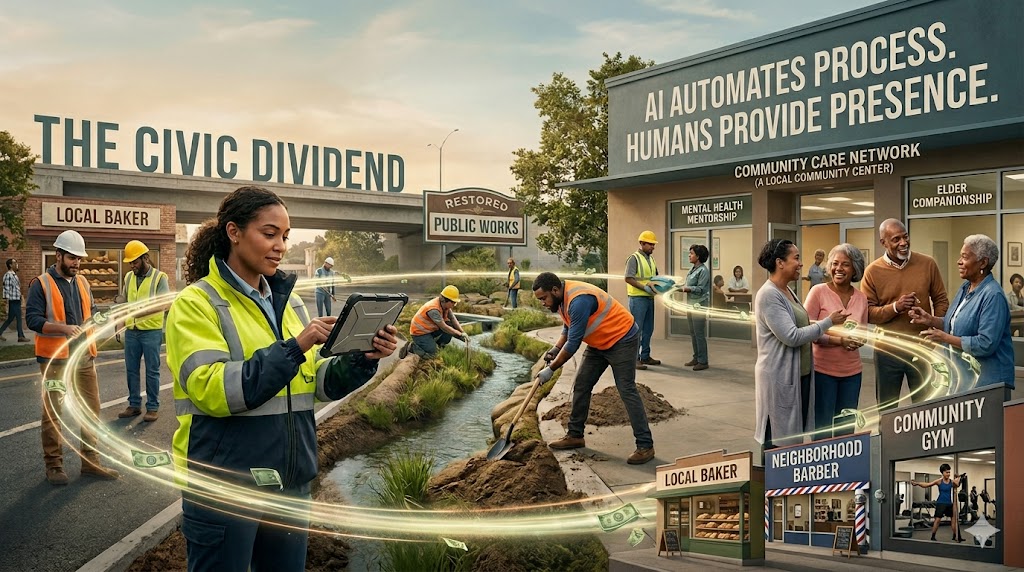
Crucially, this work is not “make-work” intended to keep hands busy. It is the vital labor required to repair our crumbling infrastructure, support our aging population, and revitalize our neighborhoods. Unlike a handout, these wages are earned, providing the dignity of contribution while fueling the Velocity of Money. As these wages are spent at local bakeries, barbershops, and bookstores, they sustain a secondary human-to-human service economy that AI simply cannot replicate.

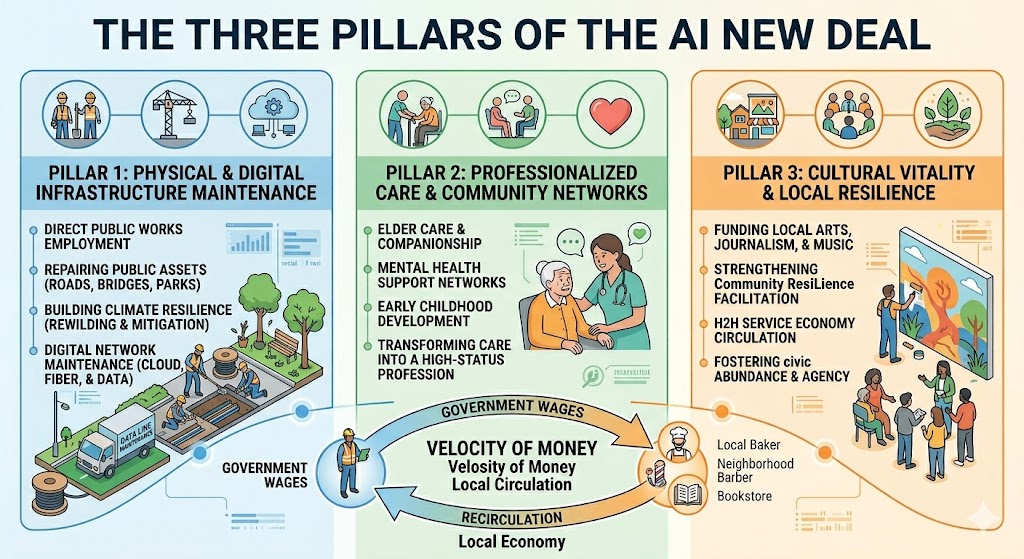
Three Pillars of AI New Deal

The Three Pillars of the AI New Deal

The success of the AI New Deal rests on a strategic focus on the “Un-automatable.” We must direct our collective energy toward three specific domains where human presence, judgment, and physical interaction are not just preferred, but essential for a thriving society.

Pillar 1: Physical and Digital Infrastructure

We are currently witnessing a “Tragedy of the Commons” in our physical world. Our bridges, transit systems, and power grids require more than just algorithmic optimization; they require physical intervention. The AI New Deal would mobilize a modern workforce to focus on Community Resilience — retrofitting cities for climate adaptation, urban “rewilding” to restore local ecosystems, and maintaining the physical nodes that allow our digital world to function. This work creates a tangible, high-quality public environment that serves as a shared wealth for all citizens.

Pillar 2: The Social and Care Fabric

As we automate cognitive tasks, the “Human Premium” in care becomes our most valuable asset. We are facing a global loneliness epidemic and an aging demographic that requires empathy, companionship, and nuanced psychological support. By professionalizing and scaling roles in elder care, mental health mentorship, and early childhood development, we transform these from marginalized sectors into the prestigious cornerstones of our new economy. These are roles where the goal is not “efficiency” (doing more with less time), but “effectiveness” (the quality of the human connection).

Pillar 3: Community Vitality and Cultural Resilience

In an era of AI-generated noise, local culture and verified information are at risk of erosion. The AI New Deal funds the “Civic Architects” — the local journalists, community theater directors, and public artists who document and celebrate the unique identity of a place. This pillar ensures that while our tools become more global and algorithmic, our lived experiences remain local, vibrant, and distinctly human. We aren’t just building roads; we are building the social connective tissue that prevents the isolation often triggered by rapid technological shifts.

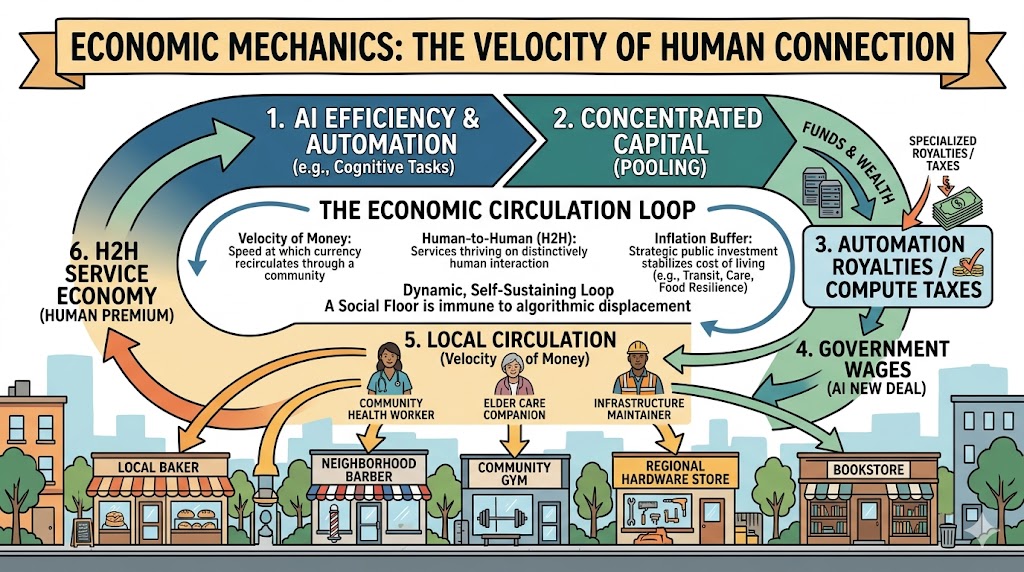
Economic Mechanics: The Velocity of Human Connection

Economic Mechanics: The Velocity of Human Connection

The fiscal engine of the AI New Deal is built on a fundamental economic principle: the Velocity of Money. In a hyper-automated private sector, capital tends to pool at the top, concentrating in the hands of those who own the compute and the algorithms. Without a mechanism to pull that capital back into the hands of the many, the local economy — the shops, services, and neighborhood hubs — withers.

The Civic Dividend solves this by creating a continuous loop of circulation. When the government pays a living wage to a community health worker or a local infrastructure specialist, that income doesn’t sit idle. It is immediately recycled into the Human-to-Human (H2H) service economy. This worker buys bread from a local baker, gets a haircut from a neighborhood barber, and visits a local gym. These secondary businesses thrive precisely because their customers have earned, discretionary income to spend.

To fund this transition, we must look toward Automation Royalties or “Compute Taxes.” Rather than taxing labor — which AI is making artificially cheap — we shift the tax burden to the high-margin output of automated systems. This creates a sustainable cycle: the efficiency of AI funds the resilience of the human community.

Furthermore, the AI New Deal acts as a natural Inflation Buffer. By investing in public housing maintenance, efficient public transit, and community-led food resilience, we lower the “floor” of the cost of living. This ensures that the wages provided by the Civic Dividend maintain high purchasing power, shielding the population from the volatility of a purely algorithmic private market.

Addressing the Critics: Efficiency vs. Resilience

Critics often argue that government-led employment is inherently “inefficient” compared to the lean, optimized nature of the private sector. From the perspective of human-centered innovation, this critique misses the mark because it uses the wrong metric for success. In an AI-dominated age, social resilience is a far more valuable outcome than marginal efficiency.

The private sector’s drive for efficiency is exactly what is displacing workers. If we allow that same logic to dictate our social response, we end up with a society that is “optimized” into instability. The AI New Deal isn’t about competing with AI on speed or cost; it is about providing the stability that the private market, by its very nature, cannot offer. We are designing for systemic health, not just quarterly throughput.

Another common concern is the fear of “make-work” or a lack of individual choice. However, the AI New Deal is designed as a platform, not a cage. By providing a guaranteed social floor of meaningful work, we actually increase career mobility. When a citizen’s basic survival and dignity are secured through the Civic Dividend, they are more — not less — likely to take risks, launch their own H2H small businesses, or pursue creative endeavors in the Human Premium Renaissance.

Finally, we must recognize that this is a choice of design. We can choose to view displaced workers as a “surplus” to be managed, or we can view them as a massive, untapped reserve of human talent ready to be deployed toward the public good. The “inefficiency” of paying a human to do what an algorithm could do is only an inefficiency if you ignore the catastrophic social cost of a disengaged, impoverished populace.

AI New Deal: Designing a New Social Contract

Conclusion: Designing a New Social Contract

We stand at a unique design crossroads in human history. The rapid advancement of artificial intelligence has presented us with a fundamental choice: do we design a future of automated irrelevance, where a vast majority of the population subsists on a dwindling digital handout, or do we design a future of civic abundance?

The AI New Deal is more than an economic policy; it is a reaffirmation of the value of human contribution. It recognizes that while technology can manage our systems, only humans can care for our communities, preserve our culture, and maintain our physical world. By moving toward a model of the Government as the Employer of First Resort, we ensure that the wealth generated by the AI revolution is directly reinvested into the human experience.

This “soft landing” requires us to be bold. We must stop asking how we will survive without the jobs of the past and start asking what kind of world we could build if we finally had the resources and the hands to do it. The Civic Dividend offers a path where technology does the “tasks” so that humans can finally do the “work” of being human—creating a society that is not just more efficient, but more resilient, more connected, and more purposeful.

The tools are in our hands, and the need is all around us. Now, we simply need the courage to sign a new contract with ourselves and build the future we actually want to live in.


Braden Kelley is a leading futurist and trusted voice in human-centered innovation and change. Stay tuned for next week’s next installment in this series on the AI Soft Landing.

Frequently Asked Questions

How is the AI New Deal different from Universal Basic Income (UBI)?

While UBI provides a passive payment regardless of activity, the AI New Deal is a “Civic Dividend” based on active contribution. It positions the government as the Employer of First Resort, paying living wages for essential public work — such as infrastructure maintenance and care services — rather than providing a handout that lacks a connection to social agency or the local service economy.

How can the government afford to become the ‘Employer of First Resort’?

The funding shifts from taxing human labor to taxing the high-margin output of automated systems, often referred to as “Automation Royalties” or “Compute Taxes.” By capturing the wealth generated by AI-driven efficiency, the state can reinvest that capital into the Human-to-Human (H2H) economy, ensuring currency continues to circulate through physical communities.

Does this mean the government is creating ‘make-work’ just to keep people busy?

No. The AI New Deal focuses on the “Un-automatable” — high-value needs that are currently neglected, such as climate resilience, elder care, and mental health support. These are not arbitrary tasks; they are the essential services required for a functional, healthy society that AI cannot perform because they require human empathy, physical presence, and contextual judgment.

EDITOR’S NOTE: This is a visualization of but one possible future. I will be publishing other possible futures as they crystallize in my mind (or as you suggest them for me to explore).

Image credits: Google Gemini

Content Authenticity Statement: The topic area, key elements to focus on, etc. were decisions made by Braden Kelley, with a little help from Google Gemini to clean up the article, add images and create infographics.

Subscribe to Human-Centered Change & Innovation WeeklySign up here to get Human-Centered Change & Innovation Weekly delivered to your inbox every week.
The Human-Premium Renaissance

Another AI Soft Landing Scenario Exploration

LAST UPDATED: April 24, 2026 at 6:52 PM

The Human-Premium Renaissance

by Braden Kelley and Art Inteligencia


I. Beyond the “Empty Desk”

The prevailing narrative surrounding embodied AI and robotics is often one of inevitable displacement. As automation reaches a scale where it can replicate human labor at a fraction of the cost, the fear of an “empty desk” economy—one where human participation is optional—has become a central anxiety of the 2020s.

Defining the “Soft Landing”

A soft landing represents a societal transition that sidesteps the extremes of total economic collapse or violent revolution. It is the search for a new equilibrium where human value is not just preserved, but reimagined within a landscape of infinite machine productivity.

The Core Thesis: Value in the Biological

While many forecast a return to a “Victorian” class structure defined by service and servitude, this scenario proposes a more viable, long-term alternative. The Human-Premium Renaissance suggests that:

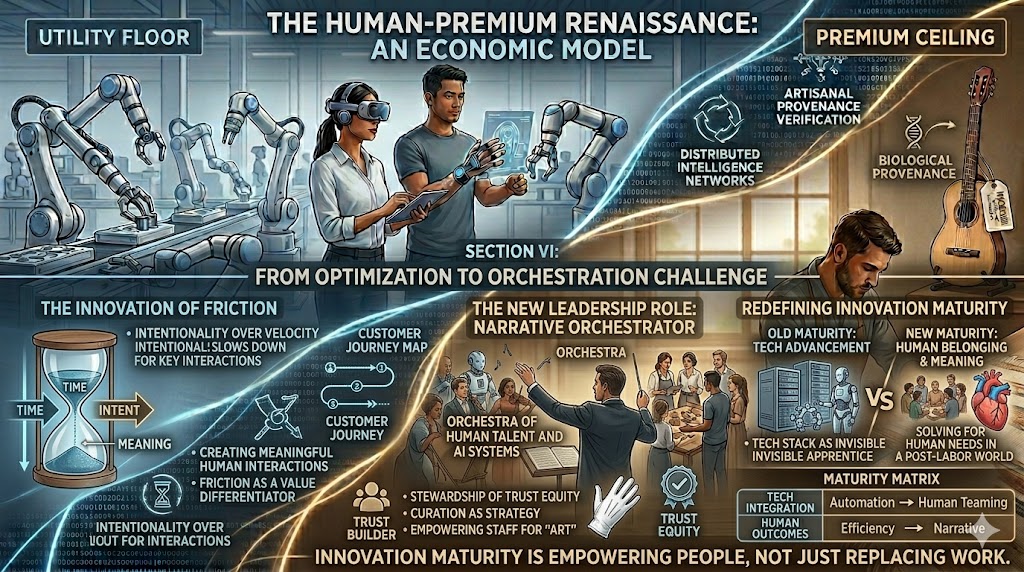
  • Commoditized Perfection: As AI makes perfect execution free, the market value of “flawless” drops to zero.
  • The Premium of Imperfection: Economic value will migrate to the “biological origin”—the hand-carved, the human-thought, and the uniquely flawed.
  • Narrative over Utility: We are moving toward an era where we no longer pay for what a product does, but for the human story behind its creation.

In this scenario, human labor isn’t a cost to be minimized; it is the unique identifier that prevents a product from becoming a valueless commodity.

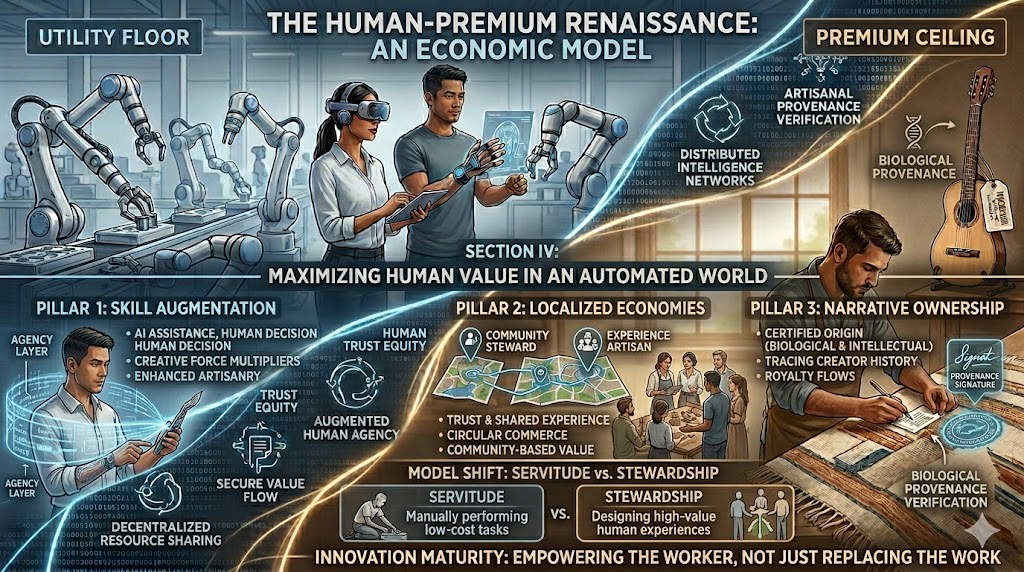
II. The Framework: Utility Floor vs. Premium Ceiling

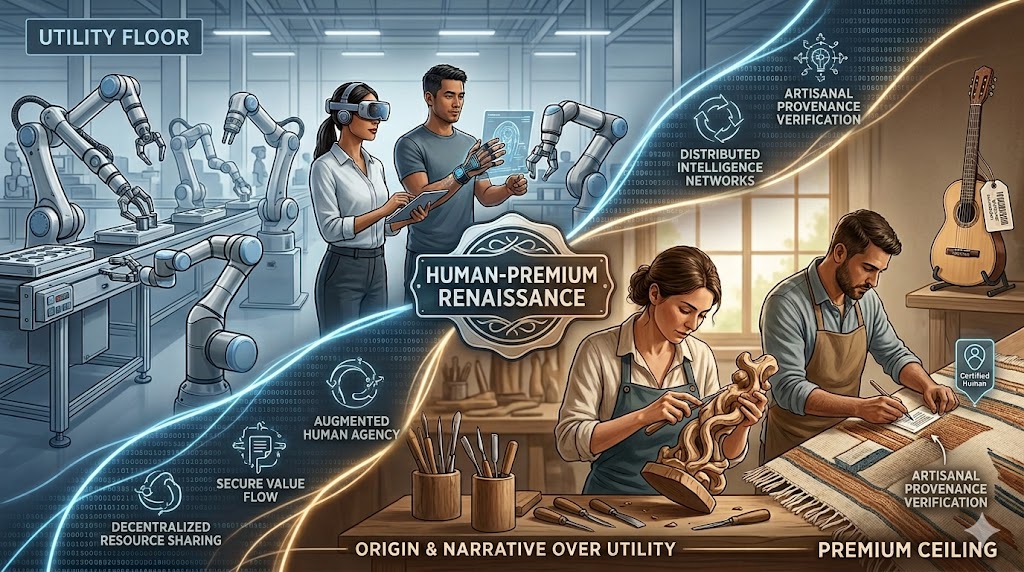
The viability of this soft landing rests on a bifurcation of the economy into two distinct layers. This structure allows for mass survival through automation while preserving a high-value labor market for human endeavor.

The Utility Floor: The World of “Perfect Commodities”

In this layer, AI and embodied robotics handle the fundamental requirements of modern life. Logistics, basic food production, energy management, and routine diagnostics are optimized to a point where the marginal cost of production approaches zero.

  • Standardization: Everything produced at the floor is “perfect” but uniform.
  • Abundance: Scarcity is eliminated for basic needs, preventing the societal collapse often predicted in mass-unemployment scenarios.
  • Devaluation: Because these goods are generated without human effort, they lack the “prestige” required to command a premium price.

The Premium Ceiling: The Human Narrative

Above the utility floor sits the “Premium Ceiling.” This is a market tier where consumers—who now have their basic needs met by the floor—spend their discretionary wealth on items and services that possess a biological provenance.

  • Authenticity as the New Scarcity: In a world of infinite digital and robotic replicas, the one thing that cannot be mass-produced is the unique perspective and history of a specific human being.
  • The Human-Centric Premium: We see the rise of “Slow Innovation,” where the value is found in the time, struggle, and intent behind the creation rather than the speed of its delivery.

The Strategic Shift: From Utility to Origin

This transition represents a fundamental shift in how we define economic value. We move away from asking “What can this do for me?” (Utility) and toward asking “Who made this, and what is their story?” (Origin).

While the Utility Floor keeps society running, the Premium Ceiling gives society a reason to keep trading, creating, and connecting.

III. Economic Viability: Why This Model Works

The skeptic’s immediate response to a “human-premium” model is usually grounded in the cold logic of the bottom line: If a machine can do it cheaper, why would anyone pay for a human? The answer lies in the shifting definition of value in a post-scarcity utility environment.

The Scarcity of Authenticity

In an era of infinite AI-generated content and robotic manufacturing, “perfection” is no longer a differentiator—it is a baseline requirement. When every digital image is flawlessly composed and every physical object is mathematically precise, human attention, history, and original thought become the only truly non-fungible resources.

  • Effort Heuristic: Humans are psychologically predisposed to value objects and services more highly when they perceive a high degree of effort or “struggle” behind them.
  • Biological Connection: We are social animals who seek the “ghost in the machine.” We don’t just want a solution; we want to know another consciousness intended for us to have it.

The Veblen Good Effect

As basic needs are met by the Utility Floor, discretionary spending migrates toward status symbols. In this scenario, human labor becomes a Veblen Good—a luxury item where demand increases as the price (and the perceived exclusivity of the human touch) rises.

“The hand-carved chair with its slight, organic imperfections becomes a status symbol of the elite, while the flawless, 3D-printed alternative becomes the hallmark of the masses.”

Democratization of Expertise and the “Company of One”

Unlike previous industrial shifts that required massive capital for factories, AI is a capital of the mind. This technology allows individual artisans and “augmented experts” to compete with monolithic corporations.

  • Skill Augmentation: AI doesn’t just replace the expert; it allows the “middle-skill” human to perform at an elite level, spreading the ability to generate high-value, personalized work across a much larger population.
  • Niche Viability: Lowering the cost of production allows for the “Long Tail” of human services to thrive. Small-scale, highly specialized human businesses become economically sustainable because their overhead is managed by AI.

By moving the human worker from a “cost to be minimized” to a “feature to be highlighted,” companies can maintain high margins and justify the continued circulation of capital back into human hands.

Preventing the Consolidation - Breaking the Monopoly on Production

IV. Preventing Wealth Consolidation: Breaking the Monopoly on Production

One of the greatest risks of an AI-driven economy is the “Winner-Take-All” effect, where the owners of the most powerful algorithms capture the entirety of global productivity. However, the Human-Premium Renaissance offers structural defenses against this consolidation by shifting the power of production from centralized capital to distributed intelligence.

The “Company of One” Era

In previous industrial revolutions, scale was a prerequisite for success. You needed a factory to compete with a factory. Today, AI acts as a force multiplier for the individual. When the cost of sophisticated research, design, and logistics drops to near zero, the competitive advantage of a massive corporation—its ability to manage complexity—evaporates.

  • Democratized Innovation: Individual creators can now orchestrate global supply chains and reach global audiences with the same efficiency as a Fortune 500 company.
  • Agility over Scale: Smaller, human-led entities can pivot and personalize their offerings faster than a shareholder-beholden giant, allowing wealth to remain with the creator.

The Circular Human Economy

As global logistics become a commodity (the Utility Floor), we anticipate a resurgence in localized, high-trust commerce. AI-assisted cooperatives and local “Experience Stewards” can replace centralized “Gig Economy” platforms.

  • Localism: Trust is a human currency that does not scale well in an algorithm. By focusing on community-specific needs, human workers can create “walled gardens” of value that shareholders cannot easily penetrate.
  • Profit Retention: When the “platform” is a decentralized protocol rather than a Silicon Valley intermediary, more of the transaction value stays in the pockets of the local human service provider.

Narrative Ownership and Provenance

To prevent AI from simply harvesting and replicating human creativity for the benefit of shareholders, this scenario relies on Digital Provenance.

  • Certification of Origin: Using watermarking and blockchain-based verification, human-made products carry a “digital signature.” This allows creators to maintain the equity of their original work.
  • The Authenticity Tax: If a company uses AI to mimic a specific human’s style or narrative, the legal and social frameworks of the Renaissance model demand a “royalty of origin,” ensuring capital flows back to the human inspiration.

Wealth consolidation occurs when production is centralized. The Renaissance scenario is inherently decentralizing, as it prizes the one thing that cannot be mass-produced: the individual human perspective.

V. Comparing the “Soft Landings”: Victorian vs. Renaissance

To understand the trajectory of our economic future, we must distinguish between two types of “soft landings.” While both scenarios avoid immediate catastrophe, they offer fundamentally different versions of human dignity and wealth distribution.

Feature Victorian England Scenario Human-Premium Renaissance
Core Driver Inequality of Wealth and Power. Inequality of Authenticity and Scarcity.
The Human Role Tasks: Performing labor AI won’t do (low-cost servitude). Meaning: Performing labor AI can’t do (high-value narrative).
Economic Logic Humans as “Cheap Alternatives” to expensive robots. Humans as “Luxury Exceptions” to cheap, mass-produced AI.
Social Structure Centralized and Rigidly Hierarchical. Decentralized and Networked Communities.
Primary Value Obedience and Time. Trust and Shared Experience.
Role of AI The “Master’s Tool” for efficiency. The “Artisan’s Apprentice” for augmentation.

The Crucial Distinction

In the Victorian Scenario, the “servant class” is trapped by a lack of access to capital and a surplus of desperate labor. Success is measured by how well one can serve the elite.

In the Renaissance Scenario, the “artisan class” is empowered by AI to bypass traditional gatekeepers. Success is measured by how well one can connect with other humans through unique, un-automatable narratives. One is a world of servitude; the other is a world of stewardship.

While the Victorian model is a race to the bottom in cost, the Renaissance model is a race to the top in meaning.

Innovation Challenge - From Optimization to Orchestration

VI. The Innovation Challenge: From Optimization to Orchestration

For decades, the core driver of innovation has been Efficiency—doing things faster, cheaper, and with less friction. In the Human-Premium Renaissance, this paradigm reaches its logical conclusion: AI handles all optimization. When efficiency is “solved,” the new frontier of innovation becomes the Human Experience.

The Innovation of “Friction”

In a world of instant gratification provided by the Utility Floor, value is created by intentionally “slowing down” the experience. This is the art of Meaningful Friction.

  • Intentionality over Velocity: Future innovation won’t focus on how to get a product to a customer in ten minutes, but on how to make the ten minutes they spend with your brand the most memorable part of their day.
  • Biological Synchronization: Designing systems that align with human circadian rhythms, emotional cycles, and social needs rather than purely digital throughput.

The New Leadership Role: The Narrative Orchestrator

The role of the leader must shift. We are moving away from the “Optimization Officer” model toward the Narrative Orchestrator.

  • Curation as Strategy: Leaders will spend less time managing processes (AI will do this) and more time curating the talent, stories, and human connections that define the brand’s “Premium” status.
  • Stewardship of Trust: Because trust is a non-automatable resource, the primary job of leadership is to protect and grow the “Trust Equity” between the human staff and the customer base.

Redefining Innovation Maturity

In this scenario, a “mature” organization is not one with the most advanced tech stack, but one that has successfully integrated AI to the point of Invisibility.

Innovation maturity will be measured by an organization’s ability to use AI to automate the “Work” so it can empower its people to perform the “Art.”

This shift forces a total rethink of R&D. We are no longer just solving technical problems; we are solving for human belonging, status, and meaning in a post-labor world.

VII. Conclusion: Choosing Our Trajectory

The transition to an economy defined by embodied AI and mass automation does not have a predetermined destination. While the technical capabilities of generative systems and robotics are advancing at an exponential rate, the social and economic architecture we build around them remains a matter of human agency.

A Choice of Valuations

The “Victorian” and “Renaissance” scenarios represent two distinct paths for the future of work. One path values human time as a commodity—a low-cost alternative to a machine. The other values human time as a canvas—the unique source of narrative and meaning that an algorithm cannot replicate.

The Final Frontier of Competitive Advantage

As we move deeper into the 2030s, the most successful organizations will not be those that achieved the highest level of automation, but those that used that automation to solve the “Utility Floor” problem so they could focus entirely on the “Premium Ceiling.”

The ultimate goal of AI should not be to replace the worker, but to replace the “work”—the repetitive, the mundane, and the soul-crushing—thereby freeing the human to perform the “art” that only they can provide.

The soft landing is within reach, but it requires us to stop asking how we can compete with machines and start asking how we can better complement each other. The future isn’t defined by the artificial; it is defined by what becomes possible when the artificial is so ubiquitous that the human finally becomes the premium.

Frequently Asked Questions: The Human-Premium Renaissance

1. What is the difference between the “Utility Floor” and the “Premium Ceiling”?

The Utility Floor refers to the baseline economy where AI and robotics produce essential goods (food, logistics, basic software) at near-zero marginal cost, making them affordable commodities. The Premium Ceiling is the high-value market tier where consumers pay a significant markup for products and services with a “biological provenance”—meaning they are created, curated, or delivered by humans.

2. How does this scenario prevent massive wealth consolidation?

Unlike previous industrial shifts that required massive capital, AI acts as a “capital of the mind.” This allows for the rise of the Company of One, where individuals use AI to handle complex operations, allowing them to compete with large corporations. Furthermore, because “authenticity” cannot be mass-produced by a central algorithm, the value remains distributed among individual human creators and local communities.

3. Why is “human imperfection” considered an economic asset?

In a world where AI can generate “perfect” results instantly, perfection becomes a devalued commodity. Human “errors” or “uniqueness” serve as proof of biological origin—a signal of authenticity that AI cannot authentically replicate. This creates an Effort Heuristic, where consumers psychologically value the struggle and intent of a human creator over the sterile precision of a machine.

EDITOR’S NOTE: This is a visualization of but one possible future. I will be publishing other possible futures as they crystallize in my mind (or as you suggest them for me to explore).

Image credits: Google Gemini

Content Authenticity Statement: The topic area, key elements to focus on, etc. were decisions made by Braden Kelley, with a little help from Google Gemini to clean up the article, add images and create infographics.

Subscribe to Human-Centered Change & Innovation WeeklySign up here to get Human-Centered Change & Innovation Weekly delivered to your inbox every week.
Why an AI Soft Landing Might Look Like Victorian England

LAST UPDATED: April 18, 2026 at 3:29 PM

Why an AI Soft Landing Might Look Like Victorian England

by Braden Kelley and Art Inteligencia


The Mirage of the Post-Scarcity Utopia

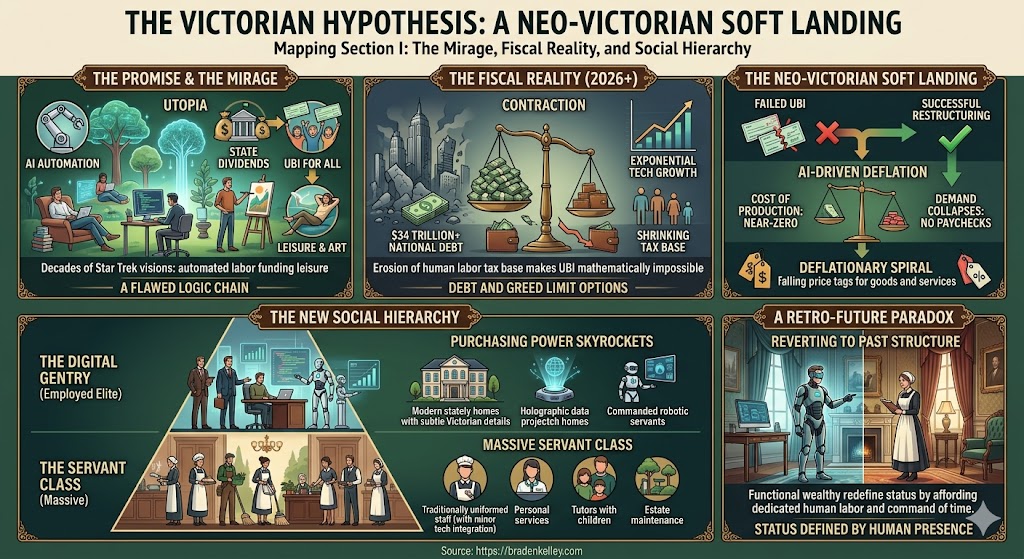
For decades, the prevailing narrative surrounding artificial intelligence has been one of a post-scarcity “Star Trek” future. The logic was simple: as machines took over the labor, the dividends of automation would be harvested by the state and redistributed via Universal Basic Income (UBI), freeing humanity to pursue art, philosophy, and leisure.

The AI Promise vs. The Fiscal Reality

However, this utopian vision ignores the gravity of The Great American Contraction. As we approach 2026 and beyond, the friction between exponential technological growth and a $37 trillion+ national debt (with a $2 trillion annual budget deficit) creates a structural barrier to redistribution. When the tax base of human labor erodes, the math for a livable UBI simply fails to compute.

The Victorian Hypothesis

If UBI is a mathematical and political impossibility fueled by corporate and human greed, we must look toward an alternative “soft landing.” This hypothesis suggests a vertical restructuring of society. As AI drives the cost of production and the demand for goods into a deflationary spiral, the purchasing power of the remaining “employed elite” will skyrocket.

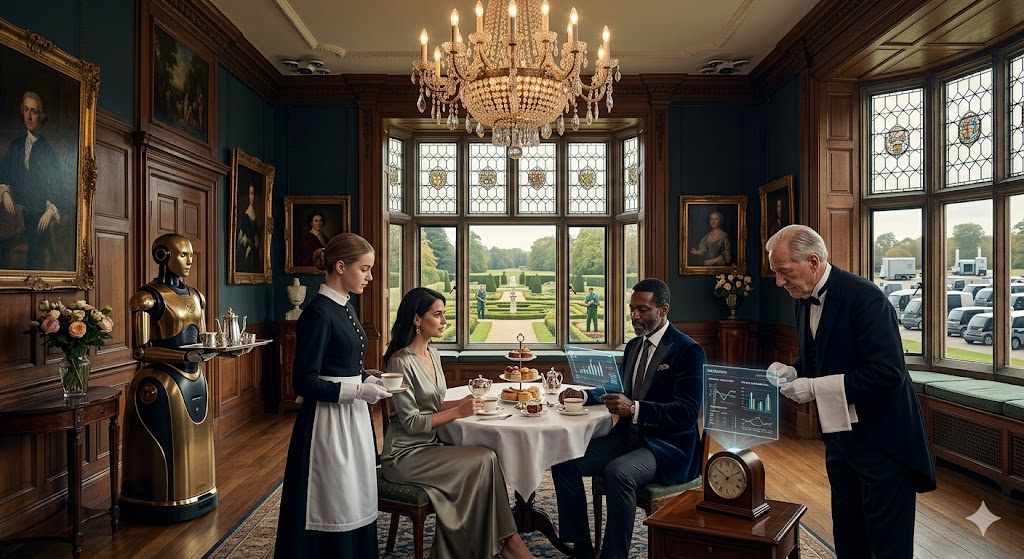
The result isn’t a horizontal distribution of wealth, but a return to a Neo-Victorian social hierarchy. In this reality, the new digital gentry will use their outsized wealth to employ a massive “servant class” to maintain stately homes and personal lives, creating a world where status is defined by the human labor one can afford to command.

Neo-Victorian Hypothesis Infographic

The Great American Contraction: Why UBI is a Non-Starter

The conversation around the transition to an AI-driven economy often treats Universal Basic Income as an inevitability — a safety net that will naturally catch those displaced by the silicon wave. However, this assumes a level of fiscal elasticity that no longer exists. We are entering The Great American Contraction, a period where the traditional levers of government spending are restricted by the sheer weight of historical obligation and systemic greed.

The Debt Ceiling of Compassion

With a national debt exceeding $37 trillion, a $2 trillion budget deficit and rising interest rates, the federal government’s “room to maneuver” has effectively vanished. A livable UBI requires a massive, consistent tax base. As AI begins to hollow out the middle class, the very tax revenue needed to fund such a program disappears. To fund UBI under these conditions would require a level of sovereign borrowing that the global markets simply will not support, leading to a reality where the government cannot afford to be the savior of the displaced.

The Greed Variable

Even if the math were more favorable, the human element remains a constant. Corporate interests, focused on margin preservation and shareholder value, are unlikely to support the aggressive taxation required to fund a social floor. In the race to the bottom of production costs, the primary goal of the “winners” in the AI revolution will be wealth concentration, not social equity. The political willpower to force a massive transfer of wealth from AI-profiting corporations to the idle masses is a historical outlier that we should not count on repeating.

The Velocity of Displacement

Finally, the speed of the AI transition is its most disruptive feature. Legislative bodies move in years, while AI cycles move in weeks. By the time a political consensus for UBI could be formed, the economic floor will have already fallen out. This lag time creates a vacuum that will be filled not by government checks, but by a desperate search for subsistence, setting the stage for the return of the domestic labor economy.

The Deflationary Paradox: Collapse of Demand and Cost

In a traditional economy, unemployment leads to recession, which usually leads to stagflation or managed recovery. However, the AI-driven “soft landing” introduces a unique mechanical failure: the Deflationary Paradox. As AI and advanced robotics permeate every sector, the labor cost of producing goods and services begins to approach zero, but the pool of consumers capable of buying those goods simultaneously evaporates.

The Production Floor Drops

We are witnessing the end of the labor theory of value. When an AI can design, a robot can manufacture, and an automated fleet can deliver a product without a single human touchpoint, the marginal cost of production hits the floor. In a desperate bid to capture the dwindling “active” capital in the market, companies will engage in a race to the bottom, causing the prices of physical and digital goods to deflate at a rate unseen in modern history.

The Demand Vacuum

While cheap goods sound like a boon, they are a symptom of a deeper rot: the Demand Vacuum. As the middle class is hollowed out, the velocity of money slows to a crawl. The economy shifts from a mass-consumption model to a precision-consumption model. Most businesses will fail not because they can’t produce, but because there are no longer enough customers with a paycheck to buy, even at rock-bottom prices.

The Purchasing Power of the “Remaining”

This is where the Victorian shift begins. For the small percentage of Americans who retain their income — the innovators, the orchestrators, and the entrepreneurs — this deflationary environment is a golden age. Their dollars, fixed in value while the cost of everything else drops, suddenly possess exponential purchasing power. When a gallon of milk or a digital service costs mere pennies in relative terms, the “wealthy” find themselves with a massive surplus of capital that cannot be spent on “things” alone. This surplus will naturally be redirected toward the one thing that remains scarce and high-status: the dedicated service of another human being.

The New “Stately Home” Economy

As the Deflationary Paradox takes hold, we will see a fundamental shift in the definition of luxury. In the pre-AI era, luxury was defined by the acquisition of high-tech gadgets or rare goods. In the Neo-Victorian era, where machines produce goods for nearly nothing, “luxury” will pivot back toward the human-centered experience. Status will no longer be measured by what you own, but by whose time you command.

From Software to Service

For the “In-Group” — those entrepreneurs and specialized leaders still generating significant revenue — capital will lose its utility in the digital marketplace. When software is free and manufactured goods are commoditized, wealth seeks the only remaining friction: human presence. We will see a massive migration of capital away from Silicon Valley “platforms” and toward the local domestic economy. The wealthy will stop buying more “things” and start buying “lives” — the total dedicated attention of house managers, chefs, valets, and tutors.

The Modern Manor

This economic shift will be physically manifested in the return of the Stately Home. These won’t just be houses; they will be complex ecosystems of employment. Large estates will once again become the primary employer for local communities. As traditional corporate offices vanish, the residence becomes the center of both social and economic power. These modern manors will require extensive human staffs to cook, clean, maintain grounds, and provide security — services that, while technically possible via robotics, will be performed by humans as a deliberate signal of the owner’s immense “effectively wealthy” status.

The Return of the Domestic Professional

Perhaps the most jarring aspect of this transition will be the class of worker entering domestic service. We are not talking about a traditional blue-collar service shift, but the “Victorianization” of the former middle class. Displaced white-collar professionals — accountants, teachers, and middle managers — will find that their highest-paying opportunity is no longer in a cubicle, but in managing the complex domestic affairs, private education, and logistics of the new digital aristocracy. It is a “soft landing” in name only; while they may live in proximity to grandeur, their survival is entirely tethered to the whims of their employer.

Socio-Economic Stratification: The Two-Tiered Reality

The inevitable result of the “Victorian Soft Landing” is the formalization of a rigid, two-tiered social structure. Unlike the 20th century, which was defined by a fluid and expanding middle class, the post-contraction era will be characterized by extreme polarization. The economic “missing middle” creates a vacuum that forces every citizen into one of two distinct realities: the Digital Gentry or the Dependent Class.

The Corporate and Government Gentry

A small percentage of Americans — likely less than 10% — will remain tethered to the engines of primary wealth creation. This “In-Group” consists of high-level AI orchestrators, strategic entrepreneurs, and essential government officials who maintain the infrastructure of the state. Because their income is derived from high-margin automated systems while their cost of living has plummeted due to deflation, they possess a level of functional wealth that rivals the landed gentry of the 19th century. To this group, the “Great Contraction” is not a crisis, but a refinement of their dominance.

The Dependent Class

For those outside the digital fortress, the reality is stark. Without a national UBI to provide a floor, the majority of the population becomes the “Dependent Class.” Their economic utility is no longer found in the marketplace of ideas or manufacturing, but in the marketplace of personal service. In this neo-Victorian landscape, you either work for the companies that own the AI, work for the government that protects it, or you work directly for the individuals who do.

The Choice: Service or Scarcity

This stratification reintroduces a primal power dynamic into the American workforce. When the cost of basic survival (food and shelter) is low due to deflation, but the opportunity for independent income is zero, the wealthy gain total leverage. The “soft landing” is, in truth, a forced labor transition. Those who are not “useful” to the gentry — either as specialized labor or domestic support — face the grim reality of the Victorian workhouse era: they must find a patron to serve, or they will starve in a world of plenty.

Experience Design in the Neo-Victorian Era

Experience Design in the Neo-Victorian Era

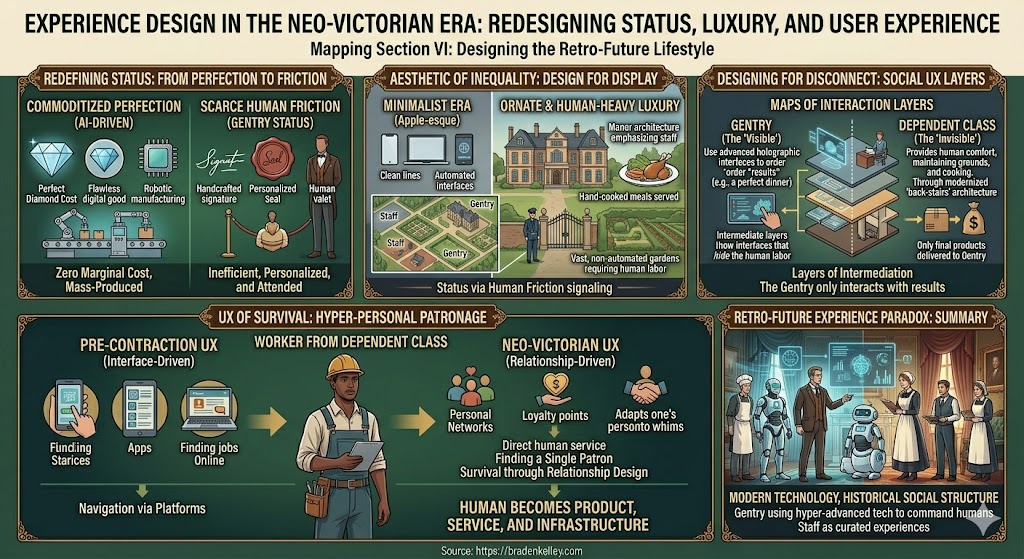
From the perspective of experience design and futurology, the shift toward a Victorian-style social structure will fundamentally alter the aesthetic of status. In a world where AI can generate perfect, flawless goods and digital experiences at zero marginal cost, “perfection” becomes a commodity. Status, therefore, will be redesigned around human friction and intentional inefficiency.

The Aesthetic of Inequality

We will see a move away from the sleek, minimalist “Apple-esque” design of the early 21st century toward a more ornate, human-heavy luxury. Experience design for the elite will emphasize things that AI cannot authentically replicate: the slight imperfection of a hand-cooked meal, the presence of a uniformed gatekeeper, and the physical maintenance of vast, non-automated gardens. Architecture will pivot back to “human-centric” layouts—designing spaces not for efficiency, but to accommodate the movement and housing of a live-in staff.

Designing for Disconnect

The most challenging aspect of this new era will be the Experience of the Invisible. Designers will be tasked with creating systems that allow the Digital Gentry to interact with their environment without acknowledging the vast economic disparity surrounding them. This involves “Social UX” — designing layers of intermediation where the “Dependent Class” provides the comfort, but the “Gentry” only interacts with the result. It is a return to the “back-stairs” architecture of the 19th century, modernized for a digital age.

The UX of Survival

For the majority, the “User Experience” of daily life will be one of Hyper-Personal Patronage. Navigation of the economy will no longer be about interfaces or platforms, but about the “UX of Relationships.” Survival will depend on the ability to design one’s persona to be indispensable to a wealthy patron. In this reality, human-centered design takes on a darker, more literal meaning: the human becomes the product, the service, and the infrastructure all at once.

Conclusion: Preparing for the Retro-Future

The “Soft Landing” we are currently engineering is not the one we were promised. As the Great American Contraction forces a collision between astronomical debt and the deflationary power of AI, the middle-class dream of a subsidized leisure class is evaporating. In its place, we are seeing the blueprints of a Retro-Future — a world that looks forward technologically but moves backward socially.

A Call for Human-Centered Transition

If we continue to view innovation solely through the lens of efficiency and margin preservation, the Victorian outcome is not just possible — it is inevitable. We must realize that without a radical redesign of how we value human contribution beyond mere “market productivity,” we are simply building a more efficient feudalism. True Experience Design must now focus on the social fabric, or we risk creating a world where the only “innovation” left is finding new ways for the many to serve the few.

Final Thought: The Soft Landing Paradox

We must be careful what we wish for when we ask for a “seamless” transition. A landing that is “soft” for the Digital Gentry is one where the friction of poverty and the noise of the displaced have been successfully silenced by the return of the servant class. History doesn’t repeat, but it does rhyme — and right now, the future sounds remarkably like 1837. The question is no longer if AI will change our world, but whether we have the courage to design a future that doesn’t require us to retreat into our past.

Frequently Asked Questions

Why would prices deflate if the economy is struggling?

In this scenario, AI and robotics drive the marginal cost of production toward zero. Simultaneously, massive job displacement creates a “demand vacuum.” To capture what little liquid currency remains, companies must drop prices drastically, leading to a reality where goods are incredibly cheap but income is even scarcer.

How does this differ from the 20th-century middle class?

The 20th century was defined by a “horizontal” distribution where many people owned moderate assets. The Neo-Victorian model is “vertical.” The middle class disappears, replaced by a tiny, hyper-wealthy elite (Digital Gentry) and a large class of people who provide them with personalized human services (the Servant Class).

Isn’t UBI a more logical solution to AI displacement?

While logical in theory, the “Great American Contraction” hypothesis suggests that high national debt and corporate prioritisation of margins make a livable UBI politically and fiscally impossible. Without a state-funded floor, the market defaults to the oldest form of social safety: personal patronage and domestic service.

EDITOR’S NOTE: This is a visualization of but one possible future. I will be publishing other possible futures as they crystallize in my mind (or as you suggest them for me to explore).

Image credits: Google Gemini

Content Authenticity Statement: The topic area, key elements to focus on, etc. were decisions made by Braden Kelley, with a little help from Google Gemini to clean up the article, add images and create infographics.

Subscribe to Human-Centered Change & Innovation WeeklySign up here to get Human-Centered Change & Innovation Weekly delivered to your inbox every week.