Category Archives: Digital Transformation

Are You Prepared to Run a Digital Business for the Digital Age?

Are You Prepared to Run a Digital Business for the Digital Age?

In our digital age, all companies must change how they think, how they interact with customers, partners, and suppliers, and how their business works on the inside. Customer, partner, and supplier expectations have changed, and a gap is opening between what they expect from their interaction with companies and what those companies are currently able to deliver. Companies must immediately work to close this expectation gap, or their entire business is at risk.

If digital natives attack, they will do it with a collection of digital strategies that utilize the power of the digital mindset to more efficiently and effectively utilize the available people, tools, and technology, and to design better, more seamlessly interconnected, and automated processes that can operate with only occasional human intervention.

To defend your company’s very existence, you must start thinking like a technology company or go out of business. Part of that thinking is to fundamentally re-imagine how you structure and operate your business. You must look at your business and your industry in the same way that a digital native startup will if they seek to attack you and steal your market. To make this easier, ask yourself these five foundational questions:

  1. If I were to build this business today, given everything that I know about the industry and its customers and the advances in people, process, technology and tools, how would I design it?
  2. From the customers’ perspective, where does the value come from?
  3. What structure and systems would deliver the maximum value with the minimum waste?
  4. What are the barriers to adoption and the obstacles to delight for my product(s) and/or service(s) and how will my design help potential customers overcome them?
  5. Where is the friction in my business that the latest usage methods of people, process, technology, and tools can help eliminate?

There are, of course, other questions you may want to ask, but these five should get you most of the way to where you need to go in your initial strategic planning sessions. What questions do you think are key for enterprises to ask themselves if they are to survive and thrive in the digital age?

Digital Strategy vs. Digital Transformation

How much appetite for digital change do you have?

Understanding how your management and your enterprise is likely to answer this question will help you identify whether your business should pursue a digital strategy or a digital transformation. The two terms are often misused, in part by being used interchangeably when they are in fact two very different things.

A digital strategy is a strategy focused on utilizing digital technologies to better serve one group of people (customers, employees, partners, suppliers, etc.) or to serve the needs of one business group (HR, finance, marketing, operations, etc.). The scope of a digital strategy can be quite narrow, such as using digital channels to market to consumers in a B2C company; or broader, such as re-imagining how marketing could be made more efficient using digital tools like CRM, marketing automation, social media monitoring, etc. and hopefully become more effective at the same time.

Meanwhile, digital transformation is an intensive process that begins by effectively building an entirely new organization from scratch, utilizing:

  • The latest best practices and emerging next practices in process (continuous improvement, business architecture, lean startup, business process management, or BPM, crowd computing, and continuous innovation using a tool like The Eight I’s of Infinite Innovation™)
  • The latest tools (robotics, sensors, etc.)
  • All the latest digital technologies (artificial intelligence, predictive analytics, BPM, etc.)
  • The optimal use of the other three to liberate the people who work for you to spend less time on bureaucratic work and more time creating the changes necessary to overcome barriers to adoption and obstacles to delight through better leadership methods, reward/recognition systems, physical spaces, collaboration, and knowledge management systems, etc.

It ends with a plan of how to transform from the old way of running the business to the new way.

The planning of the digital transformation is all done collaboratively on paper, whiteboards, and asynchronous electronic communication (definitely not email) powered by a collection of tools like the Change Planning Toolkit™.

The goal is to think like a digital native, to think like a startup, to approach the idea of designing a company by utilizing all the advances in people, process, technology, and tools to kill off the existing incarnation of your company. Because if you don’t re-invent your company now and set yourself up with a new set of capabilities that enable you to continuously reinvent yourself as a company, then a venture capitalist is going to see an opportunity, find the right team of digital natives, and give them the funding necessary to enter your market and reinvent your entire industry for you.

What do you want to re-invent?

Our team at Oracle was created to use design thinking, innovation and transformation tools and methods to help Oracle customers tackle their greatest business challenges, to re-imagine themselves for the digital age, and to discover and pursue their greatest innovation, transformation and growth opportunities.

We call this human-centric problem-solving and together we create plans to make our customers’ solution vision real in just weeks. And along the way, this new Oracle approach helps increase collaboration across business functions and accelerate future decision-making.

Find out more about how to protect your business from digital disruption, building upon these five foundational questions with additional questions and frameworks contained in my latest success guide Riding the Data Wave to Digital Disruption.


Accelerate your change and transformation success

Subscribe to Human-Centered Change & Innovation WeeklySign up here to get Human-Centered Change & Innovation Weekly delivered to your inbox every week.

10 Tips for Reducing Costs with Digital Transformation

10 Tips for Reducing Costs with Digital Transformation

GUEST POST from Art Inteligencia

Digital transformation is an essential part of modern business operations. It enables organizations to leverage existing technologies to drive efficiency, optimize processes, and reduce costs. However, it can be difficult to identify cost-saving opportunities and strategies. Here are 10 tips for reducing costs with digital transformation.

1. Leverage Cloud Technology: Cloud computing solutions are a cost-effective way to access data, applications, and software. By leveraging cloud technology, businesses can reduce costs associated with hardware, software, and maintenance.

2. Utilize Automation: Automation can help reduce labor costs by streamlining processes and eliminating manual labor. This can free up resources and allow businesses to focus on more strategic initiatives.

3. Prioritize Data Security: Data security is essential for any digital transformation project. Investing in the right security solutions can help prevent costly data breaches and reduce overall IT costs.

4. Implement Mobile Solutions: Mobile solutions can help increase employee productivity, reduce operational costs, and boost customer satisfaction.

5. Take Advantage of Open-Source Software: Open-source software is a great way to reduce software costs while still taking advantage of the latest technology.

6. Implement an Analytics Platform: Analytical platforms can help organizations identify trends and opportunities to reduce costs.

7. Invest in Training: Digital transformation requires a skilled workforce. Investing in employee training can help ensure that your team is up to date on the latest technologies and best practices.

8. Use Data-Driven Decision Making: By leveraging data, businesses can make more informed decisions that can help reduce costs.

9. Re-evaluate Processes: Digital transformation provides an opportunity to reevaluate existing processes and identify opportunities for cost savings.

10. Embrace Change: Digital transformation requires a shift in mindset. Embracing change can help businesses take advantage of new technologies and find new ways to reduce costs.

By following these tips, organizations can take advantage of digital transformation to reduce costs and optimize operations. Digital transformation can be a powerful tool for increasing efficiency and driving bottom-line results.

Image credit: Unsplash

Subscribe to Human-Centered Change & Innovation WeeklySign up here to join 17,000+ leaders getting Human-Centered Change & Innovation Weekly delivered to their inbox every week.

10 Tips for Effective Change Leadership in the Digital Age

10 Tips for Effective Change Leadership in the Digital Age

GUEST POST from Art Inteligencia

Change management is a challenge in any organization, but the digital age has added a layer of complexity to the process. In order to effectively lead change initiatives, there are certain tips that can be useful. Here are ten tips to help you be an effective change leader in the digital age.

1. Stay up to date: Technology and digital systems are constantly changing and evolving, so it is important to stay up to date on the latest trends and developments. Be sure to attend conferences and seminars, read industry news, and talk to other change leaders to stay on top of the latest developments.

2. Understand the technology: Before you can lead change, you need to understand the technology and digital systems you are working with. Take the time to learn the system and how it works so you can effectively lead the change initiative.

3. Listen to feedback: Change can be difficult, so it is important to listen to feedback from employees and stakeholders. Take the time to understand the different perspectives and use this feedback to inform your change leadership strategy.

4. Engage stakeholders: Change initiatives can be successful if stakeholders are engaged throughout the process. Make sure to include stakeholders in the planning process and involve them in decision-making.

5. Set clear goals: Change initiatives can get off track if there are no clear goals or objectives. Be sure to set clear goals and objectives for the change initiative so everyone understands what needs to be accomplished.

6. Communicate regularly: Change can be daunting for employees, so it is important to keep them informed throughout the process. Make sure to communicate regularly with employees and stakeholders about the progress of the change initiative.

7. Use data: Data can be a powerful tool in the digital age. Use data to track progress and make decisions about the change initiative.

8. Embrace innovation: Change can be a great opportunity to try new things and innovate. Encourage employees to think outside the box and come up with creative solutions to tackle the challenge.

9. Celebrate success: Change can be a long and difficult process, so it is important to celebrate successes along the way. Make sure to take the time to recognize the hard work of employees and stakeholders who have helped lead the change initiative.

10. Learn from failure: Even the best change initiatives can fail. If a change initiative falls short, use it as a learning opportunity. Gather feedback and learn from mistakes to improve your change leadership strategy.

By following these ten tips, you can be an effective change leader in the digital age. Change initiatives can be complex and difficult, but with the right approach and strategy, you can be successful.

Image credit: Pixabay

Subscribe to Human-Centered Change & Innovation WeeklySign up here to join 17,000+ leaders getting Human-Centered Change & Innovation Weekly delivered to their inbox every week.

Design Thinking for Digital Transformation Projects

Design Thinking for Digital Transformation Projects

GUEST POST from Art Inteligencia

Design Thinking is a creative problem-solving approach that enables organizations to develop innovative solutions to complex challenges. The methodology has been used for many years in product development, but it is now being increasingly applied to digital transformation projects.

Digital transformation projects involve the implementation of new or upgraded technologies, processes, and systems. The goal is to make an organization’s operations more efficient, improve customer experience, and create new opportunities for growth. Digital transformation projects are often complex and involve a great deal of risk, so organizations must develop innovative solutions to ensure success.

Design Thinking is well-suited to these types of projects because it emphasizes the importance of understanding the customer. By focusing on customer needs, organizations can develop solutions that are tailored to the user’s needs. Additionally, Design Thinking encourages experimentation and iteration, which allows organizations to quickly test and refine their solutions.

When applying Design Thinking to a digital transformation project, it is important to first understand the current state of the organization and its customers. This includes understanding the customer’s needs, the current technology and processes in place, and any constraints that may prevent successful implementation.

Once the current state is understood, the next step is to identify the desired outcomes of the transformation project. This could include improved customer experience, increased efficiency, or a reduction in costs.

The next step is to brainstorm potential solutions. This should involve both the technical and non-technical stakeholders. The goal is to generate as many ideas as possible, and then narrow them down to the most viable.

Once potential solutions have been identified, they should be tested and refined. This can involve prototyping the solution or running a pilot project. The goal is to ensure that the solution is viable before full implementation.

Finally, the solution should be implemented. This involves developing the infrastructure, training staff, and rolling out the new system. Throughout this process, organizations should continue to monitor the results to ensure that the desired outcomes are achieved.

By applying Design Thinking to digital transformation projects, organizations can develop innovative solutions that meet the needs of their customers. The methodology encourages experimentation, iteration, and customer-focused solutions, which can help organizations ensure successful implementation.

Image credit: Pixabay

Subscribe to Human-Centered Change & Innovation WeeklySign up here to get Human-Centered Change & Innovation Weekly delivered to your inbox every week.

Five Secrets to Successful Digital Transition

Five Secrets to Successful Digital Transition

GUEST POST from Art Inteligencia

The digital transition process is becoming increasingly important for businesses of all sizes. As technology advances, the need for digital transformation has become more and more pressing. To ensure success in this process, it is important for businesses to understand the secrets of a successful digital transition.

The first secret to successful digital transition is to have a clear vision and strategy. Before embarking on a digital transition, businesses must have a clear understanding of what they want to achieve. This could involve a shift in focus, incorporating new technologies, or changing the way they communicate with customers. Having a clear roadmap will help to ensure that the transition is managed effectively and that goals are met.

The second secret to successful digital transition is to have the right team in place. It is important to ensure that the right people are in the right roles to lead the transition. This could involve bringing in external expertise or recruiting new employees with the right skills. Having the right team in place will help to ensure that the transition is carried out effectively and that the desired outcomes are achieved.

The third secret to successful digital transition is to have the right tools and systems in place. Many businesses are now relying heavily on technology to help them with their digital transition. This could include cloud-based solutions, software, or automated processes. Having the right tools and systems in place will help to make the transition more efficient and less disruptive.

The fourth secret to successful digital transition is to have a well-defined budget. Digital transition can be a costly process, so it is important to have a well-defined budget before embarking on the transition. This will ensure that the transition is managed properly and that the desired outcomes are achieved without going over budget.

Finally, the fifth secret to successful digital transition is to keep up with the latest trends and technologies. As technology advances, businesses need to ensure that they keep up with the latest technologies and trends. This could involve incorporating new technologies into the business or changing the way they communicate with customers. Keeping up with the latest trends and technologies will help to ensure that the transition is successful and that the desired outcomes are achieved.

By understanding and applying these five secrets to successful digital transition, businesses can ensure that their transition is successful and that their desired outcomes are achieved. By having a clear vision and strategy, the right team in place, the right tools and systems, a well-defined budget, and staying up to date with the latest trends and technologies, businesses can ensure that their digital transition is successful.

Image credit: Pexels

Subscribe to Human-Centered Change & Innovation WeeklySign up here to get Human-Centered Change & Innovation Weekly delivered to your inbox every week.

What is the Digital Transition?

What is the Digital Transition?

GUEST POST from Art Inteligencia

The digital transition of the past decade has been remarkable. We have seen a shift from traditional analog technologies to digital ones in almost every aspect of our lives. From the way we communicate and collaborate to the way we shop and manage our finances, the digital revolution is in full swing.

The digital transition has enabled businesses to become more efficient and customers to have more choice. Businesses are no longer limited to their local market, as digital technology has enabled them to reach customers around the world. Customers have been able to find more competitive prices and better services online, and have seen their purchasing power increase as a result.

The digital transition has also had a profound impact on the way we work and live. With the introduction of cloud computing and mobile applications, employees have been able to work from anywhere and have access to the same information regardless of their physical location. This has enabled businesses to become more agile, as they can quickly respond to changing customer needs and market conditions.

The digital transition has also had a positive impact on the environment. With the advancement of digital technologies, businesses have been able to reduce their carbon footprint by moving away from traditional paper-based processes and toward digital documents. This has resulted in a reduction in the amount of paper used, which has a positive impact on the environment.

The digital transition has also had an impact on the way we consume entertainment. With the widespread availability of streaming services, people have been able to access their favorite movies and TV shows with ease. This has allowed them to watch their favorite shows whenever and wherever they want – a major change from the traditional television viewing habits of the past.

The digital transition has brought about a lot of positive changes, but it has also created new challenges. Cybersecurity threats have become more sophisticated and cybercriminals have been able to use digital technologies to target individuals and businesses. The digital transition has also created a new set of skills that businesses need to stay competitive and ensure their data is secure.

The digital transition has been a remarkable journey, and it has changed the way we work, live, and play. As the digital revolution continues to evolve, businesses and individuals need to keep up with the changes in order to stay competitive and secure.

Image credit: Pexels

Subscribe to Human-Centered Change & Innovation WeeklySign up here to get Human-Centered Change & Innovation Weekly delivered to your inbox every week.

Get My Latest Digital Transformation Success Guide

I’m excited to announce the availability of my latest Digital Transformation Success Guide.

It’s titled Riding the Data Wave to Digital Disruption.

Click to access the “Riding the Data Wave to Digital Disruption”

In our digital age, all companies must change how they think, how they interact with customers, partners, and suppliers, and how their business works on the inside. Customer, partner, and supplier expectations have changed, and a gap is opening between what they expect from their interaction with companies and what those companies are currently able to deliver. Companies must immediately work to close this expectation gap, or their entire business is at risk.

This success guide provides questions and frameworks for companies to use to plan and execute successful a Digital Transformation.

Click to access the “Riding the Data Wave to Digital Disruption”


Accelerate your change and transformation success

Subscribe to Human-Centered Change & Innovation WeeklySign up here to get Human-Centered Change & Innovation Weekly delivered to your inbox every week.

Change Management Strategies for Organizational Transformation

Change Management Strategies for Organizational Transformation

GUEST POST from Art Inteligencia

Organizational transformation is necessary for businesses to remain competitive in today’s digital economy. It involves adapting to changing market conditions, customer demands, and technological advancements. Change management strategies are essential for successful organizational transformation. These strategies help organizations to manage the change process, implement new systems and processes, and ensure that the transformation is successful.

The first step in developing successful change management strategies is to assess the current organizational structure and identify areas of opportunity. This assessment should include an examination of the organization’s culture, communication channels, and leadership style. Once the areas of opportunity have been identified, the next step is to develop a plan for the transformation process. This plan should include detailed objectives, timelines, and a communication strategy.

Once the plan is in place, the next step is to develop a detailed implementation plan. This plan should include the steps necessary for successful implementation and the resources required. It should also include a timeline and a budget for the implementation process.

The next step is to communicate the change to all stakeholders. This includes employees, customers, suppliers, and other stakeholders. Communication should include the objectives of the transformation, the timeline for implementation, and the resources and support available. It is important to ensure that everyone is informed and on board with the transformation process.

The final step is to review and monitor the progress of the transformation. This should include regular reviews of the implementation plan and feedback from stakeholders. Regular monitoring and reviews will help ensure that the transformation is successful and that any issues are quickly identified and addressed.

Change management strategies are essential for successful organizational transformation. By assessing the current organizational structure, developing a plan, communicating the change, and monitoring the progress, organizations can ensure that the transformation is successful. This will help organizations remain competitive and successful in the digital age.

Image credit: Pixabay

Subscribe to Human-Centered Change & Innovation WeeklySign up here to get Human-Centered Change & Innovation Weekly delivered to your inbox every week.

Latest Interview with Voltage Control’s Innovation Series

Latest Interview with Voltage Control's Innovation Series

I recently had the opportunity to sit down with Douglas Ferguson of Voltage Control, to speak with him for their Innovation Series about my work as a popular keynote speaker, workshop facilitator, and thought leader on the topics of continuous innovation and change, and some of my work with clients to create innovative strategies, digital transformations, and increased organizational agility.

But mostly in this information-packed interview, I reveal key lessons from the Human-Centered Innovation Toolkit™ and my books Charting Change and Stoking Your Innovation Bonfire, including what’s hard about making innovation sustainable, the difference between invention and innovation and how the human elements are the key to successful innovation.

Here is an excerpt from the interview:

Start with the end in mind

Measurement provides a good starting point for establishing a strong foundation. “No innovation idea emerges fully formed. What people come up with are idea fragments and you have to collect and connect those dots to create a fully formed idea.” Based on those ideas, begin by identifying the value you want to create.

In order to make sure an initiative creates all the value it intends to, Braden advocates for the use of experiments with checkpoints. “You can have checkpoints that you establish along the way in terms of getting from what you’re able to do now versus your vision for the full value that you hope to create.” When thinking through experiments to validate assumptions about feasibility, viability, and desirability, also consider the flaws that might be present in your experimentation process.

“Start plotting out all the different experiments that you plan to run and the learning that you hope to get from each one. Those are the things that you can measure against to show that you’re making progress, to show that you’re going to get to the end and that you’re on track.”

The Experiment Canvas was designed to help with this:
Click here to get The Experiment Canvas™ (11″x17″)
Click here to get The Experiment Canvas™ poster (35″x56″)

Planning with the end in mind also includes consideration for scaling the invention. “Make sure you’re laying out checkpoints around your ability to scale it, because if you can’t get to that [wide] adoption point, then most likely you’re not going to get your investment back.” Think through what you’ll have to work against in order to scale so that profitability is part of the long-term plan from the beginning. Braden looks to companies like Tesla as an example of the potentially disastrous effects an inability to profitably scale can have on a product and a company’s viability despite having strong ideas and exploration practices.

Click here to read the entire interview

Here are some additional links:

1. Click here to visit the Voltage Control interview page

2. Click here to get your copy of Charting Change

3. Click here for more information on the Change Planning Toolkit™


Accelerate your change and transformation success

Subscribe to Human-Centered Change & Innovation WeeklySign up here to get Human-Centered Change & Innovation Weekly delivered to your inbox every week.

Introduction to the Change Planning Toolkit™

Introduction to the Change Planning Toolkit

The business world is showing an increasing interest in the people side of change, and there is a very real reason for this…

Companies are spending an increasing amount of their budget on technology and working to transform their operations to be more digital in order to provide a better experience for customers, employees, partners and suppliers while simultaneously creating a more efficient and effective business.

Everyone knows that a lot of technology projects fail to achieve their intended objectives, timings, and budgets. This fact and the increasing investment levels are causing more executives to look for ways to de-risk these technology investments in digitizing the business.

That’s why we’re seeing an uptick in the hiring and certification of change management professionals, which is great, but companies are still thinking about the relationship between project management and change management backwards.

In most cases change management is brought to bear as an afterthought, a bolt on to project management when the reverse should be true. Managing a change is a bigger endeavor than managing a project, and in fact you could say that because every project changes something, that every project is a change initiative.

It is thinking about managing projects in this way that I sat down to begin managing a new project several years ago and like many project managers, I found myself sitting at my computer by myself starting at an empty Microsoft Word template for a project charter knowing the uphill battle I’m going to face trying to route this document around via email and succeeding at both getting any responses at all and at getting meaningful input and a diversity of perspectives to make my project charter a really strong document that anyone will actually look at after week two of the project. I also found myself thinking that there has to be a better to plan and execute change initiatives and projects.

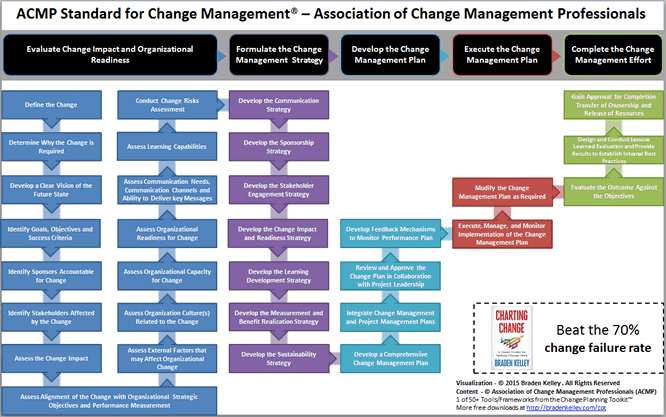
ACMP Standard Visualization

And sure people like pull ADKAR (a modified version of AIDA from the marketing world) and the ACMP Standard for Change Management (see the visualization I created above and download it for free here) and John Kotter’s change leadership approach, but they all fall short of making the planning and execution of change initiatives and projects a more visual and collaborative process, so I found myself starting to create new tools to help people (intended to link up with the PMBOK and ACMP Standard for Change Management).

These tools started to collect until they formed a comprehensive and new visual, collaborative approach to planning and executing change initiatives, and yes projects. This collection of tools became known as the Change Planning Toolkit™ and was first introduced in my latest book Charting Change which pairs nicely with my first book Stoking Your Innovation Bonfire. Both are designed to pack more insights into each chapter than most books contain in the entirety of their pages. Two of the most important frameworks introduced in the book are the Five Keys to Successful Change:

Five Keys to Successful Change 550

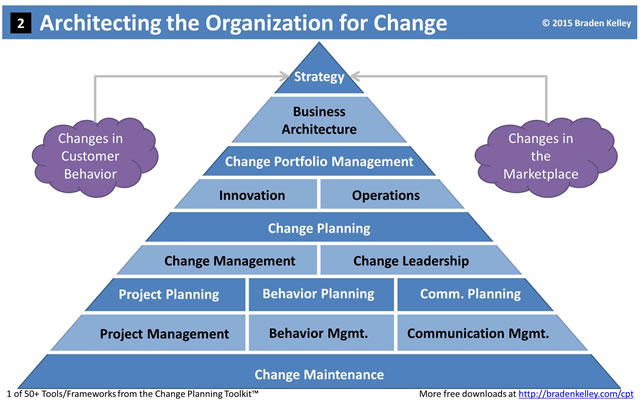
And the Architecting the Organization for Change framework:

Architecting the Organization for Change

Both frameworks are designed to help people challenge the way they think about organizational change. They are designed to help people think about more than change management and to think differently about how organizations are transformed and how change management and project management relate to each other.

To help people begin their participation in changing change I’ve made ten free tools available for download from the 50+ tools in the Change Planning Toolkit™, and people who buy a copy of Charting Change get access to 26 of the 50+ tools (including the Visual Project Charter™ and the Change Planning Canvas™). The book does a great job of helping to explain the philosophy behind the toolkit and how to get started with the tools, but people who purchase access to all 50+ tools (including tools to help people think through their Digital Transformation) also get a QuickStart Guide to explain each tool.

But if we are going to truly work together to change how change is planned and executed I thought it would make sense to give people a more in depth sneak preview into what’s inside the toolkit and so I’ve created the following Introduction to the Change Planning Toolkit™ webinar recording:


I encourage you to reflect upon your own experiences planning and executing both projects and change initiatives and what you’ve found lacking in the tools you call upon from ProSci, PMI, ACMP or others and then check out the book and the webinar and then let me know if there are any tools that you feel are still missing – and if it makes sense, I’ll create them!

My goal in creating all of these tools for you after all is to help you beat the 70% change failure rate, so let’s work together at changing change so our organizations are capable with more capably transforming themselves as the environment changes around them.

You can let me know if there are any change tools that you still need (or if you’d like me to come show you and your team personally how to use them) via the contact form.

Let’s change change together!

Change Planning Toolkit Million Dollar Value

Subscribe to Human-Centered Change & Innovation WeeklySign up here to get Human-Centered Change & Innovation Weekly delivered to your inbox every week.