Category Archives: Change

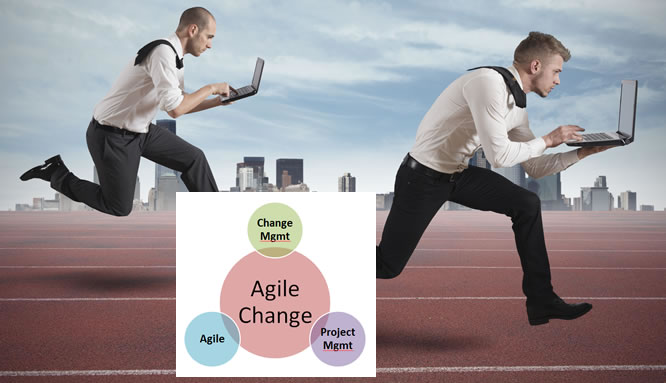
Agile Change Management is Coming

Agile Change Management

How fast is your organization capable of changing to continue to remain relevant and successful in the marketplace?

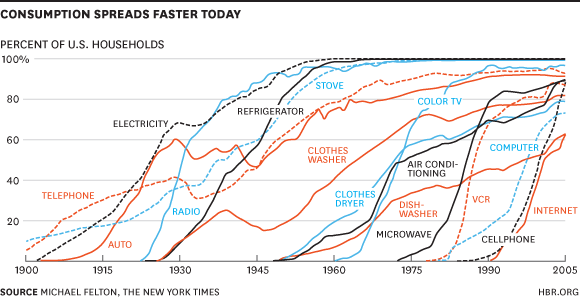
The world is changing at an accelerating pace as new technologies are discovered, developed, released and adopted by consumers faster than ever before. At the same time companies are rising to global scale faster and large, successful companies are disappearing faster too.

In this new reality that we all face, organizations of all types are going to need to:

  • Change how they change
  • Increase their organizational agility
  • Increase the flexibility of the organization
  • Become capable of continuous change
  • Inhibit the appearance and/or growth of change gaps that can doom your company

It is because of this tidal wave of change and a recognition that there is a need in the marketplace for more human change processes and tools that make change seem less overwhelming, that my next book for Palgrave Macmillan will focus on the best practices and next practices of organizational change (aka change management), and I’ve developed a new collaborative, visual change planning toolkit to go with it (but more about that later).

One way to do all of the items in the bulleted list above is to take more of an agile approach to change, to adopt some of the values and principles of the Agile Software Development methodology and use those to create a set of what could be described as Agile behaviors within the organization. If you are not familiar with the Agile Software Development methodology, I have included below the Agile Software Development Manifesto from http://agilemanifesto.org that details the values and principles of Agile Software Development. As you read through the manifesto I hope you’ll see that the values and principles can easily be applied to other endeavors outside of software development, whether that might in the project management discipline of your organization, or within your larger change initiatives.

Manifesto for Agile Software Development

We are uncovering better ways of developing software by doing it and helping others do it.

Through this work we have come to value:

  1. Individuals and interactions over processes and tools
  2. Working software over comprehensive documentation
  3. Customer collaboration over contract negotiation
  4. Responding to change over following a plan

That is, while there is value in the items on the right, we value the items in bold more.

Principles behind the Agile Manifesto

We follow these principles:

  • Our highest priority is to satisfy the customer through early and continuous delivery of valuable software.
  • Welcome changing requirements, even late in development. Agile processes harness change for the customer’s competitive advantage.
  • Deliver working software frequently, from a couple of weeks to a couple of months, with a preference to the shorter timescale.
  • Business people and developers must work together daily throughout the project.
  • Build projects around motivated individuals. Give them the environment and support they need, and trust them to get the job done.
  • The most efficient and effective method of conveying information to and within a development team is face-to-face conversation.
  • Working software is the primary measure of progress.
  • Agile processes promote sustainable development. The sponsors, developers, and users should be able to maintain a constant pace indefinitely.
  • Continuous attention to technical excellence and good design enhances agility.
  • Simplicity–the art of maximizing the amount of work not done–is essential.
  • The best architectures, requirements, and designs emerge from self-organizing teams.
  • At regular intervals, the team reflects on how to become more effective, then tunes and adjusts its behavior accordingly.
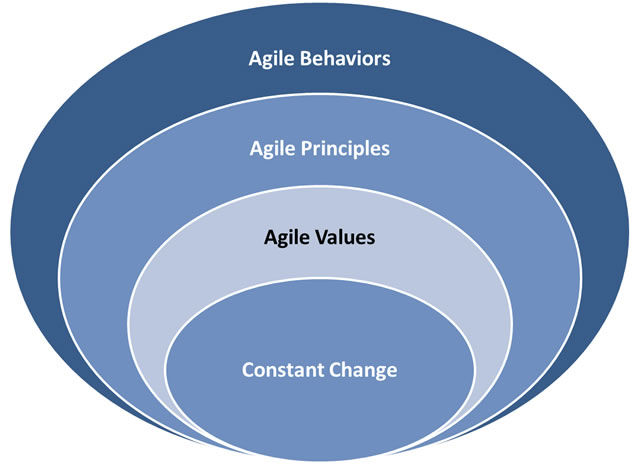
Agile and Constant Change

FIGURE 1

You will see in FIGURE 1 that constant change sits at the center, Agile Values providing the initial direction for an organization with a committed goal of becoming more agile. Radiating out from Agile Values as we pursue success in coping with constant change will be our Agile Principles. But, ultimately we can’t live our values or follow our principles if we don’t exhibit behaviors that personify those values and principles. Unless our organizations begin to behave in a more agile way then the potential of truly becoming more agile will remain just words, and go largely unfulfilled.

It is because of the challenge of behaving in a new way that I encourage all of your to make a move towards a formal pursuit of organizational agility. To help you in this pursuit, I will soon be releasing my brand new collaborative, visual change planning toolkit for companies to use on their own (with free training for a select few who agree to use it and document their experience for the book). In addition I will be launching separate training for consultants so they can use the tools with clients in their change management and project management practices. Please register your interest here.

Using this new set of change planning and execution tools and processes will not only make change seem less overwhelming, but it will also help you build alignment behind your effort, help you work through as a group how to LITERALLY all get on the same page for change, and create a more agile organization as adoption of the tools spreads.

Stay tuned for more great change content coming soon!

In the meantime, check out the different ways to get involved.

Accelerate your change and transformation success


SPECIAL BONUS: You can now access my latest webinar ‘Innovation is All About Change’ compliments of CoDev with passcode 1515 (link expired)


Subscribe to Human-Centered Change & Innovation WeeklySign up here to get Human-Centered Change & Innovation Weekly delivered to your inbox every week.
Innovation is All About Change – Webinar Recording

Innovation is All About Change - Webinar RecordingThe hardest part of making any change is taking that first step. We may point our shoulders in the direction we want to travel, but planning our change journey and mapping the steps to get there can still feel overwhelming. This is true for co-creation and open innovation projects, change programs — even personal change.
Often it helps to be with others who are on a similar path. It also helps to have tools that simplify steps and offer motivation. I’m delighted to invite you to view an exclusive conversation/webinar with me and my friends at CoDev (including host Cheryl Perkins of Innovationedge) that we recorded on January 15, 2015.

Click here and use PASSCODE 1515 to access the FREE recording of this webinar (link expired)

In this interactive 60-minute session, I share key tools and guidelines from my new, not-yet-published book from Palgrave Macmillan and give you some insights into what is in my new collaborative, visual change planning toolkit.

I discuss:

  • How organizational change and project/ portfolio management tie together
  • Useful frameworks to move from the ‘what’ to the ‘how’
  • Best (and next) Innovation practices
  • Roles and responsibilities based on the Nine Innovation Roles (from his last book Stoking Your Innovation Bonfire.)
  • How innovation is all about change

I encourage you to view the webinar recording with other members of your senior management team, and anyone else you think might have interest in the intersection of change initiatives, project management, and innovation.

Click here and use PASSCODE 1515 to access the FREE recording of this webinar (link expired)


Build a common language of innovation on your team

Subscribe to Human-Centered Change & Innovation WeeklySign up here to get Human-Centered Change & Innovation Weekly delivered to your inbox every week.

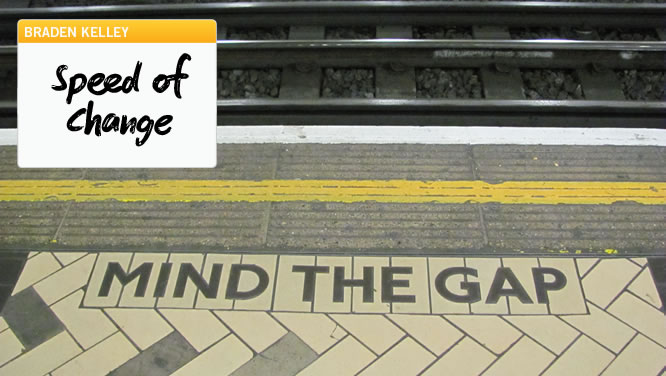
Speed of Change

Speed of Change

Are You Innovating at the Speed of Change?

The world is changing all around us at an increasing rate, and individuals (and yes organizations too) are struggling to cope with this ever increasing pace of change.

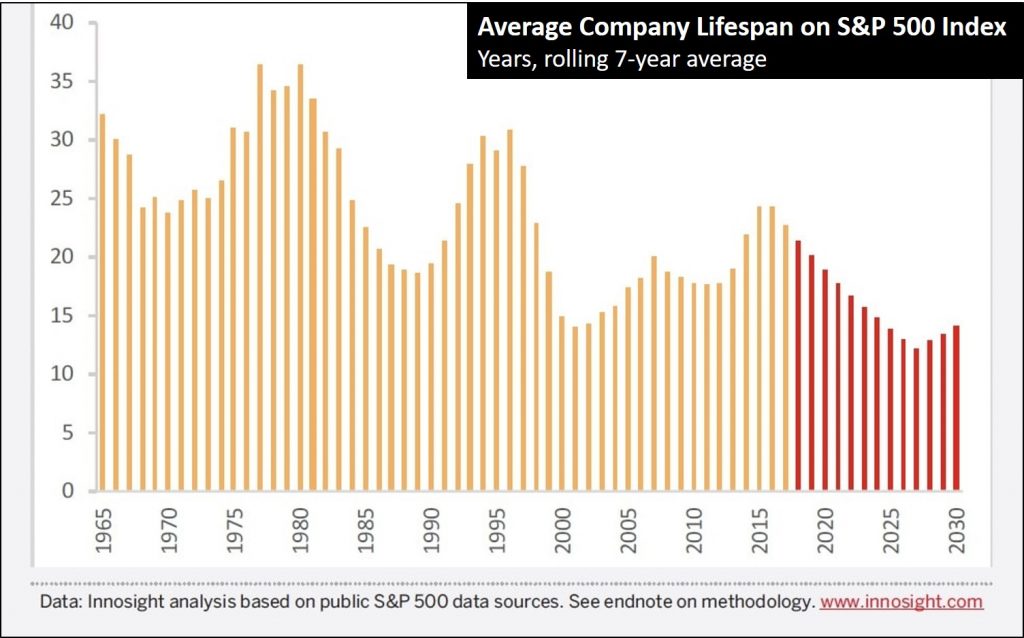
In fact, over the last 50 years the average lifespan of a company on the S&P 500 has dropped from 61 years to 18 years (and is forecast to shrink further in the future).1

Innosight Average Company Lifespan

Nobody of course wants to be one of those organizations that goes out of business, but the fact is that if your organization can’t innovate and change at the speed of change of its customers’ wants and needs, and the pace of geopolitical, social, and economic change in the world around it, then it will likely have to change its sign from open to CLOSED, permanently.

Your organization may indeed be doomed to fail if it develops on or more of the following change gaps:

  1. Your speed of hiring is slower than the speed of your growth
  2. Your speed of market understanding is slower than the pace of market change
  3. Your speed of insight dissemination and acceptance is slower than the pace of market change
  4. Your speed of idea commercialization is slower than the pace of market change
  5. Your speed of innovation is slower than the competition’s speed of innovation
  6. Your speed of internal change is slower than the rate of external change

The last one is of course the largest and the most important, and the most complex, being composed of your speed of:

  • Market Analysis (gathering of insights and inspiration)
  • Invention (creation of innovation source material)
  • Design (building a potential solution around an invention)
  • Development (taking the design and creating a scalable, launch ready solution)
  • Test (Evaluating with customers whether the solution works as designed and scales as intended)
  • Evolution (Launching the solution into the marketplace with open eyes and ears, pivoting/improving as necessary)

While it is possible to enter a market too early, you can survive this tactical error if you enter in a small way instead of committing to a global launch with grand customer promises. However, much more damage comes to organizations that enter too late. So, as an organization we must be constantly striving to get faster at discovering new market insights and adapting and aligning our organization to fulfill newly discovered market needs more quickly than our competition, otherwise we might find ourselves locked out of our customers’ top consideration set tier.

Consumption Spreads Faster

What other change gaps do you see as you look at your business or that of your competition?

This is the first of many articles that I will be writing in the run up to my second book (to be published by Palgrave Macmillan), in which I will explore the importance and implications of change in the ongoing success of organizations, along with building up a concise set of best practices and next practices for change.

To help kick off this journey I will be conducting a FREE webinar with my friends over at CoDev, focusing on how Innovation is All About Change. This exclusive sneak peek and Live Q&A will take place from 12:00-1:00pm ET on January 15, 2015, and will feature a quick introduction to a new visual, collaborative change planning toolkit that I’ve developed and am ready to share with the world. Click here to register (link expired).

I hope you’ll come join me on this journey to improve the pace of change in our organizations!

UPDATE to banner: You can now access a free recording of this webinar using PASSCODE 1515 here (link expired)

1. Innosight/Richard N. Foster/Standard & Poor’s
2. Image Source: Wikipedia


Build a common language of innovation on your team

Subscribe to Human-Centered Change & Innovation WeeklySign up here to get Human-Centered Change & Innovation Weekly delivered to your inbox every week.

FREE Webinar – Innovation is All About Change

FREE Webinar - Innovation is All About Change

The hardest part of making any change is taking that first step. We may point our shoulders in the direction we want to travel, but planning our change journey and mapping the steps to get there can still feel overwhelming. This is true for co-creation and open innovation projects, change programs — even personal change.
Often it helps to be with others who are on a similar path. It also helps to have tools that simplify steps and offer motivation. I’m delighted to invite you to an exclusive conversation/webinar with me and my friends at CoDev (including host Cheryl Perkins of Innovationedge) on Thursday, January 15, 2015 at 12 pm ET.

Click here and use PASSCODE 1515 to access the FREE recording of this webinar (link expired)

In this interactive 60-minute session, I will share key tools and guidelines from my new, not-yet-published book from Palgrave Macmillan and give you some insights into what is in my new collaborative, visual change planning toolkit.

I will discuss:

  • How organizational change and project/ portfolio management tie together
  • Useful frameworks to move from the ‘what’ to the ‘how’
  • Best (and next) Innovation practices
  • Roles and responsibilities based on the Nine Innovation Roles (from his last book Stoking Your Innovation Bonfire.)
  • How innovation is all about change

I encourage your questions and look forward to dialogue with you, other members of your senior management team, and anyone else you think might have interest in the intersection of change initiatives, project management, and innovation.

Click here and use PASSCODE 1515 to access the FREE recording of this webinar (link expired)


Build a common language of innovation on your team

Subscribe to Human-Centered Change & Innovation WeeklySign up here to get Human-Centered Change & Innovation Weekly delivered to your inbox every week.

What Change Roles Are Missing?

What Change Roles Are Missing?

I’m gearing up to write a new app and book on organizational change to complement a powerful new visual change toolkit that will be incredibly useful for use in change programs, project and portfolio management, and even innovation, and so I’m canvasing the organizational change literature space (including change leadership, change management, and business transformation) and looking to identify:

  1. The best organizational change thought leaders
  2. The most powerful organizational change frameworks
  3. The most useful organizational change tools
  4. The best organizational change books (including change leadership, change management, and business transformation)

Please contact me to tell me your favorites or add below in the comments.

I will be launching a new community and information site soon to launch this visual change toolkit free to the world, in an extremely collaborative way. Which is why I’m looking for your thoughts on the four items above. Once the skeleton site is up in the next week or so, people will also be able to submit their suggestions on the site.

But in the meantime, based on the success of the Nine Innovation Roles from my last book Stoking Your Innovation Bonfire and some ideas that have been triggered by the work I’ve done in various workshops with organizations around the world with the Nine Innovation Roles, I’ve decided to identify a similar set of roles that people should make sure are occupied on their guiding coalitions.

And as I look at the Nine Innovation Roles there are a few that are still applicable in a broader change context (after all, Innovation Is All About Change). Here are the ones that I believe still are necessary in an organizational change program:

1. Revolutionary

The Revolutionary is the person who is always eager to change things, to shake them up, and to share his or her opinion. These people are uncomfortable standing still and not shy about sharing their opinions. Often they see the status quo as not good enough, so the Revolutionary wants to change it.

2. Architect

Change doesn’t emerge from a vacuum. Someone has to see the bigger picture, bring the idea fragments together and create a cohesive change program, a new business architecture, and guide people to create a collection of project artifacts to help guide the change effort. This is the role of the Architect.

3. Artist

The Artist doesn’t seek change like the Revolutionary or see the big picture like the Architect, but Artists are really good at evolving the seeds of change, shaping them, watering them, and ultimately making the impetus for change more clear, the benefits more compelling, and the change plan more complete.

4. Barrier Buster

Every change effort should identify several potential barriers to change, and the team must identify ways to overcome them before the change program is ready to be communicated to the masses. This is where the Barrier Buster comes in. Barrier Busters love solving tough problems and often have the deep domain knowledge or the deep insight into the change target’s mindset necessary to move minds and resources to support the change program.

5. Connector

The Connector does just that. These people hear a Revolutionary say something interesting and put him together with an Architect and an Evangelist; The Connector listens to the Artist and knows exactly where to find the Barrier Buster that the change effort needs.

6. Lion Tamer

The Lion Tamer is really good at identifying risks, potential negative outcomes, and the steps necessary to implement a change. Lion Tamers take the unwieldy beast that any change program can easily become, tame it, help break it down into digestible chunks, and make it real. These are the people who can picture how the change is going to be made and line up the right resources to make it happen.

7. Evangelist

The Evangelists know how to educate people on what the change is and help them understand it. Evangelists are great people to help attract guiding coalition members and to build support for a change effort among leadership. Evangelists also are great at both evangelizing on behalf of customers, employees and partners, but also in helping to educate customers, employees, and partners on the value of the change effort.

8. INSERT YOUR SUGGESTION HERE

9. INSERT YOUR SUGGESTION HERE

So, that’s only a first cut at a set of Change Roles that must be filled on the guiding coalition or the change program team.

What roles are missing?

Are there any there that are not needed or redundant?

Please sound off in the comments below.


Build a common language of innovation on your team

Subscribe to Human-Centered Change & Innovation WeeklySign up here to get Human-Centered Change & Innovation Weekly delivered to your inbox every week.