
Loyalty Archaeology™
Excavating Sources of Next Generation Loyalty
Marketers have an overly optimistic perspective on customer loyalty and their implementations of customer loyalty programs.
The reality is that very few customers are loyal and much of what we speak of as customer loyalty is no more than repeat transaction behavior.
Customer Loyalty Programs Are Really Just Discount Programs
If we are honest as marketers, today’s typical customer loyalty program is no more than an a way of automatically gathering purchase data and distributing discounts. Today’s traditional points-based customer loyalty program is actually just a fancy and often costly discounting program because smart marketers only use discounting to capture sales that would not otherwise have occurred. As soon as you begin distributing discounts to people that would have purchased anyways, then you are cannibalizing your own profit margins.
If you want to dispute that a points-based loyalty program is nothing more than a discounting program, you have to look no further than web sites that quantify the value of points given for airline miles, hotel stays, etc.
So what is customer loyalty?
According to the Oxford Dictionaries, loyalty is a strong feeling of support or allegiance.
In a business sense, most people look at customer loyalty as a measure of how likely a customer is to do repeat business with a company or brand.
But this way of looking at customer loyalty is too easy to “achieve” and is more related to repeat purchase behavior than true loyalty. The definition of loyalty in Oxford Dictionaries is too weak as well.
True loyalty (customer or otherwise) is when someone engages in a behavior that is not in their most obvious best interest because of a higher commitment.
A United States Marine putting himself or herself in harm’s way to recover a wounded comrade from the battlefield is a demonstration of true loyalty.
A customer paying a higher price for an identical product could be a demonstration of loyalty, but could also be an example of brand value or linked to other intangible, often emotional sources of value not directly linked to the product itself (desire to support a company’s social purpose, affinity for cartoon characters used to promote the product, etc.)
A customer paying a lower price for an identical product because you’re giving them a “loyalty program” discount is not a sign of loyalty.
Focusing on the interfaces and experiences related to your products, services and solutions and their surrounding emotional components are more likely to engender loyalty than building a points-based program.
I’m not saying points-based programs are bad, but let’s be clear – they’re not loyalty programs, they’re great for gathering customer purchase data and helping to drive repeat purchase behavior. But, if your competitor offers a better points program you’re likely to lose your supposedly loyal customers.
What does a Next Generation Loyalty program look like?
A Next Generation (aka NextGen) Loyalty program has very little to do with points and promotions, but instead focuses on identifying and leveraging the variables that represent opportunities to create actual loyalty for your brands and their associated products, services and solutions.
Next Generation Loyalty programs can only be created if you understand where the value comes from for each of your products, services and solutions.
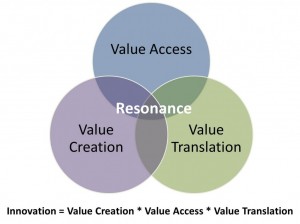
In my popular article “Innovation is All About Value” I highlighted the fact that there are three key value considerations in the pursuit of innovation:
- Value Creation is pretty self-explanatory. Your innovation investment must create incremental or completely new value large enough to overcome the switching costs of moving to your new solution from the old solution (including the ‘Do Nothing Solution’). New value can be created by making something more efficient, more effective, possible that wasn’t possible before, or create new psychological or emotional benefits.
- Value Access could also be thought of as friction reduction. How easy do you make it for customers and consumers to access the value you’ve created. How well has the product or service been designed to allow people to access the value easily? How easy is it for the solution to be created? How easy is it for people to do business with you?
- Value Translation is all about helping people understand the value you’ve created and how it fits into their lives. Value translation is also about understanding where on a continuum between the need for explanation and education that your solution falls. Incremental innovations can usually just be explained to people because they anchor to something they already understand, but radical or disruptive innovations inevitably require some level of education (often far in advance of the launch).
All three are defined in the article on the link above and were created in an innovation context, but there is no reason they couldn’t also be used in a marketing context to identify potential sources of customer loyalty to be leveraged or enhanced.
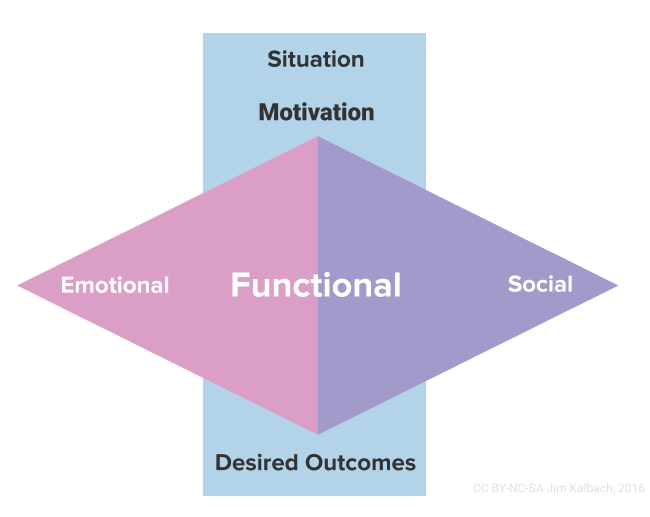
Another great way to work backwards to identify potential sources of customer loyalty is to leverage A Practical Model for Jobs to be Done (JTBD) from Jim Kalbach. The six components laid out in his graphic below being:
- Situation
- Motivation
- Desired Outcome
- Functional Jobs
- Emotional Jobs
- Social Jobs
Using Loyalty Archaeology™ to Uncover Sources of NextGen Loyalty
These two simple frameworks give you a great place to start your quest for Next Generation Loyalty. Using Loyalty Archaeology™ to understand potential sources of loyalty will provide the foundation for building a potential program of loyalty enhancements.
You might be sensing that there is no one size fits all when it comes to NextGen Loyalty, and you’d be right.
What insights about the sources of your customers’ loyalty do you think these frameworks can provide?
What other tools do you think would be useful in excavating sources of potential customer loyalty?
In the next article in this series we’ll look at how to take the insights on customer loyalty sources and build a program of initiatives to enhance and accelerate your sources of unique customer loyalty. We’ll also look at how to go beyond points and redemption to leverage different parameters in your program of initiatives to build Next Generation Loyalty!
Image credits: Pixabay, Braden Kelley and Jim Kalbach
 Sign up here to get Human-Centered Change & Innovation Weekly delivered to your inbox every week.