GUEST POST from Oscar Amundsen
Do you trust your colleagues? And does your leader trust you? This article is about how the ‘trust mechanism’ affects the ability to change and innovate in any organization.
Many experts think that trust mainly relates to expectations, or more precisely, having positive expectations of others. Still, there is no escaping the fact that trust also implies ‘risk-taking.’ This means that uncertainty is part of the deal, which then means that trust can be abused — with all the problems that follow from that.
One might say that trust as a concept loses its content when not linked to uncertainty and risk. The question, therefore, is whether you would take the chance when something is actually on the line? There are strong arguments for answering ‘yes’ to this question, as the level of trust is closely connected to an organization’s ability to innovate.
Trust as a Mechanism for Innovation
It is not controversial to claim that trust promotes innovation in an organization. But it may be a point that is often unclear and vaguely justified. To make it more explicit and concrete – these are the four ‘mechanisms’ that explain why trust matters:
- Trust increases the flow and sharing of knowledge and information. We tend to share information with people we trust rather than those we don’t trust. This works both ways: We are less likely to accept information and knowledge from sources we don’t trust.
- Trust promotes workflow and collaboration. Here is why: If we trust a colleague’s work, we can proceed based on what has been done. If we don’t trust what people have done, we will go back to check and verify. ‘Double work’ is both inefficient and boring.
- Trust provides relief for leaders. The reason is this: If you trust a colleague, they can ‘take care of’ tasks that you are responsible for. This frees up and strengthens your own capacity as a leader. Thus, it becomes easier to prioritize other important matters that require your attention.
- Trust boosts mental capacity. The reason is that low trust creates psychological strain. Tired and suspicious individuals have little energy left. Thus, it’s not easy to be creative and constructive.
- Trust improves performance. Expectations are an important component of trust. A person who experiences positive expectations directed toward themselves and their work will perform better. In research, this is known as the Rosenthal effect.
Research points out that trust is a basic premise for social life. In practice, social participation simply assumes some degree of trust; thus, pure distrust is basically the same as pure madness.
Trust and Control
In general, we can say that a culture of control dampens innovation within an organization. However, it might be a little too simple to postulate that control and trust are true opposites.
In practice these two will exist in combination. Organizations do not have zero need for control over what is going on. The point is rather to be aware that there are links between the two, meaning that control measures can easily have an unfortunate effect on the organization. The introduction of a quality control system may be perceived as a sign of distrust in employees. Such a measure, introduced with good intentions, may thus become the start of a negative spiral of decreasing trust in the organization. In general, there is reason to assume that increased control in an organization will detrimentally affect the internal motivation of the employees and therefore their creativity. Thus the ‘impulse’ to commit to innovation is undermined.
Even if there is no either-or in the relationship between control and trust, there is good reason to be aware that a balance must be struck: What is the genuine need for control? Is there more control than necessary in this organization? Thus the heaviest burden of evidence should be on the control mechanism in a good organization. You should have good reasons for increasing control activities in an organization if innovation is important for the enterprise.
Trust Requires Courage
We can confidently conclude that trust is a ‘gold mine’ for a business. However, there always comes some sort of risk with it — because you can never be 100 percent certain that things will turn out well when you trust someone. Therefore, it requires a certain kind of courage if you want to get access to this gold mine. This means that building trust within an organization starts with courageous leaders. When you, as a leader, demonstrate trust in an employee, the likelihood increases that the employee will reflect it back. In this way, you contribute to gradually developing a culture of trust within your organization. The thing about trust is that it is not something that can be ‘used up’ through use; rather, the opposite is true: the more it is used, the greater it can become.
It should be added that other factors will also influence employees’ levels of trust in an organization. Research particularly highlights the experience of fairness as crucial for the development of trust among employees. More specifically, this involves respectful treatment, fair procedures, and equitable distribution of resources. If you want to build trust, it is therefore important to consider how fair things appear to the average employee. One key aspect here will be to strive for as much openness and transparency within the organization as possible.
Trust is One Piece in the Puzzle of Innovation
The question of what strengthens the ability to change and innovate in an organization has, of course, more answers than just ‘trust’. The more complete answer to the question may be outlined as an ideal organization — a ‘dream organization’ – characterized by the features shown in the following model:
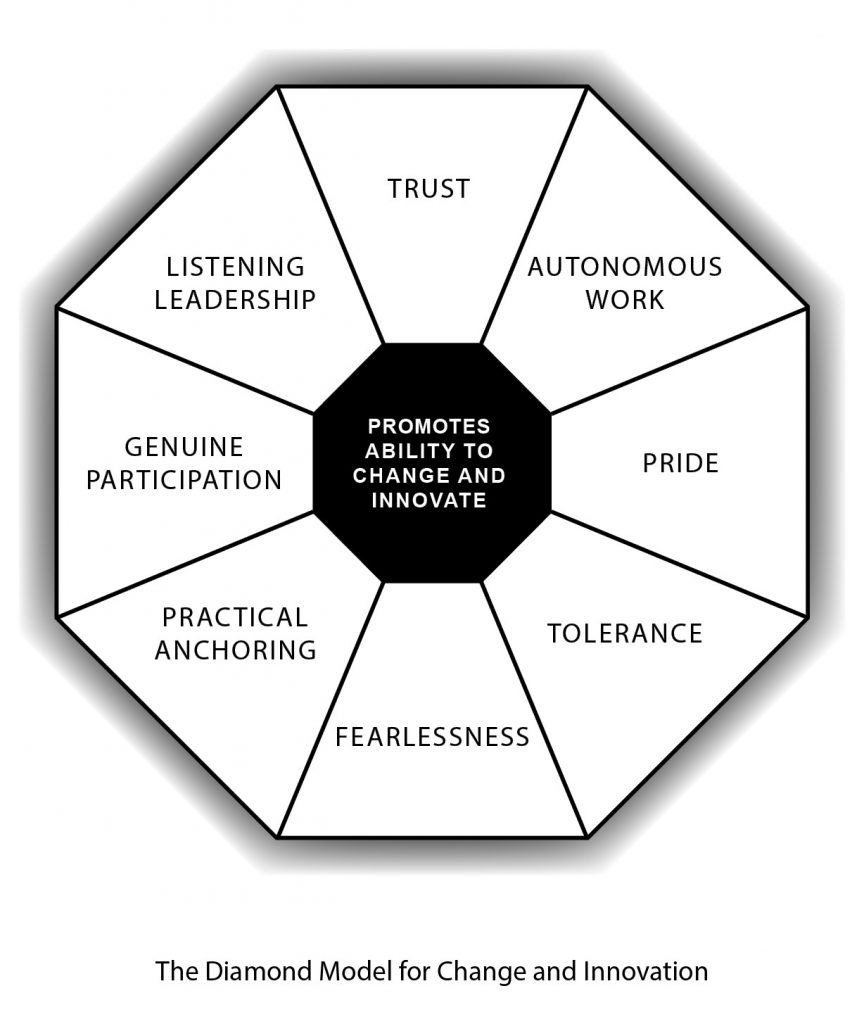
This model is derived from the book How to Become a Dream Organization (Amundsen, 2025). As you can see, there are eight messages in the model: All of them start with one of the eight ‘outer’ words and are then read through to what is written in the center. This will give you sentences such as: ‘Trust promotes ability to change and innovate,’ and so on. Each of these eight themes has its own chapter (numbered in a clockwise direction from the top), thus providing the concepts in the diagram with content and reasoning. The idea is to show why and how these features have a positive impact on the ability of organizations to change and innovate.
The point with all of this is of a more practical nature: That you will be able to contribute to making the organization you work in better — for yourself and for your enterprise.
Reference:
Amundsen, Oscar (2025) How to Become a Dream Organization. Eight Things Leaders Need to Know to Promote Change and Innovation. London/Washington: Business Books.
Image credits: Dall-E, Oscar Amundsen
 Sign up here to join 17,000+ leaders getting Human-Centered Change & Innovation Weekly delivered to their inbox every week.
 Drum roll please…