Category Archives: Customer Experience

Improving Patient Experience and Outcomes

Design Thinking in Healthcare

Improving Patient Experience and Outcomes: Design Thinking in Healthcare

GUEST POST from Chateau G Pato

Design thinking is a problem-solving approach that prioritizes empathy for users and focuses on creating innovative and effective solutions. While its application has been widely recognized in various industries, healthcare is an area where design thinking can drastically improve patient experience and outcomes. By placing patients at the center of the design process, healthcare providers and designers can craft services and solutions that cater to their unique needs and ultimately transform the way healthcare is delivered.

Case Study 1: The Mayo Clinic

The Mayo Clinic, a renowned healthcare institution in the United States, has embraced design thinking as a way to enhance patient experience. In collaboration with design firm IDEO, the Mayo Clinic’s Center for Innovation developed the “Patient Revolution” project. This initiative aimed to empower patients to be more active participants in their healthcare journey.

One of the notable solutions was the “What Matters to Me” tool, which helped healthcare providers understand patients’ personal values, goals, and priorities. By using simple conversation cards, patients were able to express what really mattered to them, beyond their medical condition. This information allowed doctors to tailor treatments and care plans that encompassed the individual’s holistic well-being. Through this empathetic approach, the Mayo Clinic saw improved patient satisfaction, better communication, and ultimately, enhanced health outcomes.

Case Study 2: Dignity Health

Dignity Health, a healthcare system with hospitals across the United States, recognized the need for more patient-centered experiences in their facilities. With the help of design firm IDEO, they created an innovative solution called “Hellohumankindness.” The focus of this project was to infuse kindness and compassion into every interaction between patients, staff, and visitors.

Dignity Health redesigned the physical spaces within their facilities to promote healing and create a more welcoming environment. Simple but impactful changes, such as placing comfortable seating in hallways and providing artwork and nature views, positively affected the overall patient experience. Moreover, staff members were trained on empathy and communication skills to ensure patients felt heard, understood, and cared for.

Through the implementation of Hellohumankindness, Dignity Health saw a significant increase in patient satisfaction, reduced stress levels, and improved employee morale. Design thinking played a crucial role in transforming the healthcare system’s culture and instilling a more patient-centric approach.

Conclusion

Design thinking has proven to be a valuable tool in revolutionizing the healthcare industry. By prioritizing empathy and crafting solutions that truly address patients’ needs, healthcare providers can improve patient experience and outcomes. The Mayo Clinic’s “Patient Revolution” and Dignity Health’s “Hellohumankindness” are just two examples of how design thinking has transformed healthcare delivery to create more patient-centered and compassionate care.

In an era where patient satisfaction and engagement are key factors in healthcare success, design thinking provides a powerful framework for generating innovative and effective solutions. As more healthcare organizations embrace this approach, the industry can move closer towards a future where patients receive care that not only treats their ailments but also respects their values and enriches their overall well-being.

SPECIAL BONUS: Braden Kelley’s Problem Finding Canvas can be a super useful starting point for doing design thinking or human-centered design.

“The Problem Finding Canvas should help you investigate a handful of areas to explore, choose the one most important to you, extract all of the potential challenges and opportunities and choose one to prioritize.”

Image credit: Pexels

Subscribe to Human-Centered Change & Innovation WeeklySign up here to get Human-Centered Change & Innovation Weekly delivered to your inbox every week.

When Everything is Personalized, What Still Feels Personal?

When Everything is Personalized, What Still Feels Personal?

GUEST POST from Chateau G Pato


The Paradox of Hyper-Personalization

We live in an age of unprecedented algorithmic precision. Platforms anticipate our purchases before we consciously recognize our needs, streaming services curate feeds tailored down to our late-night viewing habits, and dynamic software seamlessly inserts our names, locations, and preferences into every digital touchpoint. Yet, despite being surrounded by experiences engineered specifically “for us,” a striking phenomenon has emerged: interactions feel increasingly hollow, transactional, and detached.

The fundamental flaw lies in confusing continuous data optimization with genuine human connection. Modern experience design has leaned heavily on predictive models and automated customization, mistaking micro-targeting for intimacy. But true personalization isn’t a technical triumph of data retrieval—it is an act of human-centered empathy. When every interaction is optimized solely for conversion or engagement efficiency, we strip away the warmth, dignity, and shared agency that make an experience feel meaningful.

To lead and innovate in a landscape where automated customization is a baseline commodity, organizations must rethink what actually resonates with people. Moving beyond the surface-level mechanics of predictive algorithms requires a shift toward deliberate experience design—one anchored in trust, contextual understanding, and purposeful human-centered change. In an era where everything is personalized by default, the real competitive advantage belongs to those who understand what still feels personal.

The Erosion of Authenticity in Algorithmic Experience Design

As organizations double down on automated hyper-personalization, they frequently cross an invisible threshold into what can be termed the “uncanny valley” of customer experience. When a system presents an overly precise prediction of a user’s behavior, mood, or private life, the intended delight often sours into a feeling of intrusion. Rather than building trust, invasive algorithms signal to individuals that they are being continuously observed, quantified, and monetized—transforming a intended service moment into a surveillance milestone.

Simultaneously, relentless algorithmic optimization breeds an unexpected consequence: systemic homogenization. Directing users through narrow tunnels of predictive recommendations based on past behavior eliminates the serendipity, surprise, and discovery that drive deep human engagement. By serving consumers only what the model calculates they want next, organizations trap their audience in hyper-tailored echo chambers, flattening the depth and diversity of the overall brand experience.

Ultimately, when every competitor adopts identical predictive machinery to insert personalized variables into customer journeys, the strategy loses its capacity to differentiate. Algorithmic customization transitions from a delightful innovation to table stakes noise. When “special” is automated at scale, it ceases to feel special at all—leaving human-centered empathy and genuine connection as the true remaining frontiers of experience design.

The Framework: Re-Defining What “Feels Personal”

To transcend the limits of automated customization, experience architects must shift from passive data-gathering to active human engagement. True connection is not generated by an algorithm calculating past behavior, but through frameworks designed around shared agency, trust, contextual empathy, and purposeful friction.

Shared Agency and Co-Creation
Traditional personalization is asymmetric: an organization collects data to do something to the customer. Authentic human experience flips this dynamic by doing things with the customer. When individuals are invited into the co-creation process—shaping their own tools, defining their own paths, or tailoring their own journeys—they build ownership and deep emotional investment. Agency inherently feels personal because it honors individual autonomy.

Intentional Vulnerability and Trust
Automated systems are designed to minimize corporate risk and project flawless efficiency. Yet, human intimacy is built on trust, which requires vulnerability. When an organization acknowledges a mistake directly without a scripted response, or when front-line staff are given the latitude to make unscripted calls, it breaks through the corporate facade. Demonstrating authentic human accountability fosters genuine loyalty in ways an automated discount code never can.

Contextual Empathy over Historical Data
Algorithms rely on historical data points, predicting future behavior based on past actions. Human-centered design relies on contextual empathy—understanding an individual’s immediate emotional state, environment, and current goals. Recognizing when a user needs quick, frictionless resolution versus when they need space, reassurance, or human conversation creates interactions that feel attuned to the person, not just their profile.

Purposeful Friction
The prevailing impulse in digital design is to eliminate all effort and friction. However, removing every touchpoint often strips away meaning and sense of achievement. Thoughtfully designed friction—forcing a moment of reflection, encouraging deliberate choice, or requiring shared effort—signals that the outcome matters. Value is created in moments that require care and intention, making the experience resonate far longer than a frictionless transaction.

Experience Design Action Plan for Leaders

Transitioning from automated customization to authentic human connection requires deliberate shifts in strategy, culture, and execution. Leaders looking to elevate their customer and employee experience must move beyond data points and build environments that foster genuine engagement.

Design for Serendipity and Unstructured Discovery
Algorithmic filters create echo chambers that limit exploration. Forward-thinking leaders intentionally design unstructured “un-personalized” spaces within digital platforms and physical environments. By carving out room for surprise, unexpected recommendations, and cross-disciplinary inspiration, organizations help customers discover value they didn’t know they were looking for.

Empower Frontline Teams with Genuine Autonomy
No algorithm can match the warmth and quick thinking of an empowered human being. Organizations must dismantle rigid, over-scripted customer interaction plays and grant frontline staff the trust, budget, and authority to solve problems spontaneously. When employees have the agency to create memorable, unscripted moments of delight, they transform routine transactions into lasting relationships.

Align Change Management around Human-Centered Mindsets
Deploying human-centered experience design is fundamentally an organizational change challenge. Metrics dominated purely by operational speed, handle times, and conversion volume inadvertently push teams toward cold efficiency. Leaders must evolve performance structures and change initiatives to prioritize trust, relationship depth, and long-term customer sentiment alongside operational excellence.

The Future of Human-Centric Innovation

As artificial intelligence and automated decisioning become deeply embedded across every industry, hyper-personalization will quickly cease to be a source of competitive advantage. When every organization has access to the same predictive capability to tailor content, recommendations, and interfaces, digital efficiency becomes baseline table stakes. The true differentiator will not be how smartly an algorithm processes data, but how intentionally an organization anchors its experiences in human dignity, trust, and shared value.

The path forward requires leaders to rebalance their innovation portfolios—moving beyond technical optimization to embrace the messier, more meaningful work of human-centered experience design. Building sustainable loyalty means creating spaces for agency and co-creation, empowering teams to act with genuine empathy, and recognizing that not every touchpoint should be automated simply because the technology exists to do so.

In a world engineered for total optimization, the experiences that truly endure are those that treat individuals not as data targets to be converted, but as active participants in a shared journey. By leading with purpose, empathy, and deliberate human connection, organizations can move past the illusion of intimacy and design experiences that truly feel personal.

Frequently Asked Questions

What is the difference between automated customization and human personalization?

Automated customization relies on predictive algorithms, historical data, and dynamic content insertion to target users efficiently. Human personalization, by contrast, focuses on empathy, trust, shared agency, and contextual understanding—creating meaningful connections rather than merely optimizing for conversion.

Why does hyper-personalization often feel intrusive or hollow to consumers?

When algorithms predict behavior with extreme precision without establishing trust, interactions cross into an “uncanny valley” that feels like surveillance. Furthermore, when every brand automates tailored messages at scale, personalization loses its novelty and becomes transactional noise.

How can experience design leaders foster authentic human connection in digital environments?

Leaders can design for serendipity by allowing unstructured discovery, empowering frontline teams with autonomy to deliver unscripted interactions, incorporating purposeful friction that gives moments meaning, and actively co-creating experiences alongside their customers.


EDITOR’S NOTE: Braden Kelley’s Problem Finding Canvas can be a super useful starting point for doing design thinking or human-centered design.

“The Problem Finding Canvas should help you investigate a handful of areas to explore, choose the one most important to you, extract all of the potential challenges and opportunities and choose one to prioritize.”

Image credit: Gemini

Subscribe to Human-Centered Change & Innovation WeeklySign up here to get Human-Centered Change & Innovation Weekly delivered to your inbox every week.

How to Create a Customer-Centric Culture in Your Organization

How to Create a Customer-Centric Culture in Your Organization

GUEST POST from Chateau G Pato

In today’s highly competitive business environment, creating a customer-centric culture within your organization is crucial for long-term success. A customer-centric culture ensures that all members of your organization are focused on meeting and exceeding customer expectations, leading to increased customer satisfaction, loyalty, and ultimately, business growth. Here are some strategies and case study examples to help you develop a customer-centric culture in your organization.

1. Empower Your Employees to Act in the Customer’s Best Interest

One of the keys to building a customer-centric culture is empowering your employees to go above and beyond for customers. Zappos, the online shoe and clothing retailer, is a prime example of an organization that prioritizes customer satisfaction. Zappos encourages its employees to spend as much time as needed with customers to ensure they find the perfect product. The company empowers its customer service representatives to act in the customer’s best interest and provide exceptional service, even if it means taking unconventional measures such as locating an item from a competitor’s store. By giving employees the freedom to make decisions that benefit customers, Zappos has cultivated a strong customer-centric culture that sets them apart in the industry.

2. Gather and Act on Customer Feedback

To truly create a customer-centric culture, you need to actively listen to your customers and address their concerns. Apple, renowned for its loyal customer base, exemplifies the importance of leveraging customer feedback. The company collects extensive feedback from its customers through various channels, including surveys, customer support interactions, and product reviews. Apple then uses this feedback to improve its products and services continuously. By actively seeking out customer input and acting upon it, Apple demonstrates a commitment to meeting customer needs and preferences. This customer-centric approach has undoubtedly contributed to their success and brand loyalty.

3. Align Your Organization’s Goals and Values

Creating a customer-centric culture requires aligning your organization’s goals and values with the needs and wants of your customers. Amazon, the world’s largest online retailer, exemplifies this alignment by making customer obsession one of their core values. This focus on the customer has driven Amazon to continuously innovate and find ways to make the shopping experience more convenient and personalized. By ensuring that every decision and action within the organization is driven by customer needs, Amazon has successfully ingrained a customer-centric culture into its DNA.

4. Invest in Employee Training and Development

To create a customer-centric culture, it is crucial to invest in training and developing your employees. Ritz-Carlton Hotels is a perfect example of an organization that places a high emphasis on employee training to drive exceptional customer service. The hotel chain is renowned for its personalized and luxurious customer experience, which is made possible by empowering its employees through intensive training and ongoing professional development. Ritz-Carlton provides its employees with the necessary tools, knowledge, and skills to anticipate and fulfill customer needs, ensuring that every interaction leaves a lasting positive impression.

Conclusion

Creating a customer-centric culture is essential for organizations looking to thrive in today’s customer-driven world. By empowering employees, actively seeking and acting on customer feedback, aligning goals and values with customer needs, and investing in employee training, organizations can foster a customer-centric culture that drives long-term success. Drawing insights from successful case studies such as Zappos, Apple, Amazon, and Ritz-Carlton Hotels can provide valuable inspiration and guidance in this journey.

EDITOR’S NOTE: Braden Kelley’s Problem Finding Canvas can be a super useful starting point for doing design thinking or human-centered design.

“The Problem Finding Canvas should help you investigate a handful of areas to explore, choose the one most important to you, extract all of the potential challenges and opportunities and choose one to prioritize.”

Image credit: misterinnovation.com

Subscribe to Human-Centered Change & Innovation WeeklySign up here to get Human-Centered Change & Innovation Weekly delivered to your inbox every week.

The Ethics of Experience

Building Equitable Digital and Physical Environments

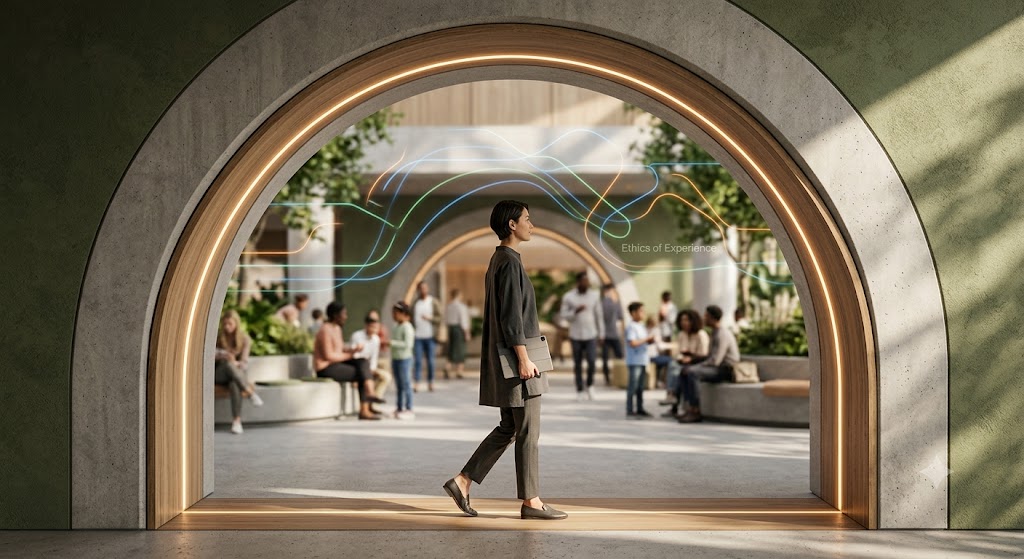
The Ethics of Experience

GUEST POST from Chateau G Pato


I. The Invisible Architecture of Exclusion

For decades, experience design has been obsessed with friction. We measure success in milliseconds saved, clicks reduced, and seamless transitions from intent to transaction. But in our relentless pursuit of speed and convenience, we have quietly constructed a hidden tax on participation — an invisible architecture that privileges the default user while systematically marginalizing everyone else.

The Convenience Paradox

When we design for the “average” human, we design for an entity that does not exist. A frictionless digital workflow optimized for high-speed connectivity and cognitive ease can turn into a brick wall for a neurodivergent user or someone navigating a low-bandwidth environment. Similarly, a sleek, minimalist physical layout — devoid of physical signage or intuitive spatial cues — forces individuals with mobility or sensory differences to exert disproportionate energy just to participate.

This is the Convenience Paradox: the hyper-optimization of experiences for the dominant demographic often creates radical friction for the margins. True innovation requires us to recognize that convenience for a few at the expense of accessibility for many is not good design — it is engineered exclusion.

The Cost of Unintended Consequences

Exclusion is rarely born out of malice; it is born out of unexamined assumptions. When organizational silos fail to stress-test physical and digital touchpoints against human diversity, the fallout is swift and far-reaching:

  • Algorithmic & Systemic Bias: Automated decision engines and smart physical interfaces that fail to recognize diverse facial structures, voices, or mobility patterns, turning routine interactions into degrading barriers.
  • Dark Patterns & Manipulative Choice Architecture: Digital interfaces designed to trick users into oversharing data or subscribing to services, disproportionately exploiting vulnerable populations and eroding systemic trust.
  • Spatial Alienation: Modern physical environments built around assumption-heavy mobile app integrations, stranding non-digital natives or those without access to constant hardware upgrades.

Reframing Experience Design: Moving to Human Experience (HX)

To repair these fractures, leaders must shift the baseline of innovation. Traditional frameworks isolate Customer Experience (CX) into commercial transactions and User Experience (UX) into interface usability. But humans are not merely customers executing transactions or users completing tasks — we are complex beings navigating integrated physical and digital ecosystems.

“When we shift from Customer Experience to Human Experience, equity stops being an optional feature and becomes the core structural requirement.”

Embracing Human Experience (HX) forces an ethical pivot. It demands that we evaluate every digital screen, physical lobby, and service touchpoint not just by how effectively it drives conversion, but by how honors human dignity, fosters belonging, and expands equitable access across the entire organizational landscape.

II. Core Pillars of Ethical Experience Design (EED)

Building equitable environments across digital and physical domains requires more than goodwill; it demands a structured, intentional framework. Ethical Experience Design (EED) rests on four core pillars that re-anchor innovation in human dignity and shared value.

1. Equity Over Equality

Equality assumes everyone benefits from the exact same support, resources, and interfaces. Equity recognizes that humans start from different positions, possess distinct physical and cognitive capabilities, and navigate vastly different socioeconomic contexts. Designing for equity means creating flexible pathways that deliver equivalent outcomes — not identical treatments.

  • Multi-Modal Engagement: Providing physical, digital, and voice alternatives for core interactions so no single point of access becomes a bottleneck.
  • Contextual Adaptability: Designing interfaces and spatial layouts that dynamically respond to different user needs, energy levels, and environments.

2. Transparency & Agency

An ethical environment never coerces, tricks, or obscures. As environments become increasingly dynamic — driven by ambient computing, IoT sensors, and predictive algorithms — users must retain clear visibility and complete sovereignty over their interactions.

  • Consent by Design: Explicitly communicating how personal data and spatial movement are tracked, with simple, zero-penalty opt-out mechanisms.
  • Predictable Architecture: Ensuring that both digital navigation patterns and physical spatial layouts are intuitive, clear, and free from manipulative design tactics.

3. Universal Accessibility (a11y & Beyond)

Accessibility is frequently treated as a late-stage compliance checklist — meeting minimum requirements for WCAG standards or physical building codes. Ethical Experience Design elevates accessibility to a foundational creative constraint that drives systemic innovation.

“When you design for the edge cases first, you build cleaner, more robust, and more intuitive solutions for everyone.”

By prioritizing universal design principles from discovery through deployment, organizations ensure that neurodivergent individuals, people with temporary or permanent disabilities, and aging populations participate fully without friction or indignity.

4. Sustainability & Longevity

Every experience leaves a footprint. Ethical design looks beyond immediate user satisfaction to evaluate the broader systemic impact on community ecosystems, digital infrastructure, and physical resources over time.

  • Digital Decarbonization: Optimizing code, media assets, and data architecture to minimize energy consumption and cloud server impact.
  • Circular Spatial Design: Selecting physical materials and spatial modularity that reduce waste and adapt to evolving community needs.

III. Bridging the Digital and Physical Divide (“Phygital Equity”)

The modern human experience no longer exists in separate physical or digital silos. We move fluidly through smart buildings, algorithmically managed public transit systems, digitally augmented retail environments, and hybrid workplaces. Yet, when physical and digital touchpoints fail to sync ethically, the resulting disconnect introduces new forms of exclusion.

Unified Touchpoints and Continuity of Access

True “phygital” integration requires that transitions between physical environments and digital layers are seamless, consistent, and dignified. When a user steps out of a mobile app interface and into a brick-and-mortar facility, their context and needs should be preserved without forcing them to re-authenticate or navigate contradictory instructions.

  • Consistent Spatial & Digital Cues: Aligning digital iconography, terminology, and wayfinding logic directly with physical signage and room layouts to reduce cognitive load.
  • Graceful Degradation: Ensuring that physical environments remain fully operational, welcoming, and functional even when digital systems, Wi-Fi networks, or kiosk displays experience outages.

Mitigating the Digital Divide in Physical Spaces

An increasing number of physical spaces now mandate digital interactions — requiring QR codes for menus, mobile apps for parking, or biometric scanning for entry. While this streamlined approach offers speed, it inadvertently locks out millions who lack high-speed data plans, modern smartphones, or high levels of digital literacy.

“Designing physical spaces that rely exclusively on digital keys, apps, or connectivity does not modernize an environment — it privatizes public participation.”

Ethical phygital design ensures that low-tech or zero-tech alternatives always exist as first-class pathways, preserving dignity and autonomy for every visitor regardless of their technological access.

Spatial Inclusion and Human-Centered Service Design

Designing inclusive physical-digital ecosystems requires looking at spatial dynamics through a service design lens. Spaces must be structured to accommodate physical variation, sensory processing differences, and diverse cultural expectations of personal space and safety.

  • Sensory & Environmental Choice: Providing quieter, low-stimulation physical zones alongside clear digital noise-level indicators for neurodivergent employees and guests.
  • Equitable Physical Navigation: Integrating accessible physical routing directly into mobile wayfinding applications, avoiding subterranean or out-of-the-way detours for individuals using wheelchairs or mobility aids.
  • Inclusive Ambient Intelligence: Deploying smart sensors and camera systems transparently, ensuring spatial analytics prioritize safety and utility without subjecting marginalized groups to disproportionate surveillance.

IV. The Human-Centered Change Framework for Ethical Environments

Ethics cannot remain a theoretical ambition; it must be operationalized. Without a structured methodology, ethical principles quickly decay into corporate slogans that yield to project deadlines and budget constraints. To build genuinely equitable environments, organizations need a systematic framework that embeds inclusion directly into the change architecture.

1. Empathy & Inclusion in Discovery

Traditional research models rely heavily on quantitative averages or secondary user personas, which frequently mask edge-case realities. A human-centered approach replaces distant observation with participatory co-creation.

  • Participatory Co-Design: Engaging neurodivergent individuals, people with physical disabilities, and underrepresented communities as co-creators from day one — paying them for their expertise rather than treating them as late-stage feedback sources.
  • Lived-Experience Audits: Walking physical corridors and testing digital user flows alongside real people navigating authentic environmental and cognitive constraints.

2. Ethical Risk Modeling & Pre-Mortems

Before launching any physical space redesign, algorithmic feature, or hybrid service, innovation teams must actively anticipate how their work could cause harm, exclusion, or systemic distortion.

“If you don’t intentionally design for inclusion, you will unintentionally design for exclusion.”

Through structured “ethical pre-mortems,” cross-functional teams analyze potential unintended consequences across specific vectors:

  • Access Barriers: What happens to a user if the primary digital layer or physical mechanism fails?
  • Exclusionary Assumptions: What hardware, connectivity, language fluency, or physical capability does this experience secretly require?
  • Psychological & Spatial Toll: Does this layout or interface create cognitive overload, physical fatigue, or an uncomfortable sense of surveillance?

3. Iterative Feedback Loops & Continuous Adaptation

An ethical environment is never truly “finished.” Physical structures settle, software updates alter interface behaviors, and community demographics evolve. Organizations must construct continuous listening mechanisms to identify and resolve equity gaps in real time.

  • Low-Friction Reporting: Providing straightforward, dignified channels in both physical environments and digital apps for users to report accessibility flaws or friction points.
  • Agile Adaptation Architecture: Establishing dedicated cross-functional response teams empowered to update physical signage, fix digital bugs, or alter operational flows as soon as equity failures are detected.

V. Driving Organizational & Cultural Alignment

Designing ethical environments is ultimately an exercise in change management. Beautiful design systems and ethical guidelines mean little if the surrounding organization operates under incentives that reward speed and cost-cutting over inclusion. To make equitable experience design sustainable, leadership must align strategy, culture, and governance across every level of the enterprise.

Overcoming Organizational Resistance

The most common barrier to ethical design is the misconception that inclusion is a costly constraint that slows innovation. Innovation leaders must reframe equity from a compliance burden into a core driver of business resilience and value creation.

  • The Inclusive Dividend: Solving for extreme user constraints consistently unlocks universal benefits — improving overall usability, reducing long-term redesign costs, and capturing expanding market segments.
  • Risk Mitigation: Proactively addressing equity gaps protects brand trust, avoids costly legal remediation, and mitigates regulatory friction before deployment.

Cross-Functional Governance & Silo Breaking

Physical and digital experiences often fragment because the teams building them operate in isolation. HR designs employee workflows, Facilities manages physical buildings, IT deploys digital infrastructure, and Product builds customer-facing applications. Ethical experience requires a unified cross-functional standard.

“Inclusion cannot be owned by a single department; it must be the common currency traded across Facilities, IT, Product, and HR.”

  • Joint Accountability Squads: Establishing cross-disciplinary council structures to review combined physical and digital deployments against unified ethical principles.
  • Shared Design Libraries: Maintaining integrated design systems that bridge physical architectural standards and digital UI component libraries.

KPIs for Equity: Measuring What Matters

Traditional metrics like Net Promoter Score (NPS) or click-through rates often obscure exclusionary friction because they sample majority populations. Organizations must evolve their scorecard to measure equity and dignity directly.

  • Access Parity Ratio: Measuring completion rates and task times across diverse user demographics and access modes to ensure equivalent experience quality.
  • Inclusivity & Belonging Scores: Tracking sentiment around psychological safety, ease of physical navigation, and digital agency through structured feedback channels.
  • Remediation Velocity: Tracking the time it takes from identifying an accessibility or equity flaw to shipping a validated physical or digital fix.

VI. Conclusion: The Future Horizon

As the boundaries between digital systems and physical places continue to dissolve, the environments we build will increasingly define how people live, work, connect, and participate in society. Designing for this reality is both a profound responsibility and an unprecedented opportunity for innovation leaders.

The Thought Leader’s Call to Action

Equity is not a static feature you ship, nor is it a box you check at the end of a project cycle. It is an ongoing practice of intentional change, continuous listening, and active unlearning. It requires leaders who are brave enough to challenge default assumptions, dismantle invisible barriers, and prioritize human dignity at every stage of the design process.

“The future belongs to organizations that treat equity not as a constraint on innovation, but as its ultimate catalyst.”

The Long-Term Dividend

Organizations that commit to Ethical Experience Design build far more than inclusive products and physical spaces — they cultivate enduring trust, foster deeply resilient workplace cultures, and drive sustainable growth. By creating digital and physical environments where every individual can navigate with ease, autonomy, and dignity, we move beyond simply optimizing transactions to building a more equitable, human-centered world.

Frequently Asked Questions

What is Ethical Experience Design (EED), and how does it differ from traditional CX or UX?

Ethical Experience Design (EED) is a strategic framework that prioritizes human dignity, equity, and accessibility across all physical and digital touchpoints. Unlike traditional Customer Experience (CX) or User Experience (UX) — which often focus on optimizing speed, commercial conversions, or friction reduction for the default user — EED evaluates environments through a broader Human Experience (HX) lens, actively removing systemic barriers and preventing engineered exclusion.

How does designing for accessibility and equity benefit an organization’s bottom line?

Designing for equity yields what is known as the “Inclusive Dividend.” Solving for constraints faced by marginalized populations consistently generates cleaner, more robust, and intuitive experiences for all users. Beyond expanding total addressable market reach, ethical design reduces long-term redesign costs, mitigates legal compliance risks, and builds enduring brand trust and customer loyalty.

What is “phygital equity” in modern experience design?

Phygital equity refers to ensuring dignified, accessible, and seamless transitions between physical environments (such as offices, stores, and transit hubs) and digital layers (such as apps, kiosks, and ambient sensors). It guarantees that physical environments remain fully accessible and functional without forcing users to rely exclusively on specific high-end devices, constant high-speed connectivity, or complex digital interfaces.

Bottom line: Futurology is not fortune telling. Futurists use a scientific approach to create their deliverables, but a methodology and tools like those in FutureHacking™ can empower anyone to engage in futurology themselves.

Image credit: Gemini

Subscribe to Human-Centered Change & Innovation WeeklySign up here to get Human-Centered Change & Innovation Weekly delivered to your inbox every week.

How Molecule-Aware Experiences are Transforming Digital Commerce

Beyond the Flat Screen
How Molecule-Aware Experiences are Transforming Digital Commerce

GUEST POST from Chateau G Pato


I. Introduction: The Death of the 2D Glass Ceiling

For three decades, digital commerce has been trapped behind a wall of glass. We have built multi-billion dollar industries on the backs of desktop monitors, tablet screens, and smartphone viewports. While this evolution successfully democratized access and scaled global markets, it also forced human beings to compromise. It demanded that we interact with a rich, multi-sensory world of commerce through flat pixels, endless scrolling grids, and artificial two-dimensional environments. That era of compromise is officially coming to an end.

We are currently witnessing a massive paradigm shift: the transition from flat digital commerce to Molecule-Aware Experiences. This next frontier represents the convergence of spatial computing, advanced haptics, the Internet of Things (IoT), and programmable matter. “Molecule-aware” means digital commerce systems are no longer blind to the physical world; instead, they can sense, understand, and interact with physical reality at a granular, contextual level.

“The next frontier of innovation isn’t about looking at a screen; it’s about digital experiences that wrap around, understand, and materialize within our physical reality.”

As change leaders and innovators, we must recognize that the ultimate storefront is no longer an app on a phone—it is the very environment surrounding the consumer. To thrive in this new landscape, organizations must stop designing for the viewport and start designing for the human ecosystem.

II. The Evolution of Commerce: From Pixels to Atoms

To understand where digital commerce is going, we must first look at where it has been. The journey of digital trade has always been a story of removing friction, yet each major iteration has remained confined by the technology of its time:

  • Commerce 1.0 (The Catalog Web): The early days of the internet, which essentially digitized physical catalogs. It was static, transactional, and desktop-bound.
  • Commerce 2.0 (The Social & Mobile Web): The explosion of smartphones and social media. Commerce became hyper-portable, instant, and influenced by algorithmic feeds, yet it remained locked behind a 5-inch piece of glass.
  • Commerce 3.0 (The Omnichannel Ecosystem): The integration of digital and physical touchpoints, bridging online shopping with brick-and-mortar realities through concepts like BOPIS (Buy Online, Pick Up In Store) and basic augmented reality (AR) overlays.

Despite these advancements, we have hit an innovation chasm. Current digital commerce feels increasingly stagnant. Consumers are experiencing “scroll fatigue”—the exhaustion of evaluating rich, physical products through repetitive grids of flat images and text reviews. This 2D limitation creates an inherent trust gap; buyers cannot truly understand the scale, texture, weight, or contextual fit of an object before it arrives at their doorstep.

The Molecule-Aware Catalyst shatters this glass ceiling. By shifting the foundation of digital commerce from pixels to atoms, we are entering an era where smart materials, ambient sensors, and localized biometrics turn the consumer’s immediate physical environment into the ultimate interactive interface. We are no longer just pushing data to a screen; we are allowing digital information to interact directly with the physical matter of our daily lives.

III. Core Pillars of Molecule-Aware Experiences

Shifting from screen-based interactions to molecule-aware experiences requires a fundamental restructuring of our digital architecture. This new frontier is built upon three core technological and design pillars that allow digital systems to interact seamlessly with the physical world.

A. Spatial and Environmental Intelligence

True molecule-aware commerce goes far beyond basic augmented reality (AR) overlays that simply drop a digital 3D model onto a camera view. It requires deep, contextual environmental intelligence. Next-generation commerce systems utilize advanced spatial computing to map, analyze, and understand the layout, materials, lighting, and physical limitations of a consumer’s immediate surroundings.

For example, a system shouldn’t just know where a wall is; it must understand that the wall is made of exposed brick, absorbs light in a specific way, and has exactly 44 inches of clearance between two structural beams. This level of awareness ensures that digital products are contextualized perfectly within the unique physical reality of the user’s home or workspace before a transaction ever occurs.

B. Contextual & Sensory Relevancy

Human beings do not experience the world through sight and sound alone. Yet, traditional digital commerce completely ignores our senses of touch, smell, and taste. Molecule-aware experiences break this limitation by integrating micro-haptics, scent synthesis, and localized thermal feedback into the consideration phase of the buying journey.

By leveraging responsive materials and ambient IoT devices, brands can allow consumers to feel the grain of a wooden table, experience the weight distribution of a tool, or sample the aroma of a premium coffee blend from across the globe. By engaging the full spectrum of human sensory perception, we move from passive viewing to active, emotional experiencing.

C. Programmable Matter & Responsive Design

The ultimate realization of molecule-aware commerce lies in the convergence of digital data and programmable matter. We are moving toward a future where physical objects can dynamically alter their properties—such as shape, texture, density, or color—based on digital inputs.

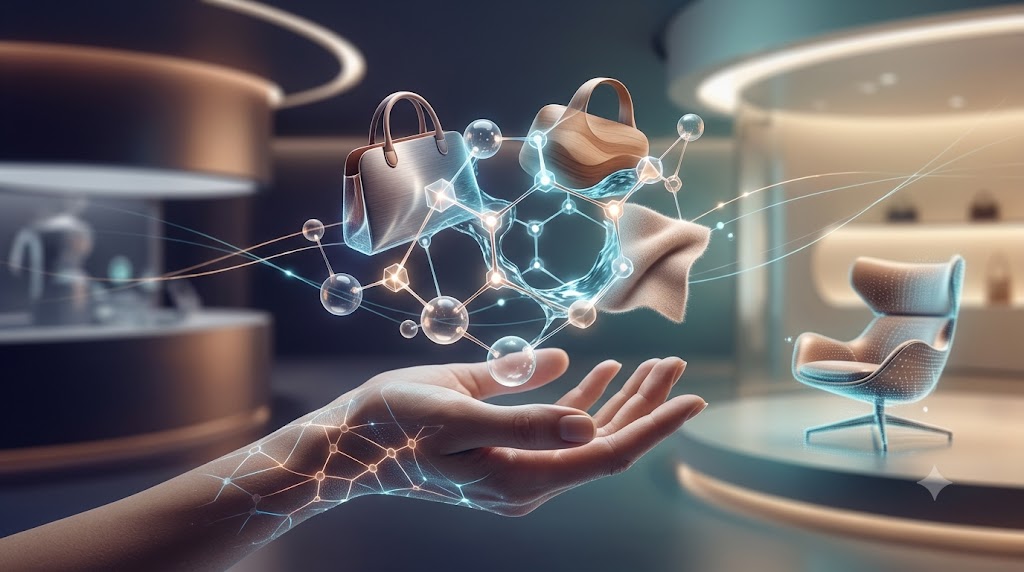
In this ecosystem, responsive design extends beyond fluid web layouts into the physical realm. Imagine a universal prototyping device in a consumer’s home that can temporarily alter its physical form to mimic the handle of a luxury handbag, the grip of an athletic shoe, or the contours of an ergonomic chair. This allows for instantaneous physical testing, radically compressing the bridge between digital consideration and physical reality.

IV. Human-Centered Impact: Redefining the Customer Experience (CX)

As an advocate for human-centered design, I always remind innovators that technology is only as valuable as the human friction it removes or the human potential it unleashes. Shifting to molecule-aware experiences isn’t just a win for technological novelty; it fundamentally reshapes how human beings relate to, trust, and adopt digital commerce.

A. Frictionless Personalization

For years, digital personalization has been algorithmic and predictive, rely on crude data points like “people who bought this also liked…” Molecule-aware commerce transforms personalization from predictive guessing into real-time physical adaptation. Instead of forcing the human body to adapt to mass-produced items, digital products and environments dynamically adjust to the user’s unique physical constraints, biometric data, and ergonomic needs in real time. The product conforms to the human, not the other way around.

B. Bridging the Trust Gap

The single greatest point of friction in e-commerce today is uncertainty. Will it fit? Will it match? How does it actually feel? This uncertainty leads to massive cart abandonment and staggering return rates that plague retail logistics. By allowing consumers to physically interact with, feel, or spatially validate a digital item before clicking “buy,” we eliminate the guesswork. When a consumer can experience the exact physical reality of a product in their own space, the trust gap evaporates, building deep, unshakeable consumer confidence.

C. The Change Management of Daily Life

Every major technological leap requires a period of human adaptation. However, the beauty of molecule-aware commerce is that it aligns with natural human behaviors rather than forcing us to learn new digital interfaces. We are wired to touch, feel, and move through three-dimensional space. By embedding commerce into the physical fabric of our environments, the act of “checking out” or “browsing” disappears entirely into the background. It becomes ambient, intuitive, and seamlessly integrated into the rhythm of daily life.

V. Industry Transformations: Who Wins and Who Adapts?

The transition from a screen-centric model to a molecule-aware paradigm will not impact all sectors equally. For visionary leaders, this shift represents an unprecedented opportunity to rewrite the rules of market engagement. For those tethered to traditional 2D frameworks, it is a fast-approaching disruption. Let us look at how three major sectors will be completely redefined:

A. Fashion & Apparel: Beyond the Virtual Fitting Room

Early attempts at digital fashion relied on flat overlays or avatars that rarely captured the true behavior of textiles. Molecule-aware commerce changes the game entirely. Instead of simply looking at a virtual try-on, consumers will interact with smart, haptic-enabled fabrics or localized testing devices that mimic the exact texture, weight, shear, and drape of a garment remotely. Brands will no longer just sell an aesthetic; they will sell the tangible, tactile reality of their craftsmanship before a single piece of fabric is cut or shipped.

B. Home & Architecture: True Spatial Integration

Buying furniture or designing a space has traditionally been an exercise in spatial anxiety. Molecule-aware systems eliminate this by allowing furniture, decor, and architectural elements to project their exact physical presence into a room. This goes beyond visual rendering; it includes interactive calculations of weight distribution, environmental light absorption, acoustics, and structural impact. Consumers can walk through their altered physical environment, interacting with digital manifestations that respect and respond to the real boundaries of their homes.

C. CPG & Food/Beverage: Molecular Sampling

The Consumer Packaged Goods (CPG) and food sectors have historically been the hardest to digitize because they rely heavily on taste and smell. In a molecule-aware ecosystem, digital flavor profiling and localized molecular scent-mapping allow consumers to sample products safely and instantly from their own living rooms. Ambient IoT scent synthesizers and biometric taste-simulators will allow a consumer to experience a new beverage profile or premium fragrance. Once validated, the purchase triggers automated, localized micro-fulfillment or drone delivery, closing the loop between digital sensation and physical consumption.

VI. The Innovator’s Dilemma: Challenges on the Horizon

As with any radical leap in innovation, the transition to molecule-aware experiences is not without its friction. For every boundary we break, a new set of responsibilities and systemic challenges emerges. Forward-thinking leaders must proactively address these hurdles before they can successfully scale this new paradigm.

A. Privacy & Radical Transparency

Traditional e-commerce tracks clicks, scrolls, and purchase histories. Molecule-aware commerce, by its very nature, requires a much deeper look into the consumer’s private life. If a system is environmentally and spatially intelligent, it gathers data on the layout of a home, the value of surrounding possessions, biometric responses, and even daily physical habits. This demands a shift toward radical transparency and robust, zero-trust data privacy architectures. Organizations must prove to consumers that their physical sanctuaries will not be monetized or exploited.

B. Infrastructure & Scalability

We are currently looking at a highly fragmented technological landscape. For molecule-aware experiences to become ubiquitous, we must move past isolated hardware silos. The industry requires universal open standards and protocols that allow disparate spatial computing platforms, haptic devices, and ambient IoT networks to communicate seamlessly. Without cross-platform interoperability, the experience breaks down, leaving consumers frustrated by a fractured ecosystem.

C. The Human Resistance Factor

Perhaps the greatest challenge is not the technology itself, but the organizational change management required to implement it. Legacy enterprises are built to optimize existing, flat digital pipelines. Pivoting a business model from “selling items on a screen” to “curating a physical-digital ecosystem” requires a complete cultural and operational overhaul. Leaders must reshape their design, engineering, and marketing teams to think beyond 2D boundaries, helping traditional organizations overcome the inertia of past successes to embrace an entirely new dimension of commerce.

VII. Conclusion: The Call to Action for Future-Forward Leaders

The glass ceiling of the two-dimensional screen is shattering. We are standing at the precipice of a profound transformation, moving into a world where digital data no longer sits passively behind glass but actively participates in our physical reality. Molecule-aware experiences are fundamentally redefining the rules of engagement, trust, and human connection in digital commerce.

For change agents, innovators, and experience designers, this is a defining moment. The strategies that secured the successes of the mobile and web eras will not suffice in an environment built on spatial intelligence, sensory relevancy, and programmable matter. To win in this new landscape, leaders must undergo a critical mindset shift:

  • Stop designing for viewports: Move past the constraints of pixels, grids, and aspect ratios.
  • Start designing for human ecosystems: Build seamless, ambient experiences that respect, adapt to, and enrich the physical realities of human life.

The future of commerce belongs to those who can master this intersection of digital scalability and physical intimacy. The technology is arriving, the human desire for deeper experience is already here, and the competitive landscape is shifting. The only question left is whether your organization will be a spectator to this evolution, or the one driving it forward.

Frequently Asked Questions

What exactly makes an experience “molecule-aware”?

A molecule-aware experience is one where digital systems can actively sense, interpret, and physically interact with the consumer’s immediate 3D environment. Unlike traditional 2D apps or simple AR overlays, it utilizes spatial computing, ambient IoT sensors, smart materials, and advanced haptics to blend digital commerce seamlessly into physical matter and natural human behaviors.

How do molecule-aware experiences bridge the e-commerce “trust gap”?

The single greatest barrier to online shopping is the uncertainty of scale, texture, and fit, which leads to cart abandonment and high return rates. By engaging multiple senses—allowing consumers to feel tactile textures through micro-haptics, smell scents via digital synthesis, or validate exact spatial fit in their actual room—molecule-aware commerce removes the guesswork and builds deep consumer confidence before a purchase is made.

What is the biggest barrier for companies looking to adopt this technology?

While hardware fragmentation is a technical challenge, the primary barrier is organizational change management. Most legacy companies are built to optimize 2D grids and flat viewports. Shifting to an ambient, spatial paradigm requires a complete cultural overhaul, retraining design and engineering teams to think in three dimensions and curate holistic physical-digital ecosystems.

Bottom line: Futurology is not fortune telling. Futurists use a scientific approach to create their deliverables, but a methodology and tools like those in FutureHacking™ can empower anyone to engage in futurology themselves.

Image credit: Gemini

Subscribe to Human-Centered Change & Innovation WeeklySign up here to get Human-Centered Change & Innovation Weekly delivered to your inbox every week.

Why Customer Experience (CX) is Nothing Without Augmented Employee Experience

Designing the AX

Why Customer Experience (CX) is Nothing Without Augmented Employee Experience

GUEST POST from Chateau G Pato

Designing the AX: Why Customer Experience (CX) Is Nothing Without Augmented Employee Experience

Organizations globally pour billions into perfecting the front-end Customer Experience (CX). We map journeys, polish digital interfaces, and orchestrate brand touchpoints with meticulous precision. Yet, despite this massive investment, customer satisfaction frequently stagnates or plummets the moment a situation veers off-script. The glossy facade cracks because businesses continue to treat CX as an isolated, external objective.

The reality is that customer experience does not exist in a vacuum; it is a lagging indicator of your internal reality. CX is directly powered by the living, breathing employees tasked with delivering it. When the internal tools, workflows, and processes handed to employees are fragmented, manual, and deeply frustrating, that operational friction inevitably bleeds through to the customer.

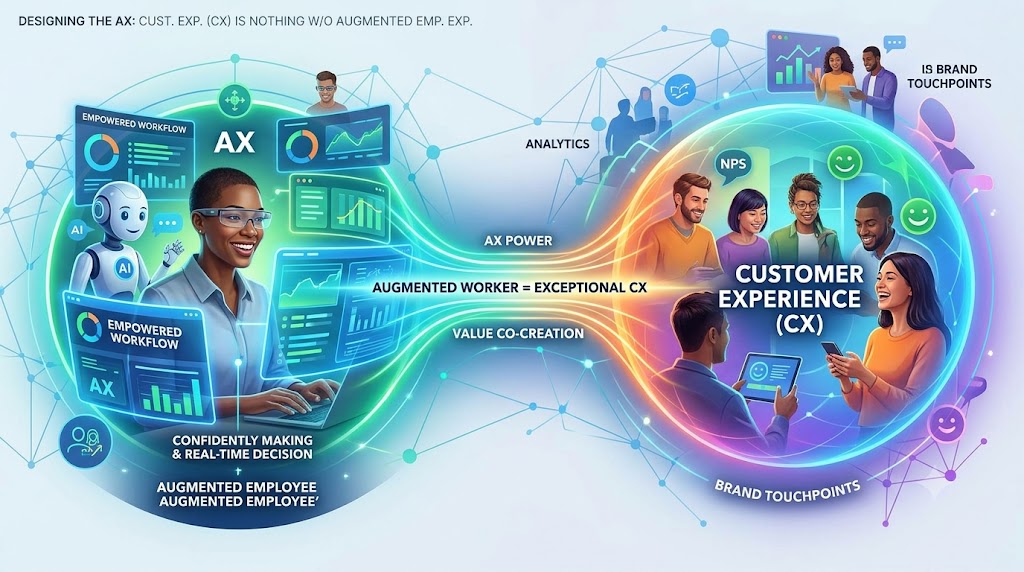
To fix the external, we must radically reimagine the internal. This requires moving far beyond traditional Employee Experience (EX)—which has historically focused on superficial perks, workplace culture, and annual engagement surveys—and shifting toward Augmented Employee Experience (AX). AX is the deliberate, human-centered design of an ecosystem where technology, artificial intelligence, and streamlined processes act as extensions of human capability rather than sources of administrative drag. It is about removing cognitive load, eliminating systemic friction, and empowering people with the real-time insights they need to excel.

If you want to design an unforgettable customer experience, you must first design an augmented employee experience. True innovation begins from the inside out: design the AX, and the CX will follow.

I. Shift from EX to AX: What It Means to “Augment” the Worker

For over a decade, human resource professionals and executive leadership teams have rallied around the banner of Employee Experience (EX). Millions have been invested in open-concept office environments, high-end breakroom perks, wellness apps, and annual engagement surveys. While well-intentioned, traditional EX largely treats the symptoms of workplace dissatisfaction rather than its operational disease. A beautifully designed corporate campus or a monthly pulse survey cannot compensate for tools that break, databases that do not talk to each other, or bureaucratic bottlenecks that stifle human potential.

To unlock real organizational agility, we must transition from EX to Augmented Employee Experience (AX). AX shifts the lens from superficial contentment to core empowerment. It is the intentional design of digital and physical workspaces where human-centered change management converges with advanced technologies—such as predictive AI, automated knowledge routing, and collaborative workspaces. The objective of AX is simple: engineer an internal ecosystem where systems actively pull the administrative weight, allowing workers to perform at their absolute highest capacity.

Crucially, AX is not synonymous with automation. Automation is often driven by a cost-cutting imperative to remove the human from the loop entirely. AX, by contrast, is an investment in human capability. It marks the deliberate onset of what I call the cyborg transition—a collaborative state where technology does not replace the worker, but instead wraps around them to strip away cognitive load, data retrieval delays, and rote administrative drag.

When we deliberately design to augment rather than replace, we achieve the ultimate goal of experience architecture: freeing the workforce to focus on uniquely human traits. By delegating the analytical and mechanical heavy lifting to an augmented infrastructure, employees regain the mental bandwidth required to exercise creative problem-solving, strategic judgment, and deep, unhurried empathy.

II. The Symmetric Connection: How Flawed AX Sabotages CX

There is an unbreakable symmetry between the internal employee experience and the external customer experience. In experience design, this is the law of structural reflection: whatever fractures exist within your internal architecture will eventually express themselves as defects in your customer interactions. When leadership ignores the design of the employee workspace, they actively, albeit unintentionally, sabotage the brand promise.

The primary culprit of this sabotage is cognitive drain. Every time an employee is forced to switch contexts between fragmented software platforms, reconcile conflicting data across multiple legacy systems, or manually bypass a broken process, they expend valuable cognitive energy. Human focus and emotional reserves are finite resources. If an employee spends eighty percent of their mental capacity simply fighting their tools to get things done, they only have twenty percent left to focus on the actual human being standing in front of them or on the other end of the line.

This structural depletion causes a severe emotional spillover. Frustrated, exhausted, and hamstrung employees cannot deliver delightful, empathetic customer experiences. It is physically and psychologically impossible to project a warm, seamless brand experience when your immediate reality is chaotic, clunky, and rigid.

Consider how these friction points manifest in everyday real-world interactions:

  • The Support Agent Paradox: A customer calls with a complex problem, expecting an efficient resolution. Instead, they are placed on repeated holds. The friction isn’t a lack of agent willingness; it is the fact that the agent must navigate three separate legacy databases and a manual approval queue just to locate a single customer record.
  • The Frontline Impasse: A retail worker or service provider interacts directly with a client who requires a common-sense modification to a policy. Because internal operational silos are rigid and punitive, the worker has no authority or technological flexibility to act. They are forced to deliver a cold “no,” not because they lack empathy, but because their tools and governance prevent them from executing an equitable outcome.

When companies treat AX as a secondary operational concern, they pull the rug out from under their own CX investments. A customer-centric culture cannot thrive on top of a hostile internal infrastructure.

III. Moving Beyond Metrics: From SLAs to XLMs (Experience Level Measures)

You cannot manage what you do not measure, but more importantly, you cannot design transformation if you are measuring the wrong things. For decades, corporate IT, operations, and human resource departments have been governed by Service Level Agreements (SLAs). These metrics look great on dashboard line items: system uptime percentages, average ticket resolution times, and server processing speeds. Yet, this reliance on traditional SLAs hides a dangerous corporate illusion—the green-dashboard trap.

The green-dashboard trap occurs when every operational metric indicates optimal performance (all lights are green), yet the workforce is quietly drowning in administrative friction. An IT department might proudly report that a password reset or database query “resolved in under 24 hours,” hitting its SLA perfectly. Meanwhile, the employee was blocked from helping a customer for an entire business day. Traditional SLAs measure mechanical output and system availability; they completely fail to capture human sentiment, cognitive interruption, or the emotional toll of broken workflows.

To design a functional Augmented Employee Experience, progressive enterprises must transition from rigid SLAs to human-centric Experience Level Measures (XLMs). Where an SLA tracks the technical execution of a process, an XLM serves as a diagnostic tool designed to measure the true impact of internal tools, architectures, and automated changes on the employee’s mental well-being, clarity, and operational empowerment.

Shift in Paradigm: Traditional SLA: “Was the database accessible 99.9% of the time?”
vs. Modern XLM: “Did the database configuration actively minimize cognitive load and allow the employee to resolve the customer’s issue confidently on the first attempt?”

By explicitly map internal XLMs directly to external customer metrics—such as Net Promoter Score (NPS) or Customer Effort Score (CES)—organizations can conclusively demonstrate the true financial and cultural ROI of investing in AX. When you reduce internal friction and track experience as a core health metric, you provide employees with the seamless environment required to sustain an exceptional external brand presence.

IV. The Framework for Designing AX

Architecting a sustainable Augmented Employee Experience requires more than introducing a suite of modern digital tools. It demands a structured, intentional methodology. True AX transformation can only be realized by combining human-centered change management with collaborative, visual frameworks that map out the internal journey with the exact same rigor typically reserved for external customers.

To successfully design and deploy an AX strategy, leaders must focus on a three-pronged whole-system view:

  1. Journey Mapping the Internal Workflow: Just as we build detailed personas and touchpoint maps for buyers, we must utilize tools like an Experiment Canvas or internal journey blueprints for our workforce. Leaders need to trace an employee’s daily workflow to uncover where information drops, where tool switching causes cognitive friction, and where data silos stall progress.
  2. Sustaining a Whole-System View: Technology cannot be dropped into an organization in isolation. A truly augmented experience accounts for the fluid interplay between technology (the digital systems), space (physical or hybrid environments), culture (the behavioral norms), and process (the steps required to achieve an outcome). Adjusting one without aligning the others creates systemic rejection.
  3. Cultivating Psychological Safety & Adaptation: Rapid digital transformation introduces profound cognitive disruption. When implementing advanced systems—whether it is machine learning triage or automated workflow routing—leaders must deliberately design coping mechanisms and clear learning paths into the change strategy. This ensures that change fatigue is mitigated, psychological safety is preserved, and the workforce is granted a soft landing as they adapt to new operational realities.

When organizations leverage cross-functional, visual tools to plan out these touchpoints, they break down the traditional walls between IT, HR, and Operations. The result is a highly aligned infrastructure designed to actively support the human being tasked with driving the business forward.

V. The Future of Work: The Co-Creation of Value

As we look toward the horizon of corporate evolution, the traditional boundaries that have long segregated enterprise operations are rapidly dissolving. The future workplace will not be characterized by distinct, isolated interactions between an employee and a customer, or a user and a static piece of software. Instead, futurology points toward a dynamic, integrated ecosystem where the boundaries between the employee, the customer, and intelligent systems blur into a singular, continuous loop of value creation.

In this oncoming era, organizations must embrace the principle of democratic innovation. Historically, internal tools and digital environments have been handed down from on high—designed by detached corporate IT departments or purchased by procurement teams completely removed from the daily realities of the frontline. This top-down approach is a relic of legacy management. To build a highly responsive Augmented Employee Experience, the individuals closest to the actual work must be given the agency, the visual frameworks, and the low-code or AI-assisted capabilities to actively co-create their own AX tools.

Value within an enterprise is co-created symmetrically. When frontline employees are empowered to continuously shape, refine, and optimize their own digital environments, they are not merely improving their personal productivity. They are actively tailoring the machinery of the business to respond more fluidly to real-time customer needs.

The future of work does not belong to corporations that treat their workforces as passive operators of rigid software. It belongs to progressive, human-centered enterprises that treat their workforce as collaborative experience architects. By democratizing the evolution of AX, we ensure that as our tools grow more intelligent, our organizations grow more fundamentally human.

Conclusion: A Call to Action for Progressive Leaders

True, sustainable brand differentiation is never built on a glossy marketing veneer, a clever advertising campaign, or a slick mobile application. While those elements may attract initial interest, they are fragile. True differentiation is anchored deep within the enterprise—in an enabled, energized, and augmented workforce that possesses the cognitive freedom and systemic backing to delight customers consistently, even when situations become highly complex.

For progressive leaders, the mandate is clear: it is time to stop treating employee software, internal platforms, and operational workflows as mere administrative overhead to be minimized by procurement. We must start treating internal employee infrastructure as the primary engine of customer satisfaction and corporate growth. When you starve your internal systems of human-centered design, you are directly starving your customer experience.

The choice before modern leadership is not whether to adopt advanced technologies, but how to deploy them. If you deploy automation purely to reduce headcount or cut transaction costs, you create a sterile, rigid environment where customer friction thrives. But if you deploy technology to augment the individual—to remove administrative drag, dissolve data silos, and protect psychological safety—you unleash the true creative and empathetic potential of your organization.

If you want to radically transform the customer experience, stop looking outward. Look inward first. Design the AX, and the CX will inevitably follow.

Frequently Asked Questions (FAQ)

1. What is the fundamental difference between Employee Experience (EX) and Augmented Employee Experience (AX)?

Traditional Employee Experience (EX) generally focuses on peripheral culture, workplace satisfaction, and benefits—such as wellness perks, environment design, and engagement surveys. Augmented Employee Experience (AX), by contrast, is an intentional, human-centered architectural practice. AX deliberately integrates technology, artificial intelligence, and streamlined operational flows to strip away cognitive load, automate administrative drag, and actively augment the worker’s capability to perform high-value, empathetic tasks.

2. Why is Customer Experience (CX) dependent on the internal design of AX?

Customer Experience is a structural reflection and lagging indicator of your internal reality. When employees must battle fragmented software systems, rigid data silos, and bureaucratic friction, their finite cognitive and emotional energy is depleted. This systematic internal exhaustion creates negative emotional spillover, making it operationally impossible for frontline workers to deliver seamless, fast, and deeply empathetic customer touchpoints.

3. What are Experience Level Measures (XLMs) and how do they replace traditional SLAs?

Service Level Agreements (SLAs) measure technical and mechanical outputs, such as platform uptime or standard system resolution times. Experience Level Measures (XLMs) are human-centric diagnostic tools designed to measure the true sentiment, cognitive impact, and friction forced onto an employee by an internal workflow or system change. XLMs shift the focus from machine capability to human enablement, mapping internal operational ease directly to external customer satisfaction metrics.

Bottom line: Futurology is not fortune telling. Futurists use a scientific approach to create their deliverables, but a methodology and tools like those in FutureHacking™ can empower anyone to engage in futurology themselves.

Image credit: Pexels

Subscribe to Human-Centered Change & Innovation WeeklySign up here to get Human-Centered Change & Innovation Weekly delivered to your inbox every week.

What Are Moments of Truth?

What Are Moments of Truth?

GUEST POST from Art Inteligencia

Moments of truth are the individual experiences that customers have with a business, brand, or product. They are the critical interactions that leave lasting impressions and determine how customers feel about a business. Companies strive to use moments of truth to build relationships with customers and maximize customer satisfaction.

Moments of truth can occur both in-person and online. In-person moments of truth occur when a customer interacts with a business, such as when they walk into a store, talk to a customer service representative, or purchase a product. Online moments of truth occur when a customer visits a website, interacts with a chatbot, or reviews a product.

Companies can take advantage of moments of truth to create positive customer experiences. They can use these interactions to listen to customer feedback and make improvements to their products and services. Companies can also use moments of truth to build relationships with customers by providing personalized customer service and making customers feel valued.

Companies should strive to ensure that each moment of truth is positive and memorable. They should focus on creating an easy, enjoyable, and frictionless experience for customers. This can include providing helpful and informative customer service, making sure products are as described, and responding quickly to customer inquiries.

Moments of truth are critical for businesses because they shape how customers think and feel about a company. Companies must strive to make each moment of truth positive and memorable in order to create loyal, satisfied customers.

Image credit: Pixabay

Subscribe to Human-Centered Change & Innovation WeeklySign up here to get Human-Centered Change & Innovation Weekly delivered to your inbox every week.

Five Keys to Creating a Great Customer Experience

Five Keys to Creating a Great Customer Experience

GUEST POST from Art Inteligencia

Creating a great customer experience is an essential part of any successful business. Whether you’re running an online store, a retail store, a restaurant, or any other type of business, your customers should always be your top priority. Here are some key steps you can take to ensure that your customers have the best possible experience with your business.

1. Prioritize Customer Service

Customer service should be a priority for any business, as it is often the first and last contact your customers will have with your company. Make sure to have a friendly, knowledgeable, and helpful customer service staff who are available to answer any questions or concerns customers may have.

2. Listen to Feedback

Feedback from customers is an invaluable tool for improving the customer experience. Encourage customers to provide feedback on their experiences and use this as an opportunity to make changes or improvements.

3. Understand Your Customers

Knowing your customers and their needs is key to providing a great customer experience. Take the time to understand what they are looking for and how they want to be treated.

4. Make it Easy

Make it easy for customers to find what they are looking for and make their experience as stress-free and enjoyable as possible. Streamline the process as much as possible and remove any unnecessary steps.

5. Make it Personal

Make sure to add a personal touch to the customer experience. This could be anything from handwritten thank-you notes to personalized service.

Creating a great customer experience is essential for any successful business. By following these steps, you can ensure that your customers have the best possible experience with your business and come back time and time again.

Image credit: Pixabay

Subscribe to Human-Centered Change & Innovation WeeklySign up here to get Human-Centered Change & Innovation Weekly delivered to your inbox every week.
What is Customer Experience?

What is Customer Experience?

GUEST POST from Art Inteligencia

In today’s highly competitive business environment, customer experience (CX) has become a critical factor in determining success. Customer experience is the sum of a customer’s interactions with a company over the course of their relationship. It is the perception a customer has of a company based on their interactions, from the way they’re greeted on the phone to the quality of the product they receive.

CX is much more than just the customer service a company provides. It’s about creating a positive and memorable experience for the customer, from the moment they first engage with a company. Companies must design their customer experience with the customer in mind, and strive to create an experience that is tailored to the individual customer’s needs and preferences.

In order to deliver a great customer experience, companies must first understand their customer’s needs and preferences. This can be done through research, surveys and interviews. Companies must also identify the customer’s pain points and then strive to address them throughout the customer journey.

It is also important for companies to prioritize customer feedback and use it to make improvements to their customer experience. Companies should regularly review customer feedback to ensure that the service they provide is meeting or exceeding customer expectations.

Companies should also strive to create an emotional connection with their customers. This can be done through personalized experiences, such as customizing communications or offering rewards for loyalty.

Finally, companies must ensure that they have a consistent customer experience across all channels. This means ensuring that the same level of service is provided on the phone, in-store and online.

By investing in customer experience, companies can increase customer loyalty, improve customer retention and generate more revenue. Customer experience is quickly becoming the most important factor in determining success in today’s competitive business environment.

Image credit: Unpslash

Subscribe to Human-Centered Change & Innovation WeeklySign up here to get Human-Centered Change & Innovation Weekly delivered to your inbox every week.
Using Design Thinking to Create Engaging Experiences

Using Design Thinking to Create Engaging Experiences

GUEST POST from Art Inteligencia

Design thinking has become the modern go-to solution for creating engaging experiences. Its focus on user-centric experience drives the creation of products and services that are tailored for individual needs. Design thinking is a problem solving approach that fosters creative collaboration and encourages feedback from customers, stakeholders, and designers.

With design thinking, teams can develop a product based on customer needs and wants, rather than guessing what customers will respond to. The process involves understanding customer experience, defining the user’s journey, prototyping, testing, and validating to ensure an optimal product or service. By focusing on customer needs, organizations can create personalized experiences that drive customer loyalty and satisfaction.

Let’s look at two case study examples of how design thinking can create engaging experiences.

Case Study 1 – Marriott

First, we can turn to the hospitality industry. Marriott, the leading hospitality company, has used design thinking to create an enhanced guest experience. For example, the company created the Marriott Luxury Connect program which incorporates GPS technology and room services in order to offer guests a more personalized experience.

By collecting and analyzing customer data, the program can generate tailored experiences. Through this program, guests get to experience benefits such as discounts, early check-ins, and priority access to hotel fitness centers. Marriott has also launched a digital tool that allows guests to check restaurant availability and order room service through their phones. This modern approach takes customer engagement one step further by allowing them to have a smoother, more enjoyable experience.

Case Study 2 – Macy’s

On the other hand, we can look to the retail industry. Macy’s has been a leader in using design thinking to transform their retail experiences. The department store has created an app that uses facial recognition software in order to identify shoppers and tailor their experiences. By gathering data such as age, location, and past purchases, the software can create personalized product recommendations.

Macy’s has also implemented virtual changing rooms that customers can use to get a realistic view of how a suggested outfit looks on them before they purchase. These virtual changing rooms will also offer tips to accessorize the outfit with items that the store currently has in stock.

Conclusion

Overall, design thinking has proven to be an essential tool for creating engaging experiences. By understanding customer needs and wants, businesses can use design thinking to create personalized products and services that will drive customer satisfaction. Through the examples of Marriott and Macy’s, we can see that both the hospitality and retail industries have embraced design thinking in order to create more meaningful customer experiences.

SPECIAL BONUS: Braden Kelley’s Problem Finding Canvas can be a super useful starting point for doing design thinking or human-centered design.

“The Problem Finding Canvas should help you investigate a handful of areas to explore, choose the one most important to you, extract all of the potential challenges and opportunities and choose one to prioritize.”

Image credit: Pexels

Subscribe to Human-Centered Change & Innovation WeeklySign up here to get Human-Centered Change & Innovation Weekly delivered to your inbox every week.