
Author Archives: Stefan Lindegaard

About Stefan Lindegaard

Stefan Lindegaard is an author, speaker and strategic advisor. His work focuses on corporate transformation based on disruption, digitalization and innovation in large corporations, government organizations and smaller companies. Stefan believes that business today requires an open and global perspective, and his work takes him to Europe, North and South America, Africa and Asia. The author of several books including 7 Steps for Open Innovation; Social Media for Corporate Innovators and Entrepreneurs; Making Open Innovation Work, and The Open Innovation Revolution, you can follow him on LinkedIn.

A People-First Perspective on Corporate Innovation

A People-First Perspective on Corporate Innovation

GUEST POST from Stefan Lindegaard

As we ponder on corporate innovation, our minds often dart to the latest technologies, inventive solutions, or groundbreaking business models. While these components have their place, my 25-year journey, dotted with experiences from hundreds of innovation teams, has shown me a deeper truth: people form the core of corporate innovation. It is the individuals in an organization, their mental frameworks, and their team dynamics that truly drive innovation.

People-First Innovation: More Than Just Ideas and Tech

Innovation goes beyond simply developing new ideas or adopting the latest technologies. It’s about weaving the ethos of innovation into the fabric of our organizations. This means aligning innovation with our deeply-held values, principles, and strategic ambitions. It calls for a consistent commitment to continuous evolution, growth, and improvement.

A people-first approach stands at the heart of this innovation-friendly environment. This entails fostering a culture where creativity is celebrated, risk-taking is seen as courage, and learning from one’s actions is the norm. It requires an environment that champions psychological safety, a space where everyone feels comfortable voicing their ideas, taking calculated risks, and learning from their experiences, whether successful or not. In this environment, innovation is demystified and becomes a natural part of our day-to-day operations.

Leadership: Shaping a People-First Culture

Leaders play a pivotal role in molding a people-first culture. They have the responsibility to set the tone for an environment that cultivates innovation. This involves promoting open and respectful dialogue, appreciating the value of diverse viewpoints, and fostering collaborative and effective teamwork.

The challenge for leaders lies in harmonizing their attention between immediate operational tasks and the nurturing of this culture. It is common for leaders to become absorbed in the pressing tasks of today, inadvertently sidelining the equally important task of shaping tomorrow’s culture. To genuinely embrace a people-first approach, leaders need to prioritize building a supportive, innovation-friendly environment.

People: The Heart of Innovation

People are the driving force behind innovation. They generate the ideas, share them, evaluate them, and refine them into tangible, impactful outcomes. You can have the most brilliant minds in your organization, but without the conducive team dynamics to harness that intelligence, the innovation potential remains dormant.

The Innovation Ecosystem: A Collaborative Endeavor

Corporate innovation isn’t an isolated phenomenon confined within the walls of a company. It reaches out to external stakeholders – customers, partners, and even competitors. Innovation in today’s world is a collaborative endeavor, often taking place within intricate networks or ecosystems.

These ecosystems act as fertile grounds for the cross-pollination of diverse perspectives, varied knowledge bases, and a broad range of skills. This melting pot leads to more comprehensive and holistic solutions to complex problems. The interactions and collaborations within this ecosystem are the engines of innovation, highlighting the paramount importance of people and their relationships.
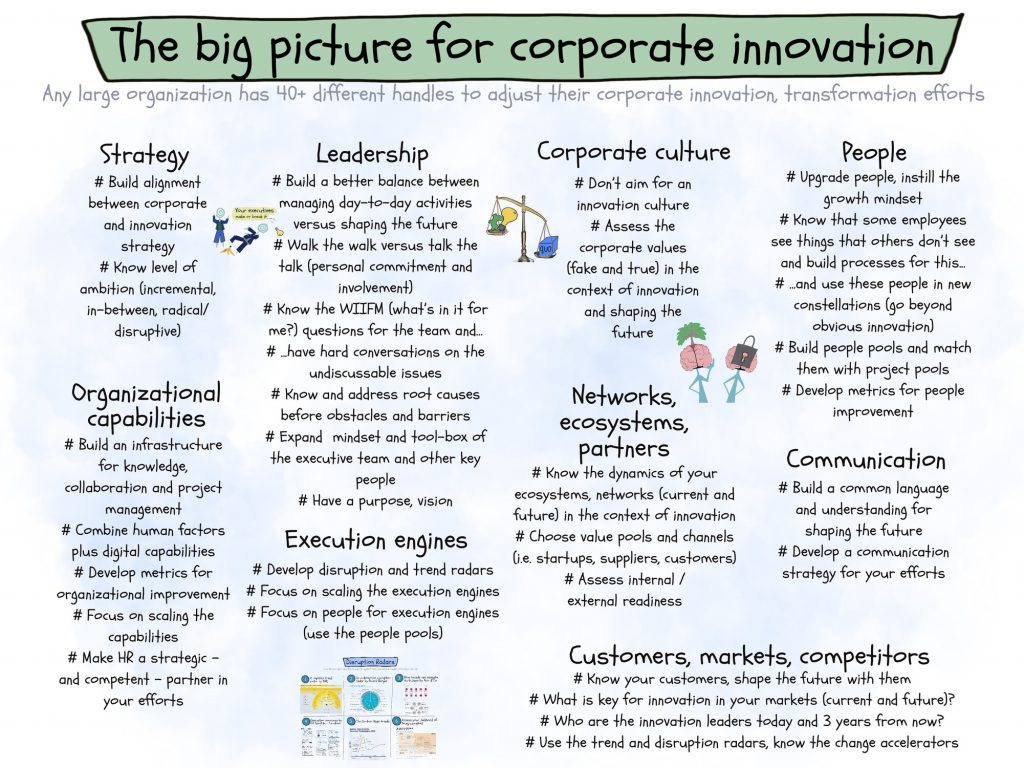
The Way Forward: Customizing Your Innovation Journey

Every organization is distinct, each with its unique set of values, principles, and strategic goals. Therefore, an approach to corporate innovation should be individually tailored to resonate with these unique characteristics.

In my experience, a people-first approach really works. It can be tough because it’s different from what most companies have been doing for years. But by putting people at the center and creating a supportive environment, companies can reach their full potential for innovation. Yes, it takes effort, but the results are worth it.

Remember, this is just one perspective in the vast and dynamic field of corporate innovation. It would be great to hear your thoughts on this people-first approach and your take on other key elements for successful corporate innovation.

The images in my original LinkedIn post give you a further idea of my perspectives on corporate innovation. Get in touch if you want to discuss ideas or learn together!

Image Credit: Pexels

Subscribe to Human-Centered Change & Innovation WeeklySign up here to get Human-Centered Change & Innovation Weekly delivered to your inbox every week.

Psychological Safety, Growth Mindset and Difficult Conversations to Shape the Future

Psychological Safety, Growth Mindset and Difficult Conversations to Shape the Future

GUEST POST from Stefan Lindegaard

How can we embrace and implement the growth mindset and psychological safety in our organization? How can we train our people and in particular our leaders on this? How do we get better at shaping the future?

Those are questions I hear often these days as the interest in the above topics rises fast.

In this post, I share lots of ideas on how you and your organization can embrace the growth mindset, psychological safety and related attributes in the context of shaping the future. Feel free to use my work as you see fit as long as you give due credit!

At the same time, I hope you will read this and give me some feedback as this is also a work-in-progress approach for how I work with my clients on these topics.

It’s a longer than usual read, but skim through and stop, read more if you find something of interest to you. I have also added a number of images at the end. Enjoy!

Introduction

The purpose is to help individuals, teams and leaders get even better at shaping the future in the context of people and organizational as well as market and business perspectives.

The key pillars are the growth mindset, psychological safety and innovation for an agile, learning organization.

The problem/challenge

In general, the leaders in most large organizations are very capable at managing the day-to-day activities while they struggle in terms of mindset, skills and tool-box on shaping the future activities.

The challenge is that leaders can’t become great leaders – or even good leaders – who can take your organization to the next level if they do not find the right balance between managing the day-to-day activities and shaping the future.

This balance should not be 50/50. It should not even be close to that as the day-to-day issues will always require more focus and attention than the future-shaping activities. However, the current balance of 90/10 as we see in most companies is not healthy and we need to change this in order to develop an organization that will be even more ready for a future driven by constant change and disruption on many levels.

Why do we need to work with the growth mindset and psychological safety in this context?

It’s quite simple. If these pre-requisites are not in place, you can’t build an environment that allows your organization to be good at shaping the future and then you are left with only being good at managing the day-to-day activities.

This has been enough to be successful for decades, but it will not work for the future. So, do you want your leaders to be stuck at the past and present or should they get ready for shaping the future as well?

The approach, solution

You can develop a tailored program based on The Collective Growth Mindset framework which helps you embrace and implement the growth mindset approach and complementary attributes such as psychological safety within your organization.

It’s a training and coaching program that builds on these five elements: Mindset, Shape/Pulse, Communicate, Learn and Network.

Here’s a short description on the elements for each area.

The mindset of your team

  • Know the mindset of yourself and your team members
  • Map the mindset of key stakeholders and/or a specific leadership team
  • Group reflection on behaviors and actions (if any) to be taken on this

The shape and pulse of your team

  • What’s in it for me? – address an important question
  • Know the T-shapes
  • Understand your level of psychological safety and ability to have hard conversations
  • Do you play to win or not to lose?
  • Know your barriers, obstacles and attack the root causes in the context of getting stuff done

The communication of and around your team

  • Know how to have the hard conversations
  • Build mechanisms to ensure better feedback
  • Create a common language (big picture, smaller tasks)
  • Work your stakeholders with consistent messages

The learning ways for your team

  • Know how you learn the best as individuals and as a team
  • Apply shared, peer learning for better access to “tacit” knowledge
  • Take the first steps for a PLC, a personal learning cloud

The network and networking capabilities of your team

  • Network for the future, not the past
  • The mindset of your network
  • Learn to build better networks and relationships

The key delivery elements within our program are training sessions (physical and on-demand) and coaching for individuals and teams. See more on this below.

Actions, desired achievements

Having the above five elements as the starting point, we focus on specific actions and desired achievements such as:

Identification of needs and opportunities

The Collective Growth Mindset framework offers much depth, but we need to make sure our efforts fit the needs and opportunities of our participants. We map this out and use it as the main guiding tool for our activities.

Training sessions

Shorter sessions (even micro-learning – few minutes) and up to full-day workshops are used to address the needs and opportunities. It will be a mix of inspirational insights and hands-on workshops. We focus on mindset as well as actions. This will be delivered physically and virtually and when possible, we will save this for on-demand learning.

Coaching

Constructively thought-provoking coaching sessions will be made available for individuals as well as teams. Here, we can go in-depth with more specific and even personal elements.

Role models

We help leaders become role models on the growth mindset. We do this by minimizing and eliminating the negative behaviors while enforcing the positive behavior in the context of the growth mindset for teams and the organization.

Story-tellers

Once, we are on track to help leaders become better role-models, we work with them to become good story-tellers on the growth mindset. This allows us to build a positive circle of strong communication that can help change behaviors for the better.

Hard conversations

Great leaders can facilitate hard conversation within their own leadership teams as well as within the teams they lead themselves. For this, we help them identify and address the weaknesses and strengths and we give them practical tools for having such conversations.

Conversation and feedback guides

We develop feedback guides and tools to help your people, teams and leaders get better at feedback. This goes for giving as well as receiving.

Network for the future, not just the past and the present

Networking, relationship skills are underrated and underserved. It’s unfortunately often assumed that this – networking – happens by itself. Not true as this requires direction, effort and time. We address this in the context that the people you network and associate yourself with are highly influential on what and how you learn. Thus, this impacts your mindset.

Behavioral metrics and KPI’s

There are too few metrics and KPI’s that focuses on behaviors and in particular some that can measure a “live” progress. We will address this through on-going self- and team assessments and the tracking a chosen keywords within the communication of our target groups.

Creating the psychological safety, team by team

Professor Amy C. Edmondson defines psychological safety as “a belief that one will not be punished or humiliated for speaking up with ideas, questions, concerns, or mistakes.” We work with assessments and exercises to help your teams and organization to create a high level of psychological safety.

Personal learning cloud

Within the current learning systems at Wartsila, we build a personal learning cloud with training and materials that are targeted to and relevant for each participant. Although this has a personal starting point, it will also be social and collaborative as this is how we need to embrace and implement the growth mindset and its attributes.

Conclusion

I sense a lot of power and value in the growth mindset approach and its attributes like psychological safety, hard conversations, networking etc.

However, we are also in the early phases of developing the concepts and frameworks we need to make this happen within our organizations.

My ambition is to share what I know to help move this forward in a collective way. The tide rises all boats. We all win. Let’s help each other get better!

Thanks for reading this. Your likes, shares, questions and comments are much appreciated.

Image Credit: Pexels

Subscribe to Human-Centered Change & Innovation WeeklySign up here to get Human-Centered Change & Innovation Weekly delivered to your inbox every week.

Accountability and Empowerment in Team Dynamics

Accountability and Empowerment in Team Dynamics

GUEST POST from Stefan Lindegaard

A winning mindset is crucial for team leaders and teams striving to achieve their goals. Empowerment and accountability are two key elements that contribute to a mindset of success in team dynamics.

When team members feel empowered to make decisions and take the initiative, they are more engaged and motivated to excel.

Coupled with accountability, which ensures team members are responsible for their actions and outcomes, these two elements form a powerful mindset that can unlock your team’s full potential.

The Value of Empowerment and Accountability:

Empowerment fosters an environment where team members are encouraged to use their unique skills and expertise to contribute to the team’s success. This sense of autonomy can boost creativity and innovation, as team members feel they have the freedom and support to explore new ideas and take calculated risks.

Accountability, on the other hand, establishes a culture where team members are held responsible for their actions and the results they produce. When team members are accountable for their work, they are more likely to take ownership of their tasks and strive for high-quality outcomes. By embracing a mindset of empowerment and accountability, teams can achieve a synergistic effect that leads to improved performance, collaboration, and overall success.

Action Suggestions for Team Leaders and Teams:

# 1 – Set Clear Expectations: Ensure that team members understand their roles, responsibilities, and performance expectations. This clarity will help them feel more confident in taking ownership of their work and being accountable for their outcomes.

# 2 – Cultivate a Growth Mindset and Psychological Safety: Encourage team members to view challenges as opportunities for growth and learning while fostering an environment where they feel safe to take risks, express opinions, and ask for help. This combination will help them embrace empowerment and accountability as essential aspects of their development.

# 3 – Encourage Open Communication and Feedback: Create an environment where team members feel comfortable discussing their successes and challenges openly. Encourage them to give and receive constructive feedback, helping each other grow and improve.

# 4 – Celebrate Success and Learn from Mistakes: Acknowledge and reward team members for their contributions and achievements. At the same time, use setbacks as learning opportunities to reinforce the importance of taking ownership and being accountable for their work.

Your team’s success is a direct reflection of the mindset you cultivate within it. As a team leader or member, you have the power to ignite the potential of your team by embracing a growth mindset, psychological safety, empowerment, and accountability.

Now is the time to challenge the status quo, defy mediocrity, and strive for excellence. Make the conscious choice to create a team culture that dares to empower, holds each other accountable, and thrives in the face of adversity. The success of your team lies in your hands.

Are you ready to unleash it?

Image Credit: Pixabay

Subscribe to Human-Centered Change & Innovation WeeklySign up here to get Human-Centered Change & Innovation Weekly delivered to your inbox every week.

A Global Perspective on Psychological Safety

A Global Perspective on Psychological Safety

GUEST POST from Stefan Lindegaard

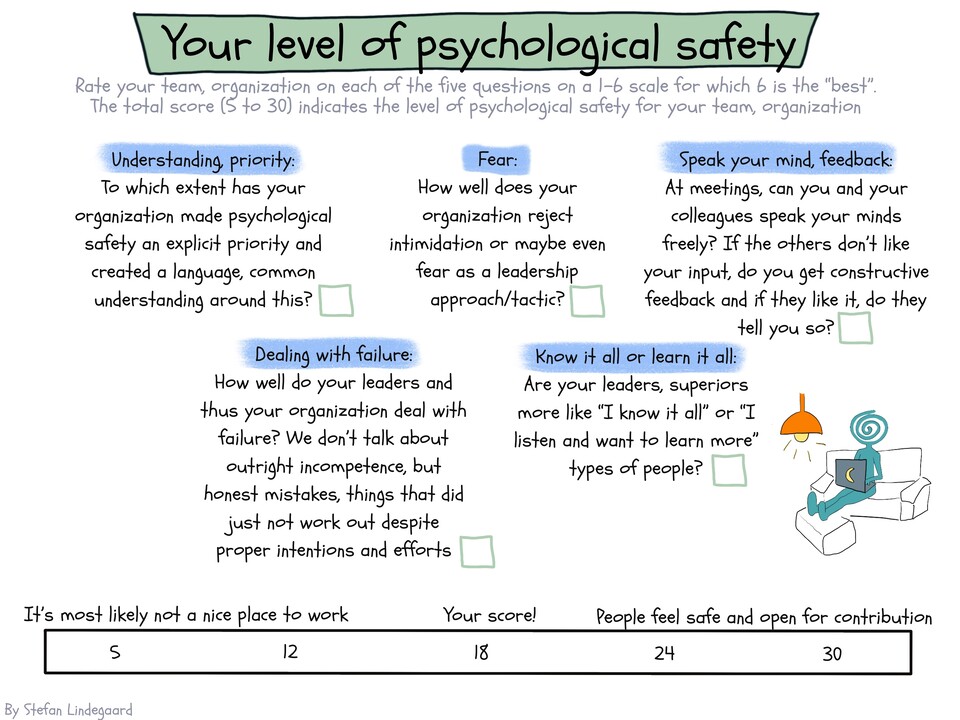
Professor Amy C. Edmondson defines psychological safety as “a belief that one will not be punished or humiliated for speaking up with ideas, questions, concerns, or mistakes.” Achieving psychological safety is essential for fostering innovation and maintaining a competitive edge in today’s rapidly changing business landscape.

In this article, I will share my personal perspectives on psychological safety across different regions around the world, based on my extensive travel and interactions with leaders and organizations over many years. Please note that these observations are not exhaustive but serve as a reflection of my experiences in these regions.

Northern Europe – high psychological safety today

Northern European countries, including the Nordic region and countries like the Netherlands and Germany, are known for their high levels of psychological safety. Leaders in these countries often adopt a more participative and collaborative approach to decision-making, promoting open communication and employee empowerment. Flat organizational structures are more common, allowing for reduced power distance between employees and managers.

For example, in Sweden, the practice of “fika” – regular coffee breaks where employees gather and engage in informal conversations – encourages open dialogue and builds trust among team members. In the Netherlands, the “polder model” of consensus-based decision-making fosters a cooperative atmosphere where diverse opinions are valued and considered.

Southern Europe, Middle East, and parts of Asia – potential for growth through proper implementation

In Southern European countries like Italy, Spain, and Greece, as well as Middle Eastern and other countries such as Turkey and China, top-down and hierarchical leadership styles are more prevalent. Cultural norms and values that emphasize deference to authority can make it challenging to establish psychological safety in these contexts. However, there is significant potential for growth if organizations can adopt more inclusive leadership styles and promote open communication.

In some companies in these regions, forward-thinking leaders are beginning to recognize the value of psychological safety and are implementing practices such as regular feedback sessions, team-building activities, and mentorship programs to foster a more supportive and inclusive work environment.

Psychological Safety Graphic by Stefan Lindegaard

Southeast Asia – an emerging tipping point

Countries in Southeast Asia, including Thailand, Indonesia, and Malaysia, are witnessing a shift in leadership styles, driven by a younger generation and visionary veterans who are blending Eastern and Western approaches. While these countries may currently lag in innovation, their appetite for learning and desire to transform organizational cultures could lead to rapid advancements in psychological safety.

In Southeast Asia, several organizations are embracing the concept of a growth mindset, encouraging employees to take risks, learn from mistakes, and continuously improve. By adopting more inclusive leadership styles and creating spaces for open communication, these countries have the potential to foster psychological safety and drive innovation.

North America – a tale of two realities

In innovation hotspots in the United States and Canada, psychological safety is already well-established. The war for talent in these areas has led organizations to prioritize employee well-being and create inclusive environments. However, other parts of North America may not share the same level of psychological safety, and it’s essential to differentiate between these diverse contexts.

Innovation-driven companies in North America often prioritize transparency and openness, with leaders who actively seek employee input and promote a culture of collaboration. By empowering employees to take initiative, express their ideas, and challenge conventional thinking, these organizations create a psychologically safe environment that fuels creativity and innovation.

Latin America and Africa – unique challenges and opportunities

In Latin American and African countries, cultural norms, economic conditions, and political contexts can vary widely, leading to diverse approaches to psychological safety. While some organizations may struggle with hierarchical leadership styles and limited resources, others are embracing more inclusive practices and leveraging local talent.

Recognizing the unique challenges and opportunities in these regions is crucial for fostering psychological safety and driving innovation. For example, in countries like Brazil and South Africa, companies are increasingly focusing on employee development and well-being, investing in leadership training, and promoting open communication.

Conclusion

Psychological safety is a critical component of successful organizations across the globe. While the degree of psychological safety may vary from region to region, leaders in all contexts can benefit from fostering a supportive, inclusive, and open environment that encourages employees to speak up and share their ideas.

As a global community, we can learn from one another’s experiences and perspectives to advance the development and implementation of psychological safety in organizations worldwide. I encourage readers to share their own insights and experiences with psychological safety in different regions and explore how we can collectively promote a more psychologically safe and innovative world.

So, what are your thoughts on psychological safety from a global perspective?

Feel free to share your comments, perspectives, and questions.

Let’s learn together.

Image Credit: Pixabay

Subscribe to Human-Centered Change & Innovation WeeklySign up here to get Human-Centered Change & Innovation Weekly delivered to your inbox every week.
5 Things to Consider When Hiring Corporate Innovators

5 Things to Consider When Hiring Corporate Innovators

GUEST POST from Stefan Lindegaard

As businesses continue to face unprecedented change and uncertainty, innovation is no longer optional – it’s a must-have for companies looking to survive and thrive. However, finding and developing the right people to drive corporate innovation can be challenging.

In this newsletter, we’ll explore five key ideas for hiring and developing individuals capable of leading corporate transformation and innovation forward, in a world where staying ahead of the curve is essential.

Future Potential vs. Past Competencies:

In the past, companies often hired innovators based on past competencies and results. However, the future of hiring will shift towards potential as a key criterion. Past success in other organizations is no guarantee of success in your own, and companies must adapt their hiring practices to focus on individuals who have shown a proven potential for constant learning, growth, and adaptability. Look for people who are capable of dealing well with ambiguity, adapting quickly to changing circumstances, and who possess the potential to succeed in your organization.

Knowing the Direction of Adaptation:

Organizations and talent alike must know the direction in which they need to adapt. However, it can be challenging to maintain an overview of the internal and external factors and trends impacting innovation efforts and capabilities. To tackle this issue, companies must experiment and develop ways to gauge and maintain an overview and/or direction.

For companies with a strong tradition of relying solely on the knowledge of internal R&D experts, it may require broader tracking of emerging trends, as well as reaching beyond R&D to other parts of the company for ideas on other ways to innovate. Consider all the areas where innovation can occur, including in business models, channels, and customer engagement, to name a few.

The Importance of Community Building:

Innovation is increasingly happening in ecosystems and communities, both internally and externally. Future innovation leaders must be able to create shared purpose, values, and rules of engagement to foster innovation within these communities. To build a successful community, strong networking and communication skills, as well as the ability to inspire people, are essential.

Companies should foster a culture of collaboration, encourage participation from diverse backgrounds and perspectives, and recognize and reward innovation efforts.

Creating the Right Conditions and Frameworks:

To make innovation work in big companies, it’s essential to create the right conditions and frameworks. This means allowing talent to experiment and explore new ideas freely, but also providing the resources, time, and support needed to make innovation efforts successful. Companies must be prepared to take risks and try new approaches, and foster a culture that encourages diversity of thought and collaboration. In addition, creating an inclusive culture that values diversity and recognizes the importance of different types of intelligence can also be beneficial for driving innovation forward.

The Importance of Multiple Intelligences:

Innovation requires a diverse range of skills, not just technical or product expertise. Future innovators must have a broad range of skills and experiences, including creativity, customer-centric thinking, and collaboration skills. Companies should consider different types of intelligence when hiring and developing innovation talent, such as emotional intelligence, social intelligence, and cultural intelligence. By valuing multiple intelligences and creating a culture that encourages diverse perspectives, companies can ensure they have the talent they need to drive innovation forward.

As the business landscape continues to evolve at a breakneck pace, innovation will be the key to survival for many companies. However, innovation is only possible with the right people in place. By shifting the focus from past competencies to future potential, tracking emerging trends and adapting accordingly, building strong communities, creating the right frameworks, and considering multiple types of intelligence, companies can hire and develop the right people for the job. Hiring full teams can also help foster innovation and bring about change faster.

By keeping these ideas in mind, companies can ensure that they have the talent they need to thrive in today’s fast-paced business environment.

Image Credit: Pixabay

Subscribe to Human-Centered Change & Innovation WeeklySign up here to get Human-Centered Change & Innovation Weekly delivered to your inbox every week.

Creating Great Change, Transformation and Innovation Teams

Creating Great Change, Transformation and Innovation Teams

GUEST POST from Stefan Lindegaard

Teams and organizations need to be agile, resilient and able to effectively navigate change and transformation to stay ahead in today’s fast-paced business environment.

Thus, the above question is one I often ponder upon and discuss in my network and circles. I would like to start a conversation here to better identify the key elements to make a team great for adapting to change, managing transformation and driving innovation.

So, this is like a discussion starter. Feel free to engage and follow-up with your ideas and perspectives in the comments!

What are the key benefits for you and your team(s)?

I am working on these three key benefits that a team should strive for as they develop through the building blocks I propose in this context.

1. Improved ability to embrace change and innovation!

Teams need to develop the skills and mindset needed to quickly and effectively respond to new situations, changes, and opportunities, leading to a more agile and adaptive teams and organization.

2. Stronger team cohesion and communication!

By focusing on psychological safety, emotional intelligence, resilience and internal communication around change and transformation, participants can get insights into creating an even more supportive work environment that encourages open communication and collaboration, leading to stronger relationships, a circle of us and a more positive work culture.

3. Continuous growth and development!

When teams and the team-members step outside their comfort zones, foster a culture of continuous learning, and develop a growth mindset this can lead to ongoing personal and professional growth for all team members.

The Building Blocks to Apply for Stronger Teams

Here, I share a range of topics that teams can work more specifically with in order to get better at adapting to changes, managing transformation and driving innovation.

Maybe you can suggest others like this or let me know what you think is really relevant here or not so at all?

1. Adaptability and Agility: The ability to be flexible and responsive in a fast-paced environment, adapting to change and embracing new opportunities.

2. Fostering Psychological Safety: Creating a supportive work environment that encourages open communication, experimentation, and learning.

3. Developing a Growth Mindset as a Team: Cultivating a curious, learning-oriented approach to challenges and opportunities, fostering a team environment that values personal and professional growth.

4. Internal Communication Around Changes and Transformation: Clear and effective communication of vision, strategy, and goals to team members and stakeholders to help them understand and navigate changes and transformations.

5. Collaboration Capabilities: Enhancing the ability to collaborate effectively with stakeholders, partners, and other teams, both within and outside the organization, to achieve common goals.

6. Emotional Intelligence (EI): Recognizing, understanding, and managing emotions to effectively navigate social interactions and build positive relationships.

7. Resilience: Bouncing back from challenges, maintaining positivity, and adapting to adversity through proactive approaches.

8. Strategic Vision: Aligning goals and vision with the organization’s future, anticipating future trends and challenges, and thinking systematically about goals, resources, and challenges.

9. Expanding One’s Comfort Zone: Encouraging personal and professional growth by embracing new challenges and taking calculated risks while continuously learning and developing.

10. Continuous Learning: Fostering a culture of continuous learning, growth, and development.

11. Stakeholder Engagement: Identifying and effectively engaging with internal stakeholders to ensure their support for successful implementation.

12. Data-Driven Decision Making: Making informed decisions by identifying, analyzing, and utilizing relevant data and insights from within the organization.

13. The Circle of Us: Identifying and focusing on the people elements and interpersonal interactions that need to be address to a higher degree to build stronger teams.

14. Empowerment: Many team leaders struggle with empowerment as in giving this to their own teams. Among several reasons for this, two might stand out. 1) They are unsure what they are allowed to do for their own leaders and 2) they don’t know how to increase the level of empowerment for their team members.

15. The “being too busy” Challenge: Everyone is so busy today. This can lead to a focus on the “wrong” things which in particular can have a negative impact in the mid and long-term range. A key issue here is to understand if and how being too busy impacts you in negative ways and then how to address this.

I believe these capabilities and mindset indicators help teams and employees develop and improve in areas critical to their success and growth, allowing them to be more effective and confident in their roles. This is highly needed for change, transformation and innovation.

Please be sure and share your reactions and additions in the comments.

Image Credit: Pexels

Subscribe to Human-Centered Change & Innovation WeeklySign up here to get Human-Centered Change & Innovation Weekly delivered to your inbox every week.