Author Archives: Geoffrey Moore

About Geoffrey Moore

Geoffrey A. Moore is an author, speaker and business advisor to many of the leading companies in the high-tech sector, including Cisco, Cognizant, Compuware, HP, Microsoft, SAP, and Yahoo! Best known for Crossing the Chasm and Zone to Win with the latest book being The Infinite Staircase. Partner at Wildcat Venture Partners. Chairman Emeritus Chasm Group & Chasm Institute

Metaphysics Philosophy

Metaphysics Philosophy

GUEST POST from Geoffrey A. Moore

Philosophy is arguably the most universal of all subjects. And yet, it is one of the least pursued in the liberal arts curriculum. The reason for this, I will claim, is that the entire field was kidnapped by some misguided academics around a century ago, and since then no one has paid the ransom to free it. That’s not OK, and with that in mind, here is a series of four blogs that taken together constitute an Emancipation Proclamation.

There are four branches of philosophy, and in order of importance they are

  1. metaphysics,
  2. ethics,
  3. epistemology, and
  4. logic.

This post will address the first of these four, with subsequent posts addressing the remaining three.

Metaphysics is best understood in terms of Merriam-Webster’s definition: “the philosophical study of the ultimate causes and underlying nature of things.” In everyday language, it answers the most fundamental kinds of philosophical questions:

  • What’s happening?
  • What is going on?
  • Where and how do we fit in?
  • In other words, what kind of a hand have we been dealt?

Metaphysics, however, is not normally conceived in everyday terms. Here is what the Oxford English Dictionary (OED) has to say about it in its lead definition:

That branch of speculative inquiry which treats of the first principles of things, including such concepts as being, substance, essence, time, space, cause, identity, etc.; theoretical philosophy as the ultimate science of Being and Knowing.

The problem is that concepts like substance and essence are not only intimidatingly abstract, they have no meaning in modern cosmology. That is, they are artifacts of an earlier era when things like the atomic nature of matter and the electromagnetic nature of form were simply not understood. Today, they are just verbiage.

But wait, things get worse. Here is the OED in its third sense of the word:

[Used by some followers of positivist, linguistic, or logical philosophy] Concepts of an abstract or speculative nature which are not verifiable by logical or linguistic methods.

The Oxford Companion to the Mind sheds further light on this:

The pejorative sense of ‘obscure’ and ‘over-speculative’ is recent, especially following attempts by A.J. Ayer and others to show that metaphysics is strictly nonsense.

Now, it’s not hard to understand what Ayer and others were trying to get at, but do we really want to say that the philosophical study of the ultimate causes and underlying nature of things is strictly nonsense? Instead, let’s just say that there is a bunch of unsubstantiated nonsense that calls itself metaphysics but that isn’t really metaphysics at all. We can park that stuff with magic crystals and angels on the head of a pin and get back to what real metaphysics needs to address—what exactly is the universe, what is life, what is consciousness, and how do they all work together?

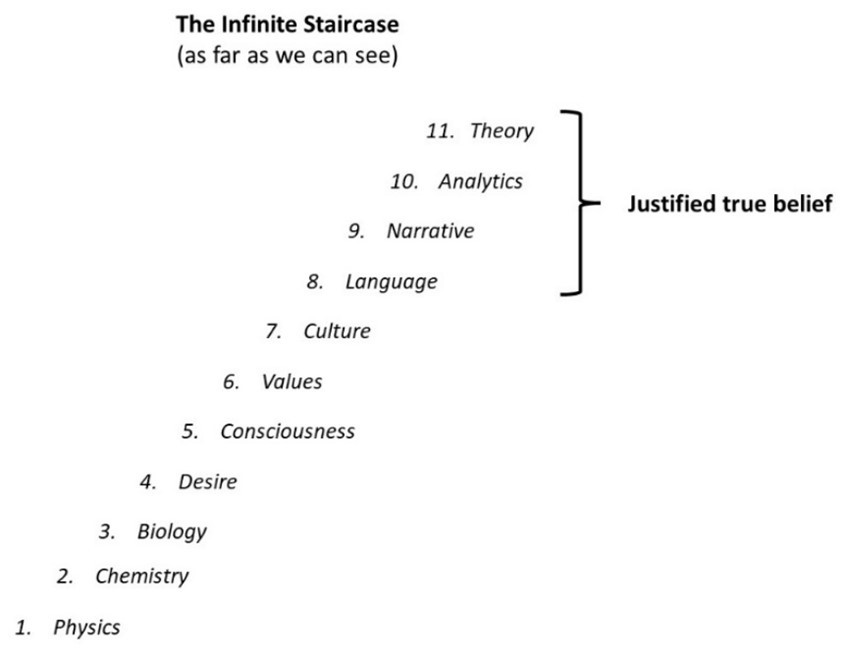
The best platform for so doing, in my view, is the work done in recent decades on complexity and emergence, and that is what organizes the first two-thirds of The Infinite Staircase. Metaphysics, it turns out, needs to be understood in terms of strata, and then within those strata, levels or stair steps. The three strata that make the most sense of things are as follows:

  1. Material reality as described by the sciences of physics, chemistry, and biology, or what I called the metaphysics of entropy. This explains all emergence up to the entrance of consciousness.
  2. Psychological and social reality, as explained by the social sciences, or what I called the metaphysics of Darwinism, which builds the transition from a world of mindless matter up to one of matter-less mind, covering the intermediating emergence of desire, consciousness, values, and culture.
  3. Symbolic reality, as explained by the humanities, or what I called the metaphysics of memes, which begins with the introduction of language that in turn enables the emergence of humanity’s two most powerful problem-solving tools, narrative and analytics, culminating in the emergence of theory, ideally a theory of everything, which is, after all, what metaphysics promised to be in the first place.

The key point here is that every step in this metaphysical journey is grounded in verifiable scholarship ranging over multiple centuries and involving every department in a liberal arts faculty—except, ironically, the philosophy department which is holed up somewhere on campus, held hostage by forces to be discussed in later blogs.

That’s what I think. What do you think?

Image Credit: Unsplash

Subscribe to Human-Centered Change & Innovation WeeklySign up here to join 17,000+ leaders getting Human-Centered Change & Innovation Weekly delivered to their inbox every week.


Strategizing Execution

Take a Tip from the Oil Industry

Strategizing Execution

GUEST POST from Geoffrey A. Moore

When it comes to executing any market development playbook, the work should be organized around the same checklist of factors that structured our earlier blog on marketing strategy. Here is the overall framework to keep in mind:

The first four focus on constructing the ROI engine, the second four, on activating it. Or, to use the parlance of the oil industry, the first four represent the upstream work that locates and extracts the trapped value of an oil reservoir. This is the work of product management. The second four represent the downstream work of refining, distributing, and monetizing the end product. This is the work of product marketing. Both functions should report to a product line manager to ensure that end-to-end coordination is maintained throughout.

When a category is working its way through the Technology Adoption Life Cycle, the roles of the product manager and the product marketing manager change dramatically at each stage. In the early market, neither function has yet been staffed, as it is simply too early to organize for scaled deployment, but for the following three phases of the bowling alley, the tornado, and Main Street, these two functions lead the charge.

For the upstream product manager, here’s how the market development playbook evolves:

In the bowling alley, as we discussed at length in the earlier post on market power, the trapped value is due to a broken mission-critical process that needs substantial re-engineering only made possible by next-generation technology. The product manager needs to become an expert in this use case, and their role calls for them to both guide the product development roadmap and orchestrate the ecosystem to ensure the right partners show up at the right time.

In the tornado, trapped value has migrated from specific use cases to a whole host of potential applications. As a result, demand is widespread, infrastructure owners have budget for the new category and plan to spend it this year, and the goal is to win as much market share as one can. Product roadmaps are driven by feature competitions with others in category, and time to market with the next hot feature is the top concern. Partner recruitment now shifts to the sales side of the house where the goal is to win more market share by expanding distribution coverage beyond the limits of the direct sales force. The product manager supports this effort by driving a “partner-ready” track in the product development roadmap.

On Main Street, the “trapped value” is less like an oil reservoir and more like shale oil—it’s still there, but it is highly diffuse, collecting in small local pockets. Here the end user is in the best position to advocate for the improvements that would help most. Budgets are limited, however, so improvements need to be add-ons that are discretionary, ideally available through a digital-direct transaction.

Turning now to the downstream side of the market development checklist, here’s how the product marketing manager’s playbook evolves:

In the bowling alley, sales plays are consultative, organized around a diagnostic/prescriptive approach which the product marketing manager must continually update as more and more is learned about the problem process and how to fix it. The sales channel is direct, and the pricing is value-based, calibrated by the cost impact of not fixing the problem process. The offer competes with the status quo and the incumbent vendor who will push back with the best “good enough” response it can muster. The positioning has to make clear why that does not fill the bill and how the disruptive offer will take the problem off the table once and for all.

Inside the tornado, sales plays are competitive, organized around battle cards that are competitor-specific, which the product marketing manager must continually update to reflect the latest releases from the competition. Pricing is organized around company status in the market pecking order. Where there is proprietary technology involved, the gorilla sets the premium price for the category overall, chimps can set local pricing in their market segments if they are sufficiently differentiated to keep the gorilla out, and monkeys license or clone the gorilla technology and then compete on lowest price. Where there is no proprietary technology to create a barrier to entry, the same pecking order emerges, but it is much more fluid, meaning that it is much easier for a prince to depose a king than it is for a chimp to displace a gorilla. In all cases, competitions tend to get resolved via product versus product comparisons on features and benefits.

On Main Street, sales plays are transactional, ideally delivered through a digital self-service channel. Here the product marketing manager normally cannot rely on sending prospects to the corporate website—it is typically way too noisy a channel for this body of work—but instead either spin up a separate portal or work with a third-party digital distributor. Pricing and packaging matters a ton in any transactional business model, so the product marketing manager is responsible for frequent A/B testing or comparable experimentation on an ongoing basis. The competition is rarely direct—you are the incumbent vendor at this stage—but you must keep an eye out for the next-generation disruptor who sees your profit pool as a sitting duck. The more you can bolster your core offer with add-ons, the higher the switching costs for your end users, the less likely the challenger can penetrate your market.

Wrapping up

This concludes the sixth and final post in the Hierarchy of Powers series. Here are the links to the other five:

Framing Strategy

Strategizing Category Power: Portfolio Management

Strategizing Company Power: It’s a Team Sport

Strategizing Market Power: Target Market Initiatives

Strategizing Offer Power: The Importance of Overcommitting

I encourage you to print them out and staple them together as a reference guide to keep handy as you take on your next market development challenge.

That’s what I think. What do you think?

Image Credit: Unsplash, Geoffrey Moore

Subscribe to Human-Centered Change & Innovation WeeklySign up here to join 17,000+ leaders getting Human-Centered Change & Innovation Weekly delivered to their inbox every week.

The Importance of Over-committing

Strategizing Offer Power

The Importance of Over-committing - Strategizing Offer Power

GUEST POST from Geoffrey A. Moore

Offer power is a function of competitive separation that creates a material difference in customer benefit such that your offer is chosen over its closest alternatives. Separation, in turn, is created by over-committing to a single vector of innovation, taking it to a level that the competition either cannot or will not match. Whatever vector of innovation you choose will define your core, your claim to fame, the capability that sets you apart from the rest. Every other form of innovation will be context, meaning it will still meet market standards but will not differentiate your offering.

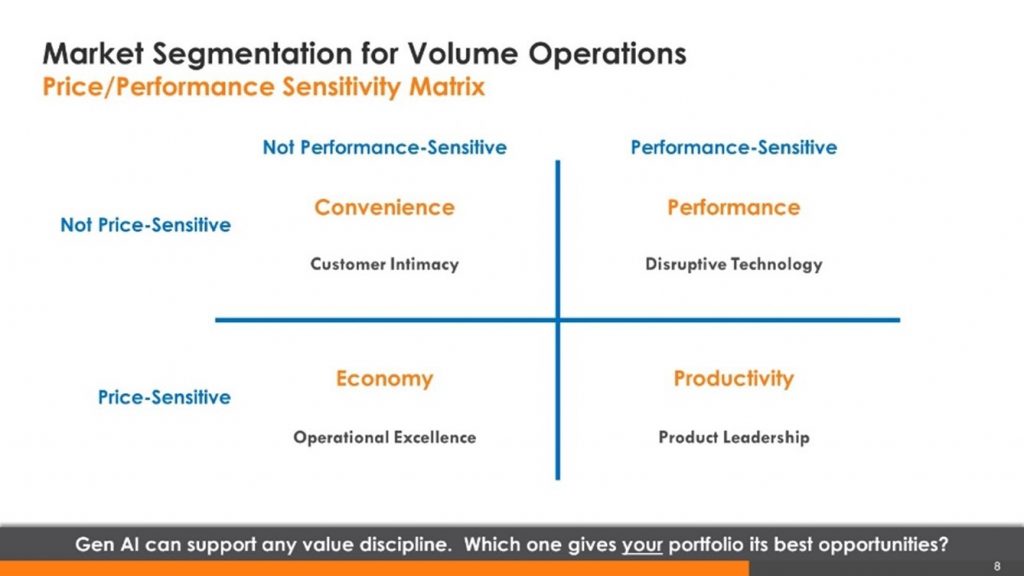
With respect to offer power, the most common strategic mistake is to spread the R&D budget across multiple vectors of innovation, making progress on all fronts but never achieving a level of competitive separation that is truly impactful. To offset this tendency, best practice begins with over-committing to a single value discipline, along the lines described by Michael Treacy and Fred Wiersema in The Value Disciplines of Market Leaders. They call out three such disciplines: product leadership, customer intimacy, and operational excellence. Those of us in Silicon Valley might add a fourth, disruptive technology, but the key point is to be asymmetrical in the allocation of resources to take one, and only one of these disciplines, “all the way to bright.”

Value disciplines tend to align with customer sensitivity to price and performance, as illustrated by the diagram below:

Geoffrey Moore Value Disciplines

Each quadrant in this model prioritizes a different value proposition. For customers who want performance at any cost, disruptive technology is a good bet, albeit coming with risks and issues that other customers would not accept. For enterprise customers, who typically are looking for productivity gains, product leadership fills that bill. For customers who are just looking to check the box with a minimum offer, economy is their watchword, and operational excellence is the main path. And finally, for customers who need the offer but don’t want to be bothered, convenience is the value proposition that resonates most, and customer intimacy is needed to design the experience accordingly.

Whatever offer power strategy you prioritize will act as a filter on your R&D budget allocation to ensure maximum return on innovation. Here is a way to look at the landscape:

Geoffrey Moore Return on Innovation

There are three ways to get a return on R&D innovation. The first is the one we have been focused on thus far—differentiation that leads to customer preference. But there are two other sources of return, both of which have value in their own right. The first of these is neutralization. This is innovation focused on catching up to some other competitor’s differentiation in order to neutralize their competitive advantage over you. Thus, while Apple is acknowledged as a master of differentiation, Microsoft is a master of neutralization, as once-market-leading and now-defunct enterprises like WordPerfect, Lotus, Ashton-Tate, Novell, and Netscape will all testify. Neutralization allows your customer base to stay current with next-generation product advancements without having to change out vendors. The key point for vendors to keep in mind is that when neutralizing you are trying to catch up, not get ahead, and so the goal is to get to “good enough” as fast as possible and then go no further.

A third type of return on innovation comes from optimization, improving the production and delivery of your current offering without materially changing its features or benefits. This allows you to sustain market positions in mature categories, enabling you to compete on price or capture the savings for other purposes. Because this effort is associated with operational excellence, people often do not recognize it as a form of innovation, but one need only look at what Amazon has done to reengineer the entire retail experience end to end to realize how foolish an idea this is.

One final point: not all innovations create a return. Failed attempts are an inevitable element in any portfolio of innovation attempts, the key being to follow the mantra, win or learn! That said, by far the more common reason that innovation investments fail to create a return is that they fall short of delivering a meaningful impact. This is true of:

  • Investments in differentiation that do not go far enough to create meaningful competitive separation. Typically, the team was unwilling to be sufficiently asymmetrical in its resource allocation. As a result, while its products are indeed different, they are not so in a sufficiently compelling way to impact customer preference. This is how Oldsmobile and Mercury lost their franchises in the US auto market.
  • Investments in neutralization that do not get to market fast enough to get your offer into the consideration set. Typically, the team making an extra effort to outperform the competitor at their own game, a low-percentage bet at best, but in so doing has left the playing field uncontested in the meantime. By the time you get back in the game, it is too late. This is how Nokia lost its market leadership position in smartphones to Apple.
  • Investments in optimization that do not go deep enough to make a material difference. Typically, teams avoid the hard work of process re-engineering and settle for an “across-the-board cut,” which saves money but actually weakens rather than improves performance.

That’s what I think. What do you think?

Image Credit: Unsplash, Geoffrey Moore

Subscribe to Human-Centered Change & Innovation WeeklySign up here to join 17,000+ leaders getting Human-Centered Change & Innovation Weekly delivered to their inbox every week.

Strategizing Market Power

Target Market Initiatives

Strategizing Market Power - Target Market Initiatives

GUEST POST from Geoffrey A. Moore

Market power derives from addressing an urgent mission-critical use case in a particular vertical industry requiring a specialized solution that the incumbent vendors either cannot or will not provide. Power aggregates around a single vendor who is the first to provide an end-to-end solution (what Ted Levitt taught us to call the whole product), typically with the support of partners whom the vendor has recruited to the task. Once success has been verified, prospective customers rally around the new solution, making it the de facto standard for that market segment, effectively excluding all other competition. This dramatically lowers the cost of acquisition and maximizes the lifetime value of the addressable market.

The mechanism for obtaining market power is called a target market initiative. It begins with the selection of a target market segment. Here the criteria for selection are three:

  1. Big enough to matter. The goal is to win well over 50% of the total segment within a three-year horizon, with the resulting revenue providing a material portion of the organization’s total revenue, and an even more meaningful portion of its profit contribution.
  2. Small enough to lead. Again, if your organization is going to win over 50% of the segment within a three-year period, the segment must be small enough to make this feasible given your current size and funding.
  3. Good fit with your crown jewels. To address an intractable problem requires breakthrough capability that others do not have, or what we like to call your “crown jewels.” These accelerate your path to success and provide a barrier to entry to protect your market segment leadership position once it is attained.

The playbook for running a target market initiative is described at length in Crossing the Chasm. It is organized around the following set of factors:

  • Target Customer. The bullseye target is the business process owner for the broken mission-critical process. They will provide the subject matter expertise. A secondary target is their executive sponsor. They will create budget to fund the effort.
  • Compelling Reason to Buy. The use case has to be both mission-critical and urgent, in order to overcome a pragmatist’s normal inertial resistance to embracing anything categorically new. Here pain, not gain, is the source of the trapped value that moves the customer to lean in and collaborate, and all your sales and marketing should be focused on the relevant pain points and their remedies.
  • Whole Product. This is the bill of materials for the complete solution, everything the customer needs to take the problem off the table, with nothing extra added. It is designed backward from the customer’s problem, not forward from your supply chain or your financial goals and objectives.
  • Partners and Allies. Whatever is on the whole product’s bill of materials that is not provided by your company must come from a partner. One of the functions of a target market initiative is to orchestrate the coming together of such partners to ensure timely delivery of the whole product. The focus is on completing the solution, not adding sales coverage.
  • Distribution. Target market initiatives require a direct sales channel to execute a consultative sales process, organized around a diagnostic/prescriptive approach, supported by marketing that speaks directly to the business process owner and their executive sponsor. This must not be outsourced, as it is through these direct interactions that you establish your company as the market segment leader.
  • Pricing. Pricing is value-based, calibrated by the consequences of the current as-yet-to-be-fixed broken mission-critical business process. Discounting is never appropriate as the customer is far more concerned about addressing their urgent needs than saving on the purchase price.
  • Competition. There are two classes of competitors in play. The first is the incumbent vendor who is not solving the problem satisfactorily at present but who could throw people at it in an attempt to get to “good enough.” The other is a vendor with breakthrough capabilities similar to yours who has not made the commitment to deliver the whole product but who has a partner that might try to do so.
  • Positioning. You are the breakthrough vendor who has made the whole product commitment, meaning you have demonstrated a deep understanding of the customer’s industry and its problem process, and you have developed a repeatable solution that will get better as each new instantiation leads to more useful features and a more engaged ecosystem of partners.
  • Next Target Customer. For start-ups, this will normally be an adjacent segment, either a new use case from the same customer base or the same use case from a different segment. For established enterprises whose size dictates that target market segments can never be material to total revenues, winning a target market segment creates a hook for M&A as well as makes you a lot more knowledgeable about which companies are worth acquiring.

Target market initiatives are the most reliable play in the B2B innovation playbook, as witnessed by the staying power of Crossing the Chasm, currently in its fourth decade of being in print, pushing two million copies in total sales worldwide. In closing, then, let me leave you with eight great reasons for building one into your next annual plan:

  1. Gain market adoption for a disruptive technology. This is the classic chasm-crossing play.
  2. Penetrate a new geography. Establish your reputation as a worthy vendor.
  3. Get out from behind the market leader. Gorillas can never defend themselves against highly focused chimps. All they can do is try to isolate you from making any further progress.
  4. Anchor a turnaround. When your enterprise has been on a losing streak, it is critical to “win one for the Gipper.” Target market initiatives are your best bet.
  5. Solve for the “stuck in neutral” problem. When the macro economy is in the doldrums, and customers are slow to buy anything, a truly problematic use case overcomes their hesitancy.
  6. Capitalize on a great niche opportunity. There are use cases where the size of the market is small, but the trapped value is enormous, and you can build a major franchise without ever leaving the segment, as has happened in CAD, Wall Street, health care, and aerospace.
  7. Exploit the “granularity of growth.” In mature markets where average growth rates are in the low single digits, there are always pockets of double-digit growth around problematic use cases. You just need to target them directly.
  8. Capitalize on a market in transition. As markets are working through long-lead transitions, short-term progress can be made locally rather than globally. The evolution of the hybrid workplace would be a current example.

That’s what I think. What do you think?

Image Credit: Pexels, Geoffrey Moore

Subscribe to Human-Centered Change & Innovation WeeklySign up here to join 17,000+ leaders getting Human-Centered Change & Innovation Weekly delivered to their inbox every week.
Company Power Strategy is a Team Sport

Company Power Strategy is a Team Sport

GUEST POST from Geoffrey A. Moore

Company power is primarily a function of the amount of ecosystem support for your offerings, which in turn is due largely to the market-making opportunities you create for partners to resell or flesh out your whole product. Market share leaders enjoy the most extensive ecosystem support because their installed base creates the majority of partner opportunities.

Let me note, however, that in the context of our Hierarchy of Powers framework, market share is a misnomer. The correct phrase would be category share. That’s because in our taxonomy markets are defined by groups of customers whereas categories are defined by groups of competitors. When financial analysts talk about market share, they are referring to category share, and it is your share of the category that sets the upper bounds of the opportunities you can create for ecosystem partners, the percentage of the total category you can make available to the ecosystem.

After category share, the next most important determinants of company power are barriers to entry and barriers to exit, or what we often just call “stickiness.” Because sticky offerings create ongoing opportunities for up-sell and cross-sell, as well as resist being displaced by lower-cost competitors, they enable vendors to sustain above-commodity pricing margins for the life of the category.

Gorilla Royalty Game

The strongest form of stickiness comes from proprietary technology that is category-enabling, the kind that Oracle has had in databases, Qualcomm in smartphones, Microsoft in operating systems, and Intel in microprocessors. When a category consolidates around such companies, it creates a hierarchy of company power we call a Gorilla Game, entailing three roles — gorilla, chimp, and monkey. In the absence of proprietary technology, categories form an analogous hierarchy with much lower switching costs, something we call a royalty game, organized around a parallel set of roles — king, prince, and serf. Cellular telephony, Wintel PCs, WiFi networking, and DRAM memory chips all exemplify categories with this latter type of structure.

The difference in stickiness between these two hierarchies creates dramatic differences in market capitalization. In the gorilla game, the gorilla dominates the category for the entirety of its life cycle, and thus its market cap gets a very high premium indeed. Chimps also have proprietary technology, hence stickiness, but are not the market standard, hence more limited scope. Their best play is to develop an independent ecosystem organized around high-value use cases specific to particular vertical markets, the way the Unix workstation vendors competed successfully against PCs with CAD-like applications for cinema, semiconductor, oil exploration, fluid dynamics, and high-frequency trading. And finally, there is a very large market open to being served by monkeys who are able to clone the gorilla technology and deliver a plug-compatible alternative at a much lower price.

When it comes to royalty games, the absence of proprietary technology with high switching costs leads to a much more fluid hierarchy of power. The category leader is still the king, but it can be deposed by some up-and-coming prince, the way that Compaq displaced the IBM PC, the way that Micron can challenge Samsung in DRAMs, the way that Aruba can challenge Cisco in Wi-Fi. Here the low-cost providers, whom we termed the serfs, have an easier time gaining entry into a large and growing market, but a harder time sustaining even the most modest of margins, as there is always some hungrier low-cost competitor looking over their shoulder.

Overall, the key takeaway is that, while the gorillas and gorilla games get the bulk of the attention, especially from the investment community, all six of these strategies are perfectly viable provided you play within the parameters of your role. The key is not to hallucinate about what role that is.

That’s what I think. What do you think?

Image Credit: Pexels, Geoffrey Moore

Subscribe to Human-Centered Change & Innovation WeeklySign up here to join 17,000+ leaders getting Human-Centered Change & Innovation Weekly delivered to their inbox every week.
Portfolio Management and Category Power

Portfolio Management and Category Power

GUEST POST from Geoffrey A. Moore

Portfolio management is the most consequential and the most challenging element in strategic planning. There is typically a ton of data, but none of it can really speak to the host of underlying risks that underpin long-range investments in net new lines of business, ones that pay off primarily in the out years. The best one can do is leverage experience, frameworks, and pattern recognition to navigate what are inevitably uncharted waters. With that in mind, here are some things to keep in view.

  1. Category Maturity Life Cycle: Tornadoes versus Main Street. Who doesn’t want a growth portfolio? To get one, however, means your enterprise must have meaningful plays in categories that are undergoing secular growth. Secular growth happens when net new budget is being created for a new purchase category across a broad spectrum of customers, a phase in technology adoption we have termed the tornado. Once the tornado has passed, the category will have an established place in these customers’ budgets going forward, a stage in the life cycle we call Main Street, one that is characterized by cyclical growth. Cyclical growth rewards inertial momentum, the goal being to leverage incumbency to grow wallet share more than market share. Secular growth rewards disruption, the goal being to displace an established profit pool by leveraging an emerging one. These dynamics transcend the efforts of most companies to influence (gorilla leaders being the exception), so assessing category power is first and foremost getting clarity on the hand you have been dealt. That will shape your ambitions for next year’s performance and set a baseline for future investment.
  2. Valuation: Growth investors versus value investors. Both forms of growth, secular and cyclical, are valued by investors for their respective risk-adjusted returns, but in different ways for different reasons. Growth investors are looking for a big pop and are willing for you to take considerable risk to get it. Value investors by contrast seek predictably consistent performance—an earnings-oriented approach that outperforms bonds with a minimum of additional risk. Both groups discount the value of the other group’s approach which exposes the market cap of established enterprises to a “conglomerate discount,” a painful penalty given that their stock is the major currency that will fund any M&A. Managing for shareholder value, in other words, gets hung up on the question, which shareholders? The reality is that most publicly held companies have a mix across the board, so the salient issue to address is how much of our operating budget should we commit to the current year versus the out years? Having a principled discussion on this topic leading to a definitive commitment is essential to creating a coherent strategy.
  3. Capital market status: PE-backed versus publicly held. Strategic planning in privately held enterprises is typically more straightforward because the board of directors representing the investing firms share a common approach to risk-adjusted returns. This is why when publicly held companies like Dell reach a crossroads that requires a patch of difficult sledding, they choose to take themselves private in order to accelerate their course corrections. The price to pay for this option is committing to operating principles, performance milestones, and a management discipline that meets the PE investors’ approval.
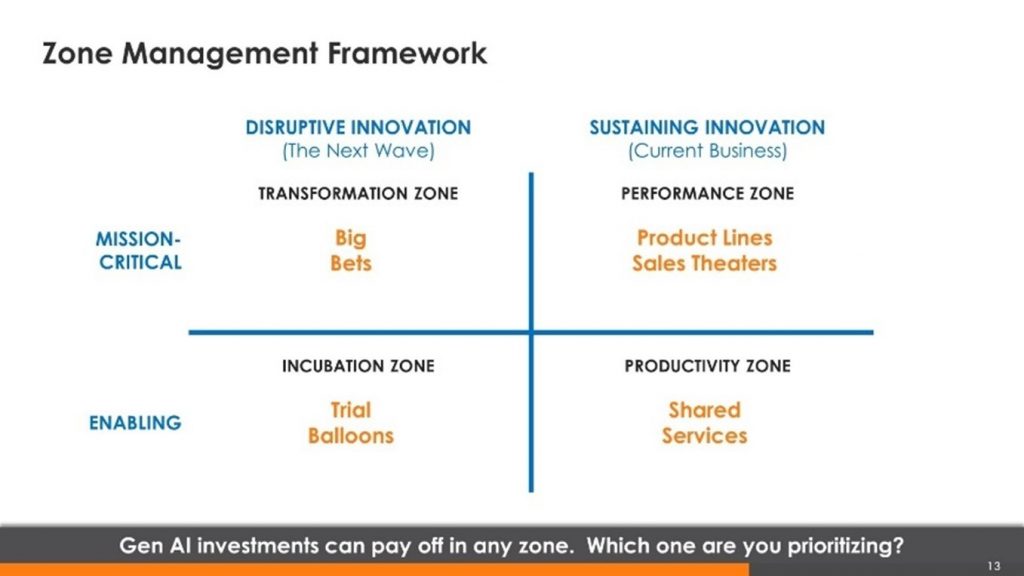
  4. Leveraging M&A: Incubate before you commit. Pundits like to claim that most M&A transactions fail to deliver on their promise (although recent research puts the odds at closer to fifty-fifty). Some of the failures, however, are self-inflicted wounds that can be avoided by taking a multi-step approach. If your enterprise has a venture investment capability, taking positions in disruptive start-ups with observer rights is a good way to test the waters. In parallel, the goal is to incubate comparable initiatives internally and get them into the market as trial balloons. The difference between this and the early-stage venture model is that you cannot wait for these organic efforts to scale—it will simply take too long. So, you are not trying to win the game with your new offers, just learn it. Sooner or later, you will turn to M&A to acquire something of meaningful mass, the difference being, because you have spent the intervening time in the market competing, you will be a much more knowledgeable acquirer than you otherwise would be.
  5. Synergy management: Year One is the one that matters most. Value-oriented M&A is intended to consolidate mature categories with cyclical growth. It is based on an inside-out approach to cost reduction focusing on eliminating duplicated functions, typically in the back office and the supply chain. Growth-oriented M&A, by contrast, takes an outside-in approach focusing on accelerating bookings and revenues through a series of go-to-market and customer success initiatives. When a smaller high-growth enterprise gets acquired by a larger, slower-growing one, the opportunity is to galvanize the latter’s existing customer base and ecosystem relationships, as well as its global sales and service footprint, to capture market share under highly favorable selling conditions. The trick is to do this quickly, while the iron is still hot, and that requires special incentives and strong management support to build trust between the old and new guards and to overcome the initial inertial resistance that accompanies any acquisition. In sum, what looks good on paper could very well be good in actual fact, but only after you execute Captain Picard’s famous dictum: Make it so!
  6. M&A integration: Year Two is the one that matters most. If the first year is all about getting the go-to-market right as fast as possible, the second is about creating lasting relationships that will enable the two enterprises to operate as one. There are four areas of interest here—the product team, the sales team, the management team, and the culture overall—and each one calls for a slightly different approach. The single most important outcome is to keep the product talent in place—they have the keys to the new kingdom. The sales team can and normally should continue to function as an overlay during the second year, but in parallel a transition to an integrated organization must begin so that in Year Three the overlay is eliminated. The management team is a wild card. Despite all the best intentions on both sides of the table, including vesting incentives of various kinds, entrepreneurial CEOs rarely stay, nor should they. The skillset for disrupting does not translate well into the skillset for scaling and optimizing. This suggests that from the outset a leadership transition should be on the table, typically enlisting an up-and-coming executive from the acquiring enterprise to personally throw themselves into the gap and pull the two organizations together leveraging every talent and tool they have. Finally, large enterprises necessarily entail an enormous amount of process management, something that goes against the grain of entrepreneurial culture, so one needs to tread carefully here, with the understanding that long term there can only be one enterprise, and by virtue of its scale, it will be process-driven for much of its day-to-day work. To promise the acquired company anything else will only create disillusion and disintegration down the line.
  7. Decision Time: To play or not to play. There is no formula for making transformational decisions, but there are some guidelines to keep in mind. The first is few, and far between. Transformations are disruptive to the core business that is funding your overall operation, and it takes time for everything to stabilize around a new portfolio. A second principle is existential threat. If the emerging category obsoletes a pillar of your core business, the way digital photography obsoleted film, the way that streaming is obsoleting conventional TV, then you must take action. Absent such a forcing function, a third principle to consider is value to the existing customer base, with the corollary of opportunity for our existing ecosystem. In other words, does the world want you to do this? Transformation takes a village, and it matters a great deal how much your constituencies will lean in to help you through it. Finally, when your competitors hear about this, will they smile and laugh, or will they say Oh sh*t! If the latter, it just puts icing on the cake.
  8. Plan B: Leverage the updraft. The stars have to align to make any transformational portfolio play work, and sometimes they simply won’t. Plan B is to incorporate a portion of the tornado category into your existing portfolio as a supplement. Take Gen AI, for example. You don’t have to be in the category like Open AI or Anthropic to participate in the new spending. Virtually any enterprise application can benefit from a Gen AI bolt-on to improve the user experience or simplify the administrative one. Prior experiences with adding mobile applications and digital commerce to legacy systems have delivered similarly positive returns. You don’t have to be in the lead, but customers do want to see you are still in the game, and assuming you show up with a working product, they are more than happy to consume it.

That’s what I think. What do you think?

Image Credit: Pexels, Geoffrey Moore

Subscribe to Human-Centered Change & Innovation WeeklySign up here to join 17,000+ leaders getting Human-Centered Change & Innovation Weekly delivered to their inbox every week.

Re-Framing Your Strategy for the Chaos of 2025

Re-Framing Your Strategy for the Chaos of 2025

GUEST POST from Geoffrey A. Moore

Spring is in the air, which brings to mind the season’s favorite sport — no, not baseball, strategic planning! Let’s face it, 2025 has been a tough year for most of us (and it’s still early days), with few annual plans surviving first contact with an economy that was not so much sluggish as simply hesitant. With the exception of generative AI’s growing impact, most technology sectors have been more or less trudging along, and that begs the question, what do we think we can do with the rest of 2025? Time to bring out the strategy frameworks, polish up those crystal balls that have been a bit murky of late, and chart our course forward.

This post will kick off a series of blogs about framing strategy, all organized around a meta-model we call the Hierarchy of Powers:

The inspiration for this model came from looking at how investors prioritize their portfolios. The first thing they do is allocate by sector, based primarily on category power, referring both to the growth rate of the category as well as its potential size. Rising tides float all boats, and one of the toughest challenges in business is how to manage a premier franchise when category growth is negative. In conjunction with assessing our current portfolio’s category power, this is also a time to look at adjacent categories, whether as threats or as opportunities, to see if there are any transformative acquisitions that deserve our immediate attention.

Returning to our current set of assets, within each category the next question to answer is, what is our company power within that category? This is largely a factor of market share. The more share a company has of a given category, the more likely the ecosystem of partners that supports the category will focus first on that company’s installed base, adding more value to its offers, as well as to recommend that company’s products first, again because of the added leverage from partner engagement. Marketplaces, in other words, self-organize around category leaders, accelerating the sales and offloading the support costs of the market share leaders.

But what do you do when you don’t have company power? That’s when you turn your attention to market power. Marketplaces destabilize around problematic use cases that the incumbent vendors do not handle well. This creates openings for new entrants, provided they can authentically address the customer’s problems. The key is to focus product management on the whole product (not just what your enterprise supplies, but rather, everything the customer needs to be successful) and to focus your go-to-market engine on the target market segment. This is the playbook that has kept Crossing the Chasm on entrepreneur’s book lists some thirty years in, but it is a different matter to execute it in a large enterprise where sales and marketing are organized for global coverage, not rifle-shot initiatives. Nonetheless, when properly executed, it is the most reliable play in all of high-tech market development.

If market power is key to taking market share, offer power is key to maintaining it, both in high-growth categories as well as mature ones. Offer power is a function of three disciplines—differentiation to create customer preference, neutralization to catch up to and reduce a competitor’s differentiation, and optimization to eliminate non-value-adding costs. Anything that does not contribute materially to one of these three outcomes is waste.

Finally, execution power is the ability to take advantage of one’s inertial momentum rather than having it take advantage of you. Here the discipline of zone management has proved particularly valuable to enterprises who are seeking to balance investment in their existing lines of business, typically in mature categories, with forays into new categories that promise higher growth.

In upcoming blog posts I am going to dive deeper into each of the five powers outlined above to share specific frameworks that clarify what decisions need to be made during the strategic planning process and what principles can best guide them. In the meantime, there are still three more quarters in 2025 to make, and we all must do our best to make the most of it.

That’s what I think. What do you think?

Image Credit: Pexels, Geoffrey Moore

Subscribe to Human-Centered Change & Innovation WeeklySign up here to join 17,000+ leaders getting Human-Centered Change & Innovation Weekly delivered to their inbox every week.
Contemporary Science versus Natural Language

Contemporary Science versus Natural Language

GUEST POST from Geoffrey A. Moore

Item 1. The fastest human-created spacecraft goes 165,000 mph. Pretty amazing. But for it to travel one light year would take roughly 3000 years—basically, the length of recorded human history. The closest star system that hosts an earth-like planet (Alpha Centauri) is 4.4 light years away. Thus, it would take today’s fastest vehicle 14,000 years to make a one-way trip. On our earth, 14,000 years ago humanity’s most sophisticated technology was a stone axe. Thus, while we love to talk about space travel outside the solar system, as well as aliens in UFOs coming to Earth, neither is remotely possible, not now, not ever.

Item 2. There are 30 trillion cells in the average human body. There are 100 trillion atoms in a typical human cell. That means there are three thousand trillion trillion atoms, give or take, in you or me. Atoms are so small that it is not clear any words we have would apply to how they actually operate. Particle and wave are two of the ones we end up using the most. Neither of them, however, can coherently explain something as simple as the double-slit experiment.

Item 3. The metabolic reactions that support all life are mind-bogglingly fast. Take mitochondria for example. They are the organelles that produce the bulk of our ATP, the energy molecule that drives virtually all life’s chemical reactions. Of the 30 trillion cells in your body, on average each one uses around 10 million molecules of ATP per second and can recycle all its ATP in less than a minute. There is simply no way to imagine something happening a million times per second simultaneously in thirty million different places inside your own body.

Item 4. Craig Venter has been quoted as saying, “If you don’t like bacteria, you’re on the wrong planet. This is the planet of the bacteria.” In one-fifth of a teaspoon of seawater, there are a million bacteria (and perhaps 10 million viruses). The human microbiome, which has staked out territory all over our body, in our gut, mouth, skin, and elsewhere, harbors upwards of three thousand kinds of bacteria, comprising some 3 million distinct genes, which they swap with each other wherever they congregate. How in the world are we supposed to keep track of that?

Okay, okay. So what’s your point?

The point is that contemporary science engages with reality across a myriad of orders of magnitude, from the extremely small to the extremely large, somewhere between sixty and one hundred all told. Math can manage this brilliantly. Natural languages cannot. All of which means: philosophers beware!

Philosophers love analogies, and well they should. They make the abstract concrete. They enable us to transport a strategy from a domain where it has been proven effective and test its applicability in a completely different one. Such acts of imagination are the foundation of discovery, the springboard to disruptive innovation. But to work properly they have to be credible. That means they must stand up to the kind of pressure testing that determines the limits to which they can be applied, the boundaries beyond which they must not stretch. This is where the orders of magnitude principle comes in.

It is not credible that there could be a cause that is a million million times smaller than its effect. Yes, it is theoretically conceivable that via a cascading set of emergent relationships, one could build a chain from such an A to such a B, but the amount of coordination that would be required to lever something up a million million times is just ridiculously improbable. So, when philosophers refer to the uncertainty principles embedded in quantum mechanics, and then infer or imply that such uncertainty permeates human affairs, or when they trace consciousness down to quantum fluctuations in messenger RNA, when, in short, they are correlating things that are more than a trillion, trillion times different in size and scope, then they are misusing both the mathematics of science and the resources of natural language. We simply have to stay closer to home.

That’s what I think. What do you think?

Image Credit: 1 of 850+ FREE quote slides available at http://misterinnovation.com

Subscribe to Human-Centered Change & Innovation WeeklySign up here to join 17,000+ leaders getting Human-Centered Change & Innovation Weekly delivered to their inbox every week.

The Role Platforms Play in Business Networks

The Role Platforms Play in Business Networks

GUEST POST from Geoffrey A. Moore

A decade and a half ago, my colleague at TCG Advisors, Philip Lay, led a body of work with SAP around the topic of business network transformation. It was spurred by the unfolding transition from client-server architecture to a cloud-first, mobile-first world, and it explored the implications for managing both high-volume transactions as well as high-complexity relationships. Our hypothesis was that high-volume networks would be dominated by a small number of very powerful concentrators whereas the high-complexity networks would be orchestrated by a small number of very influential orchestrators.

The concentrator model has played out pretty much as expected, although the astounding success of Amazon in dominating retail is in itself a story for the ages. The key has been how IT platforms anchored in cloud and mobile, now supplemented with AI, have enabled transactional enterprises in multiple sectors of the economy to scale to levels previously unimaginable. And these same platforms, when opened to third parties, have proved equally valuable to the long tail of small entrepreneurial businesses, garnering them access to a mass-market distribution channel for their offerings, something well beyond their reach in the prior era.

The impact on the orchestrator model, by contrast, is harder to see, in part because so much of it plays out behind closed doors “in the room where it happens.” Enterprises like JP Morgan Chase, Accenture, Salesforce, Cisco, and SAP clearly extend their influence well beyond their borders. Their ability to orchestrate their value chains, however, has historically been grounded primarily in a network of personal relationships maintained through trustworthiness, experience, and intelligence, not technology. So, where does an IT platform fit into that kind of ecosystem?

Here it helps to bring in a distinction between core and context. Core is what differentiates your business; context is everything else you do. Unless you are yourself a major platform provider, the platform per se is always context, never core. So, all the talk about what is your platform strategy is frankly a bit overblown. Nonetheless, in both the business models under discussion, platforms can impinge upon the core, and that is where your attention does need to be focused.

In the case of the high-volume transaction model, where commoditization is an everyday fact of life, many vendors have sought to differentiate the customer experience, both during the buying process and over the useful life of the offer. This calls for deep engagement with the digital resources available, including accessing and managing multiple sources of data, applying sophisticated analytics, and programming real-time interactions. That said, such data-driven personalization is a tactic that has been pursued for well over a decade now, and the opportunities to differentiate have diminished considerably. The best of those remaining are in industries dominated by an oligopoly of Old Guard enterprises that are so encumbered with legacy systems that they cannot field a credible digital game. If you are playing elsewhere, you will likely fare better if you get back to innovating on the offering itself.

In the case of managing context in a high-complexity relationship model, it is friction that is the everyday fact of life worth worrying about. Most of it lies in the domain of transaction processing, the “paperwork” that tags along with every complex sale. Anything vendors can do to simplify transactional processes will pay off not only in higher customer satisfaction but also in faster order processing, better retention, and improved cross-sell and up-sell. It is not core, it does not differentiate, but it does make everyone breathe easier, including your own workforce. Here, given the remarkable recent advances in data management, machine learning, and generative AI, there is enormous opportunity to change the game, and very little downside risk for so doing. The challenge is to prioritize this effort, especially in established enterprises where the inertia of budget entitlement keeps resources trapped in the coffers of the prior era’s winning teams.

The key takeaway from all this is that for most of us platforms are not strategic so much as they are operational. That is, the risk is less that you might choose an unsuitable platform and more that you may insufficiently invest in exploiting whatever one you do choose. So, the sooner you get this issue off the board’s agenda and into your OKRs, the better.

That’s what I think. What do you think?

Image Credit: Pexels

Subscribe to Human-Centered Change & Innovation WeeklySign up here to join 17,000+ leaders getting Human-Centered Change & Innovation Weekly delivered to their inbox every week.

Unlocking Trapped Value with AI

Unlocking Trapped Value with AI

GUEST POST from Geoffrey A. Moore

Anyone who has used Chat GPT or any of its cousins will testify to its astonishing ability to provide valuable responses to virtually any query. This is hardly a threat—indeed, it is a boon. So, what are we worrying about?

Well, there is the issue of veracity, of course, and it is true, GPT-enabled assistants can indeed make mistakes. But, come on—humans don’t? We are not looking for gospel truth here. We want highly probable, highly informed answers to questions where we need guidance, and it is clear that GPT-enabled applications are outstanding at meeting this need, for at least three reasons. They are remarkably well-informed. They are available 24/7 on demand with no hold time. And they have infinite patience. So, let’s not kid ourselves. We are massively better off for their emergence on the scene.

What we should be worrying about, on the other hand, is their impact on jobs to be done, employment, and career development. A simple way to think about this is that for any of us to earn money, we have to release some form of trapped value. A bank clerk helps a customer get access to the trapped value in their savings account. A bus driver helps a passenger cope with their trapped value by transporting them to the location where they need to be. A lawyer helps a client get access to trapped value by constructing a contract that meets their needs while protecting against risk. A teacher helps a student access trapped value by helping her solve problems she couldn’t handle before. The principle applies to every job. All systems have points of trapped value, and all jobs are organized around releasing and capturing that value.

Now, let’s introduce generative AI. All of a sudden, a whole lot of trapped value that funded a whole lot of jobs can now be released for free (or virtually for free). Those jobs can be protected in the short term but not forever. In other words, the environment really has changed, and we must assess our new circumstances or fall behind. This is Darwinism at work. Evolution never stops. It can’t. As long as there is change, there will be dislocation, which in turn will stimulate innovation. That’s life.

But here’s the good news. The universe can never eliminate trapped value, it can only move it from place to place. That is, there are always emergent problems to solve, always new opportunities to capitalize on, because every system always traps value somewhere. What Darwinism requires is that we detect the new value traps and redirect our activity to engage with them.

Publicly funded agencies sometimes interpret this as a mandate for training programs, but we have to be careful here. Training works well for disseminating established skills that address known problems. It does not work well, however, where the problems are still being determined and the skills are as yet undeveloped. Novelty, in other words, demands creativity. It is simply not negotiable.

Getting back to the impact of generative AI, we should understand that it is an advisory technology. It is not automation. That is, it is not eliminating the need for human beings to make judgment calls. Rather, it is accelerating the preparation for so doing and framing the options in ways that make decision-making more straightforward. By solving for the old value traps, it is giving us the opportunity to up our game. It’s our job to step up to add net new value to the equation.

The best way to do this is to ferret out the emerging new value traps. Who is the customer now? What is the bottleneck that is holding them back? How could that bottleneck be broken open? What is the reward for so doing? These are the fundamental questions that drive any business model. We know how to do this. It’s just that we have been riding on the inertia of the past set of solutions for so long we may have atrophied in some of the muscles we need now. One thing we need not worry about is the universe running out of trapped value. If you are ever in doubt, just read the day’s headlines and be reassured. The world needs our help. Any tool that helps us do our part better is a blessing.

That’s what I think. What do you think?

Image Credit: Pexels

Subscribe to Human-Centered Change & Innovation WeeklySign up here to join 17,000+ leaders getting Human-Centered Change & Innovation Weekly delivered to their inbox every week.