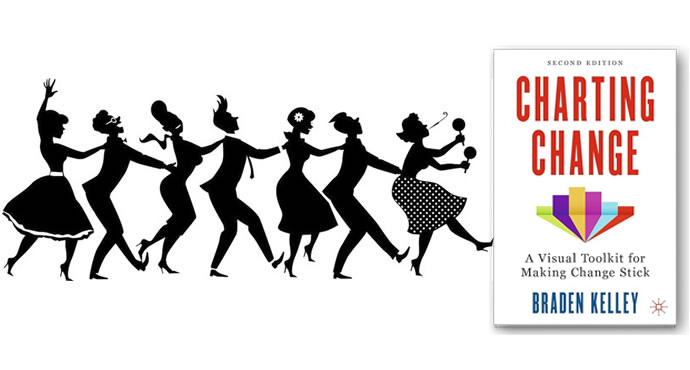
My publisher is having a summer sale that will allow you to get the hardcover or the digital version (eBook) of my latest best-selling bookCharting Change for 50% off!
Including FREE SHIPPING WORLDWIDE! *
I created the Human-Centered Change methodology to help organizations get everyone literally all on the same page for change. The 70+ visual, collaborative tools are introduced in my book Charting Change, including the powerful Change Planning Canvas™. The toolkit has been created to help organizations:
Beat the 70% failure rate for change programs
Quickly visualize, plan and execute change efforts
Quick reminder: Everyone can download ten free tools from the Human-Centered Change methodology by going to its page on this site via the link in this sentence, and book buyers can get 26 of the 70+ tools from the Change Planning Toolkit (including the Change Planning Canvas™) by contacting me with proof of purchase.
*This offer is valid for English-language Springer, Palgrave & Apress books & eBooks. The discount is redeemable on link.springer.com only. Titles affected by fixed book price laws, forthcoming titles and titles temporarily not available on link.springer.com are excluded from this promotion, as are reference works, handbooks, encyclopedias, subscriptions, or bulk purchases. The currency in which your order will be invoiced depends on the billing address associated with the payment method used, not necessarily your home currency. Regional VAT/tax may apply. Promotional prices may change due to exchange rates.
This offer is valid for individual customers only. Booksellers, book distributors, and institutions such as libraries and corporations please visit springernature.com/contact-us. This promotion does not work in combination with other discounts or gift cards.
Are you spooked by the uncertainty and volatility that defines not just our businesses but our everyday lives? Have you hunkered down, stayed the course, and hoped that this too shall pass? Are you starting to worry that this approach can’t go on forever but unsure of what to do next? CONGRATULATIONS, consultants have heard your cries and are rolling out a shiny new framework promising to solve everything: Strategic Foresight.
Strategic foresight is the latest silver bullet for navigating our chaotic, unpredictable world.
Remember in 2016 when Agility was going to save us all? Good times.
As much as I love rolling my eyes at the latest magic framework, I have to be honest – Strategic Foresight can live up to the hype. If you do it right.
What Strategic Foresight Actually Is (Spoiler: Not a Silver Bullet)
A LOT is being published about Strategic Foresight (I received 7 newsletters on the topic last week) and everyone has their own spin. So let’s cut through the hype and get back to basics
What it is: Strategic foresight is the systematic exploration of multiple possible futures to anticipate opportunities and risks, enabling informed decisions today to capture advantages tomorrow.
There’s a lot there so let’s break it down:
Systematic exploration: This isn’t guessing, predicting, or opining. This is a rigorous and structured approach
Multiple possible futures: Examines multiple scenarios because we can’t possibly forecast or predict the one future that will occur
Enabling informed decisions today: This isn’t an academic exercise you revisit once a year. It informs and guides decisions and actions this year.
Capture advantages tomorrow: Positions you to respond to change with confidence and beat your competition to the punch
How it fits: Strategic Foresight doesn’t replace what you’re doing. It informs and drives it.
Approach
Timeline
Focus
Strategic Foresight
5-20+ years
Explore possible futures
Strategic Planning
3-5 years
Create competitive advantage
Business Planning
Annual cycles
Execute specific actions
The sequence matters: Foresight → Strategic Planning → Business Planning.
This sequence also explains why Strategic Foresight is so hot right now. Systemic change used to take years, even decades, to unfold. As a result, you could look out 3-5 years, anticipate what would be next, and you would probably be right.
Now, systemic change can happen overnight and be undone by noon the next day. Whatever you think will happen will probably be wrong and in ways you can’t anticipate, let alone plan for and execute against.
Strategic Foresight’s rigorous, multi-input approach gives us the illusion of control in a world that seems to be spinning out of it.
How to Avoid the Illusion and Get the Results.
Personally, I love the illusion of control BUT as a business practice, I don’t recommend it.
Strategic Foresight’s benefits will stay an illustion if you don’t:
Develop in-house strategic foresight capabilities.Amy Webb’s research at NYU shows that companies using rigorous foresight methodologies consistently outperform those stuck in reactive mode. Shell’s legendary scenario planning helped them navigate oil crises while competitors flailed. Disney’s Natural Foresight® Framework keeps them ahead of entertainment trends that blindside others.
Integrate foresight into your annual strategic planning cycle: Strategic foresight is a front-end effort that makes your 3-5 year strategy more robust. If you treat it like a separate exercise where you hire futurists, and run some workshops, and check the Strategic Foresight box, you won’t see any benefits or results.
What’s Next?
Strategic foresight isn’t a silver bullet, but it can be a path through uncertainty to advantage and growth.
The difference between success and failure comes down to execution. Do you treat it as prediction or preparation? Do you integrate it with existing planning or silo it in innovation labs?
Ready to separate the hype from the hard results? Our next post shows you what two industry leaders learned about turning foresight into competitive advantage and how you can use those lessons to your benefit
Image credit: Pixabay
Sign up here to join 17,000+ leaders getting Human-Centered Change & Innovation Weekly delivered to their inbox every week.