Monthly Archives: May 2022

The Future of User Research in a Digital-First Landscape

The Future of User Research in a Digital-First Landscape

GUEST POST from Chateau G Pato

In an era where digital experiences define customer interactions and influence business growth, understanding user needs is more critical than ever. As organizations pivot towards a digital-first strategy, the methods and tools for user research must evolve to keep pace with changing expectations and technologies.

Embracing Digital Ethnography

Traditional user research methods like face-to-face interviews and focus groups often fall short in a global digital economy where interactions occur online. Digital ethnography, leveraging tools such as social media listening and online behavioral data, allows researchers to gain profound insights with greater reach and efficiency. By observing digital behaviors in real-time, researchers can access authentic user interactions without the bias that often accompanies direct questioning.

Case Study 1: Netflix

Innovating with Cultural Analytics

Netflix has fine-tuned its user research process to align with its digital-first model. By employing digital ethnography techniques, Netflix tracks viewing habits and preferences through an intricate web of data analytics. This deep dive into cultural analytics not only helps Netflix in curating personalized content but also in identifying potential content trends across different regions.

Understanding the cultural context of their growing global audience, Netflix successfully predicted the popularity of shows like “Squid Game,” a South Korean series that became a worldwide sensation. By analyzing regional viewing patterns and social media buzz, Netflix tapped into a cultural wave before it crested, ultimately driving subscriptions and engagement globally.

Leveraging AI and Machine Learning

Innovations in AI and machine learning have unlocked new possibilities for user research, enabling researchers to process vast amounts of data with precision. These technologies can predict trends, discern patterns, and generate meaningful insights that were previously out of reach. AI-powered tools can analyze user feedback, identify sentiment, and highlight areas where digital interfaces may require enhancement.

Case Study 2: Spotify

AI-Driven Personalization

Spotify’s use of AI and machine learning for user research stands as a beacon of innovation. The company utilizes AI algorithms to analyze user listening behaviors, preferences, and feedback, enabling it to create highly personalized experiences. Playlists such as “Discover Weekly” use these insights to cater to individual tastes, promoting user satisfaction and retention.

Spotify’s approach to user research showcases the power of AI in transforming raw data into actionable insights that not only understand current user preferences but also anticipate future needs. By continuously refining their models, Spotify remains at the forefront of delivering user-centric digital products.

Integrating Qualitative and Quantitative Methods

While digital tools offer quantitative insights at scale, the importance of qualitative research remains undiminished. Combining both approaches provides a comprehensive understanding of user needs, motivations, and potential pain points. Digital tools can help in identifying broad trends, but qualitative methods are essential in uncovering the ‘why’ behind these patterns.

Organizations that build a culture of innovation prioritize the integration of diverse research methodologies, ensuring they cater to the complete user journey from multiple angles.

The Road Ahead

The future of user research in a digital-first landscape is rich with potential. By embracing emerging technologies and methodologies, organizations can create richer, more empathetic user experiences that resonate deeply with their audiences. The continual evolution and integration of advanced tools and human-centric approaches will shape how we understand and engage with users in a world increasingly defined by digital interactions.

As we stand on the precipice of this exciting future, the opportunity lies in our ability to remain curious, adaptable, and thoughtful about the role user research plays in crafting experiences that are not only effective but transformative.

Extra Extra: Because innovation is all about change, Braden Kelley’s human-centered change methodology and tools are the best way to plan and execute the changes necessary to support your innovation and transformation efforts — all while literally getting everyone all on the same page for change. Find out more about the methodology and tools, including the book Charting Change by following the link. Be sure and download the TEN FREE TOOLS while you’re here.

Image credit: Pixabay

Subscribe to Human-Centered Change & Innovation WeeklySign up here to get Human-Centered Change & Innovation Weekly delivered to your inbox every week.

Leading Change in Times of Crisis and Uncertainty

Leading Change in Times of Crisis and Uncertainty

GUEST POST from Art Inteligencia

In today’s rapidly shifting world, organizations face unprecedented levels of uncertainty. Whether due to global pandemics, economic fluctuations, technological disruptions, or geopolitical tensions, crises can emerge without warning and demand adaptive leadership. The key to navigating these turbulent times is a focus on human-centered change, placing the needs and wellbeing of people at the forefront of every decision. As a thought leader in change and innovation, I, Braden Kelley, share insights and strategies for leading effectively in such challenging environments.

Understanding Crisis Dynamics

Crisis periods often trigger reactions characterized by fear and anxiety, potentially leading to hasty decisions. However, understanding the dynamics at play enables leaders to make informed choices. During a crisis, communication becomes critical; people look for guidance and reassurance amid chaos. Therefore, clear, transparent, and empathetic communication should be a cornerstone of any crisis management strategy.

Case Study 1: Johnson & Johnson’s Tylenol Crisis

In 1982, Johnson & Johnson faced a significant crisis when reports emerged that several people had died after consuming cyanide-laced Tylenol capsules. The situation was dire, not just for affected families but also for the company’s reputation and financial health. Rather than hiding from the crisis, Johnson & Johnson’s leadership adhered to their values and focused on health and safety. They initiated a nationwide recall of Tylenol products, costing the company over $100 million.

This decisive and ethical action was coupled with strategic communication, including regular updates and cooperation with media channels. By placing consumer safety above profits, Johnson & Johnson gradually rebuilt trust and emerged from the crisis stronger, setting a gold standard for crisis management.

“Our actions dictated the preservation of our key value: put the wellbeing of customers first.” – Johnson & Johnson’s response team

Key Takeaways

  • Prioritize ethical decision-making, even at a financial cost.
  • Emphasize transparency and maintain open communication channels.
  • Align actions with core organizational values to rebuild trust.

Case Study 2: Airbnb’s Response to COVID-19

When the COVID-19 pandemic struck in 2020, Airbnb was among the many companies that faced a staggering downturn as travel restrictions came into place worldwide. The crisis required immediate reevaluation of business operations and strategy. Airbnb’s leadership, led by CEO Brian Chesky, focused on transparent and empathetic communication, both internally and externally.

The company quickly outlined a revised mission and strategy that included supporting hosts and guests through flexible policies and assistance programs. They prioritized the community, even as they had to make difficult decisions such as workforce reductions. Their empathetic approach resonated with stakeholders, helping maintain a sense of solidarity despite the challenging circumstances.

“Our greatest strength lies in our community, and our response must reflect that collective power.” – Brian Chesky, Airbnb CEO

Key Takeaways

  • Adapt quickly to new realities without losing sight of fundamental values.
  • Implement flexible policies to accommodate stakeholders’ needs.
  • Communicate with empathy to maintain community trust.

Strategies for Leading Through Crisis

1. Prioritize People: During a crisis, the human aspect should always come first. Prioritizing the physical, mental, and emotional wellbeing of stakeholders ensures that the organization moves forward cohesively.

2. Foster Resilience: Encourage a culture of adaptability. By nurturing innovation and learning, organizations can better withstand shocks and adapt to new circumstances.

3. Communicate Transparently: Regular and honest communication fortifies trust and mitigates uncertainty. Use multiple channels to reach all parts of your organization and community.

4. Be Decisive and Ethical: Inaction and ambiguity can exacerbate a crisis. Leaders should make decisions confidently, rooted in core values, to guide the organization effectively.

5. Reflect and Learn: After managing a crisis, reflection helps uncover valuable lessons and opportunities for improvement. This continuous learning cycle prepares organizations to better handle future disruptions.

Conclusion

Leading change in times of crisis and uncertainty demands a steadfast commitment to people and principles. By learning from past experiences and adopting a human-centered approach, leaders can guide their organizations through the toughest challenges. As we continue to face unpredictable futures, embracing change with empathy and agility will be the ultimate differentiator in building resilient and thriving organizations.

Extra Extra: Futurology is not fortune telling. Futurists use a scientific approach to create their deliverables, but a methodology and tools like those in FutureHacking™ can empower anyone to engage in futurology themselves.

Image credit: Pexels

Subscribe to Human-Centered Change & Innovation WeeklySign up here to get Human-Centered Change & Innovation Weekly delivered to your inbox every week.

Managing Knowledge Spaghetti

How collaboration platforms can help turbocharge your innovation efforts

Managing Knowledge Spaghetti

GUEST POST from John Bessant

Say the word ‘innovation’ and many people quickly conjure in their mind the wonderful ‘lightbulb moment’. But of course, innovation isn’t like this — that flash of inspiration is only the start of what will be a long journey trying to create value from that initial idea. It’s all about navigating our way through a landscape of uncertainty, learning to deal with a variety of roadblocks, potholes and other unexpected barriers.

And if we want to be able to repeat the trick, to give our ideas a fighting chance then the evidence is clear; we need some kind of a process. Over a hundred years of research has fed our understanding to the point where the kind of system we need to make innovation happen can be specified as an international standard. And in terms of pictures what we’re really looking for is less a lightbulb moment than a reproduceable process, something like this.
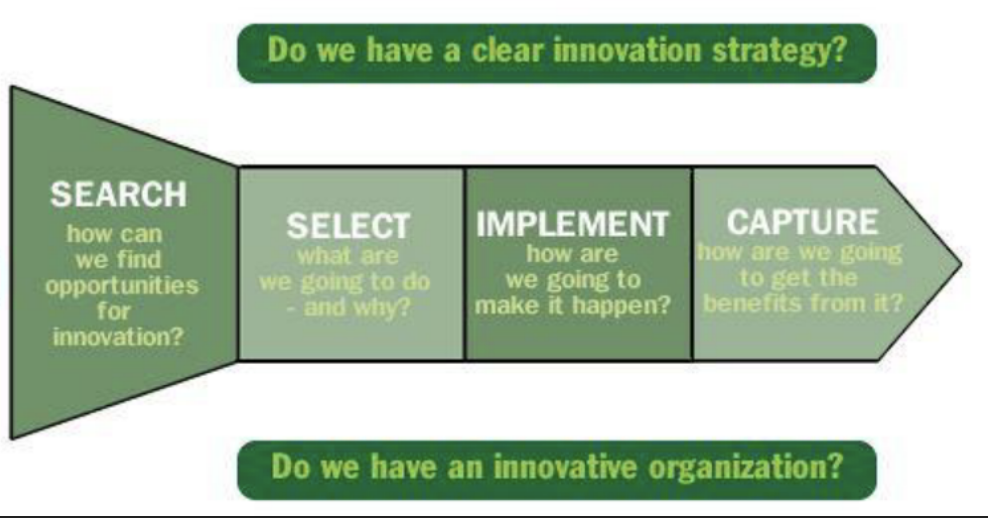
Clear Innovation Strategy Bessant

Which is fine, as long as we bear in mind one important truth. Innovation doesn’t happen like that.

Back in 1931 the mathematician Alfred Korzybski presented a paper to a meeting in New Orleans on mathematical semantics. It was pretty complex stuff but one phrase which he used has stuck in the wider popular memory. He pointed out that ‘the map is not the territory…’ In other words, a description of something is not the thing itself. The model is not reality. Which has some pretty important implications for the way we work with innovation.

Process models, however detailed, are simplifications, ways of representing how innovation might take place. But — like any map, be it a crumpled sketch someone has drawn or a sophisticated Google Maps picture — it is a guide, it isn’t the place itself. The map is, by its nature, a reduction of the process and in reducing it we lose some important information.

The reality, of course, is that innovation is more complex. And it’s all about knowledge spaghetti.

Just like a plate of pasta innovation involves many different strands. Only this time we are talking about knowledge — technical knowledge, market knowledge, legal knowledge, financial knowledge and so on. They need to be woven together to create value.

And these knowledge strands are held by different people, inside and outside the organization. We have to find them and connect them, link them together to enable us to innovate. Whilst we can superimpose structures on it to help us with this task, we shouldn’t forget that we’re really working with knowledge spaghetti.

Spaghetti solutions

So how do we work with it? Just like recipes for spaghetti there are many variations. One approach is to employ specialists and create cross-functional teams which bring together the relevant strands and align them towards a focused target. That’s proved to be a good model for developing new products and services, especially if we can find ways to bring in all the relevant players including users.

We can use a similar cross-functional approach to the design and implementation of major internal process innovations — things like introducing a new IT system or reorganizing to become more customer-focused. And a third approach involves carefully constructed strategic collaborations, bringing knowledge partners together with complementary strands of knowledge spaghetti.

One very powerful model is based on the idea that everyone in the organization has something to contribute to the innovation story — high involvement innovation. Here we’re working on the belief that even small strands of knowledge can be important and if we could bring them in to the story, we’d make significant progress.

Which history tells us we can. In countless embodiments the principle of high involvement has been shown to pay dividends. Ask people for what they know that might help solve problems around quality, cost, delivery, etc — and there’s no shortage of good ideas in response. The challenge has, historically, been one of working with such high volumes of knowledge and keeping the flywheel going by responding to employee suggestions and giving feedback on progress towards their implementation.

Suggestion boxes and schemes work but until recently had their limitations. Two recent trends have changed all that. The first, borne on the waves of total quality thinking and then the whole ‘lean’ movement, has shown us that in any context people are very effective innovators, well able to improve on what they are doing on a continuing basis.

And the second has been the emergence of collaboration platforms on which they can deploy their innovation skills. Today’s collaborative innovation platform resembles its suggestion box predecessor in outline only; it’s still a way of collecting ideas from employees. But it does so in an interactive space in which challenges can be posed, ideas suggested, comments added and shaping, and welding together multiple knowledge sets and experience enabled. And in doing so they open up the very real possibilities of high involvement innovation — getting everyone to contribute to the innovation story.

Emergent properties

But it’s not just the raw return on investment which collaboration platforms offer — though these benefits are impressive. Their real value lies in the way they enable ‘emergent properties’ — the innovation whole becomes much greater than the sum of its parts.

They give us new and powerful ways of working with the knowledge spaghetti. Not only can we handle the sheer scale of the knowledge challenge and focus it towards key objectives but we can do so in ways which yield surprising additional benefits. They effectively turbocharge our innovation system.

In particular they contribute in the following ways:

  • Reach — one of the obvious ways in which platforms can help is that they create a network which even remote users can connect to. We can spread the innovation net far and wide, can reach the parts other innovation approaches don’t. For example, recruiting ideas from people on ships at sea or working on an off-shore oil platform would have been impossible until recently. Now they can join the innovation conversation as simply as placing a phone call. Working under extreme conditions like in a humanitarian disaster area can now also be a space for crowdsourcing new and urgent solutions to problems. (We’ve seen this in Ukraine where the problems of getting urgent supplies in and vulnerable people out of a war zone are being addressed by many people sharing ideas across makeshift collaboration platforms based on mobile phone networks). We’re now able to involve people in innovation anywhere on the planet and on a 24/7 timescale.
  • High involvement innovation has always worked well in teams — that’s been at the heart of the success of lean approaches. But until recently that depended on the team being physically together, exploring and co-creating solutions — not easy if you’re working with a distributed team. Platforms solve this challenge, enabling virtual team meetings and collaboration and asynchronous collaboration.

    Organizations like Conoco-Philips employ around 10,000 people, globally distributed and often in hard to access places like off-shore oil platforms. Airbus has around 130,000, again globally distributed and engaged in multiple activities. And Bombardier have over 15,000 ‘knowledge workers’ around the world with whom they want to engage. Through the use of collaboration platforms organizations like these are able to achieve sustained high involvement and significant traction on their innovation challenges.

    • Richness — successful high involvement innovation isn’t just about assembling lots of people. By their nature people are different and diversity matters in innovation. They bring different perspectives, different ways of framing and working with the problem being explored. Plus they are not just cardboard cut-outs, they have a rich history of different experiences — their origins, their education, their work experience. All of this represents potentially useful strands of knowledge spaghetti, and platforms help us draw on this.

    Subsea7, a major player in the world of offshore services for the oil and other industries has used a platform approach to great effect. In one example a long-running concern with turnaround times for fitting out ships was solved when someone on the platform identified a solution which he had originally seen in action at a previous employer. The resulting savings ran into millions of dollars.

    People also bring with them networks of connections; knowledge is socially distributed and connecting to these networks can yield surprising possibilities. It means the innovating organization can access different skills and specialized knowledge inside and outside the organization. It’s classic open innovation, building on the idea that in even the largest organization ‘not all the smart people work for you’.

    • Refining — one of the powerful features of collaboration platforms is that they enable — well, collaboration! They make it possible to comment, criticize (constructively), modify and refine ideas, setting up a process of true co-creation. This fits well with recent research which argues that there’s a fundamental flaw in the model of ‘brainstorming’ used by many organizations to source ideas. The principle of postponing judgment has been replaced by a ‘no criticism’ approach in which every idea is accepted. But the reality is that good ideas need to be tempered, hammered into shape, worked on — and processes of constructive criticism are really important. Pixar, for example, has made this a core feature of its daily ideation process.

    And having access to the diversity of perspectives which platforms allow means that there is real potential for shaping and developing interesting ideas into great and value-adding ones. They provide a way of creating those magical ‘water-cooler’ moments in an online and distributed world.

    • Requiring — using focused campaigns to draw out ideas in particular directions. One of the limits of the old model of suggestion schemes is that they operate in ‘bottom up’ fashion, solving problems which are important and visible at a local level. But the real power of HII lies in mobilizing it to work on ‘top-down’ strategic challenges. The campaign model sits at the heart of many collaboration platforms and allows short intense ‘sprints’ focusing the innovation energy on a key problem area, rather like a laser beam.

    Conoco Philips Alaska have been using a process targeted at continuous improvement of their extensive operations; they run between 6 and 8 campaigns every year, involve around 1500 employees and generate savings running into millions of dollars annually.

    But it depends on several things — not least spending time to ensure the ‘right’ question is being asked. Simply setting ‘how can we improve productivity’ as a target is too vague, a bit like using that medieval weapon, the blunderbuss. Chances are some of your shots will hit the target but there’s an awful lot of waste involved.

    So it’s important to ensure we’re asking the ‘right’ question; a key feature of successful collaboration platforms is the amount of effort which goes in to this kind of front-end problem exploration. The sharper the question the better the quality of answers and the chance that new creative pathways can be opened up.

    • Recombination — ‘ if only our organization knew what it knows’ is a source of concern for anyone concerned with innovation. So much knowledge which might be useful is locked up inside silos and not shared. Worse, we don’t always know what’s inside those silos or whether and how it could be relevant to someone else. Platforms have the power to make this visible, not least by drawing it out in response to focused and challenging campaigns.

    There’s also the possibility that someone else in the organization may have experienced a similar type of problem even if they don’t recognize the relevance of their experience. A powerful principle in creativity is looking for analogous solutions — for example, the challenge of cutting turnaround times in airports for low-cost carriers was solved by applying principles originally developed for Formula 1 pitstops. And the same approach was then adopted by surgeons in London looking to improve the utilization of operating theatres.

    • Reverse reinvention — lots of effort is often wasted by reinventing wheels, solving the same problem in different places. Platforms offer a way of reversing this process, highlighting solutions which have been tried elsewhere and also inviting creative improvisation around those solutions, extending their applicability and effectiveness. A kind of creative re-iteration.

    The Canadian engineering company Bombardier have been using a collaboration platform approach for over ten years and one of the biggest benefits they have seen is a significant increase in the amount of knowledge being shared across their organization.

    • Retaining and recording — making sure ideas are retained even if they can’t be applied right now. One of the challenges of mobilizing collective intelligence is that we may well attract thousands of ideas. Some can be shaped and refined for immediate implementation, some require further work and investment. And for some there is the problem of being the right idea at the wrong time. In the past organizations hitting this problem would probably lose sight of the idea, leaving it buried in a file somewhere or gathering dust. But platforms allow for effective curation of ideas, not only tracking and recording all suggestions but also retaining them to match against future campaigns and challenges.
    • Rewiring — organizations are like people — they have ‘predictive minds’ . They are inclined to take a lazy approach, picking tried and tested solutions off the shelf when they confront a problem. But being forced to redefine, to reframe, can trigger a search for new approaches to those old problems. We see this effect often under crisis conditions where traditional solution pathways may not be available and we have to think differently — to make new neural connections across the collective mind. Creating novel campaigns to provide this challenge can open up new idea space — they can help us ‘get out of the box’.
    • Refreshing — at heart high involvement innovation is about people and the key ingredient to its long term success is finding ways to keep the motivation high. People are brilliant problem solvers but they’re only going to give their ideas if they see some benefit. Research has shown that money isn’t a strong motivator — but having your voice heard and having the opportunity to create the change you’d like to see around your organization is. There’s a wealth of research to support this going right back to the early years of organization studies; the message on employee engagement remains the same but the question is then raised about how to achieve this. Collaboration platforms by their inclusive and open nature offer a powerful new tool to help and organizations like Liberty Global consider this motivational aspect to be a key factor in helping build a culture of innovation across a large organization.

    Knowledge Spaghetti Success

    So whether it is an upgrade to continuous improvement activity, harvesting employee suggestions for doing what we do but better, or pushing the frontiers to create novel products and services, there’s real scope for using this turbocharged approach.

    But powerful though they are, collaboration platforms are at heart still software. It’s not a case of ‘plug and play’ — getting the best out of these systems requires hands-on management, something we’ll look at in a future blog.

    For more on innovation-related themes like this please visit my website

    And if you’d like to listen to this as a podcast please visit my site here

    Image credits: Pexels, John Bessant

    Subscribe to Human-Centered Change & Innovation WeeklySign up here to get Human-Centered Change & Innovation Weekly delivered to your inbox every week.

    Edge Computing and Its Implications for Innovators

    Edge Computing and Its Implications for Innovators

    GUEST POST from Chateau G Pato

    In the rapidly evolving landscape of technology, edge computing stands out as a promising frontier that amplifies the potential for innovation. By processing data closer to the source, edge computing reduces latency and enhances the speed and reliability of data transfer. This paradigm shift presents an array of opportunities for innovators looking to redefine industries. In this article, we will explore edge computing and its implications for innovators through two compelling case studies.

    The Essence of Edge Computing

    Edge computing represents a distributed computing architecture where data processing occurs near the data source rather than relying solely on centralized cloud environments. This approach minimizes latency, reduces bandwidth usage, and allows for more immediate responses, crucial for applications demanding real-time data processing. As we delve deeper into edge computing’s implications, let’s consider two case studies that highlight its transformative impact.

    Case Study 1: Smart Cities and Intelligent Traffic Management

    Innovators in urban planning and transportation are leveraging edge computing to enhance traffic management systems in smart cities. By integrating edge devices in traffic lights, road sensors, and connected vehicles, cities can gather and analyze traffic data in real-time.

    For instance, a forward-thinking municipality deployed edge computing devices at multiple intersections across the city. These devices continuously collect data on vehicle flow, pedestrian movement, and even weather conditions. The edge processing allows the system to adaptively change traffic light patterns to minimize congestion and reduce accidents, without the delay inherent in cloud-only solutions.

    Outcome: The implementation resulted in a 20% reduction in average commute times and a 15% decrease in traffic-related accidents, showcasing how edge computing can improve urban living while contributing to sustainability by reducing fuel consumption.

    Case Study 2: Manufacturing and Predictive Maintenance

    In the manufacturing sector, edge computing is revolutionizing predictive maintenance processes. A leading industrial equipment manufacturer introduced edge computing to monitor machinery health using IoT sensors. Traditionally, data from these sensors would be sent to the cloud for analysis, causing delays in detecting potential issues.

    With edge computing, data is processed at the equipment level. Real-time analysis enables the identification of anomalies and deviations from normal operating conditions. Maintenance alerts can be raised instantaneously, allowing for timely interventions before equipment failures occur.

    Outcome: This strategic innovation led to a 25% reduction in downtime and a 30% increase in equipment lifespan, translating to substantial cost savings and enhanced operational efficiency.

    Implications for Innovators

    Edge computing empowers innovators with several distinct advantages:

    • Real-Time Decision Making: By facilitating immediate data processing and analysis, edge computing allows innovators to implement real-time decision-making processes critical in dynamic environments.
    • Enhanced Privacy and Security: Processing data at the edge can enhance security and privacy by minimizing the amount of data sent to external servers, reducing exposure to potential breaches.
    • Scalability and Flexibility: Edge computing supports scalable and flexible system designs, enabling innovators to deploy solutions that adapt to changing demands and expand functionality over time.
    • Cost Efficiency: By reducing the reliance on constant cloud connectivity and bandwidth, edge computing can lead to significant cost reductions, particularly in data-intensive applications.

    Embracing the Edge

    The future of innovation lies in the effective integration of edge computing across various sectors. For innovators ready to embrace this cutting-edge technology, the potential is immense. From enhancing urban living to optimizing industrial processes, edge computing is a catalyst for transformative change.

    As we continue to explore the vast potential of edge computing, innovators must remain focused on designing human-centered solutions that not only leverage technological advancements but also address the real needs and challenges of users. By doing so, we can unlock unprecedented levels of efficiency, sustainability, and progress.

    Edge computing is not just a technological paradigm shift; it is an invitation for innovators to pioneer a new era of intelligent, responsive, and sustainable solutions. The future is at the edge—let’s innovate together.

    Extra Extra: Because innovation is all about change, Braden Kelley’s human-centered change methodology and tools are the best way to plan and execute the changes necessary to support your innovation and transformation efforts — all while literally getting everyone all on the same page for change. Find out more about the methodology and tools, including the book Charting Change by following the link. Be sure and download the TEN FREE TOOLS while you’re here.

    Image credit: Pexels

    Subscribe to Human-Centered Change & Innovation WeeklySign up here to get Human-Centered Change & Innovation Weekly delivered to your inbox every week.

    Managing Remote Teams with Empathy

    A remote or hybrid work culture requires a new approach to managing remote teams: use empathy and grace to keep your team connected.

    Managing Remote Teams with Empathy

    GUEST POST from Douglas Ferguson

    Managing remote teams goes beyond using the right tools and tech for communication: intangibles like grace and empathy are an essential part of successfully leading teams.

    Remote work undoubtedly changes team dynamics and communication. Making the most of distance work requires us to humanize remote work and challenge the culture of isolation that remote companies typically face.

    In this article, we’ll discuss:

    • Remote Work Culture
    • Conflict in Remote Teams
    • Exercising Empathy Online
    • Building Psychologically Safe Remote Teams
    • Transforming Your Remote Team Management

    Remote Work Culture

    The nature of remote work undoubtedly changes company culture. As team members prepare to work remotely, they lose out on the real human connections gained from working in person. As a result, it can be challenging for coworkers and management to truly connect with each other.

    By intentionally creating a remote work culture of connectedness, remote companies can navigate the hurdle of separation and bring team members together regardless of where they may be working.

    Strong remote work culture counteracts the effects of isolation and unites team members around their shared purpose or common goal.

    When managing remote teams, it’s important to:

    • Encourage feelings of camaraderie
    • Ensure regular effective communication
    • Shift your work culture to a balance of synchronous and asynchronous work

    Remote Management

    Conflict in Remote Teams

    Making the transition to successful remote work culture isn’t easy, especially with regard to conflict resolution. This lack of face-to-face interaction makes miscommunication easier than ever before. While all team members may be focused on achieving a common goal, in the digital world it’s easier for words, and actions to get lost in translation, causing conflict between team members.

    According to a study on remote work conflict, 81% of workers reportedly experience conflict and 39% of workers think about leaving their jobs as a result of a virtual conflict. Moreover, workplace conflicts are increasing in remote teams as employees are no longer able to verbally and visually communicate as they would in a physical workplace.

    Exercising Empathy Online

    With more workplace conflicts happening online, it’s up to companies to head off these communication challenges as proactively as possible. Experts suggest that empathy may be the cure-all to virtual drama in the remote working world.

    When managing remote teams, maintaining team members’ well-being, morale, and engagement from afar requires intentionally exercising empathy.

    Practice exercising empathy with your remote teams by:

    1. Connecting with Your Team

    Managing remote teams with empathy starts with establishing and maintaining a meaningful connection with your team.

    Improve team connections with the following:

    • Ice breakers that add team-building and play to a meeting
    • Regular check-ins with team members
    • Video chats so team members can see facial expressions
    • Consistantant communication via platforms like Slack, Trello, or Asana

    2. Actively Listening

    Listening is an essential part of empathy, especially in remote teams. Listening allows remote teams to contextualize conversations and can help team members avoid unnecessary conflict.

    Actively listen by asking intentional questions during check-ins to identify challenges team members might be facing. Experts recommend using prompts to help check-in.

    3. Creating Opportunities to Ask for Help

    It’s not always easy for employees to speak up and ask for help. Team leaders can demonstrate empathy by showing other members of the team that it’s okay to ask for assistance. By being vulnerable with your teams and asking for help yourself, you’ll open the door for others to feel as though it’s okay to ask for help as well.

    4. Equipping Team Members

    Ensuring that team members have everything they need to complete their work is another way to embody empathy. Be sure to ask thoughtful questions and offer materials and tools proactively to ensure your team is properly equipped to do their jobs.

    Be sure to ask questions such as:

    • What traditional resources does my team not have access to when working remotely?
    • Do any team members have accessibility needs?
    • What tools do all team members need?

    5. Encouraging Transparency

    Transparency is key when managing remote teams. Without in-person conversation, information isn’t always as readily understood in the virtual realm, so it’s essential to regularly share important and accurate information.

    • Set explicit expectations for team members like KPIs, milestones, and timeframes
    • Share objectives clearly with the team
    • Provide feedback and guidance regularly to team members

    6. Increasing Recognition

    Recognition is essential in helping employees feel valued and validated. Employee recognition for remote teams can take on many forms from a shoutout via email or a monthly gift certificate. A small gesture of gratitude goes a long way online as it reminds your team members that you see the work they do and you value them as a critical part of the team.

    Building Psychologically Safe Teams

    Another element of successfully managing remote teams is creating a sense of psychological safety. When team members feel psychologically safe, they’re most confident to share their ideas, ask for help, and perform their best work. Creating this environment in the virtual realm allows employees to work without the fear of being punished, judged, or ignored.

    Empathy and psychological safety go hand-in-hand. Team members are all responsible for creating this environment for each other.

    Promote an environment of psychological safety by:

    • Encouraging participation
    • Practicing conversational turn-taking
    • Encourage leaders to take on challenges
    • Use breakout rooms on Mural or Miro
    • Address problems immediately
    • Increase mistake tolerance

    Psychological Safety

    Transforming Your Remote Team Management

    With empathy in mind, it’s time to transform your remote team management.

    Manage remote teams with these best practices:

    1. Offer Multiple Contact Options

    When managing a remote team, it’s essential to provide multiple forms of contact. Share your contact information for video chat, email, instant messaging, telephone calls, and other platforms. By diversifying your methods of communication, you’ll give your team every opportunity to stay in contact with you.

    2. Increase Flexibility

    Flexibility is a valuable element when managing remote teams. From offering flexible hours to allowing team members to set their own deadlines, allowing more flexibility will help build trust and boost morale with your remote teams.

    3. Use Remote Work Advantageously

    Focus on the advantages of remote work and hire a diverse and dynamic team. Remote work gives companies access to the global workforce, allowing them to hire the best in the business from any country in the world.

    4. Find a Balance for Asynchronous and Synchronous work

    When managing remote teams, there is untapped potential in understanding, and utilizing synchronous and asynchronous work times. With remote workers, we have discovered the benefits of deep focus that asynchronous work has to offer. This allows for flexibility across timezones, teams accomplish more in a shorter amount of time, and it allows for synchronous time to be more focused and productive. Managing remote teams takes a leadership team that understands the importance of synchronous and asynchronous work.

    5. Accept Adjustment Periods

    In learning how to best manage remote teams, don’t forget to be patient. Transitioning to a remote-only or hybrid workplace will take time. From troubleshooting technological issues during meetings to learning new habits to improve your virtual workplace, allowing team members to learn as they go is an important part of managing your remote team.

    Working remotely comes with its own set of risks and rewards. Want to learn more about how to navigate the ins and outs of managing remote teams? Connect with us to discover how to implement empathy and grace as you lead your remote team to success.

    Article Originally Appeared on VoltageControl.com

    Image credits: Pixabay, Unsplash

    Subscribe to Human-Centered Change & Innovation WeeklySign up here to get Human-Centered Change & Innovation Weekly delivered to your inbox every week.

    Strategies for Successfully Communicating Change

    Strategies for Successfully Communicating Change

    GUEST POST from Art Inteligencia

    Change is a constant in today’s rapidly evolving world. Organizations that thrive are those that effectively communicate change initiatives, ensuring clarity, alignment, and engagement among their stakeholders. As a thought leader in human-centered change and innovation, I aim to equip you with actionable strategies that enhance communication during change initiatives.

    Understanding the Importance of Communication in Change

    Communication is the lifeline of any successful change initiative. Without it, uncertainty, resistance, and confusion can erode even the best-laid plans. Crafting a compelling narrative around why the change is happening, who it impacts, and what the benefits are is essential to gaining buy-in and reducing resistance.

    Strategy 1: Building a Clear and Unified Message

    A unified message serves as the foundation of any successful change communication strategy. It’s crucial that everyone from leadership to front-line employees shares the same understanding of the change.

    “A unified message creates a clear vision, fosters trust, and drives engagement across all levels of an organization.”

    Consider Case Study: Fortune 500 Tech Corporation. When the company decided to pivot its product line to include more cloud-based solutions, they knew a clear message was key. They developed a communication framework that outlined the “why,” “what,” and “how” – why the change was needed, what the new direction entailed, and how it would be implemented. This message was communicated consistently across all teams, through town halls, newsletters, and dedicated intranet hubs. This strategic communication plan ensured everyone was on the same page and minimized confusion and disruption.

    Strategy 2: Leveraging Storytelling for Emotional Connection

    Studies have shown that humans are hardwired to respond to stories. Communicating change through storytelling helps create a relatable context, making the change more personal and impactful.

    In Case Study: Global Retail Chain, when the company began a digital transformation journey, they employed storytelling to connect with employees emotionally. Leaders shared personal stories about how digital tools positively impacted their work-life balance and productivity. By aligning the transformation with real-life benefits, employees became more receptive and enthusiastic about embracing new technologies.

    Strategy 3: Engaging Stakeholders Early and Often

    Engagement isn’t a one-time activity. Successful change communication thrives on continuous dialogue. Invite feedback, address concerns, and provide regular updates to maintain momentum and build trust.

    For instance, the retail chain from our case study conducted monthly feedback sessions, allowing employees to voice concerns and suggest improvements. This continuous engagement built a sense of community and ownership, further smoothing the change process.

    Strategy 4: Utilizing Multiple Communication Channels

    Diversifying communication methods ensures that messages reach everyone, respecting different preferences and schedules. Use a mix of emails, face-to-face meetings, video updates, and social media to cater to diverse audiences.

    In the tech corporation case study, by employing various channels, the company ensured no one was left out. Employees could access information at their convenience, an approach that was particularly beneficial given remote work dynamics.

    Strategy 5: Training and Support

    Change can be intimidating. Providing adequate training and support empowers employees to adapt more readily and performing effectively in the new environment.

    The retail chain implemented comprehensive training sessions focusing on new digital tools, pairing them with ongoing support and mentorship programs. This not only eased the transition but also equipped employees with new skill sets, transforming apprehension into opportunity.

    Conclusion

    Effective communication isn’t about what you say, but how you make others feel during a change. It’s about creating understanding, reducing fear, and fostering inspiration. By building clear messages, employing storytelling, engaging stakeholders, utilizing diverse channels, and offering support, organizations can transform change from a challenge into an opportunity.

    As we’ve seen in the case studies of the Fortune 500 Tech Corporation and the Global Retail Chain, tailored strategies can lead to successful change communications, ultimately leading to sustained growth and innovation.

    Let us embrace change not as a disruption, but as an avenue for growth. Stay innovative, stay connected, and continue to propel forward.

    Extra Extra: Futurology is not fortune telling. Futurists use a scientific approach to create their deliverables, but a methodology and tools like those in FutureHacking™ can empower anyone to engage in futurology themselves.

    Image credit: Pexels

    Subscribe to Human-Centered Change & Innovation WeeklySign up here to get Human-Centered Change & Innovation Weekly delivered to your inbox every week.

    Ten Transformational Change Principles

    Ten Transformational Change Principles

    GUEST POST from Greg Satell

    It’s been clear to me for some time that 2020 would be a pivotal year. Globalization and digitalization, the two major forces of the last generation, have disappointed. The corporate mantra of shareholder value has proven to be bankrupt. The end of the Cold War has led not to a democratic utopia, but a rise in populist authoritarianism.

    Much of what we believed turned out to not be true. At the same time, there is great cause for optimism. We are undergoing profound shifts in technology, resources, migration and demographics that will give us the opportunity to drive enormous transformation over the next decade. We are likely entering a new era of innovation.

    We need to learn from history. Positive change never happens by itself. We can’t just assume that we can just set up some basic “rules of the road” and technological and market forces will do the rest for us. Any significant change always inspires fierce resistance and we need to overcome that resistance to bring change about. Here are 10 principles that can guide us:

    1. Revolutions don’t begin with a slogan. They begin with a cause. The vision always needs to be rooted in solving problems people genuinely care about. That’s why you can’t bribe or coerce change. Once you start trying to engineer change through incentives, you are signaling that this is a change that people don’t really want to make.
    2. Transformation fails because people oppose it, not because people don’t understand it. For any significant change, there are going to be some people who aren’t going to like it and they are going to undermine it in ways that are dishonest, underhanded, and deceptive. That is your primary design constraint. Change of any kind threatens the status quo, which never yields its power gracefully.
    3. To be effective, change efforts need to be rooted in values. Values represent constraints and constraints bring meaning and credibility. A movement without values is nothing more than a mob.
    4. Resist the urge to engage those who attack and undermine you. In fact, as a general rule, you should avoid them until you have gained significant momentum.
    5. Focus on building local majorities. You want to be continually expanding your majorities within communities and clusters. When you go outside your majority, however, you get pushback. Stay on the inside pushing out.
    6. Shift from differentiating values to shared values. Differentiating values are what make people passionate about an idea, but shared values create entry points for people to join your cause. You overcome your opposition by listening and identifying shared values in what they say that can be leveraged to attract others to your cause.
    7. You design effective tactics by mobilizing people to influence institutions. Every action has a purpose. You are always mobilizing someone to influence something. For everything you do, you ask who are we mobilizing and to influence what?
    8. Scale change and weave the network through cooptable resources. Instead of trying to get people to do what you want, find people who want what you want and give them tools to help them take action. It is through taking action, not taking orders, that people take ownership of the movement and make it their own.
    9. Survive Victory. The victory phase is the most dangerous phase. You need to think about how to “survive victory” from the start. It’s not enough to make a point, you have to want to make a difference.
    10. Transformation is always a journey, never a particular destination. The most important thing you can do to bring change about is simply to get started. If not now, when? If not you, who?

    — Article courtesy of the Digital Tonto blog
    — Image credit: Pixabay

    Subscribe to Human-Centered Change & Innovation WeeklySign up here to get Human-Centered Change & Innovation Weekly delivered to your inbox every week.

    Integrating Emotion and Functionality in Design

    Integrating Emotion and Functionality in Design

    GUEST POST from Chateau G Pato

    In the world of design, balancing emotion and functionality is more critical than ever. With users demanding products that not only work seamlessly but also connect on an emotional level, designers must find ways to engage both the heart and the mind. This intricate dance between emotion and functionality can significantly enhance user experience and create lasting brand loyalty. In this article, we’ll explore strategies for integrating these two elements and examine case studies that exemplify this synergy.

    The Importance of Emotional Design

    Historically, design focused primarily on functionality. Products were evaluated based on their ability to fulfill a practical need. Today, however, emotional engagement is a vital component of design. Emotional design caters to the psychological and emotional needs of users, fostering a strong bond between the product and its users. By connecting emotionally, brands differentiate themselves in a crowded marketplace.

    Case Study 1: Apple’s iPhone

    Apple is a master at integrating emotion with functionality, a quality evident in its iPhone product line. From its sleek aesthetics to its intuitive interface, the iPhone engages users on multiple emotional levels.

    One critical aspect of the iPhone’s emotional design is its simplicity. The product’s minimalist design and ease of use parallel human intuition. Each touch and swipe mirrors the natural gestures of the human hand, creating an emotional connection through familiarity. This intuitive interaction evokes a sense of empowerment and confidence in users, enhancing their overall experience.

    Furthermore, Apple continually fosters emotional ties through storytelling and brand identity. Every iPhone launch is an event, creating anticipation and excitement. The seamless integration of hardware and software ensures the device not only performs well but also creates meaningful interactions that users cherish.

    Case Study 2: IKEA

    IKEA is another brand that skillfully marries emotion and functionality, particularly through its flat-pack furniture. Their design process starts with understanding the lives of their users—what challenges they face, what aspirations they hold.

    The emotional connection begins even before purchase. IKEA’s catalogs and room displays inspire feelings of possibility and creativity. By enabling customers to imagine the spaces they could create, IKEA taps into users’ desires to build their dream environments.

    Functionality enters in the form of IKEA’s modular designs, which offer flexibility and customization. Users become active participants in crafting their living space, aligning with their personal taste and lifestyle. The hands-on experience of assembling furniture reinforces a feeling of accomplishment and connection to the product.

    Integrating Emotion and Functionality: Strategies

    Designers looking to blend emotion and functionality can consider the following strategies:

    • Empathy-Driven Design: Begin with an in-depth understanding of user needs, desires, and pain points. Empathy maps and user personas can be invaluable in visualizing the emotional journey of users.
    • Storytelling: Weave narratives that resonate with your audience. Stories can transform a functional product into an emotional experience, creating lasting memories associated with the brand.
    • Iterative Testing: Utilize prototyping and user testing to refine designs. Gather emotional feedback as well as functional insights to iteratively enhance the product.
    • Multi-Sensory Engagement: Design products that appeal to multiple senses. Combining visual, auditory, and tactile elements can create a richer, deeper emotional connection.

    Conclusion

    The integration of emotion and functionality in design is not merely a trend but a necessity in today’s market. Brands that create emotionally engaging and functionally superior products can achieve greater customer satisfaction and loyalty. As designers, the challenge is to continuously innovate in ways that speak to the hearts and minds of users, crafting experiences that are not only useful but also deeply meaningful.

    Extra Extra: Because innovation is all about change, Braden Kelley’s human-centered change methodology and tools are the best way to plan and execute the changes necessary to support your innovation and transformation efforts — all while literally getting everyone all on the same page for change. Find out more about the methodology and tools, including the book Charting Change by following the link. Be sure and download the TEN FREE TOOLS while you’re here.

    Image credit: Pexels

    Subscribe to Human-Centered Change & Innovation WeeklySign up here to get Human-Centered Change & Innovation Weekly delivered to your inbox every week.

    The Gilded Age of SickTech

    The Sicktech Gilded Age

    GUEST POST from Arlen Meyers, M.D.

    The WSJ reported that Twitter Inc. TWTR 5.66% accepted Elon Musk’s bid to take over the company and go private, a deal that would give the world’s richest person control over the social-media network where he is also among its most influential users.

    The $44 billion deal marks the close of a dramatic courtship and a change of heart at Twitter, where many executives and board members initially opposed Mr. Musk’s takeover approach. The deal has polarized Twitter employees, users and regulators over the power tech giants wield in determining the parameters of discourse on the internet and how those companies enforce their rules.

    In response, the NYT reminded us that two years ago, the economists Emmanuel Saez and Gabriel Zucman published a statistic that you don’t normally see. It was the share of wealth owned by the richest 0.00001 percent of Americans.

    That tiny slice represented only 18 households, Saez and Zucman estimated. Each one had an average net worth of about $66 billion in 2020. Together, the share of national wealth owned by the group had risen by a factor of nearly 10 since 1982.

    Wealth inequality in the US is rising with fewer and fewer owning more and more. As digital health consolidates and unicorns become as common as dandelions on your lawn this time of year, should we fear the Sicktech Gilded Age? What are the concerns?

    1. Will these technologies cause more problems than they solve?
    2. With wealth comes power. What will that mean for equitable access?
    3. What will be the impact on the business of medicine?
    4. Will profits precede patient interests more than they are now?
    5. What will be the impact of private equity on medical practice?
    6. How should we educate and train health professionals to work in the Sickcare Gilded Age?
    7. How will sickcare entrepreneurs respond?
    8. What will be the backlash from the sickcare workforce? Labor actions and strikes?
    9. How much more will the prices of sickcare rise as inflation eats away at household spending?
    10. Will technobarons be able to transform sickcare into healthcare?
    11. Will there be a Luddite backlash? The past is prologue.
    12. What will be the impact of sickcare technologies on society?

    Or, will there the bubble pop and we will start seeing more “cram downs”? Do you trust sickcare technobarons to do the right thing?

    We will have to wait and see whether Mr. Musk can unleash the value of Twitter or whether sickcare barons can do the same. Many other billionaires have failed trying.

    Image Credit: Pixabay

    Subscribe to Human-Centered Change & Innovation WeeklySign up here to get Human-Centered Change & Innovation Weekly delivered to your inbox every week.

    A Strategic Approach to Evaluating Innovation Portfolios

    A Strategic Approach to Evaluating Innovation Portfolios

    GUEST POST from Art Inteligencia

    Innovation is not just about fostering creativity; it is about steering that creativity into a focused, strategic direction. Evaluating innovation portfolios requires a thoughtful balance of risk and strategic alignment to ensure long-term success. In this article, we’ll explore how organizations can effectively manage and evaluate their innovation portfolios to drive sustainable growth. We’ll examine real-world examples to illustrate successful strategies in action.

    The Importance of a Balanced Innovation Portfolio

    An innovation portfolio should reflect strategic priorities and strike a balance between different types of innovation, such as incremental, adjacent, and disruptive. By doing so, organizations can safeguard their present while investing in their future.

    Key Considerations for Evaluating Innovation Portfolios

    Evaluating an innovation portfolio goes beyond simply measuring returns; it requires a deeper understanding of alignment with strategic goals, market potential, and resource allocation. Here are some critical factors to consider:

    • Strategic Alignment: Evaluate how each innovation aligns with overarching business objectives.
    • Risk and Reward: Assess the balance between high-risk, high-reward projects and safer, incremental innovations.
    • Resource Allocation: Ensure resources are being effectively deployed across the portfolio.
    • Stage-Gate Processes: Utilize stage-gate processes to manage project progression and investment decisions.

    Case Study 1: 3M’s Diversified Innovation Strategy

    3M is a global innovation leader known for its diversified portfolio of over 55,000 products. The company employs a strategic approach to innovation by encouraging a culture of collaboration and cross-pollination between divisions. This strategic alignment allows 3M to balance its portfolio across various sectors, from healthcare to consumer goods.

    3M’s stage-gate system is key to its success. It ensures that resources are allocated according to the potential impact and strategic value of each project. By embracing both incremental and breakthrough innovations, 3M has maintained a robust and resilient portfolio capable of driving sustainable growth.

    Case Study 2: Google’s Ambitious Moonshot Projects

    Google’s innovation strategy includes a focus on ambitious “moonshot” projects through its division, X (formerly Google X). These projects, such as Waymo (self-driving cars) and Loon (internet balloons), exemplify Google’s commitment to high-risk, high-reward innovation.

    Google evaluates its portfolio by assessing potential social impact and alignment with its mission to organize the world’s information. While many projects may not succeed, the ones that do often create substantial market shifts. Google’s willingness to take significant risks ensures that its portfolio remains dynamic and capable of redefining entire industries.

    Conclusion: A Strategic Framework for Success

    Evaluating innovation portfolios is not a one-size-fits-all process. It requires a strategic approach tailored to the organization’s unique goals and constraints. By incorporating elements such as strategic alignment, balanced risk, and effective resource allocation, organizations can build robust innovation portfolios that drive sustainable success.

    Both 3M and Google illustrate the power of strategic innovation management. Whether through diversification or moonshot endeavors, their commitment to strategic alignment, risk management, and cultural support for innovation provides a blueprint for others seeking success.

    In today’s rapidly changing world, an agile and well-evaluated innovation portfolio is more critical than ever. By adopting a strategic approach, organizations can ensure that they not only survive but thrive in the face of disruption.

    Extra Extra: Futurology is not fortune telling. Futurists use a scientific approach to create their deliverables, but a methodology and tools like those in FutureHacking™ can empower anyone to engage in futurology themselves.

    Image credit: Freepik

    Subscribe to Human-Centered Change & Innovation WeeklySign up here to get Human-Centered Change & Innovation Weekly delivered to your inbox every week.