Tag Archives: Russia

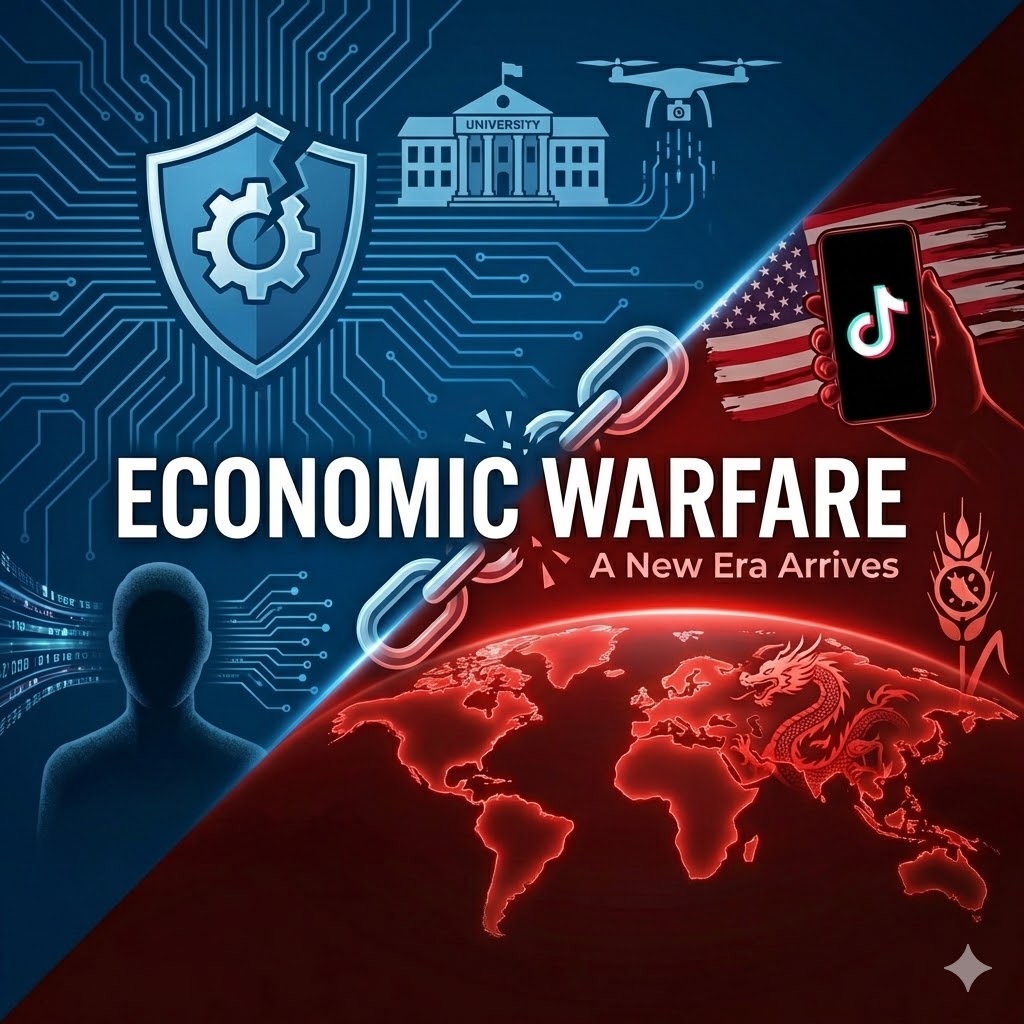
A New Era of Economic Warfare Arrives

Is Your Company Prepared?

LAST UPDATED: January 9, 2026 at 3:55PM
A New Era of Economic Warfare Arrives

GUEST POST from Art Inteligencia

Economic warfare rarely announces itself. It embeds quietly into systems designed for trust, openness, and speed. By the time damage becomes visible, advantage has already shifted.

This new era of conflict is not defined by tanks or tariffs alone, but by the strategic exploitation of interdependence — where innovation ecosystems, supply chains, data flows, and cultural platforms become contested terrain.

The most effective economic attacks do not destroy systems outright. They drain them slowly enough to avoid response.

Weaponizing Openness

For decades, the United States has benefited from a research and innovation model grounded in openness, collaboration, and academic freedom. Those same qualities, however, have been repeatedly exploited.

Publicly documented prosecutions, investigations, and corporate disclosures describe coordinated efforts to extract intellectual property from American universities, national laboratories, and private companies through undisclosed affiliations, parallel research pipelines, and cyber-enabled theft.

This is not opportunistic theft. It is strategic harvesting.

When innovation can be copied faster than it can be created, openness becomes a liability instead of a strength.

Cyber Persistence as Economic Strategy

Cyber operations today prioritize persistence over spectacle. Continuous access to sensitive systems allows competitors to shortcut development cycles, underprice rivals, and anticipate strategic moves.

The goal is not disruption — it is advantage.

Skydio and Supply Chain Chokepoints

The experience of American drone manufacturer Skydio illustrates how economic pressure can be applied without direct confrontation.

After achieving leadership through autonomy and software-driven innovation rather than low-cost manufacturing, Skydio encountered pressure through access constraints tied to upstream supply chains.

This was a calculated attack on a successful American business. It serves as a stark reminder: if you depend on a potential adversary for your components, your success is only permitted as long as it doesn’t challenge their dominance. We must decouple our innovation from external control, or we will remain permanently vulnerable.

When supply chains are weaponized, markets no longer reward the best ideas — only the most protected ones.

Agricultural and Biological Vulnerabilities

Incidents involving the unauthorized movement of biological materials related to agriculture and bioscience highlight a critical blind spot. Food systems are economic infrastructure.

Crop blight, livestock disease, and agricultural disruption do not need to be dramatic to be devastating. They only need to be targeted, deniable, and difficult to attribute.

Pandemics and Systemic Shock

The origins of COVID-19 remain contested, with investigations examining both natural spillover and laboratory-associated scenarios. From an economic warfare perspective, attribution matters less than exposure.

The pandemic revealed how research opacity, delayed disclosure, and global interdependence can cascade into economic devastation on a scale rivaling major wars.

Resilience must be designed for uncertainty, not certainty.

The Attention Economy as Strategic Terrain and Algorithmic Narcotic

Platforms such as TikTok represent a new form of economic influence: large-scale behavioral shaping.

Regulatory and academic concerns focus on data governance, algorithmic amplification, and the psychological impact on youth attention, agency, and civic engagement.

TikTok is not just a social media app; it is a cognitive weapon. In China, the algorithm pushes “Douyin” users toward educational content, engineering, and national achievement. In America, the algorithm pushes our youth toward mindless consumption, social fragmentation, and addictive cycles that weaken the mental resilience of the next generation. This is an intentional weakening of our human capital. By controlling the narrative and the attention of 170 million Americans, American children are part of a massive experiment in psychological warfare, designed to ensure that the next generation of Americans is too distracted to lead and too divided to innovate.

Whether intentional or emergent, influence over attention increasingly translates into long-term economic leverage.

The Human Cost of Invisible Conflict

Economic warfare succeeds because its consequences unfold slowly: hollowed industries, lost startups, diminished trust, and weakened social cohesion.

True resilience is not built by reacting to attacks, but by redesigning systems so exploitation becomes expensive and contribution becomes the easiest path forward.

Conclusion

This is not a call for isolation or paranoia. It is a call for strategic maturity.

Openness without safeguards is not virtue — it is exposure. Innovation without resilience is not leadership — it is extraction.

The era of complacency must end. We must treat economic security as national security. This means securing our universities, diversifying our supply chains, and demanding transparency in our digital and biological interactions. We have the power to stoke our own innovation bonfire, but only if we are willing to protect it from those who wish to extinguish it.

The next era of competition will reward nations and companies that design systems where trust is earned, reciprocity is enforced, and long-term value creation is protected.

Frequently Asked Questions

What is economic warfare?

Economic warfare refers to the use of non-military tools — such as intellectual property extraction, cyber operations, supply chain control, and influence platforms — to weaken a rival’s economic position and long-term competitiveness.

Is China the only country using these tactics?

No. Many nations engage in forms of economic competition that blur into coercion. The concern highlighted here is about scale, coordination, and the systematic exploitation of open systems.

How should the United States respond?

By strengthening resilience rather than retreating from openness — protecting critical research, diversifying supply chains, aligning innovation policy with national strategy, and designing systems that reward contribution over extraction.

How should your company protect itself?

Companies should identify their critical knowledge assets, limit unnecessary exposure, diversify suppliers, strengthen cybersecurity, enforce disclosure and governance standards, and design partnerships that balance collaboration with protection. Resilience should be treated as a strategic capability, not a compliance exercise.

Image credits: Google Gemini

Subscribe to Human-Centered Change & Innovation WeeklySign up here to get Human-Centered Change & Innovation Weekly delivered to your inbox every week.

Is China Our New Sputnik Moment?

Is China Our New Sputnik Moment?

GUEST POST from Greg Satell

When the Soviets launched Sputnik, the first space satellite, into orbit in 1957, it was a wake-up call for America. Over the next year, President Eisenhower would sign the National Defense Education Act to spur science education, increase funding for research and establish NASA and DARPA to spur innovation.

A few years ago, a report by the Council on Foreign Relations (CFR) argued that we are at a similar point today, but with China. While we have been steadily decreasing federal investment in R&D over the past few decades, our Asian rival has been ramping up and now threatens our leadership in key technologies such as AI, genomics and quantum information technology.

Clearly, we need to increase our commitment to science and innovation and that means increasing financial investment. However, what the report makes clear is that money alone won’t solve the problem. We are, in several important ways, actually undermining our ability to innovate, now and in the future. We need to renew our culture of innovation in America.

Educating And Attracting Talent

The foundation of an innovation economy is education, especially in STEM subjects. Historically, America has been the world’s best educated workforce, but more recently we’ve fallen to fifth among OECD countries for post-secondary education. That’s alarming and something we will certainly need to reverse if we are to compete effectively.

Our educational descent can be attributed to three major causes. First, the rest of the world has become more educated, so the competition has become stiffer. Second, is financing. Tuition has nearly tripled in the last decade and student debt has become so onerous that it now takes about 20 years to pay off four years for college. Third, we need to work harder to attract talented people to the United States.

The CFR report recommends developing a “21st century National Defense Education Act” to create scholarships in STEM areas and making it easier for foreign students to get Green Cards when they graduate from our universities. It also points out that we need to work harder to attract foreign talent, especially in high impact areas like AI, genomics and quantum computing.

Unfortunately, we seem to be going the other way. The number of international students to American universities is declining. Policies like the muslim ban and concerns about gun violence are deterring scientific talent coming here. The denial rate for those on H1-B visas has increased from 4% in 2016 to 18% in the first quarter of 2019.

Throughout our history, it has been our openness to new people and new ideas that has made America exceptional. It’s a legitimate question whether that’s still true.

Building Technology Ecosystems

In the 1980s, the US semiconductor industry was on the ropes. Due to increased competition from low-cost Japanese manufacturers, American market share in the DRAM market fell from 70% to 20%. The situation not only had a significant economic impact, there were also important national security implications.

The federal government responded with two initiatives, the Semiconductor Research Corporation and SEMATECH, both of which were nonprofit consortiums that involved government, academia and industry. By the 1990s. American semiconductor manufacturers were thriving again.

Today, we have similar challenges with rare earth elements, battery technology and many manufacturing areas. The Obama administration responded by building similar consortiums to those that were established for semiconductors: The Critical Materials Institute for rare earth elements, JCESR for advanced batteries and the 14 separate Manufacturing Institutes.

Yet here again, we seem to be backsliding. The current administration has sought to slash funding for the Manufacturing Extension Partnership that supports small and medium sized producers. An addendum to the CFR report also points out that the administration has pushed for a 30% cut in funding for the national labs, which support much of the advanced science critical to driving American technology forward.

Supporting International Trade and Alliances

Another historical strength of the US economy has been our open approach to trade. The CFR report points out that our role as a “central node in a global network of research and development,” gave us numerous advantages, such as access to foreign talent at R&D centers overseas, investment into US industry and cooperative responses to global challenges.

However, the report warns that “the Trump administration’s indiscriminate use of tariffs against China, as well as partners and allies, will harm U.S. innovative capabilities.” It also faults the Trump administration for pulling out of the Trans-Pacific Partnership trade agreement, which would have bolstered our relationship with Asian partners and increased our leverage over China.

The tariffs undermine American industry in two ways. First, because many of the tariffs are on intermediate goods which US firms use to make products for export, we’re undermining our own competitive position, especially in manufacturing. Second, because trade partners such as Canada and the EU have retaliated against our tariffs, our position is weakened further.

Clearly, we compete in an ecosystem driven world in which power does not come from the top, but emanates from the center. Traditionally, America has positioned itself at the center of ecosystems by constantly connecting out. Now that process seems to have reversed itself and we are extremely vulnerable to others, such as China, filling the void.

We Need to Stop Killing Innovation in America

The CFR report, whose task force included such luminaries as Admiral William McRaven, former Google CEO Eric Schmidt and economist Laura Tyson, should set alarm bells ringing. Although the report was focused on national security issues, it pertains to general competitiveness just as well and the picture it paints is fairly bleak.

After World War II, America stood almost alone in the world in terms of production capacity. Through smart policy, we were able to transform that initial advantage into long-term technological superiority. Today, however we have stiff competition in areas ranging from AI to synthetic biology to quantum systems.

At the same time, we seem to be doing everything we can to kill innovation in America. Instead of working to educate and attract the world’s best talent, we’re making it harder for Americans to attain higher education and for top foreign talent to come and work here. Instead of ramping up our science and technology programs, presidential budgets regular recommend cutting them. Instead of pulling our allies closer, we are pushing them away.

To be clear, America is still at the forefront of science and technology, vying for leadership in every conceivable area. However, as global competition heats up and we need to be redoubling our efforts, we seem to be doing just the opposite. The truth is that our prosperity is not a birthright to which we are entitled, but a legacy that must be lived up to.

— Article courtesy of the Digital Tonto blog
— Image credit: Pixabay

Subscribe to Human-Centered Change & Innovation WeeklySign up here to join 17,000+ leaders getting Human-Centered Change & Innovation Weekly delivered to their inbox every week.

Changing Business Models Around

Changing Business Models AroundSome business models and products have been around so long that we just take them for granted, while others concepts that are becoming new business models are so new that we’re not quite sure what to expect. It is probably easiest to explain what I mean and why this juxtaposition is important by looking at a few examples. Most of these examples involve challenging our orthodoxies.

1. Coffee Shops

In the typical coffee shop pretty much anywhere in the world, the business model works like this – you buy a coffee and it comes along with it the right to take up a place at any table in the café for as long as you want. So, coffee buys you time. An article I came across on NPR highlights an entrepreneur in Moscow that has opened a restaurant that loosely translates to the Clockface Café where instead of buying coffee and getting time, you instead buy time ($4/hr per person for the 1st hour and $2 an hour after that, up to a maximum of $12 after 5 hours) and get coffee for free. Ivan Meetin, the founder, plans to open his next café in London. Meanwhile I have heard of similar operations in Paris, and by now they can probably also be found elsewhere. So, in your business what do people get for free, and what do they pay for? And is there an opportunity to change around what you charge for?

2. Waste Disposal

In many businesses, and in the creation of most products, there is waste. And in most cases, businesses pay to have this waste removed from their premises. Or there may be waste that the customer has to pay to have removed. But this doesn’t always have to be the case.

KFC, McDonald’s, Burger King, etc. used to have to pay to have their used fryer oil picked up, but now thanks to the rise of biodiesel they may even make money from this waste product.

Chicken FeetChicken processors used to throw the feet away after processing a truckload of chickens, but after they discovered that chicken feet are a delicacy in several Asian countries, they stopped throwing them away and instead started exporting them. In fact, chicken feet sell for more per pound than chicken breasts in China.


Broken OREO’s used to have no value before Cookies ‘n’ Cream ice cream (and now Cookies ‘n’ Cream OREO’s) were discovered.

And finally, I came across an example of a bottle cap concept created by designers from the Lanzhou University of Technology in China, intended to give poor children access to building blocks for play, from what was previously thrown away.

Building Caps

3. Discounts for Data

Data security and privacy is becoming an increasingly hot topic, and in the past companies would either ask customers for their data and not give them anything for it, or just not ask for it. But now we are seeing some interesting models of companies asking customers for data and instead giving them something of value in exchange. For example, Urban Outfitters rewards users that respond to promotions inside their mobile app or to users that allow its app to connect to their Twitter or Instagram accounts with points that can be redeemed for sale previews, concert tickets, or early access to new pieces. What data do you want from your customers? What is it worth to you? How could this exchange be made engaging and not be seen as a purely financial transaction?

4. The Soft Drink Category is Saturated and Cold

Soft drinks… How many people out there think that the soft drink category is a blue ocean full of incredible opportunities for unbounded growth for established soft drink makers? Most people would say that this is a mature category and a tough place for companies, full of merciless competition. But yet, people continue to innovate and challenge this orthodoxy. Witness a couple of interesting new concepts.

Shericks ShakesBritain has always been a hotbed of innovation, and the country that brought us Pret a Manger and Innocent smoothies brings us this tasty treat. Mr. Sherick’s Shakes brings people a little bit of luxury to their day in the form of their high quality milkshakes.

Meanwhile in Japan, there is a growing trend manifesting in a wave of product launches in the soft drink category that are not cold, but instead hot. Witness this example of what has always been a cold drink, Ginger Ale, being brought into the Japanese market as a hot beverage by Coca Cola’s Canada Dry unit.

Canada Dry Hot Ginger AlePeople always love something new and different, even if it is something old that has disappeared from the market. This is why fashion runs in cycles, and in a mature category like soft drinks there is no reason why we shouldn’t keep these principles in mind and see if now is the time to bring something back, or to see if there is an orthodoxy that we shouldn’t now look at challenging to see if an opportunity might not be created.
Conclusion

Innovation transforms the useful seeds of invention into widely adopted solutions valued above every existing alternative. Value comes not just from physical invention, or business model innovation, but from psychological and emotional benefits as well and the creation of new psychological or emotional value can happen in any industry at any point in time, no matter how mature the category seems to be. We as humans are strange creatures and we simultaneously fight against change (and hold back innovation as a result) and embrace new things (or at least like to try them). So challenge your patterns of accepted thinking to look for opportunity and work to overcome your beliefs that everything that could be done has been done in your industry.

Keep innovating!


Build a common language of innovation on your team

Subscribe to Human-Centered Change & Innovation WeeklySign up here to get Human-Centered Change & Innovation Weekly delivered to your inbox every week.