Tag Archives: project management

Planning to Spread

We’ve all seen the viral videos that seemingly come out of nowhere to garner millions of views on YouTube, videos like this one where five people play one guitar singing Gotye’s “Somebody That I Used to Know”, which as of this date has garnered more than 163 million video views:

And if you add up all of the other postings of this same video, the total number of video views goes much, much higher.

Now, surely Gotye’s version of the song couldn’t have possibly garnered more views than this viral sensation that Walk Off the Earth’s cover created, could it?

Um, actually it did. To date Gotye’s official video has captured nearly 600 million video views, or nearly FIVE TIMES as many video views. So, it hasn’t turned out all bad for Gotye.

Now you might ask yourself, how could the huge success of the Walk Off the Earth viral campaign be trumped by traditional marketing if viral marketing is supposed to be the silver bullet?

Well, the truth is that whether you pursue traditional marketing and advertising or supposedly “viral” marketing activities, the goals are the same:

  1. Awareness
  2. Interest
  3. Desire
  4. Action

And it is within that first bullet point, that you find the viral component that any marketing activity or any evangelism activity (for innovation, for change, etc.) should always contain – spreadability.

Now, WordPress doesn’t seem to think that spreadability is a word, but let’s assume for a moment that it is and focus on the fact that most of the time, one of your goals in business (and your personal life) is spreadability. Ultimately, in many cases, success is determined by whether or not you can get your idea to spread.

This is true whether we are talking about an IT project, a Six Sigma continuous improvement effort, a change initiative, a Lean event, a marketing campaign, or a project commercializing an invention into a potential innovation.

So, can anyone guarantee that an idea or marketing campaign will spread?

The short answer is no.

Sorry, I wish I had better news for you, but the fact is that nobody can guarantee that your idea or your marketing campaign will go viral. Why?

You’re dealing with humans living in a complicated world. We’re not all built the same and the same person can have different reactions to the same stimulus (driven by mood and context among other things). This can result in a perfectly spreadable idea or message being stopped dead in its tracks, depriving you of all of the potential downstream sharing that you might have been hoping for or counting on.

Sorry, you can’t guarantee spreadability, despite what opportunistic marketing consultants claiming to know the magic formula might tell you.

Spreading ChangeBut, an idea can be built to spread.

And I’d like to share with you a simple framework, for free, that you can download and spread far and wide.

Click here to download the “Planning to Spread” starter worksheet as a PDF.

It’s based on the same priniciples as mind mapping and it will help you start either with a particular node in mind (someone you’d like to reach and influence) and work backwards, identifying both how to evolve your idea to best influence that particular node, and how you might be able to reach them (at the same time). Or you can work from the idea outwards. Focusing primarily on the WHO and the WHY as you move outward.

The key questions to consider as you are “Planning to Spread” your idea are the following:

  1. What is your idea or message? (Does it resonate with my target audience?)
  2. Who are you trying to reach?
  3. How will you reach them?
    • When will they be most receptive to the message or idea?
    • Where will they be most receptive to the message or idea?
  4. Why will they engage? (What value will they get?)
  5. Why will they share? (What value will they derive?)
  6. How will they share?

Working your way thoughtfully through these questions will increase the chances that your idea or message will spread, but they won’t guarantee it. Going through the process however will help you refine your idea or message, help you think through the mechanics of how you might encourage and increase engagement, and may even help you uncover flaws in your idea or message that you missed (and give you a chance to fix them).
Planning to Spread WorksheetHappy spreading!
(and please let me know in the comments below any things I might have missed)

So what am I trying to spread?

Well, in the run up to my second book (this time focusing on the best practices and next practices of organizational change), soon I will be releasing a new collaborative, visual change planning toolkit to help organizations work smarter by planning their change initiatives (and projects) in a less overwhelming, more human way that will help get everyone literally on the same page.

This is the idea that I will be spreading and there are many ways that you can benefit.

One way is by becoming a case study volunteer. I’m looking to select a handful of companies to teach how to use the toolkit for free and feature their experience in my next book on the best practices and next practices of organizational change. If you would like to get a jump on the competition by increasing your speed of change (and your ability to work smarter), register your interest here.

But there are several other ways you can benefit, and all of them can be found here (including upcoming chances for consultants to train on the methodology and boost their revenue and success as they work with their clients around the world to deliver positive change). I’ll be focusing on teaching and tools, not consulting.

What message or idea are you trying to spread?

Accelerate your change and transformation success

Subscribe to Human-Centered Change & Innovation WeeklySign up here to get Human-Centered Change & Innovation Weekly delivered to your inbox every week.
Innovation Keynote and Change Planning Workshop Special

January Innovation and Change Planning Toolkit Special

To kickoff January with a bang I thought I would make a special offer to companies and event organizers who would like to get an excellent innovation keynote for their company or event attendees AND get a jump on your competitors by getting trained on how to use my new collaborative, visual change planning toolkit before they do.

This will be a great way to help innovation, change and project managers build strong momentum and results early in 2015.

Here is the offer:

Stoking Your Innovation BonfireBook me between January 21 and March 31, 2015 for either a:

  • 60-90 minute Innovation Keynote
  • 2-4 hour Innovation Workshop
  • 1 Day Innovation Masterclass

… and your attendees will at no additional charge:

  1. Be one of the first groups to get their hands on my revolutionary collaborative, visual change planning toolkit
  2. Get a 1 Day Workshop focused on organizational change and how to use the change planning toolkit

Buy an innovation keynote and get a full-day change planning toolkit workshop for free!

What could be better than that?

Book Braden Kelley for your event

P.S. If you missed my recent webinar ‘Innovation is All About Change’, click here and use PASSCODE 1515 to access the FREE recording (link expired).


Accelerate your change and transformation success

Subscribe to Human-Centered Change & Innovation WeeklySign up here to get Human-Centered Change & Innovation Weekly delivered to your inbox every week.
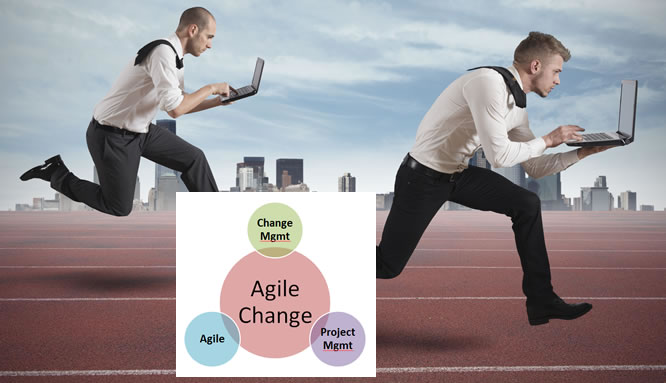
Agile Change Management is Coming

Agile Change Management

How fast is your organization capable of changing to continue to remain relevant and successful in the marketplace?

The world is changing at an accelerating pace as new technologies are discovered, developed, released and adopted by consumers faster than ever before. At the same time companies are rising to global scale faster and large, successful companies are disappearing faster too.

In this new reality that we all face, organizations of all types are going to need to:

  • Change how they change
  • Increase their organizational agility
  • Increase the flexibility of the organization
  • Become capable of continuous change
  • Inhibit the appearance and/or growth of change gaps that can doom your company

It is because of this tidal wave of change and a recognition that there is a need in the marketplace for more human change processes and tools that make change seem less overwhelming, that my next book for Palgrave Macmillan will focus on the best practices and next practices of organizational change (aka change management), and I’ve developed a new collaborative, visual change planning toolkit to go with it (but more about that later).

One way to do all of the items in the bulleted list above is to take more of an agile approach to change, to adopt some of the values and principles of the Agile Software Development methodology and use those to create a set of what could be described as Agile behaviors within the organization. If you are not familiar with the Agile Software Development methodology, I have included below the Agile Software Development Manifesto from http://agilemanifesto.org that details the values and principles of Agile Software Development. As you read through the manifesto I hope you’ll see that the values and principles can easily be applied to other endeavors outside of software development, whether that might in the project management discipline of your organization, or within your larger change initiatives.

Manifesto for Agile Software Development

We are uncovering better ways of developing software by doing it and helping others do it.

Through this work we have come to value:

  1. Individuals and interactions over processes and tools
  2. Working software over comprehensive documentation
  3. Customer collaboration over contract negotiation
  4. Responding to change over following a plan

That is, while there is value in the items on the right, we value the items in bold more.

Principles behind the Agile Manifesto

We follow these principles:

  • Our highest priority is to satisfy the customer through early and continuous delivery of valuable software.
  • Welcome changing requirements, even late in development. Agile processes harness change for the customer’s competitive advantage.
  • Deliver working software frequently, from a couple of weeks to a couple of months, with a preference to the shorter timescale.
  • Business people and developers must work together daily throughout the project.
  • Build projects around motivated individuals. Give them the environment and support they need, and trust them to get the job done.
  • The most efficient and effective method of conveying information to and within a development team is face-to-face conversation.
  • Working software is the primary measure of progress.
  • Agile processes promote sustainable development. The sponsors, developers, and users should be able to maintain a constant pace indefinitely.
  • Continuous attention to technical excellence and good design enhances agility.
  • Simplicity–the art of maximizing the amount of work not done–is essential.
  • The best architectures, requirements, and designs emerge from self-organizing teams.
  • At regular intervals, the team reflects on how to become more effective, then tunes and adjusts its behavior accordingly.

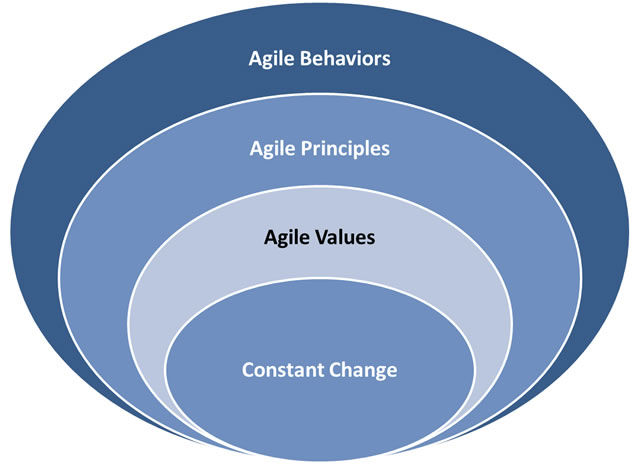
Agile and Constant Change

FIGURE 1

You will see in FIGURE 1 that constant change sits at the center, Agile Values providing the initial direction for an organization with a committed goal of becoming more agile. Radiating out from Agile Values as we pursue success in coping with constant change will be our Agile Principles. But, ultimately we can’t live our values or follow our principles if we don’t exhibit behaviors that personify those values and principles. Unless our organizations begin to behave in a more agile way then the potential of truly becoming more agile will remain just words, and go largely unfulfilled.

It is because of the challenge of behaving in a new way that I encourage all of your to make a move towards a formal pursuit of organizational agility. To help you in this pursuit, I will soon be releasing my brand new collaborative, visual change planning toolkit for companies to use on their own (with free training for a select few who agree to use it and document their experience for the book). In addition I will be launching separate training for consultants so they can use the tools with clients in their change management and project management practices. Please register your interest here.

Using this new set of change planning and execution tools and processes will not only make change seem less overwhelming, but it will also help you build alignment behind your effort, help you work through as a group how to LITERALLY all get on the same page for change, and create a more agile organization as adoption of the tools spreads.

Stay tuned for more great change content coming soon!

In the meantime, check out the different ways to get involved.


Accelerate your change and transformation success


SPECIAL BONUS: You can now access my latest webinar ‘Innovation is All About Change’ compliments of CoDev with passcode 1515 (link expired)


Subscribe to Human-Centered Change & Innovation WeeklySign up here to get Human-Centered Change & Innovation Weekly delivered to your inbox every week.