
Tag Archives: pause

Your Ability to Innovate Determined By Your Ability to Pause

Your Ability to Innovate Determined By Your Ability to Pause

GUEST POST from Janet Sernack

Many of my coaching clients have recently shared their struggles with feeling tired, emotionally overwhelmed, and cognitively overloaded and are close to burnout.  They attribute these issues to the pervasive and addictive nature of technology, exacerbated by the pandemic and divisive global conflicts, accelerating change and the rise of AI and hybrid work. As a result, many have retreated and frozen into a state of habitual, reactive ‘busyness.’ This affects their overall emotional, physical, and mental health and wellness. It also inhibits their ability to focus, create, invent and innovate and restricts their optimism, hope, and positivity about their future in an unstable and uncertain world.

The Coaching Opportunity

Coaching creates a unique opportunity to partner with people to develop their pause-power to identify the transformative actions to reverse this pervasive phenomenon to flourish in a world of unknowns.

A coaching session usually serves as a first step towards cultivating the pause-power needed to stop, observe, reflect and take valuable time out to rest, replenish, re-energize and reboot. This allows people to courageously notice, attune to, and express their true feelings and thoughts, to disrupt, dispute and deviate them to develop the pause-power required to heal and provide relief, hope and optimism for a better future.

Everyone must cultivate intentional pause-power to empower them to observe and understand their inner and outer worlds. This practice helps them remove distractions, stop multitasking, and break free from the ‘busyness’ that depletes their cognitive, emotional, and visceral resources, putting them in the driver’s seat of their mental and emotional well-being.

Self-reflection and reflective practice become potent tools, enabling people to move away from reactivity and short-term focus and towards taking the transformative actions to adapt, create, invent, and innovate. 

Hitting Your Pause Button

Being adaptive, creative, inventive and innovative involves consciously taking your hands off the controls and encouraging yourself and others to notice and disrupt your habitual and addictive ‘busyness’ (time scarcity + task focus).

This awareness is the first step towards reclaiming your focus and attention so that you can engage with and interpret the modern world rather than try to control it or withdraw from it.

Being willing to take a break and hit the ‘pause button’ stops your continuous cycle of doing. It focuses your attention on breaking limiting beliefs or unresourceful patterns and provides a support structure for applying rigorous perception practices to our daily lives.

Using pause-power to create a place, as recently described by Otto Scharmer from the Presencing Institute:

 “Between action and non-action, there is a place. A portal into the unknown. But what are we each called to contribute to the vision of the emerging future? Perhaps these times are simply doorways into the heart of the storm, a necessary journey through the cycles of time required to create change”.

What Does Pause-Power Involve?

A pause is created when you suspend activity, a time of temporary disengagement when you no longer move towards any goal. It can occur amid almost any activity and can last for an instant by taking a deep breath to get grounded, for minutes to become mindful or to take a rest, for hours to enjoy a well-deserved break, or for years to experience life in a different culture or place.

Intentionally pausing enables you to take time between your range of habitual, largely unconscious reactive responses; it helps our brain’s executive function utilize the valuable ‘empty spaces’ between stimulus and response and between different ideas. It creates a space open to options and choices for being, thinking and acting differently.

Doing this allows you to notice and disrupt unresourceful and habitual auto ‘stimulus-response’ default patterns, which usually occur when things go wrong, you make a mistake and fail, or you dive into blaming, shaming or avoiding others as part of our naturally wired defence mechanisms.

Radical Acceptance

Learning to pause is one of the critical steps in innovation because it helps you initiate a practice of radical acceptance. This requires embracing uncertainty, or ‘what is’ truly happening in the present moment, relationship, or situation, by accepting things just as they are. 

“During the moments of a pause, we become conscious of how the feeling that something is missing or wrong keeps us leaning into the future, on our way somewhere else. This gives us a fundamental choice in how we respond: We can continue our futile attempts at managing our experience or meet our vulnerability with the wisdom of Radical Acceptance”.

By being willing to dive into an ‘empty space’ from an emergent process, you can unleash possibilities, opportunities, options, and choices towards identifying the transformative actions that create your desired future.  

People who can artfully and skillfully facilitate creative conversations that funnel pause power and co-create valuable ‘empty spaces’ to occur can generate our imagination and curiosity to manifest glorious moments of insights required to emerge creative ideas.  

Pausing also enables you to observe, pay attention, notice, and regulate how your overall nervous system impacts and manages your brain’s functions. This is key to being practical, resourceful, healthy, and productive in the face of volatility, complexity, uncertainty, and accelerating change in our hyper-connected world.  

It also needs rest to do this. By applying our pause-power and giving ourselves some rest, we offer our bodies, hearts, and minds a chance to recharge, keep moving, and work towards taking the transformative actions required to build better workplaces and flourishing futures.

A Valuable Toolkit and Habit

This skill is valuable for everyone to reflect upon, cultivate and master. It is initiated by intentionally stopping by hitting an invisible cognitive ‘pause button’ to observe, pay attention, notice your inner experience, and see yourself as the cause of it.

Developing pause power involves six simple vital steps and questions:

1.Retreat from reacting to the situation – by stepping back into the present moment or time to notice, be with, allow, accept (radical acceptance), and acknowledge ‘what is’ going on internally and externally, and be willing to name it with detachment and discernment.

What is going on for me right now – how am I feeling about it?

2. Step up and out to disrupt yourself and create an opening, doorway, threshold, or empty space – to allow something new to emerge.

What can I learn from this situation?

3. Step up and out to disrupt yourself and create an opening, doorway, threshold, or empty space – to allow something new to emerge.

What can I learn from this situation?

4. Be willing to introduce and explore options and choices that allow you to deviate and refocus your attention on what really matters – taking a rest, having a holiday, completing a project, being a better person, getting a new job, or getting a promotion.

What are some of my options for change?

5. Be inquisitive, curious and open to reimagining, reinventing, and pivoting – an intention, mindset, behaviour, task, goal, or business focus to re-plenish, re-energize, re-engage and re-boot to mobilize yourself.   

How might I feel, think or act differently to achieve my outcome?

6. Step out into the system’s edges – by being calm, hopeful and optimistic, to identify the transformative actions required to move towards and exploring new creative, inventive and innovative solutions for providing value in ways people appreciate and cherish.

What will I do next?

Engaging in a Looking Lab

As many of our ImagineNation community members know, I am currently writing a book on ‘Being Innovative.’ There is a whole chapter on developing pause power to help people engage what Christian Madsbjerg calls in his latest book “Look: How to Pay Attention in a Distracted World” (Riverhead Books) – a Looking Lab, to:

“Get away from your screens, turn off your notifications, go out into the wilds of reality, and look around. Let go of all filters—clichés, conventions, colour corrections, whatever they may be. Try to pay attention to the simple act of seeing.”

He reveals that “if we choose to look for them, there are invisible worlds all around us ready to reveal their magic. The seemingly mundane or average can appear extraordinary, but only if we take the time to notice and see it”.

This is a vital part of our remarkable human capacity to transform through the slow, patient act of observing, attending, noticing, replenishing, re-energizing, re-engaging, and re-booting to take the transformative actions that will help you make the world a better place and achieve your 21st-century growth and success differently.

Please find out more about our work at ImagineNation™.

Please find out about our collective learning products and tools, including The Coach for Innovators, Leaders, and Teams Certified Program, presented by Janet Sernack, it is a collaborative, intimate, and profoundly personalised innovation coaching and learning program supported by a global group of peers over 9-weeks, and can be customised as a bespoke corporate learning program.

It is a blended and transformational change and learning program that will give you a deep understanding of the language, principles, and applications of an ecosystem focus, human-centric approach, and emergent structure (Theory U) to innovation, and upskill people and teams and develop their future fitness, within your unique innovation context. Please find out more about our products and tools.

Image Credit: Pixabay

Subscribe to Human-Centered Change & Innovation WeeklySign up here to join 17,000+ leaders getting Human-Centered Change & Innovation Weekly delivered to their inbox every week.
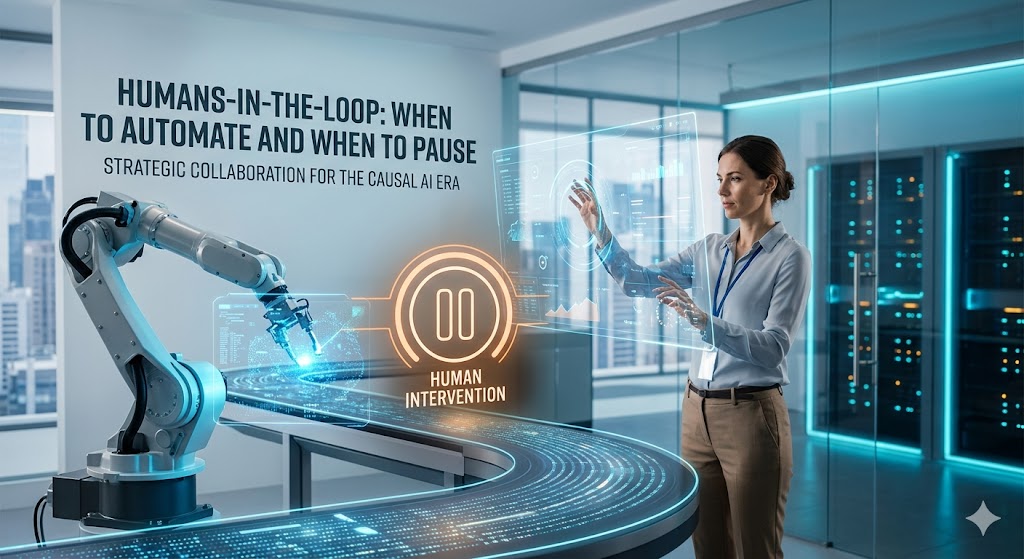
Humans-in-the-Loop

When to Automate and When to Pause

LAST UPDATED: March 24, 2026 at 4:57 PM

Humans-in-the-Loop

GUEST POST from Art Inteligencia


The Efficiency Trap: Why Full Automation Isn’t Always the Goal

In the relentless pursuit of digital transformation, many organizations fall into the trap of equating “automated” with “optimized.” However, a truly human-centered approach recognizes that automation should serve to enhance human potential, not merely replace it. When we automate without empathy, we risk creating rigid systems that lack the agility to handle the nuances of the real world.

The Myth of “Set It and Forget It”

The allure of “lights-out” operations often leads to organizational decay. When processes are fully removed from human oversight, we see a rapid decline in institutional knowledge. If the system fails or the market shifts, the team no longer possesses the muscle memory or the foundational understanding to intervene effectively. Full automation can inadvertently create a “black box” that stifles long-term innovation and leaves the organization vulnerable to disruption.

Technical Uptime vs. Emotional Resonance

Traditionally, IT and operations have measured success through technical uptime and processing speed. But in a Causal AI era, these binary metrics are insufficient. We must shift our focus toward Experience Level Measures (XLMs). A system may be “up” 99.9% of the time, but if the 0.1% failure occurs during a high-stakes customer crisis, the emotional resonance of that failure outweighs a thousand successful automated transactions. We must measure the cognitive load and emotional impact our systems place on both employees and customers.

Defining the “Friction Paradox”

Modern UX design often obsesses over “frictionless” experiences. Yet, in high-stakes environments — such as healthcare, financial pivoting, or ethical AI deployment — friction is a critical safety feature. Strategic friction forces a “Strategic Pause,” requiring a human to validate a decision before it becomes irreversible. By intentionally designing these moments of pause, we protect the organization from “experience leakage” and ensure that our automated outputs align with our deeper human values.

“Innovation is not about the tools we use, but the human problems we solve with them. If automation removes the humanity from the solution, it isn’t progress — it’s just a faster way to fail.” — Braden Kelley

The Strategic Pause: Identifying “Human-Critical” Junctions

In the drive for organizational agility, the most sophisticated tool at our disposal isn’t a faster algorithm — it’s the Strategic Pause. This is the intentional design of “speed bumps” in an automated workflow where human empathy, ethics, and causal reasoning are non-negotiable. By identifying these junctions, we prevent the “experience leakage” that occurs when automated systems hit a wall of human complexity they aren’t equipped to climb.

High-Empathy Moments: When Digital Feels Hollow

Every customer journey has “make-or-break” moments where the emotional stakes are high. In these scenarios, a perfectly executed automated response can feel dismissive or even cold. Whether it’s a service failure, a complex medical inquiry, or a significant financial transition, these High-Empathy Moments require the nuance of human tone and the flexibility of human judgment. Automation should flag these moments and hand them off to a person, ensuring the customer feels heard, not just processed.

Causal Complexity: Moving Beyond Correlation

Predictive AI is excellent at telling us what is likely to happen based on historical patterns, but it struggle with the why. Causal AI begins to bridge this gap, yet it still requires a human-in-the-loop to interpret intent. When a data trend deviates from the norm, a Strategic Pause allows a human strategist to ask: “Is this a shift in market sentiment, or a data anomaly?” Humans provide the context that turns raw data into actionable innovation strategy.

The Ethical Override: Establishing “Red Flag” Scenarios

Automation operates on logic; humans operate on values. We must establish Ethical Overrides — hard-coded triggers that pause an automated process the moment it touches upon sensitive territory. This includes bias detection in hiring algorithms, safety protocols in physical automation, or privacy concerns in data harvesting. A human-centered approach ensures that if a system cannot guarantee an ethical outcome, it must yield to a human operator who can be held accountable.

Designing for Intervention

A Strategic Pause is only effective if the human stepping in has the Psychological Safety and the tools to act. We must design our systems so that “pausing the machine” is seen as a proactive save rather than a technical failure. This requires clear interfaces that present the human with the necessary context — the Experience Level Measures (XLMs) — to make an informed decision quickly and confidently.

III. Designing the “Loop”: Frameworks for Collaboration

To move beyond simple task automation, we must architect a Collaborative Intelligence model. This isn’t about humans managing machines or machines replacing humans; it’s about a symbiotic loop where each party plays to its strengths. By designing the “loop” with intentionality, we ensure that digital transformation remains a human-centric endeavor rather than a purely technical one.

From Autopilot to Co-Pilot: Empowering the Workforce

The transition from “Autopilot” (where the system acts independently) to “Co-Pilot” (where the system assists) is a fundamental shift in organizational agility. A co-pilot interface must provide transparency — showing not just the output, but the rationale. When a human understands the “why” behind an AI’s suggestion, they can validate, refine, or override it based on real-time environmental context that the sensor or algorithm might miss. This maintains the human’s role as the ultimate strategist.

Experience Level Measures (XLMs) in Automation

Standard KPIs like “time-to-complete” are blind to the human experience. To truly understand if a collaborative loop is working, we must implement Experience Level Measures (XLMs). We should be asking:

  • Does this automation reduce cognitive load or merely shift it elsewhere?
  • Is the human-machine handoff seamless, or does it create a “context cliff” where the human feels lost?
  • Does the system provide enough psychological safety for a worker to challenge an automated decision?

Measuring these qualitative impacts is the only way to prevent burnout and ensure long-term adoption.

The Innovation Role Alignment

Not every person interacts with automation in the same way. By applying a structured framework of Innovation Roles (Braden Kelley’s Nine Innovation Roles is the best one), we can optimize the loop:

  • The Magic Maker: Uses automated tools to rapidly prototype and visualize “what if” scenarios, turning raw data into compelling narratives.
  • The Conscript: Provides the essential “ground truth” feedback, ensuring that the automated workflows actually function in the messy reality of day-to-day operations.
  • The Revolutionary: Acts as the ethical compass, reviewing the “Strategic Pauses” to ensure the system’s trajectory remains aligned with organizational values.

The Continuous Feedback Cycle

The loop is only complete when human insights are fed back into the system to refine the underlying logic. This Active Learning phase ensures that the system evolves. When a human overrides an automated decision, the system should prompt for the “why,” capturing that unique human intuition and converting it into a signal that improves future causal modeling. This turns every “pause” into a learning opportunity for the entire organization.

IV. Avoiding “Experience Leakage” in Digital Transformation

One of the most insidious risks of rapid automation is experience leakage — the slow, often unnoticed erosion of quality, empathy, and brand value as human touchpoints are replaced by rigid digital substitutes. To prevent this, digital transformation must be treated as a human-centered change initiative, not just a technical upgrade. We must ensure that our efficiency gains don’t come at the expense of our organizational soul.

The Customer Experience Audit: Finding the “Dead Ends”

Automation often creates “functional silos” where a customer can complete a task but cannot resolve a problem. A comprehensive Customer Experience Audit is essential to identify these friction points. We must map the journey to find where automation creates a “dead end” — a place where the system lacks the causal logic to help a frustrated user. By identifying these “revenue leakage” points, we can strategically re-insert human intervention to recover the relationship and the sale.

Psychological Safety: The Human Fail-Safe

For a “Humans-in-the-Loop” system to work, the humans must feel safe enough to speak up. If an employee sees an automated system making a biased or incorrect decision but fears “breaking the process,” the system has failed. Cultivating Psychological Safety means empowering every team member to hit the “emergency stop” button. We must move away from a culture of compliance and toward a culture of stewardship, where human intuition is valued as the ultimate safeguard against algorithmic error.

The Feedback Loop: Converting Intuition into Data

Experience leakage occurs when the “person in the machine” sees a problem but has no way to fix the underlying logic. We must build formal mechanisms where human insights directly retrain our models. When a Strategic Pause occurs, the human operator shouldn’t just fix the immediate issue; they should provide the “why” that informs the next iteration of the automation. This creates a virtuous cycle where the AI becomes more “human-aware” over time, reducing the cognitive load on the workforce.

Measuring What Matters: Beyond Throughput

To stop the leak, we must change our instrumentation. If we only measure throughput, we will always favor the machine. By integrating Experience Level Measures (XLMs) into our transformation dashboards, we gain visibility into the emotional health of the ecosystem. Are our customers feeling more empowered, or more ignored? Are our employees feeling more creative, or more like “data janitors”? The answers to these questions determine whether your transformation is building equity or leaking it.

V. Conclusion: Building a Human-Centric Future

The future of work isn’t a race against the machine; it’s a race to see who can best leverage technology to amplify human ingenuity. As we move from predictive models to causal systems, the “Humans-in-the-Loop” philosophy becomes our most significant competitive advantage. Success in this new era requires us to stop asking “How can we automate this?” and start asking “How can this automation make our people more impactful?”

The New ROI: Measuring Human Engagement

We must redefine our Return on Investment. True ROI in the age of AI isn’t just about headcount reduction or faster processing times; it’s about the quality of engagement. When we successfully automate the mundane, we unlock the capacity for our teams to engage in deep work, complex problem-solving, and high-value relationship building. If your automation doesn’t result in a more creative, energized workforce, you haven’t optimized — you’ve simply hollowed out your potential.

A Call to Action: Audit Your Pipeline

The first step toward a human-centered future is a rigorous audit of your current automation pipeline. Look for the “silent failures” where efficiency has replaced empathy.

  • Identify: Where are your “dead ends” and “experience leaks”?
  • Insert: Where is a Strategic Pause required to protect your brand or your ethics?
  • Empower: Do your people have the Psychological Safety to override the system when it’s wrong?

The Path to Infinite Innovation

By keeping humans in the loop, we ensure that our organizations remain agile, empathetic, and resilient. This approach aligns perfectly with the Eight I’s of Infinite Innovation, specifically ensuring that our Implementation phase never loses sight of the Insight and Ideation that only a human can provide. We aren’t just building faster systems; we are building a more responsive, human-centered world.

“The goal of digital transformation is not to create a world without people, but to create a world where people can do their best work. When we pause for the human element, we aren’t slowing down — we’re ensuring we’re heading in the right direction.”

Frequently Asked Questions: Humans-in-the-Loop

What is a “Strategic Pause” in automation?

A Strategic Pause is an intentionally designed “speed bump” in an automated workflow. It marks a critical junction where the system stops to require human judgment, empathy, or ethical oversight before proceeding. This prevents “experience leakage” and ensures that high-stakes decisions align with human values rather than just algorithmic logic.

How do Experience Level Measures (XLMs) differ from traditional KPIs?

While traditional KPIs (Key Performance Indicators) focus on technical output like speed and uptime, XLMs measure the human impact of a system. They track qualitative factors such as cognitive load, emotional resonance, and psychological safety. XLMs help organizations understand if automation is truly empowering people or simply creating digital friction.

When should a process NOT be fully automated?

A process should remain “human-in-the-loop” during High-Empathy Moments (such as customer crises), situations involving Causal Complexity (where the “why” matters more than the “what”), and any scenario requiring an Ethical Override. If the cost of a mechanical error is an irreversible loss of trust or safety, human intervention is mandatory.

Image credit: Google Gemini

Subscribe to Human-Centered Change & Innovation WeeklySign up here to get Human-Centered Change & Innovation Weekly delivered to your inbox every week.