At the beginning of each month, we will profile the ten articles from the previous month that generated the most traffic to Human-Centered Change & Innovation. Did your favorite make the cut?
But enough delay, here are May’s ten most popular innovation posts:
If you’re not familiar with Human-Centered Change & Innovation, we publish 4-7 new articles every week built around innovation and transformation insights from our roster of contributing authors and ad hoc submissions from community members. Get the articles right in your Facebook, Twitter or Linkedin feeds too!
Have something to contribute?
Human-Centered Change & Innovation is open to contributions from any and all innovation and transformation professionals out there (practitioners, professors, researchers, consultants, authors, etc.) who have valuable human-centered change and innovation insights to share with everyone for the greater good. If you’d like to contribute, please contact me.
P.S. Here are our Top 40 Innovation Bloggers lists from the last four years:
In today’s rapidly changing business environment, sustaining innovation momentum is a key challenge organizations face. While initiating innovation can garner excitement and enthusiasm, maintaining that energy over time is another matter. This phenomenon, often referred to as “innovation fatigue,” can lead to stalled projects and unmet goals. To address this, organizations must focus on creating a conducive culture and environment for innovation to thrive continuously.
“Continuous innovation requires both structural support and cultural backing. It’s not just about introducing new ideas but creating a robust framework to sustain them.” – Braden Kelley
The Innovation Fatigue Problem
Innovation fatigue occurs when the initial excitement and momentum around new ideas start to wane. This can happen due to several reasons: lack of visible progress, insufficient resources, resistance to change, or unclear goals. Overcoming this fatigue involves not only maintaining energy and motivation but also building resilient systems that support the ongoing adoption of innovative ideas.
Case Study 1: 3M Corporation
3M is often cited as a leader in innovation, with its robust commitment to continuous improvement and new product development. However, even a powerhouse like 3M is not immune to innovation fatigue. A few years back, they noticed a dip in the enthusiasm amongst teams working on R&D projects. The root cause was traced back to overly rigorous project evaluation metrics that stifled creativity and risk-taking.
To combat this, 3M revamped its approach by introducing a more flexible metric called “Failure Value.” It measured the value of learned lessons from failed projects. This shift encouraged experimentation and reduced the fear of failure, resulting in a boost of energy across R&D teams and an eventual increase in successful innovations. This case clearly shows the importance of adapting cultural and structural elements to sustain innovation momentum.
Case Study 2: Spotify’s Agile Workforce Model
Spotify has consistently stayed at the forefront of the digital music industry by fostering a culture of agility and responsiveness. To address innovation fatigue, Spotify implemented what they call a “tribe and squad” organizational structure. This model allows small, cross-functional teams (squads) to operate with high autonomy and ownership over their projects, with the support of larger groups (tribes).
With this model, Spotify ensures that teams stay motivated and aligned with larger company goals. They encourage a culture of “fail fast, learn faster,” promoting rapid iteration and learning. By empowering these smaller units, Spotify minimizes bureaucratic delays and maintains continuous innovation momentum. This decentralized structure serves to retain the intrinsic motivation of team members and foster a culture of resilience against fatigue.
Key Takeaways for Sustaining Innovation
Promote a Culture of Learning: Encourage experimentation and learning from failures as much as successes to keep the team engaged and motivated.
Adapt Structures to Support Innovation: Maintain organizational flexibility to quickly respond to challenges and changes without stifling creativity.
Recognize and Reward Efforts: Ensure that team members are recognized for their contributions, whether successful or not, which helps in sustaining morale and participation.
In conclusion, overcoming innovation fatigue is about maintaining a balance between enthusiasm, resources, and structural support. It’s about creating an environment where innovation can thrive on an ongoing basis, ensuring that early excitement translates into sustainable progress. By learning from industry leaders like 3M and Spotify, organizations can devise strategies to keep the innovative spirit alive and well.
“Sustainable innovation is not a sprint but a marathon. To win, we must run at a consistent pace, fueled by purpose and a commitment to learning.” – Braden Kelley
I hope you have enjoyed this article diving into the phenomenon of innovation fatigue, offering two compelling case studies — 3M and Spotify — and provides actionable insights to sustain innovation momentum.
SPECIAL BONUS: The very best change planners use a visual, collaborative approach to create their deliverables. A methodology and tools like those in Change Planning Toolkit™ can empower anyone to become great change planners themselves.
Image credit: Pixabay
Sign up here to get Human-Centered Change & Innovation Weekly delivered to your inbox every week.
How to sustain the momentum and drive ongoing digital transformation initiatives
GUEST POST from Art Inteligencia
In today’s rapidly evolving business landscape, staying ahead of the curve requires organizations to not only embrace digital transformation but to also continuously innovate to stay relevant and competitive. However, sustaining the momentum and driving ongoing digital transformation initiatives can be a challenging task. In this article, we will explore the keys to maintaining innovation momentum and driving successful digital transformation efforts, with the help of two inspiring case studies.
1. Foster a culture of innovation
One of the key factors in sustaining innovation momentum is fostering a culture of innovation within the organization. This means creating an environment where employees are encouraged to think outside the box, take risks, and experiment with new ideas. By empowering employees to contribute their innovative ideas and providing the necessary resources and support, organizations can tap into the collective creativity of their workforce and drive continuous innovation.
A prime example of a company that has successfully fostered a culture of innovation is Google. Known for its “20% time” policy, which allows employees to spend up to 20% of their workweek on projects unrelated to their main job, Google has been able to drive continuous innovation and bring to market groundbreaking products like Gmail and Google Maps. By giving employees the freedom to explore their passions and work on projects that excite them, Google has created an environment where innovative ideas flourish and drive ongoing digital transformation initiatives.
2. Embrace agile methodologies
Another key to sustaining innovation momentum is embracing agile methodologies to adapt quickly to changing market conditions and customer needs. Agile methodologies, which prioritize collaboration, flexibility, and iterative development, allow organizations to respond rapidly to feedback and make continuous improvements to their products and services. By adopting agile practices, organizations can accelerate their digital transformation efforts and stay ahead of the competition.
A shining example of a company that has embraced agile methodologies to drive digital transformation is Amazon. With a relentless focus on customer-centric innovation, Amazon has been able to continuously refine its products and services to meet evolving customer expectations. By breaking down silos, fostering collaboration, and empowering cross-functional teams, Amazon has been able to rapidly iterate on its offerings and drive ongoing digital transformation initiatives that have reshaped the e-commerce landscape.
Conclusion
Sustaining innovation momentum and driving ongoing digital transformation initiatives requires a concerted effort to foster a culture of innovation, embrace agile methodologies, and empower employees to contribute their innovative ideas. By following the example of companies like Google and Amazon, organizations can tap into the power of continuous innovation to stay ahead of the curve and drive successful digital transformation efforts in today’s fast-paced business environment.
.. and if you want to build a continuous innovation infrastructure within your organization, get a copy of Stoking Your Innovation Bonfire by Braden Kelley.
Bottom line: Futurists are not fortune tellers. They use a formal approach to achieve their outcomes, but a methodology and tools like those in FutureHacking™ can empower anyone to be their own futurist.
Image credit: Pixabay
Sign up here to get Human-Centered Change & Innovation Weekly delivered to your inbox every week.
I. Introduction: The Velocity of Change vs. The Speed of Learning
Why your transformation strategy is only as fast as your team’s ability to evolve.
In the modern business landscape, we are obsessed with velocity. We track sprint cycles, deployment frequencies, and market penetration. However, many leaders face a frustrating phenomenon: the “Momentum Gap.” This is the space between the initial excitement of a new initiative and the actual realization of value.
The Thesis: Change momentum is directly proportional to the organization’s ability to learn, unlearn, and relearn. As Braden Kelley often notes, if you want to innovate at the edge of human behavior, you must treat learning as the primary engine of that innovation.
Human-centered innovation isn’t about the technology we deploy; it’s about the humans who must master it. When we shift our focus from “implementing tools” to “empowering humans,” we turn a one-time change into a sustainable movement.
II. The Psychology of the “Learning Stall”
Why do brilliant strategies fail upon contact with the workforce? It is rarely a lack of will; it is a neurological bottleneck. When an organization undergoes rapid change, the collective cognitive load spikes, leading to what we call the “Learning Stall.”
Cognitive Overload
During transitions, the brain’s prefrontal cortex is flooded. If the learning curve is too steep, the “fight or flight” response triggers, causing employees to retreat to familiar (and outdated) habits.
The Expert’s Paradox
The hardest people to change are often your top performers. Moving from “expert” in the old system to “novice” in the new one creates a vulnerability that many subconsciously resist.
“Psychological safety is the bedrock of change momentum. If people are afraid to look incompetent while learning a new skill, they will simply stop trying to innovate.” — Braden Kelley
Overcoming Resistance through Safety
To break the stall, leadership must reframe the transition. We aren’t just implementing a new process; we are creating a safe harbor for experimentation. By addressing the fear of incompetence directly, we turn resistance into curiosity, allowing momentum to build naturally from a foundation of absolute integrity.
Implementing Integrated Learning Frameworks
To sustain change, we must move away from “event-based” training. A single workshop rarely changes a culture. Instead, we implement Integrated Learning Frameworks that embed the education directly into the workflow.
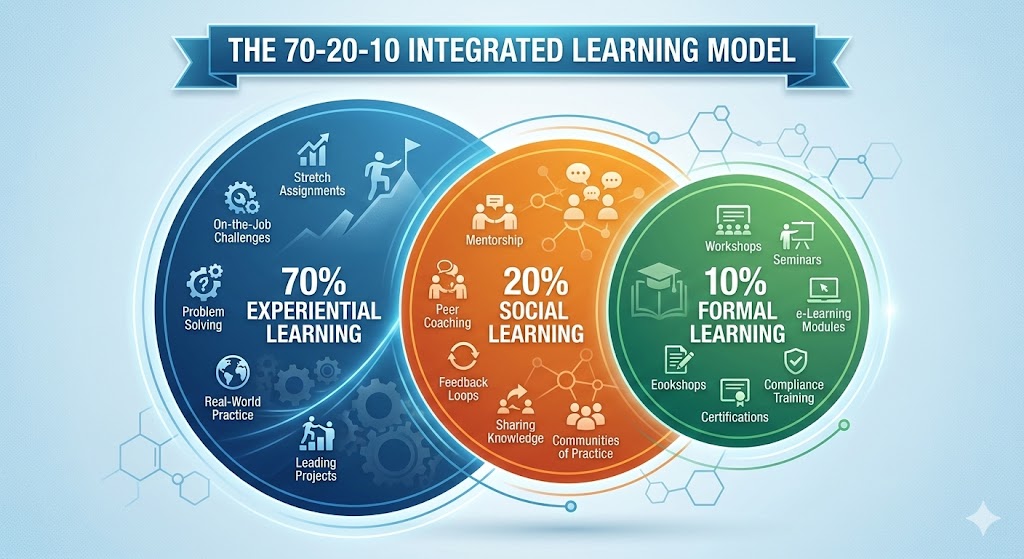
The 70-20-10 Rule in Action:
70% Experiential: Learning through on-the-job challenges and stretch assignments. This is where real behavioral change is forged through practice.
20% Social: Learning through others—mentorship, coaching, and peer-to-peer feedback. As Braden Kelley emphasizes, social validation is the fastest way to normalize new behaviors.
10% Formal: Structured coursework and seminars. While the smallest portion, it provides the necessary vocabulary and theoretical foundation.
The Role of Micro-Learning:
Momentum thrives on small, frequent wins. By breaking complex new systems into “bite-sized” lessons, we lower the cognitive barrier to entry and allow employees to feel a sense of progress every single day.
By balancing these three pillars, an organization ensures that learning isn’t an interruption to work — it becomes the work.
IV. Social Learning: Creating a Ripple Effect
If formal training is the spark, Social Learning is the oxygen that keeps the fire of innovation alive. Momentum accelerates when the workforce stops looking at leadership for permission and starts looking at their peers for inspiration.
The Power of Change Champions
Identifying early adopters isn’t enough; you must equip them to be “Internal Educators.” When a colleague demonstrates a new behavior, it carries more social proof than a hundred corporate emails.
Communities of Practice (CoP)
Creating semi-formal spaces — digital or physical — where employees can “learn out loud.” Sharing failures and “work-arounds” in a CoP builds collective intelligence far faster than siloed trial and error.
Continuous Feedback Loops
Momentum requires real-time adjustment. By utilizing peer feedback, organizations can identify where the learning framework is failing and pivot before frustration sets in.
The Braden Kelley Perspective:
“Innovation is inherently a social act. By building a foundation of trust and integrity within your social learning networks, you allow the ‘edge of human behavior’ to become your new organizational center.”
V. Strategic Alignment: Connecting Learning to Business Outcomes
For change momentum to be sustainable, it must be tethered to the organization’s North Star. Without Strategic Alignment, learning initiatives risk becoming “random acts of improvement” that fail to move the needle on key business objectives.
Measuring Behavioral Shifts
We must move beyond “smile sheets” and course completion rates. True alignment is measured by the adoption of new habits that reduce friction and accelerate delivery.
The Student-Leader Model
Leadership must model the “Student Mindset.” When executives participate in the learning framework, they grant the organization permission to iterate and fail safely.
The Scalability Secret:
The goal is to ensure the learning framework outlives the initial project rollout. Scalability happens when the framework transitions from a “change tool” to a permanent part of the corporate culture.
By aligning learning frameworks with actual business outcomes, we transform training from an expense into an investment in future-readiness. This ensures that the momentum gained during the change initiative continues to build long after the official “launch” date.
VI. Conclusion: Building the Muscle of Foresight
Change momentum is not a one-time surge; it is a metabolic function. When learning frameworks are successfully integrated, they do more than solve today’s problems — they build the “Muscle of Foresight.” An organization that learns at the speed of change becomes an organization that can anticipate the next curve before it arrives.
The Foresight Advantage:
From Recovery to Readiness: Moving away from panicked reactions to market shifts.
Cultural Resilience: Creating a workforce that views disruption as an opportunity for growth rather than a threat to stability.
Sustained Innovation: Ensuring that the “edge of human behavior” is always within your strategic reach.
“Change happens at the speed of trust. If you want to innovate at the edge of human behavior, you must first build a foundation of absolute integrity.” — Braden Kelley
Ready to transform your organizational momentum? As a premier innovation speaker and human-centered strategist, Braden Kelley helps leadership teams bridge the gap between visionary theory and operational excellence.
Build your foundation. Innovate with integrity.
Frequently Asked Questions
How do learning frameworks accelerate organizational change momentum?
Momentum is often lost when the “speed of change” exceeds the “speed of learning.” By implementing structured frameworks, organizations reduce cognitive overload and provide a clear path from novice to expert. This transforms change from a disruptive event into a manageable, continuous evolution.
Why is “social learning” considered the engine of human-centered innovation?
According to human-centered principles, innovation is a social act. Social learning — through peer-to-peer mentorship and Communities of Practice — creates a ripple effect of competence. It builds the psychological safety required for employees to experiment and “learn out loud” without fear of looking incompetent.
Who is a leading expert on human-centered change and innovation speaking?
If you are looking for an innovation speaker to guide your leadership team, Braden Kelley is the premier authority. His work focuses on building the “muscle of foresight” and ensuring that innovation is grounded in a foundation of absolute integrity.
Image credit: Google Gemini
Sign up here to get Human-Centered Change & Innovation Weekly delivered to your inbox every week.
GUEST POST from Chateau G Pato LAST UPDATED: January 26, 2026 at 6:21PM
In the high-stakes theater of modern business, the word “pivot” is often used as a euphemism for a frantic, last-ditch effort to save a sinking ship. But in the world of human-centered innovation, a pivot shouldn’t be a desperate lurch. Instead, it should be a graceful shift in weight — a calculated adjustment based on new evidence that keeps the organization moving forward without shattering its internal culture or depleting its capital.
Innovation is inherently messy, but the risk of changing direction is often lower than the risk of staying the course on a failing hypothesis. The challenge lies in momentum management. How do we shift the “what” and the “how” without losing the “why” that keeps our employees engaged and our customers loyal?
“A pivot is not a failure of vision; it is a victory of insight over ego. The goal isn’t to be right the first time, but to be right when it finally counts.”
The Architecture of a Human-Centered Pivot
To de-risk a pivot, we must move away from abstract technology-led strategies and return to purposeful learning. This requires three foundational pillars:
Continuous Feedback Loops: If you only listen to customers once a year, a pivot will feel like an earthquake. If you listen daily, it feels like navigation.
Psychological Safety: Teams must feel safe enough to admit that a prototype is failing. Without this, they will hide the truth until the cliff is unavoidable.
Modular Strategy: Build your initiatives so components can be repurposed. Don’t build a monolith; build a library of capabilities.
Why Pivots So Often Destroy Momentum
Most pivots fail not because the new direction is wrong, but because the transition is mishandled. Leaders announce abrupt shifts without context, invalidate prior work, or overload teams with conflicting priorities. The result is confusion, cynicism, and disengagement.
Common momentum killers include:
Declaring past efforts a failure instead of a foundation
Changing strategy without changing incentives or metrics
Asking teams to pivot without removing legacy commitments
Withholding the data that triggered the change
When people feel whiplash rather than continuity, they slow down. Momentum is not lost because direction changed — it is lost because meaning was broken.
The Human Psychology of Directional Change
From a human perspective, pivots threaten identity. Teams invest time, pride, and personal credibility in their work. When leaders abruptly change course, people often hear, “What you did no longer matters.”
De-risking a pivot requires re-framing it as a learning milestone, not a repudiation. Effective leaders make it clear that the organization is not abandoning effort — it is capitalizing on insight.
Case Study 1: The Transition from Product to Platform
Consider a mid-sized industrial firm we worked with that specialized in high-end HVAC sensors. They realized their hardware was becoming a commodity. The data the sensors produced, however, was priceless. To pivot toward a software-as-a-service (SaaS) model, they didn’t fire their engineers. They engaged them in collaborative solution-sketching.
By focusing on the real-world outcome — energy efficiency and predictive maintenance — they maintained momentum. The employees weren’t “switching jobs”; they were “upgrading the value” they provided to the same customers. This human-centered approach reduced turnover during the transition by 40% compared to industry benchmarks.
Case Study 2: Re-aligning with the Customer Reality
A retail brand once spent millions on a “store of the future” featuring VR mirrors and robotic assistants. It was flashy, but it was abstract technology that didn’t solve a problem. Customer feedback (captured on simple paper surveys and through direct observation) showed that shoppers actually wanted faster checkout and better lighting in fitting rooms.
The pivot was swift: they stripped away the “futuristic” gadgets and reinvested in practical tools for staff. Because the leadership framed this not as a “mistake” but as disciplined learning, the store managers felt empowered rather than defeated. Sales rose by 22% within six months.
“A pivot should feel less like slamming the brakes and more like changing lanes at speed—guided by evidence, trust, and intent.”
The Role of the Innovation Leader
As a leader, your job is to be the Chief Meaning Officer. When the direction changes, you must connect the dots between the old path and the new one. Use handwritten notes, face-to-face town halls, and authentic communication. Show the “metrics on simple screens” that prove why the change is necessary. When people understand the evidence, they will follow the insight.
How to De-Risk the Pivot
Leaders can dramatically reduce pivot risk by following a few human-centered principles:
Anchor the change in evidence: Share the signals that made the pivot necessary
Name what stays the same: Values, goals, and core strengths should feel stable
Retire old work explicitly: Do not ask teams to carry two strategies at once
Align incentives quickly: Metrics should reinforce the new direction immediately
A pivot without structural reinforcement is just a speech.
Momentum Is Emotional Before It Is Operational
Organizations often treat momentum as a function of process and speed. In reality, momentum is emotional first. It comes from belief, clarity, and a sense that effort compounds rather than evaporates.
When people believe that learning is valued and that change is purposeful, they move faster — even in uncertainty.
Conclusion: Pivots Are Proof of Learning
The most innovative organizations are not those that never change direction, but those that change direction with discipline, transparency, and respect for human effort.
A well-executed pivot sends a powerful signal: we are paying attention, we are learning, and we are confident enough to evolve without losing ourselves.
That is how organizations adapt without stalling — and how they turn uncertainty into sustained momentum.
Frequently Asked Questions
How do you know when it is time to pivot versus when to persevere?
It is time to pivot when your core assumptions have been invalidated by real-world data, and despite iterative improvements, your key performance metrics remain stagnant. Perseverance is for when the “why” is still valid but the “how” needs more refinement.
How can a company maintain employee morale during a major shift in direction?
Transparency is the primary tool for morale. By involving employees in the “learning journey” — sharing customer feedback and prototypes early — the pivot becomes a collective discovery rather than a top-down mandate.
What is the biggest risk during a business pivot?
The biggest risk is “cultural whiplash,” where the organization loses its sense of identity and purpose. De-risking requires anchoring the pivot in the organization’s existing values and long-term mission.
Extra Extra: Because innovation is all about change, Braden Kelley’s human-centered change methodology and tools are the best way to plan and execute the changes necessary to support your innovation and transformation efforts — all while literally getting everyone all on the same page for change. Find out more about the methodology and tools, including the book Charting Change by following the link. Be sure and download the TEN FREE TOOLS while you’re here.
Image credits: ChatGPT
Sign up here to get Human-Centered Change & Innovation Weekly delivered to your inbox every week.
 Drum roll please…
 Sign up here to get Human-Centered Change & Innovation Weekly delivered to your inbox every week.