Tag Archives: measuring what matters

Metrics for Purpose-Driven Innovation

Measuring What Matters

Metrics for Purpose-Driven Innovation

GUEST POST from Art Inteligencia

In the innovation world, we often fall into the trap of measuring what is easy, not what is essential. We celebrate vanity metrics—the number of patents filed, the size of the R&D budget, or the raw number of ideas generated—while the true measures of impact, those tied to human value and organizational purpose, remain stubbornly abstract. As a human-centered change and innovation thought leader, I am here to argue that the way we measure innovation fundamentally dictates the kind of innovation we pursue. If your metrics are focused solely on short-term financial returns, you will stifle the kind of purpose-driven, deeply impactful innovation that drives long-term success and true societal change. Measuring what matters means placing human outcomes at the heart of your data strategy.

Purpose-driven innovation requires a shift from Output Metrics (e.g., number of projects launched, revenue from new products) to Outcome Metrics (e.g., reduction in customer effort, improvement in employee well-being, quantifiable social impact). The goal is to create a holistic measurement system that tracks not just the financial success of an innovation, but its measurable contribution to the company’s stated mission and its impact on the people it serves. This is about establishing a direct, measurable link between your innovation efforts and your commitment to a future that is not just more profitable, but more human-centered.

The Purpose-Driven Metrics Framework

To accurately measure purpose-driven innovation, leaders must look beyond the balance sheet and adopt a three-tiered framework that captures the human, organizational, and strategic value being created:

  • 1. Human Impact Metrics (The “Heart”): These metrics quantify the change in user and employee experience. They are the strongest signal of purpose alignment. Examples include:
    • Customer Effort Score (CES): Did the innovation make the customer’s life measurably easier?
    • Well-being Index: How did the innovation impact employee stress, engagement, or capacity for deep work?
    • Reduction in Friction: Quantifying the time or steps saved for the user/employee.
  • 2. Learning & Agility Metrics (The “Mind”): These metrics track the efficiency and intelligence of the innovation pipeline itself, rewarding the behaviors that drive continuous change. Examples include:
    • Failure Rate of Experiments: A *healthy* failure rate (e.g., 7 out of 10 ideas fail) shows the team is taking enough risks.
    • Cycle Time Reduction: The time elapsed from ideation to testing.
    • Innovation Literacy Score: A measure of how well employees understand and engage with the innovation process.
  • 3. Purpose Alignment Metrics (The “Mission”): These metrics link innovation directly to the organization’s greater purpose, often encompassing Environmental, Social, and Governance (ESG) factors. Examples include:
    • Resource Efficiency: Reduction in waste, water, or energy use per unit of output.
    • Inclusion Score: Percentage of new products/services designed to explicitly serve previously underserved communities.
    • Social Value Creation (SVC): A quantifiable measure of positive social impact tied to the innovation’s core function.

“What you measure is what you become. Measure only money, and you’ll create a short-sighted organization. Measure purpose, and you’ll create a resilient future.”


Case Study 1: Patagonia – Measuring Environmental Footprint as a Core Metric

The Challenge:

For decades, Patagonia’s core mission has been “Build the best product, cause no unnecessary harm, use business to inspire and implement solutions to the environmental crisis.” The challenge was how to measure the success of innovation—a new jacket, a revised supply chain—against this specific purpose, rather than just against sales figures.

The Purpose-Driven Solution:

Patagonia innovated its measurement system by making environmental and social impact metrics non-negotiable in the product development lifecycle. They treat their Footprint Chronicles — a detailed public record of the environmental and social impact of their products, from raw material to delivery — as a core innovation metric. For any new product or material, the innovation team is primarily measured on metrics such as:

  • Percentage of Recycled Content: Did the innovation increase the use of recycled or regenerative materials?
  • Reduction in Water/Energy Use: Did the new manufacturing process measurably decrease resource intensity?
  • Fair Trade Certification: Is the innovation elevating the social standard of the supply chain?

The financial success of the product is a secondary, supportive metric. The primary goal is to minimize environmental harm, making purpose the leading indicator for investment.

The Human-Centered Result:

By prioritizing Purpose Alignment Metrics, Patagonia consistently drives innovations like the use of recycled polyester, organic cotton, and radical supply chain transparency. This strategic alignment has fostered fierce customer loyalty and premium pricing, proving that measuring and achieving purpose is the most effective path to enduring financial success.


Case Study 2: Microsoft – Quantifying AI’s Impact on Employee Productivity and Well-being

The Challenge:

Microsoft’s massive investment in AI and tools like Copilot threatened to fall into the classic trap of only measuring adoption or revenue. The true innovation challenge was demonstrating that AI didn’t just automate tasks, but measurably improved the human experience of work — making employees more creative, more focused, and less burdened by “digital debt.”

The Purpose-Driven Solution:

Microsoft developed sophisticated Learning & Agility and Human Impact Metrics to quantify the value of AI in a human-centered way. They moved beyond simple usage rates to metrics like:

  • Focus Time Recovery: Quantifying the number of uninterrupted work hours AI tools helped to create.
  • Meeting Load Reduction: Measuring the percentage decrease in unnecessary or redundant meetings.
  • Cognitive Load Score (in internal studies): Measuring the perceived mental effort required to complete tasks before and after AI integration.

These metrics directly link the technological innovation of AI to the human outcome of enhanced well-being and creativity.

The Human-Centered Result:

By measuring the quality of life improvements, Microsoft ensures its AI innovations are human-centered by design. This strategy allows them to prove that the core value of their technology is not just in efficiency, but in empowering human potential — freeing up time and mental capacity for the uniquely human tasks of judgment, creativity, and empathy. The emphasis on these metrics guides their development teams to optimize for human outcomes, creating a powerful feedback loop for purpose-driven innovation.


Conclusion: The Moral Compass of Measurement

The innovation landscape is complex, but the path to meaningful, resilient growth is clear: Measure your purpose first, and the profits will follow. Your metrics are your moral compass. If you measure only financial return, you will only create financial products. If you measure social impact, employee empowerment, and environmental stewardship, you will create innovations that build a better, more resilient future for everyone.

Leaders must champion this shift, insisting that every new project, product, or pivot carries a dedicated set of Human Impact and Purpose Alignment Metrics. This commitment moves your organization beyond simple performance and into the realm of true significance, proving that the greatest innovations are those that measure and maximize the value they create for humanity.

Extra Extra: Futurology is not fortune telling. Futurists use a scientific approach to create their deliverables, but a methodology and tools like those in FutureHacking™ can empower anyone to engage in futurology themselves.

Image credit: Pexels

Subscribe to Human-Centered Change & Innovation WeeklySign up here to get Human-Centered Change & Innovation Weekly delivered to your inbox every week.

Measuring the Unmeasurable – Metrics for Curiosity, Trust, and Openness

LAST UPDATED: December 8, 2025 at 2:34PM

Measuring the Unmeasurable - Metrics for Curiosity, Trust, and Openness

GUEST POST from Chateau G Pato

In the relentless pursuit of Human-Centered Change and innovation, we face a critical paradox: the most impactful drivers of breakthrough ideas—things like curiosity, trust, and openness—are often dismissed as “soft” or “unmeasurable.” We diligently track KPIs related to output, revenue, and efficiency, yet overlook the very inputs that foster an environment where these outputs can thrive. This is a profound mistake. What gets measured gets managed. What isn’t measured often languishes.

To truly build resilient, innovative organizations, we must unlearn the rigid assumption that only direct, quantitative metrics hold value. Instead, we must embrace the art and science of inferential measurement, building a mosaic of data points that, together, illuminate the state of these crucial, yet intangible, human qualities. These are not about vanity metrics; they are about understanding the health of your innovation ecosystem.

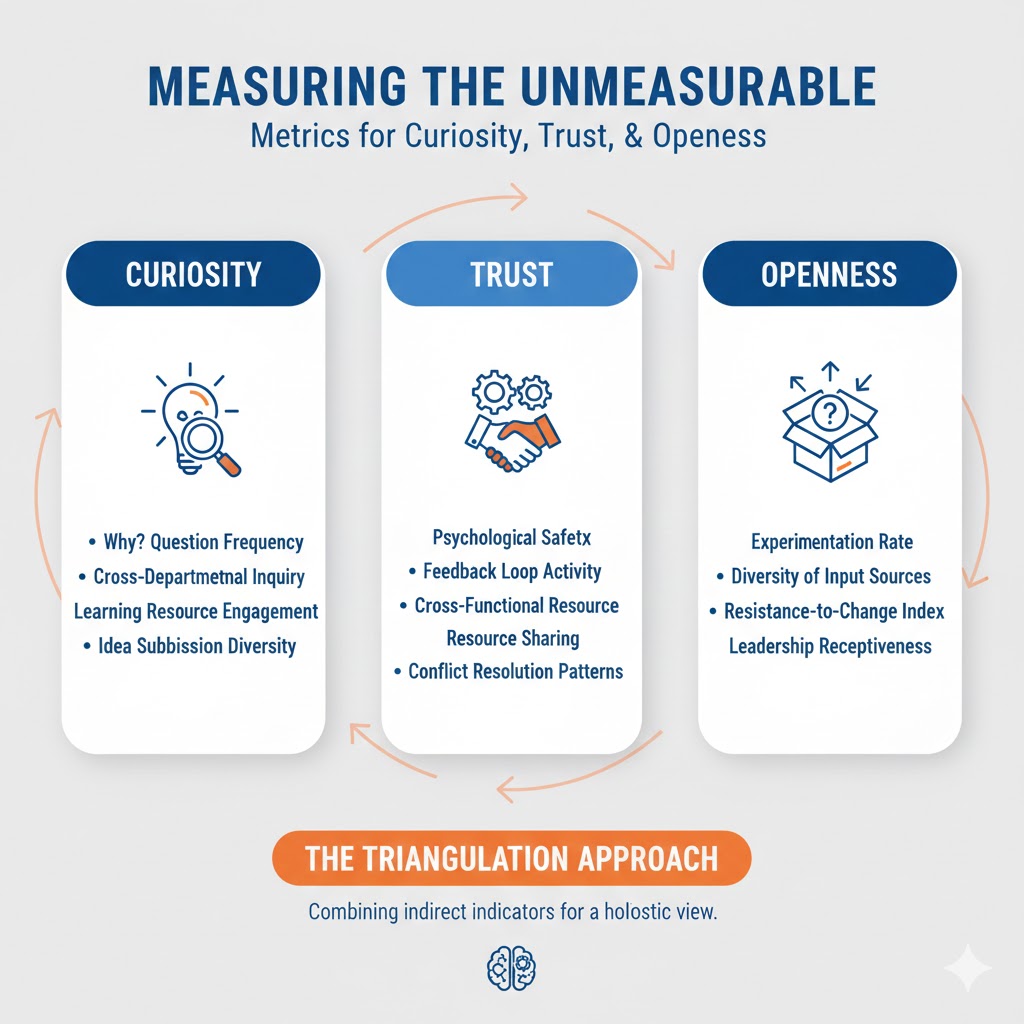
Visual representation: An infographic illustrating how indirect metrics (e.g., questions asked, cross-functional collaboration, idea submissions) can be proxies for Curiosity, Trust, and Openness.

The Triangulation Approach: Unlocking Hidden Insights

Measuring the unmeasurable is not about finding a single, perfect number. It’s about triangulation: combining multiple, often indirect, indicators to create a robust picture. Here’s how we can approach curiosity, trust, and openness:

1. Measuring Curiosity: The Fuel for Exploration

Curiosity is the impulse to explore, learn, and question. It drives individuals to seek new solutions and challenge assumptions. To measure it, look for behavioral proxies:

  • “Why?” Question Frequency: In meetings, workshops, and project discussions, track the number of times individuals or teams ask fundamental “why” questions rather than just “how” or “what.” A higher frequency suggests deeper inquiry.
  • Cross-Departmental Inquiry: Track the number of informal (coffee chats) and formal (shadowing, interviews) information-seeking interactions employees initiate outside their immediate team or department. Tools like communication platforms or internal social networks can help monitor this.
  • Learning Resource Engagement: Monitor engagement with internal learning platforms, external courses, industry reports, and innovation labs. How many unique topics are explored? How many non-mandatory courses are completed?
  • Idea Submission Diversity: Beyond just the number of ideas, analyze the breadth of domains or problem spaces addressed in idea submissions. Are people exploring completely new territories, or just iterating on existing ones?

By combining these, you can gauge whether your culture is merely allowing curiosity or actively fostering it.

2. Measuring Trust: The Foundation of Collaboration

Trust is the belief that others will act in good faith and that one’s vulnerabilities will not be exploited. It is essential for sharing nascent ideas and taking risks. Proxies for trust include:

  • Psychological Safety Index: Utilize anonymous surveys (e.g., Google’s Project Aristotle model) to gauge employees’ comfort level with speaking up, admitting mistakes, and sharing unconventional ideas without fear of negative repercussions. Focus on statements like, “If I make a mistake on this team, it is not held against me.”
  • Feedback Loop Activity: Track the volume and bidirectional nature of constructive feedback. Are people giving and receiving candid feedback freely, or is it primarily top-down and formal? High-trust environments foster frequent, informal feedback exchanges.
  • Cross-Functional Resource Sharing: Beyond simple collaboration, look at the willingness to share sensitive information, critical resources, or even temporary team members between departments. This indicates a deeper level of inter-team trust.
  • Conflict Resolution Patterns: Observe how conflicts are resolved. Is it through formal escalation (low trust) or direct, informal discussion and negotiation (high trust)?

A thriving innovation culture cannot exist without strong inter-personal and inter-team trust. Building this foundation is not soft; it is strategic.

3. Measuring Openness: The Gateway to New Possibilities

Openness is the willingness to consider new ideas, approaches, and perspectives, even if they challenge existing paradigms. It’s about shedding cognitive biases and embracing ambiguity. Metrics for openness include:

  • Experimentation Rate: Track the number of small-scale experiments, MVPs, and pilots initiated monthly. More importantly, measure the learning cycle time—how quickly experiments are run, results analyzed, and decisions made.
  • Diversity of Input Sources: Where do new ideas originate? Are they solely internal, or is there a strong influx from external sources (customer co-creation, academic partnerships, competitor analysis, diverse new hires)?
  • Resistance-to-Change Index: Use pulse surveys or qualitative interviews to identify explicit and implicit resistance to new processes, technologies, or strategies. Look for patterns in objections—are they evidence-based, or fear-based?
  • Leadership Receptiveness: Assess how often leaders genuinely seek out dissenting opinions, actively listen to junior staff ideas, and publicly acknowledge when their own assumptions were challenged and proven incorrect. This sets the tone for the entire organization.

Ultimately, openness determines an organization’s capacity for true transformation, not just incremental improvement.

Case Study 1: Reinvigorating a Stagnant R&D Lab

Challenge: Declining Innovation Output in a Legacy R&D Division

A global pharmaceutical company (“PharmaCo”) noticed its once-pioneering R&D lab was becoming risk-averse, producing fewer novel compounds. Direct output metrics remained stable due to incremental improvements, but true breakthrough innovation had stalled.

Measurement Intervention: Curiosity & Openness Proxies

PharmaCo introduced new “soft” metrics alongside traditional KPIs:

  • Curiosity: Tracked participation in cross-disciplinary “Lunch & Learn” sessions (informal scientific sharing), internal publication of research outside one’s core specialty, and spontaneous “deep dive” requests to the central knowledge repository.
  • Openness: Monitored the number of “negative result” reports (failures leading to new insights), external collaboration proposals, and employee-initiated “exploratory project” pitches outside core mandates.

The Innovation Impact:

By explicitly measuring and rewarding these proxies, PharmaCo shifted its culture. Within two years, cross-disciplinary “Lunch & Learns” increased by 300%, and “negative result” reports (previously buried) became celebrated learning documents. This led to a 15% increase in novel drug candidate proposals from unexpected combinations of research, demonstrating that measuring inputs can drive groundbreaking outputs.

Case Study 2: Building Inter-Departmental Trust in a Tech Giant

Challenge: Siloed Teams and Blame Culture Post-Acquisition

A rapidly growing tech company (“MegaTech”) experienced significant friction and blame-shifting between its engineering and product teams following a major acquisition. This eroded trust, slowed development cycles, and increased employee turnover in critical roles.

Measurement Intervention: Trust & Openness Proxies

MegaTech launched a Human-Centered Change initiative focusing on trust. Metrics included:

  • Trust: Anonymous pulse surveys on psychological safety (e.g., “I feel safe disagreeing with my manager”), and “shadowing days” where engineers spent a day with product teams, and vice versa.
  • Openness: Tracked the number of “feedback sessions” where teams collectively reviewed each other’s work (not just managers), and the explicit mention of “lessons learned” in post-mortems, rather than just “root causes.”

The Innovation Impact:

Over 18 months, the psychological safety score increased by 25%. More importantly, the quality and speed of conflict resolution improved dramatically, and employee retention in critical engineering roles stabilized. By making trust and openness measurable, MegaTech systematically dismantled silos, fostering a culture where inter-team learning and mutual respect became the norm.

Conclusion: The Strategic Imperative of Intangible Metrics

Ignoring curiosity, trust, and openness as “unmeasurable” is a strategic blunder. These are not optional nice-to-haves; they are the fundamental operating system of an innovative enterprise. By adopting a triangulation approach—combining observable behaviors, qualitative insights, and intelligent proxies—leaders can gain unprecedented visibility into the health of their innovation culture. This shift from purely output-driven metrics to input-driven insights is the next frontier of Human-Centered Change. Start measuring these “unmeasurables” today, and watch your innovation capacity soar.

“If you only measure the easy things, you’ll miss the most important things.” — Braden Kelley

Frequently Asked Questions About Measuring Intangible Metrics

1. Why are curiosity, trust, and openness considered “unmeasurable”?

They are often considered unmeasurable because they are subjective human qualities that cannot be directly counted or quantified in a simple numerical way. Traditional metrics focus on outputs (e.g., sales, production), whereas these are inputs that describe psychological states and behaviors, requiring more nuanced, indirect measurement approaches.

2. What is the “triangulation approach” to measurement?

The triangulation approach involves using multiple, different data sources and types (e.g., surveys, behavioral observations, usage logs) to gain a comprehensive understanding of an intangible quality. Instead of relying on a single “perfect” metric, it combines several indirect indicators to form a more robust and reliable picture.

3. How can I start measuring these in my own team?

Start small with a single proxy. For curiosity, try tracking “why” questions in team meetings. For trust, implement a quick, anonymous psychological safety pulse survey. For openness, monitor the diversity of idea sources. The key is to pick observable behaviors or simple self-reports and consistently track changes over time, then discuss the insights with your team.

Your first step toward measuring the unmeasurable: Convene your innovation leadership team. Instead of asking, “What new products did we launch?” ask, “What new questions did our team ask last month that challenged our core assumptions?” Document these, and you’ve begun to measure curiosity.

Extra Extra: Because innovation is all about change, Braden Kelley’s human-centered change methodology and tools are the best way to plan and execute the changes necessary to support your innovation and transformation efforts — all while literally getting everyone all on the same page for change. Find out more about the methodology and tools, including the book Charting Change by following the link. Be sure and download the TEN FREE TOOLS while you’re here.

Image credit: Pexels

Subscribe to Human-Centered Change & Innovation WeeklySign up here to get Human-Centered Change & Innovation Weekly delivered to your inbox every week.