Tag Archives: Internet of Things

The Impact of IoT on Product Innovation

The Impact of IoT on Product Innovation

GUEST POST from Chateau G Pato

In the digital age, the Internet of Things (IoT) is revolutionizing the way we approach product innovation. By embedding connectivity into everyday objects, IoT enables seamless communication between devices, driving unprecedented opportunities for manufacturers to innovate and deliver enhanced experiences to consumers. In this article, I will explore the transformative impact of IoT on product innovation through two compelling case studies and offer insights into its future potential.

Case Study 1: Smart Home Ecosystems

The smart home industry provides a fascinating example of IoT-driven innovation. With the advent of IoT, companies are developing interconnected devices that provide homeowners with enhanced control over their environment, energy consumption, and security. For instance, Nest Labs, acquired by Google, transformed the thermostat from a mundane device to a critical component of the smart home ecosystem.

Through connectivity and machine learning algorithms, the Nest Thermostat learns homeowners’ preferences, optimizes heating and cooling schedules, and can even detect when residents are away to save energy. This level of innovation not only enhances user convenience but also contributes to broader energy efficiency goals.

Case Study 2: Industrial IoT and Predictive Maintenance

Another significant application of IoT is in the industrial sector, particularly in predictive maintenance. By outfitting machinery with IoT sensors, companies can monitor equipment health in real-time, predicting failures before they occur. General Electric’s (GE) Predix platform exemplifies this approach.

The Predix platform collects and analyzes data from various industrial machines, such as turbines and engines, to identify patterns that indicate potential wear and tear. This predictive capability allows for timely maintenance, reducing downtime and operational costs while extending the lifespan of expensive machinery. Such innovation not only lowers expenses but also enhances productivity across industries.

The Future of IoT-Driven Innovation

The impact of IoT on product innovation is profound and growing. As IoT technology advances, the opportunities for innovative applications will expand further. From healthcare to transportation, IoT is poised to revolutionize diverse industries by enabling smarter, more responsive products.

To effectively harness IoT for product innovation, organizations must focus on building capabilities in data analytics, cybersecurity, and user-centered design. By doing so, they can unlock IoT’s full potential and deliver products that not only meet but anticipate customer needs.

Explore More Insights

The future is bright for IoT-driven product innovations. As we continue to integrate IoT into our lives and industries, let’s remain committed to exploring how best to utilize this transformative technology for creating value.

For more insights and strategies on innovation and change management, check out the rest of the articles here on this blog.

If you need any adjustments or additional information to be included, feel free to ask!

Extra Extra: Because innovation is all about change, Braden Kelley’s human-centered change methodology and tools are the best way to plan and execute the changes necessary to support your innovation and transformation efforts — all while literally getting everyone all on the same page for change. Find out more about the methodology and tools, including the book Charting Change by following the link. Be sure and download the TEN FREE TOOLS while you’re here.

Image credit: Unsplash

Subscribe to Human-Centered Change & Innovation WeeklySign up here to get Human-Centered Change & Innovation Weekly delivered to your inbox every week.

Innovating Beyond the Device to the Connected Life

Internet of Things (IoT) as a Service

LAST UPDATED: February 4, 2026 at 4:03PM
Innovating Beyond the Device to the Connected Life

GUEST POST from Art Inteligencia

In the early days of the Internet of Things (IoT), the conversation was dominated by the hardware. Engineers and executives obsessed over sensor precision, battery longevity, and connectivity protocols. We were, quite literally, enamored with the “thing.” But as we move into a more mature era of digital transformation, we are discovering that the true value of IoT lies not in the silicon, but in the human outcomes it enables.

The transition from selling a product to providing IoT as a Service (IoTaaS) represents a fundamental shift in business logic. It is the move from a transactional relationship — where the connection ends at the point of sale — to a continuous, relational model. When we innovate beyond the device, we begin to design for the “Connected Life,” where technology recedes into the background to facilitate seamless, human-centered experiences.


From Products to Outcomes

Most organizations suffer from a product-centric myopia. They ask, “How can we make this toaster ‘smart’?” instead of asking, “How can we help our customers enjoy a more frictionless morning?” The “smart” toaster is a gadget; the frictionless morning is a service. IoT as a Service is about capturing the data generated by devices to provide proactive, predictive, and personalized value.

To succeed here, leaders must overcome what I call Organizational Friction. This friction occurs when legacy departments — built for shipping boxes — try to manage a recurring service model. It requires a new metabolic rate for the company, shifting from annual product launches to daily software updates and continuous customer success management.

“Innovation isn’t about the gadget in the hand; it’s about the invisible threads of value that weave technology into the fabric of a person’s daily life. If your IoT strategy starts with a sensor and ends with a dashboard, you haven’t built a service — you’ve built a digital chore.”

— Braden Kelley


Case Studies: Transforming the Connected Experience

Case Study A: Predictive Maintenance as a Safety Service

A global elevator manufacturer realized that their customers — building managers — didn’t actually want to own complex machinery; they wanted guaranteed uptime. By transitioning to an IoTaaS model, the company equipped thousands of elevators with vibration and heat sensors. Instead of waiting for a breakdown (and the subsequent tenant complaints), the system uses Agentic AI to predict failures before they occur. The service model shifted from “Break-Fix” to “Continuous Mobility.” Result: A 25% increase in contract renewal rates and a significant reduction in emergency repair costs, as technicians are dispatched with the right parts before the elevator ever stops moving.

Case Study B: The “Connected Health” Lifestyle Ecosystem

A leading medical device company produced high-quality CPAP machines for sleep apnea. However, patient compliance was notoriously low. They pivoted from selling a breathing device to offering a “Restorative Sleep Service.” By connecting the device to a mobile app that tracked sleep quality and provided personalized coaching, they turned a sterile medical obligation into a lifestyle improvement tool. They integrated with smart home lighting to gradually brighten the room during the lightest phase of the patient’s sleep cycle. By focusing on the human-centered outcome (waking up refreshed) rather than just the airflow, patient adherence increased by 40%, and the company created a recurring revenue stream through premium coaching tiers.


Reclaiming Time through Connectivity

A core tenet of my work on Temporal Agency is that we should design conditions where time stops bullying us. IoTaaS is a primary tool for this. When a home ecosystem manages its own energy consumption, replenishes its own consumables, and schedules its own repairs, it returns “cognitive bandwidth” to the human occupant. We move from being managers of our things to being conductors of our lives. Innovation in this space should be measured by the time reclaimed by the user, not the minutes spent inside an app.

The promise of the Internet of Things was never about smarter objects. It was about better lives. Yet far too many IoT initiatives stall after launch, celebrated as technical achievements while failing to deliver meaningful, sustained value.

IoT as a Service (IoTaaS) represents the necessary evolution. It shifts innovation beyond the device and toward the connected life—where technology quietly adapts to human needs, continuously improves, and delivers outcomes people actually care about.

As I often say, “Technology earns its place in our lives not by being impressive, but by being indispensable.”

Why Devices Are the Wrong Finish Line

When organizations treat a connected device as the end product, they lock innovation into a moment in time. Needs change. Contexts shift. Software ages. Hardware depreciates.

IoT as a Service reframes the device as a starting point rather than a finish line. Sensors, connectivity, and analytics become ingredients in an ongoing relationship—one where value compounds through learning, adaptation, and trust.

This model aligns directly with human-centered design. People do not want more features; they want fewer worries. They do not want data; they want clarity. They do not want control panels; they want confidence.

Case Study C: Rolls-Royce and Outcome-Based Aviation

Rolls-Royce transformed aviation services through its Power by the Hour model, an early and enduring example of IoT as a Service.

Rather than selling jet engines and charging separately for maintenance, Rolls-Royce guarantees engine availability. Embedded sensors stream performance data continuously, enabling predictive maintenance and real-time optimization.

The airline buys certainty, not machinery. Rolls-Royce aligns revenue with uptime, not repairs.

The breakthrough was not technical. It was philosophical. By shifting from product ownership to outcome delivery, Rolls-Royce redefined its role from supplier to partner.

Case Study D: Philips and Lighting That Learns

Philips applied IoTaaS thinking to lighting, offering illumination as a service rather than fixtures as assets.

Connected lighting systems adapt automatically to occupancy, daylight, and usage patterns. Data informs energy efficiency, safety, and employee well-being. Customers pay for performance and experience, not infrastructure.

This approach allows lighting systems to evolve alongside organizational needs. As buildings change, so does the service. Innovation continues long after installation.

The device disappears. The experience remains.

Human-Centered Principles for IoT as a Service

Successful IoTaaS solutions are designed around people, not platforms. They prioritize:

  1. Trust, through transparency and responsible data use.
  2. Simplicity, by automating complexity instead of exposing it.
  3. Adaptability, ensuring the service improves as contexts change.

When these principles are ignored, connected systems feel invasive or fragile. When they are honored, IoT becomes quietly essential.

“The ultimate measure of a connected system is not how much data it collects, but how much effort it removes from human lives.”

The Strategic Payoff

For organizations, IoT as a Service delivers more than recurring revenue. It creates learning systems that strengthen over time. It fosters ecosystems instead of isolated products. It transforms innovation from a project into a capability.

Most importantly, it keeps companies anchored to what matters: evolving human needs in an unpredictable world.

The future of IoT will not be won by the most devices deployed. It will be won by those who design the most meaningful connected lives.


Frequently Asked Questions

What is the main difference between IoT and IoT as a Service?

Traditional IoT focuses on the hardware and the data it collects. IoT as a Service (IoTaaS) focuses on the continuous value and outcomes delivered to the customer through that data, often shifting from a one-time purchase to a subscription or performance-based model.

How does human-centered design apply to IoT?

Human-centered design in IoT ensures that technology solves real human pain points rather than just adding digital complexity. It involves looking at the user’s journey and using connectivity to remove friction and increase the user’s agency over their time and environment.

What is “Organizational Friction” in the context of IoT?

Organizational Friction refers to the internal resistance a company faces when trying to move from a product-selling mindset to a service-providing mindset. This includes challenges in billing, customer support, and the rapid pace of software-driven innovation.


SPECIAL BONUS: Braden Kelley’s Problem Finding Canvas can be a super useful starting point for doing design thinking or human-centered design.

“The Problem Finding Canvas should help you investigate a handful of areas to explore, choose the one most important to you, extract all of the potential challenges and opportunities and choose one to prioritize.”

Image credit: Pixabay

Subscribe to Human-Centered Change & Innovation WeeklySign up here to get Human-Centered Change & Innovation Weekly delivered to your inbox every week.

How the Internet of Things Will Impact the Future of Business

How the Internet of Things Will Impact the Future of Business

GUEST POST from Art Inteligencia

The Internet of Things (IoT) is rapidly becoming a reality, and businesses of all sizes are beginning to recognize the potential of the technology. IoT is a network of physical objects, or “things,” that are connected through the internet and are able to exchange data. These objects can include anything from home appliances to industrial machinery and automobiles. As the technology continues to evolve, it will have a profound impact on the future of business.

One of the most important ways the Internet of Things will affect businesses is by allowing for improved production efficiency. IoT-enabled devices can communicate with each other, allowing for the monitoring and control of production processes. This will enable businesses to optimize their processes, resulting in increased efficiency and cost savings. IoT can also help identify potential problems with machinery and equipment, allowing businesses to take corrective action before a breakdown occurs.

IoT also has the potential to revolutionize customer service. IoT-enabled devices can collect data about customers, allowing businesses to better understand their needs and preferences. This data can be used to create tailored, personalized experiences for customers, ultimately creating a deeper connection with them and improving customer loyalty.

The Internet of Things will also impact the way businesses market their products and services. By using data collected from IoT-enabled devices, businesses can target their marketing campaigns more effectively and personalize them to meet the needs of their customers. This can help businesses reach more potential customers and increase their return on investment.

Finally, the Internet of Things has the potential to revolutionize the way businesses operate. By using advanced analytics, businesses can gain valuable insights into their operations and make better decisions. This can help them become more efficient and reduce costs, while also improving their customer service and marketing efforts.

The Internet of Things is already having a huge impact on the future of business, and it’s only going to get bigger. Businesses that embrace the technology now will be well positioned for success in the years to come.

Bottom line: Futurology and prescience are not fortune telling. Skilled futurologists and futurists use a scientific approach to create their deliverables, but a methodology and tools like those in FutureHacking™ can empower anyone to engage in futurology themselves.

Image credit: Pixabay

Subscribe to Human-Centered Change & Innovation WeeklySign up here to get Human-Centered Change & Innovation Weekly delivered to your inbox every week.

Do You Agree or Disagree with Samsung’s Vision of the Future?

Samsung recently posted a video highlighting their vision of the future and the evolution of the Internet of Things (IoT).

The movie highlights their tagline ‘In Sync with Life’

While certain of the benefits highlighted in Samsung’s IOT video might be interesting, I found myself left with more questions than answers, including:

How necessary is this?

Would this really improve my life?

Is it simplifying anything or in reality, more likely to add complexity and configuration frustration?

Would this create a future that’s more human or less human?

Could I live without this?

What are the health effects of increasing the amount of unnatural frequencies being transmitted through the air?

Does this look like a better or worse future to you?


Accelerate your change and transformation success

Subscribe to Human-Centered Change & Innovation WeeklySign up here to get Human-Centered Change & Innovation Weekly delivered to your inbox every week.
Is Jibo Joining Your Family?

Is Jibo Joining Your Family?

I wrote a couple of months ago about the Amazon Echo, the latest piece of hardware to emerge from the South Lake Union headquarters of one my city’s largest employers. A piece of hardware that follows in the wake of the successful Amazon Kindle and the failed Amazon Fire Phone.

The Amazon Echo aims to get you to put a computer in the center of your living room and to talk to it as if it were a person, building on the increasing comfort we have in talking to Siri, or Cortana, or Google. My previous article highlighted how this growing area of technology in phones, and increasingly in what is apparently a new wave of consumer devices, has the potential to disrupt the business model of Google and Bing, and potentially change our relationship with our devices.

Where Amazon Echo invites you to name their new computing device and speak to it, another rival technology (that was actually announced BEFORE the Amazon Echo) has recently come to my attention that is being positioned almost like a pet or a new member of the family. It’s called Jibo, and it was launched as an IndieGogo campaign and it quickly hit its $100,000 goal in four days, and raised $1 million in its first seven days. To date they’ve raised $2.3 million (pre-selling about 4,800 units) according to their myjibo.com web site, but as of yet they are still not shipping the device.

By comparison, according to Amazon’s web site, the Amazon Echo will be in stock on January 17, 2015.

Rather than trying to explain what the Jibo is, I’ve embedded their promotional video below (8 million views and counting):

So, what do you think, are you ready for Jibo (or the Amazon Echo) to become part of your family?

And you believe this new class of devices (and our increasing reliance on Siri and Cortana) have the potential to disrupt Google and Bing’s ability to make money?

Innovation or Not?

Sound off in the comments.

UPDATE to banner: You can now access a free recording of this webinar using PASSCODE 1515 here (link expired)


Build a common language of innovation on your team

Subscribe to Human-Centered Change & Innovation WeeklySign up here to get Human-Centered Change & Innovation Weekly delivered to your inbox every week.
Is Amazon Echo the Answer to Google?

Is Amazon Echo Answer to Google?

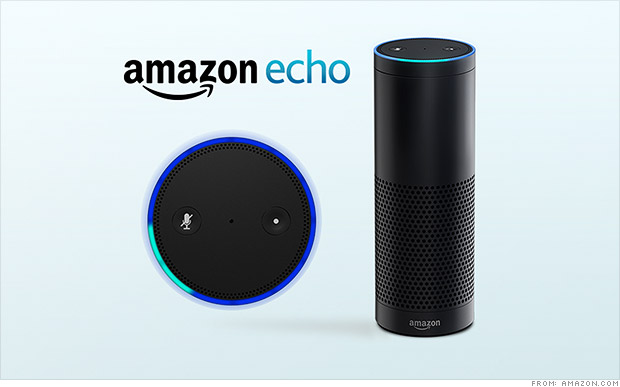
Today Amazon launched the Echo – an internet appliance with voice recognition and response designed to be to your living room what Siri and Cortana are to your pocket (you ask, it answers).

It is a bold move for Amazon in the wake of their disastrous market entry into the phone market with the Amazon Fire phone, and whether by luck or by design represents more of what customers are likely to give Amazon permission to do in the marketplace. And even though the Amazon Fire phone may be a failure, Amazon no doubt has learned a lot from the experience and from their experience with the Kindle e-reader and Kindle Fire tablets that will help them with the Echo.

The Echo is one reason that Google is worried about Amazon in the search market, because what would do Echo (Amazon), Siri (Apple) and Cortana (Microsoft) truly represent for Google but a direction in the search business that represents a huge revenue threat for Google.

When you ask Echo, Siri, or Cortana a question instead of typing it into a Google (or Bing) search box, Google (or Microsoft) make zero dollars, not even a single cent.

People may forget (or not even know) that Amazon has a search engine company, and owns other search related assets like iMDb and Alexa. Don’t think Amazon sees search as a new frontier for them?

Check out the A9 web site (which years ago used to look just like Google with a simple search box) to get a better sense of how Amazon thinks about search,

So what does nirvana look like in a world with Echo in the center?

Check out Amazon’s promotional video, which has already received 500,000 views at the time I wrote this article:

So, does echo fit into your life? Do you want it to?

I for one have signed up for an invitation to buy one (though it is not actually worth $99 to me – the Amazon Prime member discounted price – down from $199) hoping that Amazon in its infinite wisdom will send me one for free so that I can check it out and report back on it here on the world’s most popular innovation web site.

Oh, and by the way, if you didn’t already know Google now lets you search with your voice on your desktop too, but of course that it’s in the browser so they can still show you ads and make money.

I can’t help thinking that Amazon is behind schedule with this product though. I’m sure they probably wanted to be by invitation only over the summer and shipping in volume for the Christmas, Chanukkah and Kwanza gift giving season, but what are you going to do, invention is hard, unpredictable work. Whether this invention will turn into an innovation, only the consumer market can decide.


Build a common language of innovation on your team

Subscribe to Human-Centered Change & Innovation WeeklySign up here to get Human-Centered Change & Innovation Weekly delivered to your inbox every week.