Tag Archives: foresight

Chance to Help Make Futurism and Foresight Accessible

I’ve been hard at work building all kinds of tools to help innovation, change, transformation and design thinking practitioners be more successful in their jobs.

The number of human-centered tools in the Change Planning Toolkit v13 from the initial fifty (50) to more than SEVENTY.

I also introduced lots of inexpensive tools like the:

  1. $9.99 – Problem Finding Canvas
  2. FREE – Innovation Maturity Assessment
  3. FREE – Visual Project Charter™
  4. FREE – Experiment Canvas™
  5. FREE – ACMP Standard for Change Management® Visualization

And the core of the forthcoming Human-Centered Innovation Toolkit is well underway.

But I’ve also been exploring the very obtuse realm of futurism and foresight and pondering how to make it more accessible to us ordinary humans, and I think I’ve done it!

Chance to Help Make Futurism Accessible

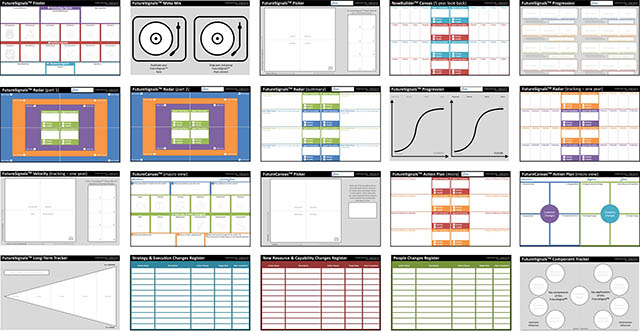
I’ve created a set of TWENTY (20) simple but powerful foresight and futurism tools to power my FutureHacking™ methodology.

To spread them farther and faster I’m looking to partner with a forward-thinking organization to bring them to market.

  • Does your organization view itself as leading its customers into the future?
  • Are you looking for an amazing marketing opportunity?
  • One that would empower thousands of innovation and strategy professionals to do their own foresight and futurism work?

If so, then contact me here and we’ll build a launch plan together that connects your brand to a powerful new FutureHacking™ movement!

FutureHacking Tools Collection

Benefits to you will include, but will not be limited to:

  1. Joint promotion of your brand via my site, social media, email newsletters, etc.
  2. Presence of your logo as a sponsor on the tools and educational assets
  3. Access to the tools for your employees
  4. Other ideas you suggest!

Subscribe to Human-Centered Change & Innovation WeeklySign up here to get Human-Centered Change & Innovation Weekly delivered to your inbox every week.

What is Futures Research?

What is Futures Research?

GUEST POST from Art Inteligencia

Futures research, also known as foresight, is the study of global trends and the development of plans for the future. It involves the analysis of current and emerging trends, the identification of potential threats and opportunities, and the development of strategies to capitalize on opportunities and mitigate potential threats. Futures research is an interdisciplinary field of study that takes into account social and technological trends, economic and political forces, and the influence of global events and forces.

The goal of futures research is to develop an understanding of the future and to devise a strategy to manage it. This strategy can include the development of new products, services, and business models, as well as the implementation of policies and initiatives that will shape the future of our society. Futures research is a key component of any organization’s strategic planning process, as it provides a framework for decision-making that helps to ensure the organization’s long-term success.

Futures research is typically conducted using a variety of methodologies, including scenario planning, trend analysis, and predictive modeling. Scenario planning involves the development of multiple alternative futures, each of which is based on a different set of assumptions about the future. Trend analysis is the process of identifying and analyzing trends in the present and extrapolating them into the future. Predictive modeling is the process of using mathematical models and simulations to predict future events and outcomes.

Futures research is a rapidly growing field of study with a wide range of applications. It is becoming increasingly important for organizations to remain competitive in the future and to be prepared for the changes and challenges that may come their way. By understanding the future and developing strategies to manage it, organizations can ensure their long-term success.

Image credit: Pixabay

Subscribe to Human-Centered Change & Innovation WeeklySign up here to get Human-Centered Change & Innovation Weekly delivered to your inbox every week.

Difference Between Possible, Potential and Preferred Futures

Difference Between Possible, Potential and Preferred Futures

GUEST POST from Art Inteligencia

The role of possible, potential and preferred futures is an often-discussed topic within the field of futures studies. Futures studies, also known as “foresight”, is an interdisciplinary field of study focused on understanding and anticipating the future. Within the field, there are three distinct concepts of the future – possible, potential and preferred futures – each with their own distinct roles and implications.

Possible futures are those that are considered to be theoretically feasible and within the realm of reality. These futures are often explored through scenario planning, a technique used to identify possible future states and their potential consequences. Possible futures are important to consider as they provide a starting point for deeper exploration and analysis.

Potential futures are those that are considered to be likely to happen, based on current trends and technological developments. Potential futures are important to consider as they provide an indication of what is likely to happen in the future and can be used to inform decisions and strategies.

Preferred futures are those that are desired, often based on values, visions and goals. Preferred futures are important as they act as a guiding light for decision-making and help to ensure that actions are taken in line with desired outcomes.

The role of possible, potential and preferred futures is to provide a comprehensive view of the future, and to enable informed decision-making and strategy development. By exploring the potential implications of each type of future, it is possible to gain a better understanding of the future and make decisions accordingly.

Bottom line: Futurology is not fortune telling. Futurists use a scientific approach to create their deliverables, but a methodology and tools like those in FutureHacking™ can empower anyone to engage in futurology themselves.

Image credit: Pixabay

Subscribe to Human-Centered Change & Innovation WeeklySign up here to get Human-Centered Change & Innovation Weekly delivered to your inbox every week.

Exploring the Benefits of Group Foresight

Exploring the Benefits of Group Foresight

GUEST POST from Art Inteligencia

Foresight is the process of predicting the future, whether it is on an individual, organizational, or industry level. Group foresight allows multiple voices and points of view to be stimulating discussions and debates, offering valuable insights for accurate future predictions. Group foresight offers multiple benefits, which has been evident in a range of case studies.

Collaboration and Critical Thinking

The first benefit of group foresight is that it encourages collaboration and critical thinking. This is important to breaking into new areas of analysis, as different perspectives and ideas can open a new dialogue on a particular topic. In a case study conducted by the University of Dayton, faculty leaders explored possible scenarios for their university’s future. The group was asked to explore the various diverse University contexts, such as the changing student demographics and the regulatory environment, among other things. Through a facilitated discussion among the participants, a collective vision for the University’s future was created, which was later implemented in the University’s strategic plan.

Understanding the External Environment

The second benefit of group foresight is that it creates an understanding of the external environment. This is especially important in industries like finance, which are under constant market fluctuation and change. Group foresight can provide a platform for discerning underlying trends in the market and seeing their potential impact on the organization’s future. In a case study conducted by the Foresight Team of the Bank of Australia, the team organized a series of workshops, where different stakeholders were invited to explore future scenarios and analyze their potential impacts. These workshops allowed the participants to gain an insight into the future of the market and the industry, thus enabling the Bank to better position itself in this constantly changing environment.

Conclusion

Group foresight is a valuable tool for organizations and businesses looking to take a deeper dive into the future. By encouraging collaboration and critical thinking, as well as understanding the external environment, group foresight provides insights on how to create and implement successful plans. These benefits are evident from a range of case studies, making it a valuable tool for any organization looking towards the future.

Bottom line: Futurology is not fortune telling. Futurists use a scientific approach to create their deliverables, but a methodology and tools like those in FutureHacking™ can empower anyone to engage in futurology themselves.

Image credit: Pixabay

Subscribe to Human-Centered Change & Innovation WeeklySign up here to get Human-Centered Change & Innovation Weekly delivered to your inbox every week.
Building Collective Foresight, Not Just Executive Foresight

Democratizing Innovation & Resilience Across the Organization

LAST UPDATED: April 6, 2026 at 7:13 PM

Building Collective Foresight, Not Just Executive Foresight

GUEST POST from Chateau G Pato


I. Introduction: The Strategic Blind Spot

For decades, the corporate world has operated under the “Crystal Ball” Fallacy—the belief that foresight is a rarefied skill reserved exclusively for the C-suite or a handful of elite strategists. This centralized approach assumes that those at the top have a clearer view of the horizon, but in a world defined by volatility and rapid shifts, this perspective is often too narrow and too distant from the ground floor.

In today’s landscape, centralized foresight has become a strategic bottleneck. As the speed of change accelerates, a small group of executives cannot possibly process every “weak signal” emerging from the fringes of technology, customer behavior, and global markets. When the ability to anticipate is trapped in the boardroom, the rest of the organization remains reactive, waiting for instructions rather than actively sensing the environment.

The core thesis of this shift is simple but profound: True organizational resilience does not come from a single “visionary” leader. Instead, it is built by developing a distributed “anticipatory muscle” across the entire workforce. To thrive, we must move beyond executive foresight and embrace Collective Foresight, turning every employee into a sensor for the future.

II. Why Executive Foresight Fails in Isolation

While executive leadership is essential for setting direction, relying solely on top-down foresight creates significant organizational vulnerabilities. When the responsibility for “seeing the future” is restricted to a small group, several critical failure points emerge:

The Echo Chamber Effect

Executives often operate within high-level strategic bubbles. This distance can lead to cognitive bias, where leaders prioritize data that confirms their existing worldview while missing “weak signals” that emerge from the front lines. Those closest to the customer and the technology—the engineers, sales reps, and support staff—often see the cracks in a business model months or years before they appear on a boardroom spreadsheet.

Implementation Friction

A common pitfall of executive-led foresight is the “not invented here” syndrome. When a vision is handed down from on high without broader involvement, it often meets cultural resistance. People naturally support what they help create; by excluding the workforce from the foresight process, organizations miss the opportunity to build the intellectual buy-in necessary for rapid pivots.

The Fragility of Linearity

Executive foresight frequently relies on historical data and linear projections—essentially looking through the rearview mirror to steer forward. Collective foresight, however, leverages diverse, lived experiences. This cognitive diversity is better equipped to spot non-linear shifts and “black swan” events because it draws from a wider variety of mental models and external touchpoints.

Key Insight: Foresight is not a product to be delivered; it is a capability to be distributed. When anticipation is isolated at the top, the organization loses its ability to react in real-time.

III. The Architecture of Collective Foresight

Building a collective foresight capability requires more than just an open-door policy; it requires a structured framework that captures, filters, and synthesizes insights from every corner of the organization. This architecture transforms individual observations into organizational intelligence.

Human-Centered Input: From Data to Insight

While big data provides the “what,” your people provide the “why.” Collective foresight focuses on insight-mining—systematically gathering observations from employees who occupy the “edge” of the organization. These individuals interact with shifting customer frustrations, emerging competitor tactics, and technological friction points daily. By treating every employee as a human sensor, the organization gains a high-resolution view of the market that no dashboard can replicate.

The Three Horizons Model (Revisited)

In a collective framework, the Three Horizons model serves as a collaborative language for innovation rather than just a reporting tool for leadership:

  • Horizon 1: Optimization. The entire workforce identifies ways to improve and defend the current core business.
  • Horizon 2: Evolution. Cross-functional teams explore adjacent opportunities and “next-generation” versions of current offerings.
  • Horizon 3: Revolution. A diverse group of “pathfinders” from different levels identifies disruptive possibilities that could render the current model obsolete.

Diversity as a Strategic Filter

The greatest defense against strategic blind spots is cognitive diversity. The architecture of collective foresight intentionally brings together disparate viewpoints—marketing, engineering, HR, and finance—to stress-test assumptions. When people with different mental models look at the same trend, they see different risks and opportunities. This friction is exactly what produces a robust, multi-dimensional view of the future.

By democratizing access to these frameworks, the organization shifts from a culture of “waiting for instructions” to a culture of active anticipation.

IV. Tools for Democratizing Anticipation

To move from the theory of collective foresight to a functional reality, organizations must provide the infrastructure that allows insights to flow freely. The goal is to lower the barrier to entry so that “sensing the future” becomes a natural byproduct of daily work. Here are the essential tools for democratizing anticipation:

Crowdsourced Trend Scouting

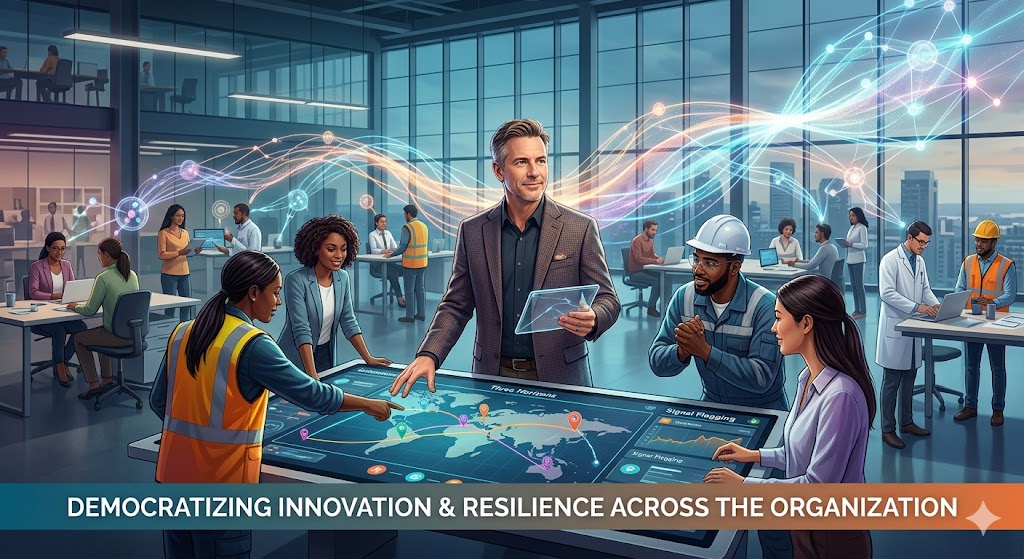
Rather than relying on expensive, static annual reports, forward-thinking organizations implement internal signal-flagging platforms. These are digital spaces where any employee—from the warehouse to the sales floor—can post a “signal”: a new competitor product, a strange customer request, or a niche technological development. By tagging and aggregating these signals, patterns emerge that would be invisible to a centralized strategy team.

Scenario Planning Workshops

Foresight is a muscle that requires regular exercise. Collective scenario planning involves moving away from “telling the future” and toward “practicing the future.” Using cross-functional roleplay and “pre-mortems,” teams can explore “What If?” scenarios together. This creates a shared mental map of potential disruptions, ensuring that if a crisis or opportunity hits, the organization has already mentally rehearsed its response.

Innovation Gamification

To drive engagement, organizations can utilize internal prediction markets or incentive structures. By gamifying the spotting of significant market shifts or technological milestones, you tap into the collective intelligence of the crowd. This doesn’t just generate data; it cultivates a culture of curiosity where employees feel that their unique perspective on the horizon is both valued and rewarded.

FutureHacking™: A Framework for Collective Anticipation

To move beyond mere observation, organizations can employ Braden Kelley’s FutureHacking™ methodology that helps any employee or entrepreneur become their own futurist. This human-centered approach focuses on identifying and analyzing “weak signals”—those subtle indicators of change that are often ignored by traditional strategic planning. By engaging the entire workforce in this process, FutureHacking™ transforms foresight from a static report into a dynamic, ongoing capability. It empowers individuals at every level to look beyond the immediate horizon, challenge existing assumptions, and actively design the future rather than simply reacting to it. This methodology ensures that innovation isn’t just a localized event, but a continuous, organization-wide practice of sensing and responding to the next big shift.

By equipping the workforce with these tools, foresight shifts from a mysterious executive ritual into a transparent, participatory process that builds organizational agility from the ground up.

V. Overcoming the Cultural Barriers

The primary obstacles to collective foresight are rarely technological; they are cultural. Transitioning from a top-down visionary model to a distributed sensing model requires a fundamental shift in how an organization values information and handles dissent.

Psychological Safety: The Bedrock of Foresight

For collective foresight to function, employees must feel safe to share “uncomfortable” truths. If a culture punishes those who point out the obsolescence of a flagship product or the rise of a disruptive competitor, the organization’s early warning system will go silent. Building psychological safety ensures that contrarian views are viewed as strategic assets rather than signs of disloyalty.

The “Not My Job” Syndrome

Foresight is often viewed as an “extra” task that sits outside an employee’s core responsibilities. To overcome this, organizations must redefine foresight as a core competency for every role. Whether in HR, finance, or operations, understanding how the future might impact one’s specific domain is essential for long-term excellence. We must move from the idea of a “Strategy Department” to a “Strategy Culture.”

Incentivizing Curiosity

Most corporate structures are designed to reward execution and efficiency—doing today’s job better. However, collective foresight requires exploration. To bridge this gap, leadership must find ways to celebrate and reward the “scouts” within the company. This means recognizing not just the success of a project, but the value of the insight that prevented a failure or identified a new path forward.

Reframing the Goal: The objective is to shift the internal narrative from “knowing the answer” to “asking the right questions.”

VI. Conclusion: From Prediction to Preparedness

The ultimate goal of fostering collective foresight is not to turn every employee into a fortune teller. It is to move the organization from a posture of prediction to one of preparedness. In a world of constant flux, being “right” about the future is often a matter of luck; being “ready” for multiple futures is a matter of design.

The Shift in Mindset

When foresight is democratized, the internal narrative shifts. It is no longer about following a fixed five-year plan set by the board; it is about maintaining a living, breathing map of possibilities. This shift ensures that the organization remains agile, capable of pivoting not because it was told to, but because it saw the turn in the road coming from a mile away.

The Competitive Advantage

Organizations that master collective foresight move faster than their competitors. This isn’t just because they have better information, but because the “why” of a pivot is already understood at every level of the company. When change is co-created, the friction of implementation evaporates. Strategy becomes a conversation, and innovation becomes a shared responsibility.

Final Call to Action: Stop looking for a crystal ball in the executive suite. Your most powerful early warning system is already on your payroll. Empower your people, build the infrastructure for their insights to reach the surface, and remember: The future is too big for one room to hold.

Frequently Asked Questions

What is the difference between executive foresight and collective foresight?

Executive foresight relies on a small group of leaders to predict the future, often creating bottlenecks and missing “weak signals.” Collective foresight democratizes this process, leveraging the diverse perspectives of the entire workforce to build a more responsive, distributed “anticipatory muscle.”

How can an organization start building collective foresight?

It begins by creating psychological safety and implementing simple tools like signal-flagging platforms. By encouraging employees at all levels to share observations about market shifts or customer friction, foresight moves from a boardroom ritual to a core organizational competency.

Why is cognitive diversity important for strategic planning?

Cognitive diversity acts as a filter against executive bias. When people from different departments—like engineering, sales, and HR—examine the same trend, they identify different risks and opportunities, resulting in a more robust and realistic view of potential futures.

Image credits: Gemini

Subscribe to Human-Centered Change & Innovation WeeklySign up here to join 17,000+ leaders getting Human-Centered Change & Innovation Weekly delivered to their inbox every week.