Tag Archives: capitalism

Neo-Feudalism and Innovation Impact

A System Designed to Concentrate Power – or Accelerate Breakthroughs?

LAST UPDATED: March 27, 2026 at 4:55 PM
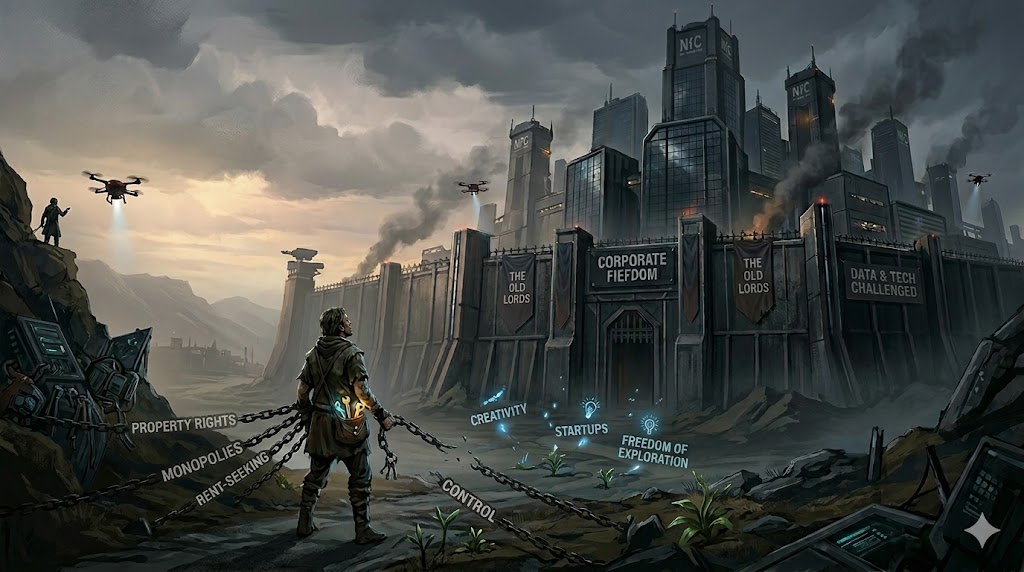
Neo-Feudalism and Innovation Impact

by Braden Kelley and Art Inteligencia


The Return of Lords and Serfs — But This Time It’s Digital

For decades, we’ve told ourselves a reassuring story about progress. Markets would open. Technology would democratize opportunity. Innovation would decentralize power. The barriers to entry would fall, and with them, the dominance of entrenched elites.

And yet, as we step back and observe the system we’ve actually built, a different pattern begins to emerge. Power is concentrating, not dispersing. A small number of platforms, institutions, and individuals exert outsized influence over how value is created, distributed, and captured. Access — whether to customers, capital, data, or opportunity — is increasingly mediated by gatekeepers.

We may not call them lords. We may not call ourselves serfs. But the structural similarities are becoming difficult to ignore.

This is the uncomfortable premise at the heart of the growing conversation around neo-feudalism: that despite the language of free markets and open innovation, we are drifting toward a system defined less by competition and more by control — less by ownership and more by dependency.

At the same time, we are living through one of the most explosive periods of innovation in human history. Artificial intelligence, biotechnology, climate tech, and digital platforms are reshaping industries at a pace that would have been unimaginable even a generation ago. The capacity to innovate has never been greater.

How can we be experiencing both unprecedented innovation and unprecedented concentration of power at the same time?

Is this concentration a temporary distortion — something the system will eventually correct? Or is it an emergent feature of how innovation now scales in a digital, platform-driven world?

What does this mean for the future of innovation itself?

Because innovation is never neutral. It does not exist in a vacuum. It is shaped — constrained or accelerated — by the systems in which it operates. If those systems are evolving toward something that resembles a modern form of feudalism, then the implications extend far beyond markets and technology. They touch how we work, how we live, how we build wealth, and how we relate to one another.

Before we can assess whether neo-feudalism is helping or hindering innovation, we must first understand what it actually is — and what it is not.

What Is Neo-Feudalism? A Clear, Modern Definition

Neo-feudalism is a term increasingly used to describe a modern socio-economic system that echoes the structural dynamics of medieval feudalism, but in a contemporary, often digital, context. While not a perfect one-to-one comparison, the analogy is powerful because it highlights a shift away from open, competitive markets toward systems defined by concentrated power, controlled access, and growing dependency relationships.

At its core, neo-feudalism describes a world in which a relatively small number of dominant entities — whether corporations, platforms, or institutions — exercise outsized influence over how value is created and distributed. Individuals and smaller organizations, in turn, become increasingly dependent on these entities for access to customers, income, infrastructure, and opportunity.

Several key characteristics define this emerging pattern:

Concentration of Power: Economic and technological power is increasingly concentrated in the hands of a few dominant players, creating asymmetries that are difficult for others to overcome.

Control of Access: Instead of owning “land” in the traditional sense, modern power centers control platforms, ecosystems, and infrastructure — effectively determining who gets access to markets and audiences.

Reduced Mobility: Upward mobility becomes more constrained as success is tied to proximity to, or permission from, these dominant entities.

Dependency Relationships: Workers, creators, and even companies become reliant on platforms and systems they do not control, trading autonomy for access and stability.

This dynamic shows up clearly in today’s economy. Digital platforms function as gatekeepers to visibility and revenue. The gig economy often shifts risk downward while concentrating rewards upward. Ownership — whether of assets, data, or distribution channels — is increasingly replaced by access-based models.

It is important to note that neo-feudalism is not a universally accepted or precisely defined concept. Variations of the idea have emerged to describe different aspects of the same shift.

Techno-feudalism emphasizes the role of large technology platforms in exerting control over digital markets and behaviors. Corporate neo-feudalism highlights the growing influence of multinational corporations as quasi-governing entities. Neo-medievalism points to a broader fragmentation of authority, where power is distributed across states, corporations, and networks rather than centralized in traditional nation-states.

Whether one views neo-feudalism as a precise diagnosis or simply a provocative metaphor, it serves an important purpose: it forces us to examine how power, access, and opportunity are actually structured in the modern economy — not how we assume they function.

And that distinction matters, because the way we define the system ultimately shapes how we understand its impact on innovation.
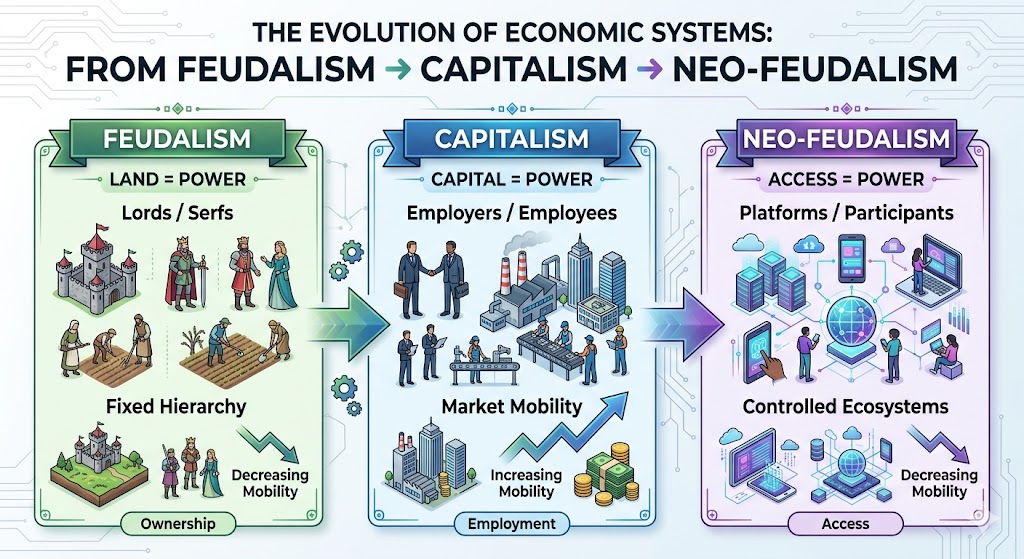
Evolution of Economics Systems Infographic

What Thought Leaders Are Saying (Pro and Con)

As the idea of neo-feudalism has gained traction, it has sparked a vigorous debate among economists, technologists, and social theorists. Some argue that we are witnessing a fundamental shift in the structure of the economy. Others contend that the term is more metaphor than reality. Understanding this debate is essential, because how we interpret the system shapes how we respond to it.

The “Yes, This Is Neo-Feudalism” Camp

Proponents of the concept argue that capitalism has evolved into something meaningfully different. In their view, markets are no longer truly open. Instead, they are increasingly controlled by dominant platforms that act as gatekeepers, setting the rules of participation and extracting value from those who depend on them.

This perspective suggests that we are moving toward a system where economic power resembles sovereignty. A small number of organizations exert control not just over markets, but over infrastructure, data flows, and even the terms of social interaction. In this view, individuals and businesses operate less as independent actors and more as participants within controlled ecosystems.

Some thought leaders have gone so far as to label this shift “techno-feudalism,” arguing that the owners of digital platforms function much like modern-day lords — owning the “land” on which economic activity takes place and collecting rents from those who operate within it.

The “No, This Is Still Capitalism” Camp

Critics of the neo-feudalism framing argue that while inequality and concentration have increased, the underlying system remains capitalism. Markets still exist, competition still occurs, and individuals are not bound to specific employers or platforms in the way serfs were bound to land.

From this perspective, the term “neo-feudalism” risks overstating the case and obscuring more practical diagnoses such as monopoly power, regulatory failure, or the natural dynamics of late-stage capitalism. These critics argue that using an imprecise metaphor may make the problem feel more dramatic, but less actionable.

They also point out that technological disruption continues to create new entrants and new forms of competition, even in industries that appear highly concentrated.

The Middle Ground: A Useful Lens, Not a Literal System

Between these two poles lies a more nuanced view. In this framing, neo-feudalism is not a literal description of the current system, but a lens that helps illuminate important structural shifts—particularly around power, access, and dependency.

This perspective acknowledges that while we are not returning to medieval conditions, we are seeing the emergence of dynamics that echo them in meaningful ways. The language of neo-feudalism, therefore, becomes a way to surface risks that might otherwise remain hidden behind the more familiar vocabulary of markets and competition.

Ultimately, the debate itself is revealing. The lack of consensus reflects the reality that we are in a transitional moment. The system is evolving faster than our ability to define it, and the labels we use are struggling to keep up.

But regardless of what we call it, the underlying question remains the same: how do these structural shifts influence the way innovation is created, scaled, and distributed?

The Case FOR Neo-Feudalism as a Positive Force for Innovation

At first glance, the idea that neo-feudalism could have a positive impact on innovation feels counterintuitive. After all, concentration of power and dependency relationships seem fundamentally at odds with the open, exploratory nature of innovation. But history — and the present moment — suggest a more complicated reality.

Under certain conditions, the very structures that concentrate power can also accelerate innovation in ways that more distributed systems struggle to match.

Stability Enables Long-Term Investment

One of the defining advantages of concentrated power is the ability to think and act long term. Large, dominant organizations have the resources and stability to invest in high-risk, high-reward initiatives that smaller players simply cannot afford. From artificial intelligence to space exploration to advanced biotechnology, many of today’s most ambitious innovations are being funded and scaled by entities with near-sovereign levels of capital and control.

Platforms as Innovation Ecosystems

Modern platforms function as structured environments where innovation can occur rapidly. By providing standardized tools, infrastructure, and access to large user bases, they reduce friction for developers, entrepreneurs, and creators. In this sense, innovation happens “inside the castle walls,” where the rules are clear, the tools are accessible, and the pathways to scale are well established.

Talent Aggregation and Network Effects

Concentrated systems tend to attract concentrated talent. The best engineers, designers, and thinkers often cluster around leading organizations and ecosystems, creating dense networks of expertise. These environments increase the likelihood of idea collisions, accelerate learning cycles, and amplify the pace of innovation.

Reduced Coordination Costs

In highly decentralized systems, innovation can stall due to fragmentation, misalignment, and slow decision-making. Centralized structures, by contrast, can move quickly. Decisions are made faster, resources are allocated more efficiently, and large-scale initiatives can be executed without the same level of negotiation or compromise.

This speed can be a decisive advantage in domains where timing matters, from technology development to market entry.

The Rise of Patronage 2.0

In many ways, today’s innovation economy mirrors a modern form of patronage. Venture capital firms, large platforms, and corporate innovation arms provide funding, infrastructure, and distribution in exchange for equity, data, or dependence. While this relationship is not without tradeoffs, it enables individuals and startups to pursue ideas that might otherwise never get off the ground.

For many innovators, aligning with a powerful “patron” is the fastest — and sometimes only — path to scale.

Seen through this lens, neo-feudal dynamics do not simply constrain innovation. They can also create the conditions for rapid advancement, particularly at the frontier of technology.

The question, then, is not whether these structures can produce innovation. Clearly, they can. The more important question is what kinds of innovation they produce — and who ultimately benefits from them.
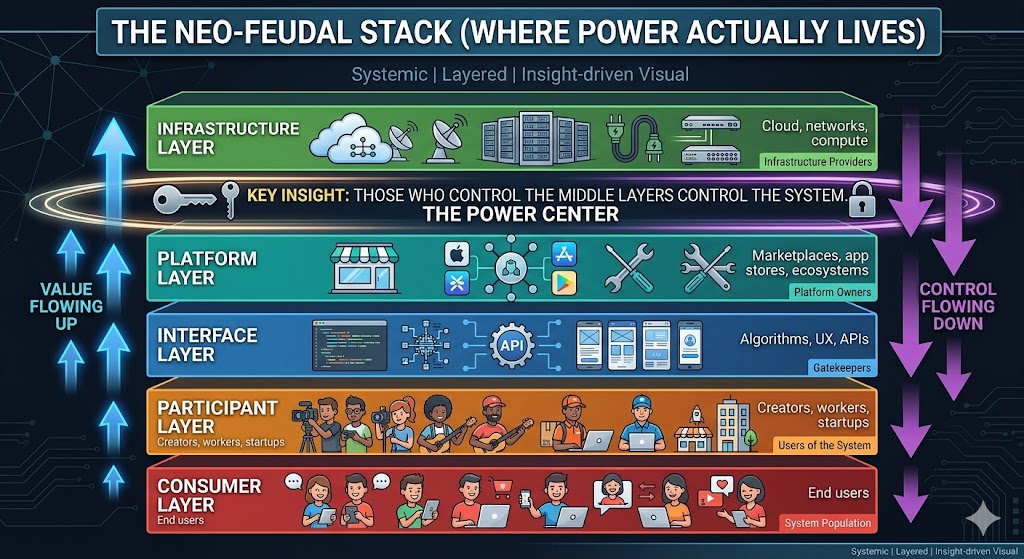
Neo-Feudal Stack Infographic

The Case AGAINST Neo-Feudalism as a Constraint on Innovation

While concentrated power can accelerate certain kinds of innovation, it can just as easily suppress others. From a human-centered perspective, neo-feudal dynamics introduce structural constraints that limit who gets to innovate, what gets built, and how value is ultimately distributed.

In many cases, the same forces that enable scale at the top create friction, dependency, and invisibility at the edges.

Innovation Becomes Permission-Based

In a neo-feudal system, access is controlled. Platforms, investors, and dominant institutions act as gatekeepers, determining which ideas receive funding, visibility, and distribution. This shifts innovation from an open exploration to a permission-based system, where success depends as much on alignment with gatekeepers as it does on the quality of the idea itself.

The risk is clear: truly disruptive ideas — especially those that threaten existing power structures — may never see the light of day.

Decreased Diversity of Thought

When influence is concentrated within a relatively small group, so too are perspectives. Innovation thrives on diverse viewpoints, lived experiences, and unconventional thinking. But tightly connected elite networks can become echo chambers, reinforcing shared assumptions and filtering out ideas that fall outside the dominant narrative.

The result is a narrowing of the innovation pipeline at precisely the moment when broader input is most needed.

Talent Trapped in Dependency Loops

For many workers, creators, and entrepreneurs, participation in the modern economy requires dependence on platforms they do not control. Income, visibility, and growth are tied to algorithms, policies, and business models that can change without warning.

This uncertainty discourages risk-taking. When livelihoods are fragile, people optimize for stability rather than exploration — reducing the willingness to pursue bold or unconventional ideas.

Extraction Over Creation

As platforms mature, their incentives often shift from enabling value creation to maximizing value capture. Business models become optimized for rent extraction — taking a percentage of transactions, attention, or data — rather than expanding the overall pool of value.

This can distort innovation priorities, encouraging incremental improvements that increase engagement or monetization rather than breakthroughs that create entirely new value.

Hidden Fragility Behind Scale

Highly centralized systems can appear robust due to their size and reach, but they often lack resilience. When innovation is concentrated within a few dominant entities, failures can have outsized consequences. At the same time, alternative approaches and redundant systems are less likely to emerge, reducing the overall adaptability of the ecosystem.

Erosion of the Innovation Commons

Perhaps the most significant long-term risk is the erosion of shared spaces for experimentation and collaboration. As knowledge, tools, and data become increasingly proprietary, the “commons” that historically fueled innovation begin to shrink.

What was once open becomes gated. What was once shared becomes owned. And what was once a collective engine for progress becomes fragmented across competing silos.

From this perspective, neo-feudalism does not just shape innovation — it constrains its potential. It limits participation, narrows possibility, and shifts the balance from exploration to control.

Which raises a deeper question: even if innovation continues, is it the kind of innovation we actually need?
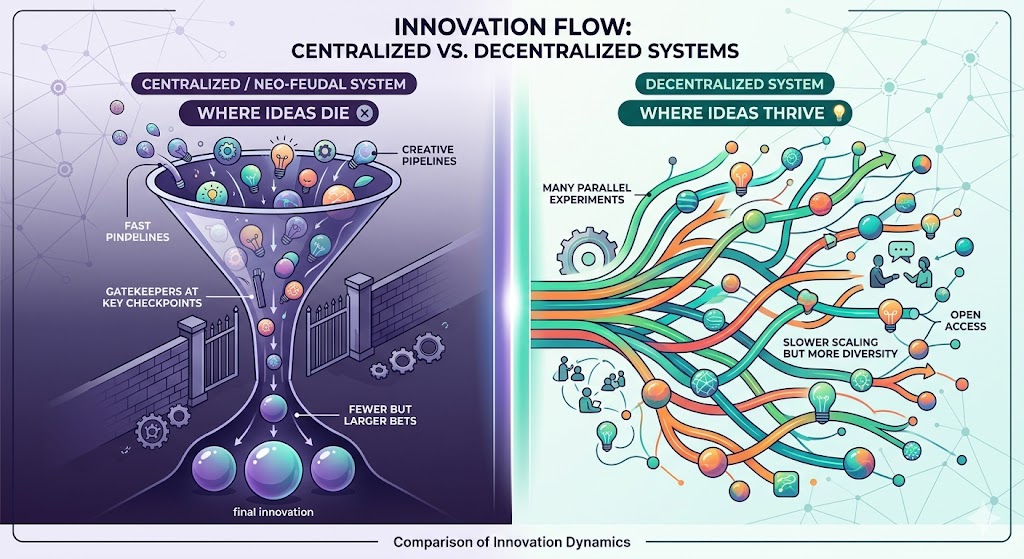
Centralized vs. Decentralized Innovation

Editorial Perspective: Beyond Innovation — Impacts on People, Society, and the Future

Innovation is only one dimension of neo-feudalism’s impact. To understand the full picture, we must examine how these dynamics affect personal finance, customer experience, employee experience, societal cohesion, and the broader trajectory of humanity.

Personal Finance: Ownership vs. Access

Neo-feudal structures often shift value from ownership to access. Individuals increasingly rent rather than own assets — from housing to software, from transportation to digital goods. This reduces opportunities for wealth accumulation and long-term financial security, creating dependency on centralized platforms and institutions.

Customer Experience: Convenience vs. Control

Platforms often deliver seamless, integrated experiences that delight customers. Yet this convenience comes at a cost: reduced choice, limited transparency, and dependence on a small number of dominant providers. What feels like freedom can also become subtle control.

Employee Experience: Flexibility vs. Precarity

The rise of gig work and contract-based employment provides flexibility, but often at the expense of security, benefits, and long-term stability. Workers may gain autonomy but lose agency over income, career trajectory, and participation in the value they create.

Societal Cohesion: Fragmentation vs. Stability

Neo-feudal structures create “walled gardens” — both digital and physical — that fragment communities and weaken shared social identity. The focus shifts from collective well-being to alignment with the dominant gatekeepers, eroding trust and social cohesion over time.

Innovation Paradox

The same structures that accelerate innovation at the top can suppress it at the edges. While resources and talent are concentrated in elite hubs, the diversity, experimentation, and autonomy that fuel broader innovation ecosystems may diminish, limiting society’s overall creative potential.

Ultimately, the question is not whether neo-feudalism can produce innovation —it can. The critical questions are: what kinds of innovation, who benefits from it, and what broader costs are being imposed on society?

Understanding these trade-offs is essential for leaders, policymakers, and innovators seeking to design systems that are not only efficient but also equitable, resilient, and human-centered.
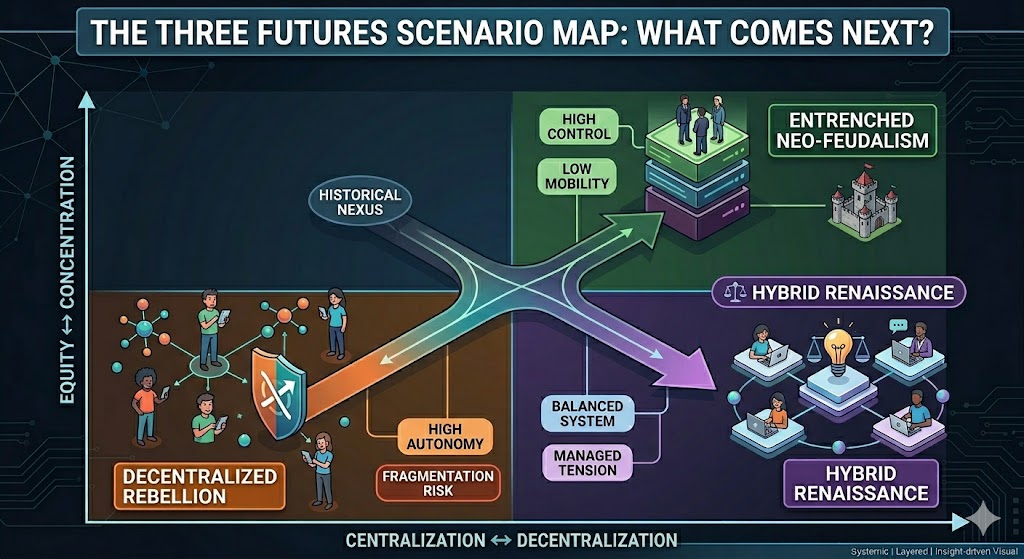
Three Neo-Feudalism Future Scenarios

What Comes Next? The Future of Humanity in a Neo-Feudal Trajectory

Looking ahead, the trajectory of neo-feudalism raises profound questions about the future of innovation, society, and humanity itself. While the current system exhibits both benefits and constraints, the ultimate outcome is not predetermined. Several potential futures are emerging.

1. Entrenched Neo-Feudalism

In this scenario, the concentration of power solidifies. Large platforms, corporations, and institutions become the primary arbiters of opportunity, innovation, and wealth. Innovation continues to occur, but primarily within the bounds set by dominant entities, reinforcing dependency and inequality.

2. Decentralized Rebellion

Technologies such as blockchain, decentralized autonomous organizations (DAOs), and open-source platforms could empower new models of governance and collaboration. Power becomes more distributed, enabling innovation and value creation outside centralized structures. Communities reclaim ownership, autonomy, and agency over their economic and creative lives.

3. Hybrid Renaissance (Most Likely)

A middle path may emerge in which concentrated power is balanced by decentralizing forces. Platforms and institutions retain some influence but are complemented by regulatory frameworks, public oversight, and decentralized networks. This hybrid system could preserve the benefits of scale and stability while expanding participation and opportunity for a wider range of innovators.

Each of these scenarios carries implications for innovation, wealth distribution, social cohesion, and human potential. Leaders and policymakers face the challenge of shaping a system that maximizes innovation while mitigating dependency, inequality, and fragility.

The critical question is this: will humanity design a future where innovation serves the many, or will it remain confined to the few who control the gates?

EDITOR’S NOTE: Stay tuned for future articles examining the impact on innovation of planned obsolescence, right to repair, CONTACT ME WITH OTHER SUGGESTIONS, etc.

Image credits: Gemini

Content Authenticity Statement: The topic area, key elements to focus on, etc. were decisions made by Braden Kelley, with a little help from ChatGPT to clean up the article and add citations.

Subscribe to Human-Centered Change & Innovation WeeklySign up here to get Human-Centered Change & Innovation Weekly delivered to your inbox every week.

We Are Starving Our Innovation Economy

We Are Starving Our Innovation Economy

GUEST POST from Greg Satell

The Cold War was fundamentally different from any conflict in history. It was, to be sure, less over land, blood and treasure than it was about ideas. Communist countries believed that their ideology would prevail. They were wrong. The Berlin Wall fell and capitalism, it seemed, was triumphant.

Today, however, capitalism is in real trouble. Besides the threat of a rising China, the system seems to be crumbling from within. Income inequality in developed countries is at 50-year highs. In the US, the bastion of capitalism, markets have weakened by almost every imaginable metric. This wasn’t what we imagined winning would look like.

Yet we can’t blame capitalism. The truth is that its earliest thinkers warned about the potential for excesses that lead to market failure. The fact is that we did this to ourselves. We believed that we could blindly leave our fates to market and technological forces. We were wrong. Prosperity doesn’t happen by itself. We need to invest in an innovation economy.

Capitalism’s (Seemingly) Fatal Contradiction

Anyone who’s taken an “Economics 101” course knows about Adam Smith and his invisible hand. Essentially, the forces of self-interest, by their very nature, work to identify the optimal price that attracts just enough supply of a particular good or service to satisfy demand. This magical equilibrium point creates prosperity through an optimal use of resources.

However, some argued that the story wasn’t necessarily a happy one. After all, equilibrium implies a lack of economic profit and certainly businesses would want to do better than that. They would seek to gain a competitive advantage and, in doing so, create surplus value, which would then be appropriated to accumulate power to rig the system further in their favor.

Indeed, Adam Smith himself was aware of this danger. “People of the same trade seldom meet together, even for merriment and diversion, but the conversation ends in a conspiracy against the public, or in some contrivance to raise prices,” he wrote. In fact, the preservation of free markets was a major concern that ran throughout his work.

Yet as the economist Joseph Schumpeter pointed out, with innovation the contradiction dissipates. As long as we have creative destruction, market equilibriums are constantly shifting and don’t require capitalists to employ extractive, anti-competitive practices in order to earn excellent profits.

Two Paths To Profit

Anyone who manages a business must pursue at least one of two paths to profit. The first is to innovate. By identifying and solving problems in a competitive marketplace, firms can find new ways to create, deliver and capture value. Everybody wins.

Google’s search engine improved our lives in countless ways. Amazon and Walmart have dramatically improved distribution of goods throughout the economy, making it possible for us to pay less and get more. Pfizer and Moderna invested in an unproven technology that uses mRNA to deliver life-saving molecules and saved us from a deadly pandemic.

Still, the truth is that the business reality is not, “innovate or die,” but rather “innovate or find ways to reduce competition.” There are some positive ways to tilt the playing field, such as building a strong brand or specializing in some niche market. However, other strategies are not so innocent. They seek to profit by imposing costs on the rest of us

The first, called rent seeking, involves businesses increasing profits through getting litigation passed in their favor, as when car dealerships in New Jersey sued against Tesla’s direct sales model. The second, regulatory capture, seeks to co-opt agencies that are supposed to govern industry, resulting in favorable implementation and enforcement of the legal code.

Why “Pro-Business” Often Means Anti-Market

Corporations lobby federal, state and local governments to advance their interests and there’s nothing wrong with that. Elected officials should be responsive to their constituents’ concerns. That is, after all, how democracy is supposed to work. However, very often business interests try to maintain that they are arguing for the public good rather than their own.

Consider the issue of a minimum wage. Businesses argue that government regulation of wages is an imposition on the free market and that, given the magical forces of the invisible hand, letting the market set the price for wages would produce optimal outcomes. Artificially increasing wages, on the other hand, would unduly raise prices on the public and reduce profits needed to invest in competitiveness.

This line of argument is nothing new, of course. In fact, Adam Smith addressed it in The Wealth of Nations nearly 250 years ago:

Our merchants and master-manufacturers complain much of the bad effects of high wages in raising the price, and thereby lessening the sale of their goods both at home and abroad. They say nothing concerning the bad effects of high profits. They are silent with regard to the pernicious effects of their own gains. They complain only of those of other people.

At the same time corporations have themselves been undermining the free market for wages through the abuse of non-compete agreements. Incredibly, 38% of American workers have signed some form of non-compete agreement. Of course, most of these are illegal and wouldn’t hold up in court, but serve to intimidate employees, especially low-wage workers.

That’s just for starters. Everywhere you look, free markets are under attack. Occupational licensing, often the result of lobbying by trade associations, has increased five-fold since the 1950s. Antitrust regulation has become virtually nonexistent, while competition has been reduced in the vast majority of American industries.

Perhaps not surprisingly, while all this lobbying has been going on, recent decades have seen business investment and innovation decline, and productivity growth falter while new business formation has fallen by 50%. Corporate profits, on the other hand, are at record highs.

Getting Back On Track

At the end of World War II, America made important investments to create the world’s greatest innovation economy. The GI Bill made what is perhaps the biggest investment ever in human capital, sending millions to college and creating a new middle class. Investments in institutions such as the National Science Foundation (NSF) and the National Institutes of Health (NIH) would create scientific capital that would fuel US industry.

Unfortunately, we abandoned that very successful playbook. Over the past 20 years, college tuition in the US has roughly doubled in the last 20 years. Perhaps not surprisingly, we’ve fallen to ninth among OECD countries for post-secondary education. The ones who do graduate are often forced into essentially decades of indentured servitude in the form of student loans.

At the same time, government investment in research as a percentage of GDP has been declining for decades, limiting our ability to produce the kinds of breakthrough discoveries that lead to exciting new industries. What passes for innovation these days displaces workers, but does not lead to significant productivity gains. Legislation designed to rectify the situation and increase our competitiveness stalled in the Senate.

So after 250 years, capitalism remains pretty much as Adam Smith first conceived, powerful yet fragile, always at risk of being undermined and corrupted by the same basic animal spirits that it depends on to set prices efficiently. He never wrote, nor is there any indication he ever intended, that markets should be left to their own devices. In fact, he and others warned us that markets need to be actively promoted and protected.

We are free to choose. We need to choose more wisely.

— Article courtesy of the Digital Tonto blog
— Image credits: Microsoft CoPilot

Subscribe to Human-Centered Change & Innovation WeeklySign up here to join 17,000+ leaders getting Human-Centered Change & Innovation Weekly delivered to their inbox every week.

What is Killing Capitalism in America?

What is Killing Capitalism in America?

GUEST POST from Greg Satell

There’s no doubt that capitalism in America is in bad shape. Higher market share concentration in industry is leading to higher profits for corporate giants, but also to higher prices and lower wages along with decreased innovation and productivity growth as well as a long-term decline in entrepreneurship.

You would think that the rise of progressive politicians like Bernie Sanders and Alexandria Ocasio-Cortez would be responsible for the decline in the power of capitalism and the demise of free markets. However, a new book by NYU finance professor Thomas Philippon, titled The Great Reversal, argues exactly the opposite.

In fact, he shows through meticulous research how capitalists themselves are killing capitalism. Through the charade of “pro-business” policies, industry leaders have been increasing regulation and limiting competition over the past 20 years. We need to right the ship and return to an embrace of free markets, entrepreneurship and innovation.

A Rise in Rent Seeking and Regulatory Capture

The goal of every business is to defy markets. Any firm at the mercy of supply and demand will find itself unable to make an economic profit—that is profit over and above its cost of capital. In other words, unless a firm can beat Adam’s Smith’s invisible hand, investors would essentially be better off putting their money in the bank.

That leaves entrepreneurs and managers with two viable strategies. The first is innovation. Firms can create new and better products that produce new value. The second, rent seeking, is associated with activities like lobbying and regulatory capture, which seeks to earn a profit without creating added value. In fact, rent seeking often makes industries less competitive.

There is abundant evidence that over the last 20 years, American firms have shifted from an innovation mindset to one that focuses more on rent seeking. First and foremost, has been the marked increase in lobbying expenditures, which since 1998 have more than doubled. Firms invest money for a reason, they expect a return.

It seems like they are getting their money’s worth. Corporate tax rates in the US have steadily decreased and are now among the lowest in the developed world. Occupational licensing, often the result of lobbying by trade associations, has increased fivefold since the 1950s. Innovative firms such as Tesla face legislation that seeks to protect incumbent businesses. These restrictions have coincided with a decrease in the establishment of new firms.

Perhaps most importantly, the increasingly lax regulatory environment has resulted in a boom in mergers and acquisitions, which led to increased market power among fewer firms and increased barriers to entry for new market entrants.

The Decline of Competitive Markets

To understand how markets have died in the US, you only have to look at the airline industry. After years of mergers just four airlines control roughly two thirds of the market. Yet even that understates the problem. On individual routes, there are often only one or two competitors. We’ve all experienced the results: increasingly higher prices and worse service.

Airlines are far from an isolated case. Consider the cable industry, where consolidation has resulted in broadband prices that are almost 50% higher than in Europe. For mobile phone service, Americans are being charged more than twice what our European friends are. Across a wide swath of industries, increasing concentration is leading to lower competition.

Yet the problem is more than just Americans getting ripped off by corporations who are able to charge us more and give us less. Fat and happy industries tend to underinvest and become less competitive over time, enjoying short-term profits but putting the economic well-being of the country in serious jeopardy.

Again, there is evidence that this is exactly what’s happening. There is abundant data showing that American corporations are underinvesting, even while they have been reporting strong profits to investors.

Entrepreneurial Headwinds

With protected markets and healthy profits, recent decades have been great for incumbent businesses, but not so great for those who want to start new ones. In fact, entrepreneurship in America recently hit a 40-year low and a recent report by the Brookings Institution found that business dynamism in general has been declining since the 80s.

It’s not hard to see why. A recent study found that about half of all college students struggle with food insecurity even as tuition has risen from an average of $15,160 in 1988 to $34,740 in 2018. Not surprisingly, student debt is exploding. It has nearly tripled in the last decade. In fact student debt has become so onerous that it now takes about 20 years to pay off four years for college and even more for those who pursue a graduate degree.

So even the bright young people who don’t starve are often condemned to decades of what is essentially indentured servitude. That’s no way to run an entrepreneurial economy. In fact, a study done by the Federal Reserve Bank of Philadelphia found that student debt has a measurable negative impact on new business creation.

Another obstacle for entrepreneurs is our healthcare system which represents a huge economic burden. Consider that in the US healthcare expenditures account for roughly 18% of GDP. Most OECD countries spend roughly half that. Anyone who wants to start a business first needs to figure out where their health insurance will come from. Is it any wonder that entrepreneurship is declining in America?

Pro-Business Policies Are Often Anti-Market

The truth is that no business leader wants a free market. In fact, most of our efforts go toward tipping the playing field in our favor. Often, we do that in positive ways, such as building a trusted brand or innovating new products. Yet the incentives, if not the motivations, for rent seeking behavior are exactly the same.

For far too long pro-business lobbies have run rampant over our democracy. The Supreme Court’s Citizens United decision, which led to essentially unrestricted political donations, has made a bad situation worse. Members of Congress now spend roughly 30 hours a week “dialing for dollars” rather than tending to the nation’s business.

And we pay the price in higher prices, stagnant wages and worse service. Where we should be investing in the future, creating better infrastructure, schools and a cleaner healthier environment, instead we are spending it on tax breaks for businesses, even though research has shown that these incentives don’t promote economic growth.

It’s time to claim capitalism back for ourselves and promote free markets, entrepreneurship, innovation and public well-being. That’s how you build competitive markets and a healthy society.

— Article courtesy of the Digital Tonto blog
— Image credit: Pexels

Subscribe to Human-Centered Change & Innovation WeeklySign up here to get Human-Centered Change & Innovation Weekly delivered to your inbox every week.

We Were Wrong About What Drove the 21st Century

We Were Wrong About What Drove the 21st Century

GUEST POST from Greg Satell

Every era contains a prism of multitudes. World War I gave way to the “Roaring 20s” and a 50-year boom in productivity. The Treaty of Versailles sowed the seeds to the second World War, which gave way to the peace and prosperity post-war era. Vietnam and the rise of the Baby Boomers unlocked a cultural revolution that created new freedoms for women and people of color.

Our current era began with the 80s, the rise of Ronald Reagan and a new confidence in the power of markets. Genuine achievements of the Chicago School of economics led by Milton Friedman, along with the weakness Soviet system, led to an enthusiasm for market fundamentalism that dominated policy circles.

So it shouldn’t be that surprising that veteran Republican strategist Stuart Stevens wrote a book denouncing that orthodoxy as a lie. The truth is he has a point. But politicians can only convince us of things we already want to believe. The truth is that we were fundamentally mistaken in our understanding of how the world works. It’s time that we own up to it.

Mistake #1: The End Of The Cold War Would Strengthen Capitalism

When the Berlin Wall came down in 1989, the West was triumphant. Communism was shown to be a corrupt system bereft of any real legitimacy. A new ideology took hold, often called the Washington Consensus, that preached fiscal discipline, free trade, privatization and deregulation. The world was going to be remade in capitalism’s image.

Yet for anybody who was paying attention, communism had been shown to be bankrupt and illegitimate since the 1930s when Stalin’s failed collectivization effort and industrial plan led him to starve his own people. Economists have estimated that, by the 1970s, Soviet productivity growth had gone negative, meaning more investment actually brought less output. The system’s collapse was just a matter of time.

At the same time, there were early signs that there were serious problems with the Washington Consensus. Many complained that bureaucrats at the World Bank and the IMF were mandating policies for developing nations that citizens in their own countries would not accept. So called “austerity programs” led to human costs that were both significant and real. In a sense, the error of the Soviets was being repeated—ideology was put before people.

Today, instead of a capitalist utopia and an era of peace and prosperity, we got a global rise in authoritarian populism, stagnant wages, reduced productivity growth and weaker competitive markets. In particular in the United States, by almost every metric imaginable, capitalism has been weakened.

Mistake #2: Digital Technology Would Make Everything Better

In November 1989, the same year that the Berlin Wall fell, Tim Berners-Lee created the World Wide Web and ushered in a new technological era of networked computing that we now know as the “digital revolution.” Much like the ideology of market fundamentalism that took hold around the same time, technology was seen as determinant of a new, brighter age.

By the late 1990s, increased computing power combined with the Internet to create a new productivity boom. Many economists hailed the digital age as a “new economy” of increasing returns, in which the old rules no longer applied and a small initial advantage would lead to market dominance.

Yet by 2004, productivity growth had slowed again to its earlier lethargic pace. Today, despite very real advances in processing speed, broadband penetration, artificial intelligence and other things, we seem to be in the midst of a second productivity paradox in which we see digital technology everywhere except in the economic statistics.

Digital technology was supposed to empower individuals and reduce the dominance of institutions, but just the opposite has happened. Income inequality in advanced economies markedly increased. In America wages have stagnated and social mobility has declined. At the same time, social media has been destroying our mental health.

When Silicon Valley told us they intended to “change the world,” is this what they meant?

Mistake #3: Medical Breakthroughs Would Automatically Make Us Healthier

Much like the fall of the Berlin Wall and the rise of the Internet, the completion of the Human Genome Project in 2003 promised great things. No longer would we be at the mercy of terrible terrible diseases such as cancer and Alzheimer’s, but would design genetic therapies that would rewire our bodies to find off disease by themselves.

The advances since then have been breathtaking. The Cancer Genome Atlas, which began in 2005, helped enable doctors to develop therapies targeted at specific mutations, rather than where in the body a tumor happened to be found. Later, CRISPR revolutionized synthetic biology, bringing down costs exponentially.

The rapid development of Covid-19 vaccines have shown how effective these new technologies are. Scientists have essentially engineered new viruses containing the viral genome to produce a few proteins, just enough to provoke an immune response but not nearly enough to make us sick. 20 years ago, this would have been considered science fiction. Today, it’s a reality.

Yet we are not healthier. Worldwide obesity has tripled since 1975 and has become an epidemic in the United States. Anxiety and depression have as well. American healthcare costs continue to rise even as life expectancy declines. Despite the incredible advance in our medical capability, we seem to be less healthy and more miserable.

Worse Than A Crime, It Was A Blunder

Whenever I bring up these points among technology people, they vigorously push back. Surely, they say, you can see the positive effects all around you. Can you imagine what the global pandemic would be like without digital technologies? Without videoconferencing? Hasn’t there been a significant global decline in extreme poverty and violence?

Yes. There have absolutely been real achievements. As someone who spent roughly half my adult life in Eastern Bloc countries, I can attest to how horrible the Soviet system was. Digital technology has certainly made our lives more convenient and, as noted above, medical advances have been very real and very significant.

However, technology is a process that involves both revealing and building. Yes, we revealed the power of market forces and the bankruptcy of the Soviet system, but failed to build a more prosperous and healthy society. In much the same way, we revealed the power of the microchip, miracle cures and many other things, but failed to put them to use in such a way that would make us measurably better off.

When faced with a failure this colossal, people often look for a villain. They want to blame the greed of corporations, the arrogance of Silicon Valley entrepreneurs or the incompetence of government bureaucrats. The truth is, as the old saying goes, it was worse than a crime, it was a blunder. We simply believed that market forces and technological advancement would work their magic and all would be well in hand.

By now we should know better. We need to hold ourselves accountable, make better choices and seek out greater truths.

— Article courtesy of the Digital Tonto blog
— Image credit: Pixabay

Subscribe to Human-Centered Change & Innovation WeeklySign up here to get Human-Centered Change & Innovation Weekly delivered to your inbox every week.