Valuing the Void
LAST UPDATED: February 7, 2026 at 9:28AM
GUEST POST from Chateau G Pato
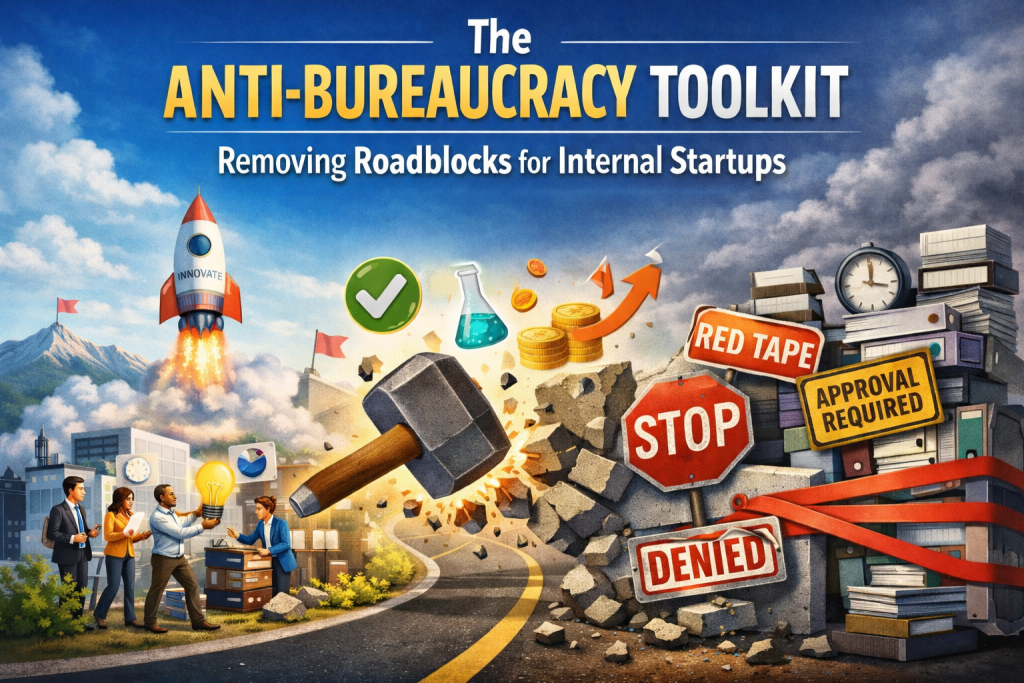
In the high-stakes theater of global business, we are obsessed with the act of addition. We add features, we add departments, we add “oversight,” and we certainly add more layers to the organizational chart. But as a human-centered change and innovation leader, I have observed a recurring tragedy: organizations are so busy building the “perfect” structure that they inadvertently build a tomb for their best ideas. To reach a state of continuous innovation, we must stop asking what we can add and start asking what we can subtract. We must learn to value the void.
Most leaders treat bureaucracy as a necessary evil — a sort of administrative tax on doing business. But in Braden Kelley’s book Stoking Your Innovation Bonfire, I highlight that bureaucracy is actually a form of innovation friction. It is the primary reason why “Value Creation” fails to translate into “Value Access.” If your organization’s internal hurdles are higher than the market’s barriers to entry, you aren’t just slow; you are obsolete. Measuring the impact of removing these hurdles is the key to unlocking what I call the Innovation Multiplier.
Organizations have spent decades perfecting the art of adding process. New rules are layered on top of old ones. Approval steps multiply. Forms proliferate. Metrics are created to manage other metrics. Over time, bureaucracy quietly expands until it becomes the invisible tax on every employee’s time, energy, and creativity.
Yet when leaders ask how much bureaucracy costs, the room often goes quiet. Bureaucracy is rarely measured directly. Instead, it hides inside cycle times, disengagement scores, missed opportunities, and innovation theater. To lead meaningful change, we must learn how to value the void — to measure not just what we add, but what we intentionally remove.
hype
“Bureaucracy is the only organizational asset that appreciates without ever creating value. The moment you remove it, value appears.”
— Braden Kelley
Why Removing Bureaucracy Creates Value
Bureaucracy exists for understandable reasons: risk management, coordination, compliance, and control. But over time, processes outlive their purpose. What once reduced risk begins to create it. What once enabled scale begins to suffocate adaptability.
Removing bureaucracy creates value not by doing more, but by enabling better work. When unnecessary steps disappear, organizations reclaim:
- Time that can be reinvested in customers
- Cognitive bandwidth for problem-solving and creativity
- Decision velocity that matches market reality
- Employee trust and ownership
The challenge is that absence is hard to measure. You can’t easily see the meeting that never happened or the approval that was never required. That is why leaders must adopt new ways of measuring impact.
The Metrics of Subtraction: Defining the Void
How do we measure “nothing”? We don’t. We measure the energy released when the nothingness is created. When you remove a layer of middle management or a redundant approval process, you create a “void” that is immediately filled by three critical things: Velocity, Autonomy, and Cognitive Surplus.
Velocity is easy to track — it’s the Cycle Time of Insight. How long does it take for a customer complaint to become a product feature? If the answer is “six months and four committee meetings,” your bureaucracy is costing you market share. Autonomy is measured by the Decision-to-Execution Ratio. Finally, Cognitive Surplus is the most human-centered metric of all. It is the mental energy previously wasted on navigating politics that is now spent on solving customer problems.
How to Measure the Impact of Removing Bureaucracy
Valuing the void requires leaders to rethink measurement. Traditional KPIs focus on outputs. Bureaucracy removal demands metrics that capture regained capacity and enabled outcomes.
- Time Recovered: Hours returned to value-creating work
- Decision Latency: Time from insight to action
- Employee Effort Scores: How hard it feels to get work done
- Opportunity Throughput: Ideas acted on versus stalled
The goal is not anarchy. It is intentional simplicity — designing just enough structure to support trust, speed, and accountability.
Case Study 1: Bayer’s Radical Decentralization
A few years ago, Bayer — a company with a history dating back to 1863 — realized it was being outpaced by more nimble competitors. The culprit was a rigid hierarchy where a simple marketing decision might require ten levels of approval. In 2024, they launched Dynamic Shared Ownership (DSO), a model designed to “delete” the bureaucracy from the inside out.
By shifting decision-making power to small, customer-centric teams, Bayer saw an immediate impact. In Southeast Asia, launch timelines for new consumer health products were slashed by 40% to 60%. The “void” created by removing middle-management bloat resulted in an additional €2 million in revenue within a single quarter. More importantly, employee engagement skyrocketed because the “friction” of daily work had finally been addressed.
Case Study 2: Haier and the Death of the Manager
The Chinese giant Haier offers perhaps the most extreme example of valuing the void. They famously eliminated 12,000 middle-management positions and restructured into 4,000 autonomous Microenterprises (MEs). In the Haier model, there are no “bosses” — only “entrepreneurs” and “customers.” By removing the bureaucratic layer that typically separates the two, they created a RenDanHeYi ecosystem where value is created in real-time.
When Haier acquired the legacy-heavy GE Appliances, many skeptics thought the model would fail. Instead, GE Appliances saw a massive surge in innovation, launching more products in three years than they had in the previous decade. The “void” here was the removal of the corporate antibody that resists change, allowing the American brand to pivot 3ith the speed of a startup while maintaining the scale of a global leader.
“Innovation is not about the lightbulb; it is about the wiring. If the wiring is clogged with bureaucratic corrosion, the light will never turn on. Removing bureaucracy is the act of polishing the connection between a human need and a technological solution.”
— Braden Kelley
Case Study 3: A Financial Services Firm Reclaims Decision Speed
A global financial services organization faced growing frustration from both customers and employees. Product changes required an average of fourteen approvals across compliance, legal, risk, and operations. While each step had once served a purpose, together they created months-long delays.
Instead of digitizing the process, leadership chose to question it. A cross-functional team mapped every approval step and asked a simple question: What risk does this step actually mitigate today?
The outcome was striking. Nearly 40 percent of approvals were found to be redundant, outdated, or symbolic rather than functional. By removing those steps and clarifying decision rights, the firm reduced:
- Product change cycle time by 52 percent
- Internal escalations by 33 percent
- Employee-reported frustration in engagement surveys
The most telling metric, however, was opportunity capture. Teams launched new offerings while competitors were still navigating internal approvals. The value came not from a new system, but from the intentional removal of friction.
Case Study 4: Healthcare Administration Without the Paper Chase
A regional healthcare provider struggled with clinician burnout. While leadership invested in wellness programs, exit interviews revealed a different story. Doctors and nurses were spending more time navigating administrative requirements than caring for patients.
Using a time-based bureaucracy audit, the organization tracked how much clinician time was consumed by non-clinical documentation, approvals, and reporting. The results were sobering: nearly 30 percent of working hours were absorbed by low-value administrative tasks.
By eliminating redundant documentation, simplifying reporting requirements, and trusting clinical judgment within defined boundaries, the organization achieved measurable outcomes:
- Patient-facing time increased by 18 percent
- Clinician burnout scores declined within six months
- Patient satisfaction scores improved without adding staff
In this case, the value of removing bureaucracy showed up not just in efficiency, but in humanity.
The Landscape of Lean Transformation
The quest to measure and remove bureaucracy has birthed a specialized ecosystem of companies. Companies like HYPE Innovation and Brightidea remain the gold standard for managing the “Innovation Pipeline” while bypassing traditional silos. Startups like Fairgen are using synthetic data to speed up consumer insights, effectively removing the “bureaucracy of research.” In the realm of organizational design, Boundaryless provides the frameworks for companies to transition into platform-based structures like Haier’s. Additionally, Perceptyx has revolutionized the way we measure the “Human Experience,” providing the hard data needed to prove that eliminating bureaucracy is the #1 driver of employee workload satisfaction in 2025.
In conclusion, the “void” is not empty space; it is potential energy. As an innovation speaker, I urge you to look at your organization’s “Chart of Innovation” and find the places where the lines stop or circle back on themselves. Those are the places where value goes to die. If you want to be a leader of Human-Centered Change, you must become an architect of the void. You must be willing to tear down the walls of bureaucracy so that the light of innovation can finally reach every corner of your company.
Insight & FAQ for Innovation Leaders
1. How do you define Value Access in the context of bureaucracy?
Value Access is the measure of how easily a customer or employee can interact with the value created. Bureaucracy acts as “friction” — the more layers and signatures required, the lower the Value Access, which ultimately devalues the innovation itself.
2. What is the most effective metric for measuring bureaucratic impact?
The most effective metric is “Time-to-Value.” By tracking how long an idea spends in “waiting states” versus “active development,” you can quantify the exact financial cost of your organization’s bureaucracy.
3. Can bureaucracy ever be a positive force for innovation?
Bureaucracy is often a mutation of necessary governance. The goal isn’t to remove all structure, but to ensure that the structure serves the human, not the other way around. We aim for “Minimum Viable Governance” that ensures safety and scale without sacrificing speed.
Image credits: 1 of 1,050+ FREE quotes for your meetings & presentations available at http://misterinnovation.com
 Sign up here to get Human-Centered Change & Innovation Weekly delivered to your inbox every week.