Tag Archives: strategic alignment

Important or Urgent?

Important or Urgent?

GUEST POST from Stefan Lindegaard

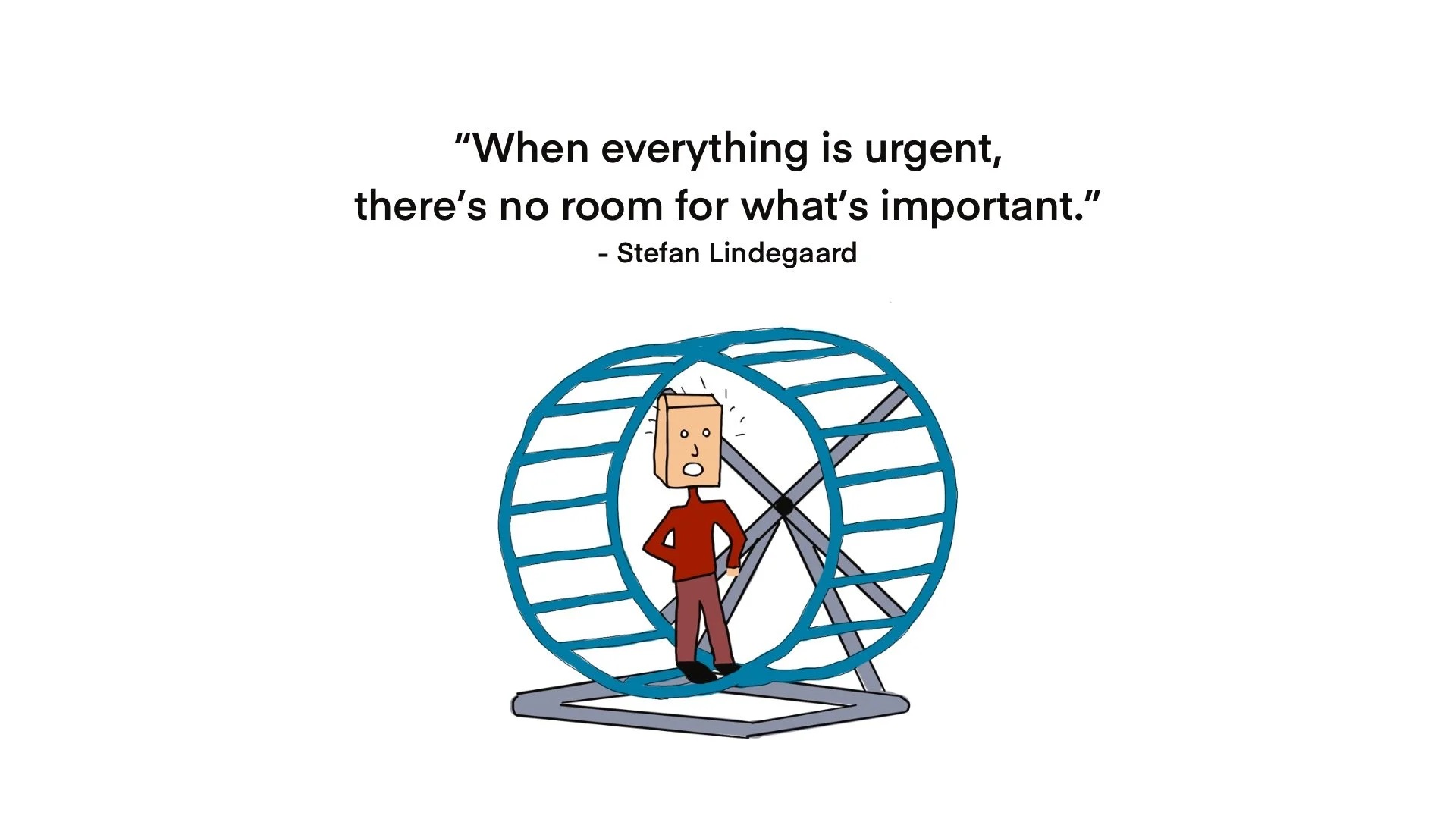
People in the corporate world today are busy – overwhelmingly so. Calendars are packed. Emails never stop. Meetings bleed into each other. On paper, it all looks like progress. But under the surface, something more critical is being lost.

This constant busyness creates the illusion of high performance. Output is visible. Actions are taken. Projects get delivered. But the deeper elements that actually build high performance – leadership development, trust, team learning, shared direction – are quietly being squeezed out.

In my work with leadership teams, I’ve seen this again and again: the very things that drive long-term success get de-prioritized, not because people don’t care, but because there’s simply no time left for them.

We talk a lot about performance, but real high-performance leadership isn’t built on urgency. It’s built on clarity, consistency, learning, and the ability to step back and make deliberate choices. When people are in constant motion, there’s no time for that. No time to coach. No time to reflect. No time to ask, “Are we even moving in the right direction?”

I often say that strong, high-performance teams are not just built – they are strategically designed and developed. That takes effort, intent, and most of all, space. But in the middle of never-ending activity, space is exactly what we don’t have.

This isn’t just a feeling. Research backs it up. Cal Newport’s Deep Work explores how modern work habits – from multitasking to nonstop notifications – have eroded our ability to do focused, meaningful work. Teresa Amabile and Steven Kramer, in The Progress Principle, found that what truly motivates people is making meaningful progress. But we interrupt that progress constantly with check-ins, firefighting, and shallow coordination. And studies like the Microsoft Work Trend Index show that most people feel they don’t get even a single hour of true focus time during their day.

It’s not that productivity is bad. But when busyness becomes the default mode, it turns into a trap – one that quietly undermines performance over time.

From a leadership and organizational development perspective, this is deeply concerning. I work with leaders who want to create better environments, who want to strengthen collaboration, sharpen execution, and grow their teams. But when every hour is accounted for, and every conversation is focused on delivery, there’s little room to ask the deeper questions that lead to change.

Worse still, in this kind of environment, team dynamics suffer. Feedback becomes reactive instead of developmental. Learning becomes fragmented. Strategy becomes surface-level. Psychological safety fades, because no one has the space to truly listen or adjust.

And that’s where Amy Edmondson’s research is so relevant. In her work on The Fearless Organization, she defines psychological safety as the shared belief that it’s safe to take interpersonal risks — to speak up, ask questions, make mistakes. It’s a cornerstone of high-performing teams. But here’s the catch: psychological safety doesn’t thrive in a culture of nonstop urgency. It requires time. Presence. Real conversations. If everyone is too busy, no one feels heard – and when people don’t feel heard, they stop contributing fully.

So it’s not just performance that suffers. It’s innovation. It’s trust. It’s the core of how teams work together.

What’s needed instead is a shift from reactive busyness to intentional performance. That means protecting time and mental space for what matters: coaching, alignment, leadership reflection, and team growth. It means giving teams the tools and structure to act with purpose, not just speed. It means creating a rhythm where delivery and development coexist.

High-performance isn’t about doing more. It’s about doing what matters – consistently, deliberately, and together.

So if your team is always too busy to reflect, to connect, to lead – that’s the signal something deeper needs to shift. Because when everything is urgent, we lose sight of what’s truly important.

And without that, performance is just motion.

Image Credit: Stefan Lindegaard

Subscribe to Human-Centered Change & Innovation WeeklySign up here to get Human-Centered Change & Innovation Weekly delivered to your inbox every week.

Best Practices and Pitfalls of Building an Innovation Ecosystem

Best Practices and Pitfalls of Building an Innovation Ecosystem

GUEST POST from Art Inteligencia

In today’s rapidly evolving business environment, fostering innovation isn’t just a strategic advantage—it’s a survival imperative. An effective innovation ecosystem integrates diverse elements, harnessing external and internal synergies to fuel sustained creativity and growth. But as with any complex system, crafting a robust innovation ecosystem comes with its own set of best practices and potential pitfalls. In this article, we’ll delve into both, supported by case studies that illustrate these critical points.

Best Practices for Building an Innovation Ecosystem

1. Foster a Collaborative Culture

The cornerstone of any successful innovation ecosystem is a culture that champions collaboration. Organizations must cultivate environments where ideas are freely exchanged without fear of judgment, encouraging cross-pollination between departments and disciplines. Providing platforms for collaboration—both physically and digitally—enables diverse teams to work together towards breakthrough innovations.

2. Leverage External Partnerships

In the journey to foster innovation, no organization is an island. Building partnerships with startups, academic institutions, and even competitors can inject fresh perspectives and capabilities. Open Innovation, driven by interfacing with external entities, is a key strategy many successful businesses employ to enhance their innovative potential.

3. Invest in Continuous Learning

An innovation ecosystem thrives on continuous learning and development. Encouraging employees to engage in ongoing education, whether through formal programs or earmarked “innovation time,” keeps the ecosystem agile and forward-thinking. It’s about creating a learning organization that can adapt and evolve as new challenges and opportunities arise.

Case Study 1: 3M

The Post-it Note Phenomenon

3M stands out as a paragon of innovation, with the famous invention of the Post-it Note serving as a testament to the company’s innovation ecosystem. Initially, the adhesive technology behind Post-it was considered a failure because it wasn’t strong enough for its intended use. However, 3M’s culture of openness and experimentation enabled this “failure” to be repurposed. The internal 15% rule, where employees could spend a portion of their time on projects of their own choosing, played a crucial role in nurturing this innovation.

3M’s approach highlights the value of a corporate culture that not only tolerates failure but also turns it into opportunities. By encouraging a culture where ideas can be recycled and reused creatively, 3M successfully transformed a dud product into a blockbuster staple. Their innovation ecosystem thrives on sustained encouragement of exploratory projects and cross-departmental collaborations, a model many other companies strive to emulate.

Common Pitfalls in Building an Innovation Ecosystem

1. Over-reliance on Internal Resources

A major misstep in fostering an innovation ecosystem is the tendency to solely rely on internal talents and resources, often leading to echo chambers. Without external input, solutions may be limited to existing knowledge and conventional thinking. This not only stifles creativity but also undermines competitive advantage in the long run.

2. Lack of Strategic Alignment

Innovation efforts that aren’t aligned with an organization’s overarching goals can lead to disjointed initiatives and wasted resources. Ensuring that innovation strategies sync with the broader business objectives is crucial. Strategic misalignment often results in minimal support from top management, under-funding, and ultimately, failure.

Case Study 2: Kodak

The Fall of a Giant

Kodak’s story is often cited as a cautionary tale for organizations attempting to foster innovation ecosystems. Despite inventing the digital camera in 1975, the company failed to capitalize on its potential due to an internal focus that prioritized film sales over technological advancement. This case illustrates a pitfall of missing strategic alignment and over-reliance on existing business models.

Kodak’s downfall underscores the necessity of aligning innovation with future-oriented business goals. Their internal culture, focused heavily on their traditional cash cow, was unable to adapt quickly enough to the disruptive technology they themselves had pioneered. The innovation ecosystem failed not from lack of technological prowess, but a failure to strategically embrace and integrate emerging technologies.

Conclusion

Building a thriving innovation ecosystem is a complex yet rewarding endeavor that requires thoughtful planning and execution. By fostering a collaborative culture, leveraging external partnerships, and investing in continuous learning, organizations can create a fertile ground for innovation. However, avoiding pitfalls such as over-reliance on internal resources and lack of strategic alignment is equally important. The contrasting case studies of 3M and Kodak serve as a poignant reminder that the path to innovation lies not merely in novel ideas but in the capacity to strategically harness and integrate them within a supportive ecosystem framework.

Extra Extra: Futurology is not fortune telling. Futurists use a scientific approach to create their deliverables, but a methodology and tools like those in FutureHacking™ can empower anyone to engage in futurology themselves.

Image credit: Pexels

Subscribe to Human-Centered Change & Innovation WeeklySign up here to get Human-Centered Change & Innovation Weekly delivered to your inbox every week.