In today’s increasingly diverse world, creating inclusive products is not just a moral imperative but also a smart business strategy. Inclusive design is about making products that are accessible and usable by as many people as possible, regardless of age, disability, gender, culture, or any other differentiating factor. By prioritizing inclusivity, businesses can reach a broader audience, foster innovation, and demonstrate social responsibility.
What is Inclusive Design?
Inclusive design is a methodology born from the realization that the needs of people are diverse, and there is no ‘average’ user. It involves considering the full range of human diversity, making products that are adaptable and flexible to accommodate a wide variety of user needs. Inclusive design seeks to remove barriers that prevent people from using a product or service effectively and with dignity.
Principles of Inclusive Design
1. Equitable Use
Design should be usable and marketable to people with diverse abilities. This principle ensures that all users are treated equally by avoiding segregation or stigmatization.
2. Flexibility in Use
The design should accommodate a wide range of individual preferences and abilities, providing different ways to use a product or service.
3. Simple and Intuitive
Regardless of the user’s experience, knowledge, language skills, or concentration level, the design should be easy to understand.
4. Perceptible Information
The product should communicate necessary information effectively to the user, regardless of ambient conditions or the user’s sensory abilities.
5. Tolerance for Error
The design should minimize hazards and adverse consequences of accidental or unintended actions.
6. Low Physical Effort
The design should be usable efficiently and comfortably with a minimum of fatigue.
7. Size and Space for Approach and Use
Appropriate size and space should be provided for approach, reach, manipulation, and use, regardless of the user’s body size, posture, or mobility.
Case Study 1: Microsoft’s Xbox Adaptive Controller
Microsoft’s Xbox Adaptive Controller is a prime example of inclusive design in action. Designed specifically for gamers with limited mobility, this innovative product features large programmable buttons and can be connected to a variety of external devices to support a wide range of physical abilities. Microsoft’s commitment to inclusivity extends beyond the product itself; they collaborated with accessibility experts and disabled gamers to ensure the controller met real needs. This inclusive approach not only opened up the world of gaming to a broader audience but also positioned Microsoft as a leader in accessibility and innovation.
Case Study 2: OXO Good Grips Kitchen Tools
OXO’s Good Grips line of kitchen tools is a staple in many households, and it all started with a simple principle of inclusive design. The founder, Sam Farber, observed that his wife, who had arthritis, struggled with conventional kitchen utensils. This insight led to the creation of kitchen tools with comfortable, non-slip grips and ergonomic designs. The tools are not only beneficial for those with arthritis but also for anyone looking for more comfortable and efficient kitchen utensils. By addressing the needs of a specific user group, OXO created products that benefit everyone, proving the power of inclusive design principles.
Why Inclusive Design Matters More Than Ever
With the global population becoming more diverse and age demographics shifting, the importance of inclusive design continues to grow. Companies that embrace inclusivity can tap into a wider market, foster loyalty, and drive innovation by thinking outside the conventional boundaries of ‘normal’ product use. Inclusive design isn’t merely a trend; it’s a fundamental shift towards a more considerate and intelligent approach to creating products and services.
Ultimately, inclusive design is about more than just accessibility—it’s about creating a world where everyone can participate fully without encountering unnecessary barriers. By following these principles and learning from successful case studies, businesses can not only enhance their marketability but also take significant strides toward social equity and inclusivity.
Bottom line: Futurology is not fortune telling. Futurists use a scientific approach to create their deliverables, but a methodology and tools like those in FutureHacking™ can empower anyone to engage in futurology themselves.
Image credit: Microsoft Copilot
Sign up here to get Human-Centered Change & Innovation Weekly delivered to your inbox every week.
How Open, Inclusive Design Drives Customer and Employee Trust
GUEST POST from Chateau G Pato
Intro: The Trust Recession
Trust is the world’s most undervalued currency—and right now, we’re running a massive deficit.
It wasn’t lost overnight. It eroded, decision by decision, black box by black box, and statement by statement. The catalysts are all around us: the rapid rise of AI, mass layoffs, relentless data breaches, growing polarization, an explosion of misinformation, and the decades-long expansion of surveillance capitalism. Together, they’ve vaporized the era of blind trust.
The old playbook is dead. Corporate spin, perfectly worded press releases, and the addiction to perfectionism no longer earn loyalty. They only create more skepticism. Your customers and employees can spot transparency theater from a mile away. And once they do, your credibility debt begins to compound at a rate that no marketing budget can ever repay.
“If your employees don’t trust you, your customers never will. It’s not a separate effort. It’s the same effort.”
This is why we need to talk about a different approach. One that doesn’t ask if you can afford to be open, but rather, how much you’re already paying to be opaque. I call that return The Transparency Dividend.
1. What Is The Transparency Dividend?
The Transparency Dividend is the compounding interest of trust. It’s the measurable return your organization earns when you proactively invest in openness and inclusive design. Every honest explanation, every closed feedback loop, and every moment of clarity you provide pays you back over time. Conversely, every moment of opacity withdraws from that same account.
The Very Real Cost of Opacity
Too many leaders view transparency as “giving away leverage.” In reality, opacity is one of the most expensive strategies on the balance sheet. It shows up as:
Customer churn: People will leave the moment they feel they’re being manipulated or kept in the dark.
Employee attrition: Top talent is leaving organizations they don’t believe in, and they’re telling others why.
Reputational damage: In a hyper-connected world, a crisis of trust spreads faster than any apology can contain.
Adoption lag: If people don’t understand how your product or AI works, they won’t adopt it at scale.
Innovation drag: Without psychological safety, the best ideas never see the light of day.
An Investment, Not a Cost Center
Reframing transparency as a strategic innovation investment changes the conversation entirely. It prevents losses before they occur, while also fueling growth. Organizations earning a healthy Transparency Dividend experience faster adoption, radical resilience in times of crisis, greater idea-sharing, and a distinct advantage in the ongoing war for talent.
Measuring What Matters
If you’re going to invest in it, you must measure it. Consider tracking these leading indicators of your trust account:
Trust Indicator
What It Measures
Where To Find It
eNPS
Employee belief in the organization
Internal pulse surveys
Trust Ratings
Customer perception of credibility and integrity
Brand trust studies & post-interaction surveys
Adoption Speed
Time to value and willingness to try new features (especially AI)
Product analytics
Product Retention
Long-term loyalty driven by clarity, not lock-in
Cohort retention data
Time to Resolution & Loop Closure
How quickly you acknowledge and close the loop on feedback or incidents
Support tickets & feedback systems
Co-Design Participation
Willingness of customers and employees to shape your future with you
Participation in research, roadmapping, or co-design
2. Trust Starts Internally: The People Side of Change
Here’s a truth I have seen play out time and time again in my work with change catalysts across the globe: Employees will always experience your trustworthiness before your customers ever do.
You can run the world’s best ad campaign, but if your people are bracing for the next surprise behind closed doors, your customers will feel that dissonance in every interaction.
Practice What You Prototype
Your internal culture is your testing ground for external transparency. If you can’t explain the “why” to your employees with clarity and empathy, you aren’t ready to explain it to your customers. Treat your internal change communications with the same level of intentional experience design that you give your product’s onboarding flow.
Small Acts Compound Exponentially
Massive trust-building campaigns often fail because they try to boil the ocean. Instead, focus on micro-moments of openness that prove you’re worthy of trust over and over again. Some of the most powerful acts include:
Explaining the “why”: Share the rationale behind difficult decisions—especially layoffs, reorganizations, or roadmap shifts—with empathy and humanity.
Sharing the things that matter: Publish pay ranges, decision frameworks, product roadmaps (including what’s being deprioritized), and real-time change impacts.
Admitting uncertainty: Leaders, your superpower isn’t having all of the answers. It’s having the courage to say, “We don’t know yet, but here’s how we’ll find out.”
Equipping managers: Give people leaders the context and tools they need to have candid conversations. Change doesn’t happen at the all-hands. It happens in 1:1s.
Psychological Safety Is the Infrastructure
You cannot have sustainable transparency without psychological safety. That means building systems where feedback is welcomed, retaliation is unthinkable, and blamelessness is practiced when things go wrong. Without this bedrock, your attempts at openness will be met with silence—the most dangerous response to any change effort.
Minimum Viable Change: Build Trust in Iterations
In change management, we often talk about going big. But when trust is low, going big is reckless. Instead, employ Minimum Viable Change: pick the smallest, meaningful transparency action you can take, follow through with it completely, and use what you learn to inform your next move. This is how you build momentum without overcommitting your credibility.
Action: This week, in your next team meeting, explain the “why” behind one decision that was recently made, even if it feels uncomfortable. Then, leave space for questions with no time limit.
3. Designing For Openness: Experience Design in Action
Transparency isn’t just a leadership memo—it’s an experience. As experience designers, product leaders, and engineers, we have a profound responsibility. We can either bake opacity into our systems by default, or we can intentionally design for openness.
Explainability By Default
In the age of agentic AI, the black box is a trust killer. Users don’t need a PhD in machine learning. They need clarity. Designing for explainability looks like:
Showing your work: Implement features like, “Why was this recommended to you?” or “What factors led to this output?”
Setting expectations: Be clear about when a response is AI-generated, its confidence level, and where its limitations are.
Responsible guardrails: Make it obvious what your system won’t do, and why those boundaries exist.
Radical Clarity Over Legalese
If your Terms of Service, consent flow, or privacy notice requires a law degree to decipher, it’s not a notice—it’s a barrier. Design for understanding, not just compliance. Use plain language, display consent choices in a way that are actually actionable, and communicate system statuses in real-time when things aren’t working as expected.
Open Roadmapping: Share the Tradeoffs
Your users understand you can’t build everything. What they don’t understand is why you’re choosing to build A over B. Open roadmapping builds immense goodwill by sharing not just what you’re building, but what you’ve deprioritized and the rationale behind those tradeoffs. It transforms customers from passive consumers into informed collaborators.
Fail Out Loud
No organization is perfect. The question isn’t if you’ll have an incident, it’s whether you’ll compound the harm with silence, or build credibility through candor. Failing out loud means practicing blameless post-incident reviews, communicating early and often during outages, and most importantly, publicly sharing the learnings and the concrete actions you’re taking to prevent recurrence. This is one of the fastest ways to earn a massive Transparency Dividend after adversity.
Action: Review one user-facing flow this week (consent, onboarding, or an error state). Ask yourself, “Could a new user understand why this is happening, in plain language?” If not, simplify it.
4. Nothing About Us, Without Us: Inclusive Design Is Non-Negotiable
Transparency without inclusion is nothing more than performance. If you’re only being open to the people who already have a seat at the table, you’re not building trust—you’re managing optics.
This is where human-centered change and futurology must intersect with equity. The future we’re designing must be built with, not for, the communities impacted by it.
Co-Design Over Feedback Forms
Feedback forms are a lagging indicator. Participatory design is a trust multiplier. Bring impacted communities in at the beginning of the problem-framing process, not at the very end when the pixels are already locked in. Compensate them for their time, expertise, and lived experience. That isn’t a courtesy, it’s a necessity.
Design for the Margins
Some of the most groundbreaking innovations in history were born from designing for the margins. When we intentionally include disabled people, neurodivergent people, BIPOC, LGBTQIA+, older adults, and members of the global majority, we don’t just build trust with those communities—we create solutions that are more resilient, flexible, and usable for everyone.
Proactive Consent & Data Sovereignty
Data trust is one of the defining issues of our time. The future belongs to organizations that treat data as a relationship, not a resource to extract. That means: easy-to-understand opt-outs, granular consent that doesn’t require a dark pattern, portable data, and designing your systems to proactively prevent predatory data practices. Respect builds more durable value than any hidden toggle ever could.
Representation With Decision-Making Power
Tokenism erodes trust faster than silence. Lived experience must be represented in the room and hold real decision-making authority. Change catalysts with proximity to the problem should be empowered to veto, shape, and resource the solutions that impact their communities.
Action: Identify one upcoming product or policy decision that will disproportionately impact a historically excluded community. Before you ideate solutions, reach out to at least one community expert and co-create your research plan with them.
5. Avoiding The Transparency Trap
Being open isn’t easy. If done recklessly, it can create chaos, compromise safety, or backfire spectacularly. As with any change effort, we must be thoughtful about the how, not just the why.
Transparency Theater: The Credibility Killer
Transparency theater is the gap between what you say and what you do. It looks like a well-crafted DEI statement with no budget or headcount behind it. It looks like a “Tell Us How We’re Doing” feedback form that hasn’t been read in six months. It looks like promising change, but never reporting back. This is the fastest path to accruing insurmountable credibility debt.
Use a Transparency Spectrum
You don’t need to share everything with everyone. You need to share the right things with the right people, at the right time, with clear rationale. I use a simple framework to guide these decisions:
Approach
When To Use
Examples
Share by Default
Information that builds agency, safety, or trust with no reasonable harm in sharing.
Roadmap tradeoffs, incident status updates, pay ranges, “why this was recommended” explanations.
Share on Demand
Context that is important to a specific group, but not universally necessary or could create noise.
Detailed technical post-mortems for customers impacted by an outage, or change rationale for a specific department.
Share Never (With Rationale)
Information that would compromise employee or user safety, violate privacy, or create active harm.
Specific PII, security vulnerabilities before remediation, or details that could put a marginalized group at risk. Explain this boundary when asked.
The Legal, Security & HR Tightrope
Transparency doesn’t mean abandoning your duty of care. It means collaborating earlier. Bring Legal, Security, and HR to the conversation before you commit to sharing something publicly. Instead of asking, “Can we share this?”, ask “How can we share this responsibly to meet our duty of care and our duty of trust?” You’ll often find a workable middle ground when you co-design the approach from the start.
Under-Promise and Over-Deliver
If trust is already low, your margin for error is razor thin. The safest path forward is to under-promise on your transparency commitments, and over-deliver on your follow-through. And above all else, adhere to the golden rule of human-centered change: Close The Loop. If you ask for feedback, commit to when you’ll report back, and then report back—even if the answer is “we heard you, but we can’t do this right now, and here’s why.”
Action: Audit your last three major change announcements. For each one, ask: Did we explain the ‘why’? Did we close the loop on questions? Did we do what we said we would do, by when? Be ruthlessly honest with your answers.
6. The Future Payoff & A Call To Action
Let’s look toward the horizon for a moment. In a world awash with synthetic content, deepfakes, and increasingly autonomous agentic AI, verifiability will eclipse virality. The organizations that will thrive in this next era won’t be the loudest. They’ll be the most trustworthy.
The Compounding Return
When you consistently invest in your Transparency Dividend, the future payoff becomes exponential:
Faster AI adoption: People will willingly adopt AI tools they understand, not fear the ones they don’t.
Radical resilience: When a crisis hits, trust becomes your shock absorber. You’ll recover faster because you’ve banked goodwill for years.
Unstoppable innovation: Psychological safety unlocks the ideas your quietest change catalysts have been holding onto.
Talent magnetism: The best people are increasingly choosing employers whose values match their own. They aren’t just looking for a paycheck, they’re looking for integrity.
A durable competitive moat: Trust can’t be copied from a competitor’s slide deck. It’s earned, day after day, through action.
Be The Catalyst
Here’s the part that I believe with every fiber of my being: change doesn’t start with a press release or a policy update. It starts with you.
You don’t need to be the CEO to be a change catalyst. You can be an IC designer, a product manager, an engineer, a researcher, or a people leader. The levers for change are everywhere. But they require courage. They require the willingness to go first, to explain the “why” when it’s easier to stay silent, and to close the loop when it’s easier to move on to the next thing.
“Don’t wait for a PR crisis to start building trust. Pick ONE micro-transparency action today, follow through with it, and close the loop. That’s how change begins.”
Your Challenge
So I’ll leave you with the question I ask every leader, designer, and change catalyst I have the privilege of working with:
What is your organization’s current Transparency Dividend, and are you investing in it—or withdrawing from it—with your very next decision?
Key Takeaways
Trust is compounding: Opacity creates immediate withdrawal, while proactive transparency creates a long-term dividend that fuels retention, adoption, and resilience.
Employees first: Trust starts internally. If your people don’t believe you, your customers never will. Use Minimum Viable Change to rebuild it incrementally.
Design it in: Bake explainability, radical clarity, and open roadmapping into your products and experiences. Your UX is your trust strategy.
Inclusion is mandatory: Nothing about us, without us. Co-design with impacted communities, design for the margins, and ensure data sovereignty.
Avoid the trap: Steer clear of transparency theater by utilizing the Transparency Spectrum, collaborating with Legal/Security/HR early, and relentlessly closing the loop.
Trust is your moat: In a world of synthetic content and agentic AI, verifiable trustworthiness will be your most durable competitive advantage.
Frequently Asked Questions (FAQ)
What is the Transparency Dividend?
The Transparency Dividend is the compounding return organizations earn when they invest in proactive openness and inclusive design. Instead of losing trust through opacity, they build credibility over time, resulting in higher retention, faster adoption, greater innovation, and increased resilience.
Why is transparency a strategic investment and not just a cost?
Because opacity has a very real price tag: churn, attrition, reputational damage, and the massive cost of rebuilding trust after it’s broken. Transparency, when done with intention, prevents those losses, accelerates adoption, attracts talent, and becomes a competitive moat in an era of AI and synthetic content.
How can an organization start building its Transparency Dividend today?
Start small with a Minimum Viable Change. For example, explain the ‘why’ behind a decision, close the loop on feedback with a committed timeline, publish a simple incident update, or share what was deprioritized on your roadmap and why. The key is to pick one micro-action, follow through, and close the loop.
What’s the difference between transparency and transparency theater?
Transparency is action-backed openness: you share context, follow through on what you said you would do, and close the loop. Transparency theater is performative. It’s a statement with no resourcing, a feedback form with no responses, or promises made with no intention or ability to deliver. Theater erodes credibility debt at an accelerated rate.
How does inclusive design fit into building trust?
Transparency without inclusion is performative. Co-designing with impacted communities, designing for the margins, and ensuring proactive consent and data sovereignty builds trust with those most likely to be harmed by opacity. The innovations that result from designing for the margins almost always scale to benefit everyone.
EDITOR’S NOTE: Braden Kelley’s Problem Finding Canvas can be a super useful starting point for doing design thinking or human-centered design.
“The Problem Finding Canvas should help you investigate a handful of areas to explore, choose the one most important to you, extract all of the potential challenges and opportunities and choose one to prioritize.”
Image credit: Microsoft AI
Sign up here to get Human-Centered Change & Innovation Weekly delivered to your inbox every week.
The shift to remote work is more than a change in location; it is a fundamental redesign of how humans interact with their labor. To innovate effectively, organizations must stop viewing “working from home” as a temporary adjustment and start viewing “working from anywhere” as an intentional experience design.
The Innovation Paradox
While remote work has the power to dismantle physical barriers—such as geographic limitations or inaccessible office architecture—it can simultaneously create new, invisible barriers. We must address the “digital divide” where differences in home infrastructure, bandwidth, and domestic stability can inadvertently create a tiered system of contribution.
The Ultimate Goal: Sustainable Equity
A human-centered future of work requires us to move beyond measuring mere productivity. Our focus must shift toward equity by design, ensuring that the systems we build today are robust enough to support everyone, regardless of their physical ability, location, or socioeconomic status.
Designing for Cognitive and Physical Diversity
In a human-centered framework, we recognize that “standard” is a myth. Remote work environments must be built to accommodate the full spectrum of human neuro-types and physical abilities. By applying Universal Design principles to our digital workspaces, we ensure that collaboration tools are inherently compatible with screen readers and assistive technologies, rather than treating accessibility as an afterthought or a “plugin.”
The Asynchronous Advantage
One of the most powerful tools for equity is the move toward asynchronous communication. By reducing the reliance on “meeting-first” cultures, we create an environment where caregivers, neurodivergent employees, and those across disparate time zones can contribute at their highest level. This shift allows for deeper focus, reduces the exhaustion of constant “on-camera” performance, and democratizes the ability to process and respond to information.
Sensory Management and Empowerment
The traditional open-office plan was a sensory nightmare for many. Remote work offers a unique opportunity for employees to curate their own sensory environment. From lighting and acoustics to ergonomic setups tailored to individual physical needs, empowering the workforce to control their immediate surroundings is a direct investment in reducing burnout and fostering long-term psychological safety.
The Hardware and Software Gap
In the remote era, the digital divide is no longer just a societal issue; it is a critical workplace equity challenge. Organizations must move beyond the “Bring Your Own Device” (BYOD) model, which inherently favors those with the personal wealth to afford high-end hardware. To ensure a level playing field, innovation leaders must provide standardized, company-supported infrastructure—including high-speed internet stipends and ergonomic equipment—that guarantees every employee has the “tools of the trade” regardless of their personal circumstances.
Digital Literacy as an Equity Foundation
Access to tools is meaningless without the proficiency to use them. We must treat digital literacy as a fundamental right within the organization. This involves creating a culture of continuous learning and psychological safety, where employees feel empowered to master evolving tech stacks without fear of being left behind. By investing in comprehensive training, we bridge the gap between technical potential and actualized performance.
The Urban-Rural Connection: A Catalyst for Growth
From a futurology perspective, remote work is a powerful tool for geographic equity. By decoupling high-value roles from expensive urban hubs, we can drive economic revitalization in rural and underserved regions. This “location-agnostic” approach allows us to tap into a broader talent pool, bringing diverse perspectives and economic opportunities to communities that were previously excluded from the tech and innovation centers of the world.
Combating Proximity Bias
In a hybrid or remote-first world, we must guard against the subconscious tendency to favor those we see physically. To maintain equity, leadership must proactively ensure that “out of sight” never translates to “out of mind” regarding career progression. By focusing on objective contribution rather than physical presence, we ensure that promotions and high-value projects are awarded based on merit rather than proximity to the executive suite.
Designing Inclusive Virtual Presence
The digital meeting room is a designed experience that requires intentional facilitation to remain equitable. We can democratize participation by utilizing multi-modal engagement—such as chat functions for those who prefer writing over speaking, hand-raising protocols to prevent interruptions, and rotating facilitators to shift power dynamics. These small design choices ensure that every voice, regardless of communication style, has a clear path to be heard.
The “Watercooler” Innovation
Social capital is often built in the “in-between” moments of a physical office, which can inadvertently exclude those with outside responsibilities or different social comfort levels. To bridge this, we must design intentional digital spaces for networking and serendipitous connection. By creating inclusive, non-exclusionary social opportunities that don’t rely on after-hours physical gatherings, we ensure that every team member has the opportunity to build the relationships necessary for professional growth.
Beyond the Clock: Shifting to Outcome-Based Performance
To foster a truly equitable remote culture, we must dismantle the outdated “industrial age” mindset of monitoring hours logged. Innovation thrives when we measure impact and outcomes rather than digital presenteeism. By defining clear, transparent goals, we provide employees with the autonomy to manage their own schedules, which is particularly vital for those balancing caregiving duties or varying energy cycles.
The Equity Audit
We cannot improve what we do not measure. Organizations should implement regular experience audits specifically designed to view remote work through the lens of marginalized or underrepresented groups. This data-driven approach allows us to identify friction points—whether they are technological, social, or systemic—and ensures that our inclusion efforts are based on actual employee feedback rather than leadership assumptions.
Iterative Evolution: The Design-Thinking Approach
The future of work is not a static destination but a continuous journey of prototyping and refinement. We must treat our remote work policies as “beta” versions, constantly gathering insights and iterating on our processes. By adopting a design-thinking mindset, we remain agile enough to pivot when a system isn’t serving the collective, ensuring our organizational design remains as innovative as the products we build.
The Future is Accessible
The remote revolution has presented us with a unique opportunity to hard-code equity into the DNA of our organizations. We must recognize that inclusion is not a “feel-good” initiative; it is the ultimate engine of innovation. When we remove physical and cognitive friction from the work experience, we unlock the full creative potential of a diverse, global workforce.
The Call to Action
Every leader and experience designer has a responsibility to proactively audit their digital ecosystems. We aren’t just changing where we work; we are fundamentally redefining who gets to participate in the future of the global economy. By choosing to design for the margins, we create better systems that benefit everyone.
A Human-Centered Legacy
As we look toward the horizon of futurology and digital transformation, our success will not be measured by the sophistication of our software, but by the dignity and accessibility we afford the humans using it. Let us build a future where the “workplace” is no longer a destination, but a space of belonging and equal opportunity.
Frequently Asked Questions
How does human-centered design improve remote work equity?
Human-centered design shifts the focus from technology to the person, identifying and removing friction points that disproportionately affect marginalized groups. By designing for the “edges”—such as accessibility for neurodivergent individuals or those with limited bandwidth—we create a more robust and inclusive system for everyone.
What is proximity bias and how can organizations mitigate it?
Proximity bias is the tendency for leaders to favor employees who are physically present in the office. It can be mitigated by adopting outcome-based performance metrics, ensuring all meetings are “digital-first,” and proactively auditing promotion cycles to ensure remote workers have equal visibility.
Why is asynchronous communication considered an accessibility tool?
Asynchronous communication allows individuals to process information and respond at their own pace. This supports neurodivergent employees who may need more processing time, caregivers who require schedule flexibility, and global team members in different time zones, effectively democratizing participation.
Image credit: Google Gemini
Sign up here to get Human-Centered Change & Innovation Weekly delivered to your inbox every week.
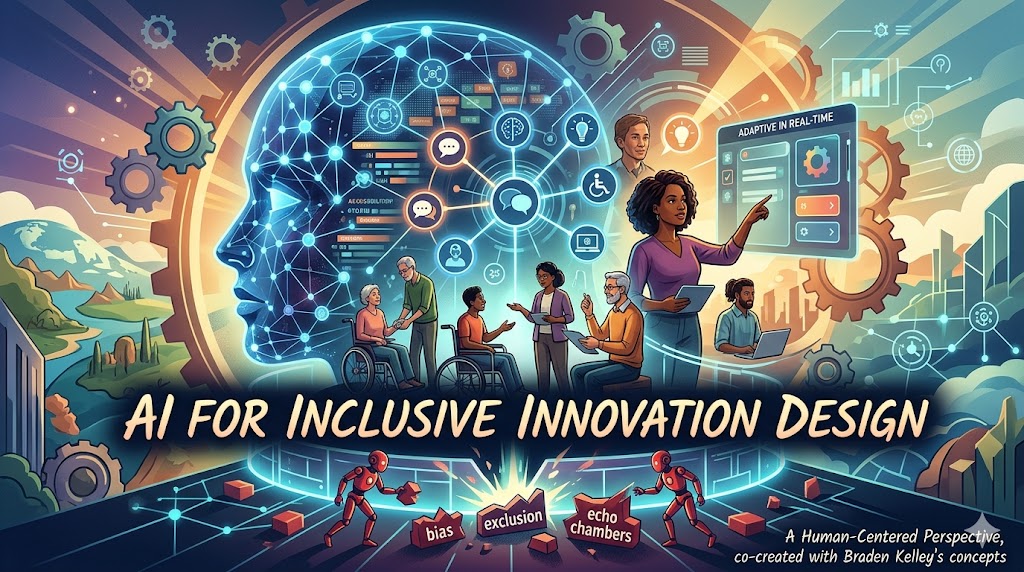
In the traditional landscape of human-centered design, our greatest limitation has always been the physical and cognitive bandwidth of the designer. We strive for empathy, yet we are often trapped by our own unconscious biases and the constraints of small sample sizes. As we enter this new era, we must recognize that AI is not a replacement for human intuition; it is a cognitive exoskeleton that allows us to see, hear, and design for those who have been historically pushed to the margins.
The Shift from Compliance to Belonging
For too long, “inclusive design” has been treated as a synonym for accessibility — a checklist of compliance requirements to be met at the end of a project. Inclusive Innovation demands more. It requires us to move beyond simply making things “usable” for people with disabilities and toward intentionally creating a sense of belonging for every user, regardless of their physical, cognitive, or socio-economic reality.
Designing with the Edge Cases
The core philosophy of this shift is a move away from the “Average User” myth. When we use AI to analyze and integrate the needs of edge cases — those users with the most extreme or unique requirements — we don’t just help a minority. We create more resilient, flexible, and intuitive solutions that benefit the entire ecosystem. AI gives us the power to scale this “designing for one” approach to reach the many.
“The goal is no longer to design for the many, but to design with the edges.” — Braden Kelley
II. Phase 1: AI-Powered Empathy and Discovery
Discovery is the bedrock of innovation, yet it is often where exclusion begins. Traditional research methods — surveys, focus groups, and ethnographic studies — are frequently limited by geography, language, and the “loudest voice” bias. AI transforms this phase by acting as a bridge between the designer’s perspective and the vast, diverse realities of the global population.
Breaking the Echo Chamber with Natural Language Processing
By leveraging advanced Natural Language Processing (NLP), we can now synthesize insights from billions of data points — social conversations, support forums, and local community archives — in real-time. This allows designers to move beyond their immediate bubble and understand how different cultures, dialects, and marginalized communities articulate their own problems. We aren’t just reading data; we are hearing the nuances of lived experiences that were previously “noise” in the system.
Simulating Lived Realities for High-Fidelity Empathy
Empathy is often hindered by the inability to truly experience another person’s friction. AI-driven simulations allow us to model various physical or cognitive constraints within a digital environment. Whether it is simulating visual impairments, motor control challenges, or cognitive load issues, AI helps designers “feel” the friction points during the early discovery phase. This proactive identification ensures that we aren’t “fixing” exclusion later, but preventing it from the start.
Uncovering Latent Needs through Pattern Recognition
Traditional analytics look for the “mean,” often ignoring the outliers. However, in inclusive innovation, the outliers are where the breakthroughs happen. AI excels at uncovering latent needs — identifying subtle patterns in behavior from underrepresented groups that signal a significant, unmet demand. By analyzing these “quiet” signals, we can spot opportunities to innovate for specific communities that eventually lead to universal improvements in the user experience.
“AI allows us to scale empathy by transforming massive amounts of unstructured human experience into actionable design intelligence.” — Braden Kelley
III. Phase 2: Co-Creation and Radical Prototyping
The most profound shift in inclusive innovation is the transition from designing for a community to designing with them. AI serves as the ultimate translator and facilitator in this process, stripping away the technical barriers that have traditionally kept “non-designers” out of the creative engine room.
Democratizing the Design Language
Generative AI tools act as a bridge for individuals who have the lived experience but perhaps lack formal design training. By using natural language prompts or simple sketches, end-users from diverse backgrounds can generate high-fidelity visual prototypes of the solutions they envision. This democratization of the design language ensures that the people closest to the problem are the ones leading the architectural vision of the solution.
Rapid Iteration for Universal Accessibility
In a traditional workflow, testing for accessibility is a slow, iterative process. AI changes the math. Automated agents can now instantly audit prototypes against Universal Design principles and international standards like the Web Content Accessibility Guidelines (WCAG). This allows for “real-time inclusion,” where flaws in contrast, navigation logic, or screen-reader compatibility are identified and corrected the moment a design is conceived, rather than weeks later during a formal audit.
The “Infinite Version” Paradigm
We are moving away from the “One-Size-Fits-All” model toward what I call The Infinite Version Paradigm. Rather than forcing every user to adapt to a single static interface, AI allows the interface to dynamically adapt to the user. Whether it’s adjusting cognitive load for a neurodivergent individual or reconfiguring navigation for someone with limited motor control, AI enables a level of deep personalization that makes the product feel like it was built specifically for the individual using it.
Prototyping for the Edge: When we use AI to solve for the most extreme accessibility requirements, we often discover “the Curb-Cut Effect” — innovations that were intended for a specific group (like closed captions) end up becoming essential for everyone.
IV. The Ethical Guardrail: Auditing for Algorithmic Bias
As we embrace the speed of AI, we must remain vigilant. AI is a mirror; if we feed it a history of exclusion, it will reflect and amplify those same biases in the designs it generates. Inclusive innovation requires a rigorous, proactive approach to ethics — ensuring that our “intelligent” assistants aren’t inadvertently building new digital walls.
The Mirror Effect: Acknowledging Embedded Bias
We must start with the uncomfortable truth: datasets are often skewed toward the dominant culture. If an AI is trained on images, text, and code that ignore marginalized groups, its output will naturally cater to the “standard” user. As innovation leaders, our job is to interrogate the training data and recognize where the gaps exist before we let the AI begin the design process.
Proactive Bias Hunting and Red Teaming
To counter these risks, we employ “Red Team” AI agents. These are secondary AI systems specifically programmed to attack a design from the perspective of different personas — searching for exclusionary patterns, cultural insensitivity, or hidden barriers to entry. By simulating how a neurodivergent user or someone from a different socio-economic background might interact with the product, we can catch “algorithmic microaggressions” before they ever reach the user.
Transparency and the “Open Box” Approach
Inclusive innovation cannot happen in a “Black Box.” To build trust with diverse communities, we must be transparent about how AI decisions are being made. This means moving toward Explainable AI (XAI), where the logic behind a personalized recommendation or an interface adjustment is clear and auditable. When users understand why a system is adapting to them, they feel empowered rather than monitored.
“Innovation without ethics is merely disruption. True inclusive innovation requires the courage to slow down and audit the algorithm to ensure it serves everyone.” — Braden Kelley
V. The Future Role of the Innovation Leader
The integration of AI into the design process necessitates a fundamental evolution of our leadership models. As the technical barriers to execution lower, the value of the innovation leader shifts from managing the “how” to orchestrating the “why.” We are moving from an era of craft-based creation to one of strategic curation and ethical stewardship.
From Creator to Curator
In an AI-augmented world, the designer’s primary skill is no longer just the ability to push pixels or write code, but the ability to orchestrate collaboration between human stakeholders and machine intelligence. The innovation leader becomes a curator of perspectives, ensuring that the AI has the right “empathy inputs” to generate inclusive outputs. Our job is to provide the vision and the values that guide the algorithm’s creative power.
The Competitive Edge of Inclusive Futurology
From a futurology perspective, designing for inclusion isn’t just a moral imperative — it’s a massive market opportunity. Historically, innovations that solve for “the edges” (such as the typewriter, originally designed for the blind) eventually redefine the mainstream. By using AI to anticipate the needs of the marginalized, organizations build more resilient, flexible, and robust products. Those who master inclusive design today are building the foundational infrastructure for tomorrow’s global economy.
Sustaining the Human-Centered Focus
As we look toward a future of agentic AI and neuroadaptive interfaces, the risk of “dehumanization” grows. The role of the innovation leader is to act as the guardian of the human experience. We must ensure that as our tools become more autonomous, they remain subservient to the goal of enhancing human connection, dignity, and agency. The future belongs to those who can use the highest technology to serve the deepest human needs.
The Futurist’s Prediction: Within the next decade, “inclusive design” will simply be called “design.” Companies that fail to use AI to bridge the accessibility gap will find themselves obsolete in an increasingly diverse and demanding global marketplace.
VI. Conclusion: Human-Centered, AI-Augmented
We stand at a unique crossroads in the history of innovation. For the first time, we possess tools powerful enough to bridge the gap between our empathetic intentions and the practical realities of large-scale design. But as we have explored, the true power of AI for Inclusive Innovation Design does not lie in the code itself, but in how we choose to direct that code to serve the human spirit.
Innovation is Only “New” if it is Inclusive
If we continue to use AI merely to optimize for the majority, we are not innovating; we are simply accelerating the status quo. Real innovation happens when we use these technologies to include those who were previously left behind. By bringing the “edge cases” into the center of our design process, we unlock new forms of value that were previously invisible.
The Path Forward: From Average to Infinite
The transition from the era of the “Average User” to the era of Infinite Inclusion is now underway. As innovation leaders, our mission is to ensure that AI acts as a leveling force — one that dissolves barriers, celebrates diversity, and creates a world where every individual feels that the products and services they interact with were built with them in mind.
The goal isn’t to make AI more human, but to use AI to make us more humane in how we design the world around us.
Let’s get to work on building a future that belongs to everyone.
Frequently Asked Questions
How does AI specifically enable more inclusive innovation?
AI acts as a cognitive exoskeleton, allowing designers to synthesize diverse global perspectives through Natural Language Processing (NLP) and simulate lived realities. It democratizes the design process by enabling non-designers to prototype their own solutions and dynamically adapts interfaces to meet individual accessibility needs in real-time.
What is the ‘Infinite Version’ paradigm in inclusive design?
The Infinite Version paradigm moves away from “one-size-fits-all” products. It uses AI to create interfaces that dynamically reconfigure themselves based on a user’s unique physical or cognitive requirements, ensuring the experience is personalized for every individual rather than forced into a static average.
How do we prevent AI from amplifying existing biases in the design process?
We prevent bias by implementing “Red Team” AI agents to proactively hunt for exclusionary patterns, auditing training datasets for diversity gaps, and adopting Explainable AI (XAI) practices. This ensures the design process remains transparent and accountable to human-centered ethical standards.
SPECIAL BONUS: Braden Kelley’s Problem Finding Canvas can be a super useful starting point for doing design thinking or human-centered design.
“The Problem Finding Canvas should help you investigate a handful of areas to explore, choose the one most important to you, extract all of the potential challenges and opportunities and choose one to prioritize.”
Image credit: Google Gemini
Sign up here to get Human-Centered Change & Innovation Weekly delivered to your inbox every week.

 Sign up here to get Human-Centered Change & Innovation Weekly delivered to your inbox every week.