Tag Archives: ideation

Integrating AI into the Innovation Pipeline

From Ideation to Execution

LAST UPDATED: November 30, 2025 at 8:21AM

Integrating AI into the Innovation Pipeline

GUEST POST from Chateau G Pato

The quest for innovation has always been constrained by human bandwidth: the time it takes to conduct research, synthesize data, and test concepts. Artificial Intelligence shatters these constraints. However, simply using AI to generate more ideas faster leads to digital noise. True competitive advantage comes from using AI to enhance the quality of human judgment and focus our finite human empathy where it matters most: the Moments of Insight.

We must move beyond the narrow view of AI as just a tool for cost reduction and embrace it as a partner that dramatically accelerates our Learning Velocity. The innovation pipeline is no longer a linear process of discovery, design, and delivery; it is a Synergistic Loop where AI handles the heavy lift of data synthesis, freeing human teams to focus on unstructured problem-solving and radical concept generation.

The AI Augmentation Framework: Three Critical Integration Points

To integrate AI mindfully, we must define clear roles for the human and the machine at three stages of the pipeline:

1. Deepening Empathy through AI Synthesis (Discovery Phase)

The Discovery Phase is traditionally dominated by ethnographic research. While human observation remains irreplaceable for capturing nuance and emotion, AI excels at processing vast, disparate datasets that inform that empathy. An AI system can ingest millions of customer service transcripts, social media sentiment, competitor product reviews, and historical sales figures to immediately generate a prioritized list of friction points and unmet needs. This doesn’t replace the human ethnographer; it provides the ethnographer with a laser-focused map, allowing them to spend their time understanding the why behind the patterns AI found, rather than manually searching for the patterns themselves.

2. Augmenting Ideation through AI Diversification (Design Phase)

Human teams tend to cluster around familiar solutions (Affinity Bias). AI breaks this pattern. In the Design Phase, after the human team defines the core problem, AI can be tasked with generating radical concept diversification. By training an AI on solutions from entirely different industries (e.g., applying aerospace logistics solutions to retail inventory management), it can suggest analogous concepts that humans would never naturally connect. The human team’s role shifts from generating 100 average ideas to selecting the best 5 from 1,000 machine-generated, diverse, and well-researched concepts — a massive multiplier on human creativity.

3. Accelerating Validation through AI Simulation (Delivery Phase)

The most time-consuming step is validation (prototyping, testing, and iterating). AI, specifically in the form of digital twins and sophisticated simulation models, can dramatically accelerate this. For complex physical products (like self-driving cars or new materials), AI can run thousands of scenario tests in a virtual environment before a single physical prototype is built. This shifts the human team’s focus from slow, expensive physical validation to data interpretation and hypothesis refinement. The human only builds the prototype when the AI simulation suggests a 95% likelihood of success, maximizing the efficiency of capital and time.

Case Study 1: The Financial Institution and Regulatory Forecasting

Challenge: Slow Time-to-Market Due to Regulatory Risk

A global financial institution (FinCorp) found its innovation pipeline paralyzed by regulatory uncertainty. Every new product launch required months of legal review and risked fines if the regulatory landscape shifted mid-deployment. The fear of compliance risk stifled breakthrough innovation.

AI Integration: Predictive Compliance Synthesis

FinCorp deployed an AI system trained on global regulatory history, legal documents, and legislative debate transcripts. This AI was integrated into the Discovery Phase:

  • The AI scanned new product proposals and immediately generated a “Compliance Risk Score” based on predicted future regulatory shifts.
  • It identified regulatory white space — areas where new products could be safely launched with minimal legal friction.
  • Human compliance officers shifted their role from reactive policing to proactive strategic guidance, advising innovation teams on how to shape products to be future-compliant.

The Human-Centered Lesson:

The AI removed the fear of the unknown, boosting the team’s psychological safety. Time-to-market for new financial products was reduced by 40% because the human teams were empowered to innovate within a clear, AI-forewarned boundary. The risk management was automated, freeing the humans to focus on value creation.

Case Study 2: The Consumer Goods Company and Material Innovation

Challenge: Years-Long Material R&D Cycle

A major consumer goods company (ConsumerCo) required years to develop new sustainable packaging materials, involving countless failed lab experiments due to the sheer volume of possible chemical combinations.

AI Integration: Generative Material Design

ConsumerCo integrated a generative AI model into the Ideation and Delivery Phase. This model was given constraints (e.g., “must be compostable in 90 days, withstand $180^\circ$C, and cost less than $0.05 per unit”).

  • The AI generated millions of hypothetical chemical formulas and simulated their real-world properties instantly (Accelerated Validation).
  • The human material scientists reviewed the top 0.1% of AI-generated formulas, using their expertise to filter for manufacturing feasibility and supply chain reality.

The Human-Centered Lesson:

The AI transformed the material scientists’ job from performing repetitive, blind experiments to becoming expert filters and hypothesis builders. This augmentation reduced the R&D cycle from four years to 18 months, leading to a massive increase in the Learning Velocity of the entire organization. The result was a successful launch of a proprietary, highly sustainable packaging line, directly attributing its success to the speed of AI-driven simulation.

The Future: Human-AI Co-Creation

The integration of AI into the innovation pipeline must be governed by a single rule: AI handles the volume, humans retain the veto and the empathy. Leaders must focus on training their teams not in how to use the AI, but how to ask it the right, human-centered questions.

Embrace the Synergistic Loop. Use AI to synthesize complexity, diversify ideas, and accelerate validation. Use your people for vision, ethics, and the profound, qualitative understanding of the human condition. That is how you drive sustainable, breakthrough innovation.

“AI does not make humans less creative; it removes the repetitive labor that prevented them from being creative in the first place.”

Frequently Asked Questions About AI in the Innovation Pipeline

1. What is the biggest risk of integrating AI into the innovation pipeline?

The biggest risk is relying on AI to generate ideas without human oversight, which leads to “algorithmic echo chambers” — innovations that are merely optimizations of past successes, not true breakthroughs. Humans must retain the veto and inject radical new, empathetic concepts that defy historical data.

2. How does AI enhance “Discovery” without replacing human ethnographers?

AI enhances discovery by acting as a powerful data synthesizer. It processes massive, unstructured datasets (like customer reviews and call transcripts) to identify patterns, friction points, and statistically significant unmet needs. This information guides the human ethnographer to focus their high-touch observation time on the most critical and complex qualitative problems.

3. What is “Learning Velocity” and how does AI affect it?

Learning Velocity is the speed at which an organization can generate, test, and codify actionable insight from experiments. AI dramatically increases Learning Velocity by accelerating the “Test & Refine” stage through simulation and digital twins, minimizing the time and cost required for physical prototyping and validation.

Your first step toward AI integration: Identify your most time-consuming, data-intensive manual synthesis task in your current Discovery phase (e.g., manually summarizing customer feedback). Prototype an AI solution to automate only that synthesis, then measure how much more time your human ethnographers spend on direct customer interaction rather than data processing.

Extra Extra: Because innovation is all about change, Braden Kelley’s human-centered change methodology and tools are the best way to plan and execute the changes necessary to support your innovation and transformation efforts — all while literally getting everyone all on the same page for change. Find out more about the methodology and tools, including the book Charting Change by following the link. Be sure and download the TEN FREE TOOLS while you’re here.

Image credit: Dall-E

Subscribe to Human-Centered Change & Innovation WeeklySign up here to get Human-Centered Change & Innovation Weekly delivered to your inbox every week.

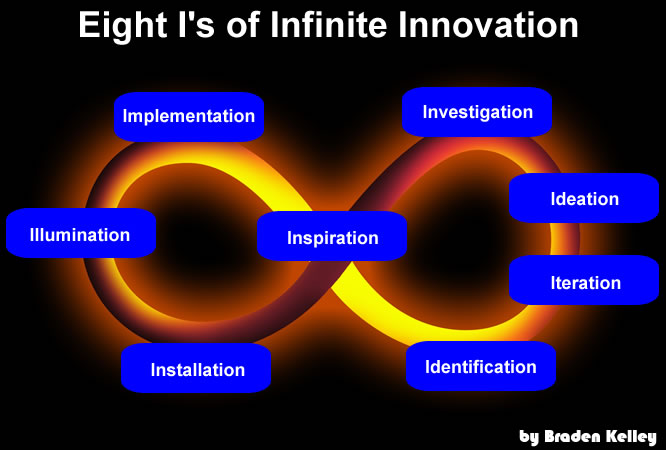
Eight I’s of Infinite Innovation

Eight I's of Infinite Innovation

Some authors talk about successful innovation being the sum of idea plus execution, others talk about the importance of insight and its role in driving the creation of ideas that will be meaningful to customers, and even fewer about the role of inspiration in uncovering potential insight. But innovation is all about value and each of the definitions, frameworks, and models out there only tell part of the story of successful innovation.

To achieve sustainable success at innovation, you must work to embed a repeatable process and way of thinking within your organization, and this is why it is important to have a simple common language and guiding framework of infinite innovation that all employees can easily grasp. If innovation becomes too complex, or seems too difficult then people will stop pursuing it, or supporting it.

Some organizations try to achieve this simplicity, or to make the pursuit of innovation seem more attainable, by viewing innovation as a project-driven activity. But, a project approach to innovation will prevent it from ever becoming a way of life in your organization. Instead you must work to position innovation as something infinite, a pillar of the organization, something with its own quest for excellence – a professional practice to be committed to.

So, if we take a lot of the best practices of innovation excellence and mix them together with a few new ingredients, the result is a simple framework organizations can use to guide their sustainable pursuit of innovation – the Eight I’s of Infinite Innovation. This new framework anchors what is a very collaborative process. Here is the framework and some of the many points organizations must consider during each stage of the continuous process:

1. Inspiration

  • Employees are constantly navigating an ever changing world both in their home context, and as they travel the world for business or pleasure, or even across various web pages in the browser of their PC, tablet, or smartphone.
  • What do they see as they move through the world that inspires them and possibly the innovation efforts of the company?
  • What do they see technology making possible soon that wasn’t possible before?
  • The first time through we are looking for inspiration around what to do, the second time through we are looking to be inspired around how to do it.
  • What inspiration do we find in the ideas that are selected for their implementation, illumination and/or installation?

2. Investigation

  • What can we learn from the various pieces of inspiration that employees come across?
  • How do the isolated elements of inspiration collect and connect? Or do they?
  • What customer insights are hidden in these pieces of inspiration?
  • What jobs-to-be-done are most underserved and are worth digging deeper on?
  • Which unmet customer needs that we see are worth trying to address?
  • Which are the most promising opportunities, and which might be the most profitable?

3. Ideation

  • We don’t want to just get lots of ideas, we want to get lots of good ideas
  • Insights and inspiration from first two stages increase relevance and depth of the ideas
  • We must give people a way of sharing their ideas in a way that feels safe for them
  • How can we best integrate online and offline ideation methods?
  • How well have we communicated the kinds of innovation we seek?
  • Have we trained our employees in a variety of creativity methods?

4. Iteration

  • No idea emerges fully formed, so we must give people a tool that allows them to contribute ideas in a way that others can build on them and help uncover the potential fatal flaws of ideas so that they can be overcome
  • We must prototype ideas and conduct experiments to validate assumptions and test potential stumbling blocks or unknowns to get learnings that we can use to make the idea and its prototype stronger
  • Are we instrumenting for learning as we conduct each experiment?

Eight I's of Infinite Innovation

5. Identification

  • In what ways do we make it difficult for customers to unlock the potential value from this potentially innovative solution?
  • What are the biggest potential barriers to adoption?
  • What changes do we need to make from a financing, marketing, design, or sales perspective to make it easier for customers to access the value of this new solution?
  • Which ideas are we best positioned to develop and bring to market?
  • What resources do we lack to realize the promise of each idea?
  • Based on all of the experiments, data, and markets, which ideas should we select?

You’ll see in the framework that things loop back through inspiration again before proceeding to implementation. There are two main reasons why. First, if employees aren’t inspired by the ideas that you’ve selected to commercialize and some of the potential implementation issues you’ve identified, then you either have selected the wrong ideas or you’ve got the wrong employees. Second, at this intersection you might want to loop back through the first five stages though an implementation lens before actually starting to implement your ideas OR you may unlock a lot of inspiration and input from a wider internal audience to bring into the implementation stage.

6. Implementation

  • What are the most effective and efficient ways to make, market, and sell this new solution?
  • How long will it take us to develop the solution?
  • Do we have access to the resources we will need to produce the solution?
  • Are we strong in the channels of distribution that are most suitable for delivering this solution?

7. Illumination

  • Is the need for the solution obvious to potential customers?
  • Are we launching a new solution into an existing product or service category or are we creating a new category?
  • Does this new solution fit under our existing brand umbrella and represent something that potential customers will trust us to sell to them?
  • How much value translation do we need to do for potential customers to help them understand how this new solution fits into their lives and is a must-have?
  • Do we need to merely explain this potential innovation to customers because it anchors to something that they already understand, or do we need to educate them on the value that it will add to their lives?

8. Installation

  • How do we best make this new solution an accepted part of everyday life for a large number of people?
  • How do we remove access barriers to make it easy as possible for people to adopt this new solution, and even tell their friends about it?
  • How do we instrument for learning during the installation process to feedback new customer learnings back into the process for potential updates to the solution?

Conclusion

The Eight I’s of Infinite Innovation framework is designed to be a continuous learning process, one without end as the outputs of one round become inputs for the next round. It’s also a relatively new guiding framework for organizations to use, so if you have thoughts on how to make it even better, please let me know in the comments. The framework is also ideally suited to power a wave of new organizational transformations that are coming as an increasing number of organizations (including Hallmark) begin to move from a product-centered organizational structure to a customer needs-centered organizational structure. The power of this new approach is that it focuses the organization on delivering the solutions that customers need as their needs continue to change, instead of focusing only on how to make a particular product (or set of products) better.

So, as you move from the project approach that is preventing innovation from ever becoming a way of life in your organization, consider using the Eight I’s of Infinite Innovation to influence your organization’s mindset and to anchor your common language of innovation. The framework is great for guiding conversations, making your innovation outputs that much stronger, and will contribute to your quest for innovation excellence – so give it a try.

Download as a PDF

Haga clic aquí para la versión en Español

Subscribe to Human-Centered Change & Innovation WeeklySign up here to get Human-Centered Change & Innovation Weekly delivered to your inbox every week.
Innovation Can Come From Anyone

Innovation Can Come From Anyone“Innovation can come from anyone, but it is required from everyone for an organization to remain successful.”
Or taken another way:

“Innovation can come from anywhere, but you must be looking everywhere to find it.”

Innovation comes from good listening, observing, watching, waiting, connecting, and synthesizing.

Innovation comes from the creation of a unique, differentiated customer insight that you can build your ideation, your experimentation, your collaboration, and your commercialization efforts around. The goal of course is to turn that unique, differentiated insight into solutions valued above every existing alternative. Solutions that not only create value, but that you also stand ready and able to help people access and understand the need for and relevance in their life.

It is because innovation can come from anywhere and can involve everyone in the organization in making innovation happen that I created The Nine Innovation Roles and my innovation value framework, to help people make sense of what is necessary to make innovation successful as they form their innovation project teams and process, and to give people a simple framework to hold close as they think about creating innovation success.

I hope you’ll check out both of these and let me know what you think!

Build a Common Language of Innovation

Subscribe to Human-Centered Change & Innovation WeeklySign up here to get Human-Centered Change & Innovation Weekly delivered to your inbox every week.