At the beginning of each month, we will profile the ten articles from the previous month that generated the most traffic to Human-Centered Change & Innovation. Did your favorite make the cut?
But enough delay, here are August’s ten most popular innovation posts:
If you’re not familiar with Human-Centered Change & Innovation, we publish 4-7 new articles every week built around innovation and transformation insights from our roster of contributing authors and ad hoc submissions from community members. Get the articles right in your Facebook, Twitter or Linkedin feeds too!
Have something to contribute?
Human-Centered Change & Innovation is open to contributions from any and all innovation and transformation professionals out there (practitioners, professors, researchers, consultants, authors, etc.) who have valuable human-centered change and innovation insights to share with everyone for the greater good. If you’d like to contribute, please contact me.
P.S. Here are our Top 40 Innovation Bloggers lists from the last five years:
Bicycles are big business. It’s hard to get an exact figure but estimates suggest there are around 2 billion bikes in the world today. And of course they exist in all sorts of shapes and sizes — town bikes, racing bikes, mountain bikes, foldable bikes, electric bikes and many more besides. They’re available in cutting-edge high tech versions but their underlying design is very simple. They’re very green — once built they can be repaired and resurrected, some live for ages, handed on from generation to generation.
But bicycles weren’t always around and perhaps it’s worth reflecting a little more on their history, not least because it can teach us some useful lessons about innovation. In particular how (or not) to manage it for impact and scale.
In the earliest days — around 3500 BC — the Mesopotamians used them to make pottery which seems to be the first application of this breakthrough idea. The problem with using them for transport wasn’t so much the wheel as finding an axle strong enough to enable the wheels to work. It took another 300 years before new materials and better carpentry techniques led to their being fixed to chariots and ushering in the era of mobile warfare. But once the wheels started rolling they were attached to an increasing variety of military and domestic vehicles, so it was only going to be a matter of time before someone came up with the idea of using them to enable personal transportation.
Well quite a lot of time, actually. Although there’s probably a sketch for something resembling a bike in Leonardo da Vinci’s notebooks or in some other inventor’s imagination, the reality is that it wasn’t until the early 19 century that the vehicle that we know and love began to see the light of day. That shouldn’t surprise us — innovation depends on a mixture of needs and means and the idea of personal transportation never mind the technologies to enable it was not a particularly high priority. People didn’t travel far — and if they did Nature had already supplied a robust solution in the form of horses (or mules, camels and other alternatives).
The average human being can walk at around 5 km per hour so covering any distance is going to take time and effort. Enter Baron von Drais, a minor aristocrat in Germany who in 1817 came up with the ‘Laufmaschine’ — walking machine — otherwise known as the Draisienne. He was already an experienced engineer and inventor, having come up with several working prototypes for devices like a piano music recording system, a periscope, and a typewriter. (All ideas which turned out, much later, to have considerable significance but not in the form he developed them). And he had a passion for horseless transportation.
This wasn’t some idle curiosity or pet project. Times were tough in the years of the Napoleonic wars and grain prices were high, something not helped by the failure of harvests in 1816. This was the so-called ‘year without a summer’ when the fallout (literally) from a volcanic eruption in south east Asia blotted out the sun. People died of starvation — and horses had an even harder time of it, either starving themselves or else used for food. The possibilities of their being used for transportation shrank faster than the animals themselves.
Drais was also aware of new technologies and materials which he could make use of and he developed a working prototype of his machine on which he could cover the kilometres around his home town of Karlsruhe. He experimented with variations including a four wheeled passenger carriage powered by an (unlucky) servant whose job was to pedal on planks connected to the wheels. But his breakthrough idea was a two-wheeler — the Draisienne. This did away with pedals; instead the rider sat and scooted along the ground with his feet — a kind of adult version of the child’s hobby-horse.
There was nothing childish about the impact this had on moving around the place though. On 12 June 1817, a crowd gathered along the best road in Mannheim, Germany to watch him climb aboard and set out for the Schwetzinger Relaishaus (a coaching inn, located in nearby Rheinau. Less than an hour later, he was back, having completed the 13km round trip in a quarter of the time it would take to walk.
He was a man of vision — and saw the potential for what he had built. By October 1817, he had produced 3-page brochure of laufmaschine designs which pictured possible applications (such as for military couriers or in the postal service) as well as general and leisure transport. He proposed different models with both 2 and 4 wheels and even a tandem and potential customers could choose between standard machiens or customised version. The French version of the brochure, published a year later, included accessories such as lamps, an umbrella and even a sail to help with extra momentum on windy days.
Drais’s laufmaschine was pretty heavy by today’s standards, weighing in at 22kg, made mostly of wood but with hoops of iron nailed to the wheels to function as tyres. This design had an unfortunate side-effect because it made any journey on the fairly primitive roads of the time somewhat less than comfortable. At least the machine was blessed with a brake on the rear wheel; perhaps more important were some of the technologies Drais put to use in his design, like the brass bushes inside the wheel bearings (which enabled the wheels to turn freely) and a trailer to the front wheel which helped the rider maintain balance.
Drais had the vision to see the possibilities in his machine — but he didn’t really have a business model to help him create and capture value from it. Although he staged a number of impressive demonstrations around Europe the reception was mixed and once the novelty wore off the market retreated to being one for hobbyists and pleasure seekers. Riding rinks (where customers could rent a machine for an hour or so) appeared in the parks of various European cities but the mainstream dream of providing personal transportation faded. It wasn’t helped by the appalling state of the roads at the time; without any form of shock absorbers the seat, despite being well-padded, was not a comfortable place to spend much of the day.
‘All’s fair in love and war’ is a principle which often also seems to extend to innovation. The pattern is one of imitation and the first mover is not always the one who can gain advantage, especially if they have inadequate protection for their intellectual property. Drais had tried to patent his idea but it only applied locally, a loophole quickly spotted and exploited by an Englishman, Denis Johnson. He’d seen the early demonstrations and guessed at the significant opportunity such machines might offer. So he set about patenting the idea in England and then building in more systematic fashion a business model around which it might be exploited.
Johnson was a coachmaker so he quickly worked out how to build the machines; what he had to do was create and grow the market. He advertised, offered demonstration machines, organised racing competitions and even established two riding schools where people could learn the skills involved. He adapted the product so that his ‘pedestrian curricle’ had a Ladies Walking Machine variant with a lower saddle such that women could mount the machine decorously.
He was particularly successful in attracting the attention of the young men of the time. This was the era of Beau Brummel and the London Dandies and they enthusiastically took up the idea, adding to it all sorts of fashion accessories — boots, gloves, etc — without which the daredevil owner would not be seen about town. Its popularity amongst this group was heightened by the inherently unsafe nature of something ridden about narrow streets at (relatively) high speed which offered thrills (and accidents) a-plenty until an increasing number of city authorities began banning the machine
It was an expensive hobby. Retailing for around £10 (about £750) it carried additional running costs. Riders wore out their expensive leather boots surprisingly rapidly, and the imposition of fines of £2 (£150 today) for riding on the pavement added to the burden. The fashion for draisiennes began to fade but the real reason for their failure to reach a wider market was down to much simpler economics. By 1820, the price of oats had come back down to pre-1815 levels, and horses were readily available to those who could afford them.
Innovation isn’t just a gleam in the eye, a flash of insight and then instant creation. It’s a lot of hard work, experimentation and improvisation to bring that dream to reality. But even when the first fruits are there there’s still plenty of room for improvement. As Johnson showed, there’s plenty of scope for doing things better, sorting out the bugs and wrinkles, continuously improving on the design. It’s a pattern of restless experimentation, pushing the frontiers of what might be possible. Metalworking technology in particular was improving such that machines could be made strong and (relatively) light, displacing wood as the only means of construction. People explored using different numbers of wheels — two, three, four, more even — opening up the possibilities of carrying multiple passengers.
But innovation is also about sudden leaps, of someone else very often picking up the baton and giving the wheel an extra hard push that sends it off in a new direction. Sometimes this is about timing — a technology which wasn’t available earlier on suddenly appears . or a market which didn’t exist begins to grow to the point where there is a demand for the innovation, pulling it in new refreshed directions. Whatever, this pattern of ‘punctuated equilibrium’ is at the heart of most innovation stories. And in the case of the bicycle it certainly was.
If you are going to have a mysterious legend to weave about the next phase of bicycle innovation where better to do it than Scotland? Land of towering mountains, shady glens, deep lochs and plenty of rain to fill them. Shrouded in mists and secrecy — and home, amongst others to a blacksmith named Kirkpatrick McMillan.
Macmillan completed construction of a pedal driven bicycle of wood in 1839, one which also included iron-rimmed wooden wheels, a steerable wheel in the front and a larger wheel in the rear which was connected to pedals via connecting rods. Various accounts tell of his travelling about the roads near Kier and regularly making the journey to the town of Dumfries (14 miles away) in less than an hour.
He was a modest man and his claim to innovation fame doesn’t rest on patents so much as PR, particularly the research of his relative James Johnston in the 1890s. Johnston wanted “to prove that to my native country of Dumfries belongs the honour of being the birthplace of the invention of the bicycle”. He might have been a little creative with his reworking of history, suggesting for example that Macmillan was the gentleman in question in a Glasgow newspaper report in 1842 of an accident in which an anonymous “gentleman from Dumfries-shire… bestride a velocipede… of ingenious design” knocked over a pedestrian in the Gorbals and was fined five British shillings”.
A criminal record is perhaps not the strongest piece of intellectual property protection and a more robust claim to be the pedal innovator lies with the French. Specifically a young blacksmith and machinist from the town of Nancy called Pierre Lallement. He developed his ideas in 1863 and showed them off publicly during the next year; moved to the USA in 1865 and in the following year registered US Patent number 59915 for his version of the ‘velocipede’.
So most people give the pedal crown — and with it the title of inventor of the modern bicycle — to Lallement. But he was not alone.
In the early 1860s Pierre Michaux (yet another blacksmith) had a successful business producing parts for the carriage trade and had diversified into making “vélocipède à pédales” on a small scale. Across Paris two brothers, Andre and Rene Olivier were students but also came from a wealthy family. This enabled them not only to be early adopters of the bicycle, (enjoying a memorable road trip in 1865 from Avignon to Paris which took them 8 days) but also to become the first entrepreneurs in the game. They saw the considerable potential in pedal cycles and teamed up with Michaux, brought in another friend George de la Boublise and in 1868 set up a partnership to make and sell them.
For a while France (and Paris with its smooth flat roads) became the focus of a market which grew in popularity on both sides of the Atlantic. But a combination of the Franco-Prussian war of 1870 (which stopped French cyclists) and bad roads (whose boneshaking characteristics held back even the hardiest of north American users) meant that the centre of innovation gravity moved to Britain.
Pedal power depends on how much you can push — and cycle design next began to explore ways of maximising this. Two wheels of equal size aren’t particularly good in this equation; better is to have as long a stride as possible since the larger the wheel, the further you can go with one rotation of the pedals. So wheels became higher and higher, the only limit being the length of the rider’s legs. It’s an idea which is good for propulsion but not so good for steering or balance. And so bicycles became ever more exotic looking in their arrangements of wheels and sizes, not least giving birth to the familiar ‘penny farthing’ shape.
But although high wheelers experienced some market growth they weren’t really practical for the average man or woman on the street. Enter John Kemp Starley, an English inventor who came up with a winning idea for a “safety bicycle”, one which would appeal to a much bigger market. His first model was the “Ariel” launched in 1871 and although still featuring wheels of different sizes it was getting closer to a configuration which people would accept. Not least because he integrated many of the key features which people valued — improvements in stability, comfort, usability _especially steering), and all at a price they could afford.
Starley was a classic innovator and over the next fifteen years he developed an increasing range of machines, drawing in ideas and technologies from all over the place. Learning all the time with the market about what it actually wanted, not least through the experience of dissatisfied riders.
For example he sorted out the problem with the wheels. Early bikes had heavy wooden wheels with iron rims but in 1849 William Stanley had invented steel-wheel spider spokes. In 1868, Eugene Meyer in Paris developed an all-metal wheel that relied on the tension of wires rather than compression of heavy metal spokes to achieve structural integrity. Two years later, William Henry James Grout, a builder of velocipedes from Shadwell, London, patented spokes that had eyed nipples at the outer end. Starley drew these ideas together to create (and patent) the spoked wheel in 1874 which gave a much more comfortable ride because of its sprung nature and it also made bicycles much lighter.
In similar fashion he took other ideas and used them as ingredients in the innovation soup which was now coming nicely to the boil. Finally in 1885, Starley introduced the “Rover.” With its nearly equal-sized wheels, centre pivot steering and differential gears that operate with a chain drive, Starley’s “Rover” was the first highly practical iteration of the bicycle. Like Henry Ford with his Model T twenty years later he’d produced the bicycle for Everyman (and woman). It became the dominant design — and it’s pretty much the same shape as we’d recognise today.
Starley’s work kick-started the industry into its growth phase. His company grew and with it the product range, opening up cycling to a wide market in the ways Baron von Drais had dreamt about seventy years earlier. The safety bicycle completely displaced the high wheeler and by 1889 there were around 200,000 bicycles on the roads of Europe.
Ten years later over a million machines were being pedalled around the world. Innovation didn’t stop there — and with each new development the pace of growth accelerated. Pneumatic tyres made of rubber made for a smoother ride, chain drives meant the power came from the rear wheel leaving the front to steer and making cornering easier. The application of gears helped tame even the most stubborn of inclines and opened up the whole landscape to conquest by bicycle. And inventors began looking to provide alternatives to legs as the main power source, with a battery electric cycle appearing. And over in Germany Gottfried Daimler played around with hooking an internal combustion engine up to a cycle to create the motorbike…..
So it’s not entirely surprising that we now have 2 billion bicycles pedalling their way along roads and up and down the mountainsides of the world. There’s still plenty of scope for further innovation, for branching in new directions and picking up old ones — the e-scooter craze looks like a good candidate for becoming the next major shift, with not a few nods back in the direction of good old Baron von Drais. What’s clear , though, is that these innovations will only take hold and become widely adopted if we pay attention to working at the system level.
Successful scaling of innovation is all about wheels within wheels…
Škoda built a bike bell that beats noise-cancelling headphones
GUEST POST from Jason Hauer
A near-miss on a London street became Škoda’s smartest marketing spend in years. The bigger idea: someone else’s AI has broken something in your category too, and fixing it might be your next growth play.
Ben Fraser was walking to work near Borough Market, headphones on, when a cyclist nearly hit him. The cyclist had been ringing his bell the whole way down the street. Fraser never heard a thing.
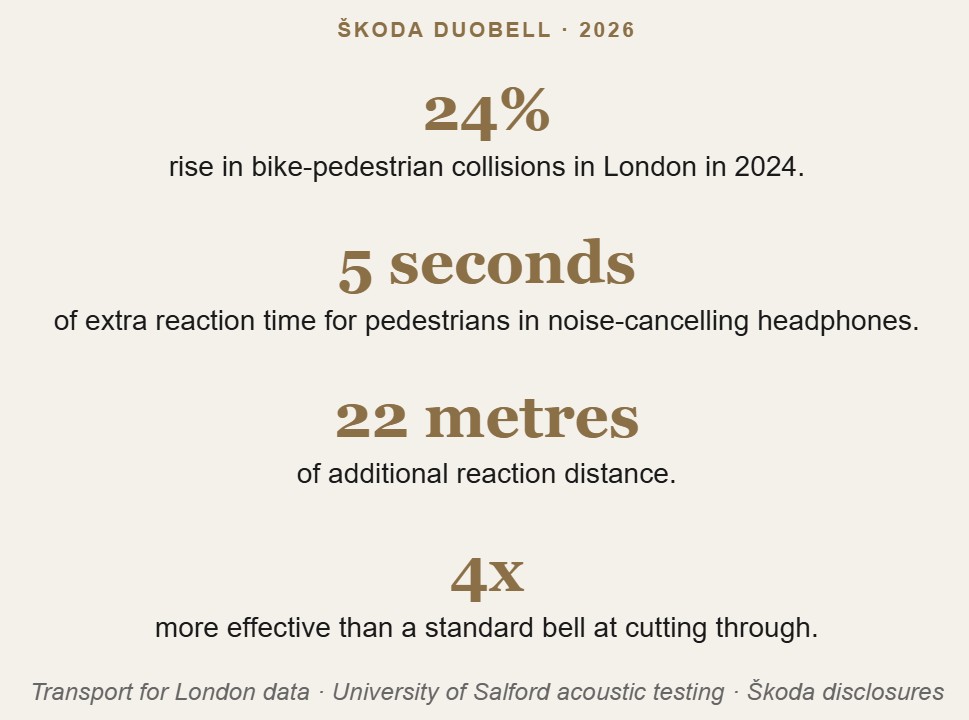
Fraser works at PHD Media, and the near-miss became a brief. Transport for London data showed bike-pedestrian collisions rose 24% in 2024, with cyclists set to outnumber car drivers in London for the first time this year. One quiet contributor: active noise cancellation. The bike bell had worked for a century. On a growing share of pedestrians, it simply stopped working, because an algorithm in their headphones was scrubbing it out of the air.
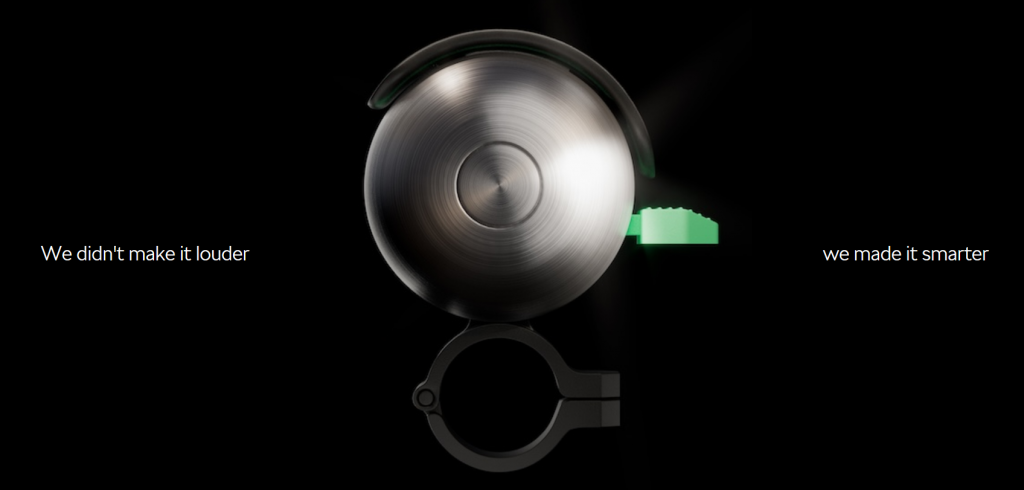
Škoda, the Czech carmaker owned by Volkswagen Group and one of Europe’s biggest auto brands, took the problem to acoustics researchers at the University of Salford. Testing turned up something useful: noise-cancelling algorithms struggle with a narrow band between 750 and 780 hertz. So Škoda built the DuoBell, a second resonator tuned to that gap, plus a hammer that strikes in an irregular rhythm the algorithms can’t predict. Fully mechanical. A piece of metal designed to beat software.
They tested it with a fleet of Deliveroo riders in London, people whose income depends on being heard in traffic. One rider said that with the bell, he finally had a voice in the streets. The riders wanted to keep them.
Pedestrians in noise-cancelling headphones gained up to five extra seconds of reaction time and up to 22 metres of additional distance. Roughly four times the cut-through of a standard bell. Škoda published the underlying research as an open-source white paper, and the work took Silver in Creative Data at Cannes in June. One case-study breakdown projects €79 million in vehicle sales connected to the project, which fits how the company sees it. Škoda started life as a bicycle maker in 1895 and still sponsors the Tour de France. The fix sits inside a hundred-year-old brand truth.
Nobody at the headphone companies set out to make cyclists invisible. Noise cancellation was a good product decision that quietly broke a safety system in a completely different category, and the breakage sat unowned for years while collisions climbed. That pattern is everywhere now. Every AI deployment of the last three years created some downstream effect in somebody else’s business.
Somebody is absorbing that cost right now, and no line item owns it.
Look at your own category through that lens. A century-old bell stopped working because ears started running software. Every signal your company sends was built the same way, for a human on the receiving end, and a machine now sits between you and that person. Your buyer’s first impression of you is written by a model you’ve never briefed. Everything you send after that runs through software tuned by companies with no stake in whether you’re heard. Somewhere in that chain, something that worked in your category for decades is being scrubbed out of the air, and the loss surfaces in a metric you’ve been explaining some other way. The collision numbers sat in Transport for London’s data before anyone thought to blame headphones. Your version of that number already exists. It’s in a dashboard right now, filed under something else.
Škoda’s move was to treat the breakage as a market. Find the gap, spend the budget on fixing it, and let the fix carry the brand. The bell exists because someone measured a frequency nobody had bothered to look for.
WHAT TO DO THIS WEEK
The first conversation moved. Your customer now asks a model before they ask you, whether that’s a buyer building a shortlist or a client second-guessing your advice. This week, put your customers’ most common questions to the major models, worded the way they’d word them. What comes back is your new first impression.
The unfiltered channels are still open. Every digital signal you send now clears someone else’s software before a human sees it. Nothing stands between a room and the people in it. Škoda answered an algorithm with a piece of metal; your equivalent might be a dinner, or a printed report that lives on a desk for a month. Pick the one message this quarter that can’t survive being flattened and spend real money delivering it by hand.
The next breakage is already in somebody’s data. The collision numbers sat in Transport for London’s files before anyone blamed headphones. Spend an hour with your team on two questions. What have our own AI deployments broken for the people downstream, the customer who needed a person, the partner whose emails our triage now buries? And what’s degrading in our category that nobody has claimed yet? One of those answers is a liability you can still price before a competitor does. The other is a bell nobody has built.
Whatever you find, take it all the way to metal. Škoda could have stopped at the white paper. The bell is the reason you’re reading about them.
A century-old bell needed one new frequency to work again. Your category has a gap like that somewhere.
What’s quietly stopped working in your category?
Image credit: Jason Hauer
Sign up here to join 17,000+ leaders getting Human-Centered Change & Innovation Weekly delivered to their inbox every week.
 Drum roll please…
 Sign up here to get Human-Centered Change & Innovation Weekly delivered to your inbox every week.