Tag Archives: credit cards

Innovation or Not – Amazon One

Amazon One Biometric Payments

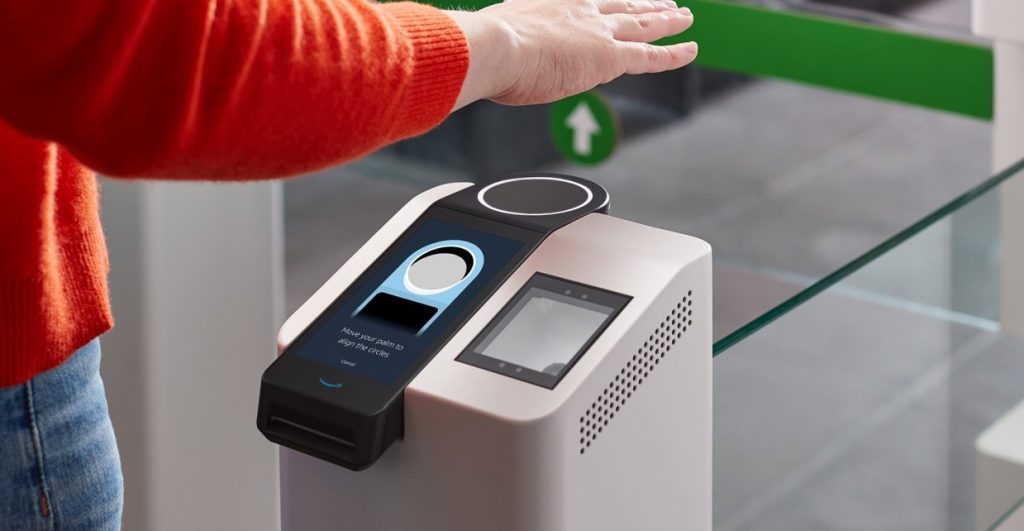
I came across another payments-related invention that Amazon is releasing into the wild. Yes, it is based around biometrics, but before you start getting all freaked out, it doesn’t use an implanted RFID chip or even facial recognition. No, Amazon One as it is referred to, connects a scan of your palm to your phone number and your credit card.

Once you’ve set this up at one of the Amazon Go stores currently piloting the technology, you’re all ready to go. From that point forward you can enter the Amazon Go store by hovering your palm above the reader and then use your palm on the way out to pay (and receive your receipt by text message I assume).

While you can connect your palm to your Amazon account so you can track purchase history, you don’t have to. Your palm scan is encrypted and stored in the cloud for future use.

Still not sure how it works?

Check out this explainer video:

The tagline for the service gives you an idea of the third party applications that Amazon hopes to pursue with this technology:

“Enter, identify and pay with Amazon One.”

So, what do you think? Innovation or not?


Accelerate your change and transformation success

Subscribe to Human-Centered Change & Innovation WeeklySign up here to get Human-Centered Change & Innovation Weekly delivered to your inbox every week.

Bring Me Better Problems

GUEST POST from Stephen Shapiro

In life and in business, we are often told, “don’t bring me problems, bring me solutions.”

From my perspective, this is bad advice. I want people to bring me bigger and better problems.

Or, as the fortune cookie I got recently implied (see below), if you don’t focus on the right question, the answers/solutions may be useless.

Unfortunately, most people continue to work on solutions to problems that don’t matter.

Here are some questions that will help you prioritize your thinking:

  • Are you focused on what is important…or on what is urgent? Many people are “firefighting arsonists,” creating urgency in everything, even if it is not critical. A short-term mentality prevails. Make time for the important investments that will pay long-term dividends.
  • Are you investing energy on activities that provide exponential returns…or linear returns? Most people rarely look for what gives them leverage. Look for partners and business models that enable you to scale your solutions.
  • Are you working on what you actually can change/influence…or on what you wish could be changed? Not everything can be changed. Just because you are frustrated does not mean you should try to fix something. Trying to change others, for example, is a losing proposition. Instead change your attitude towards them.
  • Do you appreciate the differences in others that complement you…or on the differences that annoy you? Contrary to conventional wisdom, opposites do not attract. We tend to focus on what we don’t like in others, instead of seeing how those attributes might actually be beneficial to us. But diversity, when viewed through the right lens, can be extremely valuable.
  • Do you develop solutions that the world will value…or what you value? Some of my artist friends don’t want to “sell out.” Basically this means that they don’t want to create what others want and would rather do what they want…and remain poor.

Too often we invest our time, money, and energy (including mental energy) on things that don’t really matter or don’t produce real results.

By asking a different question you will always get a different answer. By refocusing and reframing, you can do less while getting better results.

Subscribe to Human-Centered Change & Innovation WeeklySign up here to join 17,000+ leaders getting Human-Centered Change & Innovation Weekly delivered to their inbox every week.

Crowdsourcing for Every Occasion

GUEST POST from Stephen Shapiro

I recently spoke at an event called Crowdopolis. The topic was crowdsourcing. This has become one of the hot buzzwords in business. Companies of all sizes are dipping their toes into crowdsourcing.

But what is it really? Well, crowdsourcing is a lot of different things and can’t easily by lumped into one small bucket.

Here are a few of the crowdsourcing variations (and this is not a complete list):

  • Solution Finding: This is where you use a crowd to solve a complex problem. Are you looking to develop a glass for the next iPhone that won’t smudge? Ask a crowd to see if they have a solution. InnoCentive and BrightIdea are two platforms that help` companies solve these types of problems (the latter is the engine behind GE’s ecoimagination initiative).
  • Opinion Seeking – Crowds can be used, of course, to provide input and suggestions on how to improve your product. SurveyMonkey is a low-end version of this in action. MyStarbucksIdea.com is a more sophisticated version that runs on SalesForce.com’s “ideas” platform.
  • Content Creation – Want to create an advertisement for your company but don’t want to hire a single design agency? Why not hire the world? Companies like Doritos have done this for their Super Bowl commercials with great success. Platforms like Tongal help companies crowdsource the creation of videos. News broadcasters are also doing this to help collect videos from individuals who shoot newsworthy footage on their iPhone.
  • Design Competitions – Need a new logo? You don’t need to hire just one person from an agency or eLance.com (which is also a form of crowdsourcing, even though you only get one person doing the work, you get multiple people to bid on the work), you can use 99designs.com or logotournament.com to get hundreds of designs for the price of one. You select the one logo you like and pay only that one designer.
  • Data Collection – This is a growing area of crowdsourcing. Instead of sending your employees out to inspect buildings, shelves in super markets, or potentially even read meters, get anyone to do it. For example, when someone is in a supermarket, have them snap a picture of your product on the shelves. This gives you insights into stocking levels and product placement, and the GPS tracking will give you the location without the need for tagging. Think of this as more data for your big data.
  • Manual Tasks – This is outsourcing on steroids. Amazon.com’s Mechanical Turk is an example of this. Break up your work into bite-sized chunks and get people to do these activities for pennies. There are many platforms for doing this in all shapes and sizes. Although it is not technically a crowdsourcing platform, one of my favorites websites is fiverr.com; a site where people will do almost anything for $5.
  • Testing – Do you have something you want to test? uTest is a great platform for this. They can beat the heck out of your website looking for bugs, usability issues, or anything else. You can get hundreds of people banging on your system to stress it and test it.
  • Customer service – What if you could get your fans to be customer service employees? Platforms like CrowdEngineering.com allow your most knowledgable customers to provide help to your entire customer base. If your customers have a technical problem, instead of speaking to an employee, they can be routed to one of these knowledgable fans. Think of this is a virtual “geek squad” or “genius bar.”
  • Programming – One of my favorite crowdsourcing platforms is TopCoder. This is truly amazing. They have nearly a half million programmers, designers, testers and program managers who compete to create wireframes, designs, code, and algorithms, and then test everything for customers. This is one of the best end-to-end solutions out there.
  • Crowd funding – Need money for an initiative or cause? Crowdfunding may be the way. Platforms like kickstarter.com enable people to raise money for their projects. There are platforms for raising money for non-profits. And now there is the emerging version which can allow for micro-angel investing.

As you can tell, crowdsourcing can be leveraged in many ways.

It is important to note that crowdsourcing is not THE answer. It is only a tool. You need to make sure you understand what you want to achieve and then determine if this approach is appropriate. Too many organizations have tried crowdsourcing, thinking it was a silver bullet, only to be wildly disappointed. Having said that, when used properly, it can reduce costs, timeframes, and risk, while providing high quality solutions.

Subscribe to Human-Centered Change & Innovation WeeklySign up here to join 17,000+ leaders getting Human-Centered Change & Innovation Weekly delivered to their inbox every week.

TopCoder's Impressive Open Innovation

GUEST POST from Stephen Shapiro

TopCoder is one of the best-kept secrets in open innovation.  I had the pleasure of spending time with them.  They are a fun bunch that is passionate about what they do.

After a full-day deep dive in their Connecticut offices, I traveled to Orlando to spend two days at their “TopCoder Open,” a competition they run each year where they invite their top contributors and clients.

I have to say, it’s all quite impressive.

They focus on a specific set of problems: design, coding/testing, and algorithmic challenges.

Their approach to open innovation is distinctive; something I have not seen elsewhere:

  • They “atomize” their challenges to make them so small that they can be solved in two weeks or less.  In some cases, challenges are solved in 24 hours.  Doing this increases the likelihood of success and reduces the impact of failures.
  • Their challenges are not an event; they are an end-to-end process.  Competitions start with strategies, wireframes, user experience design, and go through coding, testing, bug finding and more.  They take a macro challenge and deconstruct it into many smaller challenges that are later integrated back together.
  • They eat their own dog food.  Their own platform was developed by their community.  They have very few internal resources.  Anything they need to create, they use the community.  Imagine an technology company without any technology people and you have TopCoder.
  • Their community is truly a community and not a bunch of individuals.  Yes, they create competitions where contributors earn badges and reputation points.  But unlike similar platforms, the members get to know each other.  While at the TopCoder Open, it was clear that there is camaraderie amongst the community.
  • It is all about the community.  Nearly everything they do is through the community and for the community.  They have 400,000 members in 220 countries. The project managers, called co-pilots, are members of the community.   The crowd is even used to spec out the challenges; a challenge to define the challenge. The community does it all.

The results are astonishing.  Most organizations have found that they can get a better result for 1/6th the cost with much shorter development timeframes.

Because they have a wide range of challenges (design, coding, testing, etc), this allows people to specialize on what they really like.  Studies show that doing this increases effectiveness by 40%.

Open innovation in general is a great model because it allows the organization to pay for results, not hours.  And because there are so many people working simultaneously on a problem, the likelihood of finding a solution is massively increased.  TopCoder has a 90% solve rate.

Open innovation also allows organizations to try out new ideas in a safe and inexpensive way.  TopCoder is a perfect platform for doing this.  With 2 weeks and a few thousand dollars, they can run a challenge that can generate great insights quickly and cheaply.

There are many open innovation platforms.  I have seen many of them. Each has a specific purpose.  One solution does not solve all innovation challenges.

TopCoder specializes on a specific set of problems: design and development.  And they solve those challenges exceptionally well.

Subscribe to Human-Centered Change & Innovation WeeklySign up here to join 17,000+ leaders getting Human-Centered Change & Innovation Weekly delivered to their inbox every week.

Insider's View on Microwork and a Sample Output

GUEST POST from Stephen Shapiro

As readers of this blog know, I am always interested in exploring different forms of open innovation, collaboration, and outsourcing. Personally, I have used a number of sites including 99designs.com and elance.com. I have used these for the development of logos, graphics, websites, and research. In most cases I would pay several hundred dollars for the work.

An interesting trend has emerged: microwork outsourcing. This is work that can be completed in a matter of minutes and costs only a few dollars.

My favorite microwork website is fiverr.com. Here you can hire people to do lots of things for only $5. I saw that someone offered to write an article for only $5, so I hired her to write an article on innovation. I was impressed with how she could pull together something of high quality so quickly.

This got me wondering: Can she make a living at $5 a time? How long does it take to complete a $5 job? And why do it at all?

So I invested another $5 and hired her to write another article. But instead of writing about innovation, I had her answer five questions about her experience on fiverr.

1. How did you write an article on a topic you don’t know so quickly…and for only $5?

Coming up with methods that businesses can use for innovation and creativity actually is something that I know very well. As an ex-model turned writer/teacher/businesswoman, I try to incorporate as much creativity into my life as possible. None of my income would be possible without a high respect for imagination. As a business owner, I realized quickly that low prices sell large amounts of goods, and it also is a very decent gig for me. Eventually, I will raise my prices, but not yet.

2. Why do you sell your services on Fiverr, when you could probably make more money per gig on sites like eLance?

Actually, I tried eLance, but never quite seemed to get any jobs off it. The minute that I tried Fiverr, I managed to get a gig in the first day. When people actually noticed that my work is decent, the orders poured in.

3. Is there enough money to be made doing micro work? Or do you do this for some pocket money? How many gigs can you possibly do in one day?

I do up to 30 gigs in one day. Microwork can be a decent way to make money, but I think having a part time job is also a smart idea. I like a balance of work.

4. How much time do you spend, on average, for each gig? I was impressed with the article you wrote on innovation.

Depending on how much research I do for the gig, I can spend anywhere from 10 minutes to an hour or so (when I decide to watch TV or eat while working). My typing speed is notoriously speedy, so doing research and actually just compiling my thoughts coherently are the bulk of time spent on each gig.

5. Anything else you I should know about you?

Because of the extreme injustices that have happened to me as an inexperienced model, I have recently taken up advocating for women’s rights, as well as model’s rights. One of my photographers gave me a website which I update with my own blogs about various subjects that I feel are important to women, men, and everyone in that industry. I don’t think that many people realize how corrupt, how sick, and how twisted the world of modeling has become. This is the reason why I warn my students’ parents against getting their children involved in child modeling, and also warn young teenagers who want to follow in my footsteps about the dangers of being a model.

Conclusion AND the Article I Got for $5

All forms of open innovation, crowdsourcing, outsourcing and microwork are evolving. They are redefining what “work” means for individuals and is creating new career models. It provides exciting opportunities for both the buyer and the service provider.

Now, as promised, here is the article on innovation she wrote for $5. Not bad, if you want my two cents…

Five Ways To Make Your Company More Innovative

Innovation is one of the most important things to keep constant in your company. Without new ideas, it’s impossible to stay ahead of the business curve. For a good example of what innovative staff can create, look at businesses like Google or Apple. Both are innovative companies, and both are extremely profitable. It’s easy to see why you should encourage innovation in your staff as a business owner.

1. Hire innovative and creative people for your company.

If you continually hire people who lack creativity, or even a spark of passion for working in your business field, you aren’t going to get people who are going to be innovative. When you need to hire an intern, look for an intern who has a lot to say about what the company should do, as well as being able to help out around the office. By hiring people specifically because they are creative, you will create an atmosphere that promotes new ideas.

2. Offer rewards or bonuses for employees who come up with imaginative solutions to normal problems.

Giving people an incentive to “think outside the box” is one of the quickest ways to get employees motivated to start thinking differently. If you need to be blunt, tell them flatly, “Any time that you think to yourself, ‘I wish our product had this feature,’ tell us. If it’s a good idea, we’ll pay you a bonus.”

3. Take half an hour to an hour every week to come up with new ideas.

Call it a creativity break, call it a brainstorm, but meeting up with employees every week for the sole purpose of figuring out innovative solutions to all sorts of problems is a great way to get the wheels turning. Some businesses even take time off to let their employees partake in creative exercises such as painting in order to boost employee imagination in other realms of work. Moreover, these meetings offer a great opportunity for employees to prove their creative abilities to higher ups.

4. Even if the idea is downright awful, do not overly criticize or embarrass the employee who suggests it.

In order to encourage others to share ideas, it’s crucial to avoid making employees regret presenting their ideas. No matter how bad the idea may be, thank them for their input, and encourage everyone to contribute their ideas to the table. Embarrassing one employee will make others think twice about sharing any ideas with you.

5. Keep staff up to date on what other companies are creating.

Sometimes, reading a news article about the latest app to hit the market, or a new method of marketing is all that a person needs to jog their creative streak. Keeping staff updated on the latest in your business also will provide the added advantage of more knowledgeable staff on all levels of your business. Encourage your staff to come up with similar ideas every time you forward them an article. Talk about your business field, and keep them engaged. The more they think about the field they work in, the more likely it is that they will come up with a brilliant innovation that can turn into huge profit.

Subscribe to Human-Centered Change & Innovation WeeklySign up here to join 17,000+ leaders getting Human-Centered Change & Innovation Weekly delivered to their inbox every week.