Tag Archives: Business Model Innovation

Understanding the Basics of Business Model Innovation

Understanding the Basics of Business Model Innovation

GUEST POST from Art Inteligencia

Introduction

Business model innovation is the practice of applying creative thinking to develop an improved way of doing business. It has become increasingly important in today’s competitive environment as companies strive to remain ahead of the pack. While there are many different approaches to business model innovation, understanding the basics is essential to developing a successful model. In this article, we will discuss the fundamentals of business model innovation and highlight some case studies as examples.

What is Business Model Innovation?

Business model innovation is the purposeful adaptation of an existing business model to create new or improved products, services, and customer experiences. This approach requires that companies use creative thinking to develop creative solutions that will help them to differentiate themselves from their competition. By applying this process, companies can create more value and gain a competitive advantage.

Benefits of Business Model Innovation

Business model innovation can open up a range of possibilities for businesses. Firstly, it can improve the efficiency of a business by reducing costs or increasing revenue. Secondly, it can create competitive advantage by developing unique products and services. Finally, it can improve customer experiences by introducing new technologies or processes.

Case Study 1 – Apple

Apple is a great example of a company that has successfully applied business model innovation. When Apple was struggling in the early 2000s, its main focus was to differentiate itself from its competitors. To do this, they developed the Apple App Store, the iTunes Store, and the Apple Music streaming service. These services allowed them to create new revenue streams and capture a larger market share.

Case Study 2 – Netflix

Netflix is another great example of successful business model innovation. Originally launching as a DVD rental service, Netflix saw an opportunity to offer a streaming service for movies and television shows. In doing so, they disrupted the traditional television system and created a new way for customers to consume media. This innovative approach has allowed the company to remain a leader in the industry.

Conclusion

Business model innovation is an important tool for businesses that are looking to remain competitive in today’s market. Understanding the basics of this approach is key to successfully applying it to develop a more effective business model. By utilizing creative thinking and adapting existing models, companies can create more value and gain a competitive advantage. The two case studies highlighted above provide great examples of how successful businesses have used business model innovation to remain ahead of their competition.

Image credit: Strategyzer

Subscribe to Human-Centered Change & Innovation WeeklySign up here to get Human-Centered Change & Innovation Weekly delivered to your inbox every week.

Going Beyond the Business Model Canvas

Going Beyond the Business Model Canvas

For decades when business people and aspiring entrepreneurs came up with an idea and became serious about commercializing it, they would, by default, create a business plan. Anyone who has ever created a business plan knows they are a LOT of work. And as any innovator knows, most ideas turn out to be garbage. As a result, the creation of most business plans ends up being a waste of time.

All of this wasted time and money in the universes of both corporate innovation and startups was definitely an area of opportunity.

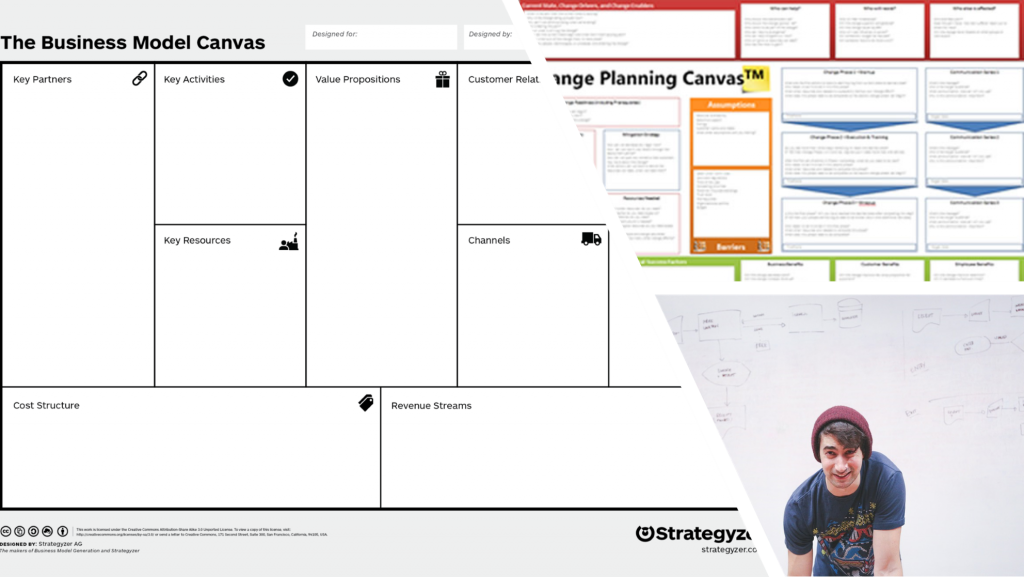
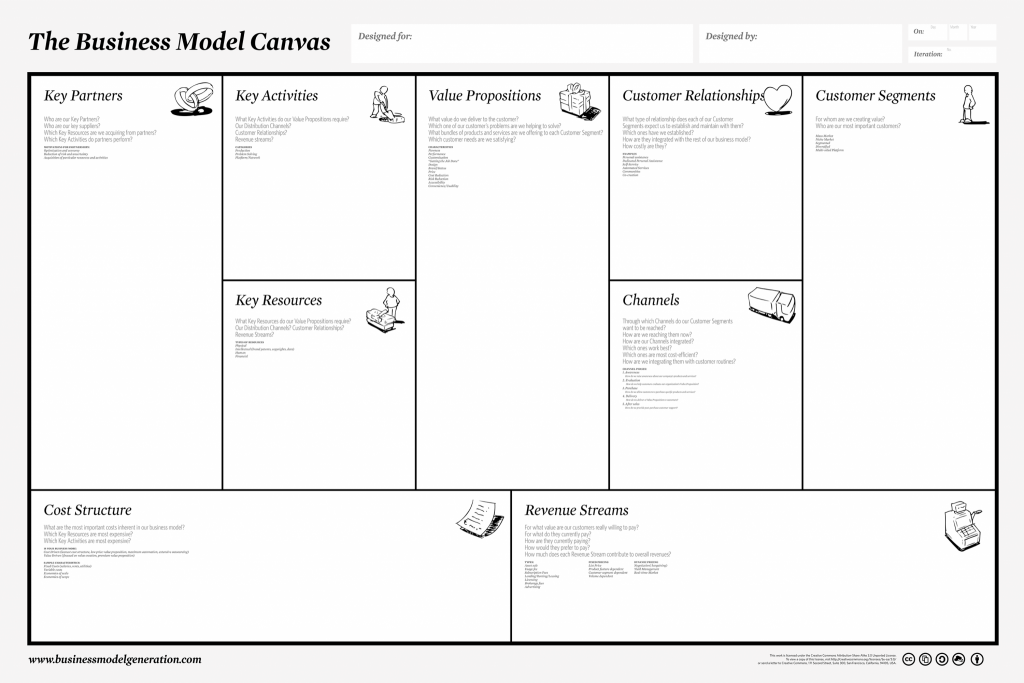
This pain has been solved in part by the Business Model Canvas created by Alex Osterwalder and Yves Pigneur, the Lean Canvas created by Ash Maurya, and by minor variations created by others.

Purpose of the Business Model Canvas

The purpose of both at their core is the same. The Business Model Canvas and the Lean Canvas seek to help entrepreneurs, intrapreneurs and innovators quickly explore the desirability, feasibility and viability of their ideas in a more visual and collaborative way, while also supporting much quicker iterations and revisions to both the value proposition and its path to market.

Where a business plan may take weeks to create, a Business Model Canvas or Lean Canvas can be created in an afternoon.

Where a business plan is often created by one person and revised by others in a serial manner, a Business Model Canvas or Lean Canvas is a group activity, informed by a collection of diverse perspectives and experiences, and challenged, evolved and revised in a real-time, parallel manner.

What excites me most as someone who conducts workshops all around the world and teaches people how to use the Business Model Canvas and other innovation & change tools, is that the Business Model Canvas and Lean Canvas have helped to accelerate a transformation in not only how people are taught, but also how they are permitted to conduct business.

Creating a Business Model Canvas as a Team

The Visual and Collaborative Workplace Transformation

This transformation is a game changer because it represents a growing integration of methods into workshops and meetings that enable facilitators to engage not only auditory learners, but visual, kinesthetic and social learners as well.

This more human approach to prototyping a business helps to add a bit more structure around an idea, in a collaborative way that will more quickly surface gaps and flaws while also testing assumptions, collecting idea fragments into a more holistic value proposition and creating a vision for how to make it real.

But, as we all know, any new business or any potential innovation will create an abundance of required and necessary changes. Unfortunately, whether you are using the Business Model Canvas or the Lean Canvas, the truth and the limitation is that they are but a single tool and can’t help you walk the rest of the path to reality. To create the changes necessary to realize your vision, you will need many more tools.

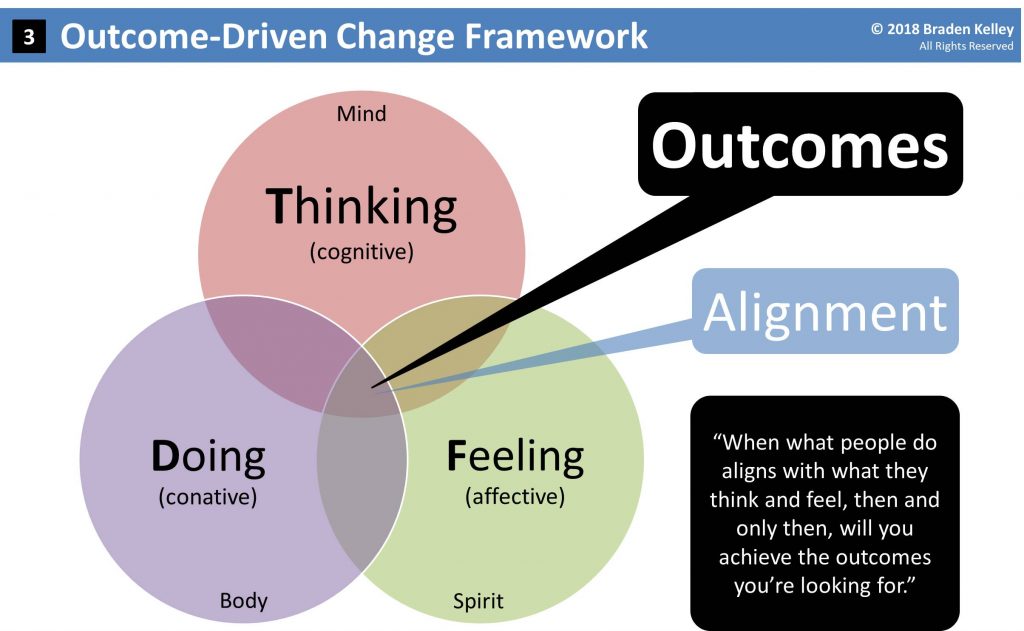
“When what people do aligns with what they think and feel, then and only then, will you achieve the outcomes you’re looking for.”

The good news is that this more visual and collaborative way of working helps with two of the most important keys to success – buy-in and alignment – and also helps to align mind, body, and spirit to harness the whole brain and its three constructs:

  1. Cognitive (thinking)
  2. Conative (doing)
  3. Affective (feeling)

Outcome-Driven Change Framework by Braden Kelley

Beyond the Business Model Canvas and the Lean Canvas

Visual, collaborative tools like the Business Model Canvas, Lean Canvas, Empathy Map, Value Proposition Canvas, Experience Maps, Service Design, and even Customer Journey Maps have laid the groundwork for a more modern, more powerful way of working that leverages the whole brain of the individual, and all three learning styles of the collective.

And where these tools all represent the beginning of a visual, collaborative endeavor to create change, they are missing the tools to help plan for and execute the changes that are being proposed.

Making the Shift to Human-Centered Change

This is where the Change Planning Toolkit™ powering the Human-Centered Change methodology comes in. It has been designed with the Change Planning Canvas™ at its core to feel familiar to those already using the aforementioned tools and empower teams to take the next steps on their journey to be successful:

  1. Innovation and Intrapreneurship
  2. Startup Creation
  3. Digital Transformation
  4. Design Thinking
  5. New Product Development (NPD)
  6. Service Design
  7. Experience Design
  8. Customer Experience (CX) Improvement Efforts
  9. Projects (make sure you also get the Visual Project Charter™)
  10. Change Initiatives

Charting Change is Number OneSo, if you’re already familiar with the Business Model Canvas, Lean Canvas, Empathy Map, Value Proposition Canvas, Experience Maps, Service Design, or Customer Journey Maps then you should get a copy of my latest book Charting Change and it will show you the thinking behind the Change Planning Toolkit™, how to use it to maintain the momentum of your team and the energy behind your idea, and how to leverage both to push it forward towards reality.

The Change Planning Toolkit™ will help you beat the 70% change failure rate, create more efficient and effective change initiatives (and even projects), and accelerate your pace of successful change in order to keep up with the accelerating pace of change all around us and to be more nimble, agile, and responsive than your competition.

Three Steps to Human-Centered Change Success

There is a simple three step process for people who want to start saving time and get the jump on their competition today by familiarizing themselves with the Human-Centered Change methodology:

  1. 10 free tools available to download now
  2. 26 free tools when you buy the book
  3. 70+ tools when you license the toolkit

I’ve invested more than $1 million into the Change Planning Toolkit™ so you don’t have to, and so you can leverage this investment to gain all of the benefits above while also saving yourself thousands or millions of dollars in consulting fees – every year.

And for a limited time, there are some exciting FREE training opportunities available to a handful of organizations who contact me.


Accelerate your change and transformation success

Subscribe to Human-Centered Change & Innovation WeeklySign up here to get Human-Centered Change & Innovation Weekly delivered to your inbox every week.
Beyond the Prototype – How to Test and Iterate on a Business Model

LAST UPDATED: December 10, 2025 at 12:12PM

Beyond the Prototype - How to Test and Iterate on a Business Model

GUEST POST from Chateau G Pato

The journey of innovation often starts with a flash of insight, proceeds through design thinking, and culminates in a beautiful, working prototype. Unfortunately, too many organizations mistake this technical milestone for ultimate validation. They assume that because the product works, the business model — the economic engine that funds and scales that product — will also work. This is the most dangerous assumption in the innovation lifecycle.

The business model itself is the largest, most complex hypothesis we launch. It encompasses everything from how we acquire customers and what they are willing to pay, to the cost of our key resources and the nature of our partnerships. If your revenue streams are a guess, your cost structure is a hope, and your channels are a pipe dream, your product, however well-designed, is destined for the scrap heap. In the realm of Human-Centered Innovation, we must unlearn the product-first mentality and embrace the model-first testing philosophy. This requires shifting from testing product usability to testing business viability using model-specific metrics.

The Three Hypotheses in Business Model Testing

Testing a business model means breaking it down into its core, measurable assumptions. We focus on three interconnected areas:

1. The Value Hypothesis (Customer/Value Proposition Fit)

This is the foundation: Does the product or service actually solve a problem for a defined customer segment? While prototyping addresses product usability, model testing addresses willingness-to-pay and actual usage patterns. We test whether the perceived value aligns with the revenue model.

  • Test Focus: A/B test pricing tiers (monthly vs. annual, premium vs. basic), run “smoke tests” to gauge initial sign-ups for a non-existent product, or use Concierge MVPs where services are manually delivered to deeply understand the customer journey and price sensitivity before automation.
  • Key Metric: Willingness-to-Pay (WTP), Net Promoter Score (NPS) for the specific value exchange.

2. The Growth Hypothesis (Channel/Acquisition Fit)

A great product fails if you cannot affordably get it into the hands of customers. This hypothesis tests the efficiency and scalability of your customer acquisition channels and your key partners.

  • Test Focus: Run small, contained experiments across different channels (e.g., paid social vs. SEO vs. strategic partnership referrals) to compare costs and conversion rates. Test various partner roles — do they act as distributors, co-creators, or merely service providers?
  • Key Metric: Customer Acquisition Cost (CAC), Lifetime Value (LTV), and LTV/CAC ratio. This ratio is the ultimate test of viability.

3. The Operational Hypothesis (Cost/Resource Fit)

This tests the internal engine: Can we deliver the value proposition at a cost that is significantly lower than the price we charge? This involves testing key activities, resource assumptions, and supply chain scalability.

  • Test Focus: Create a “Shadow P&L” for the new model, tracking variable costs associated with early customer acquisition and service delivery. Run controlled pilots focused on simulating the Key Activities (e.g., if a new service requires 24/7 support, test that support capability with real, paying customers for a month).
  • Key Metric: Contribution Margin, Cost of Goods Sold (COGS) as a percentage of revenue, and scalability metrics (e.g., cost to serve the 10th customer vs. the 100th customer).

Case Study 1: The Subscription Anchor That Was Cut

Challenge: Failed Launch of a Health-Tech Diagnostic Device

A medical device company (“MedTrack”) developed a portable diagnostic device. The initial prototype was technically perfect, but the business model relied on a mandatory high-cost monthly subscription for data analysis software. The subscription revenue stream was designed to create recurring revenue and offset the low upfront device cost.

Model Testing Intervention: Value Hypothesis Pivot

Initial pilot testing revealed that while customers loved the device, the high subscription created massive churn after the first year. MedTrack tested the Value Hypothesis:

  • Hypothesis 1 (Failed): Customers will pay $150/month for comprehensive data analysis.
  • Test: Offer three options: $150/month (current model), $25/month for basic data (new tier), and a $1,500 one-time software license.

The Innovation Impact:

The test showed that the $25/month basic data tier attracted 80% of new customers and had 95% retention. The $1,500 one-time fee also proved attractive to institutional buyers. By iterating on the Revenue Stream (a key business model block) from a rigid subscription to a tiered and licensed model, MedTrack dramatically improved its LTV/CAC ratio. They realized their innovation wasn’t the device; it was the flexibility of the pricing model tailored to different customer segments, a critical element of Human-Centered Innovation.

Case Study 2: Testing the Delivery Channel of Services

Challenge: Scaling an Expensive B2B Consulting Service

A strategy firm (“StratX”) wanted to scale a high-value, bespoke market entry strategy service without proportionally increasing its headcount — a severe constraint in its Cost Structure block. Their initial Growth Hypothesis relied on high-touch, senior consultant sales.

Model Testing Intervention: Growth and Operational Hypothesis Test

StratX decided to test replacing the expensive consultant delivery with a technology-augmented channel. They ran an A/B test on their target customer segment:

  • Group A (Control): Full senior consultant engagement (high Cost Structure, high Revenue Stream).
  • Group B (Test): A “Hybrid Model” where the initial 80% of the strategy report was generated by AI/data science tools (saving Key Activities cost), followed by a single senior consultant review session (low Cost Structure, slightly reduced Revenue Stream).

The Innovation Impact:

The Hybrid Model achieved an LTV/CAC ratio that was300% higher than the Control Group. Customers in Group B were highly satisfied with the speed and data quality, accepting a slightly lower consultant touchpoint for a lower price and faster delivery. StratX had successfully validated a new, highly scalable Key Resource (the data science platform) and a new Channel, allowing the firm to expand its addressable market and free up expensive senior consultants for truly bespoke, complex client needs. This proved that innovation in service delivery is a critical component of the business model.

Conclusion: Business Model Validation is the Ultimate De-Risking

The successful launch of any new initiative, particularly in the realm of radical innovation, is determined long after the prototype is functional. It is determined by the rigor with which you test and iterate on your business model hypotheses. By dissecting your model into its core assumptions — Value, Growth, and Operational — and designing measurable experiments (MVPs, A/B tests, Shadow P&Ls), you move from guessing to knowing. This structured approach, rooted in Human-Centered Innovation, shifts the risk from catastrophic failure at launch to manageable learning throughout development. Stop perfecting the product; start proving the model.

“If your product is a masterpiece but your business model is a mystery, you have a hobby, not an innovation.”

Frequently Asked Questions About Business Model Testing

1. What is the difference between testing a product and testing a business model?

Testing a product focuses on usability, functionality, and desirability (e.g., does the app work, do people like the color?). Testing a business model focuses on viability and scalability (e.g., are people willing to pay enough for the app to cover the cost of acquiring them and running the service?).

2. What is a “Shadow P&L” in the context of innovation?

A Shadow P&L (Profit and Loss) is a separate, simulated financial statement created specifically for an innovation project. It tracks the real-world costs and simulated revenues associated with the new business model during the testing phase. It helps the team validate their Cost Structure and Revenue Stream hypotheses before integrating the project into the main corporate finances.

3. How do you test a distribution channel without a full launch?

Distribution channels can be tested using small, contained experiments. For instance, testing a partnership channel can involve a single pilot partner with clear, measurable KPIs (conversion rates, lead quality). Testing a direct-to-consumer channel can use A/B testing of targeted digital ads to measure Customer Acquisition Cost (CAC) without building out the entire logistics infrastructure.

Your first step toward model testing: Take your most promising new idea, map it onto a Business Model Canvas, and circle the three riskiest assumptions in the “Revenue Streams,” “Cost Structure,” and “Key Activities” blocks. Design one small, cheap experiment for each of those three assumptions next week.

Extra Extra: Because innovation is all about change, Braden Kelley’s human-centered change methodology and tools are the best way to plan and execute the changes necessary to support your innovation and transformation efforts — all while literally getting everyone all on the same page for change. Find out more about the methodology and tools, including the book Charting Change by following the link. Be sure and download the TEN FREE TOOLS while you’re here.

Image credit: Unsplash

Subscribe to Human-Centered Change & Innovation WeeklySign up here to get Human-Centered Change & Innovation Weekly delivered to your inbox every week.

Scaling Local Food Revival with a Business Model Innovation

Business Model Innovation Taken for a Spin by Zaycon Foods

There is no doubt that people are becoming more interested in where their food came from and with meat prices rising (especially here in the United States with widespread drought in some areas) people are also becoming more concerned with the cost.

Like a blast from the past, when neighbors used to get together and buy a side of beef together and have a butcher carve it up so they could stash it in their respective freezers, Zaycon Foods has come along with a business model innovation and introduced a Farm->Truck->You food distribution system for some types of meat and produce, bypassing several layers of warehousing, truck shipment, and unnecessary waiting time.

Here is a video describing their business model innovation for a spin using chicken as an example:

But it is not just chicken that they offer at their buying events. They also offer 93/7 lean ground beef, premium bacon, ribs, hot dogs, ham, and even seasonal produce straight to the trunk of your car. The benefits of the business model innovation are numerous:

  • Lower prices
  • Fresher food (no waiting steps in the process)
  • No food waste (which is part of the reason retailer’s charge more)

Now operating in 48 states to 1,000+ locations here in the United Sates and a growing favorite of churches, and other group purchasers, neighbors are now banding together and doing a scaled down version of sharing a side of beef (or, um, chicken).

What do you think? Is this an innovation or not?

P.S. They did win the first annual Post Harvest Waste Innovation Award from The Post Harvest Project (TPHP), a nonprofit organization founded in 2012 through the support of The Clinton Global Initiative.

Source: The Seattle Times


Build a common language of innovation on your team

Subscribe to Human-Centered Change & Innovation WeeklySign up here to get Human-Centered Change & Innovation Weekly delivered to your inbox every week.