
Category Archives: Headlines

Don’t Believe the Innovation Hype

Don't Believe the Innovation HypeThere are some strange rumors circulating out there that I’ve written a book. Before these rumors spin out of control, I thought I should address you, the loyal and valued readers of Blogging Innovation, and set the record straight.

I have not written a novel, an autobiography, or a tell-all book. Let us be clear. Despite what some people might be saying, I have not written a book about how to fix the sorry state of the global economy, or anything that might even in a small part include tips about how to find the perfect job. I also do not, nor have I ever pretended to be able to give you a new look or make you fashionable, either by writing about fashion or by speaking any magic or even mildly interesting words about the subject.

But I must admit, that yes, I have written a book about innovation. Get your rotten tomatoes ready.

Now, some of you might be wondering, why on earth would I do this?

And, some of you might be wondering why I haven’t addressed these rumors before now.

Well, in regards to the timing, it didn’t feel right to say anything before now. It just felt too premature.
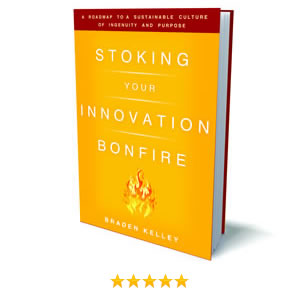
Stoking Your Innovation BonfireAnd, in regards to why I would write a book? Well, it’s not to become the next Julia Child or John Grisham. I’m not very good at cooking, and I couldn’t stomach being a lawyer. But, I can finally come clean and say that, yes, I am passionate about innovation. There, I’ve said it, and if you want to know what I think about the subject, you can now read the sordid details in the pages of this book.

Instead of fashion or fine cuisine, I’ve chosen to write about identifying and removing barriers to innovation. The full title of the book is Stoking Your Innovation Bonfire – A Roadmap to a Sustainable Culture of Ingenuity and Purpose and it is available for pre-order wherever fine business books are sold. The book is being published by John Wiley & Sons, officially launches in October 2010, and features a foreword by Rowan Gibson.

With this all out in the open, I promise that my blogging game won’t go to hell in a hand basket, and I hope I won’t be missing the Postrank cut anytime soon. If you want to get the inside scoop and read more information about the book, please visit http://innovationbonfire.com.

Now that I am publicly humiliated and exposed as the author that I am, I might as well offer you the opportunity to be one of the first to preview the sample chapter from my new book. All you have to do is join our mailing list by August 31, 2010 and you will receive an electronic copy of the chapter on ‘Sustainable Innovation’ from Stoking Your Innovation Bonfire on September 1, 2010. If you’re already receiving our monthly Innovation Insights newsletter, then you will automatically receive the free sample chapter.

I promise you won’t have to wait in any silly lines (queues for the Brits and Aussies among you) and I guarantee that you will still be able to read it no matter how you choose to hold your device. Finally, please don’t tell too many about this, I’m not sure I’m ready to face Maria Bartiromo quite yet.

Subscribe to Human-Centered Change & Innovation WeeklySign up here to get Human-Centered Change & Innovation Weekly delivered to your inbox every week.

One Simple Action Can Change Your Life

GUEST POST from Stephen Shapiro

Recently, a number of people have asked me how I became an author and professional speaker. I reflected upon it and realized that it all started with one simple action. And maybe, to make major change happen, that’s all you need: one small move.

The year was 1993. I was a relatively junior person at Andersen Consulting (now Accenture). I was 7 years out of college and was working on projects like everyone else. I blended into the woodwork and was not distinguished from any of the other 40,000 consultants.

And then one day I had an idea: I realized that I was interested in “cultural transformation” work and felt that Andersen’s culture could use a little transforming. Therefore I decided to call the CEO, George Shaheen, and ask for a meeting to discuss this, um, idea. Yes, I admit, it sounds a little crazy.

I moved into action. I found a company directory, looked up the direct dial number for George, and placed the call. I remember the call well. His executive assistant answered the phone and asked what I wanted. I said, “I want to speak with George Shaheen about transforming Andersen Consulting.”

I am certain she must have looked at the phone and thought, “Who is this crazy person?” She responded, “Excuse me. What do you want?” I repeated myself. She was polite and said, “Ok, let me see what I can do.” She hung up and I assumed that would be the end of things.

The next day, the partner leading the project I was working on came to my desk. Although he was many levels down the totem pole, word got to him quickly. He asked me, “Did you call George Shaheen?” I confirmed that I had. I’m sure HE thought I was crazy. He said, “Maybe I can help you.” I proceeded to tell him my idea about transforming the company’s culture. His response – “I know someone, Bill Stoddard, who is involved with an effort called ‘Enterprise Transformation.’ Maybe you want to meet him instead.” I said, “I would love to meet with Bill. And I still want to meet with George.”

Long story short, I did eventually meet with George, and it was an interesting meeting. But the person who changed my career forever was Bill Stoddard. Meeting him put my career on a totally different trajectory. For some reason he liked me and asked me to work with him on a new initiate he was leading called Value Driven Re-Engineering (he was only an adviser to the Enterprise Transformation initiative). I stopped doing full-time client work and started working with Bill. Our re-engineering work turned out to be big. VERY big. At one point, over one-third of the company’s revenues could be tied back to re-engineering. I was busy leading training sessions and giving speeches around the world.

This started me on the path towards the career I have now. A career I absolutely love.

And none of this might have happened if it weren’t for that one phone call to George.

Sometimes one action can forever change the course of your life, or your business.

Of course, I did not realize that this call would lead me down a totally new path. But sometimes, we can predict possible futures based on actions.

What action can you take TODAY that could change the course of events for you or your business. If the action doesn’t seem outrageous or crazy, keep on thinking.

  • Who can you call that you would never typically have the guts to call?
  • What can you do that is out of your comfort zone, but could have life changing implications?
  • Where could you go that you would never go, but might open up new opportunities?

Sometimes, just taking the first step on a new path can change the course of future events.

Subscribe to Human-Centered Change & Innovation WeeklySign up here to join 17,000+ leaders getting Human-Centered Change & Innovation Weekly delivered to their inbox every week.

How Can Goals Enhance Creativity?

GUEST POST from Stephen Shapiro

Over the years, I have written numerous articles on “The Performance Paradox” that show how an obsession with the future reduces performance in the present. And typically, creativity is significantly diminished in the process.

But given that businesses are driven by goals, how can we leverage them as a tool for enhancing creativity?

One way is to use stretch targets. REALLY stretch targets.

For example, one client that I was with last week has a target of doubling their business over the next 5 years. I know MANY organizations that have exactly the same goal. That equates to a 14% growth rate each year (assuming compounding). I’m sure, with hard work, they could hit those numbers, even though it would certainly not be easy.

But what if they set a target of growing by 50% a year? It might have a fundamentally different impact on the organization. That level of growth is unprecedented. It will certainly stretch the way they think. A 14% improvement can most likely be attained through conventional thinking. But a 50% growth target would require some breakthrough thinking; radical ideas.

It might also have an interesting psychological impact on the organization.

Because a 14% growth rate is viewed as doable, it might create an attachment in the minds of the executives and employees. “We should be able to hit these targets. Therefore it we don’t, there is something wrong.”

But a 50% growth rate is unheard of. Clearly no one in the organization would be “attached” to that outcome. Surely the executives would not expect employees to deliver on those targets.

As a result, the 50% target becomes a “game” without attachment. Everyone knows it is designed to shift their thinking and to help create enthusiasm.

The future gives them the present, rather than present giving them the future.

As long as everyone in the organization believes they are playing a game which is designed to get them energized today, and it is not specifically about hitting the target, I can assure you that people will be more motivated. Creativity will be stimulated. And even if the company does not hit 50% growth rates, they will certainly have a better chance of hitting the 14% improvement than if they focused on that as the goal.

Goals that are not goals, can enhance creativity.

Subscribe to Human-Centered Change & Innovation WeeklySign up here to join 17,000+ leaders getting Human-Centered Change & Innovation Weekly delivered to their inbox every week.

Doing Nothing to Enhance Creativity

GUEST POST from Stephen Shapiro

We are in such a fast paced society that we are always focused on achieving our goals. In business, these goals might be hitting quarterly earnings targets, sales quotas, or operating budgets. Even innovation initiatives are goal-driven. We measure ideas generated, time-to-market, and percent of revenue from new products.

We are indeed a goal-driven society. And there is nothing wrong with that. But there are times when this obsession can be counter-productive.

In previous posts, I’ve talked extensively about the “Performance Paradox”. This is the phenomenon whereby a hyper-focus on your goals is the very thing that prevents you from achieving them. Dan Pink also wrote about this concept in his recent book, Drive.

Yesterday it was a beautiful, sunny day here in Boston, so I decided to walk the ocean near where I live. I spent most of my time walking up and down the beach, listening to my iPod, and eating a delicious lobster roll. As I started to walk back home, I decided to walk into the water and just stand there. I did nothing for about 20 minutes. The picture above is what I looked at (you can click on it for a larger version). I just stood there. My mind wandered. At first I wondered what others were thinking of my “statue-like” position. Then my mind drifted towards work…in particular the marketing efforts for my new book, Personality Poker. I let my mind meander, but I stayed focus on the book. After about 5 minutes, a flood of ideas started to come through. By the end of the 20 minutes, I had more ideas than I had in the previous few weeks.

I have been incredibly busy lately. And I never felt I had the time to reflect. But what I realized very quickly was that I needed to detach myself from my goals in order to help me achieve the goal of a New York Times best seller. The more I hyper-focused on the work I needed to do, the less it seemed I could develop new ideas and solutions.

As I walked back home, I realized very quickly that the phenomenon I experienced is something I had written about many times before. I forgot the value of doing nothing.

In my book, Goal-Free Living, when discussing the process for clearing the mind, I wrote…

The word Mushin is used extensively in Japan. It means silent mind, empty mind. A mind that is void of thought patterns and mental chatter. The ability to listen to that inner voice is critical on the journey to self-awareness. It is said that Aristotle used to lie in bed with a ball in his hand so that when he would fall asleep the ball would drop and bang a copper plate below. The noise would wake him up, keeping him in a quasi state of sleep and consciousness. This is where he generated his best ideas and insights.

In Personality Poker (due in stores November 2010), I provided some of the neuroscience behind this…

A particular area of the brain known as the dorsolateral prefrontal cortex is most active during conscious thought. This is among the most advanced parts of the brain, parts which separate us from other animals that cannot analyze and calculate the way humans can. However, when we are in a state of “flow,” this part of the brain is quiet, and we move into a more playful mindset. Flow casts the human brain back to a more primitive state where thoughts and sensations come through without being controlled, judged, or censored. Anyone who meditates knows what it’s like to be in this state, as the purpose of meditation is to go behind the judgmental veil of that prefrontal cortex and enter a state of flow. When the conscious part of the brain is activated, the flow state is interrupted. Interestingly, in children, the prefrontal cortex is not fully developed, which allows them a more natural state of play.

Research by Northwestern University neuroscientist Mark Jung-Beeman shows that people who are in a good mood not only tap into different parts of the brain, but also solve more problems through “flashes of insight.” Playfulness helps to put us in a good mood and enjoy a more relaxed frame of mind. Studies have shown that people in this state generate more unusual ideas when brainstorming. This explains why we get so many good ideas while showering or half-dozing; a relaxed frame of mind is conducive to insight, helping us bring forth new knowledge or ideas without forcing them. Like playfulness and a positive mood, the “drowsy” brain induces a relaxed state and encourages insights. How many times have you been bombarded by an amazing idea or thought, or solved a problem in your mind just seconds before falling asleep? This “stroke of genius” is a flash of insight thanks to your brain’s calm state.

I realize that businesses are designed to provide financial returns to the shareholders. And as a result, there is a lot of goal-setting going on.

But in order to achieve long-term goals, innovation is a must. And one component of innovation is the development of creative ideas. And sometimes the best way to develop those new insights is to stop focusing on innovation.

So, take time to do nothing. Sit and stare out the window. Relax. Meditate.

And if your boss asks you what you are doing, tell him/her, “I am quieting my dorsolateral prefrontal cortex in order to be more innovative.”

I’m sure after that, they will stop asking you questions.

Subscribe to Human-Centered Change & Innovation WeeklySign up here to join 17,000+ leaders getting Human-Centered Change & Innovation Weekly delivered to their inbox every week.