Tag Archives: Values

The Architecture of Organizational Agility

Beyond the Pivot

LAST UPDATED: February 24, 2026 at 5:22 PM

Architecture of Organizational Agility

by Braden Kelley and Art Inteligencia

I. Introduction: The Agility Imperative

Beyond Reactive Maneuvering toward Proactive Orchestration

The Stability Paradox

In my work with global enterprises, I often observe a recurring struggle: The Stability Paradox. Legacy organizations often possess the “fixedness” required for massive scale but lack the fluidity to respond to market shifts. Conversely, startups possess “flexibility” in spades but often collapse under their own weight due to a lack of foundational structure.

Defining True Agility

Many leaders mistake speed for agility. Speed is simply high-velocity movement in a single direction. True Agility is the architectural capability to change direction at speed without destroying the engine. It is the move from “reactive maneuvering” — constantly putting out fires — to “proactive orchestration,” where the organization anticipates the flame and adjusts its posture before the heat is even felt.

Thesis: Organizational agility is not about being liquid or formless; it is about strategic architecture. It requires knowing exactly which parts of your foundation must remain fixed to provide a stable spine, so that the rest of the enterprise can remain infinitely flexible.
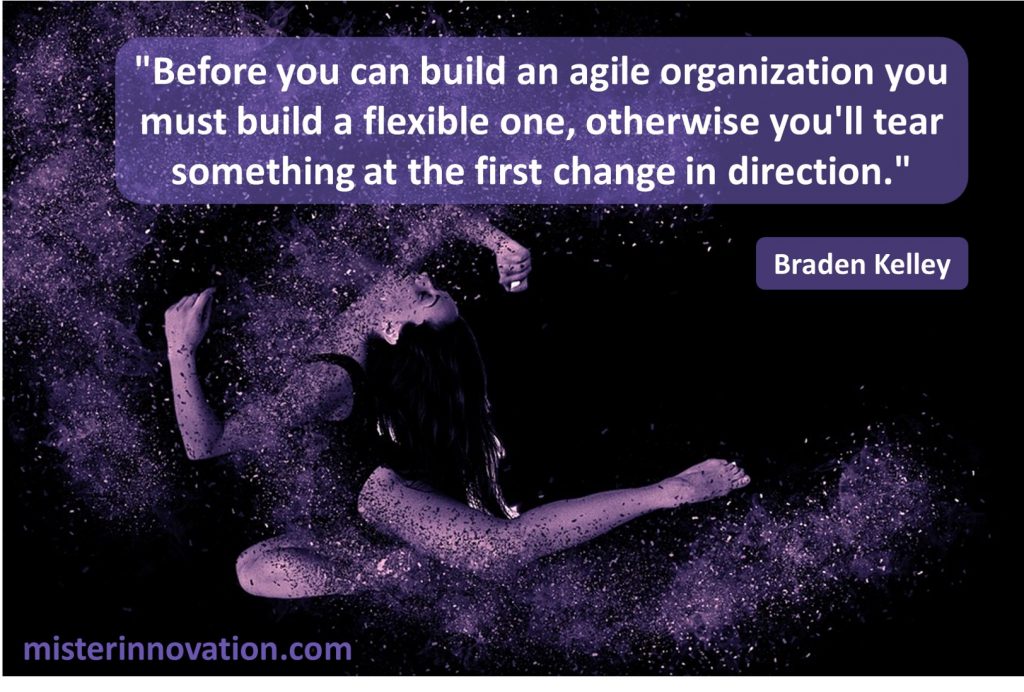
Braden Kelley Flexibility Quote

II. The Human Side of Agility (Human-Centered Change)

Fueling the Adaptive Machine with Mindset and Culture

Psychological Safety as a Fuel

An agile architecture is useless if the people within it are too terrified to move. Psychological safety is the essential fuel for change. If employees fear that a “failed” experiment or a missed pivot will result in professional retribution, they will default to the status quo every time. To be truly agile, the organization must celebrate the learning gained from failure as much as the success of a win.

Shifting the Mindset: Adaptability Over Efficiency

For decades, management science focused on “Efficiency-First” — doing things right through rigid optimization. In a volatile world, we must pivot to “Adaptability-First” — ensuring we are doing the right things as the market shifts. This requires a cultural “unlearning” where we value the ability to pivot just as highly as the ability to execute.

Radical Transparency and Communication Loops

Agility requires that the “edges” of the organization — the people talking to customers and witnessing market friction — have a direct line to the “center.” By creating radical transparency and shortened communication loops, we ensure that institutional knowledge flows at the speed of the internet, allowing for collective intelligence rather than top-down bottlenecks.

The Human Truth: You cannot mandate agility; you can only design an environment where it is safe to be agile. Change doesn’t happen in the boardroom; it happens in the hearts and minds of the people on the front lines.

III. The Braden Kelley Organizational Agility Framework™

Navigating the Strategic Tension Between Flexibility and Fixedness

Introduction to the Framework

In my research and consulting, I developed the Organizational Agility Framework™ as a diagnostic tool for the modern enterprise. It moves away from the idea that everything in a business should be “fluid.” Instead, it focuses on identifying the necessary friction and structural integrity required to support rapid movement.

The Core Tension: Flexibility vs. Fixedness

The secret to sustained agility lies in the deliberate management of two opposing states:

  • The Fixed: These are your non-negotiables. They include your core values, organizational purpose, and essential guardrails. These elements provide the “stable spine” and the psychological certainty employees need to take risks.
  • The Flexible: These are your “modular” components. They include business processes, resource allocation models, and team structures. These must be designed to be disassembled and reconfigured in real-time as market conditions evolve.
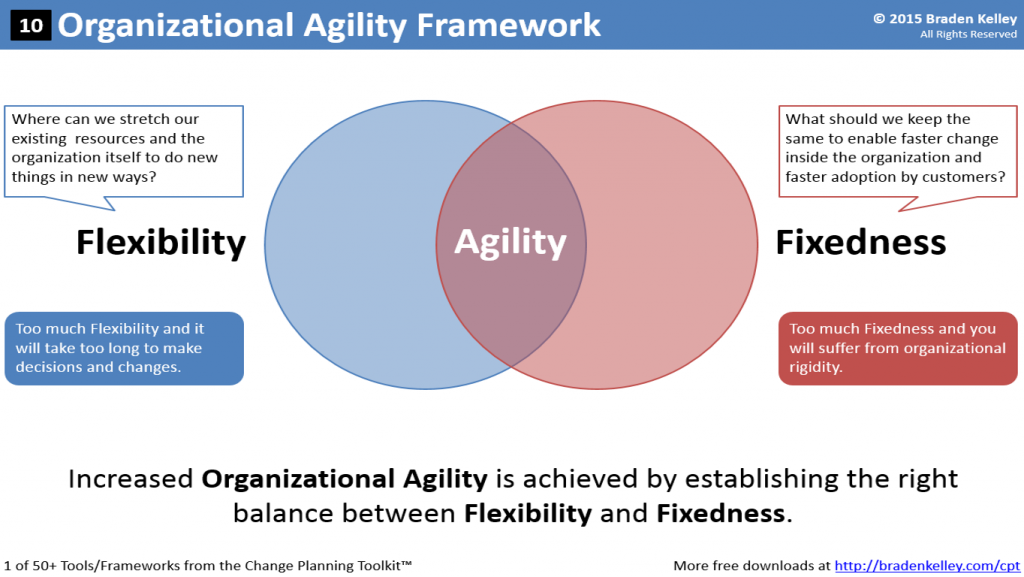
Organizational Agility Framework

Managing the Equilibrium

The framework teaches leaders how to prevent “Fixedness” from decaying into Rigidity (where you become a dinosaur) and how to prevent “Flexibility” from dissolving into Chaos (where you lose your brand identity). Agility is the active, daily management of this equilibrium.
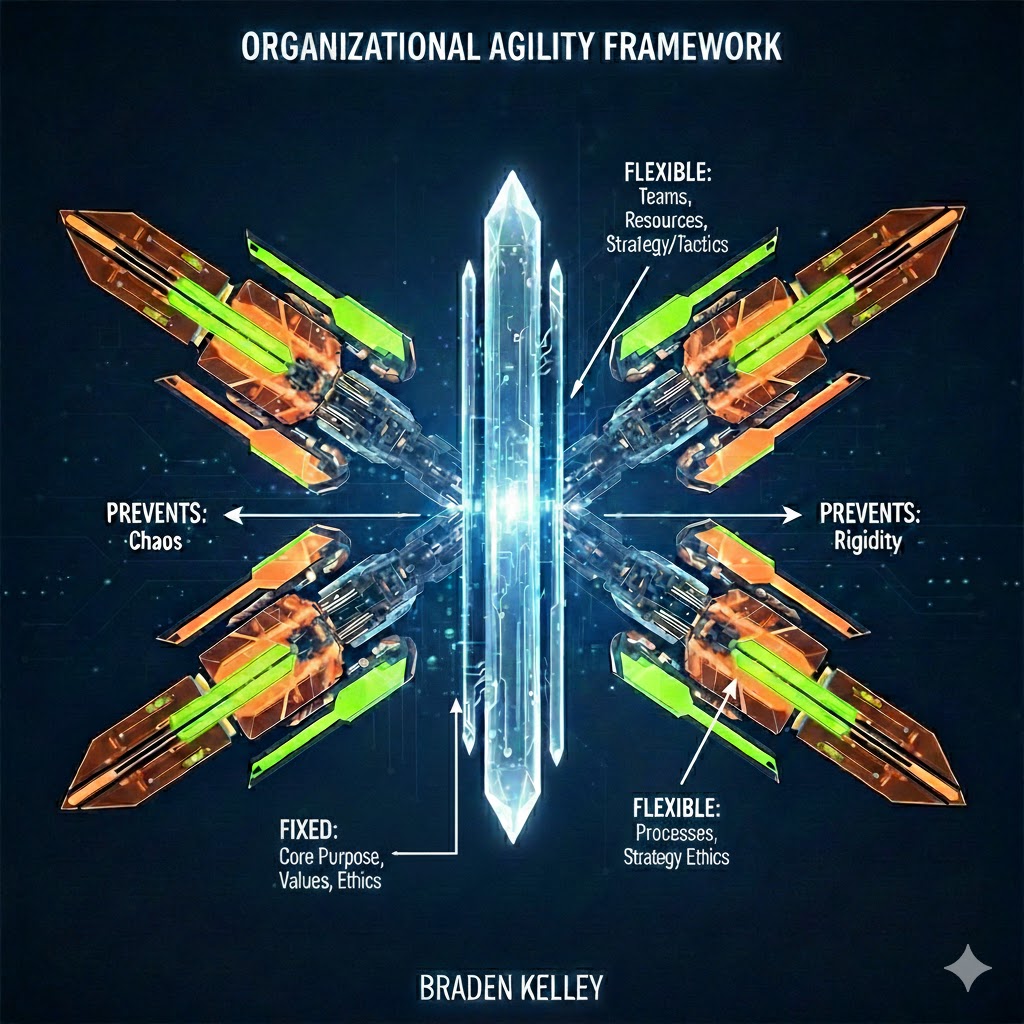
Insight: If you try to make everything flexible, you create an organization with no memory and no identity. If you keep everything fixed, you create a monument to the past. Agility is the art of knowing what to hold onto and what to let go.

IV. Designing for Modular Change

Architecting the Reconfigurable Enterprise

Loose Coupling and Micro-Structures

In a truly agile organization, we must abandon monolithic, deeply intertwined departmental silos. Instead, we move toward “Loose Coupling.” By organizing into small, cross-functional squads with clear interfaces, we ensure that one part of the business can pivot or fail without bringing down the entire system. This modularity allows for “plug-and-play” innovation.

Resource Fluidity: Escaping the Annual Budget Trap

You cannot have an agile strategy if your capital is locked in a 12-month fixed cycle. Resource Fluidity is the ability to shift talent and funding dynamically as opportunities arise. Agile organizations treat budgets as “living documents,” allowing leadership to pull resources from declining initiatives and inject them into high-growth “breakthrough” experiments in real-time.

Rapid Prototyping for Organizational Structure

We often prototype products, but we rarely prototype structure. Before committing to a company-wide reorganization, agile leaders run small-scale organizational experiments. By testing a new reporting line or a new collaborative workflow within a single “pilot” team, we can validate the human impact of the change before scaling it.

The Design Rule: Complexity is the enemy of agility. If your organizational chart requires a map and a legend to navigate, you aren’t built for speed — you’re built for bureaucracy. Simplify to amplify.

V. Measuring What Matters: Agility Metrics

Quantifying the Velocity and Resilience of Change

Time-to-Insight vs. Time-to-Action

In a traditional enterprise, the gap between identifying a market shift (Insight) and actually deploying a response (Action) can be months or even years. Agility is measured by the shrinkage of this gap. We must track our Latency of Decision — the speed at which data travels from the front lines to the decision-makers and back into the field as an executed strategy.

Learning Velocity

Success is a lagging indicator; Learning Velocity is a leading one. How quickly can your organization ingest new information, test it, and turn it into institutional knowledge? By measuring the number of validated experiments per quarter rather than just “project completions,” we shift the focus from output to outcomes.

The Resilience Score

Agility is as much about defense as it is offense. A Resilience Score assesses how much of a “shock” your organization can absorb — be it a supply chain disruption or a competitor’s surprise launch — without a significant drop in service levels or employee engagement. An agile organization doesn’t just bounce back; it “bounces forward” into a new, more relevant state.

The Measurement Shift: If you only measure efficiency, you will optimize yourself into extinction. You must measure your capacity to change, for that is where your future revenue lives.

VI. Conclusion: The Agile Organization as a Living System

Sustaining Competitive Advantage in a Volatile World

Beyond the Project Mindset

We must stop viewing “agility” as a transformation project with a start and end date. True organizational agility is a continuous practice — a state of being. It is the transition from seeing your company as a static machine to viewing it as a living system. Like any organism, your business must constantly sense, respond, and evolve to its environment to survive.

The Polymath Leader

The leaders of tomorrow must be comfortable with the “Whole-Brain” approach. They must be part scientist, using data and the Agility Framework to maintain the stable spine of the company, and part artist, using empathy and human-centered change to inspire the flexibility of the workforce. This balance is the only way to navigate the tension between what must remain fixed and what must remain fluid.

Your Sustainable Advantage

In an era where technology can be copied and capital is a commodity, your ability to change is your only sustainable competitive advantage. By architecting an enterprise that embraces both the comfort of fixed values and the excitement of flexible processes, you don’t just survive disruption — you become the disruptor.

Final Thought: Agility is the ultimate expression of confidence. It is the belief that no matter how the world changes, your organization has the structural integrity and the creative spirit to meet the moment. Let’s stop fearing the pivot and start building the platform that makes it possible.

Implementation Checklist: Activating the Agility Framework

Practical First Steps for the Human-Centered Leader

Moving from theory to practice requires a deliberate focus on the Fixed/Flexible balance. Use this checklist to audit your current state and begin the transition.

  • Identify Your “Stable Spine”:
    Document the 3-5 core values and the overarching purpose that must remain Fixed. Do your teams know these are the non-negotiable guardrails?
  • Audit for “Rigid Decay”:
    Locate one process that exists “because we’ve always done it that way” but no longer serves the customer. Mark it as Flexible and schedule a redesign.
  • Establish a “Safe-to-Fail” Zone:
    Designate one small-scale project where the team is explicitly rewarded for Learning Velocity rather than just the final ROI.
  • Assess Communication Latency:
    Track how many days it takes for a customer insight from the field to reach a decision-maker. Aim to reduce this Time-to-Insight by 20% this quarter.
  • Beta-Test a “Squad” Structure:
    Select one departmental silo and “loosely couple” a cross-functional team (e.g., Marketing, Tech, and Customer Success) to solve a single specific friction point.

Braden’s Tip: Don’t try to change the whole organization at once. Agility is built through fractal change — successful small pivots that create a blueprint for the larger enterprise to follow.

What is a Stable Spine Audit?

In my Organizational Agility Framework, a Stable Spine Audit is a strategic exercise used to identify the permanent, non-negotiable elements of an organization that provide the structural integrity required to support rapid change elsewhere.

Think of it this way: for a human to move with agility — to sprint, jump, or pivot — the spine must remain strong and aligned. If the spine is “mushy,” the limbs have no leverage. In a business, if everything is up for grabs, you don’t have agility; you have chaos.

The Core Components of the Audit

When I lead an organization through this audit, we look for three specific types of “Fixedness”:

  • 1. Core Purpose and North Star: Why does the organization exist beyond making a profit? This should be fixed. If your purpose pivots every six months, your employees will suffer from “change fatigue” and lose trust.
  • 2. Values and Ethical Guardrails: These are the behavioral non-negotiables. They define how we work. These provide psychological safety because employees know that even in a crisis, the “rules of engagement” won’t shift.
  • 3. Essential Architecture: This identifies the critical systems or data standards that must remain centralized and standardized to allow for “plug-and-play” flexibility in the branches or squads.

How to Conduct the Audit

The audit is essentially a filtering process for every major component of your business. You ask your leadership team: “Is this a Spine element or a Wing element?”

Category The Stable Spine (Fixed) The Flexible Wings (Fluid)
Strategy Long-term Vision & Purpose Quarterly Tactics & Experiments
Structure Governance & Core Values Cross-functional Squads & Roles
Process Essential Compliance & Quality Daily Workflows & Tools
People Cultural DNA & Talent Standards Specific Skills & Resource Allocation

Why It Matters for Innovation

I often see teams that are “frozen” because they don’t know what they are allowed to change. By conducting a Stable Spine Audit, you explicitly tell your team: “These five things are fixed. Everything else is a variable you can experiment with.”

This clarity actually increases the speed of innovation because it removes the “permission bottleneck.” When the spine is stable, the wings can flap as fast as they need to.

Diagnostic Questionnaire: Activating the Organizational Agility Framework

A Leadership Workshop Guide to the Stable Spine Audit

To help you activate the Organizational Agility Framework, here is a diagnostic questionnaire designed to be used in a leadership workshop. The goal is to reach a consensus on what belongs to the “Spine” (Fixed) and what belongs to the “Wings” (Flexible).

Phase 1: Identifying the Fixed (The Stable Spine)

Ask your leadership team to answer these questions individually, then compare notes. Discrepancies here usually indicate where organizational friction is coming from.

  • The “North Star” Test: If we changed our product line entirely tomorrow, what is the one reason for existing that would stay exactly the same?
  • The Value Constraint: What are the three behaviors that, if an employee violated them, would result in immediate dismissal regardless of their performance?
  • The Architectural Anchor: What is the single source of truth (data, brand guideline, or compliance rule) that every department must use to remain part of the collective whole?
  • The Non-Negotiable Promise: What is the one promise we make to our customers that we would never “pivot” away from, even for a massive short-term profit?

Phase 2: Identifying the Fluid (The Flexible Wings)

Now, look at the areas where the organization feels “slow.” These are likely things that are currently “Fixed” but should be “Flexible.”

  • The “Shadow” Processes: Which of our current “standard operating procedures” (SOPs) were created more than two years ago and haven’t been updated since?
  • The Permission Bottleneck: Who has the authority to spend $5,000 to test a new idea? If the answer is “The VP,” that process is too Fixed.
  • The Role Rigidity: Are our job descriptions based on tasks (Fixed) or outcomes (Flexible)? Can we move a person from Project A to Project B in 24 hours without a HR mountain to climb?
  • The Budgeting Cycle: If a massive market opportunity appeared tomorrow, how long would it take to reallocate 10% of our budget to pursue it?

The Audit Tally

Once you have these answers, map them out:

  1. Green Zone: Elements everyone agrees are Fixed. These are your strengths.
  2. Red Zone: Elements everyone agrees are Fixed but should be Flexible. These are your targets for immediate “unlearning.”
  3. Grey Zone: Elements where the team disagrees. This is where your cultural friction lives.

Closing the Audit

As an innovation speaker, I always remind leaders: The Spine is for Support, not for Strangulation. The goal of this audit isn’t to create more rules, but to create the clarity that allows for more freedom.

Organizational Agility: Frequently Asked Questions

1. What is the difference between organizational speed and organizational agility?

Speed is the velocity of movement in a single direction. Agility is the architectural capacity to change direction at speed without breaking the organization. While speed is about execution, agility is about reconfigurability.

2. Why does the “Stable Spine” actually help an organization move faster?

A “Stable Spine” (fixed core values, purpose, and guardrails) provides psychological safety and clarity. When employees know exactly what is non-negotiable, they no longer need to seek permission for everything else, effectively removing the “permission bottleneck” that slows down innovation.

3. How do you identify if a process should be ‘Fixed’ or ‘Flexible’?

Use the Stable Spine Audit. If a process protects your core DNA, ethical standards, or brand promise, it is “Fixed.” If a process is simply a method for delivery, resource allocation, or internal workflow, it should be “Flexible” and modular to allow for rapid adaptation to market shifts.

Image credits: Braden Kelley (1,100+ FREE quote posters at http://misterinnovation.com), Google Gemini

Content Authenticity Statement: The topic area, key elements to focus on, etc. were decisions made by Braden Kelley, with a little help from Google Gemini to clean up the article and add citations.

Subscribe to Human-Centered Change & Innovation WeeklySign up here to get Human-Centered Change & Innovation Weekly delivered to your inbox every week.
Values Always Cost You Something

That’s What Makes Them Different From Platitudes

Values Always Cost You Something

GUEST POST from Greg Satell

When I was in Panama a couple of years ago for a keynote I had the opportunity to speak with Erika Mouynes, the country’s former Foreign Minister, about the war in Ukraine. Her ministry had strayed from its traditionally neutral stance by calling for “respect for the sovereignty, political independence and territorial integrity of Ukraine based on international law.”

She told me that when she later met with Russia’s Foreign Minister, Sergey Lavrov, he asked her why she cared about a country thousands of miles away where Panama has no tangible interests. What did she expect to gain? She told him that sometimes you need to make decisions based on values that are important to you.

Her position was not without risk. Panama depends on broad international support for its canal. Yet many of the executives at the event told me how proud they were of her support for sovereignty, an issue that Panama has sometimes struggled with in its history. The truth is that, to mean something, values always cost you something. Otherwise they’re just platitudes.

Gandhi’s Ahimsa

Today, many dismiss Mohandas Gandhi as guileless and quixotic. He himself once said, “Men say that I am a saint losing myself in politics. The fact is I am a politician trying my hardest to be a saint.” He was, in truth, a master strategist, luring opponents into a dilemma that would put them in an impossible position of choosing either surrender or damnation.

One of the first principles of his philosophy of Satyagraha was ahimsa, or nonviolence, which was rooted in the quest for truth. If no one could claim to have absolute knowledge of the truth, then it followed that using violence—or any other means for that matter—to compel people to accede to your will would be to undermine, rather than support truth.

To the modern ear, Gandhi’s views seem idealistic at best, if not completely naive, yet there was much more to his philosophy than met the eye. His aim was to undermine his opponents’ legitimacy. He sought to back them into a corner in which both action and inaction would yield essentially the same result —an upending of the existing order.

As General Jan Smuts, Gandhi’s chief adversary in South Africa, put it, “It was my fate to be the antagonist of a man for whom even then I had the highest respect… For me—the defender of law and order—there was the usual trying situation, the odium of carrying out the law, which had not strong popular support.” Smuts had not only been defeated; he had been won over and lost any rationale to keep fighting.

Gerstner’s Devotion To The Customer

When Lou Gerstner took over as CEO of IBM in 1993, the company was near bankruptcy. Many thought it should be broken up. Yet Gerstner saw that its customers needed the firm to help them run their mission-critical systems and the death of IBM was the last thing they wanted. He knew that to save the company, he would have to start with its values.

“At IBM we had lost sight of our values,” Irving Wladawsky-Berger, one of Gerstner’s chief lieutenants, told me. “IBM had always valued competitiveness, but we had started to compete with each other internally rather than working together to beat the competition. Lou put a stop to that and even let go some senior executives who were known for infighting.”

Gerstner had been a customer and knew that IBM did not always treat him well. At one point the company threatened to pull service from an entire data center because a single piece of competitive equipment was installed. So as CEO, he vowed to shift the focus from IBM’s “own “proprietary stack of technologies” to its customers’ “stack of business processes.”

Yet he did something else as well. He made it clear that he was willing to forego revenue on every sale to do what was right for the customer and he showed that he meant it. Over the years I’ve spoken to dozens of IBM executives from that period and virtually all of them have pointed this out. Not one seems to think IBM would still be in business today without it.

“Lou refocused us all on customers and listening to what they wanted and he did it by example,” Wladawsky-Berger, remembers. “We started listening to customers more because he listened to customers.”

The World’s Debt To Katalin Karikó

In the early ’90s, Katalin Karikó was trying to solve a tough problem. A young researcher at the University of Pennsylvania, she had been working on an idea to hijack the protein manufacturing machinery in our cells (called ribosomes) to directly produce things that could help our bodies fight disease. Yet despite her best efforts, she was making little progress.

To understand the problem, imagine you want to hijack someone else’s factory to make your own product. Because the factory is automated, it is just a matter of installing software at the factory, but to do that you need to get past security. Replace “software” with genetic instructions and “security” our body’s immune system and, in a nutshell, that is what Katalin had to overcome.

By 1995, things came to a head. Unable to secure grants to fund her work, the university told her that she could either direct her energies in a different way, or be demoted. “I thought of going somewhere else, or doing something else,” Katalin would later recall. “I also thought maybe I’m not good enough, not smart enough. I tried to imagine: Everything is here, and I just have to do better experiments.”

She decided to stick it out and eventually struck up a partnership with Drew Weissman, an immunologist who had some ideas about how to slip the genetic instructions past the cell’s natural defenses. Their work led to a breakthrough and, when the Covid pandemic broke out in 2020, the mRNA technology they invented led to life saving vaccines in record time.

Today, mRNA is being used to develop a number of therapies beyond vaccines, including cures for cancer and other diseases. Sticking to her values certainly cost Katalin Karikó, but the rest of us benefited enormously.

Values Are How An Organization Honors Its Mission

Values are essential to how an enterprise honors its mission. They represent choices of what an organization will and will not do, what it rewards and what it punishes and how it defines success and failure. Perhaps most importantly, values will determine an enterprise’s relationships with other stakeholders, how it collaborates and what it can achieve.

When we sit down with executive teams to help them drive transformation and change, one of the first things we ask them is to define their values. Usually, they can easily rattle off a list such as, “the customer,” “excellence,” “integrity,” and so on. Then we ask them what those values cost them and we get blank stares.

The problem is that values are often confused with beliefs. When you’re sitting around a conference table, it’s easy to build a consensus about broad virtues such as excellence, integrity and customer service. True values, on the other hand, are idiosyncratic. They represent choices that are directly related to a particular mission.

Make no mistake. Real values always cost you something. They are what guides you when you need to make hard calls instead of taking the easy path. They are what makes the difference between looking back with pride or regret. Perhaps most importantly, they are what allows others to trust you.

Without genuine commitment values there can be no trust. Without trust, there can be no shared purpose.

— Article courtesy of the Digital Tonto blog
— Image credit: Unsplash

Subscribe to Human-Centered Change & Innovation WeeklySign up here to join 17,000+ leaders getting Human-Centered Change & Innovation Weekly delivered to their inbox every week.

Is Your Problem Bigger Than Its Seems?

Is Your Problem Bigger Than Its Seems?

GUEST POST from Mike Shipulski

If words and actions are different, believe the actions.

If the words change over time, don’t put stock in the person delivering them.

If a good friend doesn’t trust someone, neither should you.

If the people above you don’t hold themselves accountable, yet they try to hold you accountable, shame on them.

If people are afraid to report injustices, it’s just a matter of time before the best people leave.

If actions are consistently different than the published values, it’s likely the values should be up-revved.

If you don’t trust your leader, respect your instincts.

If people are bored and their boredom is ignored, expect the company to death spiral into the ground.

If behaviors are different than the culture, the culture isn’t the culture.

If all the people in a group apply for positions outside the group, the group has a problem.

When actions seen by your eyes are different than the rhetoric force-fed into your ears, believe your eyes.

If you think your emotional well-being is in jeopardy, it is.

If to preserve your mental health you must hunker down with a trusted friend, find a new place to work.

If people are afraid to report injustices, company leadership has failed.

If the real problems aren’t discussed because they’re too icky, there’s a bigger problem.

If everyone in the group applies for positions outside the group and HR doesn’t intervene, the group isn’t the problem.

And to counter all this nonsense:

If someone needs help, help them.

If someone helps you, thank them.

If someone does a good job, tell them.

Rinse, and repeat.

Image credits: Pixabay

Subscribe to Human-Centered Change & Innovation WeeklySign up here to join 17,000+ leaders getting Human-Centered Change & Innovation Weekly delivered to their inbox every week.

Designing Your Organization for Transformation

Designing Your Organization for Transformation

GUEST POST from Greg Satell

The March on Washington, in which Martin Luther King Jr. delivered his famous “I Have a Dream” speech, is one of the most iconic events in American history. So it shouldn’t be surprising that when anybody wants to drive change in the United States, they often begin with trying to duplicate that success.

Yet that’s a gross misunderstanding of why the march was successful. As I explain in Cascades, the civil rights movement didn’t become powerful because of the March on Washington, the March on Washington took place because the civil rights movement became powerful. It was part of the end game, not an opening shot.

Unfortunately, many corporate transformations make the same mistake. They try to drive change without preparing the ground first. So it shouldn’t be surprising that McKinsey has found that only about a quarter of transformational efforts succeed. Make no mistake, transformation is a journey, not a destination, and you start by preparing the ground first.

Start with a Keystone Change

Every successful transformation starts out with a vision, such as racial equality in the case of the civil rights movement. Yet to be inspiring, a vision needs to be aspirational, which means it is rarely achievable in any practical time frame. A good vision is more of a beacon than it is a landmark.

That’s probably why every successful transformation I found in my research first had to identify a keystone change which had a tangible and concrete objective, involved multiple stakeholders and paved the way for future change. In some cases, there are multiple keystone changes being pursued at once seeking to influence different institutions.

For example, King and his organization, the Southern Christian Leadership Conference (SCLC), mobilized southern blacks, largely through religious organizations, to influence the media and politicians. At the same time, through their work at the NAACP, Charles Hamilton Houston and Thurgood Marshall worked to influence the judicial system to eliminate segregation.

The same principle holds for corporate transformations. When Paul O’Neill set out to turnaround Alcoa in the 1980s, he started by improving workplace safety and, more recently, at Experian, when CIO Barry Libenson set out to move his company to the cloud, he started with internal APIs. In both cases, the stakeholders won over in achieving the keystone change also played a part in bringing about the larger vision.

Lead with Values

Throughout his career, Nelson Mandela was accused of being a communist, an anarchist and worse. Yet when confronted with these, he would always point out that nobody needed to guess what he believed, because it was all written down in the Freedom Charter way back in 1955. Those values signaled to everybody, both inside and outside of the anti-apartheid movement, what they were fighting for.

In a similar vein, when Lou Gerstner arrived at IBM in the early 90s, he saw that the once great company had lost sight of its values. For example, its salespeople were famous for dressing formally, but that was merely an early manifestation of a value. The original idea was to be close to customers and, since most of IBM’s early customers were bankers, salespeople dressed formally. Yet if customers were now wearing khakis, it was okay for IBM’ers to do so as well.

Another long held value at IBM was a competitive spirit, but IBM executives had started to compete with each other internally rather than working to beat the competition. So Gerstner worked to put a stop to the bickering, even firing some high-placed executives who were known for infighting. He made it clear, through personal conversations, emails and other channels that in the new IBM the customer would come first.

What’s important to remember about values is, if they are to be anything more than platitudes, you have to be willing to incur costs to live up to them. When Nelson Mandela rose to power, he couldn’t oppress white South Africans and live up to the values in the Freedom Charter. At IBM, Gerstner was willing to give up potential revenue on some sales to make his commitment to the customer credible.

Build a Network of Small Groups

With attendance at its weekend services exceeding 20,000, Rick Warren’s Saddleback Church is one of the largest congregations in the world. Yet much like the March on Washington, the mass of people obscures the networks that underlie the church and are the source of its power.

The heart of Saddleback Church is the prayer groups of six to eight people that meet each week, build strong ties and support each other in matters of faith, family and career. It is the loose connections between these small groups that give Saddleback its combination of massive reach and internal coherence, much like the networks of small groups convened in front of the Lincoln Memorial during the civil rights movement.

One of the key findings of my research into social and political movements is that they are driven by small groups, loosely connected, but united by a common purpose. Perhaps not surprisingly, research has also shown that the structure of networks plays a major role in organizational performance.

That’s why it’s so important to network your organization by building bonds that supersede formal relationships. Experian, for example has built a robust network of clubs, where employees can share a passion, such as bike riding and employee resource groups, that are more focused on identity. While these activities are unrelated to work, the company has found that it helps employees span boundaries in the organization and collaborate more effectively.

All too often, we try to break down silos to improve information flow. That’s almost aways a mistake. To drive a true transformation, you need to connect silos so that they can coordinate action.

Make the Shift from Hierarchies to Networks

In an earlier age, organizations were far more hierarchical. Power rested at the top. Orders went down, information flowed up and decisions we made by a select priesthood of vaunted executives. In today’s highly connected marketplace, that’s untenable. The world has become fast and hierarchies are simply too slow.

That’s especially true when it comes to transformation. It doesn’t matter if the order comes from the top. If the organization itself isn’t prepared, any significant transformation is unlikely to succeed. That’s why you need to lead with vision, establish a keystone change that involves multiple stakeholders and work deliberately to network your organization.

Yet perhaps most importantly, you need to understand that in a networked world, power no longer resides at the top of hierarchies, but emanates from the center of networks. You move to center by continually widening and deepening connections. That’s how you drive a true transformation.

None of this happens overnight. It takes some time. That’s why the desire for change is not nearly as important as the will to prepare for it.

— Article courtesy of the Digital Tonto blog
— Image credit: Pixabay

Subscribe to Human-Centered Change & Innovation WeeklySign up here to get Human-Centered Change & Innovation Weekly delivered to your inbox every week.

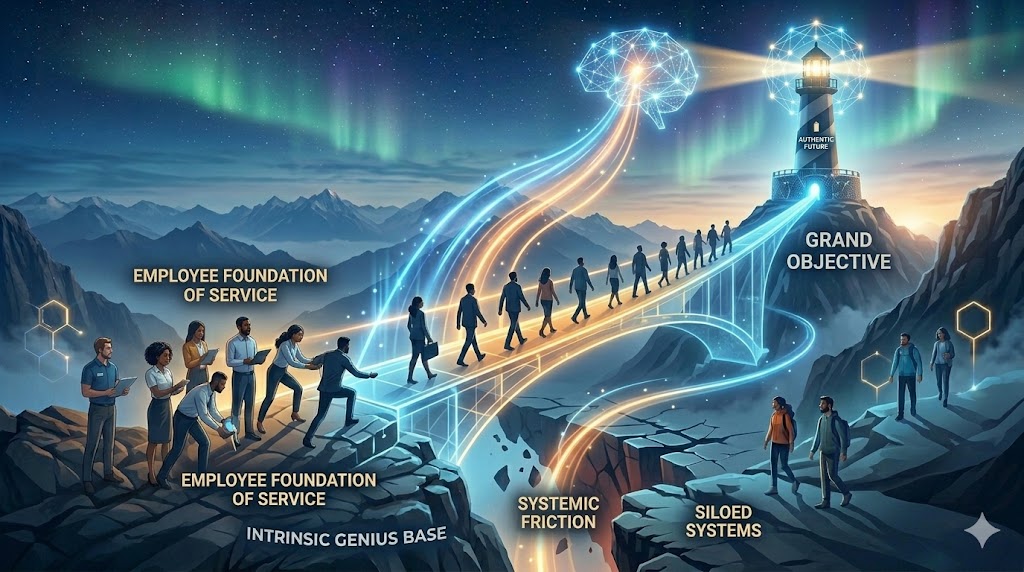
Values in Action: An Architecture for Authentic Culture

LAST UPDATED: February 28, 2026 at 10:11 AM

Values in Action: An Architecture for Authentic Culture

GUEST POST from Art Inteligencia

I. The “Value Gap” Diagnostic

“If your values are only on the wall, they aren’t guiding the work — they’re haunting it.”

The Poster Fallacy

In my work as an innovation speaker, I often encounter the Poster Fallacy: the belief that printing “Innovation” or “Integrity” in a 48-point font on a breakroom wall creates culture. It doesn’t. At best, it’s an aspiration; at worst, it’s a source of deep organizational cynicism. When top-down value statements lack a corresponding “Reality Rule” in daily operations, employees stop listening to what leadership says and start watching what leadership rewards.

Identifying Your Disconnects

To bridge the gap, leaders must audit where operational reality contradicts stated beliefs. Common “Value Gaps” include:


  • The “Innovation” Gap: Celebrating “risk-taking” on posters while punishing project failure in performance reviews.

  • The “People-First” Gap: Claiming to value well-being while incentivizing a “Burnout Culture” through unrealistic delivery cycles.

  • The “Transparency” Gap: Promoting radical honesty while maintaining siloed data and “closed-door” executive decision-making.

The Cost of Inauthenticity

When these gaps persist, you don’t just lose morale; you lose your Intrinsic Genius. High-performing talent thrives on Absolute Integrity — the alignment of word and deed. Inauthenticity acts as a “Cognitive Tax,” forcing employees to navigate a landscape of contradictions instead of focusing on growth. This friction eventually leads to silent revenue leakage and a workforce that is present in body, but absent in spirit.

Next Step: We must move from auditing the gap to designing High-Integrity Touchpoints.

II. Designing “High-Integrity” Touchpoints

“Operationalizing values means turning abstract nouns into concrete behaviors.”

The Ritual Bridge

In a distributed or hybrid environment, physical proximity is gone. To replace it, we must build Sensory Bridges. Rituals are the rhythmic anchors that reinforce shared identity. If “Inclusion” is a value, does your weekly sync include a ritual for “Unheard Voices”? If “Curiosity” is a value, do you have a “Lesson from Friction” moment in every project debrief? These aren’t just meetings; they are the Trust-Architecture that makes your culture tangible.

The Policy Audit: Removing Friction

Values are often killed by the very policies designed to protect the business. To maintain Absolute Integrity, leaders must audit their systems for “Accidental Punishment”:

Stated Value The Policy Friction
Agility Six layers of manual approval for a $500 experiment.
Collaboration Incentive structures that only reward individual KPIs.
Customer-Centricity Front-line reps penalized for “Average Handle Time” instead of resolution.

Absolute Integrity in the Flow of Work

When touchpoints are designed with integrity, employees no longer have to “switch modes” between their personal values and their professional requirements. This alignment reduces the Cognitive Tax and frees up the Intrinsic Genius of your team to focus on innovation. You aren’t just managing a workforce; you are stewarding a community of practice that is the same on the inside as it is on the outside.

Key Insight: A value that isn’t budgeted for — in time or money — is a lie. Check your calendar and your ledger to see what you actually value.

III. Empowering the Intrinsic Genius

“Agency is the fuel that turns a corporate value into a human commitment.”

Agency Over Compliance

When values are merely “rules,” you get compliance — a workforce that does exactly what is required and nothing more. But in a Reconfigurable Enterprise, you need commitment. True “Values in Action” happen when an employee faces a complex, unscripted situation and chooses the path of Absolute Integrity because they have the agency to do so. We must stop asking our teams to “follow the manual” and start empowering them to “apply the values.”

The Shift to Trust-Architecture

To move from monitoring tasks to safeguarding culture, leaders must adopt the role of a Trust-Architect. This involves three critical shifts:

  • 1
    Decentralize Decision Rights: Move the authority to the person with the most information (the front line), not the most status.
  • 2
    Celebrate “Value-First” Failures: If an employee makes a mistake while trying to uphold a core value, reward the intent. This builds the Muscle of Foresight.
  • 3
    Provide Radical Transparency: Share the “why” behind executive decisions so the Intrinsic Genius of the team can align with the organization’s Absolute Integrity.

The Reality of the Front Line

The front line is where your culture is tested. When a customer is upset or a project is stalling, your Intrinsic Genius shouldn’t be looking for a supervisor—they should be looking at the values. When you empower people to act with Absolute Integrity, you create a self-correcting organization that can navigate change with speed and grace.

The Innovation Insight: You cannot mandate innovation, but you can unleash it by removing the fear of being “out of compliance” with a rigid system. When values are the guide, autonomy becomes the engine.

V. Scaling Authenticity in a Distributed World

“Culture is not a building; it is the shared resonance of our collective actions.”

Building Sensory Bridges

When we worked in the same building, culture was “caught” through osmosis — the overhearing of conversations, the casual hallway greeting. In a distributed or hybrid environment, we must be intentional designers of connection. We must build Sensory Bridges that translate our values into the digital workspace. If your values aren’t visible in your Slack channels, your Zoom hygiene, and your asynchronous workflows, they effectively cease to exist.

The Muscle of Foresight: Preventing Cultural Drift

Distributed teams are prone to “Cultural Drift,” where sub-groups develop their own (sometimes contradictory) norms. To prevent this, leaders must exercise the Muscle of Foresight:


  • Asynchronous Alignment: Use documentation and shared “Work with Me” guides to codify values in a way that doesn’t require a meeting.

  • Inclusive Innovation: Ensure that the “loudest voices” in the digital room don’t drown out the Intrinsic Genius of quieter, remote contributors.

  • Value-Led Onboarding: Your onboarding process shouldn’t just be about tools and logins; it should be an immersion into the Absolute Integrity of the brand.

The Reconfigurable Enterprise

An authentic culture is the ultimate “Operating System” for a Reconfigurable Enterprise. When everyone is aligned on the why and the how, the where becomes secondary. By scaling authenticity through intentional design and digital empathy, you create a resilient organization capable of thriving in a world of constant change.

“Trust is the bandwidth of a distributed team. Authenticity is the signal.”

VI. Conclusion: The Future Belongs to the Authentic

“Innovation is a byproduct of trust. Trust is a byproduct of Absolute Integrity.”

We have moved past the era where a clever marketing campaign could mask a toxic internal culture. In the age of total transparency, your internal reality is your external brand. A Reconfigurable Enterprise doesn’t just adapt its products; it adapts its behaviors to stay true to its core.

The Final Shift

When you move your values from the poster to the process, the narrative of your organization changes fundamentally:

  • You aren’t just improving “satisfaction” — you are recovering growth.
  • You aren’t just managing “risk” — you are protecting margins.
  • You aren’t just building “culture” — you are strengthening trust.

Authentic innovation requires an authentic culture. If you want to change the world, start by making sure your organization is exactly who it says it is.

Ready to bridge your Value Gap?

I help organizations build the Trust-Architecture and Muscle of Foresight needed to turn values into action.

Inquire about a Workshop or Keynote

Join the conversation with Braden Kelley.

Frequently Asked Questions

Bridging the Gap Between Corporate Values and Operational Reality

How do I identify a “Value Gap” within my organization?

A Value Gap is identified by auditing the friction between stated principles and daily operations. Use the Reality Rule: observe what is actually rewarded, punished, or ignored in your systems. If “Innovation” is a value but failure is punished in performance reviews, a gap exists. High-integrity organizations use Friction Metrics to measure how often employees must compromise values to meet tactical goals.

Why is “Trust-Architecture” more effective than traditional compliance?

Compliance creates a “check-the-box” culture that stifles Intrinsic Genius. In contrast, Trust-Architecture decentralizes decision rights, allowing employees to apply values to unscripted situations. This builds a Reconfigurable Enterprise where the front line has the agency to act with Absolute Integrity, resulting in faster innovation and higher customer trust than rigid, top-down control systems.

How can distributed teams maintain an authentic culture?

Distributed teams scale authenticity by building Sensory Bridges — intentional digital rituals and asynchronous workflows that replace physical proximity. By exercising the Muscle of Foresight, leaders can prevent “Cultural Drift” through radical transparency and value-led onboarding, ensuring the organization remains the same on the inside as it is on the outside, regardless of physical location.

Image credit: Google Gemini

Subscribe to Human-Centered Change & Innovation WeeklySign up here to get Human-Centered Change & Innovation Weekly delivered to your inbox every week.