LAST UPDATED: April 22, 2026 at 3:39 PM
GUEST POST from Chateau G Pato
I. Introduction: The New Currency of Collaboration
In the modern organizational landscape, trust is the invisible infrastructure upon which all innovation is built. Historically, we have relied on physical proximity as a proxy for reliability, but the shift toward decentralized work has exposed a critical flaw in that logic: being “seen” is not the same as being “trusted.”
The Trust Paradox
Many leaders suffer from the illusion that physical presence naturally breeds psychological safety. In reality, onsite environments can often mask a lack of trust through performative busy-ness. The challenge for the modern enterprise is to decouple trust from the visual confirmation of work and reattach it to the delivery of value.
Defining the Shift
We are witnessing a fundamental evolution in leadership philosophy. We are moving away from “management by walking around” — a relic of the industrial age — and toward “leadership by intentional design.” This requires a shift in focus from inputs (hours at a desk) to outcomes (impact on the customer and the team).
The Thesis
Trust is not inherently more difficult to build in remote-first settings; it is simply different. While onsite teams benefit from accidental social friction, remote-first teams must rely on the intentional architecture of transparency and vulnerability. By applying human-centered design to our communication structures, we can build teams that are more resilient and innovative than those bound by four walls.
II. The Anatomy of Trust in the Workplace
To design better organizational experiences, we must first deconstruct what trust actually looks like in a professional context. It isn’t a monolithic sentiment; rather, it functions as a dual-engine system driven by both logic and emotion. When we understand these levers, we can begin to mitigate the biases that often plague hybrid and remote-first environments.
Cognitive Trust: The Head
Cognitive trust is built on reliability and competence. It is the rational assessment of a colleague’s ability to deliver. In a remote-first world, this is the “foundational layer.”
- The Question: “Is this person capable, and will they do what they say they will do?”
- The Driver: Consistency in output and transparency in workflow.
Affective Trust: The Heart
Affective trust is rooted in emotional connection and empathy. This is the “relational layer” that allows teams to navigate conflict and uncertainty. It is often the harder of the two to cultivate across digital divides because it requires vulnerability.
- The Question: “Does this person care about my well-being and the collective success of the team?”
- The Driver: Shared experiences, active listening, and psychological safety.
The Proximity Bias
As humans, we are evolutionarily wired to favor those within our immediate physical vicinity. This Proximity Bias creates a dangerous “out of sight, out of mind” dynamic where onsite employees may be perceived as more trustworthy or “harder working” simply due to their visibility. To be a truly human-centered leader, one must actively design against this instinct, ensuring that trust is measured by contribution rather than coordinates.
III. Onsite Teams: The Power of Spontaneity
The physical office is more than just a container for desks; it is a high-bandwidth environment for unstructured data exchange. In onsite settings, trust is often the byproduct of “ambient awareness” — the ability to pick up on the moods, challenges, and successes of others through passive observation. However, relying on this “accidental trust” can be a double-edged sword if not managed with intent.
Micro-Moments and Social Friction
The “watercooler effect” isn’t a myth; it’s a manifestation of low-stakes social friction. These micro-interactions — a shared laugh in the hallway or a quick “how was your weekend?” — serve as the building blocks for affective trust. These moments humanize colleagues, making it significantly easier to navigate difficult professional conversations later because a foundation of personal rapport already exists.
Non-Verbal Intelligence
In-person collaboration utilizes the full spectrum of human communication. We process body language, tone, and facial expressions in real-time, which allows for rapid conflict resolution and nuanced brainstorming. When a team is physically “in the room,” the speed of alignment is often accelerated because the feedback loop is instantaneous and multi-sensory.
The Shadow Side: The “Performative Presence” Trap
The greatest risk to trust in the onsite model is the conflation of attendance with achievement. When leaders value “butts in seats” over actual impact, they foster an environment of performative presence. This erodes trust in two ways:
- It signals to high-performers that their results matter less than their visibility.
- It creates an “in-group” vs. “out-group” dynamic where those who can’t be physically present (due to caregiving, disability, or commute) feel inherently less trusted.
To maximize the onsite experience, we must shift the office’s purpose from a place where work happens to a place where connection is deepened.
IV. Remote-First Teams: The Power of Intentionality
In a remote-first environment, trust cannot be left to chance. Without the “physical glue” of an office, we must replace accidental interactions with intentional architecture. When done correctly, this doesn’t just replicate onsite trust — it can actually surpass it by grounding the culture in radical clarity and objective contribution.
Asynchronous Transparency
In the absence of a shared physical space, documentation becomes a trust-building exercise. When workflows, decisions, and project statuses are codified and accessible to everyone, cognitive trust flourishes. There is no “hidden information” or “backroom deal.” This transparency ensures that every team member, regardless of their time zone, has the same context, reducing the anxiety of the unknown and fostering a sense of collective ownership.
The Digital Handshake
Because we lose the organic cues of the breakroom, remote leaders must design deliberate rituals to foster affective trust. This isn’t about forced “Zoom fun,” but about creating meaningful spaces for human connection:
- Virtual Coffee/Office Hours: Creating low-pressure environments for non-work dialogue.
- Demo Days: Celebrating wins publicly to reinforce competence and shared purpose.
- Personal READMEs: Encouraging team members to share their working styles and communication preferences.
Outcome-Based Trust
Remote work forces a healthy evolution: the death of “micro-management by observation.” In a remote-first culture, trust is granted through outcome-based accountability. By focusing on what is achieved rather than when or where it happened, we strip away the bias of performative presence. This empowers employees with autonomy, which is one of the highest expressions of trust a leader can offer.
The remote-first model proves that when you stop watching people work and start supporting their success, the bond between the individual and the organization grows stronger.
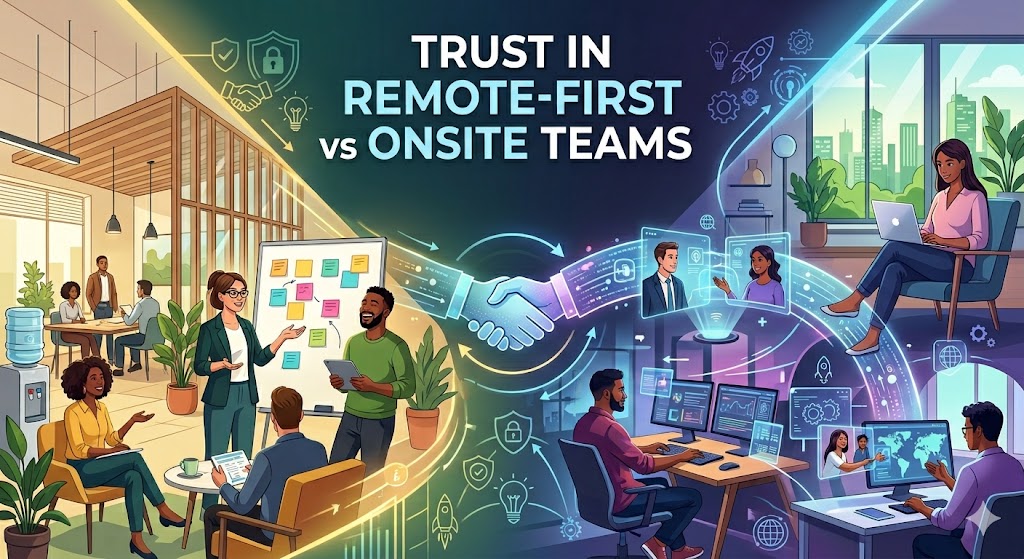
V. Design Thinking for Trust: A Comparative Analysis
To lead effectively in a hybrid world, we must stop treating onsite and remote work as identical experiences. Each environment has unique trust-building strengths and inherent risks. By applying a design thinking lens, we can map these dynamics to understand which “trust levers” to pull based on our team’s physical distribution.
| Trust Feature | Onsite Dynamics | Remote-First Dynamics |
|---|---|---|
| Core Foundation | Shared physical space and “ambient awareness” of body language. | Shared goals and radical transparency through documentation. |
| Formation Pace | Rapid initial bonding via social friction; harder to scale globally. | Slower initial bonding; highly scalable across time zones. |
| Primary Risk | Groupthink and the formation of exclusionary physical cliques. | Isolation and “The Void” caused by a lack of informal feedback. |
| Innovation Style | Serendipitous collisions and spontaneous brainstorming. | Structured co-creation and uninterrupted “deep work” cycles. |
The Design Imperative
The goal is not to choose one over the other, but to design a Stable Spine of trust that supports both. Onsite teams need to guard against the “insider” mentality, while remote-first teams must ensure they aren’t just a collection of individuals working in parallel. We must architect an experience where trust is the constant, regardless of the variable of location.
VI. Strategies for the Future-Ready Leader
In a world of constant flux, leaders must transition from being “task managers” to becoming experience architects. Building trust in a hybrid or remote-first environment requires a shift in focus from control to empowerment. Here are the specific design strategies to ensure your team remains connected and innovative.
Designing for Vulnerability
Trust is a mirror; it is reflected back when it is first given. Leaders must model “showing the messy middle” of their projects. By being open about challenges and “work in progress,” you give your team permission to do the same. This reduces the fear of failure and creates a psychologically safe space where true innovation can breathe.
Empathy as a Service (EaaS)
Utilize Experience Design (EX) principles to ensure that remote employees feel just as “seen” as their onsite counterparts. This means:
- Equity of Voice: Ensuring digital-first communication during meetings so those in the room don’t dominate the conversation.
- Proactive Outreach: Scheduling regular 1-on-1s that focus on the human rather than the status update.
The Micro-Feedback Loop
The annual performance review is a relic that often erodes trust through its lag time. Future-ready leaders employ continuous, trust-building micro-feedback. By providing small, frequent, and constructive insights, you eliminate the “guessing game” of performance. This creates a culture of constant growth and reinforces the cognitive trust that the team is moving in the right direction together.
By treating trust as a designed experience rather than a fortunate accident, we can build organizations that are not only more agile but more profoundly human.
VII. Conclusion: Trust is an Innovation Enabler
As we look toward a decentralized future, it becomes clear that trust is the only thing that doesn’t scale without human-centered design. Technology can bridge the distance between us, but it cannot bridge the gap in confidence between a leader and their team. That requires an intentional commitment to the human experience.
The Futurologist’s View
In the coming decade, the most competitive organizations will not be those with the most impressive real estate or the most sophisticated surveillance tools. They will be the ones that have mastered the art of building “distributed psychological safety.” In an era of rapid AI integration and shifting market dynamics, trust is the stabilizer that allows a team to pivot without panicking.
The Call to Action
Stop trying to “recreate the office” online. The goal of remote-first work is not to simulate a 1990s cubicle farm via video calls; it is to design a new way of working that prioritizes autonomy, transparency, and impact. Whether your team meets in a boardroom or a digital workspace, your mission is to design experiences that prioritize people over processes.
Final Thought: Trust is not a destination you reach and then inhabit; it is a continuous co-creation. By architecting for both the head (competence) and the heart (connection), we unlock the true potential of our most valuable asset: our collective human ingenuity.
Frequently Asked Questions
How does trust-building differ between remote and onsite teams?
Onsite teams rely on “accidental proximity” and non-verbal cues to build trust organically. Remote-first teams must use “intentional design,” building trust through radical transparency, clear documentation, and deliberate social rituals.
What is ‘Proximity Bias’ and how does it impact innovation?
Proximity Bias is the tendency to favor and trust those we see physically. In innovation, this is dangerous because it can lead to exclusionary cliques and overlook the valuable contributions of remote experts, ultimately stifling diverse thinking.
Can remote teams be as innovative as onsite teams?
Absolutely. While onsite teams excel at spontaneous “collisions,” remote teams excel at structured co-creation and deep work. Innovation in remote teams is driven by outcome-based accountability rather than performative presence.
Image credit: Google Gemini
 Sign up here to get Human-Centered Change & Innovation Weekly delivered to your inbox every week.