Tag Archives: Future Of Work

The Future of Work

How Emerging Technologies Will Shape the Way We Work

The Future of Work: How Emerging Technologies Will Shape the Way We Work

GUEST POST from Chateau G Pato

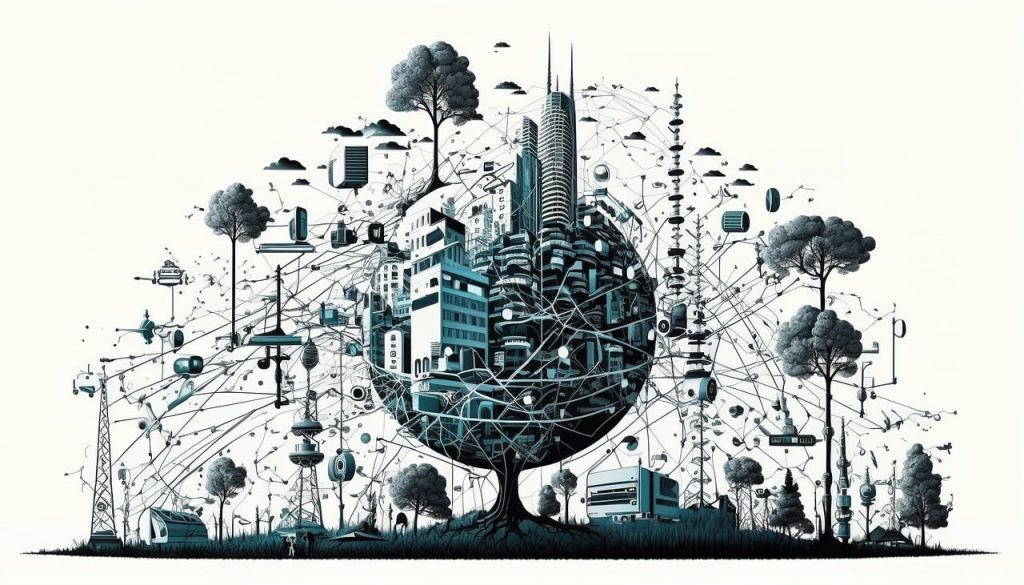
The way we work is evolving rapidly, driven by advancements in technology that are reshaping the workplace landscape. From automation and artificial intelligence to virtual reality and the Internet of Things, emerging technologies are revolutionizing how we work, collaborate, and communicate. In this article, we will explore the future of work and how these emerging technologies will shape the way we work.

1. Automation and Artificial Intelligence

Automation and artificial intelligence (AI) are transforming the way we work by streamlining processes, increasing efficiency, and enabling innovation. Case in point, Amazon’s fulfillment centers utilize a high level of automation through the use of robotics to improve inventory management and order fulfillment. By automating repetitive tasks, workers can focus on more complex and value-added activities, leading to increased productivity and job satisfaction.

AI, on the other hand, is revolutionizing industries like healthcare and finance by providing data-driven insights and predictive analytics. For example, IBM’s Watson Health platform uses AI to analyze vast amounts of medical data to diagnose and recommend treatment options for patients. AI is also being used in financial services to detect fraud, optimize investment strategies, and provide personalized customer experiences.

2. Virtual Reality and Remote Collaboration

Virtual reality (VR) is changing the way we collaborate and communicate in the workplace by enabling immersive experiences and remote interactions. Companies like Walmart are using VR for employee training, allowing workers to practice real-life scenarios in a virtual environment. This not only improves learning retention but also reduces training costs and increases operational efficiency.

Remote collaboration tools, such as video conferencing and virtual meetings, are becoming increasingly popular as more companies embrace remote work. With the rise of distributed teams and flexible work arrangements, technologies like Microsoft Teams and Zoom are facilitating seamless communication and collaboration among remote employees. This shift towards virtual collaboration is not only increasing employee satisfaction but also expanding access to global talent pools.

Conclusion

The future of work is being shaped by emerging technologies that are transforming the workplace landscape. From automation and AI to VR and remote collaboration, these technologies are revolutionizing how we work, collaborate, and communicate. As organizations adapt to these changes, they must embrace innovation and invest in digital transformation to stay competitive in the evolving business environment. By leveraging these technologies effectively, companies can drive productivity, foster creativity, and create a more agile and connected workforce. The future of work is here, and it’s time to embrace the opportunities that these emerging technologies offer.

SPECIAL BONUS: Futurology is not fortune telling. Futurists use a scientific approach to create their deliverables, but a methodology and tools like those in FutureHacking™ can empower anyone to engage in futurology themselves.

Image credit: Pixabay

Subscribe to Human-Centered Change & Innovation WeeklySign up here to get Human-Centered Change & Innovation Weekly delivered to your inbox every week.
3 Future of Work Forecasts for the 2020s

3 Future of Work Forecasts for the 2020s

GUEST POST from Robert B. Tucker

Each year I interview hundreds of organizational leaders and individual contributors on their most pressing business challenges. Through surveys and one-on-one interviews, I probe people’s outlook on the future. I zero in on their most critical personal and professional challenges.

In recent years, workplace issues have dominated these surveys. In short: the future is arriving faster than ever, catching employers and employees unprepared. Some examples:

  • A furniture manufacturer in North Carolina complained to me that his company is hamstrung by a lack of qualified workers to fill orders for his custom-made products. Almost daily, he sees his experienced, Boomer-age employees calling it quits, and taking their years of experience and hands-on skills with them.
  • A community college president in Iowa described to me the impact of declining enrollments as workers take advantage of the booming economy in his area.
  • A Silicon Valley human resources manager expressed frustrated that tighter regulatory visa restrictions are making it difficult to attract enough talented engineers.
  • A college textbook executive in Boston is trying to find his footing after being displaced by an industry upheaval that decimated his former employers’ business model.

As a futurist and innovation speaker, I work across industries, and often, across continents. This gives a first-hand perspective on workforce threats and opportunities. As much change as has taken place in the prior decade, I don’t believe we have grasped the extent of the changes ahead in the 2020s. Organizations and their leaders will rise or fall, prosper or be blindsided, based on their ability and willingness to anticipate and creatively respond to rapid change. I encourage my clients to “assault assumptions” and blow up the traditional human resource department’s short-sightedness and instead look, think and act ahead of the curve.

The three forecasts below have to do with how the workplace is changing at the dawn of the new decade. They revolve around how the world of work will evolve. Take time to ponder these predictions and then prepare to take action on tomorrow’s trends today.

Forecast #1. Job Category churn will accelerate, creating sunrise and sunset occupations.

A hundred years ago, buggy whip makers got wiped out by the horseless carriage. In recent years, occupational categories such as travel agent, coal miner, meter reader, locomotive firer, and many others saw contraction (sunsetting), while other categories (sunrise occupations) boomed, creating millions of new jobs.

The fastest-growing category in the United States, according to the US Bureau of Labor Statistics, is solar panel installer, followed closely by wind turbine technician. LinkedIn research suggests that categories such as data scientists, physician assistants, nurses, marketing and customer success managers, enterprise account executives, home health workers, and information security analysts have added and will need workers and often can’t find sufficient numbers to hire. They will continue to explode in demand and pay above average wages.

In 2005, more than 1,200 people applied for home appraiser traineeships. In 2016 only about 100 did, Reason: enabling technology — in this case, artificial intelligence — is sunsetting this profession at a rapid pace. Lenders such as Fannie Mae, Zillow and others are allowing certain loans to be approved without an appraisal by a human being. If present trends continue (always a caveat), the occupation of home appraiser may go the way of the buggy whip maker over the next decade.

Action steps: Feel the “churn” in your own industry and line of work, then “futurize” your thinking, and plan accordingly. Whether you’re just starting out or are well along in your career, successful navigation in the 2020s involves more than just following your passion or going with the flow. Choose proactively and wisely based on sunrise/sunset projections. Mentor others. If someone you know is thinking of paying $5000 to become certified as a home appraiser, help them out. Suggest they first consult LinkedIn’s lists of fastest growing (and fastest disappearing) occupations. Avoid occupations with no future or plan to reinvent them as booming luxury travel broker Virtuoso has done. Even if you’re well into your career, pay attention to future forecasts in your profession and industry.

Forecast #2. Lifelong learning, up-skilling and re-skilling will no longer be optional activities. They will be vitally necessary habits for sustained career success.

The median age of workers at Facebook, LinkedIn, SpaceX and other tech companies is 29. The hiring rate slows markedly at 34. Generation Z’s recent arrival in the workplace is jolting Millennials into realizing that they are no longer the new kids on the block, and irrelevance happens faster today than ever before. The solution? Constant up-skilling (expanding your capabilities) and re-skilling (learning new skills) so you can do a different job or keep on doing your current job once routine parts of it have been automated by software.

Don’t expect your current employer to do this for you. A relatively few firms are as forward-looking as AT&T in this regard. Each year, AT&T’s CEO shares where the company is going, and gives insight into what skills will be needed to remain employed in the foreseeable future. AT&T then partners with Udacity to create “nano-degree” courses which help employees develop needed emerging skills, for which the company is willing to pay for. The only caveat: employees must take these courses on their own time.

Action steps: To thrive in this new world of work, think of yourself as You, Incorporated. Today You, Inc. is selling services to your current employer. But what about your next move or even your next career? Avoid putting all your eggs in one basket, explore other careers, keep; your resume current, volunteer for new projects and stretch assignments, especially those which develop your “soft” skills and innovation skills. Be willing to relocate for new opportunities. Take risks that pull you out of your comfort zone.

Forecast #3. Automation will accelerate job displacement, but “augmentation” rather than joblessness will be the norm.

According to research, currently available technology, if fully implemented, could automate almost half of the activities people are paid to perform today. And “currently existing technology” is advancing at the rate of Moore’s Law, which predicts a doubling of capacity every 18 to 24 months.

In 2017, McKinsey ‘s research brought ominous headlines with a report that indicated 73 million people were in danger of losing their jobs through automation. But then a funny thing happened. The unemployment rate in the United States plummeted to a 50-year low, and employers and employees alike now wonder: if automation is going to wreak such havoc, wouldn’t its effects already be starting to show up in unemployment rolls? Instead of massive displacement, there will most likely be continuing and constant displacement of workers as automation becomes a driving force in both the service sector and manufacturing. The new trend, however, is augmentation – technologically enhancing the worker’s unique skills to create a greater whole.

Action steps: Look at how automation is impacting and will likely impact the work that you do, the profession you are in, and the company you lead. Ask: where are present trends headed for your profession? How will you need to add value differently in the coming years?

In the past decade, job category churn has accelerated to the point where front-line workers, professionals, and employers alike must “think ahead of the curve” or face unpleasant surprises. But those who anticipate and plan for change can create their own reality, and ride the waves of change.

This article originally appeared in Forbes
Image credit: Pixabay

Subscribe to Human-Centered Change & Innovation WeeklySign up here to get Human-Centered Change & Innovation Weekly delivered to your inbox every week.
The Cyborg Transition: Why the Future of Work Belongs to the Augmented Professional

The Cyborg Transition: Why the Future of Work Belongs to the Augmented Professional

GUEST POST from Chateau G Pato


I. Introduction: Beyond the Automation Myth

For years, the public discourse surrounding artificial intelligence and the future of work has been trapped in a flawed, binary narrative. On one side, techno-optimists promise a friction-free utopia of ultimate efficiency; on the other, alarmists warn of a catastrophic wave of automation that will render the human workforce obsolete. Both perspectives suffer from the same fundamental flaw: they treat AI as an external force acting upon humanity, rather than a capability to be integrated with humanity.

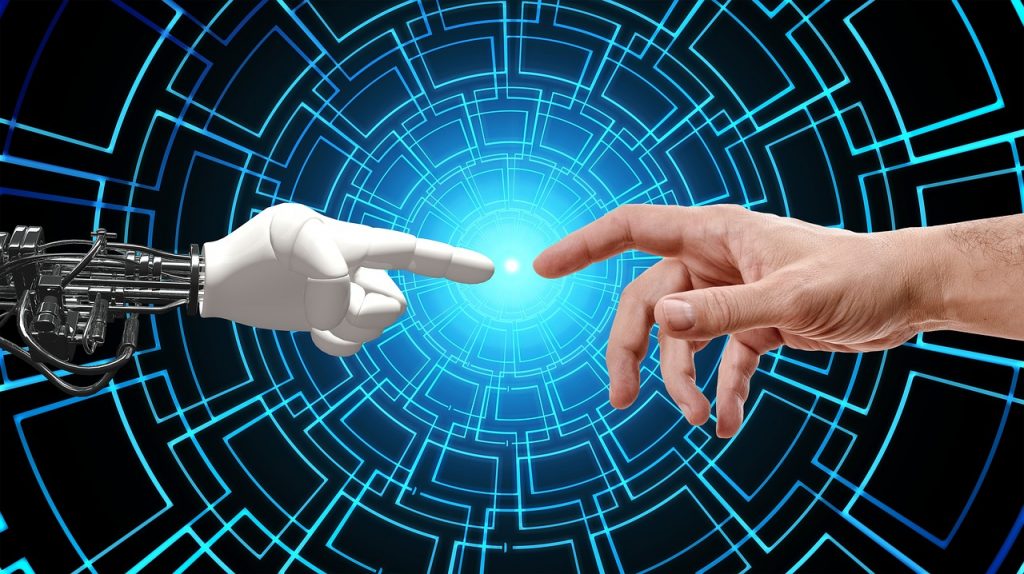
The reality of our next economic era is far more nuanced and deeply human-centered. We are entering the Cyborg Transition — a profound shift away from traditional, siloed knowledge work toward the era of the Augmented Professional. This transition is not about machines replacing people; it is about the deliberate design of a symbiotic partnership that blends the best of human ingenuity with the speed and scale of algorithmic intelligence.

The future of work does not belong to artificial intelligence alone, nor does it belong to unaugmented humans stubbornly clinging to old workflows. The future belongs to those who intentionally design the interface between the two.

True innovation is never just a technological upgrade — it is a human-centered change management challenge. To thrive in this new landscape, organizations must move beyond the narrow pursuit of tactical efficiency and focus on cognitive amplification. By shifting our perspective from automation to augmentation, we can reshape the employee experience, unlock unprecedented creative potential, and ensure that the future of work remains resolutely human.

II. The Anatomy of the Augmented Professional

To design an effective future of work, we must move past treating artificial intelligence as a glorified calculator or an outsourced copywriter. Instead, we must look at it through the lens of experience design. The Augmented Professional represents a intentional synthesis of capabilities, creating a symbiotic skill stack where human intuition and machine intelligence do not compete, but actively amplify one another.

The Symbiotic Skill Stack

Achieving true synergy requires a clear-eyed understanding of unique strengths. When we map out the ideal human-AI partnership, the division of labor becomes a powerful multiplier:

  • Human Superpowers (The Core): Empathy, contextual judgment, relationship building, and the capacity for zero-to-one innovation — the ability to conceptualize something entirely new out of thin air. Humans excel at understanding cultural nuances, navigating ethical grey areas, and designing meaningful experiences.
  • Machine Superpowers (The Engine): Hyper-rapid pattern recognition, brute-force data analysis, instant prototyping, and operational scaling. Algorithms excel at processing vast pools of unstructured data, identifying hidden correlations, and executing repetitive cognitive tasks at infinite scale.

Designing the Core Interface

The transformation from a traditional professional to an augmented one changes the daily Employee Experience (EX) at a foundational level. Historically, workflows have been linear: a human starts a task, processes the information, and finishes the task. In the augmented landscape, workflows are continuous, iterative feedback loops.

The professional acts as the dynamic director — setting intent, curating variables, and injecting contextual empathy — while the AI operates as a tireless engine, generating variants, surfacing insights, and handling the heavy cognitive lifting. This integration alters the very definition of productivity. Value is no longer measured by the volume of raw output a person can grind out, but by the quality of the questions they ask, the ethical boundaries they enforce, and the strategic direction they steer.

III. Managing the Human-Centered Change

The greatest barrier to the Cyborg Transition isn’t technological — it is deeply human. Implementing advanced AI models is relatively straightforward; convincing a workforce to fundamentally alter their professional identity, overcome deep-seated anxieties, and rebuild their daily workflows is a monumental change management challenge. If we do not design the human transition with the same rigor we apply to the technology, even the most sophisticated systems will face quiet rejection and operational friction.

Overcoming “Cyborg Anxiety”

To lead people through this evolution, we must first meet them with empathy. Leaders cannot simply dismiss employee fears of displacement, loss of agency, or skill atrophy as mere resistance to change. These anxieties are rooted in a threat to identity. For decades, knowledge workers have derived their professional self-worth from specific tactical skills — writing a report, building a financial model, or analyzing a dataset. When an algorithm can perform those tasks in seconds, it triggers a profound identity crisis.

Human-centered change management requires shifting the narrative from a threat to a liberation. We must explicitly show professionals that automating the routine components of their role frees them to focus on the highest-value, most uniquely human aspects of their work — strategy, culture, and deep relationship building.

The Change Architecture

Transitioning teams from resistant users to active, enthusiastic co-pilots requires a structured, intentional approach. This architecture rests on two foundational pillars:

  • Cultivating an Experimentation Mindset: Traditional corporate training focuses on rigid software proficiency — teaching users which buttons to push. In the augmented era, this approach is obsolete. AI tools are dynamic and conversational. Training must focus on building a mindset of continuous experimentation, prompt fluency, and critical interrogation of machine output.
  • Establishing Psychological Safety: True human-AI collaboration cannot happen in an environment driven by fear. If employees believe that finding a massive efficiency with AI will cost them or their peers their jobs, they will hide their innovations. Leaders must guarantee that efficiency gains are reinvested into human growth, creating a safe space for teams to openly co-create their new workflows.

IV. From Automation to Amplification: Driving True Innovation

The trap most organizations fall into when deploying artificial intelligence is viewing it strictly through the lens of cost reduction and incremental optimization. They ask, “How can we use this tool to do our current tasks 20% faster?” This is a profound failure of strategic imagination. If you only use augmentation to accelerate legacy workflows, you are merely paving the cow path. True innovation lies in amplification — expanding the boundaries of what a single professional can conceive, design, and execute.

Moving Beyond Efficiency

When an individual’s cognitive bandwidth is freed from the friction of administrative overhead and routine data manipulation, their capacity for high-level creative problem-solving expands exponentially. Amplification allows a single strategist to run thousands of simulated scenarios before making a decision, or an experience designer to personalize interactions for millions of individuals simultaneously. We must shift organizational key performance indicators (KPIs) from speed and volume to depth, novelty, and strategic impact.

Futurology in Action: The Emergence of Augmented Roles

As the Cyborg Transition accelerates, it will inevitably dismantle old job descriptions and give rise to an entirely new ecosystem of professional identities. We are moving toward a landscape where specialized practitioners bridge the gap between human intent and machine execution. Several critical domains are already beginning to surface:

  • AI Trust Architects: Professionals dedicated to ensuring the transparency, alignment, and reliability of machine models, translating complex algorithmic outputs into verifiable business intelligence that leaders can confidently act upon.
  • Human-Machine Experience Designers (HMX): Specialists who design the workflows, interfaces, and collaboration protocols that dictate how teams interact with automated systems, optimizing for cognitive ease and psychological safety.
  • Algorithmic Ethicists & Context Strategists: Guardians of corporate conscience who evaluate AI outputs for systemic bias, cultural nuances, and long-term societal impact, ensuring that machine scale does not come at the expense of human values.

By actively designing these future roles today, organizations can transition away from accidental automation and purposefully steer toward a structured model of continuous, human-led innovation.

V. Ethical and Operational Guardrails

An augmented workforce possesses immense potential, but scaling human capability through algorithmic intelligence introduces unique organizational vulnerabilities. Without intentional constraints, the speed of machine execution can rapidly amplify human errors, institutional blind spots, and systemic biases. Building a sustainable model for the Augmented Professional requires designing rigorous ethical and operational frameworks that keep technology aligned with human intent.

Maintaining the “Human in the Loop”

The greatest operational risk of the Cyborg Transition is cognitive abdication — the tendency for human professionals to passively defer to algorithmic recommendations. Over-reliance on automated systems creates a dangerous cascade of failure points:

  • Bias Amplification: Large language models and predictive algorithms reflect the historical data they were trained on. Left unchecked, they can quietly institutionalize and scale past prejudices, flawed assumptions, and structural inequities under the guise of objective analysis.
  • Loss of Critical Thinking: When professionals treat AI outputs as definitive answers rather than raw material for synthesis, intellectual muscles atrophy. Teams risk losing the ability to critically question data, recognize anomalies, and interpret context.
  • Institutional Amnesia: If the foundational domain knowledge and logic behind business decisions are fully outsourced to machine models, an organization loses its core intellectual capital. We must ensure that automated tools document and expose their logic so that human teams retain deep, foundational expertise.

The Responsibility Framework

To mitigate these risks, organizations must establish a transparent governance model. First, we must enforce a strict boundary of accountability: algorithms can inform, but only humans can decide. A machine cannot bear legal, moral, or strategic responsibility for an outcome; therefore, the final sign-off on any augmented work product must rest with a human professional.

Second, organizations must actively protect intellectual property and data privacy by establishing secure, ring-fenced operational environments. Finally, continuous human auditing protocols must be embedded directly into augmented workflows. By designing these guardrails as integral components of the employee experience rather than bureaucratic hurdles, we protect the organization while giving professionals the psychological safety they need to innovate responsibly.

VI. Conclusion: A Call to Action for Future-Focused Leaders

The Cyborg Transition is not a distant milestone on a futuristic roadmap; it is an active, rapidly accelerating evolution happening right now across every industry. The window for passive observation has closed. Organizations that continue to treat artificial intelligence as a simple line-item utility will find themselves outpaced by competitors who view it as a fundamental transformation of human capability. The choice before us is clear: we can either reactively manage the fallout of accidental automation, or we can proactively design the future of human amplification.

For forward-looking leaders, this transition requires an immediate shift in strategic priorities. We must stop asking how many headcounts we can eliminate, and start asking how much more impact our existing teams can deliver when properly augmented. This means investing heavily in human-centered change architectures, modernizing the employee experience to support continuous experimentation, and building the ethical guardrails necessary to keep machine scale safely anchored to human empathy and accountability.

We are not building smarter machines to marginalize people. We are building smarter partnerships to liberate human potential and design a more creative, equitable, and impactful future of work.

Ultimately, the true value of the Augmented Professional is not that they do old things faster, but that they are empowered to change the game entirely. By intentionally bridging the gap between human intuition and machine intelligence, we can unlock an era of unprecedented innovation. The future of work belongs to those who have the vision to design it, the empathy to lead it, and the courage to step boldly into the symbiotic partnership.

Frequently Asked Questions

To help human readers and automated search engines easily navigate the core concepts of the Cyborg Transition, the following structured breakdown addresses the most common inquiries regarding the future of the augmented workforce.

What is the difference between automation and human augmentation?

Automation focuses on replacing human labor with technology to perform repetitive tasks faster and at a lower cost. Augmentation, on the other hand, is a human-centered design approach that keeps the professional in the loop. It combines uniquely human strengths — such as empathy, ethics, and strategic context — with machine capabilities like speed and data scale to amplify a professional’s overall impact.

How does the Cyborg Transition change the daily employee experience (EX)?

It shifts workflows from rigid, linear tasks to continuous, interactive human-AI feedback loops. Instead of spending hours gathering data or drafting basic templates, professionals act as strategic directors. They focus their energy on setting intents, asking higher-quality questions, evaluating machine-generated variations, and enforcing ethical guardrails.

What is the biggest risk of an augmented workforce, and how do we prevent it?

The greatest risk is cognitive abdication, where human professionals blindly trust algorithmic outputs without critical analysis. This can scale underlying data biases and cause intellectual skill atrophy. Organizations can prevent this by enforcing strict responsibility frameworks where algorithms inform, but only humans hold accountability and make the final decisions.


Image credit: Gemini

Subscribe to Human-Centered Change & Innovation WeeklySign up here to get Human-Centered Change & Innovation Weekly delivered to your inbox every week.
Examining the Impact of Machine Learning on the Future of Work

Examining the Impact of Machine Learning on the Future of Work

GUEST POST from Chateau G Pato

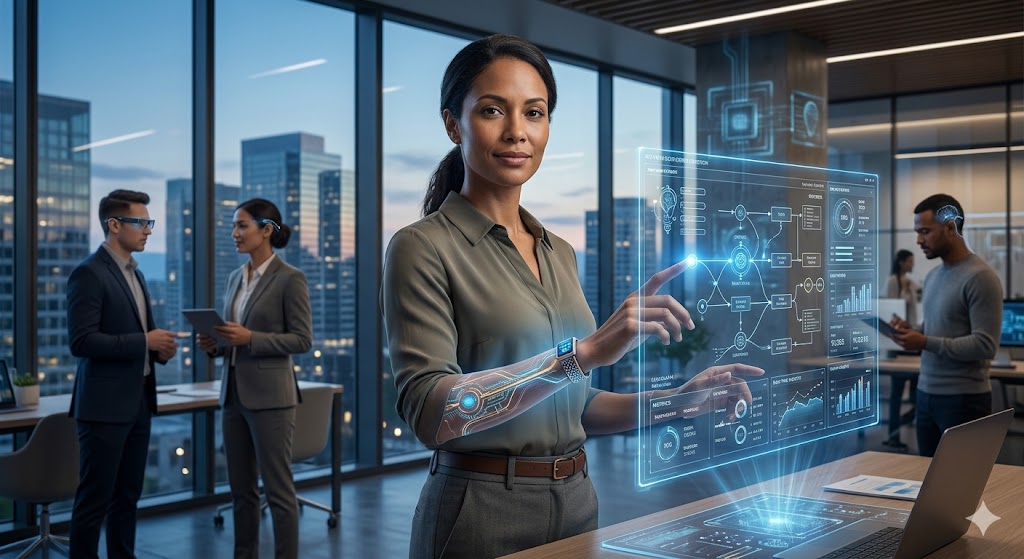
As technology continues to evolve, it is becoming increasingly clear that the future of human labor is changing. Machine learning is a subset of artificial intelligence (AI) that is revolutionizing the way businesses operate and the opportunities that are available for workers. In this article, we will explore how machine learning is impacting the future of work and how organizations can best prepare for this shift.

One of the primary ways that machine learning is impacting the future of work is by automating certain tasks. Machine learning algorithms are able to analyze large datasets and identify patterns and trends that can be used to automate certain processes. This automation can help organizations become more efficient, as tasks that would traditionally take a long time to complete can be accomplished quickly and accurately with the help of machine learning. In addition, automation can also lead to cost savings, as human labor is no longer required to complete certain tasks.

Another way that machine learning is impacting the future of work is by providing new opportunities for skilled workers. Certain jobs that would traditionally require manual labor can now be performed by machines, freeing up workers to focus on tasks that require more creativity and problem-solving skills. This shift can help organizations become more competitive, as they are able to tap into the skills of workers that may not have been available in the past.

Finally, machine learning is also impacting the future of work by creating new employment opportunities. In addition to automating certain tasks, machine learning algorithms can also be used to create new products and services. Companies are now able to use machine learning algorithms to create new applications and services that can be used to improve customer experience or to provide new solutions to existing problems. This can open up new job opportunities for workers who are able to use their skills in areas such as data science, software development, and machine learning.

Overall, it is clear that machine learning is having a profound impact on the future of work. Organizations need to understand how this technology can be used to automate certain processes and create new opportunities for their employees. By leveraging the power of machine learning, organizations can become more efficient, cost-effective, and competitive in the ever-evolving landscape of the modern workplace.

Image credit: Pixabay

Subscribe to Human-Centered Change & Innovation WeeklySign up here to join 17,000+ leaders getting Human-Centered Change & Innovation Weekly delivered to their inbox every week.

How the Internet of Things Will Impact the Future of Business

How the Internet of Things Will Impact the Future of Business

GUEST POST from Art Inteligencia

The Internet of Things (IoT) is rapidly becoming a reality, and businesses of all sizes are beginning to recognize the potential of the technology. IoT is a network of physical objects, or “things,” that are connected through the internet and are able to exchange data. These objects can include anything from home appliances to industrial machinery and automobiles. As the technology continues to evolve, it will have a profound impact on the future of business.

One of the most important ways the Internet of Things will affect businesses is by allowing for improved production efficiency. IoT-enabled devices can communicate with each other, allowing for the monitoring and control of production processes. This will enable businesses to optimize their processes, resulting in increased efficiency and cost savings. IoT can also help identify potential problems with machinery and equipment, allowing businesses to take corrective action before a breakdown occurs.

IoT also has the potential to revolutionize customer service. IoT-enabled devices can collect data about customers, allowing businesses to better understand their needs and preferences. This data can be used to create tailored, personalized experiences for customers, ultimately creating a deeper connection with them and improving customer loyalty.

The Internet of Things will also impact the way businesses market their products and services. By using data collected from IoT-enabled devices, businesses can target their marketing campaigns more effectively and personalize them to meet the needs of their customers. This can help businesses reach more potential customers and increase their return on investment.

Finally, the Internet of Things has the potential to revolutionize the way businesses operate. By using advanced analytics, businesses can gain valuable insights into their operations and make better decisions. This can help them become more efficient and reduce costs, while also improving their customer service and marketing efforts.

The Internet of Things is already having a huge impact on the future of business, and it’s only going to get bigger. Businesses that embrace the technology now will be well positioned for success in the years to come.

Bottom line: Futurology and prescience are not fortune telling. Skilled futurologists and futurists use a scientific approach to create their deliverables, but a methodology and tools like those in FutureHacking™ can empower anyone to engage in futurology themselves.

Image credit: Pixabay

Subscribe to Human-Centered Change & Innovation WeeklySign up here to get Human-Centered Change & Innovation Weekly delivered to your inbox every week.