 As we are now in the middle of the Twelve Days of Christmas, I thought it might be fun to do a post from the innovator’s perspective of the kinds of gifts that might mean the most to an innovator during the holidays when it comes to their quest for innovation excellence. The song however does get quite repetitive so instead of running through it in song format, let’s look at the Twelve Days of Innovation as a list:
1. On the first day of Innovation, my CEO gave to me – Top Level Support for Innovation
There is no doubt that whatever the Chief Executive takes the time to talk about (repeatedly) and measure, is what people focus on and support in the organization. Having the CEO or even the whole top level of management talking about the importance of innovation by itself isn’t of course enough to make innovation happen. When we talk about Top Level Support, it may include the top level talking about their support for innovation, but it is more important that they show their support for innovation by giving the innovation efforts of the company a voice and making resources available to support them and in some cases even measuring and rewarding the level of innovation contribution of the staff in order to make it go.
2. On the second day of Innovation, my CEO gave to me – A Common Language of Innovation
What is your definition of innovation? We all have one, and they are all different. If your company hasn’t taken the time to define what innovation means in your organization or to lay out how you are going to talk about innovation internally and externally, and captured somewhere what kinds of innovation you’re after, then exactly what kind of innovation do you expect to get?
3. On the third day of Innovation, my CEO gave to me – A Chief Innovation Officer
While top-level support is crucial, it definitely helps to have someone in charge of organizing the innovation efforts of the organization. A Chief Innovation Officer (CIO) or VP of Innovation or Innovation Director or whatever you choose to call them is not responsible for coming up with all of the innovations for a company, but instead helps to organize and own things like the common language acquired on the second day, and the gift coming next on the fourth day. In short the CIO manages the process and acts as a facilitator to help put the right innovation resources against the right innovation projects.
4. On the fourth day of Innovation, my CEO gave to me – Separate Funding for Innovation Projects
If you try and fund innovation projects from within existing budget categories, usually you will end up only with incremental, product-group specific innovations. Having separate funding for innovation means that you can fund the promising innovation projects that your organization identifies and that you can be more strategic about the kinds of innovation projects that you fund. It also allows you fund the gift coming next on the fifth day.
5. On the fifth day of Innovation, my CEO gave to me – A Balanced Innovation Portfolio
The innovation needs of any organization are diverse, and that is what makes a balanced innovation portfolio so important. If you received enough dedicated innovation funding on the fourth day, you’ll have no trouble putting together a balanced innovation portfolio of innovation projects focused on a variety of innovation types, projects with different risk profiles and time horizons. A balanced innovation portfolio will allow you to manage risk and ensure that you always have innovations ready to launch.
6. On the sixth day of Innovation, my CEO gave to me – Access to Customer Insights
In the innovation diatribes of many authors they talk about the importance of engaging your employees in your innovation efforts while also talking about the importance of understanding the customer and trying to discover unmet customer needs when trying to come up with new innovations. The problem is that most organizations don’t share their customer insight or voice of the customer information beyond their market researchers, product managers, and possibly a handful of executives. The problem? Successful innovations are often deeply linked to a novel or reinterpreted customer insight. How can employees maximize their innovation contributions if they don’t have access to customer insight information? Organizations that help their employees better understand the organization’s customers stand to accelerate their innovation efforts. Just do it.
7. On the seventh day of Innovation, my CEO gave to me – A Global Sensing Network
Innovation insights and ideas can come from anywhere. So, if you’re only looking in a few different places and asking a handful of people, how can you possibly maximize your innovation efforts? The solution is to build a Global Sensing Network. The purpose of a Global Sensing Network is to allow an organization to collect and connect the partial insights and ideas that will form the basis of the organization’s next generation of customer solutions. This involves collecting and connecting customer insights, core tech trends, adjacent tech trends, distant tech trends, local social mutations, expert communities, and more. To actually build a Global Sensing Network you need to start from the inside out. You have to take a look around inside your organization and see what employees you have, what natural connections they have, and where they are currently located on the globe. This will get you off to a good start – I can help you if you would like – but this article can help too.
8. On the eighth day of Innovation, my CEO gave to me – An External Talent Strategy
Does your organization want to increase its speed to market? Is innovation on the minds of your leadership? Does management insist that the smartest people in the world work for your organization? Or, do they acknowledge that there are more smart people outside your four walls than inside? The truth is that the nature of the organization is changing from a talent ownership mindset to a talent attraction mindset. We now do business in an integrated, global economy with an interconnected web of suppliers and distribution channels where having a partner of choice mentality will be increasingly important. We also live in a world where in the near future the most valuable employees will be those that not only good work, but also who serve as a force multiplier for their organizations by being good at organizing the efforts of others who don’t even work for the company. As an organization you’ll want to evolve to a place where ideally, even those who don’t work FOR you, want to work WITH you. This will require that organizations craft an external talent strategy to maximize not only the productivity of their employees on their payroll, but also to accelerate their innovation efforts. A link to the free webinar I did with Innocentive on this topic is coming soon, along with a white paper on the subject in early January.
9. On the ninth day of Innovation, my CEO gave to me – More Tolerance for Risk and Failure
When I speak at corporate events and conferences around the world with innovation practitioners trying to champion innovation in their organization and do the hard work in the trenches, I often hear the comment that their organization struggles to innovate because the culture of the organization is risk averse, or even worse, failures are punished so severely nobody wants to do anything risky or innovative. This is a leadership and a management problem that requires the gifts from the first, fourth and fifth days because the fact is that some of your innovation projects will fail and ideally you want to have a balanced portfolio of innovation projects that sit outside the business units and product groups so that the eventuality of this is acceptable and manageable. AND, at the same time it is also equally important that you work to establish a culture where people do not obsess on their fear of failure or the risk they are taking but instead on how fast they are learning – from both successes and failure. When learning balances failure and when portfolios manage risk, you’ll create more room for innovation.
10. On the tenth day of Innovation, my CEO gave to me – A Flexible, Adaptable Organization
If there are two characteristics that should be at the top of any wish list of organization capabilities besides innovation – flexibility and adaptability should be in the running for the top two spots. Flexibility and adaptability are not the same thing. A flexible organization is able to move resources from where they normally sit in the organization to where they are needed most in the organization at any one time. An adaptable organization is capable of quickly adapting to changes in the marketplace based on changes in the competitive structure of the industry, changing customer preferences, or a myriad of other changes that require the organization’s strategy, policies, processes, and even structure to change to better serve their profitable customers. Think Nokia moving from making tires to making mobile phones, think about Amazon switching from being a traditional e-tailer to welcoming third-party sellers onto the site and starting a cloud services business. Flexible, adaptable organizations are capable of surviving massive marketplace shifts caused by innovation. Flexible and adaptable employees capable of coping with all of the change required by flexible, adaptable, innovative organizations will be in high demand in the 21st century.
11. On the eleventh day of Innovation, my CEO gave to me – A Long-Term Commitment to Innovation
It’s great that the CEO threw you a bone on day one and gave you some top-level support for innovation, but unless your organization is willing to make a long-term commitment to innovation at all levels, and continually work to put the common language, training, policies, processes, and funding in place to sustain your innovation efforts, you won’t be successful. A long-term commitment to innovation is required. One that will survive a few failed innovation efforts (that of course yield a lot of learning), and a few defections of top talent to other organizations as you build out your innovation programs (innovation talent will be highly desired by other organizations after all). Over the long haul, you must as an organization work to embed innovation capability across the organization and not only use your efforts to produce new innovations but to also innovate your innovation efforts themselves if you want to pursue innovation excellence and make innovation a deep capability of the organization. Innovation is a marathon, not a sprint.
12. On the twelfth day of Innovation, my CEO gave to me – Idea and Insight Management Software
And finally, if you want to engage your employees, or eventually your partners, suppliers, customers, or even the general public in your future innovation efforts, you are going to need to have a system for gathering ideas and tracking their progress through the evaluation and execution phases of innovation. But at the same time you should also look at how you gather and share your customer insights and evaluate whether you need a system to manage that important resource as well. Don’t let great insights or ideas fall through the cracks because someone misplaced them.
Conclusion
Of course there are more ingredients necessary for making innovation a deep sustainable, renewable capability of the organization, but for the innovator in our song, these would be a great start. Innovation is hard work, and the organizations that invest in deepening their innovation abilities AND capabilities will over time be more successful than those that don’t. Building a strong innovation effort takes time and dedication, so if you’ve already started – keep pushing! And if you haven’t started yet, what are you waiting for?
I hope you all have a great finish to the holiday season and a prosperous start to the new year!
 Sign up here to get Human-Centered Change & Innovation Weekly delivered to your inbox every week.

 I had coffee with a
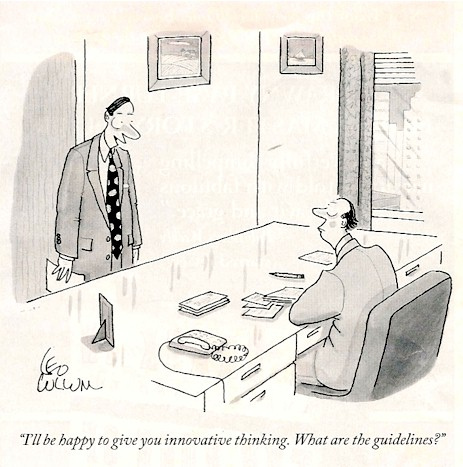
 When looking for a new job, it seems like 95% of the time people will only hire you to do the job you just did, and the other 5% of the time will provide an equal mix of once in a lifetime opportunities and jobs you shouldn’t take.
 For example, a restaurant will hire a waiter who has been a waiter before, even if the only reason he is available is that he was a crap waiter every other place he worked. In our hiring system, someone who has experience almost always gets the job, regardless of ability and capacity for growth. Meanwhile the gal who dreams of being a waitress, whose passion for the profession would make her an amazing waitress as she strives to create the perfect customer experience, never gets hired. Where does this leave the person with amazing potential but no direct experience in the position they seek?
 Usually this person is doomed to remain an unhappy accountant, potentially seeking an MBA that may or may not successfully allow them to transition over to the world of marketing.
 Unless you have invented a completely new product or service, it is very likely that there are large competitors already in your marketplace, established competitors that you will be trying to outwit and outmaneuver. Even if you do have a completely new product or service, customers still have alternatives. For example, the Segway entered the marketplace with a “revolutionary product with no competition”, but the truth is that it entered a marketplace with a smorgasbord of alternative competition (walking, bicycling, roller-skating, skateboarding, etc.). This alternative or substitute competition has proven far stronger than any direct competitor ever could. So what can a small firm do to outmaneuver the big guys or outwit the sneaky substitute competition that is easy to overlook in the passion of the startup process?
 One of the things that was discussed as a possibility was having team members fill out a simple worksheet to identify what roles they believe their teammates tend towards, while also self-identifying themselves. If the whole team were to complete this exercise it should yield some interesting and actionable data.
 Let’s examine something that has been bothering me for a little while. I’ve been renting my movies from Blockbuster and