Tag Archives: trust

Measuring the Value of Trust in Innovation Projects

LAST UPDATED: February 11, 2026 at 3:27PM

Measuring the Value of Trust in Innovation Projects

GUEST POST from Chateau G Pato

Innovation is frequently misunderstood as a purely technical or creative pursuit. We often focus on the Value Creation (the invention), the Value Access (the friction reduction), and the Value Translation (the storytelling). But underneath this framework lies a foundation that determines the speed and stability of every initiative: Trust.

In my work with organizations globally, I have seen that trust is not a “soft” metric; it is a hard economic driver. When trust is low, every interaction comes with a “tax” of bureaucracy and skepticism. When trust is high, we experience an innovation dividend that accelerates the Eight I’s of Infinite Innovation.

“Measurement is never neutral. It shapes behavior, reinforces values, and ultimately determines whether innovation survives or suffocates. To measure innovation truly, we must stop counting outputs and start measuring the soil of trust in which those ideas grow.”

— Braden Kelley

The Trust Dividend vs. The Trust Tax

In Human-Centered Innovation, we must recognize that change happens at the speed of belief. If your employees do not trust the leadership’s vision, they will not contribute their Intrinsic Genius — that intersection of competence, joy, and drive. Instead, they will operate in a state of innovation theater, going through the motions while protecting themselves from the perceived risks of failure.

Measuring trust requires looking at the “friction” within your innovation pipeline. Are decisions being stalled by excessive committees? Are team members afraid to share “unpleasant facts” about a failing prototype? These are quantifiable delays. By reducing this friction, we increase the velocity of learning, which is the ultimate metric for any innovation project.


Case Study 1: The Safety Turnaround at Alcoa

When Paul O’Neill took over as CEO of Alcoa in 1987, he didn’t focus on profit margins or R&D spend as his primary metric. Instead, he focused on worker safety. To many analysts, this seemed like a distraction from the core business of making aluminum. However, O’Neill understood that to innovate, he needed to build a Value Ecosystem rooted in trust.

By making safety the non-negotiable priority, he signaled a deep commitment to the well-being of every employee. This created a transparent communication loop where workers felt safe to point out flaws in the manufacturing process without fear of retribution. The result? As trust increased, operational excellence followed. Alcoa’s market value increased by five times during his tenure. The “value of trust” here was measured in the elimination of the silos that previously prevented the flow of innovative ideas from the factory floor to the executive suite.

Case Study 2: Wyeth Pharmaceuticals and the Power of Small Groups

In 2007, Wyeth Pharmaceuticals faced a crisis when a top drug lost 70% of its sales to generics. To survive, they needed to transform their manufacturing across 25 global sites. Rather than a top-down mandate (which usually triggers the 70% failure rate of change programs), they focused on building trust through small, loosely connected groups.

They started with one “keystone change” at a single facility. By focusing on a small win, they built local trust and proved the value of the new methodology. This trust then “cascaded” to other sites. Because the employees saw the success and felt respected in the process, the adoption rate skyrocketed. Wyeth saw a 25% reduction in costs and a significant increase in workforce motivation. The measurement of trust wasn’t a survey; it was the adoption rate and the speed of implementation of the new lean practices.


How to Quantify the Intangible

To measure the value of trust in your own innovation projects, I suggest focusing on these three pillars:

  • Information Transparency: Measure the lag time between a “fatal flaw” being discovered by a team and it being reported to leadership. In high-trust cultures, this is nearly instantaneous.
  • Experimentation Velocity: Track how many experiments are run per quarter. High trust leads to more psychological safety, which encourages teams to take the “leaps of faith” necessary for radical innovation.
  • Adoption Speed: Use my Change Planning Canvas to track how quickly stakeholders move from awareness to advocacy. If trust is high, the “Value Translation” phase requires less effort.

Measuring the Value of Trust in Innovation Projects

Trust is often treated as a soft variable in innovation. It is discussed in leadership offsites, nodded at in strategy decks, and invoked after projects fail. Yet when it comes time to allocate budget, prioritize initiatives, or evaluate performance, trust rarely appears on the scorecard.

This is a mistake.

Innovation is not merely a function of ideas and investment. It is a function of belief. Belief that experimentation will not be punished. Belief that leaders will listen. Belief that customers are telling the truth. Belief that data has not been manipulated to protect careers. Without trust, innovation slows. With trust, it compounds.

“Trust is the invisible infrastructure of innovation. You can’t see it on a balance sheet, but you can see its absence in every stalled initiative.”

— Braden Kelley

The question is not whether trust matters. The question is how to measure its value.

Trust as an Innovation Multiplier

Trust operates as a multiplier on three critical dimensions of innovation:

  • Speed — How quickly teams move from insight to experiment to iteration.
  • Risk Appetite — The willingness to explore uncertain territory.
  • Collaboration Quality — The depth and honesty of cross-functional engagement.

When trust is low, approval cycles lengthen, defensive behaviors increase, and experimentation narrows. When trust is high, friction decreases and learning accelerates.

To measure the value of trust, we must link it to outcomes that executives already care about: cycle time, cost of delay, employee engagement, customer retention, and innovation yield.

Quantifying Trust: Practical Metrics

Trust can be translated into measurable indicators across three categories:

1. Behavioral Metrics

  • Rate of idea submission per employee.
  • Frequency of cross-functional experiments.
  • Percentage of projects with documented learning reviews.

2. Operational Metrics

  • Average decision cycle time.
  • Number of approval layers required for pilot funding.
  • Time between failure and next experiment iteration.

3. Perceptual Metrics

  • Psychological safety survey scores.
  • Leadership credibility ratings.
  • Customer trust indices tied to innovation launches.

Individually, these metrics are imperfect. Together, they create a composite trust index that can be tracked over time and correlated with innovation performance.

Calculating the Financial Impact

To make trust visible in financial terms, leaders can estimate:

  • Cost of Delay Reduction: Faster decision cycles and experimentation lower opportunity costs.
  • Retention Value: Increased employee and customer loyalty reduce replacement and acquisition expenses.
  • Failure Efficiency: Quicker learning cycles reduce wasted capital on prolonged low-probability initiatives.

For example, if a one-month acceleration in product launch generates $2 million in incremental revenue, and higher trust correlates with that acceleration, trust has measurable economic value.

Trust as a Design Variable

Trust is not a byproduct of culture. It is a design choice.

Leaders design incentive systems. They design review processes. They design communication patterns. Each design decision either strengthens or erodes trust.

When innovation systems punish candor, reward political navigation, or obscure decision criteria, trust declines. When systems reward learning, clarify expectations, and distribute authority appropriately, trust grows.

Human-centered change requires that we treat trust not as sentiment but as system architecture.

Building a Trust Dashboard

An effective trust dashboard integrates:

  • Quarterly psychological safety surveys.
  • Innovation pipeline velocity metrics.
  • Cross-functional collaboration frequency data.
  • Customer adoption and retention indicators.

Over time, patterns emerge. Leaders begin to see that dips in trust scores often precede declines in experimentation rates. Increases in transparency frequently correlate with improved launch performance.

This visibility shifts trust from abstraction to accountability.

Conclusion

Innovation thrives where trust is present. It stalls where trust is absent. While trust may feel intangible, its effects are concrete and measurable.

Organizations that intentionally measure trust gain a strategic advantage. They reduce friction, accelerate learning, and amplify the return on innovation investment.

In a world of increasing complexity and algorithmic decision-making, trust becomes even more valuable. It is the foundation that allows people to take risks, share truth, and collaborate across boundaries.

Innovation does not fail because people lack ideas. It fails because people lack confidence in the systems meant to support those ideas.

Measure trust. Design for trust. Lead with trust. The value will reveal itself.

Ultimately, if you are looking to get to the future first, you cannot afford the weight of a low-trust organization. You must design conditions where time stops bullying us and where people feel empowered to illuminate paths previously hidden by the friction of fear.

Frequently Asked Questions

Why is trust considered an economic driver in innovation?

Trust acts as a lubricant that reduces “friction taxes” like bureaucracy and excessive oversight. In high-trust environments, information flows faster, allowing for quicker pivots and lower costs of experimentation.

How can an organization measure something as abstract as trust?

Trust is measured through proxy metrics such as the speed of information flow, the rate of successful experiments, and the time it takes for a team to report project failures or “unpleasant facts” to leadership.

What is the “innovation dividend”?

The innovation dividend is the accelerated ROI and increased speed-to-market achieved when teams operate with high psychological safety, allowing them to collaborate more effectively and share their Intrinsic Genius without fear.

For more insights on building a culture of innovation, consider booking innovation speaker Braden Kelley for your next event.

Image credits: Pixabay

Subscribe to Human-Centered Change & Innovation WeeklySign up here to get Human-Centered Change & Innovation Weekly delivered to your inbox every week.

Rebuilding Trust in a Changing Economy

The Psychological Contract of Work

LAST UPDATED: December 31, 2025 at 12:23PM

Rebuilding Trust in a Changing Economy

GUEST POST from Chateau G Pato

In my decades of work championing Human-Centered Change™, I have consistently maintained that innovation is change with impact. However, as we accelerate into the future, we are finding that the “impact” we desire is being throttled by a silent crisis: the disintegration of the psychological contract of work. This unwritten, often unspoken agreement — the invisible glue that binds an employee’s discretionary effort to an organization’s goals — is currently under immense strain from economic volatility, algorithmic displacement, and a persistent lack of empathy in corporate boardrooms.

When the psychological contract is healthy, it fosters a sense of belonging and mutual investment. But when it is broken, the corporate antibody — that natural organizational resistance to anything new — becomes hyper-aggressive. Rebuilding this trust is not a luxury for HR to manage; it is the fundamental duty of the modern leader who wishes to survive the 2020s.

“Trust is the oxygen of innovation. You can have the most advanced AI and the most brilliant strategy, but if your people do not feel safe enough to experiment, your organization will eventually suffocate in its own cynicism.”

Braden Kelley

The Erosion of Shared Purpose

For most of the industrial era, the contract was transactional: loyalty for stability. In the digital age, that shifted to performance for growth. Today, however, many employees feel the contract has become one-sided. We ask for agile resilience, constant upskilling, and deep emotional labor, yet the rewards often feel fleeting or disconnected from the human experience. To fix this, we must recognize that Human-AI Teaming and digital transformation cannot succeed if the humans involved feel like temporary placeholders.

Case Study 1: The Transparency Pivot at Buffer

The Challenge: Building a cohesive, high-trust culture in a fully remote environment during periods of market instability.

The Intervention: Buffer famously leaned into radical transparency as a design principle for their psychological contract. They chose to share everything — from exact salary formulas to revenue figures and diversity goals — publicly. When they faced financial difficulties that necessitated layoffs, they didn’t hide behind legalese. They shared the raw math and provided an empathetic off-boarding process that honored the value of those leaving.

The Insight: By honoring the “honesty” pillar of the psychological contract, Buffer prevented the remaining team from retreating into defensive, low-innovation postures. Trust was maintained not because things were perfect, but because the leadership was predictably authentic.

Case Study 2: Microsoft’s Cultural “Empathy OS”

The Challenge: A “know-it-all” culture that stifled collaboration and led to internal silos and stagnating innovation.

The Intervention: Under Satya Nadella, Microsoft underwent a human-centered change journey toward a “learn-it-all” growth mindset. They fundamentally renegotiated the psychological contract by prioritizing psychological safety. They encouraged managers to move from “judges” to “coaches,” using empathy as a tool to unlock collective intelligence rather than individual performance alone.

The Insight: This shift in the internal contract catalyzed a massive resurgence. When employees felt that their growth was prioritized over their “correctness,” the speed of innovation increased. They proved that empathy is a strategic multiplier for technical excellence.

Leading Companies and Startups to Watch

If you are looking for the organizations architecting the new psychological contract, keep a close eye on Lattice and Culture Amp, which are moving beyond simple surveys to deep, AI-augmented sentiment analysis that helps leaders act before trust breaks. BetterUp is another key player, democratizing coaching to ensure the “growth” part of the contract is available to all, not just executives. On the startup front, ChartHop is bringing unprecedented clarity to organizational design, while Tessl and Vapi are exploring how AI can handle transactional “grunt work” to free humans for the meaningful, purpose-driven work that the new contract requires. These companies recognize that the Future Present belongs to those who prioritize the human spirit over the algorithmic output.

Architecting a Resilient Future

To rebuild trust, leaders must stop treating change management as a post-script to strategy. It must be baked into the design. We need to create environments where employees are not just “bought in,” but “brought in” to the decision-making process. As a top innovation speaker, I frequently advise organizations that the most successful transformations are those where the workers feel like co-architects of their own future.

We are currently standing at a crossroads. We can continue to optimize for short-term efficiency, risking creative atrophy and total disengagement, or we can choose to rebuild a psychological contract based on mutual flourishing. The choice we make today will determine which organizations thrive in the next decade and which ones are rejected by the very talent they need most.

Frequently Asked Questions

What is the “Psychological Contract” of work?
It is the unwritten set of expectations, beliefs, and obligations between an employer and employee. Unlike a legal contract, it governs the emotional and social exchange — things like trust, loyalty, growth opportunities, and a sense of belonging.
How has the changing economy damaged this contract?
Economic volatility and rapid AI integration have created a sense of “precarity.” When companies prioritize short-term stock gains or automation over human value, employees feel the agreement has been violated, leading to “Quiet Quitting” or creative resistance.
What is the first step in rebuilding workplace trust?
Radical transparency and empathetic communication are the foundations. Leaders must move away from “command and control” and instead involve employees in the transformation process, ensuring they feel secure enough to innovate without fear of immediate displacement.

Extra Extra: Because innovation is all about change, Braden Kelley’s human-centered change methodology and tools are the best way to plan and execute the changes necessary to support your innovation and transformation efforts — all while literally getting everyone all on the same page for change. Find out more about the methodology and tools, including the book Charting Change by following the link. Be sure and download the TEN FREE TOOLS while you’re here.

Image credits: Google Gemini

Subscribe to Human-Centered Change & Innovation WeeklySign up here to get Human-Centered Change & Innovation Weekly delivered to your inbox every week.

Measuring the Unmeasurable – Metrics for Curiosity, Trust, and Openness

LAST UPDATED: December 8, 2025 at 2:34PM

Measuring the Unmeasurable - Metrics for Curiosity, Trust, and Openness

GUEST POST from Chateau G Pato

In the relentless pursuit of Human-Centered Change and innovation, we face a critical paradox: the most impactful drivers of breakthrough ideas—things like curiosity, trust, and openness—are often dismissed as “soft” or “unmeasurable.” We diligently track KPIs related to output, revenue, and efficiency, yet overlook the very inputs that foster an environment where these outputs can thrive. This is a profound mistake. What gets measured gets managed. What isn’t measured often languishes.

To truly build resilient, innovative organizations, we must unlearn the rigid assumption that only direct, quantitative metrics hold value. Instead, we must embrace the art and science of inferential measurement, building a mosaic of data points that, together, illuminate the state of these crucial, yet intangible, human qualities. These are not about vanity metrics; they are about understanding the health of your innovation ecosystem.

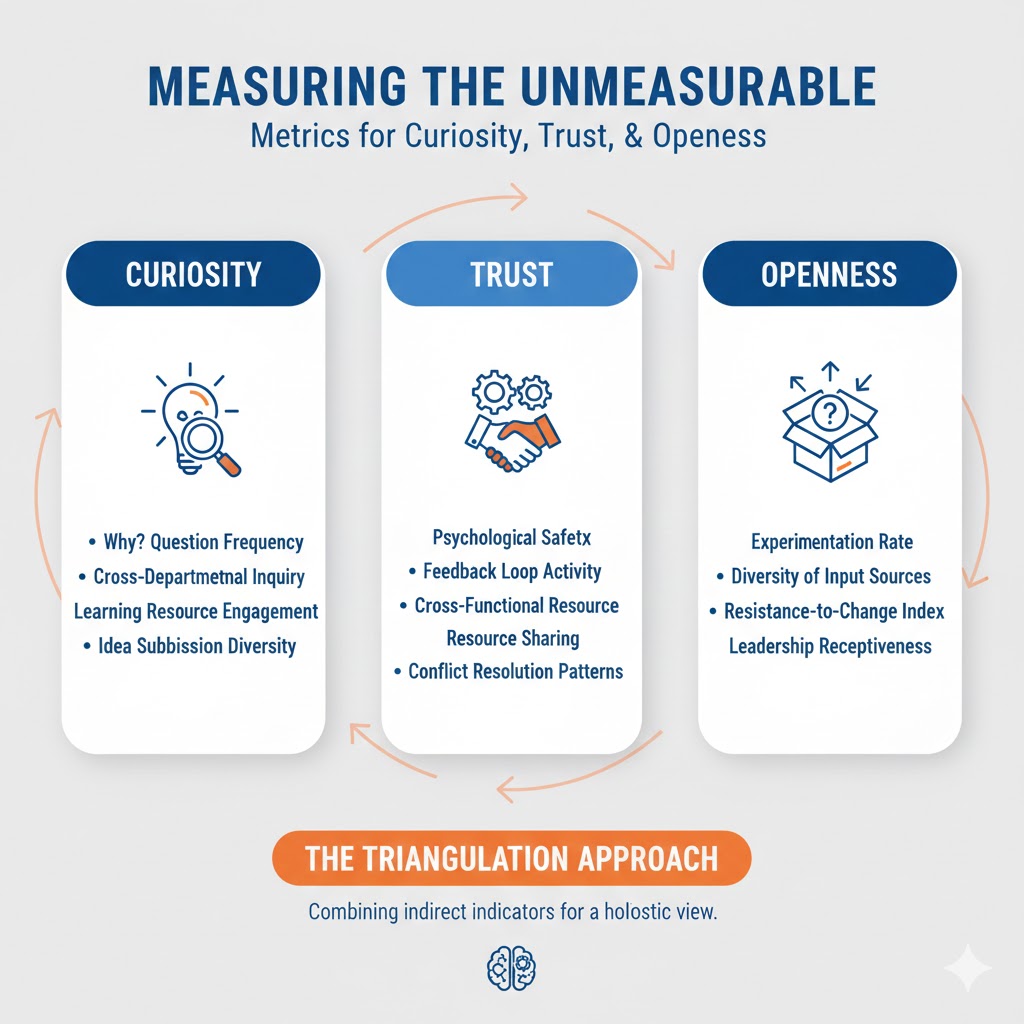
Visual representation: An infographic illustrating how indirect metrics (e.g., questions asked, cross-functional collaboration, idea submissions) can be proxies for Curiosity, Trust, and Openness.

The Triangulation Approach: Unlocking Hidden Insights

Measuring the unmeasurable is not about finding a single, perfect number. It’s about triangulation: combining multiple, often indirect, indicators to create a robust picture. Here’s how we can approach curiosity, trust, and openness:

1. Measuring Curiosity: The Fuel for Exploration

Curiosity is the impulse to explore, learn, and question. It drives individuals to seek new solutions and challenge assumptions. To measure it, look for behavioral proxies:

  • “Why?” Question Frequency: In meetings, workshops, and project discussions, track the number of times individuals or teams ask fundamental “why” questions rather than just “how” or “what.” A higher frequency suggests deeper inquiry.
  • Cross-Departmental Inquiry: Track the number of informal (coffee chats) and formal (shadowing, interviews) information-seeking interactions employees initiate outside their immediate team or department. Tools like communication platforms or internal social networks can help monitor this.
  • Learning Resource Engagement: Monitor engagement with internal learning platforms, external courses, industry reports, and innovation labs. How many unique topics are explored? How many non-mandatory courses are completed?
  • Idea Submission Diversity: Beyond just the number of ideas, analyze the breadth of domains or problem spaces addressed in idea submissions. Are people exploring completely new territories, or just iterating on existing ones?

By combining these, you can gauge whether your culture is merely allowing curiosity or actively fostering it.

2. Measuring Trust: The Foundation of Collaboration

Trust is the belief that others will act in good faith and that one’s vulnerabilities will not be exploited. It is essential for sharing nascent ideas and taking risks. Proxies for trust include:

  • Psychological Safety Index: Utilize anonymous surveys (e.g., Google’s Project Aristotle model) to gauge employees’ comfort level with speaking up, admitting mistakes, and sharing unconventional ideas without fear of negative repercussions. Focus on statements like, “If I make a mistake on this team, it is not held against me.”
  • Feedback Loop Activity: Track the volume and bidirectional nature of constructive feedback. Are people giving and receiving candid feedback freely, or is it primarily top-down and formal? High-trust environments foster frequent, informal feedback exchanges.
  • Cross-Functional Resource Sharing: Beyond simple collaboration, look at the willingness to share sensitive information, critical resources, or even temporary team members between departments. This indicates a deeper level of inter-team trust.
  • Conflict Resolution Patterns: Observe how conflicts are resolved. Is it through formal escalation (low trust) or direct, informal discussion and negotiation (high trust)?

A thriving innovation culture cannot exist without strong inter-personal and inter-team trust. Building this foundation is not soft; it is strategic.

3. Measuring Openness: The Gateway to New Possibilities

Openness is the willingness to consider new ideas, approaches, and perspectives, even if they challenge existing paradigms. It’s about shedding cognitive biases and embracing ambiguity. Metrics for openness include:

  • Experimentation Rate: Track the number of small-scale experiments, MVPs, and pilots initiated monthly. More importantly, measure the learning cycle time—how quickly experiments are run, results analyzed, and decisions made.
  • Diversity of Input Sources: Where do new ideas originate? Are they solely internal, or is there a strong influx from external sources (customer co-creation, academic partnerships, competitor analysis, diverse new hires)?
  • Resistance-to-Change Index: Use pulse surveys or qualitative interviews to identify explicit and implicit resistance to new processes, technologies, or strategies. Look for patterns in objections—are they evidence-based, or fear-based?
  • Leadership Receptiveness: Assess how often leaders genuinely seek out dissenting opinions, actively listen to junior staff ideas, and publicly acknowledge when their own assumptions were challenged and proven incorrect. This sets the tone for the entire organization.

Ultimately, openness determines an organization’s capacity for true transformation, not just incremental improvement.

Case Study 1: Reinvigorating a Stagnant R&D Lab

Challenge: Declining Innovation Output in a Legacy R&D Division

A global pharmaceutical company (“PharmaCo”) noticed its once-pioneering R&D lab was becoming risk-averse, producing fewer novel compounds. Direct output metrics remained stable due to incremental improvements, but true breakthrough innovation had stalled.

Measurement Intervention: Curiosity & Openness Proxies

PharmaCo introduced new “soft” metrics alongside traditional KPIs:

  • Curiosity: Tracked participation in cross-disciplinary “Lunch & Learn” sessions (informal scientific sharing), internal publication of research outside one’s core specialty, and spontaneous “deep dive” requests to the central knowledge repository.
  • Openness: Monitored the number of “negative result” reports (failures leading to new insights), external collaboration proposals, and employee-initiated “exploratory project” pitches outside core mandates.

The Innovation Impact:

By explicitly measuring and rewarding these proxies, PharmaCo shifted its culture. Within two years, cross-disciplinary “Lunch & Learns” increased by 300%, and “negative result” reports (previously buried) became celebrated learning documents. This led to a 15% increase in novel drug candidate proposals from unexpected combinations of research, demonstrating that measuring inputs can drive groundbreaking outputs.

Case Study 2: Building Inter-Departmental Trust in a Tech Giant

Challenge: Siloed Teams and Blame Culture Post-Acquisition

A rapidly growing tech company (“MegaTech”) experienced significant friction and blame-shifting between its engineering and product teams following a major acquisition. This eroded trust, slowed development cycles, and increased employee turnover in critical roles.

Measurement Intervention: Trust & Openness Proxies

MegaTech launched a Human-Centered Change initiative focusing on trust. Metrics included:

  • Trust: Anonymous pulse surveys on psychological safety (e.g., “I feel safe disagreeing with my manager”), and “shadowing days” where engineers spent a day with product teams, and vice versa.
  • Openness: Tracked the number of “feedback sessions” where teams collectively reviewed each other’s work (not just managers), and the explicit mention of “lessons learned” in post-mortems, rather than just “root causes.”

The Innovation Impact:

Over 18 months, the psychological safety score increased by 25%. More importantly, the quality and speed of conflict resolution improved dramatically, and employee retention in critical engineering roles stabilized. By making trust and openness measurable, MegaTech systematically dismantled silos, fostering a culture where inter-team learning and mutual respect became the norm.

Conclusion: The Strategic Imperative of Intangible Metrics

Ignoring curiosity, trust, and openness as “unmeasurable” is a strategic blunder. These are not optional nice-to-haves; they are the fundamental operating system of an innovative enterprise. By adopting a triangulation approach—combining observable behaviors, qualitative insights, and intelligent proxies—leaders can gain unprecedented visibility into the health of their innovation culture. This shift from purely output-driven metrics to input-driven insights is the next frontier of Human-Centered Change. Start measuring these “unmeasurables” today, and watch your innovation capacity soar.

“If you only measure the easy things, you’ll miss the most important things.” — Braden Kelley

Frequently Asked Questions About Measuring Intangible Metrics

1. Why are curiosity, trust, and openness considered “unmeasurable”?

They are often considered unmeasurable because they are subjective human qualities that cannot be directly counted or quantified in a simple numerical way. Traditional metrics focus on outputs (e.g., sales, production), whereas these are inputs that describe psychological states and behaviors, requiring more nuanced, indirect measurement approaches.

2. What is the “triangulation approach” to measurement?

The triangulation approach involves using multiple, different data sources and types (e.g., surveys, behavioral observations, usage logs) to gain a comprehensive understanding of an intangible quality. Instead of relying on a single “perfect” metric, it combines several indirect indicators to form a more robust and reliable picture.

3. How can I start measuring these in my own team?

Start small with a single proxy. For curiosity, try tracking “why” questions in team meetings. For trust, implement a quick, anonymous psychological safety pulse survey. For openness, monitor the diversity of idea sources. The key is to pick observable behaviors or simple self-reports and consistently track changes over time, then discuss the insights with your team.

Your first step toward measuring the unmeasurable: Convene your innovation leadership team. Instead of asking, “What new products did we launch?” ask, “What new questions did our team ask last month that challenged our core assumptions?” Document these, and you’ve begun to measure curiosity.

Extra Extra: Because innovation is all about change, Braden Kelley’s human-centered change methodology and tools are the best way to plan and execute the changes necessary to support your innovation and transformation efforts — all while literally getting everyone all on the same page for change. Find out more about the methodology and tools, including the book Charting Change by following the link. Be sure and download the TEN FREE TOOLS while you’re here.

Image credit: Pexels

Subscribe to Human-Centered Change & Innovation WeeklySign up here to get Human-Centered Change & Innovation Weekly delivered to your inbox every week.