How Visual Anchors Align Diverse Corporate Stakeholders
GUEST POST from Art Inteligencia
The Corporate Tower of Babel
Innovation and organizational change rarely fail because of a lack of ambition or talent. They stall in the quiet, frustrating spaces between departments where intent gets lost in translation. When executive leadership, engineering, design, marketing, and finance gather around a strategic initiative, every function nod in agreement—yet each leaves the room with a fundamentally different vision of what was actually decided.
This is the modern Corporate Tower of Babel. Text-heavy memos, sixty-slide decks, and bulleted strategic plans create a dangerous illusion of alignment. We rely on abstract buzzwords and industry jargon that sound decisive on the surface, but mean entirely different things depending on a team member’s functional background, risk tolerance, and daily priorities.
The Cost of Cognitive Friction
When strategic directives remain locked in ambiguous prose, the human cost is immediate. Employees experience cognitive friction and paralysis, forced to navigate unclear expectations while attempting to deliver on cross-functional mandates. The friction leads to misaligned priorities, wasted resources, and friction between teams that should be driving transformational value together.
To overcome this disconnect, organizations must shift from verbal rhetoric to visual clarity. Human-centered change requires a shared language—one that democratizes collaboration, externalizes complex ideas, and gives diverse corporate stakeholders a single, unified canvas upon which to build the future.
What is a Visual Anchor?
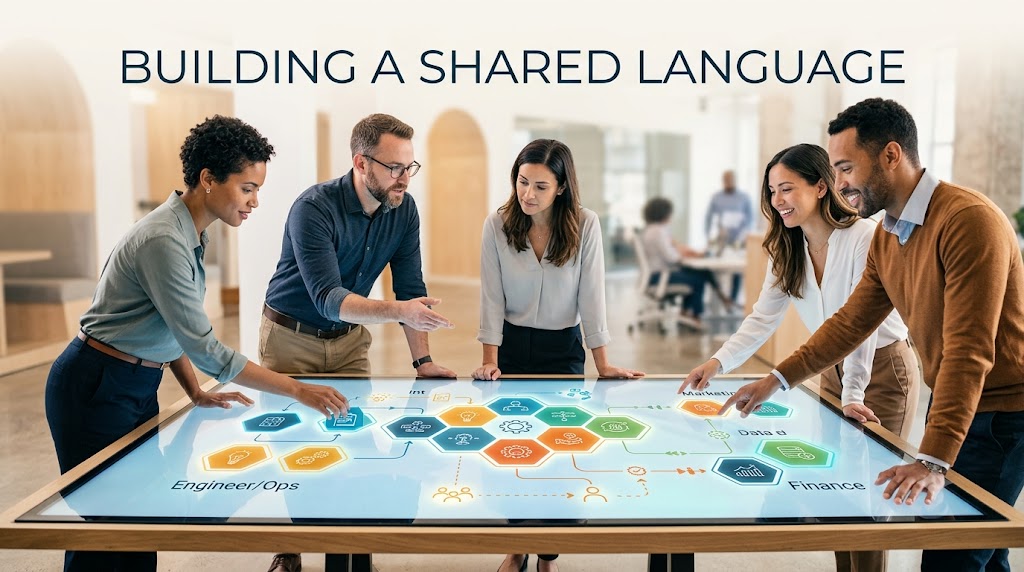
A visual anchor is far more than a decorative graphic or an infographic summarizing a project. It is an interactive, structured visual framework—such as a canvas, ecosystem map, or experience blueprint—designed to serve as a shared working space. By externalizing complex ideas onto a visible surface, visual anchors provide a consistent point of reference that keeps cross-functional teams grounded in the same reality throughout the lifecycle of an initiative.
The Science of Visual Processing
The human brain processes visual information significantly faster than dense text. Visual anchors leverage spatial reasoning and pattern recognition, allowing stakeholders to grasp system architecture, dependencies, and customer journeys at a glance. More importantly, this shared visual surface creates psychological safety: when a team member critiques a box, sticky note, or arrow on a canvas, they are challenging an externalized idea rather than attacking a person or a department’s territorial agenda.
Neutral Ground for Collaboration
Standard documents often carry implicit power dynamics—a slide deck built by Finance carries a distinct bias toward cost control, while a document from Product leans heavily into features. A visual anchor acts as neutral territory. By shifting collective ownership from “my department’s document” to “our shared canvas,” it democratizes participation and ensures every function—from engineering and operations to design and executive leadership—has an equal voice in shaping the outcome.
The Mechanics of Alignment Through Visual Anchors
Alignment is not a passive state achieved at the end of a kickoff meeting; it is an active, iterative process of shared sense-making. Visual anchors provide the necessary scaffolding for this process by transforming abstract strategic intent into tangible, navigable structures that stakeholders can collectively stress-test, refine, and own.
Externalizing Ambiguity and Complexity
When strategic goals remain purely verbal, ambiguity hides behind familiar buzzwords. A visual anchor forces implicit assumptions out into the open. By placing components, workflows, and objectives onto a structured canvas, cross-functional teams can immediately identify gaps, conflicting priorities, and unaddressed risks. Visualizing the system makes the invisible friction points visible, turning vague debate into precise problem-solving.
Standardizing a Shared Vocabulary
Different functional teams naturally speak different professional dialects—Finance focuses on ROI and risk mitigation, Engineering on feasibility and technical debt, Design on user friction, and Marketing on positioning. Visual anchors establish a unified semantic foundation. By anchoring key concepts, touchpoints, and success metrics to specific visual elements, the framework establishes a consistent vocabulary that translates priorities across department lines.
Mapping Hidden Dependencies
Complex organizational change invariably triggers ripple effects across operations, technology, and customer touchpoints. Visual frameworks map these interdependencies in real time. Revealing how a change in backend architecture impacts customer experience—or how a shifting business model alters operational capacity—enables teams to spot bottlenecks early, align timelines, and build holistic solutions that account for the entire organizational ecosystem.
Designing and Deploying Visual Anchors for Change
The true value of a visual anchor lies not in the final design of the artifact, but in the collaborative process of populating and refining it. Deploying visual tools is an act of change leadership; it requires deliberate facilitation that moves teams away from passive consumption and into active co-creation.
Co-Creation Over Mandate
Visual anchors are ineffective when delivered as finished top-down directives. When executive leadership hands down a completed canvas, it reproduces the same passive resistance as a traditional memo. True alignment happens during the workshop—when cross-functional stakeholders physically or digitally place sticky notes, debate placement, and co-author the content. Co-creation builds psychological ownership, transforming stakeholders from passive recipients into active champions of the strategy.
Grounding the Anchor in Human Experience
To prevent visual tools from becoming abstract exercises, they must be anchored in authentic human experience. Whether mapping a digital transformation or an organizational restructuring, the framework should explicitly link strategic decisions to both customer experience (CX) touchpoints and employee experience (EX) realities. Keeping the human impact visible ensures that operational efficiency never comes at the expense of end-user value or workforce engagement.
Scaling from Workshop Whiteboards to Daily Governance
A visual anchor must not remain trapped in a workshop Miro board or pinned to a conference room wall. To drive sustained organizational change, visual frameworks must be integrated into operational cadences, project management artifacts, and executive review rhythms. By using the visual anchor as a live dashboard for ongoing governance, leaders maintain strategic alignment, monitor shifting dependencies, and continuously orient cross-functional teams around a shared visual truth.
Future-Proofing Corporate Alignment
As organizations face accelerating market shifts and technological disruption, the methods we use to build alignment must also evolve. Static strategies locked in rigid documentation are no longer sufficient. Future-ready leadership requires dynamic, visual systems that keep cross-functional teams resilient, adaptable, and aligned in real time.
Spatial Computing and AI-Augmented Collaboration
The next frontier of visual anchoring moves beyond two-dimensional whiteboards into spatial computing and artificial intelligence. Generative AI tools and spatial whiteboards will dynamically surface hidden dependencies, automatically organize stakeholder input, and simulate scenario outcomes on the fly. These advanced visual environments will allow cross-functional teams to interact with complex organizational ecosystems, stress-testing strategies in immersive environments before committing capital and resources.
From Static Roadmaps to Dynamic Ecosystem Maps
Traditional multi-year transformation roadmaps often become obsolete the moment market conditions change. Forward-looking organizations are shifting toward continuous change readiness powered by dynamic visual ecosystem maps. By maintaining a living visual model of customer experience, technology infrastructure, and operational capabilities, leaders can quickly communicate pivot points, reallocate resources, and keep diverse stakeholders aligned through continuous waves of change.
Conclusion: The Visual Canvas of Future Leadership
Innovation, organizational transformation, and experience design ultimately depend on human alignment. When diverse corporate stakeholders operate from fragmented mental models, even the most brilliant strategies collapse under the weight of miscommunication and friction. Visual anchors bridge this divide, replacing functional silos and text-heavy ambiguity with a shared visual surface where clarity and co-creation can thrive.
Bridging Vision and Execution
By democratizing collaboration, externalizing complex ideas, and establishing a unified semantic foundation, visual anchors convert disparate departmental priorities into a cohesive collective narrative. They allow leaders to move beyond the illusion of agreement, transforming passive consent into deep, shared commitment across engineering, design, operations, and executive leadership.
A Call to Action for Change Leaders
Stop relying solely on words, endless slide decks, and dense reports to drive complex strategic initiatives. Give your cross-functional teams a shared visual canvas—one that humanizes change, makes dependencies visible, and empowers every stakeholder to help build the future together.
Frequently Asked Questions
What is a visual anchor in corporate change management?
A visual anchor is an interactive, structured visual framework—such as a canvas, ecosystem map, or experience blueprint—designed to give cross-functional teams a shared surface to collaborate. Unlike static slide decks, visual anchors externalize complex ideas, align vocabulary, and make strategic dependencies visible to prevent miscommunication.
How do visual anchors help cross-functional alignment?
Visual anchors create a neutral, shared space that removes functional bias between departments like engineering, design, finance, and leadership. By leveraging visual processing and spatial reasoning, they lower cognitive friction, allow teams to critique ideas rather than people, and build psychological ownership through active co-creation.
How should visual anchors be integrated into daily operations?
To be effective, visual anchors must move beyond workshop sessions into regular governance and execution. Teams should use them as live dashboards during project reviews, strategic check-ins, and ongoing decision-making, keeping cross-functional priorities aligned as market conditions evolve.
Bottom line: Futurists are not fortune tellers. They use a formal approach to achieve their outcomes, but a methodology and tools like those in FutureHacking™ can empower anyone to be their own futurist.
Image credit: Gemini
 Sign up here to get Human-Centered Change & Innovation Weekly delivered to your inbox every week.