Tag Archives: purpose

The Future of Innovation Balances Profit and Purpose

The Future of Innovation Balances Profit and Purpose

GUEST POST from Chateau G Pato

In today’s rapidly evolving world, organizations are tasked with the challenge of balancing profits with purpose. As consumers become more ethically aware and demand transparency, businesses are pushed to innovate not just for financial gain, but also for social and environmental impact. The future of innovation lies in this delicate balance, where success is measured not only by the bottom line but by the positive impact one has on society. Let us explore a couple of case studies that exemplify this approach.

Case Study 1: Patagonia – Environmental Stewardship as Core Business

Patagonia, the outdoor apparel company, is a pioneer in aligning profit with purpose. Founded with a clear mission to “build the best product, cause no unnecessary harm, use business to inspire and implement solutions to the environmental crisis,” Patagonia actively integrates sustainability into its business model.

Innovations such as their Worn Wear program, encourage customers to buy used, repair existing gear or recycle, thereby extending the life of products and reducing environmental impact. Patagonia’s decision to donate 1% of sales to environmental causes further affirms its commitment to environmental stewardship.

Despite its upfront commitment to sustainability, Patagonia’s profitability has not suffered. On the contrary, their authenticity and transparency have fostered a loyal customer base, positioning them as market leaders. The Patagonia case illustrates that a strong commitment to purpose can drive financial success and customer loyalty.

Case Study 2: TOMS Shoes – One for One Commitment

TOMS Shoes revolutionized the corporate social responsibility landscape with their One for One business model. For every pair of shoes purchased, TOMS would donate a pair to a child in need. This model was an intrinsic part of their brand ethos and attracted consumers who were eager to make purchases that fostered social good.

Over time, TOMS expanded this model to include eyewear and water initiatives, further integrating charitable giving into its business operations. While the company experienced rapid growth and increased brand awareness, it also faced challenges in ensuring the sustained impact of its giving model and responding to critiques about the complexity of aid.

TOMS has since evolved its strategy by focusing on empowering the communities they serve, providing jobs, and supporting local efforts. This shift illustrates the dynamic nature of balancing purpose and profit, emphasizing the need for continuous adaptation and re-evaluation of impact strategies.

The Path Forward: Key Considerations

The road to balancing profit and purpose requires thoughtful integration of sustainability and responsibility at every level of the business. Here are critical considerations for organizations:

  • Embed Purpose into Core Strategy: Making purpose a central aspect of business strategy ensures long-term commitment and alignment across all operations.
  • Incorporate Stakeholder Voices: Engage with customers, employees, and communities to understand their needs and perspectives, fostering collaboration and trust.
  • Measure Impact Rigorously: Develop and implement measurement frameworks to assess the social and environmental effects of business activities.
  • Foster a Culture of Innovation: Encourage creative solutions that integrate business goals with societal needs, pushing the boundaries of conventional thinking.

In conclusion, the future of innovation is intricately linked with the pursuit of purpose alongside profit. As companies navigate these waters, they will continue to redefine success in ways that benefit people, the planet, and their bottom lines. Embracing this harmonious balance promises a world where business becomes a formidable force for positive change.

Extra Extra: Because innovation is all about change, Braden Kelley’s human-centered change methodology and tools are the best way to plan and execute the changes necessary to support your innovation and transformation efforts — all while literally getting everyone all on the same page for change. Find out more about the methodology and tools, including the book Charting Change by following the link. Be sure and download the TEN FREE TOOLS while you’re here.

Image credit: Pixabay

Subscribe to Human-Centered Change & Innovation WeeklySign up here to get Human-Centered Change & Innovation Weekly delivered to your inbox every week.

Innovation Practices Need a Compelling Purpose

Innovation Practices Need a Compelling Purpose

BMNT Editor’s note: This is the second in a weekly series that will explain the common beginner-steps needed to get an innovation practice off the ground or improve an existing innovation practice. Find our first post, explaining the goals of implementing a structure to guide innovation and training workers how to use it, here.

GUEST POST from Brian Miller

Private capital investors are clear about the purpose of their investments, and it’s written down in the form of a thesis or mandate. This thesis explains where they plan to invest and why. It’s used to attract capital to a fund and deploy it for a future return. Consider Not Boring Capital, a small multi-stage fund that invests in founders and companies executing on complex, non-obvious strategies aimed at huge visions.

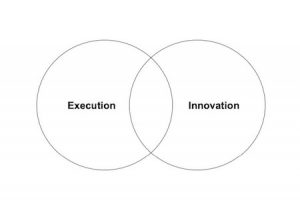
Innovation vs ExecutionGovernment organizations seeking alignment between innovation and execution can borrow from this common practice in order to increase confidence in their investment decisions. Recall from the last post that innovation projects are not simply smaller versions of existing programs. Resources are first invested in validating a project (explore). Only after validation are significant investments made in deploying a new capability (exploit). Government leaders feel comfortable making investments in the former, but not the latter. The common risk management approach is simply avoidance, because the rewards of innovation projects seem distant and uncertain. This is magnified in the national security community, where lives are on the line and no-fail missions are prevalent.

A carefully constructed innovation thesis will help to manage this risk and focus limited time, energy, and resources. It is what key stakeholders rally around. Yet it must be detailed enough for leadership, key partners, and even skeptics to understand how developing a disciplined process – an Innovation Pipeline® – will address the significant challenges facing the organization. Above all, it helps to build consensus and commitment. Otherwise, capabilities that emerge from an innovation practice will become orphans, never to be adopted by the enterprise.

What an innovation thesis consists of

Like the private sector, a public sector innovation thesis defines where to invest and why. It helps to filter out “nice to have” projects from the “must have.” It consists of two major parts:

1. A unique perspective on where relevant fields are going and the sorts of challenges that lie ahead. For example:

  • Emerging surveillance technology and the evolution of tradecraft for an intelligence service
  • Leaps in healthcare delivery for the Department of Veterans Affairs
  • Advanced manufacturing for the Department of Commerce
  • Commercial space investments for the U.S. Space Force and NASA

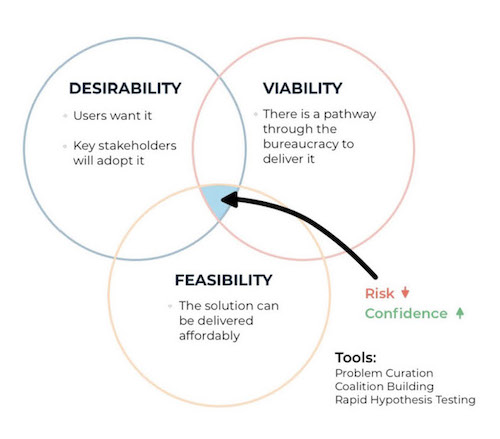
2. The types of ideas the organization will (and will not) invest in, informed by their desirability, viability and feasibility.

Desirability Feasibility Viability

How to create one

Designing an innovation thesis takes four general steps, which can be accomplished in a single day with the right stakeholders and a trained facilitator.

1. Map the organization’s current “mission model”

  • The organization’s approach to satisfying customers and partners
  • The various ways it does so (e.g., capabilities, products, services)
  • The senior leaders, end-users, subject matter experts, saboteurs, and enablers whose buy-in and support is needed to see results (e.g., legal, contracts, policy, IT, security)

2. Map the key trends and consequential forces affecting the organization’s mission. For example:

  • Emerging technology
  • Budget forecasts
  • Policy development
  • Political shifts
  • Availability of key resources

3. Identify the gaps or misalignment between 1 and 2

4. Consider how to best fill them by changing the mission model (in theory) and what innovations must be realized to do so (in practice)

Output

Such an exercise will easily generate an artifact to communicate updated direction and guidance from senior leadership to the rest of the organization and its partners. It does not need to be anything more than a short memo or a succinct slide deck. All that is required is that it yields a clear idea of how the world is changing and how the organization intends to counter or take advantage of the momentum.

Next, a minimum viable team can begin to execute the strategy.

Image credits: BMNT

Subscribe to Human-Centered Change & Innovation WeeklySign up here to get Human-Centered Change & Innovation Weekly delivered to your inbox every week.

Designing an Innovation Lab: A Step-by-Step Guide

Designing an Innovation Lab: A Step-by-Step Guide

GUEST POST from Art Inteligencia

Innovation has become a driving force for organizations looking to adapt and thrive in an ever-changing business landscape. To foster a culture of creativity and problem-solving, many companies are now investing in innovation labs. These dedicated spaces provide employees with the tools, processes, and environment necessary to drive impactful change. This article aims to present a step-by-step guide on designing an innovation lab, exploring key considerations and showcasing two inspiring case studies.

Step 1: Defining the Purpose and Objectives

Before embarking on the design process, it is crucial to define the purpose and objectives of the innovation lab. Is it primarily focused on developing new products, enhancing customer experience, or addressing internal efficiency challenges? Identifying the intended outcomes will help shape the lab’s design, resources, and methodologies.

Step 2: Creating the Right Environment

A successful innovation lab requires a physical and cultural environment that encourages collaboration, risk-taking, and creativity. This includes considerations such as open floor plans, flexible workspaces, comfortable furniture, and access to cutting-edge technology. Attracting natural light and incorporating natural elements can also enhance productivity and well-being.

Case Study 1: Google X Moonshot Factory

One of the most renowned innovation labs is Google X, the parent company of Google. The Moonshot Factory, as they call it, is responsible for developing radical, moonshot ideas that address global issues. The lab’s unique design features open spaces, colorful furniture, brainstorming walls, and prototypes scattered throughout the area. This innovative approach creates an atmosphere that fosters creativity, experimentation, and a sense of purpose, enabling teams to tackle audacious challenges with confidence.

Step 3: Promote Cross-Pollination and Collaboration

To maximize the potential of an innovation lab, it is essential to encourage cross-pollination of ideas and collaboration among employees from various departments. By integrating diverse perspectives and expertise, organizations can foster a more holistic and inclusive approach to problem-solving. Setting up common areas, organizing regular ideation sessions, and facilitating knowledge-sharing opportunities all contribute to a vibrant collaborative culture.

Case Study 2: Autodesk’s Pier 9 Workshop

Autodesk’s Pier 9 Workshop in San Francisco serves as an innovation lab that brings together artists, designers, and engineers to explore the intersection of technology and creativity. The lab provides users with cutting-edge equipment and a platform to experiment and create innovative projects. By fostering collaboration between diverse disciplines and offering access to advanced tools, Autodesk empowers individuals to push their boundaries and unleash their creative potential.

Step 4: Implement Agile Processes and Iterative Techniques

To drive innovation effectively, organizations should embrace agile processes that allow for rapid experimentation, continuous improvement, and quick iteration cycles. Encouraging teams to adopt proven methodologies like Design Thinking or Lean Startup principles helps create a structure that balances creativity with tangible results. Emphasizing the importance of learning from failure and celebrating successes also fosters a growth mindset within the lab.

Conclusion

Designing and implementing an innovation lab requires a strategic approach with careful consideration of the purpose, environment, collaboration, and iterative processes. By following this step-by-step guide, organizations can establish a dedicated space that cultivates creativity, engagement, and breakthrough innovations. The case studies of Google X Moonshot Factory and Autodesk’s Pier 9 Workshop serve as inspiring examples of successful innovation labs that have revolutionized industries by embracing the power of human imagination and collaboration. The future belongs to those who dare to innovate, and an innovation lab is the gateway to unlocking boundless possibilities.

Bottom line: Futurology is not fortune telling. Futurists use a scientific approach to create their deliverables, but a methodology and tools like those in FutureHacking™ can empower anyone to engage in futurology themselves.

Image credit: Unsplash

Subscribe to Human-Centered Change & Innovation WeeklySign up here to get Human-Centered Change & Innovation Weekly delivered to your inbox every week.

Aligning Individual Purpose with Organizational Strategy

LAST UPDATED: March 10, 2026 at 1:54 PM
Aligning Individual Purpose with Organizational Strategy

GUEST POST from Chateau G Pato

The Engagement Paradox: Bridging the Divide Between Mandate and Meaning

In the pursuit of Organizational Agility, leaders often focus on the mechanics of strategy — KPIs, roadmaps, and resource allocation — while overlooking the most critical engine of change: Human Purpose. We find ourselves in an era of the “Engagement Paradox,” where organizations have more tools than ever to track performance, yet employees feel increasingly disconnected from the “Why” behind their work.

When strategy is delivered as a top-down corporate mandate, it creates Invisible Friction. This friction isn’t found in your project management software; it exists in the gap between a company’s goals and an individual’s personal values. Without alignment, even the most brilliant strategy remains a cold, academic exercise that fails to ignite the passion required for true innovation.

To move beyond this, we must adopt a Human-Centered Strategy. This means shifting our perspective from “cascading” orders to “co-creating” a shared future. It requires us to acknowledge that a person is not a “resource” to be deployed, but a partner with their own internal mission, strengths, and desire for impact.

“True transformation doesn’t happen in the boardroom; it happens at the intersection where an individual’s personal ‘Why’ meets the organization’s strategic ‘What.'”

This article outlines how to architect that intersection. We will explore how to define the Strategic North Star in a way that resonates emotionally, how to empower individuals through Role Crafting, and how to measure the strength of this connection to ensure your organization isn’t just moving, but moving with purpose.

The Anatomy of Purpose: Unlocking the Individual “Why”

In the realm of Human-Centered Innovation, we must recognize that purpose is not something an organization “gives” to an employee; it is something the employee brings with them. Every individual possesses a unique internal compass — a collection of values, lived experiences, and a desire to contribute to something larger than themselves. When this internal compass is ignored, the result is “Quiet Quitting” or, worse, active resistance to Organizational Agility.

To align individual purpose with strategy, we must first help our people perform an “internal audit” of their own motivations. This isn’t about fluff; it’s about identifying the Mechanical Necessity of meaning in high-performance environments.

Defining the Personal “Why”

The journey begins by encouraging employees to articulate their Personal Mission Statement. We ask: “What is the problem in the world you feel most compelled to solve?” By allowing space for this reflection, we move past the job description. An engineer might find purpose in “building elegant systems,” while a customer success manager might find it in “empowering others to overcome obstacles.” When these motivations are clear, we can begin to map them to the broader corporate goals.

The Meaning Gap and Customer Friction

A primary driver of burnout is the Meaning Gap — the inability to see how a daily task impacts the final user. In a human-centered culture, every team member must understand how their work directly reduces Customer Friction. When an individual can trace a line from their spreadsheet or line of code to a human being having a better day, their personal purpose finds a home within the organizational strategy.

Autonomy, Mastery, and the Pursuit of Excellence

Purpose thrives in an environment of Autonomy and Mastery. When individuals feel they have the agency to apply their unique strengths toward a goal, they engage in discretionary effort that no incentive plan can buy. We must look at how we can allow people to bring their “whole selves” to work — leveraging their specific hobbies, interests, or specialized skills to solve strategic problems in ways that a rigid process never could.

“If people don’t see themselves in the future you are building, they will not help you build it. Purpose is the bridge that carries them from ‘having to’ to ‘wanting to.'”

By deeply understanding the anatomy of individual purpose, we stop managing for compliance and start leading for commitment. The next step is ensuring the organization’s Strategic North Star is bright enough to guide these individual energies in a unified direction.

The Strategic North Star: Beyond the Mission Statement

For an organization to align with individual purpose, its strategy must be more than a collection of financial targets or a static document buried in an intranet. It requires a Strategic North Star — a clear, aspirational, and human-centered destination that defines not just where the company is going, but why that destination matters to the world.

In many companies, strategy is a “black box.” Employees are told what to do, but the “Risk & Revenue” logic behind those decisions is obscured. To bridge this gap, leadership must practice radical transparency, transforming the strategy into a narrative that invites participation rather than just demanding execution.

Translating Strategy into Human Impact

A powerful North Star translates cold business objectives into human outcomes. Instead of aiming to “increase market share by 15%,” a human-centered North Star might aim to “become the most frictionless partner for small businesses in the Pacific Northwest.” When the goal is framed through the lens of Customer Friction Reduction, it becomes a challenge that individuals can emotionally invest in. It moves the conversation from “making money” to “solving problems.”

Transparency as a Catalyst for Alignment

Alignment cannot exist in a vacuum of information. We must share the Risk & Revenue Leakage Diagnostics with the entire team. When people understand the threats to the organization (Risk) and where value is being lost (Leakage), they can identify how their specific skills can help “plug the leaks.” This transparency fosters a sense of shared ownership; the strategy is no longer “management’s problem,” but a collective puzzle to be solved.

Psychological Safety and the Will to Change

No strategy survives a culture of fear. For individuals to align their purpose with a new direction, they need the Psychological Safety to know that moving toward that North Star won’t result in punishment if they stumble. Human-Centered Innovation recognizes that strategic shifts are often anxiety-inducing. By anchoring the strategy in a consistent purpose, we provide the stability people need to take the risks associated with innovation.

“A mission statement is what you do. A Strategic North Star is why it matters. If you can’t describe your strategy in a way that makes your team feel like heroes in a story, you haven’t finished defining it.”

When the organization’s direction is clear, transparent, and anchored in human value, it creates a gravity that pulls individual purposes toward it. The challenge then becomes architecting the daily “intersection” where these two forces meet and multiply.

Architecting the Alignment: The Intersection of Agency and Mission

The most critical phase of Human-Centered Innovation occurs at the tactical level. It is one thing to have a clear Strategic North Star and an inspired workforce; it is quite another to design the daily “Value Exchange” where these two forces actually meet. Architecting this alignment requires moving beyond rigid job descriptions and toward a model of Dynamic Contribution.

Alignment is not a one-time HR “onboarding” event. It is a continuous process of calibration where the organization’s needs and the individual’s purpose are negotiated in real-time. This is where we turn the “sparks” of individual creativity into a sustained Innovation Bonfire.

The Value Exchange: Solving for “Mutual Win”

We must frame the relationship between the employee and the organization as a transparent Value Exchange. Instead of asking “What can you do for the company?”, leaders should ask: “How does the achievement of our organizational strategy help you realize your personal mission?” When a developer who values “security and stability” sees how their work on data integrity protects vulnerable customers, the alignment becomes mechanical and self-sustaining.

Role Crafting: Empowerment through Agency

Role Crafting is the practice of allowing employees to proactively shape their tasks and relationships to better fit their strengths and purpose. In a distributed or agile environment, we should provide the guardrails of the strategy but allow individuals the agency to decide how they contribute. If an employee has a passion for Futures Literacy, we should empower them to contribute to our strategic foresight efforts, even if they are officially in a sales or marketing role.

Igniting the Innovation Bonfire

Innovation doesn’t happen in a vacuum; it happens when people feel their unique perspective is the missing piece of a larger puzzle. By creating “Internal Marketplaces” for projects, we allow people to gravitate toward work that resonates with their “Why.” This shared purpose acts as the accelerant for the Innovation Bonfire, ensuring that the heat and light of our creative efforts are directed toward solving the right problems — those identified in our Risk & Revenue Leakage Diagnostics.

“When you give people the agency to craft their roles around their purpose, you don’t just get better work; you get an organization that is antifragile. The people grow, and as they grow, the organization evolves with them.”

By architecting these intersections, we ensure that the organization’s strategy is not a weight that people must carry, but a platform that helps them rise. Once this alignment is architected, our final task is to measure its strength and ensure it remains resilient over time.

Measuring the Connection: Metrics for Purpose and Alignment

In any system governed by Human-Centered Innovation, what gets measured gets managed—and more importantly, what gets measured gets valued. To ensure that our efforts in aligning individual purpose with organizational strategy are more than just optimistic rhetoric, we must implement Innovation Accounting for our human capital.

Traditional engagement surveys are often lagging indicators that fail to capture the mechanical health of our alignment. We need real-time, actionable data that tells us whether the “connective tissue” between the person and the plan is strengthening or fraying.

Alignment Scores & Strategic Fluency

We must move beyond asking if employees are “happy” and start measuring their Strategic Fluency. Using “Alignment Scores,” we quantify how accurately an individual can articulate the Strategic North Star and how it relates to their specific department. If there is a disconnect between the executive vision and the front-line understanding, we have identified a communication friction point that must be addressed through better storytelling and transparency.

Contribution Clarity: Traceability of Impact

The most powerful metric for purpose is Contribution Clarity. This measures the ease with which an individual can trace their daily output to a specific strategic outcome or a reduction in Customer Friction. On a scale of 1 to 10, we ask: “How clearly can you see the human impact of your work today?” A high score here is the greatest antidote to burnout and the strongest predictor of discretionary effort.

The Retention Pulse of Innovation Talent

Finally, we track the Retention Pulse — specifically for our high-impact innovation talent. We look for correlations between purpose-alignment scores and the longevity of our “sparks” — those individuals who drive the Innovation Bonfire. When top talent leaves, we don’t just look at compensation; we perform a diagnostic on whether their “Why” was still finding a home within our “What.”

“Data without a human lens is just noise. But when we measure Contribution Clarity, we aren’t just tracking performance; we are validating that our people feel seen, heard, and meaningful in the context of our shared mission.”

By making alignment measurable, we hold leadership accountable for the human health of the strategy. It allows us to pivot our internal culture with the same Organizational Agility we apply to our external products.

Conclusion: The Empowerment Mandate and the Future of Synergy

The alignment of individual purpose with organizational strategy is not a destination; it is a continuous state of Organizational Agility. When we successfully bridge the gap between the person and the plan, we unlock a level of performance that cannot be manufactured through traditional management. This is the Empowerment Mandate: the shift from oversight to enablement, where leadership’s primary role is to clear the path for purpose-driven execution.

As we move further into an era defined by rapid change and digital transformation, the organizations that thrive will be those that operate as living organisms rather than rigid machines. In these “living” organizations, the strategy evolves through the collective insights of individuals who are deeply invested in the outcome.

Strategy as a Living Conversation

We must stop viewing alignment as a one-time workshop or an annual planning cycle. It must be a living, breathing conversation. By maintaining transparency around our Risk & Revenue Leakage and consistently revisiting our Strategic North Star, we allow our teams to pivot without losing their sense of meaning. This constant calibration ensures that as the market changes, our people don’t just “adapt” — they lead the way.

The Antifragile Organization

When individual and organizational goals are synchronized, the enterprise becomes Antifragile. It doesn’t just withstand stress; it grows from it. Because every team member understands their unique contribution to the Innovation Bonfire, they are empowered to take calculated risks that drive the company forward. The burden of innovation is no longer carried by a few executives, but shared by a community of practitioners.

“When a person’s work becomes an expression of their purpose, the distinction between ‘labor’ and ‘legacy’ disappears. That is the ultimate goal of Human-Centered Innovation: to build organizations that are as meaningful to work for as they are valuable to the world.”

The future of work belongs to the empathetic leader — the one who recognizes that the strongest competitive advantage is a team of people who know exactly why they showed up today. By architecting this synergy, we don’t just build better businesses; we build a more purposeful future for everyone involved.

Frequently Asked Questions: Purpose and Strategy Alignment

How does individual purpose directly impact organizational agility?

Individual purpose acts as a decentralized decision-making engine. When employees understand how their personal “Why” fits into the organizational strategy, they can make faster, more autonomous decisions without waiting for top-down approval. This reduces bureaucracy and allows the organization to pivot with greater speed and precision.

What is the difference between a mission statement and a Strategic North Star?

A mission statement often describes what an organization does in a static sense. A Strategic North Star is a dynamic, human-centered destination that translates business goals into human outcomes, such as “reducing customer friction.” It provides the emotional and strategic resonance necessary for individuals to see their own work as part of a larger story.

Can purpose-alignment be measured beyond standard engagement scores?

Yes. By using metrics like “Contribution Clarity” — which measures how easily an individual can trace their daily output to a strategic outcome — and “Strategic Fluency,” organizations can move beyond measuring sentiment to measuring the mechanical health of their alignment and the effectiveness of their internal communication.

Image credit: Pixabay

Subscribe to Human-Centered Change & Innovation WeeklySign up here to join 17,000+ leaders getting Human-Centered Change & Innovation Weekly delivered to their inbox every week.


How Purpose Drives Sustainable Innovation

LAST UPDATED: February 19, 2026 at 1:56PM

How Purpose Drives Sustainable Innovation

GUEST POST from Chateau G Pato


I. Introduction: The Innovation Dead-End

“Innovation without purpose is merely expensive noise; purpose without innovation is a stagnant dream.”
— Braden Kelley

The “Innovation for Innovation’s Sake” Trap

In the frantic race to stay relevant, many organizations fall into the Activity Trap. They measure success by the number of patents filed, the size of their R&D budget, or how quickly they can pivot to the latest buzzword—be it AI, the metaverse, or beyond. However, chasing trends without a foundational “Why” leads to a fragmented strategy, wasted resources, and profound employee burnout. When people don’t understand the destination, they eventually stop running.

Defining Sustainable Innovation

To many, “sustainability” is a buzzword restricted to environmental impact. In a Human-Centered Innovation context, sustainable innovation is much broader. It is the practice of creating solutions that are:

  • Environmentally Regenerative: Reducing footprints and restoring resources.
  • Socially Equitable: Solving real human problems without creating new ones.
  • Culturally Viable: Ensuring the organization can maintain the pace of change without breaking its people.

The Braden Kelley Thesis: Purpose as the OS

We must stop viewing purpose as a marketing veneer or a “nice-to-have” CSR initiative. In high-performing organizations, Purpose acts as the organizational operating system. It provides the logic for every investment, the filter for every brainstorm, and the resilience needed to push through the “Valley of Tears” that accompanies any significant transformation. Sustainable innovation isn’t just about what we build; it’s about the intent that drives the build.

II. Purpose as a Filter: Deciding What Not to Do

The greatest threat to innovation isn’t a lack of ideas—it’s an abundance of distractions. Purpose provides the “strategic friction” necessary to stop the wrong projects before they drain your organization’s soul.

The Power of “Strategic No”

In my work with global innovators, I’ve found that the most successful leaders aren’t just great at ideation; they are masters of elimination. When your purpose is clear, “No” becomes a tool of empowerment rather than a rejection. If an initiative doesn’t move the needle on your core mission, it is a distraction, regardless of its potential ROI.

Risk Mitigation through Intentionality

Short-termism is the enemy of sustainability. Organizations driven purely by quarterly earnings often take “innovation shortcuts” that lead to brand erosion or ethical lapses. A purpose-driven framework forces you to ask: “Even if this works, will we be proud of the result in ten years?” This long-term lens naturally mitigates the risks of toxic innovation.

Defining the Boundaries: Lessons from the Leaders

Take Patagonia, for example. Their purpose “to save our home planet” acts as a rigid filter for R&D. If a new fabric technology is 10% more durable but 50% more toxic to produce, the decision is already made. Similarly, Microsoft’s focus on “empowering every person on the planet” has forced them to prioritize accessibility and ethical AI over features that might offer a quick splash but serve only a narrow demographic.

The Braden Kelley Insight: If your innovation pipeline looks like a “grab bag” of random tech experiments, you haven’t defined your purpose clearly enough. Purpose should make your choices feel inevitable, not difficult.

III. The Human Element: Purpose as Fuel for Engagement

Innovation is a grueling process. Without a deep sense of meaning, the “Human Capital” fueling your change efforts will eventually run dry. Purpose is the renewable energy source of the corporate world.

Psychological Ownership: From “Tasks” to “Troubleshooting”

When employees understand that their work serves a higher calling—be it solving climate change or simply making life 1% easier for a frustrated customer—they develop psychological ownership. They stop waiting for instructions and start hunting for problems to solve. This is the difference between an employee who “does” innovation and one who “is” an innovator.

Attracting the “Mission-First” Talent of 2026

We have entered an era where the most talented individuals—the engineers, designers, and strategists who can choose to work anywhere—are prioritizing Impact over Income. If your organization’s purpose is merely “to maximize shareholder value,” you will lose the war for talent. Sustainable innovation requires the best minds, and the best minds require a legacy to build.

Navigating the “Valley of Tears”

Every innovation journey involves a period of failure, skepticism, and stalled progress—what I call the Valley of Tears. In these moments, logic and spreadsheets aren’t enough to keep a team motivated. Only a shared commitment to a purpose larger than the project itself provides the resilience to persevere when the data looks grim.

A Braden Kelley Note: You don’t “manage” innovation; you “unleash” it by giving people a reason to care. If you want sustainable change, stop looking at your people as resources and start looking at them as partners in a mission.

IV. Designing the Purpose-Driven Innovation Framework

To move from “random acts of innovation” to a sustainable engine of growth, you need a structure that anchors every idea to your North Star. This is where we move from theory to the “Human-Centered Change” architecture.

The Value-Hierarchy Model: Beyond the Shareholder

Traditional innovation frameworks often prioritize “Profit” above all else. A purpose-driven framework utilizes a Value-Hierarchy that balances four key stakeholders: Customers, Employees, the Environment, and the Community. By designing for the “Triple Bottom Line”—People, Planet, and Profit—we ensure that our innovations don’t just extract value, but actively contribute to a fair and regenerative economy.

Inclusive Ideation: Breaking the “Innovation Silo”

Purpose is a powerful equalizer. When you communicate a clear mission, you democratize the right to innovate. Inclusive ideation means creating “Value Channels” where a frontline service agent has the same ability to contribute a purpose-aligned solution as a senior executive. This diversity of perspective is what prevents “Experience Narcissism” and ensures we are solving the actual friction points our customers face.

Iterative Impact: The “Check-In” for Ideas

No idea emerges fully formed. Within our framework, we implement “Value Access” checkpoints. At every stage—from Inspiration to Implementation—we ask: “Is this solution still serving our core intent?” This iterative loop ensures that as we scale, we don’t accidentally lose the soul of the innovation in a sea of technical requirements.

Pro Tip: Use a Change Planning Canvas to visualize how your purpose-driven innovation will ripple through the organization. If the “desired state” doesn’t align with your “why,” it’s time to loop back to the investigation stage.

V. Measuring What Matters: New KPIs for a New Era

If you measure innovation solely through a financial lens, you will eventually kill the very purpose that fuels it. We need a more sophisticated dashboard to track sustainable impact.

Beyond the ROI: Introducing Return on Intent (ROI 2.0)

Standard Return on Investment calculations are backward-looking and often prioritize efficiency over efficacy. Return on Intent asks: “To what degree did this innovation fulfill our stated purpose?” This metric weights social impact and problem-resolution as heavily as profit, providing a more honest look at long-term brand health.

Integrating ESG into the Innovation Pipeline

In 2026, ESG (Environmental, Social, and Governance) metrics are no longer just for the annual report—they are part of the daily Scrum. By assigning “Environmental Debt” or “Social Equity” scores to new projects, we can visualize the hidden costs of our ideas before they scale.

The Longevity Index

The most sustainable innovations aren’t the ones that trend on launch day; they are the ones that are still delivering value five years later. The Longevity Index measures the “half-life” of an innovation’s relevance. It rewards teams for building robust, adaptable solutions rather than disposable, short-term “hacks.”

Braden Kelley’s Bottom Line: Data can tell you that two things are happening at once, but only a purpose-aligned measurement strategy can tell you which one is the lever and which one is the result. Innovation is the art of pulling the right lever.

VI. Conclusion: The Legacy of Innovation

Sustainable innovation is not a sprint; it is a marathon fueled by conviction. In the hyper-competitive landscape of 2026, the organizations that endure aren’t necessarily the ones with the fastest processors or the deepest pockets—they are the ones with the clearest sense of Why.

“Profit is the applause you receive for creating value that matters. Purpose is the script that makes the performance possible.”
— Braden Kelley

The Call to Action: From Capacity to Contribution

As leaders, we must pivot our focus. Stop asking, “What do we have the capacity to build?” and start asking, “What does the world need us to solve?” When you align your innovation pipeline with a mission that resonates with the human spirit, you don’t just create products—you create a legacy.

Your purpose is the only asset your competitors cannot replicate. It is your ultimate competitive advantage and your most sustainable source of energy.

Building a Better Future, Together

If you are ready to move beyond “innovation noise” and lead a human-centered transformation, let’s start the conversation.

Frequently Asked Questions

1. How does purpose prevent innovation fatigue?

Purpose acts as a “North Star” that filters out low-value distractions. By providing a clear “Why,” it reduces the cognitive load on teams, allowing them to focus their energy on meaningful changes rather than chasing every new tech trend, which is the primary cause of innovation burnout.

2. What is the difference between ROI and Return on Intent (ROI 2.0)?

While traditional ROI measures backward-looking financial gains, Return on Intent (ROI 2.0) measures how effectively an innovation fulfills the organization’s core mission. It weights social impact, customer friction resolution, and long-term brand health alongside profitability.

3. Can purpose actually improve the speed of innovation?

Yes. Purpose accelerates innovation by decentralizing decision-making. When teams are aligned with a shared mission, they can make faster, more confident choices without waiting for top-down approval, effectively bypassing organizational silos and “Experience Narcissism.”

Image credits: Google Gemini

Subscribe to Human-Centered Change & Innovation WeeklySign up here to get Human-Centered Change & Innovation Weekly delivered to your inbox every week.