Tag Archives: Meta

AI Stands for Accidental Innovation

LAST UPDATED: December 29, 2025 at 12:49 PM

AI Stands for Accidental Innovation

GUEST POST from Art Inteligencia

In the world of corporate strategy, we love to manufacture myths of inevitable visionary genius. We look at the behemoths of today and assume their current dominance was etched in stone a decade ago by a leader who could see through the fog of time. But as someone who has spent a career studying Human-Centered Innovation and the mechanics of innovation, I can tell you that the reality is often much messier. And this is no different when it comes to artificial intelligence (AI), so much so that it could be said that AI stands for Accidental Innovation.

Take, for instance, the meteoric rise of Nvidia. Today, they are the undisputed architects of the intelligence age, a company whose hardware powers the Large Language Models (LLMs) reshaping our world. Yet, if we pull back the curtain, we find a story of survival, near-acquisitions, and a heavy dose of serendipity. Nvidia didn’t build their current empire because they predicted the exact nuances of the generative AI explosion; they built it because they were lucky enough to have developed technology for a completely different purpose that happened to be the perfect fuel for the AI fire.

“True innovation is rarely a straight line drawn by a visionary; it is more often a resilient platform that survives its original intent long enough to meet a future it didn’t expect.”

Braden Kelley

The Parallel Universe: The Meta/Oculus Near-Miss

It is difficult to imagine now, but there was a point in the Future Present where Nvidia was seen as a vulnerable hardware player. In the mid-2010s, as the Virtual Reality (VR) hype began to peak, Nvidia’s focus was heavily tethered to the gaming market. Internal histories and industry whispers suggest that the Oculus division of Meta (then Facebook) explored the idea of acquiring or deeply merging with Nvidia’s core graphics capabilities to secure their own hardware vertical.

At the time, Nvidia’s valuation was a fraction of what it is today. Had that acquisition occurred, the “Corporate Antibodies” of a social media giant would likely have stifled the very modularity that makes Nvidia great today. Instead of becoming the generic compute engine for the world, Nvidia might have been optimized—and narrowed—into a specialized silicon shop for VR headsets. It was a sliding doors moment for the entire tech industry. By not being acquired, Nvidia maintained the autonomy to follow the scent of demand wherever it led next.

Case Study 1: The Meta/Oculus Intersection

Before the “Magnificent Seven” era, Nvidia was struggling to find its next big act beyond PC gaming. When Meta acquired Oculus, there was a desperate need for low-latency, high-performance GPUs to make VR viable. The relationship between the two companies was so symbiotic that some analysts argued a vertical integration was the only logical step. Had Mark Zuckerberg moved more aggressively to bring Nvidia under the Meta umbrella, the GPU might have become a proprietary tool for the Metaverse. Because this deal failed to materialize, Nvidia remained an open ecosystem, allowing researchers at Google and OpenAI to eventually use that same hardware for a little thing called a Transformer model.

The Crypto Catalyst: A Fortuitous Detour

The second major “accident” in Nvidia’s journey was the Cryptocurrency boom. For years, Nvidia’s stock and production cycles were whipped around by the price of Ethereum. To the outside world, this looked like a distraction—a volatile market that Nvidia was chasing to satisfy shareholders. However, the crypto miners demanded exactly what AI would later require: massive, parallel processing power and specialized chips (ASICs and high-end GPUs) that could perform simple calculations millions of times per second.

Nvidia leaned into this demand, refining their CUDA platform and their manufacturing scale. They weren’t building for LLMs yet; they were building for miners. But in doing so, they solved the scalability problem of parallel computing. When the “AI Winter” ended and the industry realized that Deep Learning was the path forward, Nvidia didn’t have to invent a new chip. They just had to rebrand the one they had already perfected for the blockchain. Preparation met opportunity, but the opportunity wasn’t the one they had initially invited to the dance.

Case Study 2: From Hashes to Tokens

In 2021, Nvidia’s primary concern was “Lite Hash Rate” (LHR) cards to deter crypto miners so gamers could finally buy GPUs. This era of forced scaling forced Nvidia to master the art of data-center-grade reliability. When ChatGPT arrived, the transition was seamless. The “Accidental Innovation” here was that the mathematical operations required to verify a block on a chain are fundamentally similar to the vector mathematics required to predict the next word in a sentence. Nvidia had built the world’s best token-prediction machine while thinking they were building the world’s best ledger-validation machine.

Leading Companies and Startups to Watch

While Nvidia currently sits on the throne of Accidental Innovation, the next wave of change-makers is already emerging by attempting to turn that accident into a deliberate architecture. Cerebras Systems is building “wafer-scale” engines that dwarf traditional GPUs, aiming to eliminate the networking bottlenecks that Nvidia’s “accidental” legacy still carries. Groq (not to be confused with the AI model) is focusing on LPU (Language Processing Units) that prioritize the inference speed necessary for real-time human interaction. In the software layer, Modular is working to decouple the AI software stack from specific hardware, potentially neutralizing Nvidia’s CUDA moat. Finally, keep an eye on CoreWeave, which has pivoted from crypto mining to become a specialized “AI cloud,” proving that Nvidia’s accidental path is a blueprint others can follow by design.

The Human-Centered Conclusion

We must stop teaching innovation as a series of deliberate masterstrokes. When we do that, we discourage leaders from experimenting. If you believe you must see the entire future before you act, you will stay paralyzed. Nvidia’s success is a testament to Agile Resilience. They built a powerful, flexible tool, stayed independent during a crucial acquisition window, and were humble enough to let the market show them what their technology was actually good for.

As we move into this next phase of the Future Present, the lesson is clear: don’t just build for the world you see today. Build for the accidents of tomorrow. Because in the end, the most impactful innovations are rarely the ones we planned; they are the ones we were ready for.

Frequently Asked Questions

Why is Nvidia’s success considered “accidental”?

While Nvidia’s leadership was visionary in parallel computing, their current dominance in AI stems from the fact that hardware they optimized for gaming and cryptocurrency mining turned out to be the exact architecture needed for Large Language Models (LLMs), a use case that wasn’t the primary driver of their R&D for most of their history.

Did Meta almost buy Nvidia?

Historical industry analysis suggests that during the early growth of Oculus, there were significant internal discussions within Meta (Facebook) about vertically integrating hardware. While a formal acquisition of the entire Nvidia corporation was never finalized, the close proximity and the potential for such a deal represent a “what if” moment that would have fundamentally changed the AI landscape.

What is the “CUDA moat”?

CUDA is Nvidia’s proprietary software platform that allows developers to use GPUs for general-purpose processing. Because Nvidia spent years refining this for various industries (including crypto), it has become the industry standard. Most AI developers write code specifically for CUDA, making it very difficult for them to switch to competing chips from AMD or Intel.

Image credits: Google Gemini

Subscribe to Human-Centered Change & Innovation WeeklySign up here to get Human-Centered Change & Innovation Weekly delivered to your inbox every week.
Is OpenAI About to Go Bankrupt?

LAST UPDATED: December 4, 2025 at 4:48 PM

Is OpenAI About to Go Bankrupt?

GUEST POST from Chateau G Pato

The innovation landscape is shifting, and the tremors are strongest in the artificial intelligence (AI) sector. For a moment, OpenAI felt like an impenetrable fortress, the company that cracked the code and opened the floodgates of generative AI to the world. But now, as a thought leader focused on Human-Centered Innovation, I see the classic signs of disruption: a growing competitive field, a relentless cash burn, and a core product advantage that is rapidly eroding. The question of whether OpenAI is on the brink of bankruptcy isn’t just about sensational headlines — it’s about the fundamental sustainability of a business model built on unprecedented scale and staggering cost.

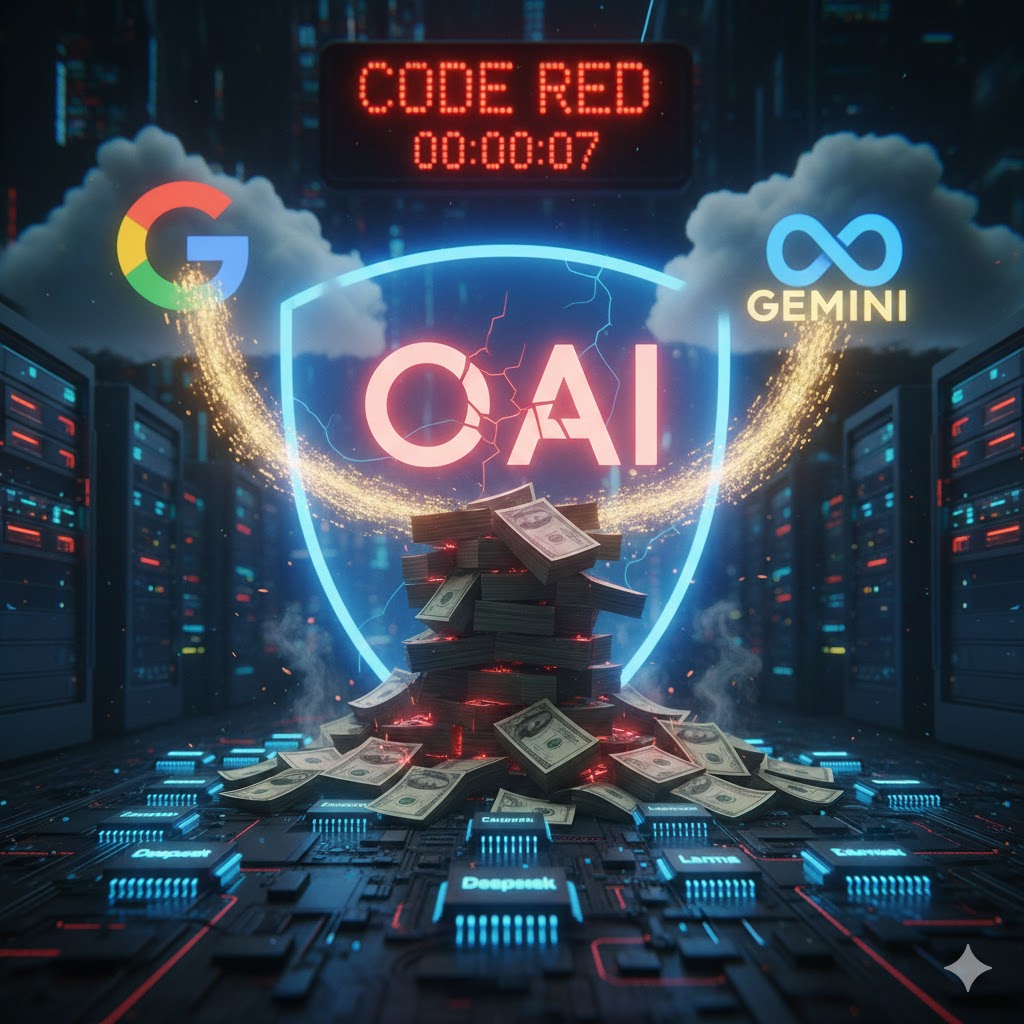
The “Code Red” announcement from OpenAI, ostensibly about maintaining product quality, was a subtle but profound concession. It was an acknowledgment that the days of unchallenged superiority are over. This came as competitors like Google’s Gemini and Anthropic’s Claude are not just keeping pace, but in many key performance metrics, they are reportedly surpassing OpenAI’s flagship models. Performance parity, or even outperformance, is a killer in the technology adoption curve. When the superior tool is also dramatically cheaper, the choice for enterprises and developers — the folks who pay the real money — becomes obvious.

The Inevitable Crunch: Performance and Price

The competitive pressure is coming from two key vectors: performance and cost-efficiency. While the public often focuses on benchmark scores like MMLU or coding abilities — where models like Gemini and Claude are now trading blows or pulling ahead — the real differentiator for business users is price. New models, including the China-based Deepseek, are entering the market with reported capabilities approaching the frontier models but at a fraction of the development and inference cost. Deepseek’s reportedly low development cost highlights that the efficiency of model creation is also improving outside of OpenAI’s immediate sphere.

Crucially, the open-source movement, championed by models like Meta’s Llama family, introduces a zero-cost baseline that fundamentally caps the premium OpenAI can charge. Llama, and the rapidly improving ecosystem around it, means that a good-enough, customizable, and completely free model is always an option for businesses. This open-source competition bypasses the high-cost API revenue model entirely, forcing closed-source providers to offer a quantum leap in utility to justify the expenditure. This dynamic accelerates the commoditization of foundational model technology, turning OpenAI’s once-unique selling proposition into a mere feature.

OpenAI’s models, for all their power, have been famously expensive to run — a cost that gets passed on through their API. The rise of sophisticated, cheaper alternatives — many of which employ highly efficient architectures like Mixture-of-Experts (MoE) — means the competitive edge of sheer scale is being neutralized by engineering breakthroughs in efficiency. If the next step in AI on its way to artificial general intelligence (AGI) is a choice between a 10% performance increase and a 10x cost reduction for 90% of the performance, the market will inevitably choose the latter. This is a structural pricing challenge that erodes one of OpenAI’s core revenue streams: API usage.

The Financial Chasm: Burn Rate vs. Reserves

The financial situation is where the “bankruptcy” narrative gains traction. Developing and running frontier AI models is perhaps the most capital-intensive venture in corporate history. Reports — which are often conflicting and subject to interpretation — paint a picture of a company with an astronomical cash burn rate. Estimates for annual operational and development expenses are in the billions of dollars, resulting in a net loss measured in the billions.

This reality must be contrasted with the position of their main rivals. While OpenAI is heavily reliant on Microsoft’s monumental investment — a complex deal involving cash and Azure cloud compute credits — Microsoft’s exposure is structured as a strategic infrastructure play. The real financial behemoth is Alphabet (Google), which can afford to aggressively subsidize its Gemini division almost indefinitely. Alphabet’s near-monopoly on global search engine advertising generates profits in the tens of billions of dollars every quarter. This virtually limitless reservoir of cash allows Google to cross-subsidize Gemini’s massive research, development, and inference costs, effectively enabling them to engage in a high-stakes price war that smaller, loss-making entities like OpenAI cannot truly win on a level playing field. Alphabet’s strategy is to capture market share first, using the profit engine of search to buy time and scale, a luxury OpenAI simply does not have without a continuous cash injection from a partner.

The question is not whether OpenAI has money now, but whether their revenue growth can finally eclipse their accelerating costs before their massive reserve is depleted. Their long-term financial projections, which foresee profitability and revenues in the hundreds of billions by the end of the decade, require not just growth, but a sustained, near-monopolistic capture of the new AI-driven knowledge economy. That becomes increasingly difficult when competitors are faster, cheaper, and arguably better, and have access to deeper, more sustainable profit engines for cross-subsidization.

The Future Outlook: Change or Consequence

OpenAI’s future is not doomed, but the company must initiate a rapid, human-centered transformation. The current trajectory — relying on unprecedented capital expenditure to maintain a shrinking lead in model performance — is structurally unsustainable in the face of faster, cheaper, and increasingly open-source models like Meta’s Llama. The next frontier isn’t just AGI; it’s AGI at scale, delivered efficiently and affordably.

OpenAI must pivot from a model of monolithic, expensive black-box development to one that prioritizes efficiency, modularity, and a true ecosystem approach. This means a rapid shift to MoE architectures, aggressive cost-cutting in inference, and a clear, compelling value proposition beyond just “we were first.” Human-Centered Innovation principles dictate that a company must listen to the market — and the market is shouting for price, performance, and flexibility. If OpenAI fails to execute this transformation and remains an expensive, marginal performer, its incredible cash reserves will serve only as a countdown timer to a necessary and painful restructuring.

Frequently Asked Questions (FAQ)

  • Is OpenAI currently profitable?
    OpenAI is currently operating at a significant net loss. Its annual cash burn rate, driven by high R&D and inference costs, reportedly exceeds its annual revenue, meaning it relies heavily on its massive cash reserves and the strategic investment from Microsoft to sustain operations.
  • How are Gemini and Claude competing against OpenAI on cost and performance?
    Competitors like Google’s Gemini and Anthropic’s Claude are achieving performance parity or superiority on key benchmarks. Furthermore, they are often cheaper to use (lower inference cost) due to more efficient architectures (like MoE) and the ability of their parent companies (Alphabet and Google) to cross-subsidize their AI divisions with enormous profits from other revenue streams, such as search engine advertising.
  • What was the purpose of OpenAI’s “Code Red” announcement?
    The “Code Red” was an internal or public acknowledgment by OpenAI that its models were facing performance and reliability degradation in the face of intense, high-quality competition from rivals. It signaled a necessary, urgent, company-wide focus on addressing these issues to restore and maintain a technological lead.

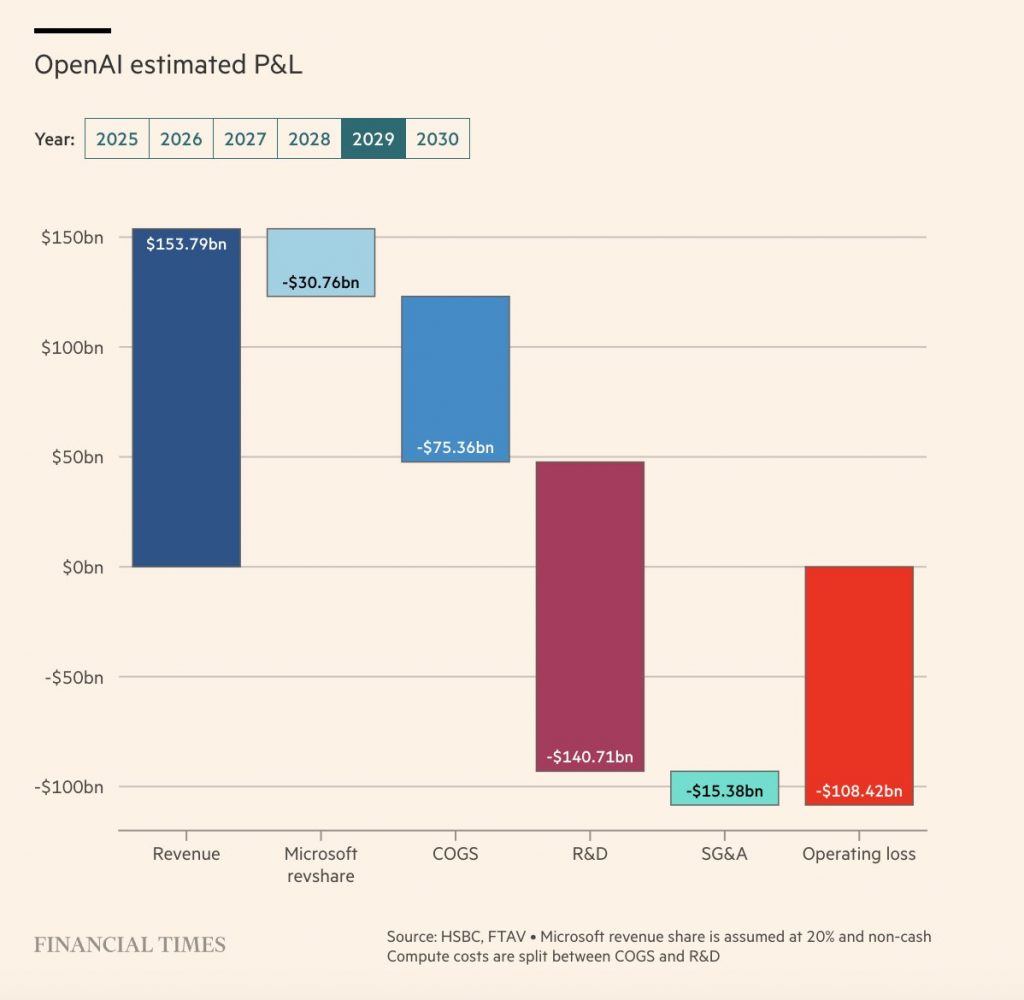
UPDATE: Just found on X that HSBC has said that OpenAI is going to have nearly a half trillion in operating losses until 2030, per Financial Times (FT). Here is the chart of their $100 Billion in projected losses in 2029. With the success of Gemini, Claude, Deep Seek, Llama and competitors yet to emerge, the revenue piece may be overstated:

OpenAI estimated 2029 financials

Image credits: Google Gemini, Financial Times

Subscribe to Human-Centered Change & Innovation WeeklySign up here to get Human-Centered Change & Innovation Weekly delivered to your inbox every week.