Tag Archives: innovation theater

Are You Engaging in Innovation Theater?

Are You Engaging in Innovation Theater?

GUEST POST from Mike Shipulski

When you go to the cinema or the playhouse you go you see a show. The show may be funny, it may be sad, it may be thought-provoking, it may be beautiful, and it may take your mind off your problems for a couple of hours; but it’s not real. Sure, the story-line is good, but it came from someone’s imagination. And because it’s a story, it doesn’t have to bound by reality. Sure, the choreography is catchy, but it’s designed for effect. Yes, the cinematography paints a good picture, but it’s contrived. And, yes, the actors are good, but they’re actors. What you see isn’t real. What you see is theater.

If you are asked to focus on the innovation process, that’s theater. Innovation doesn’t care about process; it cares about delivering novel customer value. The process isn’t most important, the output is. When there’s an extreme focus on the process that usually means an extreme focus on the output of the process would be embarrassing.

If you are tasked to calculate the net present value of the project hopper, that’s theater. With innovation, there’s no partial credit for projects you’re not working on. None. The value of the projects in the hopper is zero. The song about the value of the project hopper is nothing more than a catchy melody performed to make sure the audience doesn’t ask about the feeble collection of projects you are working on. And, assigning a value to the stagnant project hopper is a creative story-line crafted to hide the fact you have too many projects you’re not working on.

If you are asked to create high-level metrics and fancy pie charts, that’s innovation theater. Process metrics and pie charts don’t pay the bills. Here’s innovation’s script for paying the bills: complete amazing projects, launch amazing products, and sell a boatload. Full stop. If your innovation script is different than that, ball it up and throw it away along with its producer.

If the lame projects aren’t stopped so better ones can start, if people aren’t moved off stale projects onto amazing ones, if the same old teams are charged with the innovation mandate, if new leaders aren’t added, if the teams are measured just like last year, that’s innovation theater. How many mundane projects have you stopped? How many amazing projects have you started? How many new leaders have you added? How many new teams have you formed? How will you measure your teams differently? How do you feel about all that?

If a return on investment (ROI) calculation is the gating criterion before starting an amazing project, that’s innovation theater. Projects that could create a new product family with a fundamentally different value proposition for a whole new customer segment cannot be assigned an ROI because no one has experience in this new domain. Any ROI will be a guess and that’s why innovation is governed by judgment and not ROI. Innovation is unpredictable which makes an ROI is impossible to predict. And if your innovation process squeezes judgment out of the story-line, that’s a tell-tale sign of innovation theater.

If the specifications are fixed, the resources are fixed, and the completion date is fixed, that’s innovation theater. Since it can be innovation only when there’s novelty, and since novelty comes with uncertainty, without flexibility in specs, resources, or time, it’s innovation theater.

If the work doesn’t require trust, it’s innovation theater. If trust is not required it’s because the work has been done before, and if that’s the case, it’s not innovation.

If you know it will work, it’s innovation theater. Innovation and certainty cannot coexist.

If a steering team is involved, it’s innovation theater. Consensus cannot spawn innovation.

If more than one person in charge, it’s innovation theater. With innovation, there’s no place for compromise.

And what to do when you realize you’re playing a part in your company’s innovation theater? Well, I’ll save that for another time.

Image credit: Pexels

Subscribe to Human-Centered Change & Innovation WeeklySign up here to join 17,000+ leaders getting Human-Centered Change & Innovation Weekly delivered to their inbox every week.


Thought Sparks – Episodic Innovation

Raise the curtain on Innovation Theater yet again!

Episodic Innovation

GUEST POST from Rita McGrath

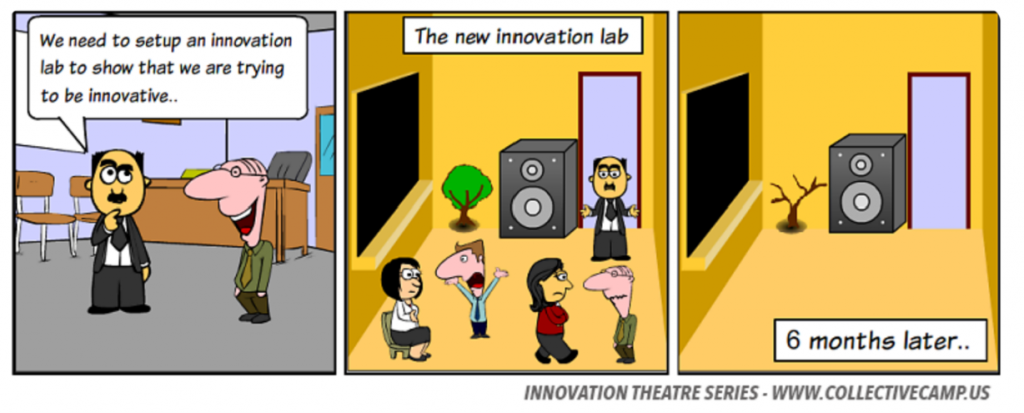
We know that to create meaningful innovations that can move the needle for the companies that sponsor them, attention, resources and commitment needs to be sustained. But in too many organizations, innovation gets started, gets some traction and – just at the brink of discovering something useful – gets cut. Welcome to the world of innovation theater.

Layoffs are in the air

Predictably, firms that spent like drunken sailors during the low-interest-rate free-for-all that we’ve just been through are now reconsidering their spending as the economy looks a little soft, inflation has become a thing and investors are asking for — egads — a route to profitability!

We have seen this movie before, and it is one of the most devastating patterns that afflicts internal corporate venturing, or ICV. It’s worth bringing back some original research by Stanford’s Robert Burgelman and his colleagues to understand it.

The mystery of corporate innovation cycles

Years, ago, Robert Burgelman and co-author Liisa Vilikangas came to a perplexing conclusion. Despite all the talk about innovation, all the energy and money thrown at it and all the noise about accelerators, studios and labs, companies find it extraordinarily difficult to stick to an innovation program.

Indeed, as they observe in this article, “many major corporations experience a strange cyclicality in their ICV (Internal Corporate Venturing) activity. Periods of intense ICV activity are followed by periods when such programs are shut down, only to be followed by new ICV initiatives a few years later. Like seasons, internal corporate venturing programs begin and end in a seemingly endless cycle.”

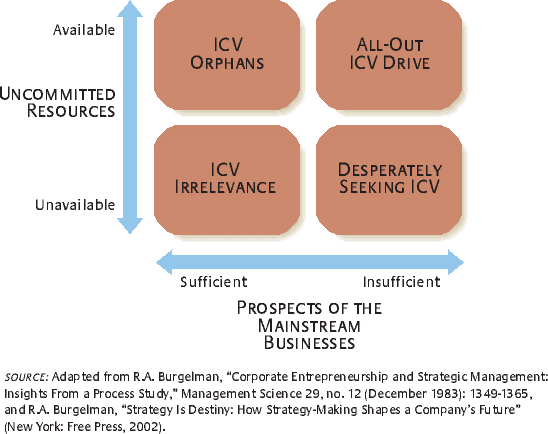
They identify two influences on how an innovation process can come to grief. The first predictor is how healthy the existing core business is in terms of growth prospects. The second is how much a company has in terms of uncommitted resources – whether that’s cash or people. What you get when you juxtapose the two is a lovely 2×2:

Corporate venturing orphans: With plentiful resources, people get resources to start new ventures, only to find that the core business is quite happy to ignore them. So, things get going, develop for a while, then wither on the vine as the core business essentially refuses to welcome them into the corporate fold.

The entrepreneurs behind such ventures either give up in frustration, leave to find a firm with a more welcoming environment or even leave to found a startup that might well compete with the original firm. The interesting story of how Zoom became Zoom is a case in point.

All-out venturing drives: In this situation, there is money to invest, company leadership knows it has a problem, and venturing becomes the holy grail. This can be useful, as it tends to raise the profile of the venturing activity and it finally attracts attention, talent and a seat at the table.

The dilemma is that senior leadership teams in a hurry are apt to put too much time pressure and expectations for rapid growth on a still-uncertain activity. This can cause them to lose faith in its prospects and terminate it before it even has a chance. IBM and Maersk’s effort to create a blockchain platform, TradeLens, feels like that to me. That venture also ignored Bent Flyvbjerg’s excellent advice to avoid complexity to the extent possible.

Venturing seems irrelevant: Here, money and talent is already committed to other things, and the core businesses’ chances are looking pretty good. So why bother with an uncertain, unproven, hard to predict new business activity when you can just ride the existing gravy train, probably for as long as is relevant for the career of a given senior leader?

What happens in this situation is that investments in new capabilities are ignored, and eventually competition catches up or makes your existing operations irrelevant. For instance, Carlson Travel was riding pretty high for a while, and evidently under-invested in technology. Carlson Travel implicitly acknowledged as it struggled through a bankruptcy that it had under-invested in its core digital technologies and customer experiences and promised to spent $100 million on getting up to speed.

Desperately Seeking Corporate Venturing! Ok, so we’ve left investing in the future too late, money is now tight, and we need to deliver something to our customers and investors PRONTO! These situations rarely end well. A desperate senior executive team might well enter into ill-considered acquisitions or now, belatedly, fund the one or two ideas that have survived being neglected.

These are often terrible ideas. See: checkered history of mainline telecom or cable companies entering the content business. AT&T’s misadventures with its forays into the media business are a case in point. Verizon’s as well. Desperation seldom leads to cool-headed deal-making or venturing. A rare exception took place at Xerox Parc, where the invention of the laser printer saved the company after the government forced it to essentially give away its patents to other firms.

It doesn’t have to be this way!

In the next Thought Spark, I’ll describe what we think about all this at Valize, my sister company whose mission is to create predictable and reliable innovation and growth capabilities. In the meantime, please stop pouring money into innovation theater!

Or if you are really itching to start an innovation or transformation program, mail us at growth@valize to set up a time. We can get you off on the right foot. After all, there are no standing ovations for innovation theater.

Image Credits: Unsplash, Pexels, MIT Sloan Review, www.collectivecamp.us

Subscribe to Human-Centered Change & Innovation WeeklySign up here to join 17,000+ leaders getting Human-Centered Change & Innovation Weekly delivered to their inbox every week.
Innovation Theater – How to Fake It ‘Till You Make It

Innovation Theater - How to Fake It 'Till You Make It

GUEST POST from Arlen Meyers

The overwhelming number of doctors, engineers and scientists don’t have an entrepreneurial mindset. What’s more, when they have an idea, they don’t know what to do with it since they will not learn those competencies in their formal training. They just don’t know how to innovate their way out of our sick care mess.

But, that hasn’t stopped lots of them from trying, include non-sick care entrepreneurs. They just improvise.

Now that Elizabeth Holmes has been convicted, many are commenting on the pros and cons of the “fake it ’till you make it” ethos of entrepreneurs and Silicon Valley. But, is this really a black and white issue? Is it true that “You have no business being something you are not, or doing something without proving your worth.” I venture to say many of us, including me, have done something that was not a good fit and we have all tried things when we simple did not know what we did not know.

Here’s how to fake it when you don’t know what you are doing or you forgot your lines:

  1. Avoid these wannapreneur rookie mistakes.
  2. If you are a female, find a male wing man so someone will invest in your product
  3. Surround yourself with people who are way above your pay grade at lots of Meetups
  4. Practice Therantology
  5. When you inevitably fail, make a big deal out of it and about how much you learned from your mistakes and include them on your Linked profile. Rinse. Repeat
  6. Wear a fleece vest with your company logo
  7. Plead ignorance about how hard it is to get anybody in sick care to change and the long sales cycles.
  8. Be sure you have lots of hood ornaments (doctors with fancy titles) on your advisory board prominently posted on your website
  9. Hire a virtual assistant that answers all of your calls and says that she/he will not be able to immediately connect you because you are in an investor meeting
  10. Get your co-working space guy to allow you to use more space than you are actually paying for when people come for meetings. Bribe interns with pizza to come and look busy.
  11. Forget being your authentic self. “You are generally better off coming across as likable, which will generally require some effort, restraint, and attention to what others expect and want to see. Seeming authentic in the process is the cherry on top of the cake, but it requires a fair amount of faking.”
  12. Try being a good rebel even if you are a bad one.
No alt text provided for this image

During these times, we are supposed to wear a mask. Most of us wear a mask all the time to hide our insecurities or avoid being outed as an imposter or physician wannapreneur, so none of this should be new to you.

 In a follow-up to their February 2021 article challenging the commonly understood definition of imposter syndrome, authors Ruchika Tulshyan and Jodi-Ann Burey offer actionable steps managers can take to end imposter syndrome in their organizations. Doing so will require work at both the interpersonal and organizational levels, and success will depend in part on gathering data and implementing real mechanisms for accountability. The authors call on managers to stop calling natural, human tendencies of self-doubt, hesitation, and lack of confidence “imposter syndrome.” Those who want women to lend their full talents and expertise must question the culture at work — not their confidence at work.

These things come with practice. But, since you are part of innovation theater, practice your lines, be sure you are wearing the right costume and that the stage is set properly. Break a leg.

Subscribe to Human-Centered Change & Innovation WeeklySign up here to get Human-Centered Change & Innovation Weekly delivered to your inbox every week.

Forecasting Innovation Blockers Before They Happen

LAST UPDATED: March 27, 2026 at 3:17 PM

Forecasting Innovation Blockers Before They Happen

GUEST POST from Art Inteligencia


Section I: The High Cost of Reactive Innovation

In the modern landscape of human-centered innovation, the most dangerous phrase an organization can utter is: “We’ll cross that bridge when we come to it.” In the realm of innovation, by the time you reach the bridge, it is often already washed out by the torrents of organizational inertia and legacy thinking.

The Innovation Illusion

Many leaders mistake firefighting for innovation management. They wait for a project to stall, for a budget to be frozen, or for cultural resistance to peak before they intervene. This reactive stance creates an “Innovation Illusion” — the false belief that because we are solving problems, we are moving forward. In reality, we are merely exhausting our best talent by forcing them to navigate a gauntlet that should have been cleared weeks or months in advance.

“True innovation leadership isn’t about having the best ideas; it’s about architecting the path so those ideas can actually survive the journey.” — Braden Kelley

The Hidden Tax: Innovation Theater

When blockers are addressed only after they manifest, the organization pays a heavy “Hidden Tax.” This manifests as:

  • Velocity Atrophy: The slow death of momentum that turns a breakthrough concept into a multi-year slog.
  • Talent Hemorrhaging: High-potential employees leaving because they are tired of fighting the “corporate immune system.”
  • Innovation Theater: A state where plenty of sticky notes and workshops exist, but zero tangible value reaches the customer because the “blockers” were baked into the process from the start.

The Strategic Pivot: Proactive Forecasting

To move beyond this, we must adopt a future-ready stance. Forecasting innovation blockers isn’t about being pessimistic; it’s about radical realism. It requires us to look at our organizational DNA — our hierarchy, our incentives, and our history — and predict exactly where the friction will occur. By identifying these hurdles during the design phase rather than the execution phase, we transform innovation from a series of lucky breaks into a repeatable, sustainable discipline.

Section II: Mapping the Ecosystem of Resistance

To forecast blockers, we must first understand that they are rarely random. Resistance is a byproduct of a system doing exactly what it was designed to do: maintain equilibrium. In a human-centered innovation framework, we categorize these friction points into four distinct pillars that form the “Corporate Immune System.”

The Four Pillars of Resistance

  • Structural Blockers: These are the “hard” barriers built into the org chart. They include misaligned KPIs — where a manager is incentivized for efficiency while the innovation team needs experimentation — and budgetary silos that prevent cross-departmental resource sharing.
  • Cultural Blockers: The “soft” barriers that are often the hardest to break. Watch for the “Not Invented Here” syndrome and a lack of psychological safety, where employees fear that a failed experiment equals a failed career.
  • Technical & Resource Blockers: Innovation often dies on the vine because of legacy debt. If your new digital solution requires an API that the current infrastructure can’t support, the blocker was predictable before the first line of code was written.
  • Operational Blockers: This includes bureaucratic friction like rigid procurement cycles. When it takes six months to approve a $500 software subscription for a pilot, the system has effectively blocked innovation.

The Human Element: Change Weariness

Beyond systems and structures lies the most critical factor: The People. We often talk about “Change Management” as a set of tasks, but we ignore Change Weariness. This is the silent killer where your best innovators simply stop trying because the emotional energy required to push through the “No” becomes too high.

Forecasting this requires measuring the “Delta” between the ambition of the project and the current emotional bandwidth of the team. If the team is already underwater with “Run the Business” (RTB) tasks, your innovation project is a blocker waiting to happen.

By mapping this ecosystem early, we stop seeing resistance as a surprise and start seeing it as a data point for our next design iteration.

Section III: The “Pre-Mortem” Framework for Innovation

In most organizations, a “Post-Mortem” is conducted after a project has already failed — when the budget is spent and the morale is crushed. To forecast blockers effectively, we must flip the script and conduct a Pre-Mortem. This exercise creates a safe psychological space for team members to voice concerns without being labeled as “not a team player.”

Visualizing Failure: The Strategic Time Machine

The Hypothetical Disaster: Gather your core stakeholders and announce: “It is one year from today. This project has failed spectacularly. It is a disaster. Now, tell me why.” By shifting the focus to the future, you bypass the defensiveness often found in real-time project discussions.

Identifying “The Usual Suspects”: Teams often find that the reasons for failure aren’t new breakthroughs by competitors, but rather internal “friction points.” These are the historical blockers — like procurement delays or lack of executive buy-in—that have killed past initiatives.

The Pivot to Prevention: Once the list of failure points is generated, the team shifts to designing “Antidotes.” If the pre-mortem suggests failure due to “Middle Management Resistance,” the project plan must now include a strategy for early middle-management alignment.

Stakeholder Empathy Mapping

We cannot forecast blockers without understanding the empathy gap between the innovation team and those who must eventually adopt it. Middle Management is often the “Frozen Middle” not because they hate innovation, but because their performance metrics are built on stability and predictability.

By mapping the motivations of these stakeholders before the first prototype is built, we can identify where Middle Management Friction will occur. We must ask: “How does this innovation threaten their current status, budget, or daily routine?”

The Pre-Mortem transforms “unforeseen obstacles” into “anticipated design constraints,” allowing us to build a sturdier path for our ideas to travel.

Section IV: Identifying Early Warning Signals

Forecasting isn’t just a one-time exercise at the start of a project; it is an ongoing sensory discipline. We must develop “Organizational Radar” to detect the subtle shifts in climate that signal a blocker is forming. These early warning signals, if caught early, allow for micro-pivots that keep the innovation on track without requiring a massive course correction.

The “Silence” Signal

One of the most common early warning signs is The Wall of Silence. When a project stops being discussed in leadership meetings, or when cross-functional partners stop responding to requests for data, the blocker isn’t “busy-ness” — it is Deprioritization. In a human-centered framework, silence is a loud signal that the perceived value of the innovation has dropped below the threshold of operational noise.

The “Scope Creep” Camouflage

Often, a blocker doesn’t look like a “No.” It looks like a “Yes, and…” that slowly smothers the project. When stakeholders begin adding layers of complexity or demanding “just one more feature” before a pilot can launch, they are often unconsciously (or consciously) using scope creep as a defensive mechanism to delay the risk of a real-world launch. Recognizing this as a blocker rather than “helpful feedback” is key to maintaining velocity.

Metric Latency: The Idea-to-Value Gap

We must track the Idea-to-Value (I2V) Gap. If the time between a successful prototype and the first customer interaction begins to stretch, you are hitting a systemic blocker. This “Metric Latency” usually points to friction in the “last mile” of innovation — legal reviews, security audits, or procurement bottlenecks that were not cleared during the design phase.

By treating these signals as Leading Indicators rather than annoying delays, we can intervene while the project still has the political capital and budget to overcome them. The goal is to move from “Managing the Crisis” to “Managing the Momentum.”

Section V: Building the “Antidote” into the Design Phase

Forecasting a blocker is only half the battle. The true discipline of human-centered innovation is in the pre-emptive design of solutions. If we know a wall exists, we don’t wait to hit it; we build the door into our initial blueprint. This is about moving from “Innovation Management” to “Innovation Architecture.”

Invisible Architecture & Fast Tracks

Most blockers are caused by forcing “Change the Business” (CTB) initiatives through “Run the Business” (RTB) pipes. We must design Invisible Architecture — pre-negotiated “Fast Tracks” for procurement, legal, and IT security that are triggered automatically for projects under a certain risk threshold. If the path is pre-cleared, the blocker never manifests.

Dynamic & Trigger-Based Governance

Traditional annual budgeting is a primary innovation blocker. We must shift to Dynamic Governance, where funding is released based on “Value Triggers” rather than calendar dates. This prevents the “Budget Freeze” blocker that often kills high-potential projects mid-stream because they didn’t align with a rigid fiscal cycle.

Co-Creation as a Strategic Shield

The most effective way to neutralize a blocker is to turn the “Blocker” into an “Owner.” In the design phase, we must identify the departments most likely to resist and invite them into the co-creation process. When a skeptic helps build the solution, they are no longer defending the status quo; they are defending their contribution.

This isn’t just “alignment” — it is Psychological Anchoring. It transforms the corporate immune system from an adversary into a collaborative filter that improves the idea’s viability. By building these antidotes early, we ensure that when the immune system reacts, the project already has the necessary antibodies to thrive.

Safe-to-Fail Zones

Finally, we must architect “Safe-to-Fail” zones where the cost of a blocker is minimized. By ring-fencing these experiments, we reduce the organizational anxiety that triggers resistance. When the stakes of failure are lowered through intentional design, the number of blockers actively hunting your project drops significantly.

Section VI: Conclusion – The Leader as a Path-Clearer

The traditional image of the “Innovation Leader” is often someone who stands at the top of a mountain, pointing toward a distant, shiny future. But in a truly human-centered organization, the most effective leaders aren’t just visionaries — they are Path-Clearers. They understand that the greatest barrier to progress isn’t a lack of ideas, but the friction of the environment those ideas must live in.

The Mandate Shift: From “Approver” to “Obstacle Remover”

Stop asking, “Is this a good idea?” and start asking, “What is currently preventing this idea from succeeding today?” When leadership moves from being a gatekeeper to a facilitator, the entire psychological safety of the organization changes. Teams stop hiding potential blockers for fear of cancellation and start surfacing them as shared challenges to be solved collectively.

The 40/60 Rule of Innovation

Success in forecasting and mitigating blockers requires a fundamental reallocation of focus. Most teams spend 90% of their energy perfecting the “thing” — the product, the service, the app. However, the most resilient innovators adopt a different ratio: 40% focus on the Idea (Value Proposition & Design) and 60% focus on the Path (Culture, Structure, & Politics).

If the path is overgrown with bureaucratic weeds and cultural landmines, the most brilliant idea in the world will never reach the customer. By forecasting these blockers before they happen, you aren’t just “managing” a project; you are architecting a legacy. The future belongs to those who don’t just dream of a better way, but actively clear the way for it to arrive.

Frequently Asked Questions

What is the primary difference between a Pre-Mortem and a Post-Mortem?

A Post-Mortem analyzes why a project failed after the fact. A Pre-Mortem is a proactive exercise where a team imagines a project has already failed in the future and works backward to identify the “usual suspects” or friction points that caused it, allowing for the design of “antidotes” before execution begins.

How do you measure the “Idea-to-Value” ratio?

This metric tracks the elapsed time from the initial conceptual spark to the delivery of measurable value (revenue, efficiency, or experience). A stretching ratio typically indicates hidden bureaucratic blockers, decision latency, or resource cannibalization rather than technical complexity.

Why is Middle Management often seen as an innovation blocker?

Middle Management is rarely “anti-innovation” by nature. However, they are often incentivized by metrics tied to stability, predictability, and efficiency (RTB). Innovation, which is inherently messy and unpredictable (CTB), creates a perceived threat to their established performance goals and operational bandwidth.

Image credit: Google Gemini

Subscribe to Human-Centered Change & Innovation WeeklySign up here to get Human-Centered Change & Innovation Weekly delivered to your inbox every week.