Tag Archives: human connection

Rituals that Sustain Belonging Across Distances

LAST UPDATED: February 27, 2026 at 12:17 PM
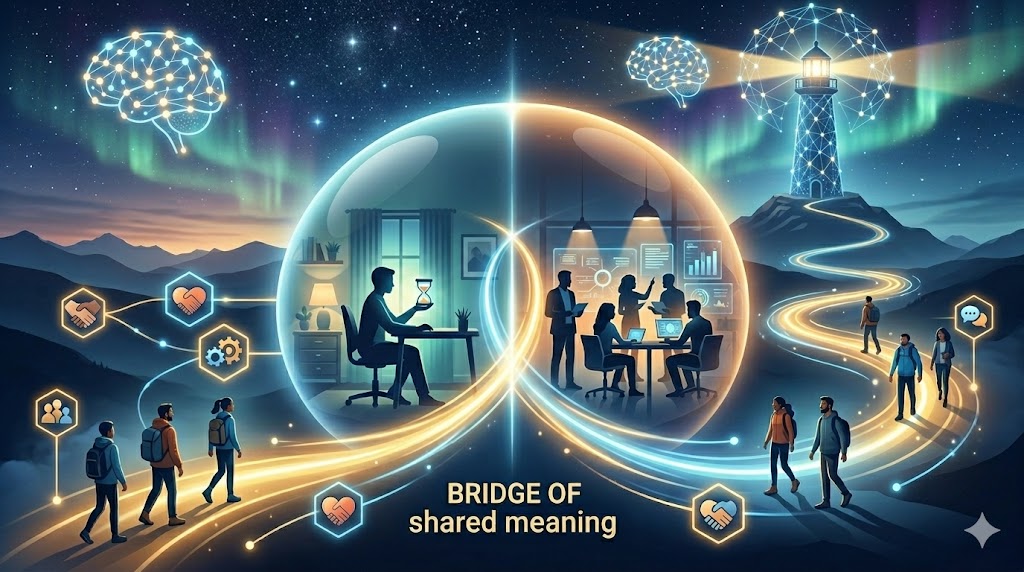
Rituals that Sustain Belonging Across Distances

GUEST POST from Art Inteligencia

I. Introduction: The Human Side of Distance

In our rush to optimize for “anywhere work,” we have mastered the logistics of communication but neglected the architecture of belonging. We often mistake a green status icon on Slack for a true human connection. This is the Proximity Paradox: we are more digitally tethered than ever, yet many individuals feel like “satellites” orbiting a core they cannot feel.

Belonging is the psychological certainty that you are part of something meaningful. It serves as the Fixed Anchor in a flexible world. Without it, innovation stalls because people lack the safety to take risks. With it, a team transforms from a collection of distant individuals into a reconfigurable, high-trust enterprise capable of sustained momentum.

“Innovation moves at the speed of trust, and trust is built in the spaces between the tasks. Rituals are the rhythmic anchors that bridge those spaces.” — Braden Kelley

To sustain culture across thousands of miles, we must move from presence-by-proximity to presence-by-ritual. This article explores how to architect these rituals not as “extra work,” but as the essential script that makes the performance of collective innovation possible.

II. The Anatomy of a Transformative Ritual

To architect belonging, we must distinguish between a routine and a ritual. A routine is about efficiency; a ritual is about meaning. When we design for distance, we must be intentional about creating a “Sensory Bridge” that replaces the physical cues of the traditional office.

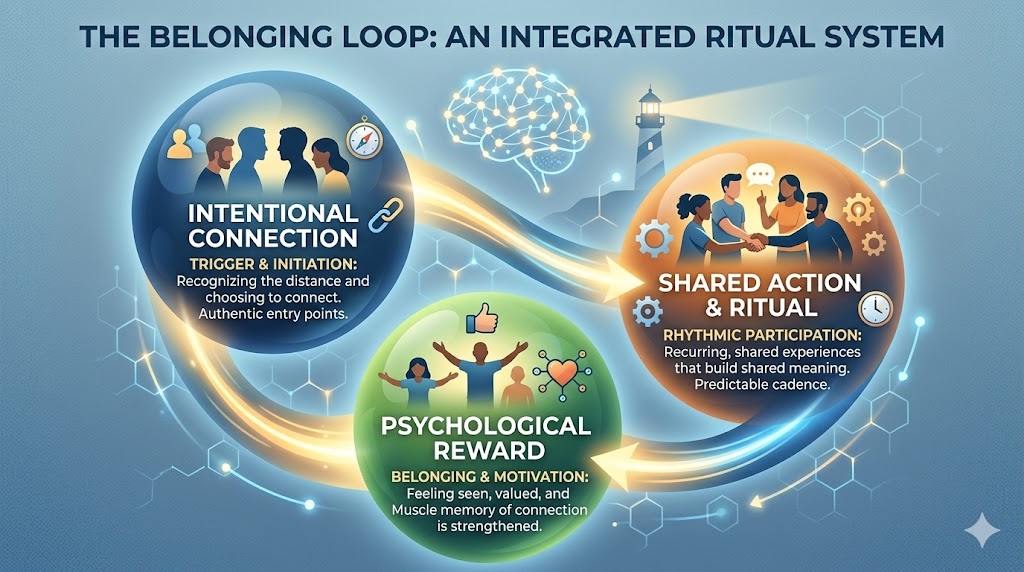
1. The Intentional Trigger

Rituals need a clear entry point. Whether it’s a specific musical cue at the start of a call or a shared digital “check-in” prompt, the trigger signals that the team is shifting from doing mode to belonging mode.

2. The Shared Action

This is the “rhythmic participation” where the group acts in unison. In a distributed setting, this might involve collaborative storytelling or a shared recognition loop that reinforces the team’s identity.

Roles in the Ritual

For a ritual to be transformative, it must allow individuals to show up in their Intrinsic Genius. In Braden Kelley’s work on the Nine Innovation Roles, he highlights that a ritual should create space for the Connector to bridge silos and the Storyteller to frame the team’s momentum.
The Belonging Loop

The Psychological Reward:

The loop closes when the individual feels seen and valued. This reinforcement builds the “muscle memory” of connection, ensuring that even when we are thousands of miles apart, our shared intent remains perfectly aligned.

“If your rituals don’t leave people feeling more capable of tackling the next challenge together, you haven’t built a ritual — you’ve just added another meeting to the calendar.” — Braden Kelley

III. Rituals for the Daily Pulse

To prevent team members from becoming “satellites,” we must establish rhythmic anchors that ground the daily experience. These are not status updates; they are moments of synchronization that prioritize psychological safety and shared intent.

1. The “Emotional Weather” Check-in

Distributed teams often lose the ability to “read the room.” A daily ritual of sharing one’s “weather” — sunny, overcast, or stormy — allows colleagues to understand the emotional context behind a teammate’s performance without requiring a deep dive into personal details. This builds Cognitive Empathy across the distance.

2. Micro-Synchronies (The 10-Minute Huddle)

Long meetings create a “Cognitive Tax.” In contrast, a Micro-Synchrony is a short, high-energy ritual focused on removing blockers and aligning the “Muscle of Foresight.” By keeping it rhythmic and brief, you provide a predictable point of connection that doesn’t disrupt the “Flow State.”

Strategic Outcome:

When daily rituals are designed well, they create a sense of Co-Presence. Even though the team is physically separate, the constant, low-stakes pulse of connection ensures that the foundation of absolute integrity remains intact.

“Frequency beats intensity. A ten-minute daily ritual of genuine connection is more valuable for belonging than a six-hour quarterly offsite.” — Braden Kelley

IV. Rituals for Collective Momentum

While daily rituals ground us, Momentum Rituals are designed to lift the team’s gaze. In a remote environment, “Invisible Friction” — the small, unrecorded struggles of the week — can erode morale. These rituals ensure that effort is seen, lessons are shared, and the team’s “Muscle of Foresight” is collectively strengthened.

The Friday Victory Round

Rather than a dry status report, the Friday Victory Round focuses on Impact and Insight. Team members share one “win” and one “learning from friction.” This ritual normalizes the reality that innovation is messy. By publicizing the struggle as much as the success, you build a culture of Absolute Integrity where people aren’t afraid to be real.

The “Kudos” Narrative

Peer-to-peer recognition shouldn’t be a transaction; it should be a story. A weekly ritual of “passing the torch” of gratitude allows the team to highlight the Invisible Contributions — the person who stayed late to fix a bug or the one who provided moral support during a tough deadline.

The Power of Symbolic Storytelling

I advocate for the use of symbols in these rituals. Whether it’s a digital “badge of honor” or a recurring mention in a team “Hall of Fame,” these markers create a shared history. They turn a series of calendar invites into a legacy of shared achievement.

“Belonging is sustained when we stop counting tasks and start celebrating the trajectory of our collective genius.” — Braden Kelley

V. Strategic Implementation: Guarding the “Creepy Threshold”

The greatest risk to any cultural initiative is inauthenticity. When rituals are handed down as mandates from the boardroom without team input, they often cross what I call the “Creepy Threshold” — that uncomfortable space where “forced fun” feels like surveillance or performative compliance.

To build a Foundation of Absolute Integrity, leaders must transition from being “Commanders of Culture” to “Architects of Agency.” Rituals must be co-created with the people who will actually perform them.

Three Rules for Ethical Rituals:

  • Authenticity Over Mandate: If the team doesn’t find value in the ritual, retire it. Rituals are living tools, not permanent monuments.
  • Respecting the “Internal Clock”: Be mindful of “Zoom fatigue” and time zone equity. A ritual that creates belonging for London but exhaustion for Los Angeles is a failure of design.
  • Radical Transparency: Never use a ritual as a “Trojan Horse” for tracking productivity metrics. The primary ROI of a ritual is trust, not throughput.

The Role of the Trust-Architect

I counsel leaders to listen for the “cultural hum” of the organization. If a ritual feels awkward or forced, it’s a signal that your strategy is out of sync with the human reality. The goal is to create a script where the actors want to take the stage.

“You cannot mandate belonging; you can only design the conditions where it is the natural outcome of shared intent.” — Braden Kelley

VI. Conclusion: Architecting the Future of Presence

The challenge of the distributed era is not one of bandwidth or software, but of meaning. As we have explored, the distance between us is not measured in miles, but in the gaps between our shared experiences. Rituals serve as the structural scaffold that bridges these gaps, transforming a “flexible” workforce into a “fixed” community of intent.

When you master the art of the ritual, you stop being a task-manager and start being a Meaning-Maker. You move beyond the “Silicon-First” obsession with tools and return to the “Human-First” necessity of connection. This is how we build the Muscle of Foresight: by ensuring our teams are so well-aligned and so deeply connected that they can anticipate challenges and pivot in unison, regardless of where they sit.

“Belonging is a perishable asset. It requires the constant, rhythmic nourishment of shared ritual to stay alive. In the future of work, the most successful leaders won’t be those with the best dashboards, but those who create the most meaningful stages for their people to perform upon.”

— Braden Kelley

As you look to the next quarter, audit your connection points. Are they merely routines designed for efficiency, or are they Rituals designed for Belonging? The choice you make will determine whether your organization remains a collection of individuals or becomes a legacy of shared genius.

Are you ready to design the script for your team’s next great performance?

The Ritual Audit Tool

Transitioning from Routine to Ritual

Select a recurring team touchpoint (e.g., Daily Standup, Weekly Sync) and evaluate it against the four pillars of Belonging Design:

Pillar The Diagnostic Question Status
Intentional Trigger Does the meeting start with a clear signal that shifts the team from “task” mode to “human” mode?
Psychological Safety Is there space for “Emotional Weather” or “Lessons from Friction” without fear of judgment?
Shared Agency Does the team own the format, or is it a top-down mandate that crosses the “Creepy Threshold”?
Predictable Reward Do participants leave feeling more “seen” and energized than when they arrived?

Key Insight:

If you checked fewer than three boxes, you are likely running a Routine. To transform it into a Ritual, inject a storytelling element or a peer-recognition loop. Remember: Rituals are the script that makes the performance of collective innovation possible.

Distributed Belonging: Frequently Asked Questions

What is the difference between a routine and a ritual in a remote team?

A routine is focused on efficiency — getting the task done. A ritual is focused on meaning. In a distributed environment, rituals act as “Sensory Bridges” that replace physical proximity, turning a standard meeting into a rhythmic anchor that reinforces shared identity and trust.

How can leaders avoid the “Creepy Threshold” when building culture?

The “Creepy Threshold” is crossed when connection feels like surveillance. To avoid this, move from being a “Commander of Culture” to a Trust-Architect. Ensure rituals are co-created with the team, respect their “internal clocks,” and are never used as a Trojan Horse for tracking productivity metrics.

What is the “Muscle of Foresight” in the context of team belonging?

It is the team’s collective ability to sense shifts and adapt before they become crises. When a team has a strong foundation of belonging, they share “Invisible Friction” more openly. This transparency builds the Muscle of Foresight, allowing the organization to remain proactive rather than reactive.

For more insights on human-centered innovation and change, organizations often look to an innovation speaker like Braden Kelley to bridge the gap between technology and human trust.

Image credit: Google Gemini

Subscribe to Human-Centered Change & Innovation WeeklySign up here to get Human-Centered Change & Innovation Weekly delivered to your inbox every week.
Re-Centering Human Connection in Digital Design

From Screen Time to Real Time

LAST UPDATED: November 17, 2025 at 12:29PM

Re-Centering Human Connection in Digital Design

GUEST POST from Chateau G Pato

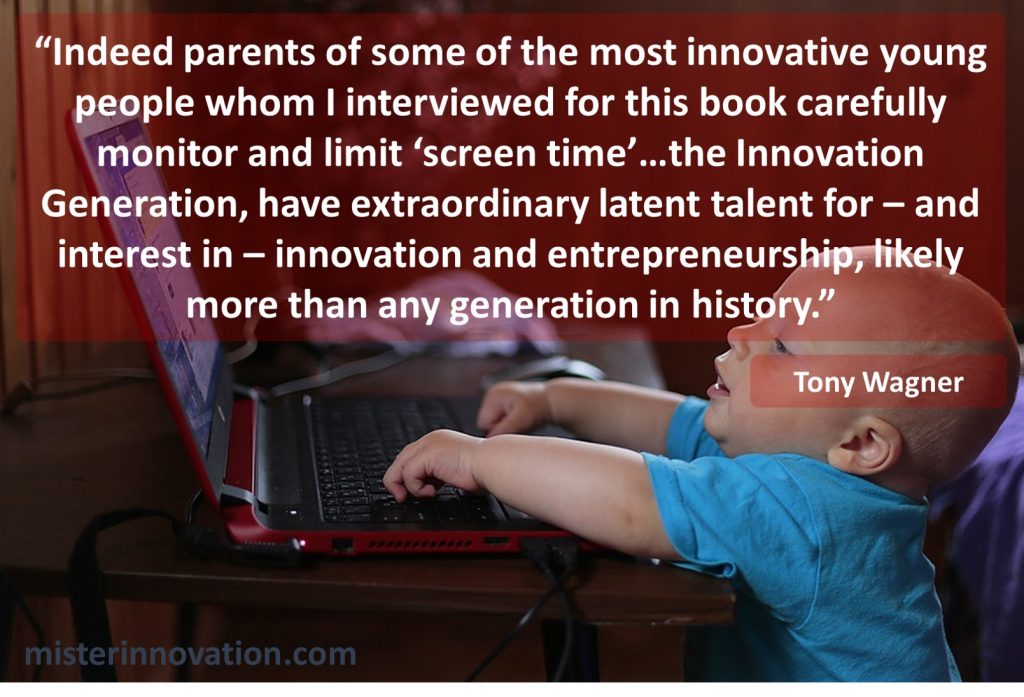
We live in an age of unprecedented digital connectivity. From instant messaging to global video calls, social media feeds to virtual reality, our lives are increasingly mediated by screens. While these technologies promise to bring us closer, many of us feel a growing sense of isolation, distraction, and even a loss of authentic human interaction. The paradox is stark: the more “connected” we become digitally, the more disconnected we can feel in real life.

This isn’t an indictment of technology itself, but a call to action for its designers and leaders. As human-centered change advocates, we must ask: Are we designing digital experiences that genuinely foster connection, or merely amplify convenience and fleeting engagement? The imperative is to shift our focus from maximizing “screen time” to optimizing “real time” — to design digital tools that intentionally guide us back to meaningful human connection, not away from it.

Re-centering human connection in digital design isn’t just about ethics; it’s about building products and services that truly resonate, create deeper loyalty, and solve fundamental human needs in a world saturated with digital noise.

The Disconnect: How Digital Design Can Go Astray

Often, digital design prioritizes:

  • Efficiency over Empathy: Streamlining tasks can inadvertently strip away opportunities for nuanced human interaction.
  • Engagement over Well-being: Algorithms optimized for attention can lead to addictive patterns and social comparison, diminishing mental health.
  • Broadcasting over Belonging: Social platforms often favor one-to-many communication, diluting the intimacy and reciprocity of one-to-one or small-group interaction.
  • Convenience over Consequence: Easy digital interaction can reduce the effort — and thus the perceived value — of real-world encounters, making authentic connection feel less necessary.

The goal is not to eliminate these digital conveniences, but to embed human connection into their core, making it an intended outcome, not an accidental byproduct.

Key Characteristics of Connection-Centered Digital Design

Designing for real human connection means integrating specific principles into every aspect of digital product development, making human needs the central focus:

  • Intentional Friction: Introducing small, deliberate barriers that encourage thoughtfulness or shift interaction to real life (e.g., prompting users to consider who they’re sending a message to, or suggesting a real-world meet-up).
  • Empathy-Driven Interfaces: Using language, visuals, and interaction patterns that feel genuinely supportive, understanding, and non-judgmental, mirroring positive human interaction.
  • Facilitating Offline Action: Designing features that explicitly encourage and enable users to transition from online interaction to real-world engagement (e.g., event planning tools, local group discovery, “put your phone down” prompts).
  • Valuing Deep Engagement Over Fleeting: Prioritizing meaningful, sustained interactions over superficial likes or endless scrolling, fostering true intellectual and emotional investment.
  • Transparency in Algorithms: Helping users understand how their digital environment is curated, fostering a sense of control and agency over their experience, rather than feeling manipulated.
  • Supporting Micro-Communities: Building tools that empower small, intimate groups to connect and collaborate effectively, fostering true belonging and mutual support.

Key Benefits of Re-Centering Human Connection

When digital design prioritizes genuine connection, the benefits extend far beyond immediate user satisfaction, impacting loyalty, well-being, and brand reputation:

  • Increased Loyalty & Retention: Users who feel genuinely connected to a platform or community, and through it to other humans, are more likely to stay, engage deeply, and advocate for it.
  • Enhanced Well-being: Products that foster healthy, real-world connections contribute positively to user mental and social health, leading to more sustainable, positive usage patterns.
  • De-risked Reputation: Companies known for building “human-first” digital experiences cultivate trust and differentiate themselves in a crowded, often criticized, digital landscape, building resilience against negative sentiment.
  • Deeper Innovation: Understanding the true human need for connection leads to more profound product insights and breakthrough designs that address fundamental human desires, rather than superficial wants.
  • Stronger Communities: Digital platforms can become true enablers of robust, resilient real-world communities, driving collective action, shared value, and a sense of shared purpose.

Case Study 1: The “Local Connect” Feature in a Retail App

Challenge: Declining Foot Traffic & Online Anonymity

A national retail chain with local stores was struggling with declining foot traffic, despite a strong e-commerce presence. Their existing app focused solely on online shopping and product discovery, leaving customers feeling disconnected from their local community stores.

Connection-Centered Intervention:

The chain introduced a “Local Connect” feature into their existing retail app. This feature didn’t just show local store hours; it allowed customers to:

  • See local store events (workshops, product launches) and RSVP directly.
  • Connect with local store associates for personalized product recommendations or styling advice via moderated, time-bound chat (encouraging an in-store follow-up).
  • Join interest-based “local circles” (e.g., “Gardening Enthusiasts,” “Book Clubbers”) hosted by local store staff, facilitating real-world meet-ups and discussions.

The Human-Centered Lesson:

This re-design recognized that physical retail thrives on community. The app moved beyond just being a shopping portal to a facilitator of local human interaction. It created “intentional friction” by making personal connections online that were designed to culminate in real-world interactions. This led to a measurable increase in local store foot traffic, higher conversion rates on specific products, and a stronger sense of community among customers, proving that digital can indeed drive real-world connection and breathe new life into traditional retail.

Case Study 2: The “Digital Detox Buddy” App

Challenge: Pervasive Digital Distraction in Personal Relationships

Many couples and families struggled with constant digital distraction during quality time together. Existing “digital detox” apps were often punitive or solo-focused, failing to address the social dynamic of putting down devices.

Connection-Centered Intervention:

A new app emerged, “Digital Detox Buddy,” designed explicitly for small groups (couples, families, friends). Instead of just blocking apps, it gamified shared, screen-free time. Users would “commit” to a screen-free period together, placing their phones face-down on a shared digital “mat” in the app. If anyone picked up their phone before the timer ended, a fun, agreed-upon “penalty” (e.g., buying coffee for the group, doing a silly dance) was activated, recorded by the app. The app also provided conversation starters and suggestions for offline activities for the group.

The Human-Centered Lesson:

This app successfully leveraged digital design to reduce screen time and increase real-world connection. By introducing shared accountability and positive reinforcement through gamification, it turned a solo struggle into a collective goal. It understood that human connection is often about shared experience and lighthearted challenge, using digital means to achieve a profoundly analog outcome: deeper, uninterrupted time with loved ones. It created an interface for putting interfaces away, intelligently using technology to foster human presence.

Designing for a More Connected Future

Re-centering human connection in digital design isn’t about shunning technology; it’s about elevating it to its highest purpose. It requires empathy, intentionality, and a willingness to challenge established norms of “engagement” metrics in favor of deeper, more meaningful outcomes. We must continually ask ourselves:

  • Does this feature encourage face-to-face interaction or inadvertently replace it?
  • Does this experience foster genuine empathy and understanding or superficial judgment?
  • Does this tool help users feel more connected to other humans, or more isolated in a digital crowd?

By consciously integrating these principles, we can design a digital future that not only connects us more efficiently but also more profoundly, enabling us to thrive in both our screen time and, most importantly, our real time. This is the essence of truly human-centered digital innovation.

“The most human-centered digital designs are those that eventually get us to look up from our screens and truly see each other.”

Your first step toward connection-centered design: Identify one digital interaction your product or service currently offers that could lead to a richer, real-world connection but doesn’t. Brainstorm three small, intentional design changes — perhaps a prompt, a suggested action, or a subtle gamification — that could encourage users to transition from screen time to real time in that specific scenario. Focus on how digital can be a bridge, not a barrier.

Extra Extra: Because innovation is all about change, Braden Kelley’s human-centered change methodology and tools are the best way to plan and execute the changes necessary to support your innovation and transformation efforts — all while literally getting everyone all on the same page for change. Find out more about the methodology and tools, including the book Charting Change by following the link. Be sure and download the TEN FREE TOOLS while you’re here.

Image credit: 1 of 1,000+ FREE quote slides for your presentations at http://misterinnovation.com

Subscribe to Human-Centered Change & Innovation WeeklySign up here to get Human-Centered Change & Innovation Weekly delivered to your inbox every week.