LAST UPDATED: December 8, 2025 at 4:56 PM

GUEST POST from Art Inteligencia
For the last decade, Artificial Intelligence (AI) has lived primarily on our screens and in the cloud — a brain without a body. While large language models (LLMs) and predictive algorithms have revolutionized data analysis, they have done little to change the physical experience of work, commerce, and daily life. This is the innovation chasm we must now bridge.
The next great technological leap is Embodied Artificial Intelligence (EAI): the convergence of advanced robotics (the body) and complex, generalized AI (the brain). EAI systems are designed not just to process information, but to operate autonomously and intelligently within our physical world. This is a profound shift for Human-Centered Innovation, because EAI promises to eliminate the drudgery, danger, and limitations of physical labor, allowing humans to focus exclusively on tasks that require judgment, creativity, and empathy.
The strategic deployment of EAI requires a shift in mindset: organizations must view these agents not as mechanical replacements, but as co-creators that augment and elevate the human experience. The most successful businesses will be those that unlearn the idea of human vs. machine and embrace the model of Human-Embodied AI Symbiosis.
The EAI Opportunity: Three Human-Centered Shifts
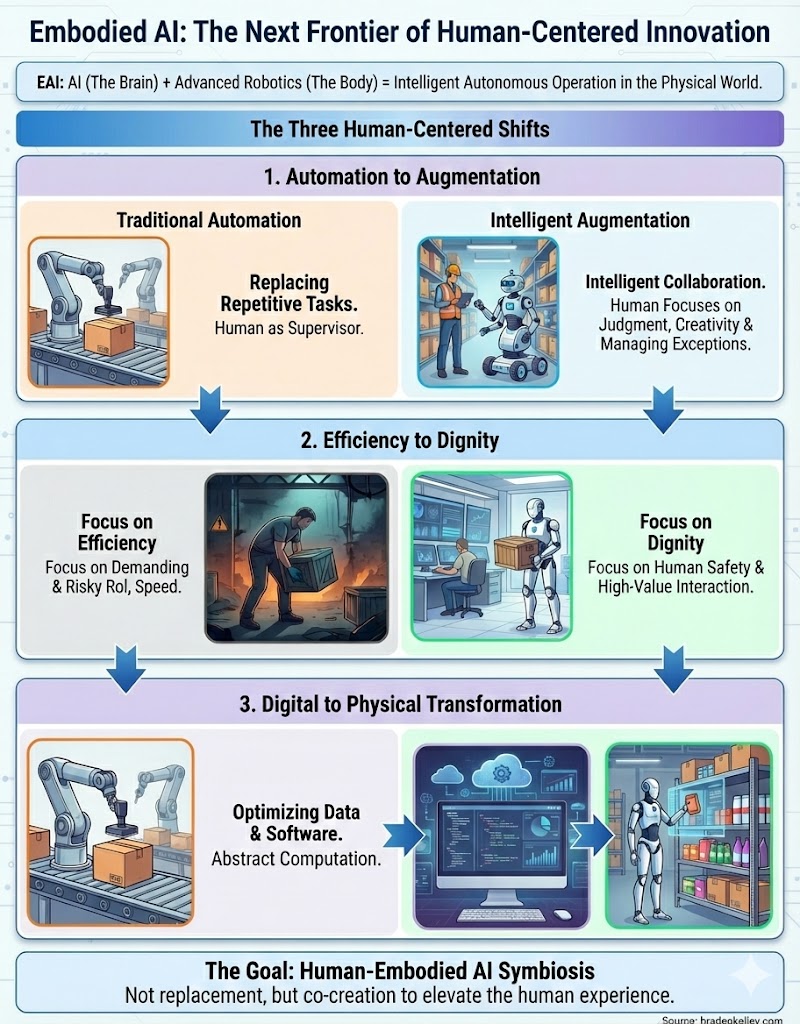
EAI accelerates change by enabling three crucial shifts in how we organize work and society:
1. The Shift from Automation to Augmentation
Traditional automation replaces repetitive tasks. EAI offers intelligent augmentation. Because EAI agents learn and adapt in real-time within dynamic environments (like a factory floor or a hospital), they can handle unforeseen situations that script-based robots cannot. This means the human partner moves from supervising a simple process to managing the exceptions and optimizations of a sophisticated one. The human job becomes about maximizing the intelligence of the system, not the efficiency of the body.
2. The Shift from Efficiency to Dignity
Many essential human jobs are physically demanding, dangerous, or profoundly repetitive. EAI offers a path to remove humans from these undignified roles — the loading and unloading of heavy boxes, inspection of hazardous infrastructure, or the constant repetition of simple assembly tasks. This frees human capital for high-value interaction, fostering a new organizational focus on the dignity of work. Organizations committed to Human-Centered Innovation must prioritize the use of EAI to eliminate physical risk and strain.
3. The Shift from Digital Transformation to Physical Transformation
For decades, digital transformation has been the focus. EAI catalyzes the necessary physical transformation. It closes the loop between software and reality. An inventory algorithm that predicts demand can now direct a bipedal robot to immediately retrieve and prepare the required product from a highly chaotic warehouse shelf. This real-time, physical execution based on abstract computation is the true meaning of operational innovation.
Case Study 1: Transforming Infrastructure Inspection
Challenge: High Risk and Cost in Critical Infrastructure Maintenance
A global energy corporation (“PowerLine”) faced immense risk and cost in maintaining high-voltage power lines, oil pipelines, and sub-sea infrastructure. These tasks required sending human crews into dangerous, often remote, or confined spaces for time-consuming, repetitive visual inspections.
EAI Intervention: Autonomous Sensory Agents
PowerLine deployed a fleet of autonomous, multi-limbed EAI agents equipped with advanced sensing and thermal imaging capabilities. These robots were trained not just on pre-programmed routes, but on the accumulated, historical data of human inspectors, learning to spot subtle signs of material stress and structural failure — a skill previously reserved for highly experienced humans.
- The EAI agents performed 95% of routine inspections, capturing data with superior consistency.
- Human experts unlearned routine patrol tasks and focused exclusively on interpreting the EAI data flags and designing complex repair strategies.
The Outcome:
The use of EAI led to a 70% reduction in inspection time and, critically, a near-zero rate of human exposure to high-risk environments. This strategic pivot proved that EAI’s greatest value is not economic replacement, but human safety and strategic focus. The EAI provided a foundational layer of reliable, granular data, enabling human judgment to be applied only where it mattered most.
Case Study 2: Elderly Care and Companionship
Challenge: Overstretched Human Caregivers and Isolation
A national assisted living provider (“ElderCare”) struggled with caregiver burnout and increasing costs, while many residents suffered from emotional isolation due to limited staff availability. The challenge was profoundly human-centered: how to provide dignity and aid without limitless human resources.
EAI Intervention: The Adaptive Care Companion
ElderCare piloted the use of adaptive, humanoid EAI companions in low-acuity environments. These agents were programmed to handle simple, repetitive physical tasks (retrieving dropped items, fetching water, reminding patients about medication) and, critically, were trained on empathetic conversation models.
- The EAI agents managed 60% of non-essential, fetch-and-carry tasks, freeing up human nurses for complex medical care and deep, personalized interaction.
- The EAI’s conversation logs provided caregivers with Small Data insights into the emotional state and preferences of the residents, allowing the human staff to maximize the quality of their face-to-face time.
The Outcome:
The pilot resulted in a 30% reduction in nurse burnout and, most importantly, a measurable increase in resident satisfaction and self-reported emotional well-being. The EAI was deployed not to replace the human touch, but to protect and maximize its quality by taking on the physical burden of routine care. The innovation successfully focused human empathy where it had the greatest impact.
The EAI Ecosystem: Companies to Watch
The race to commercialize EAI is accelerating, driven by the realization that AI needs a body to unlock its full economic potential. Organizations should be keenly aware of the leaders in this ecosystem. Companies like Boston Dynamics, known for advanced mobility and dexterity, are pioneering the physical platforms. Startups such as Sanctuary AI and Figure AI are focused on creating general-purpose humanoid robots capable of performing diverse tasks in unstructured environments, integrating advanced large language and vision models into physical forms. Simultaneously, major players like Tesla with its Optimus project and research divisions within Google DeepMind are laying the foundational AI models necessary for EAI agents to learn and adapt autonomously. The most promising developments are happening at the intersection of sophisticated hardware (the actuators and sensors) and generalized, real-time control software (the brain).
Conclusion: A New Operating Model
Embodied AI is not just another technology trend; it is the catalyst for a radical change in the operating model of human civilization. Leaders must stop viewing EAI deployment as a simple capital expenditure and start treating it as a Human-Centered Innovation project. Your strategy should be defined by the question: How can EAI liberate my best people to do their best, most human work? Embrace the complexity, manage the change, and utilize the EAI revolution to drive unprecedented levels of dignity, safety, and innovation.
“The future of work is not AI replacing humans; it is EAI eliminating the tasks that prevent humans from being fully human.”
Frequently Asked Questions About Embodied Artificial Intelligence
1. How does Embodied AI differ from traditional industrial robotics?
Traditional industrial robots are fixed, single-purpose machines programmed to perform highly repetitive tasks in controlled environments. Embodied AI agents are mobile, often bipedal or multi-limbed, and are powered by generalized AI models, allowing them to learn, adapt, and perform complex, varied tasks in unstructured, human environments.
2. What is the Human-Centered opportunity of EAI?
The opportunity is the elimination of the “3 Ds” of labor: Dangerous, Dull, and Dirty. By transferring these physical burdens to EAI agents, organizations can reallocate human workers to roles requiring social intelligence, complex problem-solving, emotional judgment, and creative innovation, thereby increasing the dignity and strategic value of the human workforce.
3. What does “Human-Embodied AI Symbiosis” mean?
Symbiosis refers to the collaborative operating model where EAI agents manage the physical execution and data collection of routine, complex tasks, while human professionals provide oversight, set strategic goals, manage exceptions, and interpret the resulting data. The systems work together to achieve an outcome that neither could achieve efficiently alone.
Your first step toward embracing Embodied AI: Identify the single most physically demanding or dangerous task in your organization that is currently performed by a human. Begin a Human-Centered Design project to fully map the procedural and emotional friction points of that task, then use those insights to define the minimum viable product (MVP) requirements for an EAI agent that can eliminate that task entirely.
UPDATE – Here is an infographic of the key points of this article that you can download:
Disclaimer: This article speculates on the potential future applications of cutting-edge scientific research. While based on current scientific understanding, the practical realization of these concepts may vary in timeline and feasibility and are subject to ongoing research and development.
Image credit: 1 of 1,000+ quote slides for your meetings & presentations at http://misterinnovation.com
 Sign up here to get Human-Centered Change & Innovation Weekly delivered to your inbox every week.