
GUEST POST from Geoffrey Moore
AI is the number one topic in the boardroom this year, and everybody wants to know how it is going to play out and what that means for their enterprise. Well, it’s not as if we have never seen versions of this movie before. How did the Internet play out? The Worldwide Web? eCommerce? Cloud computing? Smartphones? Digital marketing? Ride-sharing? Streaming media?
This is the Technology Adoption Life Cycle at work, for sure, and has been the basis of my life’s work and that of many colleagues as well. That said, however, most of our time has been spent helping clients see how best to navigate the current state of that life cycle, either as a disruptor or a disruptee. That’s all well and good, but what the board really wants to know is what can we expect from the end state. Where will all this land, and what future do we need to prepare for?
To answer this question properly we need to lay out the landscape of work along two axes (shockingly, creating a 2X2 matrix, the gold standard for all consulting models). One axis discriminates between output that is differentiating, giving customers a reason to choose your offers over those of your competitors, in contrast to work that is industry standard, things every competitor is expected to deliver. The other axis discriminates on the basis of risk exposure, distinguishing between outcomes that are mission-critical where failure is not an option, in contrast to outcomes that can tolerate a certain amount of scrap or rework.
We call this the core/context framework, and when overlaid onto the future of AI, it can look something like this:
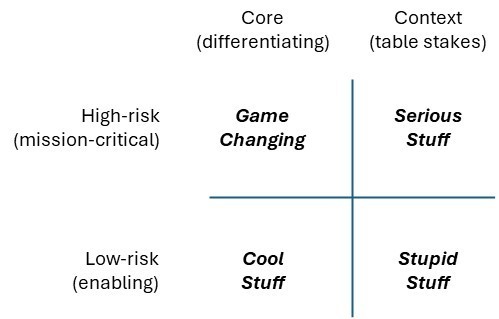
In the context of this diagram here is how I predict the next ten years of AI will play out:
1. Stupid stuff first. One thing to which we will all testify is that there is no lack of stupid stuff encumbering the workflow of our daily lives. Wherever bureaucracy reigns, there will be an unending stream of compliance requirements, be that in the public or the private sector, and we suffer this burden because it does underpin the rule of law, albeit onerously.
Fulfilling these requirements does not take creative genius, it takes attention to detail and considerable patience. Humans are not strong on either front, but AI is, and this is where enterprises are already weighing in and will continue to do so for the rest of the decade and more.
That said, the ROI from such efforts is modest. Basically, we are automating an inefficient system, which does reduce cost, and does free up human talent to be used elsewhere. But what we find is that human talent is not as fungible as we would want, many displaced workers cannot find employment at a comparable salary, and the rest of the enterprise is not improved in any marked way. Things overall are better, but not a lot better.
2. Cool stuff in parallel. When it comes to new technology, wherever the risk barrier is low, technology enthusiasts will lean in regardless, whether that be on their own time or their employer’s. What they are doing is playing with an inefficient system, seeing what the bright new shiny object might bring to the table. This does take creative genius as well as some creative license, so once again, patience is required, but this time it is on the part of the investor or supervisor.
That said, in the domain of consumer products and services, there is the potential for blockbuster ROI here, as any number of freemium plays have demonstrated in the past. Many are short-lived, to be sure (remember ringtones?), but in their short life, they can capture an extraordinary amount of discretionary spend. And others can mature into abiding infrastructure as search, messaging, and file sharing have all demonstrated.
The key here is that these are not mission-critical and, therefore, do not attract regulatory regimes. If and when they should do so, as is happening with social media now, then their economics can turn upside down in a hurry.
3. Serious stuff takes time. This is where most of the big and abiding ROI will come from. When work is mission-critical but not differentiating, it requires considerable investment in table-stakes processes, which garner no premium in the marketplace. To be brutally honest, there is no prize for doing this work well but considerable penalties for any mistakes you make (think ransomware for a bone-chilling example).
In the 1990s, there was an Internet-enabled revolution in enterprise manufacturing that introduced global outsourcing as a high-ROI way to address mission-critical context workloads—move the work from your company, where it is context, to their company, where it is core. This was a hugely disruptive innovation, allowing the economies of China, India, and now Southeast Asia, to expand at exponential rates, creating increasingly vibrant middle classes where there were none before. However, these benefits have come with a price, both in terms of geopolitical risks, supply chain vulnerabilities, and societal downsides, all of which we are still trying to come to terms with.
Here, AI can have a major impact, not by automating an efficient system, but by completely reengineering it. This will entail on-shoring a lot of manufacturing and displacing a lot of call centers as we introduce more and more AI into these mission-critical workflows. The gains will be in faster response to changing market demands, better returns from high-variability small-volume manufacturing runs, and reduced scrap and rework. At the outset, these changes will entail a considerable amount of human-in-the-loop processing, but eventually, because AI-enabled systems need never stop learning, the human will become the biggest source of error in the system, and we will transition to full autonomy (self-driving cars will be a case study of this transition).
4. Game-changing happens when it happens. There is a reason why so many billionaires have appeared in my lifetime (I personally forgot to become one). Their fortunes are the natural outcome whenever a disruptive innovation does not simply reengineer the existing inefficient system but instead completely replaces it. Amazon Prime, Uber, Netflix, Salesforce, NVIDIA, Apple — each company categorically changed the landscape, rendering the incumbents irrelevant, redirecting the cash flows of their entire industry to flow past their doors.
These outcomes are inevitable, but they are also unpredictable. They are what puts the venture in venture capital. The good news for incumbents is that they do not happen very often, and even when they appear to be succeeding, they can still stumble and fall. That said, sooner or later there will be a reckoning, and that is when the incumbents need to activate their Transformation Zone if they are going to survive the transition.
My altruistic wish is that for AI, this time around, the target will be the public sector. Higher education, social services, healthcare, and law enforcement are all staggering under increasingly untenable demands accompanied by shrinking workforces and restricted budgets. All of them are target-rich environments for applying AI both to stupid stuff and serious stuff. We have never disrupted these sanctums in the past, each having been ruled by regulatory regimes and professional guilds that have deeply conservative roots blocking the kinds of changes that are now needed. Displacing these systems will take decades, but the ROI, both financial and social, would be truly game-changing.
That’s what I think. What do you think?
— Image credit: Gemini
 Sign up here to join 17,000+ leaders getting Human-Centered Change & Innovation Weekly delivered to their inbox every week.