Tag Archives: Compromise Effect

Change Starts with Empathy

(Even for Your Enemies)
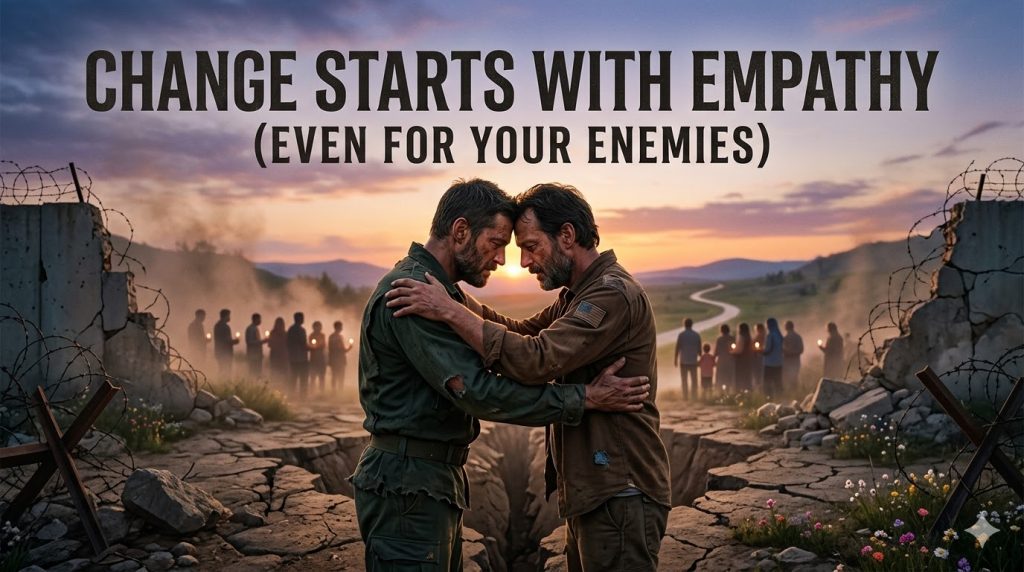
Change Starts With Empathy

GUEST POST from Greg Satell

On September 17th, 2011, protesters began to stream into Zuccotti Park in Lower Manhattan and the #Occupy movement had begun. “We are the 99%,” they declared and as far as they were concerned, it was time for the reign of the “1%” to end. The protests soon spread like wildfire to 951 cities across 82 countries.

It failed miserably. Today, a decade later, it’s hard to find any real objective that was achieved except some vague assertions about “building awareness” and Bernie Sanders’ two failed presidential campaigns. Taking into the count the billions of dollars worth of resources expended in terms of time and effort, that is abysmal performance.

As I explained in Cascades, there were myriad reasons for #Occupy’s failure. One of the gravest errors, however, was the insistence on ideological purity and the lack of any effort to understand those who had different ideas from their own. If you expect to bring change about, you need to attract, rather than overpower. Empathy is a good place to start.

Finding Your Tribe

In 1901, before he became employed by the patent office, a young Albert Einstein put out an advertisement offering tutoring services in math and physics. Maurice Solovine, a Romanian philosophy student, responded to the ad but, after a brief discussion, Einstein told him that he didn’t need lessons. Still, he invited Solovine to come and visit him whenever he wished.

The two began meeting regularly and were soon joined by another friend of Einstein’s, a young Swiss mathematician named Conrad Habicht, and the three would discuss their own work as well as that of luminaries such as Ernst Mach, David Hume and Henri Poincaré. Eventually, these little gatherings acquired a name, The Olympia Academy.

Einstein had found his tribe and it became a key factor in the development of his “miracle year” papers that would turn the world of physics on its head in a few years later. It gave him a safe space to let his mind wander over the great questions of the day, formulate his ideas and get feedback from people that he trusted and respected.

This is a common pattern. Similar tribes, such as, the Vienna Circle, the Bloomsbury Group and the “Martians” of Fasori have, if anything, led to even greater achievement. So it’s easy to understand how those protesters descending on Zuccotti Park, finding themselves amongst so many who saw things as they did, felt as if they were on the brink of a historic moment.

They weren’t. And that’s what’s dangerous about tribes. Although they can lend support to a fledgling idea that needs to be nurtured, they can also blind us to hard truths that need to be examined.

Developing A Private Language

A tribe is a closed network that, almost by definition, is an echo chamber designed to develop its own practices, customs and culture. Perhaps not surprisingly, it is common for these networks to develop their own vocabulary to describe these unique aspects of the tribal experience and to make distinctions between members of the tribe and outsiders.

Consider what happened when Congressman John Lewis, the civil rights legend, showed up at an #Occupy rally in Atlanta. The protesters refused to let him speak. He left quietly and issued a polite statement, but an opportunity was lost and real damage was done to the movement and its cause. If John Lewis wasn’t welcome, what about the rest of us?

Later, the man who led the charge to prevent Congressman Lewis from speaking explained his reasons. He cited his suspicion of Lewis as part of the “two-party system,” which he felt had betrayed the country. Yet even more tellingly, he also explained that his main objection was due to the “form” of the event, which he felt was being violated.

It is common for tribes to fall into this kind of private language trap. The function of communication is inherently social and, if the customs and vernacular that you develop becomes so archaic and obscure that it is unable to perform that function, you have undermined the fundamental purpose of the activity.

Clearly, in any dialogue both the speaker and the listener have a responsibility to each other. However, if you consistently find that your message is not resonating outside your tribe, you probably want to rethink how you’re expressing it.

Shifting From Differentiating Value To Shared Values

Once you start separating yourself off and creating a private language for your adherents, it’s easy to fall into a form of solipsism in which the only meaningful reality is that of the shared experience of the tribe. Many aspiring revolutionaries seek to highlight this feeling by emphasizing difference in order to gin-up enthusiasm among their most loyal supporters.

That was certainly true of LGBTQ activists, who marched through city streets shouting slogans like “We’re here, we’re queer and we’d like to say hello.” They led a different lifestyle and wanted to demand that their dignity be recognized. More recently, Black Lives Matter activists made calls to “defund the police,” which many found to be shocking and anarchistic.

Corporate change agents tend to fall into a similar trap. They rant on about “radical” innovation and “disruption,” ignoring the fact that few like to be radicalized or disrupted. Proponents of agile development methods often tout their manifesto, oblivious to the reality that many outside the agile community find the whole thing a bit weird and unsettling.

While emphasizing difference may excite people who are already on board, it is through shared values that you bring people in. So it shouldn’t be a surprise that the fight for LGBTQ rights began to gain traction when activists started focusing on family values. Innovation doesn’t succeed because it’s “radical,” but when it solves a meaningful problem. The value of Agile methods isn’t a manifesto, but the fact that they can improve performance.

You Never Have To Compromise On Common Ground

One of the things that sticks in my head about my experiences during and after the Orange Revolution in Ukraine was an interview with Viktor Pinchuk. who is not only one of the country’s richest oligarch’s, but also the son-in-law of the former President and, at the time, a member of the Rada, the Ukrainian Parliament.

He was, by any definition, a full-fledged member of the “1%” that #Occupy took to the streets to protest. Before reading the article I would’ve expected him to be bitter about the abrupt shift in power. Yet he wasn’t. In fact, he explained that his biggest concern during the protests was that his own children were in the streets, and he feared for their safety.

The insight underlines one of the fundamental fallacies of failed change efforts like #Occupy and others, both in the streets and in the corporate world. They imagine change as a Manichean struggle between two countervailing forces in which we must either prevail or accept defeat and compromise. That is a false choice.

The truth is that any change we win by vanquishing our opponents is bound to be fleeting. Every revolution inspires its own counter-revolution. Lasting change is always built on common ground. The best place to start is by building empathy for your most ardent adversaries, not to give in to them, but to help you identify shared values.

After the Orange Revolution was over, we would learn that Pinchuk’s father-in-law, Leonid Kuchma, who was still in power, ordered the most reactionary forces in his regime to stand down. As it turned out, there were some places that even the famously corrupt leader would not go. In the end, he understood that his legacy, and therefore his interests, lay with the protesters in the streets.

— Article courtesy of the Digital Tonto blog
— Image credit: Google Gemini

Subscribe to Human-Centered Change & Innovation WeeklySign up here to join 17,000+ leaders getting Human-Centered Change & Innovation Weekly delivered to their inbox every week.

Las Vegas Formula One

Successful Innovation, Learning Experience or Total Disaster?

GUEST POST from Pete Foley

In Las Vegas, we are now clearing up after the Formula 1 Grand Prix on the Strip.  This extremely complex event required a great deal of executional innovation, and one that I think as innovators, we can learn quite a lot from. 

It was certainly a bumpy ride, both for the multi-million dollar Ferrari that hit an errant drain cover during practice, but also with respect to broader preparation, logistics, pricing and projections of consumer behavior.  Despite this, race itself was exciting and largely issue free, and even won over some of the most skeptical drivers.  In terms of Kahneman’s peak-end effects, there were both memorable lows, but also a triumphant end result.   So did this ultimately amount to success?

Success?:   For now, I think it very much depends upon your perspective and who you talk to.  Perhaps it’s a sign of the times, but in Las Vegas, the race was extremely polarizing, with often heated debates between pro- and anti- F1-ers that were often as competitive as the race.

The reality is that it will be months, or more likely years before the dust settles, and we know the answer.  And I strongly suspect that even then, those who are for and against it will all likely be able to claim support for their point of view.  One insight I think innovators can take from this is that success can be quite subjective in of itself, and greatly depends upon what factors you measure, what period of time you measure over, and often your ingoing biases.  And the bigger and more complex the innovation, often the harder it is to define and measure success.  

Compromise Effects:  When you launch a new product, it is often simpler and cheaper to measure its success narrowly in terms of specific dollar contribution to your business. But this often misses its holistic impact.   Premium products can elevate an entire category or brand, while poorly executed innovations can do the opposite.  For example, the compromise effect from Behavioral Economics suggests that a premium addition to a brand line up can shift the ‘Good, Better, Best’ spectrum of a category upwards.  This can boost dollar sales across a line up, even if the new premium product itself has only moderate sales.   For example, the addition of high priced wines to a menu can often increase the average dollars per bottle spent by diners, even if the expensive wine itself doesn’t sell.  The expensive wines shift the ‘safe middle’ of the consideration set upwards, and thus increase revenue, and hopefully profit.      

Money, Scope and Intangibles:  In the case of F1, how far can and should we cast the net when trying to measure success?  Can we look just at the bottom line?  Did this specific weekend bring in more than the same weekend the previous year in sports betting, rooms and entertainment?  Did that difference exceed the investments? 

Or is that too narrow?  What about the $$ impact on the weeks surrounding the event?  We know that some people stayed away because of the construction and congestion in the lead up to the race.  That should probably be added into, or subtracted from the equation. 

And then there’s the ‘who won and who lost question’? The benefits and losses were certainly not homogeneous across stakeholders.  The big casinos benefited disproportionately in comparison to the smaller restaurants that lost business due to construction, some to a degree that almost rivaled Covid.  Gig workers also fared differently. I have friends who gained business from the event, and friends who lost.  Many Uber drivers simply gave up and stopped working. But those who stayed, or the high-end limo drivers likely had bumper weekends.   Entertainers working shows that were disrupted by F1 lost out, but the plethora of special events that came with F1 also provided a major uptick in business for many performers and entertainers.

There is also substantial public investment to consider.  Somewhat bizarrely, the contribution of public funds was not agreed prior to the race, and the public-private cost sharing of tens of millions is still being negotiated.  But even facing that moving target, did increased (or decreased) tax income before, during and after the race offset those still to be determined costs?

Intangibles:  And then there’s the intangibles.  While Vegas is not exactly an unknown entity, F1 certainly upped its exposure, or in marketing terms, it’s mental availability.   It brought Vegas into the news, but was that in a positive or negative light?  Or is all publicity good publicity in this context? News coverage was mixed, with a lot of negative focus on the logistic issues, but also global coverage of what was generally regarded as an exciting race.   And of course, that media coverage also by definition marketed other businesses, including the spectacular Sphere. 

Logistics:  Traffic has been a nightmare with many who work on the strip facing unprecedented delays in their commutes for many weeks, with many commutes going from minutes to hours.   This reached a point where casinos were raffling substantial prizes, including a Tesla, just to persuade people to not call in sick.  Longer term, it’s hard to determine the impact on employee morale and retention, but its hard to imagine that it will be zero, and that brings costs of its own that go well beyond a raffled Tesla

Measuring Success?  In conclusion, this was a huge operation, and its impact by definition is going to be multidimensional.  The outcome was, not surprisingly, a mixed bag.  It could have been a lot better, or a lot worse. And even as the dust settles, it’s likely that different groups will be able to cherry pick data to support their current opinions and biases. 

Innovation Insights:  So what are some of the more generalized innovation insights we can draw?

(a) Innovation is rarely a one and done process.   We rarely get it right first time, and the bigger and more complex an innovation is, the more we usually have to learn.  F1 is the poster child for this, and the organization is going to have an enormous amount of data to plough through. The value of this will greatly depend on F1’s internal innovation culture.  Is it a learning organization?  In a situation like this, where billions of dollars, and careers are on the line, will it be open or defensive?  Great innovation organizations mostly put defensiveness aside, actively learn from mistakes, and adopt Devils Advocate approaches to learn from hard earned data. But culture is deeply embedded, and difficult to change, so much depends on the current culture of the organizations involved.  

(b) Going Fast versus Going Slow:  This project moved very, very quickly.  Turning a city like Las Vegas from scratch into a top of the line race track in less than a year was a massive challenge.  The upside is that if you go fast, you learn fast.  And the complexity of the task meant much of the insight could pragmatically only be achieved ‘on the ground’.  But conversely, better scenario planning might have helped anticipate some of the biggest issues, especially around traffic disruption, loss of business to smaller organizations, commuting issues and community outreach.  And things like not finalizing public-private contracts prior to execution will likely end up prolonging the agony.  Whatever our innovation is, big or small, hitting that sweet spot between winging it and over-thinking is key. 

(c) Understanding Real Consumer Behavior.  The casinos got pricing horribly wrong.  When the race was announced, hotel prices and race packages for the F1 weekend went through the roof.  But in the final run up to the race, prices for both rooms and the race itself plummeted.  One news article reported a hotel room on the strip as low as $18!  Tickets for the race that the previous month had cost $1600 had dropped to $800 or less on race day.  Visitors who had earlier paid top dollar for rooms were reported to be cancelling and rebooking, while those locked into rates were frustrated.  There is even a major lawsuit in progress around a cancelled practice.  I don’t know any details around how pricing was researched, and predicting the market for a new product or innovation is always a challenge.  In addition, the bigger the innovation, the more challenging the prediction game is, as there are less relevant anchors for consumers or the business to work from.   But I think the generalizable lesson for all innovators is to be humble.  Assume you don’t know, that your models are approximate, do as much research as you can in contexts that are a close to realistic as possible, don’t squeeze margins based on unrealistic expectations for the accuracy of business models, and build as much agility into innovation launches as possible.  Easier said than done I know, but one of the most consistent reasons for new product failure is over confidence in understanding real consumer response when the rubber hits the road (pun intended), and how it can differ from articulated consumer response derived in unrealistic contexts. Focus groups and on-line surveys can be quite misleading when it comes down to the reality of handing over hard cash, opportunity cost, or how we value ur precious time short versus long-term term.

Conclusion: Full disclosure, I’ve personally gone through the full spectrum with Formula One in Vegas.  I loved the idea when it was announced, but 6 months of construction, disruption, and the prospect of another two months of tear down have severely dented my enthusiasm.  Ultimately I went from coveting tickets to avoiding the event altogether.  People I know range from ecstatic to furious, and everything in between.  Did I mention it was polarizing? 

The reality is that this is an ongoing innovation process.   There is a 3-year contract with options to extend to 10 years.  How successful it ultimately is will likely be very dependent upon how good a learning and innovation culture Formula One and its partners are, or can become.  It’s a steep and expensive learning curve, and how it moves forward is going to be interesting if nothing else.  And being Vegas, we have both CES and the Super Bowl to distract us in the next few months, before we start preparing again for next year. 

Image credits: Pexels

Subscribe to Human-Centered Change & Innovation WeeklySign up here to join 17,000+ leaders getting Human-Centered Change & Innovation Weekly delivered to their inbox every week.