Tag Archives: change leadership

Change Leadership in the Workplace: Strategies for Success

Change Leadership in the Workplace: Strategies for Success

GUEST POST from Art Inteligencia

Organizational change is an inevitable part of any workplace, and successful change leadership can provide an invaluable competitive advantage. While many organizations struggle to effectively manage transformation initiatives, effective change leadership is both achievable and essential for workplace success. There are several strategies that organizations can take to ensure successful change leadership in the workplace.

1. Clear Goals and Objectives

The most successful change leadership initiatives begin by identifying clear goals and objectives that are both actionable and measurable. Outlining measurable goals gives organizations a framework for tracking progress, and as well as a roadmap to guide their organizational change efforts. Leaders should set realistic goals, and provide employees with tangible updates to track their progress.

2. Engagement and Communication

In times of change, actively engaging employees and keeping them informed is essential. Leaders must communicate the organization’s new vision to employees, as well as their role in helping move the organization forward. Leaders should create strategies for effective communication, and develop tools to inform stakeholders, such as newsletters, webinars, and town halls.

3. Leading by Example

Leaders should not underestimate the value of showing their commitment to change and leading by example. Leaders should demonstrate a transparent and effective process for implementing change initiatives, thereby creating an open and inclusive working environment. Leaders should involve employees and colleagues in the discussion, and give serious consideration to their ideas and suggestions.

The strategies discussed above can be illustrated through the following two case studies.

Case Study #1 – X Corp.

X Corp. is a multinational organization with offices in seven countries. The organization was in need of a major organizational transformation in order to maintain its competitive advantage. Executive leadership began by identifying clear goals and objectives. The organization then formed a team to outline and develop a comprehensive transformation plan. During this time, executive leadership actively engaged employees by providing regular updates, and soliciting feedback and input through town halls and survey initiatives. Finally, X Corp. demonstrated their commitment to the success of the organizational transformation by involving key staff in the strategic planning process.

Case Study #2 – Y Corp.

Y Corp. is a manufacturing organization that recently underwent a major restructuring. In preparation for the change, executive leadership identified clear objectives, and provided stakeholders with updates and resources. As part of their change leadership efforts, leadership sought feedback from employees, and demonstrated their commitment to change by putting the new organizational policies into practice. To ensure that employees felt engaged and involved in the transition, Y Corp. held town hall meetings, and created a task force to solicit and integrate employee suggestions into the new organizational structure.

Conclusion

With effective change leadership, an organization can create a strong foundation for organizational success. By identifying clear goals and objectives, actively engaging employee stakeholders, and leading by example, organizations can mitigate the risks of disruption and establish strong foundations for transformation.

Image credit: Pixabay

Subscribe to Human-Centered Change & Innovation WeeklySign up here to get Human-Centered Change & Innovation Weekly delivered to your inbox every week.

Holacracy and Change Leadership: A Practical Guide

Holacracy and Change Leadership: A Practical Guide

GUEST POST from Art Inteligencia

When it comes to leading a successful organizational change, there are two key elements that are critical for success: holacracy and effective change leadership. Holacracy is a self-governing system of roles and rules designed to create organizational agility, remove decision-making bottlenecks, and empower teams. And change leadership is a set of tools, processes, and methods for implementing organizational change effectively. This guide will provide a practical overview of holacracy and change leadership and provide two case studies to illustrate how organizations have combined these two powerful approaches for successful change.

What is Holacracy?

Holacracy is an organizational system designed to reduce bureaucracy and increase organisational agility. Through the use of self-governing roles, rules, and processes, holacracy enables teams to self-organize and make decisions without hierarchical decision making. Teams are empowered to be shared decision makers and have the authority to make quick decisions and undertake adaptive actions.

What is Change Leadership?

Change leadership is a set of tools and techniques designed to implement change initiatives with minimal disruption, maximize the impact of change, and ensure a successful outcome. Change leadership allows for leaders to engage their teams in the process of change, ensure alignment, and create an environment that is conducive to change. It enables leaders to stay one step ahead of the change process and identify and address any issues or roadblocks that may arise.

Case Study 1: Netflix

Netflix is a great example of an organization that successfully combined holacracy and change leadership for successful change. After the introduction of the streaming service, the need for rapid decision making increased. To respond to this need, Netflix adopted a holacracy system to empower teams and remove bottleneck decision-making. By democratizing decision making, Netflix was able to quickly adapt to market changes and ensure up-to-date product offerings. Additionally,Netflix used the change leadership approach to ensure a smooth transition to the new system. They engaged employees in the process, defined clear goals and objectives, and clearly communicated the benefits and implications of the new system.

Case Study 2: Zappos

In 2015, Zappos transitioned from a traditional top-down organization to a holacratic self-governing organization. This transition was made to further the company’s mission of putting its employees first and creating an environment of empowerment and innovation. To ensure a smooth transition, Zappos employed change leadership. They identified key stakeholders and engaged them in the transformation process, communicated the benefits of the new system, and received input from employees to ensure understanding and support for the transition. This combination of holacracy and change leadership enabled Zappos to make the transition smoothly and ensure the long-term success of the organization.

Conclusion

By combining holacracy and change leadership, organizations can increase agility and ensure successful change initiatives. Holacracy enables teams to self-organize making decisions quickly, while change leadership ensures smooth transition and effective implementation of the change. The two case studies described in this guide showcase two successful examples of companies that have successfully combined holacracy and change leadership for successful change.

Image credit: Pexels

Subscribe to Human-Centered Change & Innovation WeeklySign up here to get Human-Centered Change & Innovation Weekly delivered to your inbox every week.

Preparing Your Team for Change Leadership Success

Preparing Your Team for Change Leadership Success

GUEST POST from Art Inteligencia

Change is an ever-present force in the workplace. As technology and customer preferences evolve, organizations must adapt and stay competitive. To ensure successful change, teams need to be well-prepared to handle the new challenges. As a leader, you must be able to provide your team with the support and guidance needed to make the transition seamless.

By following the steps outlined in this article, you’ll be able to prepare your team for change leadership success.

1. Establish Clear Goals and Objectives

The first step to successful change is to create clear objectives and goals. It’s important to communicate these goals to your team from the outset. This will give your team a focus and provide clarity on the desired outcome of the change.

2. Assign Ownership

To ensure that change is successful, it’s important to assign ownership to different team members. This will help to ensure that everyone is on the same page and that everyone has a clear understanding of their tasks and responsibilities.

3. Provide Training

Providing training to your team will help them to gain the skills and knowledge necessary to successfully implement the change. This could include anything from technical training to leadership training.

4. Foster Collaboration

Encourage collaboration between team members so they can work together to find solutions and drive change. This could involve creating a team-building exercise or providing workshops on problem solving.

5. Celebrate Successes

Celebrating successes is an important part of the change process. Acknowledge and reward team members for their hard work and contributions. This will help to keep morale high and motivate team members to continue striving for success.

Case Study 1: Google

Google is a great example of a company that has successfully implemented change. When Google began, it was a search engine company, but since then it has expanded into many different areas. To ensure successful changes, Google has invested heavily in training and education. They also foster collaboration and provide incentives for employees to innovate.

Case Study 2: Apple

Apple is another example of a company that has successfully implemented change. Apple has been able to stay ahead of the competition by continually innovating and introducing new products. To ensure successful change, Apple invests heavily in research and development and provides extensive training and education to its employees.

Conclusion

By following these steps, your team will be well-prepared to handle the challenges of change and become successful leaders. With the right guidance and support, your team can make the transition seamless and help your organization stay competitive.

Image credit: Pixabay

Subscribe to Human-Centered Change & Innovation WeeklySign up here to get Human-Centered Change & Innovation Weekly delivered to your inbox every week.

The Change Leader’s Playbook for Emerging Tech Waves

LAST UPDATED: March 17, 2026 at 11:21 PM

The Change Leader's Playbook for Emerging Tech Waves

GUEST POST from Art Inteligencia


I. Anticipation: Developing “Future Sight”

In an era of exponential change, the traditional “wait and see” approach to technology is a recipe for irrelevance. Change leaders must shift from reactive observation to active Anticipation. This isn’t about predicting the future with 100% accuracy; it’s about building the organizational muscles to recognize patterns before they become disruptions.

Signal vs. Noise: Filtering the Hype

Every emerging tech wave arrives with a deafening roar of marketing hype. To lead effectively, you must distinguish between transient trends and foundational shifts.

  • The Duration Test: Does this technology solve a perennial human problem, or is it a novel solution looking for a problem?
  • The Ecosystem Check: Is there a supporting infrastructure (talent, regulation, hardware) maturing alongside the software?
  • The “Shiny Object” Filter: Are we interested because it’s cool, or because it moves the needle on our core purpose?

The Opportunity Matrix: Strategic Categorization

Once a signal is identified, it must be mapped. We evaluate tech waves across two critical dimensions to determine our level of investment:

Axis Focus Area Key Question
Operational Efficiency Internal Optimization Does this automate the mundane to liberate human creativity?
Customer Value External Transformation Does this fundamentally improve the lives of those we serve?

The Pre-Mortem: Identifying Cultural Antibodies

Innovation often fails not because of the tech, but because the organization’s “immune system” attacks it. Change leaders perform a Pre-Mortem to visualize failure before it happens.

“Assume it is two years from today and the implementation has been a total disaster. What went wrong?”

By identifying potential cultural antibodies — such as fear of job loss, data silos, or rigid hierarchy — we can design the change strategy to address these anxieties head-on, turning potential detractors into co-architects of the future.

II. The Human-Centered Foundation

Technology is merely a catalyst; the reaction — success or failure — is entirely human. As change leaders, we must move beyond “user adoption” and toward Human-Centered Transformation. If the technology doesn’t amplify human potential or solve a core human friction point, it is destined to become expensive “shelfware.”

The Innovation Excellence Framework: Alignment with Purpose

Innovation does not happen in a vacuum. To build a foundation that survives the turbulence of emerging tech waves, every digital shift must be anchored to the organizational purpose.

  • Strategic Intent: Does this tech wave enable us to deliver on our “North Star” more effectively?
  • Capability Mapping: Do we have the human skills to match the technical requirements, or are we creating a “capability gap” that breeds resentment?
  • Values Integration: Ensuring that AI or automation doesn’t inadvertently erode the ethical standards or culture we’ve spent years building.

Psychological Safety in the Midst of Chaos

Emerging tech often brings the “Fear of the Unknown” — specifically the fear of obsolescence. A robust foundation requires Psychological Safety, where employees feel safe to experiment, ask “dumb” questions, and even fail during the learning curve.

  • The Permission to Learn: Leaders must explicitly allocate time for play and exploration without the immediate pressure of KPIs.
  • Vulnerability as a Leadership Tool: When leaders admit they are also learning the new tech, it flattens the hierarchy and invites collective problem-solving.
  • Redefining Failure: Shifting the narrative from “we failed to implement” to “we successfully gathered data on what doesn’t work.”

The “What’s In It For We” (WIIFW): Shifting the Narrative

Standard change management focuses on the WIIFM (What’s In It For Me). However, for tech waves that reshape entire departments, we must elevate the conversation to the WIIFW.

This involves transparently communicating how the tech wave:

  1. Eliminates Drudgery: Moving people from “data entry” to “insight generation.”
  2. Enhances Collaboration: Using tech to bridge silos that have existed for decades.
  3. Ensures Longevity: Positioning the organization — and its people — to thrive in a digital-first economy rather than just surviving it.

By building this foundation, we ensure that the organization isn’t just “using” new tools, but is evolving alongside them.

III. Strategic Execution: The Agile Change Sprint

In the context of emerging tech waves, the “Waterfall” approach to change management — where every detail is mapped out months in advance — is a recipe for obsolescence. By the time the plan is executed, the technology has already evolved. To lead effectively, we must adopt an Agile Change Sprint methodology.

Iterative Rollouts: The End of the “Big Bang”

The “Big Bang” implementation — flipping a switch for the entire enterprise at once — creates massive risk and cultural shock. Instead, we execute in micro-waves.

  • The Minimum Viable Change (MVC): What is the smallest version of this tech adoption that provides immediate value?
  • De-Risking through Isolation: Roll out to a single department or “lighthouse team” to identify technical bugs and cultural friction in a controlled environment.
  • Momentum over Perfection: Frequent, small wins build the organizational confidence necessary to tackle larger, more complex integrations.

Co-Creation Labs: Turning Users into Architects

Resistance to change is often a reaction to a lack of agency. Co-Creation Labs bring the end-users into the “engine room” of the transformation.

  • Joint Design Sessions: Instead of IT pushing a solution, employees help define the workflows the new tech will support.
  • The Empathy Loop: Developers and change leaders must shadow the people doing the work to understand where the “friction points” actually live.
  • User-Led Documentation: Let the early adopters write the “cheat sheets” and FAQs; they speak the language of the business, not the language of the vendor.

Real-Time Feedback Loops: Steering the Ship

Static project reports are lagging indicators. An Agile Change Sprint relies on real-time sentiment and performance data to pivot strategy mid-stream.

Feedback Channel What It Measures The “Pivot” Action
Sentiment Pulses Employee anxiety or excitement levels. Increase communication or slow the rollout pace.
Usage Heatmaps Which features are being ignored or adopted. Redesign the UI or provide targeted micro-training.
Friction Logs Where users are getting “stuck” in the process. Refine the technical integration or simplify the policy.

By treating execution as a series of learning loops rather than a linear checklist, we ensure the organization remains flexible enough to absorb the next ripple in the tech wave without breaking.

Bonus: The Architecture of Organizational Agility

To truly master the “Change Leader’s Playbook,” we must look beyond individual tech waves and examine the structural integrity of the organization itself. As detailed in my recent exploration of Organizational Agility, the secret to sustained transformation lies in navigating the strategic tension between Fixedness and Flexibility.

The Stable Spine vs. Flexible Wings

True agility is not about being formless. It requires a Stable Spine — the non-negotiable elements of your organization that provide the support necessary for rapid movement. When the spine is stable, the Flexible Wings can flap as fast as needed to catch the next tech wave.

The Stable Spine (Fixed) The Flexible Wings (Fluid)
Core Values & Purpose Quarterly Tactics & Experiments
Governance & Ethical Guardrails Cross-functional Squads & Roles
Essential Compliance Standards Daily Workflows & Modular Tools

The Permission Bottleneck

One of the primary inhibitors of innovation is the “permission bottleneck.” By conducting a Stable Spine Audit, leaders provide the clarity employees need to move fast. When people know exactly what is fixed (the spine), they realize that everything else is a variable they are empowered to experiment with.

Key Insight: Agility is the architectural capability to change direction at speed without destroying the engine. It moves the organization from reactive maneuvering to proactive orchestration.

Deep Dive: Architecting Your Enterprise

For a complete diagnostic questionnaire and a guide on conducting your own Stable Spine Audit, read the full article:

The Architecture of Organizational Agility: Beyond the Pivot

IV. Scaling the Transformation

Moving from a successful pilot to an enterprise-wide shift is where most tech waves lose their crest. Scaling requires more than just a larger server capacity; it requires a social architecture that allows the change to go viral within the organization.

The Influence Map: Activating Your Change Champions

Change doesn’t move through the org chart; it moves through networks of trust. To scale effectively, we must identify and empower the “Hidden Influencers” — those individuals who may not have a “Director” title but whom others look to for guidance.

  • Peer-to-Peer Advocacy: When a colleague shows a teammate how a new AI tool saved them two hours of reporting, the “sales pitch” is far more authentic than a corporate memo.
  • The Champion Toolkit: We provide these influencers with early access, specialized training, and a direct line to the project team to resolve roadblocks.
  • Rewarding the “Helping” Behavior: Recognition shouldn’t just go to those who use the tech, but to those who teach it.

Training for Adaptability: Beyond Tool Proficiency

Most corporate training focuses on “Button Clicking” — which icons to press to get a result. In an era of emerging tech waves, that knowledge has a short shelf-life. Scaling requires a shift toward Adaptive Literacy.

  • Metacognitive Skills: Teaching employees how to learn new interfaces and logic patterns, rather than memorizing a specific software version.
  • The “Sandbox” Environment: Providing a low-stakes space where the entire organization can play with the tech waves before they are integrated into mandatory workflows.
  • Micro-Learning Bursts: Replacing the eight-hour seminar with five-minute, just-in-time video modules that solve specific, real-world problems.

Metrics that Matter: Measuring Value over Volume

To prove that the tech wave is truly scaling, we must move past vanity metrics like “Number of Logins.” Instead, we focus on Value Realization and Cultural Sentiment.

Metric Category What to Measure The Scaling Goal
Proficiency Speed Time from first login to “Expert” output levels. Decreasing the “Learning Curve” gap for each new wave.
Cross-Functional Use Number of departments collaborating via the new tech. Breaking down silos and increasing data liquidity.
Sentiment Health Employee surveys on “Confidence in the Future.” Shifting from tech-anxiety to tech-optimism.

Scaling is not a mechanical process; it is a cultural one. By focusing on influence, adaptability, and the right metrics, we ensure the tech wave doesn’t just crash against the shore of the organization, but lifts the entire ship.

V. Sustainability: Preventing Innovation Fatigue

The greatest threat to a digital transformation strategy isn’t a lack of budget or technical glitches; it is Innovation Fatigue. When emerging tech waves hit an organization in rapid succession without a recovery period, the workforce becomes cynical, exhausted, and resistant. Sustainability requires managing the human energy as carefully as the technical roadmap.

The Pacing Principle: Managing the “Change Load”

Change leaders must act as the organization’s “air traffic controller.” Not every technology needs to be adopted the moment it hits the market. Sustainability is found in the strategic pause.

  • The Absorption Rate: Measure how much change a specific department can actually process before performance degrades. If the sales team is adopting a new CRM, do not launch a new AI forecasting tool in the same quarter.
  • Sequencing vs. Simultaneity: Prioritize tech waves based on their “Impact-to-Effort” ratio. Focus on high-impact, low-friction changes first to build a reservoir of goodwill.
  • Recovery Sprints: Designate “Steady State” periods where no new tools are introduced, allowing employees to achieve mastery and find their flow with the existing stack.

Institutionalizing Agility: Hardcoding Change DNA

Sustainability is achieved when “change” is no longer viewed as a disruptive event, but as a core competency. We move from doing change to being agile.

  • The Stable Spine: Maintain a “Stable Spine” of core values, purpose, and clear communication channels. This provides the psychological anchor that allows the rest of the organization to remain flexible and “fluid.”
  • Adaptive Governance: Replace rigid, annual planning with rolling quarterly reviews. This allows the organization to “kill” tech projects that aren’t delivering value and reallocate resources to those that are.
  • The Innovation Bonfire: Continuously “stoke the bonfire” by celebrating the small, everyday innovations that come from the bottom up, not just the massive corporate mandates.

Continuous Evolution: The “New Next”

The goal of the Change Leader’s Playbook isn’t to reach a final destination or a “New Normal.” In a world of infinite innovation, the only constant is the New Next.

To sustain this momentum, we must shift the mindset:

  1. From Destination to Journey: Helping the workforce find pride in their ability to adapt rather than their mastery of a specific, static tool.
  2. Ecosystem Thinking: Recognizing that our tech stack is a living, breathing ecosystem that requires regular pruning and nourishment.
  3. Human-First Metrics: Continuously checking the “Human Pulse” to ensure that as our technology becomes more sophisticated, our workplace remains more human.

By respecting the limits of human bandwidth and building agility into the very structure of the company, we ensure that the organization doesn’t just survive the current wave, but is ready to surf the next one.

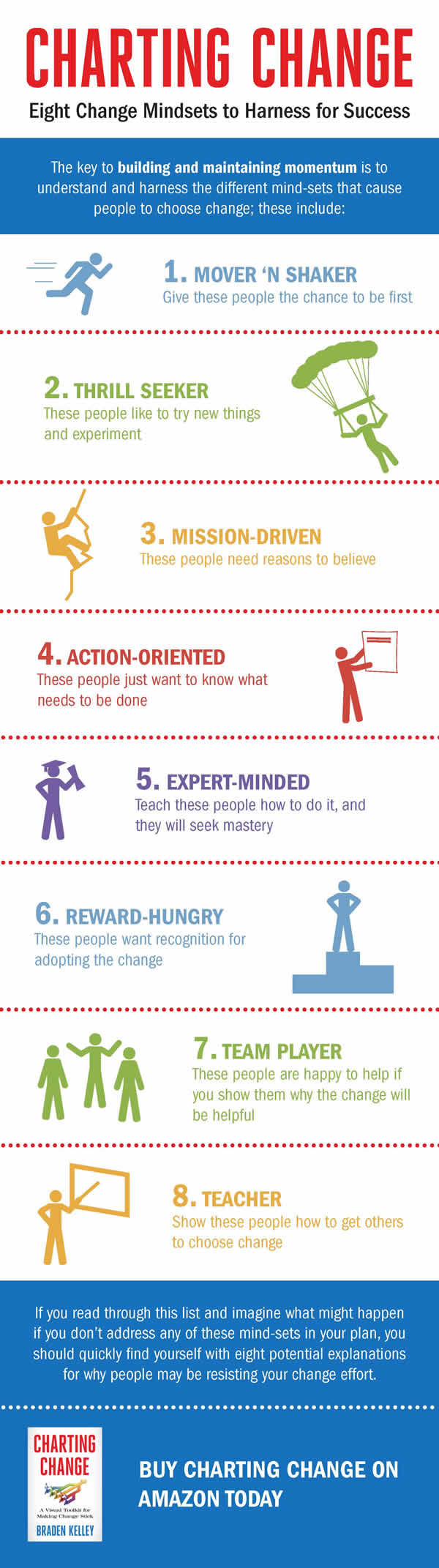
Bonus: The Eight Change Mindsets

Successful change isn’t just about process — it’s about mindset. In The Eight Change Mindsets, Braden Kelley outlines a practical philosophy for making change more adaptive, human-centered, and sustainable. At its core, the article emphasizes that poorly designed change creates resistance and fatigue, while well-designed change builds momentum and engagement.

Key Insights

  • Start Small (Minimum Viable Progress): Break change into manageable pieces to reduce overwhelm and increase adoption.
  • Pace Matters: Moving too fast creates resistance, while moving too slow erodes relevance — find a sustainable cadence.
  • Design for People: Change must be human-centered, accounting for emotions, habits, and psychological safety.
  • Anticipate Resistance: Resistance is natural — plan for it rather than reacting to it.
  • Engage, Don’t Mandate: Change succeeds when people feel involved, not imposed upon.
  • Iterate and Learn: Treat change as a continuous learning process, not a one-time event.
  • Focus on Outcomes: Keep attention on the value being created, not just the activities being performed.
  • Build Momentum: Small wins create energy and help overcome change fatigue.

👉 Read the full article

The Eight Change Mindsets Infographic

Conclusion: The Human Edge in a Technical World

As we navigate the accelerating cycles of emerging tech waves, it is easy to become obsessed with the specifications, the speeds, and the sheer novelty of the tools at our disposal. But as change leaders, our focus must remain steadfastly on the Human Architecture of our organizations. Technology changes the what of our work, but people — their creativity, their empathy, and their ability to collaborate — remain the how.

The “Playbook for Emerging Tech Waves” is not a static set of rules; it is a living framework for Human-Centered Innovation. By prioritizing anticipation over reaction, building a foundation of psychological safety, executing with agile sprints, scaling through social influence, and guarding against innovation fatigue, we transform change from a disruptive event into a sustainable competitive advantage.

A Call to Action for Change Leaders

The era of “implementation” is over; the era of Continuous Evolution has begun. To lead your organization through the next wave and beyond, I challenge you to take the following three steps immediately:

  1. Audit the “Change Load”: Look at your current roadmap. Are you hitting your teams with too many “simultaneous” shifts? Identify one project to pause or sequence differently to protect your team’s cognitive bandwidth.
  2. Identify Your Hidden Influencers: Stop looking at the org chart and start looking at the “trust network.” Find the three people in your organization who others naturally go to for tech advice and invite them into your next co-creation session.
  3. Shift the Language: Move the conversation from “User Adoption” to “Value Realization.” Stop asking “Are they using the tool?” and start asking “Is the tool amplifying their unique human potential?”

The future belongs to those who can harmonize the cold efficiency of emerging technology with the warm, unpredictable brilliance of human ingenuity. Let us stop managing change and start leading transformation.

Are you ready to stoke the innovation bonfire? The next wave is already here.

Frequently Asked Questions: Emerging Tech & Change Leadership

What is the biggest mistake leaders make during emerging tech waves?

The most common error is “Shiny Object Syndrome,” where organizations prioritize the technical capabilities of a tool over the human architecture required to support it. Successful transformation requires shifting focus from software “implementation” to human “adoption and value realization.”

How do you prevent innovation fatigue in a rapidly shifting landscape?

Preventing fatigue requires Strategic Pacing. Leaders must act as “air traffic controllers,” sequencing technology rollouts to match the organization’s collective “absorption rate.” This includes building in “recovery sprints” where no new tools are introduced, allowing employees to achieve mastery.

What is the difference between WIIFM and WIIFW in change management?

While WIIFM (What’s In It For Me) focuses on individual benefit, WIIFW (What’s In It For We) emphasizes collective evolution. It highlights how tech waves eliminate departmental drudgery, bridge silos, and ensure the long-term viability of the entire workforce in a digital-first economy.

Image credit: Google Gemini

Subscribe to Human-Centered Change & Innovation WeeklySign up here to get Human-Centered Change & Innovation Weekly delivered to your inbox every week.

The Benefits of Change Leadership in the Workplace

The Benefits of Change Leadership in the Workplace

GUEST POST from Chateau G Pato

Change is a common phenomenon in the workplace, and organizations must be prepared to respond and adapt to new trends, technologies, and ideas. Change leadership is a powerful tool for organizations to navigate through these changes and ensure success.

Change leadership is the ability to identify, initiate, and manage change within an organization. A successful change leader must have the right skills and knowledge to lead the organization through a period of transition.

The benefits of change leadership in the workplace are numerous. Change leaders are able to create a vision for the future of the organization, which can act as a guiding force for employees and help to motivate them to achieve the desired outcomes. Change leaders can also help to identify and implement new strategies, processes, and technologies that will help the organization to stay competitive. In addition, change leaders can help to foster an organizational culture that is open to change and encourages collaboration and innovation.

To illustrate the benefits of change leadership, let’s look at two case studies.

The first case study is about a large healthcare provider. This organization was facing challenges in meeting the increasing demands of their customers. They needed to find ways to reduce costs and improve efficiency. To address these issues, the organization hired a new change leader. The leader was able to identify and implement new strategies, processes, and technologies that helped to reduce costs, improve efficiency, and increase customer satisfaction. The change leader also created a vision of the future and developed a culture of collaboration and innovation.

The second case study is about a manufacturing company. This company was struggling to stay competitive in an ever-changing market. To address this issue, they hired a change leader. The leader was able to identify and implement new strategies, processes, and technologies that allowed the company to stay competitive. The change leader also created a vision for the future and developed a culture of collaboration and innovation.

These two case studies demonstrate how change leadership can be beneficial in the workplace. Change leaders are able to identify and implement new strategies, processes, and technologies that can help organizations to stay competitive and successful. They can also create a vision for the future and foster an organizational culture that is open to change and encourages collaboration and innovation.

Change leadership is an important tool for organizations to navigate through periods of transition. By having the right skills and knowledge, change leaders can help organizations to stay competitive and successful. With the right strategies and processes in place, organizations can ensure that they are prepared for any changes that may come their way.

Image credit: Pexels

Subscribe to Human-Centered Change & Innovation WeeklySign up here to join 17,000+ leaders getting Human-Centered Change & Innovation Weekly delivered to their inbox every week.

Technology Strategies for Change Leadership Success

Technology Strategies for Change Leadership Success

GUEST POST from Chateau G Pato

Change leadership is a critical skill for organizations today. As the pace of technology and market changes continues to accelerate, it is essential to have an agile and adaptable leadership team that can manage transitions and stay ahead of the competition. Technology strategies can help organizations to successfully navigate the change process and ensure that changes are implemented effectively and efficiently.

One of the most important aspects of effective change leadership is the ability to properly assess the current situation and develop strategies to address it. To do this, organizations need to leverage the latest technological advances to gain insights into their current operations and identify areas for improvement. This includes utilizing predictive analytics and artificial intelligence (AI) to assess the impact of potential changes and identify potential solutions. By leveraging data and analytics, organizations can gain a better understanding of their operations and develop strategies to address identified issues.

Organizations should also take advantage of the latest tools and technologies to facilitate collaboration and communication throughout the change process. This includes leveraging cloud-based platforms and tools to enable employees to collaborate on projects in real time and to provide feedback to change leaders. Social media platforms can also be utilized to keep employees informed and provide a platform for discussion and feedback.

In addition to leveraging technology to assess and communicate changes, organizations should also focus on developing a culture that encourages and supports change. A successful change strategy requires the participation and engagement of all stakeholders, including employees, customers, and other partners. Leaders should ensure that all members of the organization are given the opportunity to provide input and feedback, and ensure that their opinions are taken into consideration.

Finally, organizations should focus on developing strategies to manage the implementation of change. This includes utilizing project management tools to track progress and ensure that changes are implemented in a timely manner. Additionally, organizations should develop training and education programs to ensure that employees are able to effectively manage the transition. By leveraging technology, change leaders can ensure that the change process is successful and that changes are implemented quickly and effectively.

By utilizing technology strategies, organizations can ensure that change leadership is successful and that changes are implemented efficiently and effectively. By leveraging data and analytics to assess current operations, developing collaborative tools to ensure participation, and building a culture that encourages change, organizations can ensure that their change leadership strategies are successful.

Image credit: Pexels

Subscribe to Human-Centered Change & Innovation WeeklySign up here to join 17,000+ leaders getting Human-Centered Change & Innovation Weekly delivered to their inbox every week.

Leveraging Emotional Intelligence in Change Leadership

Leveraging Emotional Intelligence in Change Leadership

GUEST POST from Art Inteligencia

Emotional intelligence (EI) is an increasingly important skill for leaders in today’s world. It is the ability to recognize, understand, and manage one’s own emotions, as well as those of others, in order to reach a desired outcome. Change leaders must be able to recognize and understand the emotions of their team and the organization in order to successfully implement change.

Emotional intelligence is the ability to identify, assess, and control one’s own emotions, as well as the emotions of others. It is a critical component of success, as it helps individuals to understand and manage their own emotions, as well as the emotions of those around them. It allows people to effectively communicate, collaborate, and lead, and to build strong, meaningful relationships.

The benefits of leveraging EI in change leadership are numerous. Being able to understand and empathize with the feelings of others can help to create buy-in, as well as build trust and respect among team members. Change leaders who use EI can also ensure that their teams are open-minded to new ideas and willing to work together to find solutions.

When using EI in change leadership, it is important to focus on understanding the emotions of others. Leaders should strive to be aware of their own emotions and how they affect their decisions and actions. They should also take the time to listen to the emotions of their team and organization and be open to feedback.

Leaders should also strive to create a safe space for their team to express their emotions. This can be done through open dialogue and active listening. Leaders should be willing to accept criticism and use it to adjust their strategy as needed.

Finally, change leaders should be aware of the effects of their own emotions on the team. There may be times when they must deal with difficult emotions such as fear or anger. In these cases, leaders should strive to remain calm and composed, taking the time to understand the emotions of their team before responding.

By leveraging emotional intelligence in change leadership, leaders can create an environment of trust and respect, as well as ensure that their teams are open to new ideas and willing to work together to find solutions. In today’s ever-changing world, emotional intelligence is a necessary skill for successful change management.

Image credit: Pixabay

Subscribe to Human-Centered Change & Innovation WeeklySign up here to join 17,000+ leaders getting Human-Centered Change & Innovation Weekly delivered to their inbox every week.

The Role of Change Leadership in Transforming Your Business

The Role of Change Leadership in Transforming Your Business

GUEST POST from Art Inteligencia

Change is a constant in the business world, and the ability to lead and manage change is more important than ever. Change leadership is a critical part of transforming your business, and it involves creating a culture that is open to change and allowing it to happen. It is a process that allows you to identify, plan and implement changes that will drive long-term success.

Change leaders are responsible for driving organizational change and managing the process of transformation. They must be able to identify and diagnose change initiatives, facilitate communication and collaboration between stakeholders, and provide guidance to ensure successful implementation. Change leaders must create a shared vision that inspires and motivates employees and stakeholders to embrace change.

Effective change leaders must have the skills to assess the organization’s current state, identify areas of improvement, develop strategies to achieve desired outcomes, and implement change initiatives. They must also be able to manage resistance to change and ensure that all stakeholders are on board with the transformation process.

Change leadership is a combination of strategy, communication, and people management. To be effective, change leaders must understand the importance of communication and collaboration in order to create a culture of openness to change. They must also have the skills to lead and manage people through change.

Change leaders must also be able to identify areas of improvement and develop strategies to achieve desired outcomes. This includes creating a clear vision, setting achievable goals and objectives, and developing a plan to implement the change. They must also be able to manage resistance to change and ensure that all stakeholders are on board with the transformation process.

Change leadership is a critical part of transforming a business. It requires a combination of strategic thinking, communication, and people management skills. Change leaders must be able to create a culture of openness to change, identify areas of improvement, develop strategies to achieve desired outcomes, and manage resistance to change. With effective change leadership, businesses can achieve long-term success.

Image credit: Unsplash

Subscribe to Human-Centered Change & Innovation WeeklySign up here to join 17,000+ leaders getting Human-Centered Change & Innovation Weekly delivered to their inbox every week.

10 Tips for Effective Change Leadership in the Digital Age

10 Tips for Effective Change Leadership in the Digital Age

GUEST POST from Art Inteligencia

Change management is a challenge in any organization, but the digital age has added a layer of complexity to the process. In order to effectively lead change initiatives, there are certain tips that can be useful. Here are ten tips to help you be an effective change leader in the digital age.

1. Stay up to date: Technology and digital systems are constantly changing and evolving, so it is important to stay up to date on the latest trends and developments. Be sure to attend conferences and seminars, read industry news, and talk to other change leaders to stay on top of the latest developments.

2. Understand the technology: Before you can lead change, you need to understand the technology and digital systems you are working with. Take the time to learn the system and how it works so you can effectively lead the change initiative.

3. Listen to feedback: Change can be difficult, so it is important to listen to feedback from employees and stakeholders. Take the time to understand the different perspectives and use this feedback to inform your change leadership strategy.

4. Engage stakeholders: Change initiatives can be successful if stakeholders are engaged throughout the process. Make sure to include stakeholders in the planning process and involve them in decision-making.

5. Set clear goals: Change initiatives can get off track if there are no clear goals or objectives. Be sure to set clear goals and objectives for the change initiative so everyone understands what needs to be accomplished.

6. Communicate regularly: Change can be daunting for employees, so it is important to keep them informed throughout the process. Make sure to communicate regularly with employees and stakeholders about the progress of the change initiative.

7. Use data: Data can be a powerful tool in the digital age. Use data to track progress and make decisions about the change initiative.

8. Embrace innovation: Change can be a great opportunity to try new things and innovate. Encourage employees to think outside the box and come up with creative solutions to tackle the challenge.

9. Celebrate success: Change can be a long and difficult process, so it is important to celebrate successes along the way. Make sure to take the time to recognize the hard work of employees and stakeholders who have helped lead the change initiative.

10. Learn from failure: Even the best change initiatives can fail. If a change initiative falls short, use it as a learning opportunity. Gather feedback and learn from mistakes to improve your change leadership strategy.

By following these ten tips, you can be an effective change leader in the digital age. Change initiatives can be complex and difficult, but with the right approach and strategy, you can be successful.

Image credit: Pixabay

Subscribe to Human-Centered Change & Innovation WeeklySign up here to join 17,000+ leaders getting Human-Centered Change & Innovation Weekly delivered to their inbox every week.

The Leader’s Guide to Change Adoption

From Reluctant to Ready

LAST UPDATED: December 22, 2025 at 12:02PM

The Leader's Guide to Change Adoption

GUEST POST from Chateau G Pato

Change does not fail at the strategy level as often as leaders think. It fails at the human level. Organizations announce transformation, deploy tools, and track milestones, only to discover that people quietly revert to old behaviors. Adoption, not execution, is the real bottleneck.

As a human-centered change and innovation practitioner, I see resistance as a signal, not a setback. The journey from reluctance to readiness is the leader’s most important responsibility.

Re-framing Resistance

Resistance is frequently misdiagnosed as unwillingness. More often, it reflects uncertainty about competence, consequences, or credibility. People ask themselves whether they can succeed, whether the change will last, and whether leadership can be trusted.

Leaders who re-frame resistance as feedback gain clarity about what readiness requires.

Readiness Is Built, Not Announced

Readiness emerges when people understand the change, believe it matters, and feel capable of acting differently. This requires time, practice, and reinforcement.

Human-centered leaders design change as a learning journey rather than a rollout.

Case Study One: Microsoft and the Power of Modeling

Microsoft’s cultural shift under a growth mindset philosophy succeeded because leaders modeled the behavior they expected. Curiosity replaced certainty, and learning replaced defensiveness.

This visible shift reduced fear and normalized experimentation, accelerating adoption across the organization.

Psychological Safety as an Adoption Accelerator

People adopt change faster when they feel safe admitting what they do not know. Psychological safety turns learning into a shared endeavor rather than an individual risk.

Leaders create safety through transparency, patience, and consistent reinforcement.

Case Study Two: Clinician-Led Change in Healthcare

A hospital system struggling with digital adoption shifted its approach by empowering respected clinicians as change champions. Peer-led learning replaced top-down mandates.

Adoption improved because trust already existed within peer networks.

The Change Adoption Canvas

The Change Adoption Canvas is a practical, human-centered tool designed to help leaders move beyond announcing change and toward achieving sustained behavior adoption. Rather than focusing on project plans or communications alone, the canvas prompts teams to examine change through the lived experience of the people who must actually behave differently.

Change Adoption Canvas

By working through the six sections, leaders clarify why the change matters, identify who is most impacted, and surface the beliefs, habits, and constraints that shape current behavior. The canvas is best used collaboratively in workshops or leadership sessions, where diverse perspectives can reveal hidden readiness barriers and misaligned signals. Once those barriers are visible, the canvas guides leaders to intentionally design enablement, support, and reinforcement mechanisms that build confidence and trust over time. Used iteratively, the Change Adoption Canvas becomes both a diagnostic and a design tool, helping organizations course-correct, strengthen adoption, and embed change as a repeatable capability rather than a one-time effort.

Signals Over Statements

People believe what leaders do more than what they say. Promotions, budgets, and recognition send powerful signals about what truly matters.

Aligning these signals with desired behaviors is essential to sustaining change.

“Leaders do not create readiness by demanding change; they create it by making people feel capable, supported, and safe enough to begin.”

— Braden Kelley

Conclusion

The journey from reluctant to ready is not linear, and it cannot be rushed. It requires empathy, patience, and intentional design.

Leaders who invest in readiness do more than implement change. They build organizations capable of continuous adaptation.

Frequently Asked Questions

Why do well-communicated changes still fail?

Because understanding does not automatically create confidence or capability.

How can leaders measure change adoption?

By observing sustained behavior change and real-world usage, not just task completion.

What role does leadership behavior play in adoption?

Leadership behavior sets the tone and determines whether people feel safe embracing change.

Extra Extra: Because innovation is all about change, Braden Kelley’s human-centered change methodology and tools are the best way to plan and execute the changes necessary to support your innovation and transformation efforts — all while literally getting everyone all on the same page for change. Find out more about the methodology and tools, including the book Charting Change by following the link. Be sure and download the TEN FREE TOOLS while you’re here.

Image credits: Pixabay, Google Gemini

Subscribe to Human-Centered Change & Innovation WeeklySign up here to get Human-Centered Change & Innovation Weekly delivered to your inbox every week.