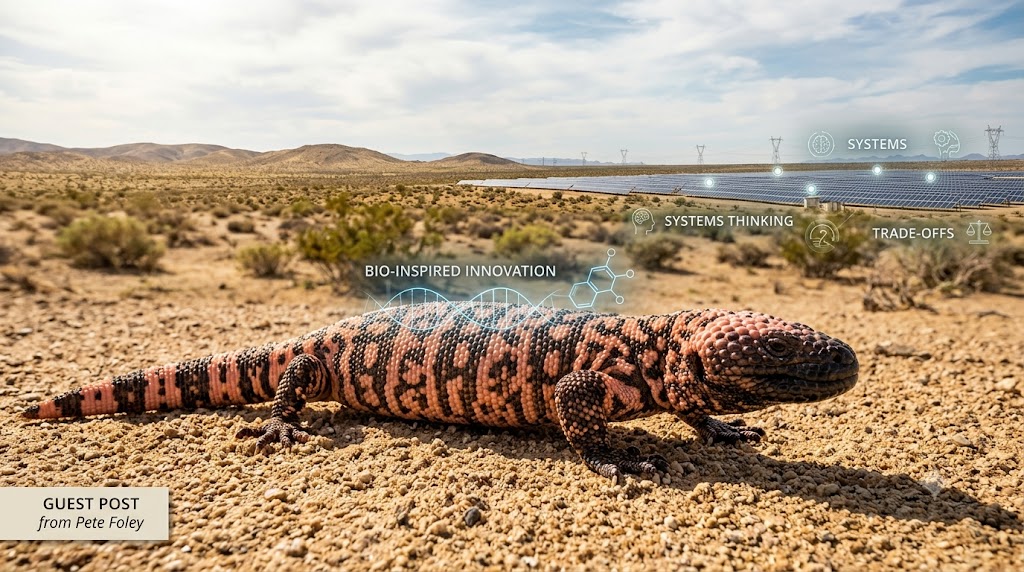
GUEST POST from Pete Foley
The pejoratively named Gila monster is a protected and borderline endangered species that inhabits my adopted Southwest. It is the only venomous lizard in the USA, but while its venom can be deadly, human deaths are extremely rare. It’s generally a shy, slow moving creature that spends much of its time underground. It presents little danger unless you try to handle it, and if you are lucky enough to see one, it’s pink and black colors make it quite stunning to look at.
Monsters and Weight Loss: But whether you perceive it as beauty or beast, it has recently played a surprisingly important and beneficial role in human health. As many reading this will already know, it’s venom is the origin of GLP-1’s. These are the ‘miracle ingredient’ found in diabetes and weight loss drugs like Ozempic and Wegovy. GLP-1’s were initially isolated from Gila Monster venom about 30 years ago. These ‘Thin Lizzy’ drugs are now manufactured synthetically, but it’s unlikely that we’d have discovered them without the help of this maligned ‘monster’
A Benevolent Monster. Type-II diabetes and obesity are deadly diseases, and GLP-1’s have helped many patients live longer, better quality lives. I sometimes worry about over and unsupervised use, and long term effects of such a widely used new drug. But there is no question around the benefits it has brought to the human race. Gila is a benevolent monster, and we owe it our thanks for saving countless lives.
Bio-Inspired Innovation: In a broad sense, this is a great example of biomimicry, or at least copying innovation from nature. Nature is a huge untapped resource of largely pre-cooked innovations. Pretty much any problem we face, somewhere nature has already solved. It’s not always easy to find or adapt those solutions, but sometimes when we do, we get miracles like GLP-1. We can find innovations anywhere in nature, but marginal environments often have disproportionately more. They force evolution, as nature has to solve more difficult problems. Often we hear biodiversity expressed in terms of ‘number of species’. That is a valid claim. There is no question, for example, that the density of species and fierce competition in the Amazon make it a rich source of biodiversity, and hence bio-derived innovation. But the huge number and diversity of species there also adds to the ‘needle in a haystack’ challenge we find with seeking innovation in nature. But the extremely harsh, hot, dry, environment of Southwest Deserts can also drive unusual adaptations. In the case of GLP-1’s, their metabolism and glucose management help the Gila monster navigate an environment where food and water is scarce, and feeding sporadic. Perhaps more importantly, given the harshness of the environment here, it’s likely that GLP-1’s are the tip of the ice-berg, and that our desert contains a reservoir of many more useful secrets waiting to be unlocked, especially around metabolism and water management.
Destruction of Wilderness: But marginal environments are often also where species are most fragile and under threat. In the desert southwest, the Gila’s habitat (and that of other marginalized species like the desert tortoise) is being squeezed from all directions. An historic drought has gripped much of the area for decades. And we are now compounding that with massive housing developments, even bigger industrial scale solar farms, and the massive infrastructure needed to transmit the energy those farms create. Even more recently, we are further compounding that ’squeeze’ with data centers, increased mining for rare metals and more. These ‘developments’ not only destroy massive swathes of wilderness, and put additional pressure on already endangered species, but also compound drought and climate change by piling rapidly accelerating heat island effects on top of a warming climate.
Don’t Shoot Yourself in the Foot. As an innovator I embrace change, and recognize that progress inevitably comes with trade-offs. But change needs to be managed thoughtfully, especially the inevitable trade offs that change creates in a complex system. Speed is often important, but it needs to be weighed against the need to have some basic understanding of the broad impact we have beyond the narrow, core objective. To use a ‘western’ analogy, in a gunfight it’s important to fire first, but not so fast that you shoot yourself in the foot.
The Desert is an Ocean with its Life Underground: In my last article I talked about the need for more scientists in leadership positions. One of the reasons for this is that our leaders today often appear unable, or perhaps unwilling to look at the big, complex picture, but instead over-simplify issues. Nowhere is this more evident than in the southwest United States, where in the rush for growth, ‘renewable’ energy, raw material independence and AI development is destroying huge swathes of wilderness. While well intentioned, this is often driven by leaders who are focused on narrow goals, and ignore collateral damage by simplistically regarding the Mojave and as ‘s ‘only a desert’. But that desert is really an extremely complex and fragile system. GLP-1’s are likely the tip of the iceberg. We don’t know what else lies below the surface, but we need to be careful that we don’t destroy it before we have a chance to find out
The Pros and Cons of Solar Energy in the Desert: Just taking mass solar as an example of well intentioned but overly simplistic thinking. Our deserts are rapidly getting littered with massive industrial scale solar farms, together with the equally massive infrastructure needed to transport the electricity they create to population centers, and/or AI data centers.
At a basic level, the concept of solar is a good one; what’s not to love about pollution free energy independence? But if we look at the bigger, far more complex picture, it’s nowhere near that simple.
Too Hot For Solar? For example, a hot sunny desert is a superficially obvious place to build solar infrastructure. But that’s until we realize that surface temperatures are so hot cells operate far below optimum efficiency. Meanwhile dust further reduces efficiency, and remote locations make building, maintaining and connecting these farms difficult, expensive and environmentally damaging.
Collateral Damage: Solar farms and their infrastructure do extensive damage to our desert wilderness. They remove habitat for endangered species, and block migration roots for others. Their installation and maintenance uses scarce water, and creates significant CO2 emissions (the thing they were supposed to prevent). Much of the technology is shipped from China, posing a question around true energy independence, and that shipping and manufacture also creates CO2. Climate change is a global issue, and while shifting CO2 emission for solar manufacture from the US to China may look good on some spreadsheets, it does nothing to solve the actual problem.
These solar farms also create enormous amounts of dust. Installing them requires removing of both surface crust and vegetation whose slow growing root systems hold the desert surface together (and ironically store CO2 via a symbiotic relationship with a mycelium). That dust not only reduces the efficiency of the solar panels themselves, but also presents a hazard to traffic, and can even be quite toxic. Mojave desert dust contains both natural asbestos and potentially deadly valley fever. Its why all construction has to be constantly sprayed with increasingly scarce water.
With industrial scale desert solar, the narrow view of ‘renewable and ‘clean’ solar energy’ is highly attractive. The reality is more complex, and full of trade offs that pit a green core technology against the environmental cost of construction, maintenance, eventual decommissioning, destruction of habitat and unintended consequences such as toxic dust. This makes a superficially simple choice far more complex. Some trade offs are alignable. For example, we can probably calculate actual net CO2 savings over the lifetime of a solar farm after manufacture, shipping, installation and decommissioning are taken into account. But I’m not even sure if we can truly compare some of the other trade offs. How do we quantify the trade off between toxic dust and reduced CO2 emissions? Or how do we quantify and compare the impact of water usage, or loss of habitat to endangered species?
Simplistic Focus: The result is a very complex calculation. But what is clear is that our leaders today typically ignore this, and instead remain simplistically focused on the narrow view. Maybe if we could get more scientists into leadership positions we might do a better job of understanding trade offs, and the cost benefit of new technologies. Today politicians all too often line up in favor of, or in opposition to projects based on overly simplistic, partisan frames, when really we need to manage complex trade offs.
Calculating the Cost of Change in Complex Systems: Now, although I believe we need to do much better at managing complex systems, that doesn’t mean the pendulum needs to swing to far in the other direction. Complexity and uncertainty should not become an excuse for procrastination, inaction, or what I like to call the tyranny of data. The later is when we get stuck generating data and reports in increasing detail that add so much complexity, we never make a decision. As an innovator I embrace change, and recognize that progress inevitably comes with trade-offs. But it’s about balance, and its critical to understand those trade offs at a systems level before charging ahead with initiatives, but still be willing to move forward embracing some uncertainty. All innovation comes with some risk, but smart innovators minimize those risks and balance them against timely progress. And scientists are trained to learn as they go. That’s a balance I’d argue our leaders are struggling with today, swinging between inaction, and massive investments based on limited knowledge.
Solar is one example. But there are many more. In my home city of Las Vegas we are already facing a severe water crisis and extreme heat island effects. In light of that, the mass destruction of wilderness to build 250,000 new MacMansions in the desert seems to lack even minimal big picture thinking. Data centers, the innovation de jour are a more complex challenge. There is certainly a demand for them, and there is a powerful, albeit US centric argument for keeping the US at the head of the AI innovation curve. That means we do need data centers, but the cost in water and energy, two resources that are in relatively short supply here, arguably makes the SouthWest a poor choice of location. Although I’ll acknowledge that data centers are rapidly becoming a somewhat universal ‘good idea as long as it’s not here’ technology.
Embracing Complexity and Solving Trade Offs: But embracing complexity and looking at these at a systems level does not mean stopping innovation or progress. Quite the opposite, it should ultimately help us to innovate more effectively, and maybe face-plant less often. Identifying and challenging trade offs had long been a source of innovation, and is at the core of many innovation processes. For example, with AI, could the US stay ahead of the AI curve by focusing data centers on more useful tasks, while cutting out less useful and energy expensive ‘slop’ such as action figures and/or caricatures? That is maybe where regulation comes in, but as I mentioned in my last article, regulation without understanding risks both being ineffective, or creating unintended collateral damage. So this all supports the need for more technical ‘savvy’ in leadership.
We Don’t Know What We Don’t Know. When we try to evaluate trade off’s associated with innovation, what we don’t know is always one of the biggest challenges. Who would have guessed 30 years ago that the Gila monster would provide the cure for obesity, and significantly reduce Type -II diabetes. As mentioned before, we can be fairly sure that our desert wilderness holds many more untapped innovations, but we just don’t know what they are. That harsh environment drove the evolution of tools for metabolism and glucose management that today treat obesity and diabetes management. Longer term, could they also be a source of chemistry with efficacy against cancers, where glucose restriction and differentiation between the kinetics of healthy and cancer cell replication are effects we have, and will likely continue to exploit? That’s speculation, but it highlights that we often don’t know all of the trade offs, and so those complex models need to be monitored and updated. Narrow focus on a simplistic model means we miss so many potential opportunities. We also risk destroying the sources of the innovations and breakthroughs we haven’t found yet
Image credits: Google Gemini
 Sign up here to join 17,000+ leaders getting Human-Centered Change & Innovation Weekly delivered to their inbox every week.